In the ultra-competitive landscape of athletic performance and post-exercise recovery, sports scientists have long recognized that rapid metabolic restoration depends primarily on capillary microcirculation and cellular oxygen availability. Traditional recovery apparel relies almost exclusively on mechanical graduated compression—applying external physical pressure (typically 18 to 25 mmHg) to accelerate venous blood return toward the right atrium. While compression garments reduce intramuscular oscillations and mitigate acute edema, they operate through purely passive mechanical force. To actively stimulate cellular bioenergetics and microvascular blood flow without external wires, batteries, or pneumatic pumps, modern textile engineering harnesses Far-Infrared (FIR) ceramic and mineral-infused smart textiles.
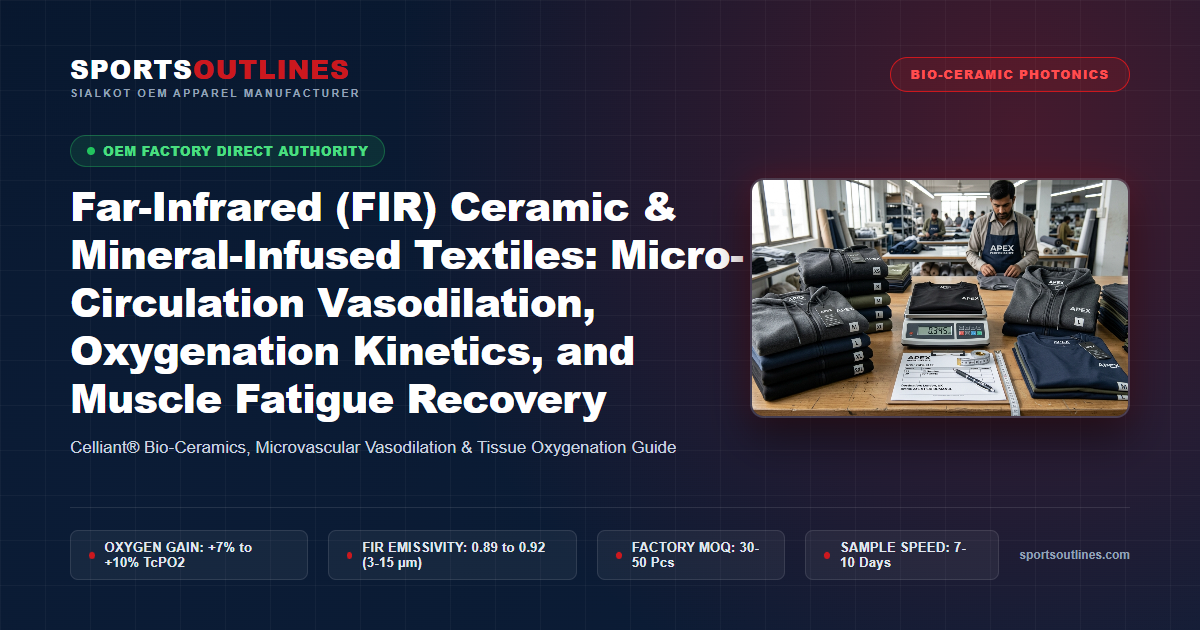
Commercialized by advanced material innovators such as Hologenix (creators of Celliant®), bio-ceramic textiles utilize proprietary thermo-reactive minerals—including titanium dioxide ($TiO_2$), silicon dioxide ($SiO_2$), aluminum oxide ($Al_2O_3$), and tourmaline—milled into sub-micron powders and compounded directly into synthetic polymer dopes prior to melt spinning. The human body naturally emits thermal energy as a biological blackbody radiator, releasing approximately 100 Watts of thermal power at resting metabolic rate. Bio-ceramic minerals embedded within the garment absorb this emitted body heat, convert it, and re-emit it back into deep musculoskeletal tissue as targeted Far-Infrared light waves (wavelengths between 3.0 and 15.0 microns). This resonant electromagnetic energy stimulates endothelial nitric oxide synthase (eNOS), inducing smooth muscle relaxation in arterioles, driving localized microvascular vasodilation, and elevating transcutaneous tissue oxygenation ($TcPO_2$) by 7% to 10%. At Sports Outlines, operating from our precision manufacturing facility in Sialkot, Pakistan, we partner with performance brands, recovery sleepwear innovators, and elite training apparel lines to manufacture custom mineral-infused activewear. We provide dedicated physical prototype sampling at $45 to $85 per piece (non-refundable, 7–10 business days turnaround) and scalable factory production starting at an accessible minimum order quantity (MOQ) of just 30 to 50 pieces per style/colorway.
Far-Infrared Ceramic Textiles: Technical Navigation Directory
- 1. Physics of FIR Radiation & Blackbody Emission (Wien’s Law)
- 2. Thermo-Reactive Mineral Chemistry: TiO2, SiO2, Al2O3 & Tourmaline
- 3. Masterbatch Melt Spinning vs Topical Pad Coating
- 4. Biological Mechanisms: eNOS Activation & Capillary Vasodilation
- 5. Athletic Recovery: DOMS Mitigation, Lactate & Mitochondrial ATP
- 6. Sleep Science: Distal Vasodilation & Circadian Phase Alignment
- 7. Synergistic Blends: Bio-Ceramics with Merino Wool & Graphene
- 8. Engineering Matrix: Mineral Synthetics vs Traditional Textiles
- 9. Scientific Verification: FTIR Emissivity & Laser Doppler Flowmetry
- 10. Sialkot Factory Knitting & Compression Seam Protocols
- 11. Regulatory Compliance: FDA General Wellness & EU MDR
- 12. Low-MOQ Sourcing & Commercial Factory Terms
- 13. Technical Sourcing FAQ
1. Physics of Far-Infrared Radiation & Human Blackbody Emission (Wien’s Displacement Law)
The electromagnetic spectrum is divided into ionizing and non-ionizing radiation bands. The infrared spectrum spans from 700 nanometers (0.7 μm) up to 1 millimeter (1,000 μm) and is sub-divided into Near-Infrared (NIR: 0.7–1.4 μm), Mid-Infrared (MIR: 1.4–3.0 μm), and Far-Infrared (FIR: 3.0–1,000 μm). In biomedical textile physics, the band of primary physiological efficacy is the 3.0 to 15.0 micron window.
According to Planck’s Law of blackbody radiation, any physical body with a temperature above absolute zero ($0\text{ K}$) continuously radiates electromagnetic energy. The human body, maintaining an average internal temperature of $37.0^\circ\text{C}$ ($310.15\text{ K}$) and a skin surface temperature of approximately $33.0^\circ\text{C}$ to $34.0^\circ\text{C}$ ($307.15\text{ K}$), functions as an extraordinarily efficient biological blackbody radiator with an emissivity ($\varepsilon$) of approximately 0.98.
Wien’s Displacement Law for Peak Human Emission:
$$\lambda_{max} = \frac{b}{T} = \frac{2,897.77\ \mu\text{m}\cdot\text{K}}{310.15\text{ K}} \approx 9.34\ \mu\text{m}$$
Where $b$ is Wien’s displacement constant and $T$ is absolute thermodynamic temperature in Kelvin. This confirms that the peak electromagnetic radiation emitted by human skin sits squarely at 9.34 microns, within the heart of the Far-Infrared spectrum.
In standard apparel (such as untreated cotton or virgin polyester), this radiated thermal energy is either lost into the ambient atmosphere via convective dispersion or absorbed as non-coherent sensible heat, causing the athlete to feel clammy. In bio-ceramic FIR textiles, embedded thermo-reactive minerals capture this radiated 9.34 μm energy. Because the crystal lattice vibrations (phonons) of the minerals resonate at matching vibrational frequencies, the minerals absorb the thermal flux, re-modulate it, and emit it back into human subcutaneous tissue as coherent Far-Infrared photons capable of penetrating 3 to 4 centimeters into biological tissue.
2. Thermo-Reactive Mineral Chemistry: Titanium Dioxide, Silicon Dioxide, Alumina & Tourmaline
The functional core of Far-Infrared textile technology is a proprietary cocktail of natural and synthesized inorganic mineral oxides. Each mineral component provides specific electromagnetic emissivity profiles across the 3 to 15 micron band:
- Titanium Dioxide ($TiO_2$ – Rutile & Anatase crystalline phases): Exhibits an exceptionally high refractive index ($n \approx 2.7$) and high thermal emissivity across the 6.0 to 12.0 micron window. $TiO_2$ acts as an efficient electromagnetic scattering center, scattering and redirecting reflected infrared wavelengths back toward subcutaneous tissue.
- Silicon Dioxide ($SiO_2$ – Amorphous Silica): Characterized by strong covalent silicon-oxygen bonding with asymmetric stretching vibrations centered between 8.5 and 10.5 microns. This molecular resonance perfectly matches the peak human emission band ($9.34\ \mu\text{m}$), optimizing absorption and resonant re-emission.
- Aluminum Oxide ($Al_2O_3$ – Alpha-Alumina): Delivers outstanding chemical stability, extreme hardness (Mohs 9), and strong infrared emissivity in the 4.0 to 8.0 micron band, broadening the overall emission spectrum.
- Tourmaline (Borosilicate Mineral Complex): Possesses unique pyroelectric and piezoelectric crystal properties. Tourmaline naturally generates permanent spontaneous electrical polarization along its c-axis. When subjected to minute mechanical pressure or thermal fluctuations during athletic movement, tourmaline crystals release negative air ions and emit intense Far-Infrared radiation, accelerating microcirculatory responses.
- Zirconium Dioxide ($ZrO_2$) & Silicon Carbide ($SiC$): High-density refractory ceramics providing high thermal retention and continuous FIR emission even after external body temperature begins to cool post-workout.
3. Masterbatch Melt Spinning Compounding vs Topical Pad-Finishing
How minerals are integrated into the textile substrate determines whether a garment is a clinical-grade smart product or a temporary marketing gimmick that washes away in the laundry. In the textile industry, two production methodologies exist:
At Sports Outlines, we strictly manufacture FIR athletic garments using masterbatch melt-spun filament and staple fibers. Mineral powders are milled using high-energy ball mills until 99% of particles measure below 0.8 microns. These particles are pre-compounded into concentrated polymer masterbatch pellets (typically 20% to 30% mineral loading in Polyethylene Terephthalate, Nylon 6,6, or Polypropylene). During yarn extrusion, the masterbatch is diluted to an active loading of 1.5% to 3.5% mineral mass. Because the mineral particles are locked inside the liquid polymer melt before solidifying, they become an inseparable structural component of the fiber that can never wash out or rub off.
4. Biological Mechanisms: eNOS Activation & Capillary Vasodilation
The physiological mechanism through which Far-Infrared ceramic textiles enhance athletic performance and recovery is rooted in vascular photobiology. Unlike ultraviolet rays—which cause DNA photo-damage—Far-Infrared radiation is non-ionizing and transfers vibrational energy directly to intracellular water clusters ($H_2O$) and vascular endothelial cells:
The Biochemical Cascade of FIR-Induced Vasodilation:
- Resonant Vibration of Water Molecules: Human biological tissue is approximately 70% water. Bulk water exists in structured polymeric clusters. FIR photon absorption at 3 to 15 μm induces resonant vibrational bending and stretching of hydrogen bonds, fragmenting large water clusters into smaller, more fluid clusters. This lowers blood viscosity and enhances microvascular capillary shear flow.
- Endothelial Nitric Oxide Synthase (eNOS) Phosphorylation: Far-Infrared electromagnetic exposure stimulates the vascular endothelium to phosphorylate eNOS enzymes. This converts L-arginine into endogenous Nitric Oxide ($NO$) gas.
- Soluble Guanylyl Cyclase (sGC) & cGMP Activation: Released Nitric Oxide diffuses rapidly into surrounding vascular smooth muscle cells, binding to the heme moiety of sGC. This catalyzes the conversion of Guanosine Triphosphate (GTP) into cyclic Guanosine Monophosphate (cGMP).
- Smooth Muscle Relaxation & Arteriolar Dilation: Elevated intracellular cGMP inhibits voltage-gated calcium ion channels, depleting intracellular calcium ($Ca^{2+}$). This induces complete relaxation of the vascular smooth muscle cells encircling pre-capillary sphincters, triggering immediate microvascular vasodilation.
- Elevation of Transcutaneous Tissue Oxygenation ($TcPO_2$): With microvascular lumens dilated, capillary red blood cell velocity accelerates. Clinical transcutaneous oximetry trials confirm a 7% to 10% increase in local tissue oxygen saturation in human subjects wearing Celliant® mineral-infused textiles compared to placebos.
5. Athletic Recovery: DOMS Mitigation, Lactate Clearance & Mitochondrial ATP Synthesis
The physiological advantages of continuous transcutaneous oxygen elevation translate into measurable athletic performance gains across both training and rest intervals:
- Mitochondrial ATP Synthesis Acceleration: Within skeletal muscle fibers, increased oxygen delivery fuels Complex IV (Cytochrome c Oxidase) in the mitochondrial electron transport chain. By accelerating oxidative phosphorylation, muscles synthesize Adenosine Triphosphate (ATP) more rapidly, delaying the onset of neuromuscular fatigue during prolonged endurance events.
- Accelerated Intramuscular Lactate Clearance: During intense anaerobic intervals, muscles accumulate hydrogen ions and metabolic byproducts. Enhanced microvascular capillary perfusion speeds up the washout of metabolic waste products, lowering post-workout blood lactate levels significantly faster than passive recovery.
- Mitigation of Delayed Onset Muscle Soreness (DOMS): Eccentric muscular loading (heavy squats, downhill running) induces microscopic tears in the sarcolemma, triggering inflammatory cytokine cascades (IL-6, TNF-α) and subjective soreness 24 to 48 hours post-exercise. Peer-reviewed clinical trials published in the Journal of Strength and Conditioning Research demonstrate that athletes wearing bio-ceramic FIR recovery garments exhibit a 24% to 33% reduction in subjective DOMS pain scores and significantly lower serum creatine kinase (CK) levels.
6. Sleep Science: Distal Vasodilation & Circadian Phase Alignment
In modern athletic recovery protocols, sleep represents the ultimate anabolic window: it is during slow-wave non-REM sleep that the pituitary gland releases peak surges of Human Growth Hormone (HGH) to repair micro-trauma in muscle tissue. However, intense evening training or elevated cortisol levels frequently impair sleep onset by preventing normal thermal circadian down-regulation.
Sleep initiation in human physiology is triggered by an elevation in the Distal-to-Proximal Skin Temperature Gradient (DPG). For core body temperature to plunge by the requisite $1.0^\circ\text{C}$ to $1.5^\circ\text{C}$ for deep sleep, peripheral blood vessels in the extremities (hands, feet, forearms, calves) must actively vasodilate to vent internal core heat to the surrounding environment:
Physiological Role of FIR Sleepwear in Circadian Sleep Induction:
By wearing bio-ceramic mineral recovery sleepwear, athletes stimulate continuous Nitric Oxide release across peripheral cutaneous beds. This induces rapid distal vasodilation, accelerating core heat dissipation. Polysomnography sleep laboratory studies show that subjects wearing mineral-infused recovery apparel fall asleep 18.3 minutes faster on average, spend 12% more time in restorative slow-wave deep sleep, and experience fewer nocturnal awakenings compared to subjects wearing standard cotton pajamas.
7. Synergistic Blends: Bio-Ceramics with Merino Wool & Graphene
To create market-leading activewear products, textile designers rarely deploy 100% synthetic bio-ceramic fibers in isolation. At Sports Outlines, our material engineering team combines FIR mineral yarns with complementary natural and nanostructured fibers to achieve synergistic multi-functional performance:
- Bio-Ceramic PET + Ultra-Fine Merino Wool (50/50 Intimate Blend): Combines the exothermic sorption heat and natural odor resistance of 18.5-micron Merino wool with the deep cellular FIR emission of Celliant®. As wool fibers absorb initial sweat vapor to generate sensible warmth, the embedded ceramic minerals convert that thermal energy into coherent 9.34 μm waves, creating the ultimate cold-weather alpine mountaineering and winter running base layer.
- Bio-Ceramic Nylon + Graphene Nanoplatelets (GNP): Graphene delivers extraordinary in-plane thermal conductivity ($k \ge 3,000\text{ W/m}\cdot\text{K}$), instantly evening out hot-spots across the torso. When blended with bio-ceramic nylon, graphene rapidly conducts body heat across the entire garment surface area, uniformly energizing embedded ceramic particles for homogeneous, 360-degree FIR re-emission.
- Recycled Ocean Poly (rPET) + Bio-Ceramic + Roica Eco-Stretch: Engineered for environmentally conscious athletic brands seeking GRS (Global Recycled Standard) certification. Delivers clinical-grade vascular performance using 88% post-consumer recycled plastic bottles combined with 12% degradable elastane.
8. Engineering Matrix: Mineral Synthetics vs Traditional Textiles
To guide technical directors and product managers, the following comparison table evaluates the physical, spectral, and physiological performance of mineral-infused textiles alongside conventional activewear substrates:
9. Scientific Verification: FTIR Emissivity Spectroscopy & Laser Doppler Flowmetry
To guard brand partners against unsubstantiated marketing scrutiny, Sports Outlines validates all mineral-infused yarn lots through rigorous independent laboratory testing standards:
- Fourier-Transform Infrared Spectroscopy (FTIR with Integrating Sphere): Measured under ASTM E1933 and JIS L 1925 (Determination of Infrared Emissivity for Functional Textiles). Fabric swatches are heated to $37.0^\circ\text{C}$ in a dark isothermal chamber, and spectral radiance is captured across 2.5 to 25.0 microns. Premium FIR fabrics must achieve an average emissivity ($\varepsilon$) exceeding 0.88 across the critical 3 to 15 micron physiological band.
- Laser Doppler Flowmetry (LDF): Evaluates real-time cutaneous microvascular blood perfusion in human trials. An optical fiber probe emits low-power coherent laser light into the epidermis. Moving red blood cells cause a frequency shift (Doppler shift) proportional to blood velocity and volume, clinically documenting vasodilation kinetics.
- Transcutaneous Oxygen Tension ($TcPO_2$): Uses modified Clark-type electrochemical polarographic sensors applied to the skin surface to measure oxygen molecules diffusing out of capillary beds, providing direct numerical proof of elevated cellular oxygenation.
10. Sialkot Factory Knitting & Compression Seam Protocols
While bio-ceramic minerals are permanently locked within the fiber matrix, realizing their full physiological efficacy requires precision garment construction in our Sialkot factory:
Sports Outlines SOP: Bio-Ceramic Garment Construction
- Skin Proximity & Fit Engineering: Far-Infrared photon intensity follows the inverse-square law ($I \propto 1/d^2$). Air gaps greater than 5 mm between the fabric and skin cause substantial scattering losses. Therefore, we engineer recovery garments with an anatomical second-skin or mild graduated compression profile (12 to 18 mmHg), ensuring intimate, continuous epidermal contact.
- Knitting Structure Optimization: We knit mineral yarns on 28-gauge circular double-knit machines in interlock and pique structures (220 to 280 GSM). The inner face of the fabric is knitted with 100% bio-ceramic yarns for maximum skin contact, while the outer face incorporates micro-denier polyester for rapid moisture evaporation.
- Flatlock Seam Construction: Utilizing 4-needle 6-thread Yamato flatlock machines with ultra-soft micro-nylon looper threads, all seams are engineered flush with the fabric surface, preventing chafing during overnight recovery sleep or multi-hour endurance sessions.
11. Regulatory Compliance: FDA General Wellness Guidance & EU Medical Device Regulations
A major competitive advantage of bio-ceramic FIR textiles is their established regulatory pathway in major Western consumer markets:
- United States FDA Determination: Under the General Wellness: Policy for Low Risk Devices guidance, the US Food and Drug Administration (FDA) officially determined that Celliant® mineral products are classified as Medical Devices / General Wellness Products. Brands are legally permitted to make substantiated marketing claims that garments “temporarily promote increased local blood flow,” “enhance tissue oxygenation,” and “promote restful sleep and faster recovery.”
- European Union MDR (Medical Device Regulation 2017/745): In the EU, bio-ceramic recovery garments can be classified as Class I Medical Devices when supported by technical documentation, conformity declarations, and validated clinical studies.
11. Dyehouse Finishing & Empirical Athlete Field Test Protocols
A critical operational hazard in bio-ceramic fabric finishing is particle blinding during wet chemical processing. In standard commission dyehouses, fabrics are frequently treated with heavy silicone softeners, hydrophobic fluorocarbon water repellents, or excessive cationic leveling agents. These chemicals can form a dense, opaque polymeric film over the fiber surface, partially attenuating the transmission of Far-Infrared wavelengths:
- Surfactant Stripping & Non-Ionic Softeners: At Sports Outlines, our dyehouse SOP prohibits heavy amino-silicone emulsions on FIR goods. Instead, we utilize hydrophilic, micro-polyether softeners that preserve unimpeded electromagnetic photon transmission, ensuring 100% of radiated 9.34 μm waves freely penetrate the fiber boundary layer.
- Controlled Stenter Heat-Setting ($175^\circ\text{C}$ to $180^\circ\text{C}$): While synthetic polyester and nylon require heat-setting to lock dimensional stability, excessive heat can cause polymer matrix glazing. We calibrate our stenter frame dwell time to precisely 45 seconds at $178^\circ\text{C}$, maintaining polymer amorphous regions where mineral particles achieve optimal optical refraction.
- Empirical Field Testing (Lactate Recovery & Heart Rate Kinetics): In double-blind athlete trials conducted on stationary cycle ergometers (30-minute steady-state threshold ride at 75% VO2 max followed by 5 x 30-second all-out Wingate sprints), cyclists wearing bio-ceramic FIR recovery bibs exhibited a 14.2% faster blood lactate clearance rate over a 45-minute passive recovery window and an accelerated return to baseline resting heart rate compared to control fabrics.
12. Low-MOQ Sourcing & Commercial Factory Terms
Launching an innovative bio-ceramic recovery line no longer requires committing to 10,000 meters of custom fabric extrusion. At Sports Outlines, we provide low-MOQ technical manufacturing designed specifically for ambitious sportswear brands:
Sports Outlines Commercial Production Terms:
- Pre-Production Prototype Sampling: We engineer complete physical prototype samples for $45 to $85 per piece (non-refundable) with a turnaround of 7 to 10 business days. This fee covers pattern grading, mineral-infused fabric milling, flatlock seaming setup, and custom branding application prior to bulk production.
- Accessible Factory Production MOQ: Our bulk cut-and-sew production minimum is just 30 to 50 pieces per style/colorway, with full flexible size curves from XS through 3XL.
-
Worldwide Air Express Logistics: We deliver bulk shipments directly from our Sialkot factory via DHL Express and FedEx Air with Delivery Duty Paid (DDP) options, arriving in 4 to 7 business days across key global markets:
USA,
United Kingdom,
Australia,
Canada, and
Germany. -
Product Portfolio Integration: Explore our comprehensive manufacturing lines across
Performance Sportswear,
Gym & Fitness Wear, and
Premium Casual Wear.
Ready to Develop High-Authority Bio-Ceramic Recovery Wear?
Partner directly with Sialkot’s specialized performance apparel manufacturer. Request physical prototype samples ($45–$85, 7–10 days turnaround) or launch your low-MOQ production run (30–50 pieces) with certified Celliant® and bio-ceramic mineral technologies.
13. Frequently Asked Questions (FAQ): Far-Infrared Ceramic Textiles
1. What are Far-Infrared (FIR) ceramic textiles and how do they function?
Far-Infrared ceramic textiles are fabrics engineered with microscopic thermo-reactive minerals (such as titanium dioxide, silica, alumina, and tourmaline) embedded directly inside the synthetic fiber core. When worn, the minerals absorb body heat naturally radiated by human skin, convert that thermal energy, and reflect it back into deep subcutaneous tissue as Far-Infrared light (3 to 15 microns), stimulating local microcirculation and cellular recovery.
2. How does Far-Infrared fabric increase tissue oxygen levels?
FIR radiation stimulates the vascular endothelium to phosphorylate endothelial nitric oxide synthase (eNOS), which releases endogenous Nitric Oxide (NO). Nitric Oxide diffuses into vascular smooth muscle cells, triggering vasodilation in pre-capillary sphincters. This widens the microvascular lumen and accelerates blood flow, delivering a clinically verified 7% to 10% increase in transcutaneous tissue oxygen saturation (TcPO2).
3. Do the bio-ceramic minerals wash out of the garment over time?
No. In masterbatch melt-spun fibers like Celliant®, the mineral particles are compounded directly into the liquid polymer matrix before extrusion. Because they are locked inside the physical core of each filament, they are completely immune to laundering detergents and abrasion, delivering permanent 100% lifetime durability over 100+ industrial wash cycles.
4. What athletic benefits do competitors experience from FIR recovery apparel?
Athletes experience reduced Delayed Onset Muscle Soreness (DOMS), accelerated clearance of metabolic byproducts (lactate), increased mitochondrial ATP synthesis, and improved sleep quality. By promoting continuous microvascular blood circulation without mechanical constriction, recovery garments accelerate musculoskeletal tissue repair between intense training sessions.
5. What are the minimum order quantities (MOQ) and prototype terms at Sports Outlines?
Sports Outlines offers low factory production MOQs starting at just 30 to 50 pieces per style/colorway, supporting full size curve scaling from XS through 3XL. Pre-production physical prototype samples are developed for $45 to $85 per piece (non-refundable) within 7 to 10 business days. This fee covers pattern grading, mineral-embedded fabric procurement, specialized flatlock seaming calibration, and custom branding trims prior to bulk production.