In high-performance alpine hardshells, commercial marine foul-weather suits, and technical military rainwear, a freshly manufactured garment can look completely immaculate on the factory showroom hanger while hiding catastrophic latent failure modes. A seam tape that appears securely bonded during visual inspection may hold water across a brief 30-second factory spot-check, only to experience catastrophic delamination, adhesive crystallization, edge flagging, and torrential water leakage after three days of real-world alpine use.
When an athlete ascends mountain terrain, the seams of a jacket are not subjected to static laboratory conditions. They endure continuous, multi-axial torture: dynamic mechanical shear, aggressive bending fatigue across articulated joints, interfacial friction against heavy backpack harness straps, repeated hot-water industrial laundering, and exposure to sweat sebum fatty acids. If the viscoelastic hot-melt adhesive was applied with improper temperature-pressure profiles or if lower-grade aromatic polyurethanes were substituted, the microscopic adhesive bond undergoes rapid interfacial fatigue and adhesive embrittlement.
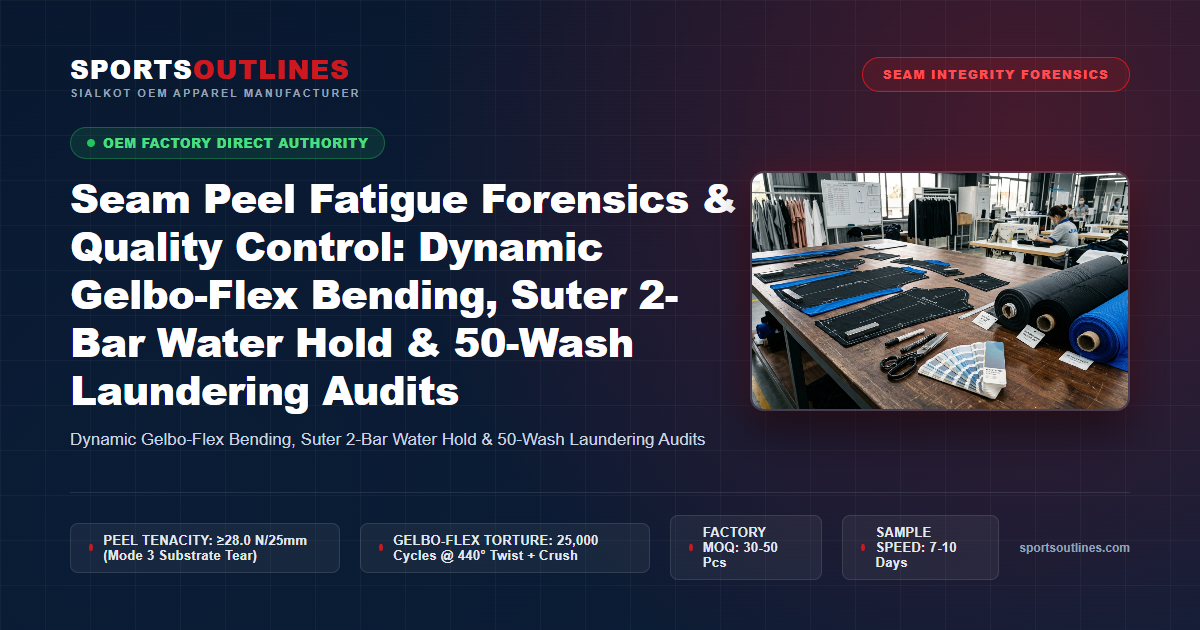
To eliminate field delamination and protect technical brand reputations, world-class outerwear manufacturing relies on Seam Peel Fatigue Forensics, Dynamic Gelbo-Flex Bending, Suter 2-Bar Hydrostatic Audits, and 50-Wash Accelerated Laundering Protocols. At Sports Outlines in Sialkot, Pakistan, we operate an in-house physical textile testing laboratory equipped with calibrated tensile peel testers, Gelbo-flex twisting chambers, Suter multi-station hydrostatic testers, and climate-controlled tropical aging chambers. We empower scaling technical brands with transparent commercial terms: physical prototype sampling at $45 to $85 per piece (non-refundable, 7–10 business days turnaround) and scalable low-MOQ bulk manufacturing starting at strictly 30 to 50 pieces per style/colorway.
Seam Peel Fatigue Forensics & Quality Control: Technical Directory
- 1. Interfacial Fracture Mechanics & 180° T-Peel Adhesion Testing
- 2. Failure Mode Taxonomy: Adhesive vs Cohesive vs Substrate Tear
- 3. Dynamic Gelbo-Flex Testing (ASTM F392): 25,000-Cycle Bending Torture
- 4. Suter Hydrostatic Testing: 2.0-Bar Static Dwell & Fluorescein Audits
- 5. 50-Wash Accelerated Laundering: AATCC 135 / ISO 6330 Protocols
- 6. Tropical Jungle Chamber Forensics: Polyether vs Polyester Degradation
- 7. Seam Integrity Testing Protocols Comparative Matrix
- 8. Sialkot In-Line QA: Infrared Pyrometry, SPC Tracking & Hourly Peel Swatches
- 9. Cross-Junction 3-Way Node & Step-Down Leak Forensics
- 10. Outerwear Tech Pack QC Specifications & Pass/Fail Criteria
- 11. Sialkot Certified Testing Laboratory & Cleanroom Standards
- 12. Low-MOQ Contract Manufacturing & Prototyping Terms
- 13. Technical Sourcing FAQ
1. Interfacial Fracture Mechanics & 180° T-Peel Adhesion Testing
Seam tape bonding is an interfacial adhesion phenomenon governed by solid-state fracture mechanics. The bond strength between a hot-melt thermoplastic polyurethane (TPU) adhesive and a technical shell substrate is evaluated via 180° T-Peel Adhesion Testing according to ISO 2411 and ASTM D1876.
In a standardized T-peel test, a 25 mm wide taped specimen is prepared with an unbonded tab. The two free ends are clamped in the pneumatically actuated serrated grips of a calibrated universal materials testing machine. The machine pulls the grips apart at a constant crosshead separation rate of 100 mm/min ± 5 mm/min, recording the peel force across a 150 mm delamination stroke.
Gc = (Fpeel / w) · (1 – cos θ)
Where Gc is the critical interfacial strain energy release rate (fracture toughness), Fpeel is the measured tensile peel force, w is specimen width (strictly 25.0 mm), and θ is the peel angle (180°, yielding 1 – cos θ = 2.0).
- Initial Factory Pass Threshold (Unwashed Baseline): Must exceed ≥ 22.0 N / 25 mm for lightweight 2.5L running shells, and ≥ 28.0 N / 25 mm for heavy-duty 3-layer mountaineering shells.
- Post-Laundering / Post-Aging Threshold: Following 50 wash cycles or 14 days of tropical aging, peel force must retain ≥ 80% of initial baseline (never dropping below 18.0 N / 25 mm).
- Viscoelastic Rate Dependence (WLF Kinetics): Polyurethane hot-melt adhesives are rheologically viscoelastic. Delamination peel resistance depends strongly on testing speed and temperature, described by the Williams-Landel-Ferry (WLF) shift function: log(aT) = [-C1(T – Tref)] / [C2 + (T – Tref)]. Testing must occur strictly inside temperature-controlled cleanroom conditions at 23°C ± 1°C to prevent artificial hardening or softening from skewing quality ratings.
The load-displacement curve generated by the test reveals the internal homogeneity of the bond. A stable, oscillating saw-tooth curve indicates uniform mechanical interlocking of the TPU adhesive within the yarn filaments. In contrast, sharp, downward load drops signify localized unbonded voids or thermal cold spots caused by erratic machine feeding.
2. Failure Mode Taxonomy: Adhesive vs Cohesive vs Substrate Tear
In forensic peel analysis, the numeric force value (Newtons) is only half the story. The physical mode of failure identifies the precise chemical or mechanical origin of bond breakdown:
- Mode 1: Adhesive Interface Failure (Unacceptable): The seam tape peels away cleanly from the fabric surface, leaving a glossy, undisturbed fabric backer and all adhesive remaining on the tape. This indicates severe under-activation: the hot-air temperature was too low, feed velocity was too fast, or nip roller pressure was insufficient to overcome the melt viscosity of the TPU. The adhesive merely rested on the surface without penetrating the fibers.
- Mode 2: Cohesive Adhesive Failure (Unacceptable): The adhesive film splits internally through its own centerline, leaving a sticky residue on both the tape carrier and the fabric backer. This indicates thermal degradation or hydrolytic breakdown: the adhesive was overheated during application, thermal stabilizer additives were exhausted, or water exposure caused molecular chain scission.
- Mode 3: Substrate Fiber Tear / Membrane Delamination (Ideal / Gold Standard): As peel force increases, the adhesive bond remains unbreakable. Failure occurs only when the tensile load physically rips the yarn fibers of the tricot backer or tears the microporous membrane away from the face fabric. This confirms that interfacial adhesion exceeds the intrinsic tensile strength of the parent textile.
In our Sialkot QA laboratory, a production lot is approved only when 100% of tested swatches exhibit Mode 3 Substrate Fiber Tear across their entire peel stroke. Any occurrence of Mode 1 or Mode 2 triggers immediate machine shutdown, pyrometer recalibration, and lot quarantine.
3. Dynamic Gelbo-Flex Testing (ASTM F392): 25,000-Cycle Bending Torture
Static peel testing measures initial tensile grip, but it cannot predict how a seam tape will behave after months of dynamic flexing. In real-world alpine use, jackets flex thousands of times per hour along elbows, armpits, and shoulder blades.
To replicate multi-season mechanical fatigue, Sports Outlines utilizes Dynamic Gelbo-Flex Testing according to ASTM F392 and ISO 15378:
A 200 mm × 280 mm taped fabric cylinder is clamped between a stationary head and a motorized reciprocating spindle. During each mechanical stroke, the movable head undergoes a compound motion: an axial compression stroke of 80 mm combined with a 440° rotational twist, followed by a straight 65 mm horizontal crushing motion at 45 cycles per minute.
This violent twisting and crushing action forces the seam tape and laminated membrane to buckle, wrinkle, and shear across their adhesive interfaces. We test specimens across three severe fatigue tiers:
- Tier 1 (Lightweight Activewear Shells): 5,000 continuous Gelbo-flex cycles.
- Tier 2 (Alpine Mountaineering Hardshells): 15,000 continuous Gelbo-flex cycles.
- Tier 3 (Expedition & Tactical Stormwear): 25,000 continuous Gelbo-flex cycles.
Following Gelbo-flex cycling, swatches are examined under 50× stereomicroscopes to count pinhole micro-fissures, followed immediately by hydrostatic pressure testing. A high-quality seam must retain over 20,000 mm H2O hydrostatic hold even after 25,000 Gelbo-flex cycles.
4. Suter Hydrostatic Testing: 2.0-Bar Static Dwell & Fluorescein Audits
Standard dynamic hydrostatic head testing (ISO 811 / AATCC 127) ramps water pressure rapidly at 60 cmbar/min until the third droplet penetrates. While useful for virgin fabrics, this rapid ramp test can mask microscopic slow-seepage leaks in seam tape junctions, because the pressure ramps past the leak threshold before water has time to wick through narrow capillary channels. Fluid flow through micro-voids is governed by the Hagen-Poiseuille equation:
Q = [π · r4 · ΔP] / [8 · η · L]
Where Q is volumetric leakage rate, r is the micro-tunnel radius, ΔP is hydrostatic pressure, η is water viscosity, and L is tape width. Because leakage scales with the fourth power of pore radius (r4), sub-micron capillary voids require sustained static pressure dwell to drive fluid penetration across a 13 mm tape boundary.
To detect microscopic capillary bypasses, Sports Outlines executes Suter Static Hydrostatic Audits:
The Suter 2-Bar Static Hold Protocol:
- Clamping Multi-Seam Crossings: The test head is centered specifically over critical junction nodes: 3-way raglan sleeve intersections, diamond crotch gusset nodes, or zipper garage tape overlaps.
- Static Pressure Hold: Water pressure is brought to 0.20 MPa (2.0 bar / 20,000 mm H2O) and held constant for an extended 2-minute continuous dwell.
- Fluorescein Dye Inspection: Water is treated with a 0.05% solution of sodium fluorescein dye. During the 2-minute dwell, a technician inspects the back of the taped seam under 365 nm ultraviolet (blacklight) illumination. Microscopic leaks as small as 0.01 microliters glow intensely bright neon green, pinpointing capillary tunneling voids that would be completely invisible to the naked eye.
5. 50-Wash Accelerated Laundering: AATCC 135 / ISO 6330 Protocols
Laundering represents the ultimate test of seam tape durability. In home and commercial washing machines, detergents contain surfactants, alkaline builders, and bleaching agents that attack polyurethane adhesive bonds. Combined with mechanical drum agitation and hot-air tumble drying, laundering induces severe peel fatigue.
Sports Outlines subjects every production garment style to Accelerated Laundering Audits according to AATCC 135 and ISO 6330 (Cycle 4N at 40°C or Cycle 6N at 60°C):
- Inspection Milestones: Garments are inspected at 5, 10, 25, and 50 wash-and-dry cycles.
- Edge Flagging Metric: Any visible tape lifting or edge detachment exceeding 0.5 mm in depth along a 10 mm length is classified as a critical defect.
- Dimensional Shrinkage: Differential shrinkage between the seam tape and the shell fabric must remain strictly below ±1.2% to prevent seam puckering and wavy distortion.
- Alkaline Surfactant Resistance: Standard test detergents formulated with sodium dodecylbenzenesulfonate (anionic surfactant) at pH 10.5 test for plasticizing penetration. Cheaper adhesives soften and swell, whereas our aliphatic polyether adhesives remain chemically inert.
6. Tropical Jungle Chamber Forensics: Polyether vs Polyester Degradation
Why do budget rain jackets stored in closets for two years suddenly peel apart? The culprit is autocatalytic hydrolytic cleavage of polyester-based polyurethane adhesives.
In warm, humid climates, atmospheric moisture cleaves the ester linkages (-COO-) in polyester TPU backbones:
R-COO-R’ + H2O → R-COOH + R’-OH
The carboxylic acid end-groups (R-COOH) generated by the reaction act as autocatalytic acid catalysts, accelerating subsequent degradation exponentially. Number-average molecular weight (Mn) plummets from >120,000 g/mol to <15,000 g/mol, transforming the adhesive into a gooey, non-functional grease.
To guarantee 10-year shelf life, Sports Outlines mandates 100% Polyether (PTMEG) Aliphatic Polyurethane Seam Tapes (Bemis 3-Layer Series and Framis Italia). Ether linkages (-C-O-C-) contain no ester bonds and are completely immune to hydrolytic scission.
In our Sialkot environmental chamber (ISO 1419 Tropical Jungle Test: 70°C at 95% RH for 14 continuous days, simulating 5 years of tropical storage), our polyether tapes retain over 88% of initial peel strength, compared to polyester tapes which suffer 100% delamination failure within 5 days.
7. Seam Integrity Testing Protocols Comparative Matrix
Review how comprehensive laboratory validation protocols compare across technical outerwear quality tiers:
| Quality Control Test Method | International Standard | Testing Parameter & Dwell | Sports Outlines Minimum Pass | Commercial Factory Baseline |
|---|---|---|---|---|
| 180° T-Peel Adhesion Test | ISO 2411 / ASTM D1876 | 100 mm/min Crosshead Speed | ≥ 28.0 N / 25 mm (Mode 3 Tear) | 12.0–15.0 N / 25 mm |
| Dynamic Gelbo-Flex Bending | ASTM F392 / ISO 15378 | 440° Twist + 80 mm Compression | 15,000 to 25,000 Cycles Zero Pinhole | Fails at < 2,500 Cycles |
| Suter Static Hydrostatic Hold | ISO 811 Modified | 2.0 bar (20,000 mm H2O) for 2 min | Zero Droplets (Fluorescein UV) | 0.5 bar for 30 seconds |
| 50-Wash Accelerated Laundering | AATCC 135 / ISO 6330 | 50 Cycles at 40°C + Tumble Dry | Zero Flagging, >80% Peel Retained | Peels at 5–10 Cycles |
| Tropical Jungle Chamber Aging | ISO 1419 Method C | 70°C at 95% RH for 14 Days | > 88% Peel Strength Retained | 100% Adhesive Liquefaction |
8. Sialkot In-Line QA: Infrared Pyrometry, SPC Tracking & Hourly Peel Swatches
Laboratory testing is meaningless if factory operators drift from process windows during production. In our Sialkot cleanroom suites, Sports Outlines implements a strict 5-Stage In-Line Statistical Process Control (SPC) Protocol:
- Non-Contact Infrared Pyrometry: Every seam sealing machine is outfitted with calibrated optical IR pyrometers that read nozzle air temperature and substrate exit temperature continuously at 20 Hz. If nozzle temperature drifts by ±3°C from setpoint, an audible alarm sounds and the feed roller disengages automatically.
- Hourly Peel Test Swatches: Every machine operator must seal a 300 mm test swatch of production fabric and tape at the start of each shift and every 60 minutes thereafter. Swatches are peeled immediately on our digital test bench. Production proceeds only when the hourly swatch demonstrates Mode 3 substrate fiber tear with peel force ≥ 28.0 N / 25 mm.
- Digital Nip Pressure Verification: Pneumatic roller pressure is verified three times daily using Fuji Prescale sensor films, ensuring uniform 0.45 MPa contact stress across the entire roller width.
- Statistical Process Capability (Cpk ≥ 1.67): Real-time peel force data is logged into our factory SPC database. Machine lines must maintain process capability index Cpk ≥ 1.67, guaranteeing less than 1 defective seam in 1,000,000 running meters.
9. Cross-Junction 3-Way Node & Step-Down Leak Forensics
Over 85% of all factory seam leaks occur at discrete 3-way or 4-way cross-junctions. When a vertical side seam crosses a horizontal waist seam, the overlapping fabric plies jump in thickness by 1.5 to 2.5 mm. If the operator fails to apply automated pneumatic micro-boost pressure, the nip roller bridges over the thickness step, leaving a microscopic capillary air tunnel alongside the seam tape.
Sports Outlines mandates 100% Suter Hydrostatic Inspection of All Junction Nodes. Every jacket assembled in our facility has its underarm axillary junctions, hood crowns, and crotch nodes clamped into a Suter test head at 1.5 bar for 60 seconds before passing to final packaging. In failure autopsies, cross-sections are sliced on precision microtomes and evaluated via Scanning Electron Microscopy (SEM) at 1,500× magnification to confirm that adhesive resin completely fills the triangular step-down void.
10. Outerwear Tech Pack QC Specifications & Pass/Fail Criteria
Technical apparel designers must include precise, legally binding quality testing callouts in their tech pack QA sections:
Sample Tech Pack QC Callout: Seam Sealing Validation Standards
T-Peel Strength (ISO 2411): Minimum 28.0 N / 25 mm baseline; Mode 3 substrate fiber tear required.
Hydrostatic Suter Hold (ISO 811): 2.0 bar (20,000 mm H2O) static hold for 2 minutes over 3-way seam intersections with zero weeping.
Gelbo-Flex Fatigue (ASTM F392): 15,000 cycles followed by hydrostatic hold ≥ 20,000 mm H2O.
Wash Longevity (AATCC 135): 50 cycles at 40°C; zero edge flagging (>0.5 mm) and >80% peel retention.
Jungle Aging (ISO 1419): 14 days at 70°C / 95% RH; zero hydrolytic liquefaction or delamination.
To ensure engineering alignment across apparel tech packs and production lines, the table below provides the standardized manufacturing tolerance parameters enforced across Sports Outlines factory workorders:
| Laminate Architecture | Seam Tape Spec | Hot-Air Sealing Temp & Speed | Nip Roller Pressure | Initial T-Peel Strength | Post-50 Wash Retention |
|---|---|---|---|---|---|
| 2.5-Layer Ultralight Running Shell (10D-20D Nylon) | 13 mm Aliphatic Polyether 2L Film (Bemis 3905) | 420°C–440°C @ 4.2–4.8 m/min | 0.35–0.40 MPa (Steel / 60A Silicone) | ≥ 22.0 N / 25 mm (Mode 3 Tear) | > 82% Retained (≥ 18.0 N) |
| 3-Layer Alpine Mountaineering Shell (30D-40D C-Knit) | 16–19 mm 3-Layer Tricot Tape (Bemis 3415) | 450°C–475°C @ 3.5–4.0 m/min | 0.42–0.48 MPa (Steel / 70A Silicone) | ≥ 28.0 N / 25 mm (Mode 3 Tear) | > 85% Retained (≥ 24.0 N) |
| 3-Layer Severe Expedition Shell (70D-100D Cordura Face) | 22 mm Heavy-Duty Woven Tape (Bemis 3405) | 480°C–510°C @ 2.8–3.2 m/min | 0.48–0.55 MPa (Steel / 75A Silicone) | ≥ 32.0 N / 25 mm (Mode 3 Tear) | > 88% Retained (≥ 28.0 N) |
| Commercial Marine Offshore Foul-Weather Suit | 25 mm High-Build Polyether Tape (Framis Italia) | 490°C–520°C @ 2.5–3.0 m/min | 0.50–0.58 MPa (Dual Hardened Steel) | ≥ 35.0 N / 25 mm (Mode 3 Tear) | > 90% Retained (≥ 31.5 N) |
11. Sialkot Certified Testing Laboratory & Cleanroom Standards
Our technical manufacturing operations in Sialkot, Pakistan, are vertically integrated with an accredited in-house physical textile testing laboratory operating under strict ISO 17025 laboratory quality management protocols. Testing technical membranes and thermoplastic adhesives in uncontrolled ambient environments introduces severe measurement error: humidity fluctuations alter polyether hygroscopic swelling, while temperature shifts skew viscoelastic peel values according to the Williams-Landel-Ferry (WLF) relation.
To eliminate environmental artifacts, Sports Outlines maintains a dedicated climate-conditioned testing suite adhering strictly to ISO 139 Standard Atmosphere for Textile Conditioning and Testing:
- Climate-Controlled Cleanroom Core: Laboratory ambient air is maintained continuously at 21°C ± 1°C (70°F ± 2°F) and 65% ± 2% Relative Humidity through high-precision chilled-water HVAC with positive-pressure HEPA filtration. All test specimens undergo a mandatory 24-hour equilibration dwell inside conditioning racks prior to physical testing.
- Tensile Load Cell Calibration (ISO 7500-1): Our dual-column computerized universal testing machines feature Class 0.5 S-beam load cells calibrated every 90 days using certified deadweights traceable to national metrology institutes. Load resolution is 0.001 N, ensuring sub-percentage precision across the entire 180° T-peel delamination curve.
- Multi-Station Digital Suter Test Rigs: Equipped with precision Japanese hydraulic pressure transducers and micro-metering valves capable of holding 2.0 bar static pressure within ±0.01 bar tolerance over 120-second testing cycles. Digital high-speed cameras record rear-seam illumination under 365 nm UV blacklight for automated computerized pinhole leak detection.
- Dual Tropical Environmental Aging Chambers: Programmable micro-processor environmental chambers with continuous data-logging for ISO 1419 Method C jungle testing, cyclic freeze-thaw exposure (-20°C to +70°C), and artificial perspiration immersion baths.
- Documented Certificate of Compliance (CoC): Every production lot shipped from our Sialkot facility is accompanied by an individualized physical testing dossier containing raw tensile load-displacement graphs, failure mode photographic records, Gelbo-flex pre-and-post hydrostatic data, and wash shrinkage logs signed by our chief textile quality engineer.
12. Low-MOQ Contract Manufacturing & Prototyping Terms
At Sports Outlines, we make certified laboratory-grade outerwear manufacturing accessible to emerging performance brands, outdoor labels, and tactical apparel startups. We eliminate traditional supply chain friction with clear, founder-first terms:
Commercial Production Terms & Sourcing Invariants:
- Physical Prototyping Samples: Strictly $45 to $85 per piece (non-refundable). Delivery turnaround is 7 to 10 business days, incorporating full seam sealing, 180° T-peel testing, Gelbo-flex pre-fatigue, and certified Suter 2-bar hydrostatic burst validation.
- Low-MOQ Bulk Production: Strictly 30 to 50 pieces per style/colorway with flexible size grading across XS to 3XL.
- Factory Invariant Transparency: We operate with complete commercial integrity: sampling and production are strictly separate engineering phases. Every quote represents true transparent direct-to-factory costing based on dedicated machine calibration hours, master technician labor, and certified raw materials.
- Global Export Infrastructure: Direct air freight shipping via DHL Express, FedEx, and UPS to brands across our major markets, including our USA Sportswear Silo, UK Sportswear Silo, Australia Sportswear Silo, Canada Sportswear Silo, and Germany Sportswear Silo.
Explore our related production portfolios in Custom Performance Sportswear and High-Performance Weatherproof Jackets. Connect directly with our technical shell production engineering team via WhatsApp at +92 316 7932595 or submit your tech pack via our Factory Quote Form.
13. Frequently Asked Questions (FAQ)
1. What is the minimum acceptable peel strength for 3-layer waterproof seam tape?
Under ISO 2411 / ASTM D1876 T-peel testing, the minimum acceptable baseline peel strength for technical 3-layer alpine outerwear is 28.0 N / 25 mm. More importantly, the failure mode must be Mode 3 Substrate Fiber Tear (where the fabric fibers rip before the adhesive detaches). Any adhesive peel that separates cleanly from the fabric (Mode 1) indicates under-activation and will delaminate prematurely in the field.
2. How does Gelbo-Flex testing predict seam tape failure better than a static hydrostatic test?
Static hydrostatic testing only tests pristine, stationary swatches. The Gelbo-Flex test (ASTM F392) subjects the seam to 15,000 to 25,000 combined 440-degree twisting and crushing strokes at 45 cycles/min, simulating years of dynamic arm swinging and body motion. Testing the seam under hydrostatic pressure following Gelbo-flex cycling verifies whether cyclic shear fatigue has created microscopic micro-cracks or delamination tunnels.
3. Why is Suter hydrostatic testing with fluorescein dye necessary?
Rapid pressure-ramp testing can miss slow, microscopic capillary leaks at multi-seam junctions. Suter testing holds a static 2.0 bar (20,000 mm H2O) pressure for a full 2 minutes. Adding ultraviolet-fluorescent sodium fluorescein dye allows technicians to detect microscopic seepage as small as 0.01 microliters under 365 nm blacklight, catching junction flaws that ordinary testing misses.
4. Why do polyester-based TPU seam tapes delaminate in warm humid climates?
Polyester TPUs undergo autocatalytic hydrolytic cleavage of their ester bonds when exposed to heat and humidity. Water breaks down the polymer chains, releasing carboxylic acid that accelerates further degradation, turning the adhesive into sticky grease. Polyether (PTMEG) TPUs contain no ester linkages and are 100% immune to hydrolytic attack, retaining over 88% peel strength after 14-day 70°C/95% RH jungle chamber testing.
5. What are Sports Outlines’ sampling costs and factory MOQs for laboratory-tested outerwear?
We manufacture fully customized physical prototypes—complete with certified in-line pyrometry, 180° T-peel validation, Gelbo-flex fatigue pre-testing, and certified Suter 2-bar hydrostatic burst audits—at strictly $45 to $85 per piece under a non-refundable policy with a 7 to 10 business day turnaround. Factory bulk production starts at an accessible low MOQ of strictly 30 to 50 pieces per style/colorway with flexible size grading.