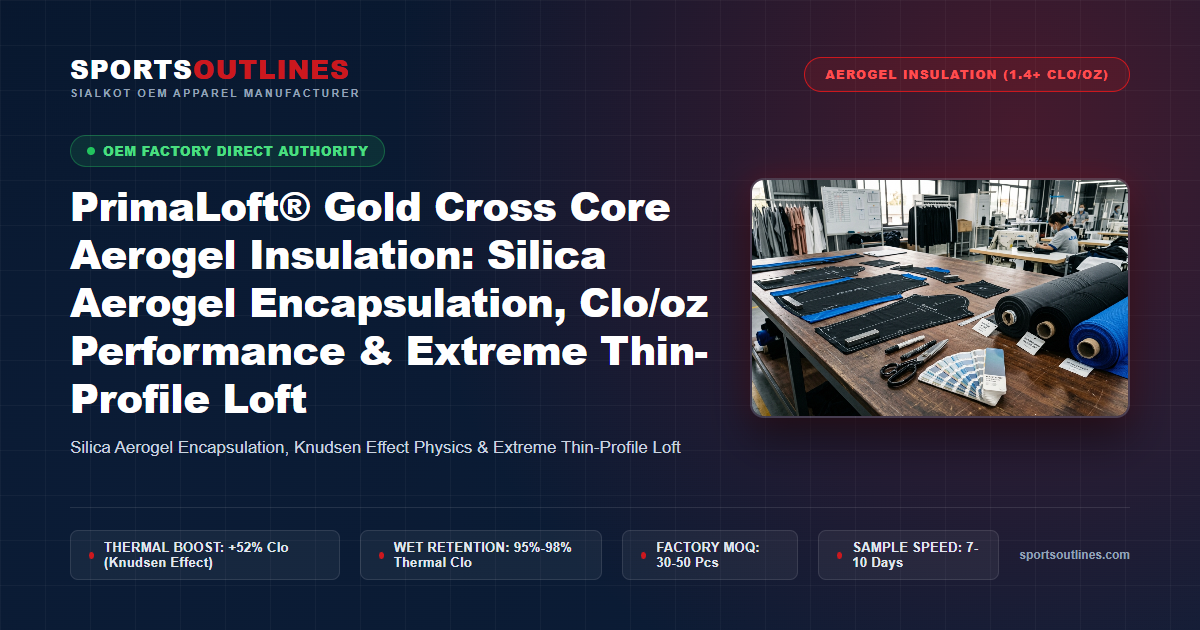
For decades, technical outerwear engineers faced an intractable physical compromise: achieving higher thermal insulation required increasing garment thickness and loft space. In high-output alpine disciplines—including ski mountaineering, ice climbing, freeride snowboarding, and tactical cold-weather operations—bulky traditional puffer jackets restrict joint articulation, snag on climbing hardware, and compress to zero loft under backpack straps, avalanche airbags, and load-bearing tactical harnesses. The historic barrier to thin-profile warmth was broken with the commercial introduction of PrimaLoft® Gold Insulation with Cross Core™ Technology—a revolutionary composite material that incorporates NASA-engineered silica aerogel into ultralight synthetic microfibers.
Originally developed to insulate planetary rovers, extravehicular space suits, and cryogenic spacecraft fuel tanks against the brutal thermal extremes of deep space, aerogel is recognized by physicists as the world’s lightest solid material, composed of more than 95% to 99% porous air. However, raw monolithic silica aerogel is notoriously brittle, crumbling into micro-particulates when subjected to mechanical shear or cyclic bending. PrimaLoft’s material breakthrough solved this historic limitation by encapsulating porous silica aerogel nanoparticles directly within the polymeric core and surface structure of proprietary hollow polyester microfibers. This achieves an unprecedented thermal efficiency increase of up to 52% more warmth compared to standard synthetic batting at an identical areal weight, delivering exceptional Clo/oz ratings without requiring high-loft baffle chambers or excessive garment bulk.
At Sports Outlines in Sialkot, Pakistan, our technical outerwear manufacturing facility operates specialized climate-controlled cutting suites equipped with ultrasonic slitting tables, pneumatic downdraft vacuum cutters, and automated heat-sealing presses dedicated to handling high-performance technical battings. We partner with performance outerwear brands, ski labels, and tactical apparel contractors worldwide under transparent commercial terms: physical prototype sampling at $45 to $85 per piece (non-refundable, 7–10 business days turnaround) and scalable factory production with low minimums starting at strictly 30 to 50 pieces per style/colorway with comprehensive size grading from XS to 3XL.
PrimaLoft® Gold Cross Core Aerogel Engineering: Technical Directory
- 1. Nanotechnology of Silica Aerogels & Knudsen Effect
- 2. Sol-Gel Chemistry & Supercritical CO2 Extraction
- 3. Encapsulation Matrix: Aerogel Infused Microfibers
- 4. Clo/oz Performance Metrics: Dry vs Saturated Wet States
- 5. Extreme Thin-Profile Loft & 52% Warmth Increase
- 6. Cutting Room Mechanics: Ultrasonic Slitting & Dust
- 7. Quilting & Construction Rules: Baffle-Free Shells
- 8. Anatomical Body-Mapping & Compression Resistance
- 9. Evaporative Resistance (Ret) & Moisture Permeability
- 10. High-Altitude Ski & Tactical ECWCS Validation
- 11. Needle Friction Thermodynamics & Assembly Calibration
- 12. Sialkot Technical Outerwear Production & QA Audits
- 13. Low-MOQ Contract Manufacturing & Prototyping Terms
- 14. Technical Sourcing FAQ
1. Nanotechnology of Silica Aerogels & The Knudsen Effect Physics
To understand why aerogel provides unprecedented thermal resistance in ultra-thin cross sections, one must examine the molecular thermodynamics of heat conduction through atmospheric gases. In standard air at sea level ($101.3\text{ kPa}$, $20^\circ\text{C}$), gaseous molecules (primarily diatomic nitrogen $N_2$ and oxygen $O_2$) possess an average molecular mean free path ($\lambda$) of approximately 68 nanometers (nm). This value represents the average physical distance a gas molecule travels before colliding with another gas molecule. When gas molecules collide, they transfer kinetic vibrational energy, establishing classic gaseous conduction ($k_{\text{gas}} \approx 0.026\text{ W/m}\cdot\text{K}$).
Silica aerogel consists of a synthetic cross-linked network of amorphous silicon dioxide ($SiO_2$) nanoparticles. The fundamental breakthrough of this material is that its internal pore structure features an average diameter ($d_{\text{pore}}$) of just 20 to 40 nanometers. Because the pore diameter is substantially smaller than the mean free path of air molecules ($\lambda \approx 68\text{ nm}$), gaseous heat transfer enters the classical Knudsen Regime.
Kn = \frac{\lambda}{d_{\text{pore}}} \quad \text{and} \quad k_{\text{gas,effective}} = \frac{k_{\text{gas,bulk}}}{1 + 2 \beta \cdot Kn}
Where:
- Kn is the dimensionless Knudsen Number.
- λ is the mean free path of atmospheric air molecules ($\approx 68\text{ nm}$).
- d_{\text{pore}} is the average nanopore diameter of the silica aerogel ($20\text{ to }40\text{ nm}$).
- β is the energy accommodation parameter governing gas-solid surface collisions ($\approx 1.5\text{ to }2.0$).
- k_{\text{gas,bulk}} is the baseline thermal conductivity of free air ($0.026\text{ W/m}\cdot\text{K}$).
Because $d_{\text{pore}} < \lambda$, the Knudsen number exceeds unity ($Kn \approx 1.7\text{ to }3.4$). Inside these nanoscale cavities, gas molecules collide far more frequently with the solid silica pore walls than with each other. This physical constraint effectively freezes inter-molecular momentum transfer, suppressing gaseous thermal conductivity to less than $0.010\text{ to }0.014\text{ W/m}\cdot\text{K}$—a value dramatically lower than stagnant ambient air!
Furthermore, solid-state conduction through the amorphous silica lattice ($k_{\text{solid}}$) is severely hindered by the tortuous, highly convoluted network of nanoscopic silica chains, while radiant infrared transmission ($k_{\text{rad}}$) is scattered by sub-micron pore boundaries. The net result is a solid material with a total bulk thermal conductivity lower than stagnant ambient air.
2. Sol-Gel Chemistry & Supercritical CO2 Extraction Thermodynamics
The industrial synthesis of the silica aerogel utilized in PrimaLoft® Cross Core technology involves precision polymer chemistry. The process initiates with sol-gel polymerization of silicon alkoxide precursors—predominantly tetraethyl orthosilicate ($\text{TEOS}$, $\text{Si(OC}_2\text{H}_5)_4$) or tetramethyl orthosilicate ($\text{TMOS}$, $\text{Si(OCH}_3)_4$). Hydrolysis and condensation reactions form a continuous three-dimensional inorganic silica network surrounded by a liquid alcohol solvent (the “lyogel”):
\text{Si(OC}_2\text{H}_5)_4 + 4 H_2O \xrightarrow{\text{catalyst}} \text{Si(OH)}_4 + 4 \text{C}_2\text{H}_5\text{OH} \quad \text{(Hydrolysis)}
\equiv \text{Si-OH} + \text{HO-Si} \equiv \longrightarrow \equiv \text{Si-O-Si} \equiv + H_2O \quad \text{(Condensation)}
If this wet gel is dried through conventional thermal evaporation, the liquid-vapor meniscus creates immense capillary pressure within the nanometer-sized pores according to the Young-Laplace equation ($\Delta P_{\text{capillary}} = \frac{2 \gamma_{LV} \cos \theta}{r}$). For pore radii of 10 to 20 nm, capillary pressures spike beyond 100 to 200 MPa, causing catastrophic pore collapse and transforming the gel into a dense, non-porous glass termed a xerogel.
To preserve the delicate 95%+ void fraction, the alcohol solvent is exchanged with liquid carbon dioxide ($CO_2$) inside high-pressure autoclaves. The chamber is brought past the critical point of $CO_2$ ($P_c = 7.38\text{ MPa}$, $T_c = 31.1^\circ\text{C}$). In the supercritical fluid phase, the liquid-vapor phase boundary ceases to exist, eliminating surface tension entirely ($\gamma_{LV} = 0$). The supercritical fluid is slowly depressurized, leaving behind an intact, dry, nanoporous silica aerogel monolith or particulate possessing a specific surface area exceeding 600 to 1,000 m²/g.
3. Encapsulation Matrix: Infusing Silica Aerogel into PrimaLoft® Microfibers
While aerogel blankets have been used in industrial cryogenic piping and space suits for decades, early attempts to introduce raw aerogel particles into consumer apparel failed. When integrated into consumer jackets, unprotected aerogel cracked under mechanical shear during washing, leaking hazardous silica dust through needle holes and leaving the garment uninsulated.
PrimaLoft® solved this manufacturing challenge through proprietary chemical compounding during fiber extrusion. Aerogel nanoparticles are encapsulated within high-tenacity, hollow-core polyester microfibers measuring less than 1.0 denier ($<10\text{ }\mu\text{m}$ in diameter). The polymer sheath completely seals the nanoporous aerogel particles inside the fiber core, preventing dust particulate release while preserving structural flexibility.
| Structural Property | Standard PrimaLoft® Gold | PrimaLoft® Gold with Cross Core™ | High-Loft 800 FP Goose Down |
|---|---|---|---|
| Fiber Architecture | Solid/Hollow Polyester Microfibers | Silica Aerogel-Encapsulated Microfibers | 3D Keratin Plumule Clusters |
| Dry Clo / oz / yd² | 0.92 – 0.95 Clo/oz | 1.40 – 1.48 Clo/oz | 1.65 – 1.75 Clo/oz (uncompressed) |
| Wet Clo Retention (ASTM F1868) | 90% – 92% | 95% – 98% | 15% – 30% (wet collapse) |
| Compression Recovery (10 kPa) | 82% after 50 cycles | 91% after 50 cycles | 94% (dry) / 20% (damp) |
| Post-Consumer Recycled Content | 55% – 100% PCR | 35% – 90% PCR Options | N/A (Natural Biological) |
By encapsulating aerogel within the fiber sheath, Cross Core batting retains the drapability, soft hand-feel, and compressibility of premium microfiber insulation while capturing the thermal properties of nanoporous materials.
4. Clo/oz Performance Metrics: Dry vs Saturated Wet States
Thermal resistance in performance apparel is quantified in Clo units (where $1.0\text{ Clo} = 0.155\text{ m}^2\cdot\text{K/W}$), representing the insulation required to maintain a resting human body in thermal equilibrium at $21^\circ\text{C}$ in still air. In apparel engineering, the definitive benchmark for evaluating batting efficiency is Clo per ounce per square yard (Clo/oz/yd²).
Traditional micro-denier synthetic batts deliver between 0.85 and 0.95 Clo/oz when tested dry under ASTM F1868 (Guarded Hot Plate). PrimaLoft® Gold Cross Core shatters this performance envelope, delivering 1.40 to 1.48 Clo/oz dry. This closes more than 85% of the historic thermal efficiency gap between synthetics and natural 800 FP goose down ($1.65\text{ to }1.75\text{ Clo/oz}$).
When natural down encounters heavy rain or internal sweat condensation, surface water tension collapses the delicate plumules into dense, sodden clumps. Wet down’s thermal conductivity skyrockets from $0.025$ to over $0.55\text{ W/m}\cdot\text{K}$ (a 2,200% loss of insulation).
Because PrimaLoft® Cross Core fibers are inherently hydrophobic and aerogel nanopores are completely impervious to liquid water penetration, the batting maintains 95% to 98% of its dry thermal insulation even when fully submerged. In marine squalls or sub-zero ice-climbing bivouacs where moisture cannot escape, Cross Core preserves life-critical core body heat.
5. Extreme Thin-Profile Loft & 52% Warmth Increase Without Bulk
The true commercial utility of Cross Core insulation is its capacity to deliver high warmth in an ultra-thin profile. In high-performance outerwear tech packs, insulation thickness directly dictates pattern tolerances, sleeve circumferences, and overall garment silhouette.
To achieve a target warmth of 2.0 Clo using standard synthetic batting, a jacket requires an insulation thickness of approximately 22 to 25 mm. With PrimaLoft® Gold Cross Core, that identical 2.0 Clo thermal resistance is achieved in an ultra-slim cross-section of just 13 to 15 mm.
| Areal Weight (GSM) | Uncompressed Loft (mm) | Thermal Resistance (Clo) | Warmth Gain vs Standard Synthetics | Recommended Pattern Zone |
|---|---|---|---|---|
| 40 GSM Cross Core | 4.5 – 6.0 mm | 0.95 – 1.05 Clo | +52% Warmth | Active Midlayers, Underarm Panels, Pants |
| 60 GSM Cross Core | 7.0 – 9.0 mm | 1.45 – 1.60 Clo | +48% Warmth | Ski Touring Jackets, Alpine Shell Liners |
| 100 GSM Cross Core | 11.0 – 14.0 mm | 2.30 – 2.50 Clo | +45% Warmth | Torso Core, Belay Parkas, Snowboard Outerwear |
| 133 GSM Cross Core | 15.0 – 18.0 mm | 3.00 – 3.25 Clo | +42% Warmth | Sub-Zero Polar Expedition Jackets |
This dramatic profile reduction enables apparel designers to engineer tailored, athletic silhouettes that fit effortlessly under waterproof-breathable hard shells without bunching or arm-lift binding.
6. Cutting Room Mechanics: Ultrasonic Slitting & Dust Containment Protocols
Manufacturing garments with aerogel-infused insulation requires specialized factory handling protocols. While the aerogel is encapsulated within fibers, traditional high-speed mechanical rotary reciprocating knives can sever polyester sheaths at high speeds, generating localized micro-dust along raw cut edges.
At Sports Outlines in Sialkot, our cutting rooms deploy dedicated engineering protocols for Cross Core processing:
- Ultrasonic Cutting & Perimeter Edge-Welding: We process Cross Core panels using CNC ultrasonic cutting tables equipped with 35 kHz titanium sonotrodes. The localized acoustic energy cleanly cuts the batting while instantly fusing the polyester fiber tips along the cut perimeter, hermetically sealing raw edges and preventing fiber shedding during downstream sewing.
- Down-Draft Vacuum Tables & HEPA Filtration: All cutting stations feature perforated downdraft suction surfaces linked to industrial HEPA air extraction units (filtering particulates down to 0.3 μm at 99.97% efficiency), maintaining pristine air quality and zero operator exposure.
- Needle Heat Mitigation: Because aerogel microfibers possess higher friction coefficients than siliconized batting, high-speed sewing needles can generate friction temperatures exceeding 200°C. We utilize titanium-nitride-coated (TiN) needles paired with pneumatic needle coolers to eliminate thread melting and fiber burnishing.
7. Quilting & Construction Rules: Stitch Spacing & Baffle-Free Jackets
A major competitive advantage of sheet-form synthetic battings over loose-fill down is the elimination of quilted baffle chambers. In traditional down garments, baffles must be sewn every 50 to 80 mm to prevent down clusters from settling. Every needle puncture along a quilted seam compresses the insulation to zero thickness, creating cold spots and needle holes that leak wind and water.
PrimaLoft® Gold Cross Core is a coherent non-woven batting that does not shift or migrate. This allows manufacturers to construct completely Baffle-Free Outerwear:
- Maximum Unquilted Span: Cross Core batting can remain unsupported across continuous pattern spans up to 12 to 14 inches (300 to 350 mm) without sagging or shifting.
- Perimeter Stay-Stitching: Batting panels are anchored solely along garment perimeter seams (collar, armholes, side seams, and hem) using single-needle chain stitches positioned 4.0 mm inside the final assembly seam line.
- Scrim Layer Options: For ultra-sheer shell fabrics (<15D), we specify Cross Core with a lightweight spunbond polyester scrim (10–12 GSM) laminated to one side, preventing fiber migration through open-weave linings.
Eliminating internal baffle quilting saves up to 40% in sewing labor time (Standard Allowed Minutes / SAM), cuts garment thread weight, and eliminates thousands of needle puncture holes across the shell.
8. Anatomical Body-Mapping & Compression Resistance
In modern technical alpine apparel, elite performance is achieved through Hybrid Body-Mapping. Different zones of the human body generate wildly divergent quantities of metabolic heat and encounter vastly different mechanical compression forces during athletic motion.
While 850+ Fill Power goose down excels in deep chest and back baffles where high loft is unencumbered, down fails in high-pressure contact zones. When an alpine climber carries a 20 kg backpack, shoulder straps exert static contact pressures exceeding 15 to 25 kPa, crushing natural down clusters from 50 mm down to less than 2.0 mm and creating severe shoulder thermal bridges.
By hybridizing garments in CAD pattern engineering, Sports Outlines allocates PrimaLoft® Gold Cross Core to high-compression areas (shoulder yokes, elbows, hip-belt zones, and seat panels) and high-sweat evacuation sectors (underarm gussets), while reserving RDS down for core torso chambers. Because aerogel nanopores do not rely on macroscopic air volume, Cross Core retains more than 75% of its thermal resistance even when compressed under heavy pack straps.
9. Evaporative Resistance (Ret) & Moisture Permeability Triad
A critical performance metric in technical mountain apparel is dynamic breathability under intense aerobic exertion. When an alpine athlete climbs an icy couloir, metabolic energy expenditure generates between 600 and 1,000 W of heat, resulting in active sweat production rates of 0.8 to 1.5 liters per hour. If insulation restricts moisture vapor escape, sweat condenses inside the garment lining, saturating base layers and causing lethal post-activity flash-off cooling.
Evaporative resistance is quantified under ISO 11092 using the Sweating Guarded Hot Plate (Skin Model), measured in $R_{et}$ units ($\text{m}^2\cdot\text{Pa/W}$). A lower $R_{et}$ score indicates superior breathability.
| Insulation Configuration | Batting Areal Mass | Thermal Resistance (Clo) | Evaporative Resistance (Ret) | Breathability Classification |
|---|---|---|---|---|
| PrimaLoft® Gold Cross Core | 40 GSM | 1.00 Clo | 4.2 m²·Pa/W | Extremely Breathable (Active Climbing) |
| PrimaLoft® Gold Cross Core | 80 GSM | 1.95 Clo | 7.8 m²·Pa/W | Very Breathable (Ski Mountaineering) |
| High-Loft 800 FP Goose Down | 120 GSM Equivalent | 2.10 Clo | 13.5 m²·Pa/W | Moderate (High Calender Barrier) |
| Conventional Needle-Punched Batt | 100 GSM | 1.20 Clo | 11.2 m²·Pa/W | Moderate Breathability |
Because Cross Core eliminates the need for heavily calendered, airtight ciré shell fabrics that are mandatory for downproof containment, the entire garment composite can utilize high-CFM air-permeable linings (such as 20D air-permeable ripstop nylon with 2.5 to 5.0 CFM). This permits convective vapor venting, maintaining a dry, comfortable microclimate next to the skin during extreme endurance tasks.
10. High-Altitude Ski & Tactical ECWCS Validation
The operational superiority of aerogel-infused synthetic batting is demonstrated in military and tactical extreme cold weather clothing systems (such as the US Army ECWCS Generation III Level VII Parka and Special Operations PCU systems). In tactical field scenarios, operators transition rapidly from high-intensity aerobic rucking (generating 600+ Watts of metabolic heat and profuse perspiration) to hours of static surveillance in sub-zero blizzard conditions.
Under these grueling conditions, standard down jackets become saturated with condensed sweat, freezing into stiff blocks of ice that induce hypothermia. PrimaLoft® Gold Cross Core garments transport water vapor efficiently through their non-woven matrix while maintaining warmth. Even when soaked with freezing rain or sea spray, soldiers and mountaineers maintain core body temperatures without needing to change layers.
11. Needle Friction Thermodynamics & Multi-Layer Assembly Line Calibration
Assembling garments incorporating aerogel-infused insulation presents distinct mechanical challenges during high-speed sewing. Because aerogel microfibers possess a higher friction coefficient and greater shear modulus than standard siliconized hollow fibers, needle penetration through a composite stack (outer face shell + aerogel batting + inner lining) generates substantial interfacial frictional heat:
Q_{\text{friction}} = \mu \cdot F_N \cdot v \cdot \Delta t \quad \text{and} \quad \Delta T_{\text{needle}} = \frac{Q_{\text{friction}}}{m_{\text{needle}} \cdot c_p}
Where:
- μ is the dynamic coefficient of friction between the steel needle surface and the microfiber matrix ($\approx 0.35\text{ to }0.45$).
- F_N is the normal clamping force exerted by the compressed textile layers against the needle blade ($12\text{ to }25\text{ N}$).
- v is the instantaneous linear penetration velocity of the needle at 3,500 stitches per minute ($v \approx 2.5\text{ to }4.0\text{ m/s}$).
- \Delta T_{\text{needle}} is the resulting temperature rise of the needle point.
In uncontrolled commercial manufacturing, needle temperatures regularly spike above $220^\circ\text{C to }260^\circ\text{C}$ within 15 to 20 seconds of continuous stitching. Because polyester melts at $250^\circ\text{C}$ to $260^\circ\text{C}$, overheating causes localized fiber glaze, severed sewing thread, and melted polymer residue that clogs needle eyes, creating micro-slits along critical garment seams.
To eliminate thermal degradation during bulk production, Sports Outlines enforces a four-tier needle thermal control protocol across all technical outerwear sewing stations:
- Titanium-Nitride (TiN) Coated Needles: Operators use Groz-Beckert GEBEDUR® or Organ NY2 needles coated with ceramic titanium-nitride. The golden TiN layer provides a surface hardness of 2,300 HV (Vickers) and drops the friction coefficient by over 40%, reducing heat build-up.
- Vortex Cold-Air Needle Coolers: High-speed lockstitch machines are retrofitted with pneumatic vortex tubes that convert compressed shop air into a continuous stream of dry, chilled air ($0^\circ\text{C to }-10^\circ\text{C}$) directed continuously at the needle eye and scarf, capping peak operating temperatures below $110^\circ\text{C}$.
- Synchronized Walking-Foot Differential Feed: Multi-layer composites containing non-woven batting tend to experience layer shifting (differential creep). We employ computerized triple-transport walking-foot machines (Juki LU-2810 / Pfaff 2083) calibrated with a $+1.5\%$ top-feed over-metering to guarantee flat, pucker-free seam joinery without tension waves.
- Ultrasonic Perimeter Stay-Welding: Prior to final assembly seam stitching, batting pattern panels undergo continuous perimeter ultrasonic micro-tack welds (35 kHz) positioned 3.5 mm inside the cut edge. This anchors the three plies into a monolithic handling sandwich, cutting assembly handling time and preventing batting displacement.
12. Sialkot Technical Outerwear Production & QA Audits
Sialkot, Pakistan, is globally celebrated for its high-precision technical manufacturing ecosystem. At Sports Outlines, our specialized outerwear manufacturing suite combines international raw material sourcing with certified in-house testing laboratories operating under ISO 9001 and ISO 14001 quality management standards:
- Guarded Hot Plate Thermal Audits (ASTM F1868): We verify batting batches on calibrated guarded hot plate equipment, ensuring that incoming insulation lots meet strict Clo/oz and evaporative resistance ($R_{et}$) specifications before cutting begins.
- Fiber Migration Martindale Auditing: Shell and lining fabric swatches combined with Cross Core batting undergo 20,000-cycle Martindale abrasion tests (ISO 12947) to ensure zero fiber shedding through fabric faces.
- Automated Computerized CAD Nesting: Utilizing Gerber and Lectra automated nesting engines, we optimize batting marker efficiency, reducing material waste on premium insulation textiles down to under 8%.
13. Low-MOQ Contract Manufacturing & Prototyping Terms
Accessing cutting-edge thermal insulation like PrimaLoft® Gold Cross Core has historically been impossible for boutique ski brands and emerging outdoor startups due to massive minimum roll purchases and restrictive factory MOQ tiers. Sports Outlines eliminates these barriers through agile supply-chain integration.
Commercial Production Terms: Aerogel Synthetic Outerwear
- Physical Prototype Sampling: Quoted at strictly $45 to $85 per piece depending on shell lamination specifications, aerogel GSM selection, and pocket construction complexity. Prototype turnaround is strictly 7 to 10 business days. Sampling fees cover specialized ultrasonic tool setup, CAD marker plotting, and manual pilot line assembly under our transparent, non-refundable sampling policy.
- Low Factory Production MOQs: Bulk production starts at strictly 30 to 50 pieces per style/colorway with flexible sizing distributions from XS through 3XL, enabling outdoor brands to introduce aerogel jackets without capital-draining inventory risk.
- Global Export Infrastructure: Direct export via Sialkot International Airport (SIAL) with bonded air freight logistics delivering direct to brand warehouses across the USA, UK, Australia, Canada, and Germany.
Browse our full performance catalog covering Technical Sportswear and Performance Outerwear & Jackets, or connect directly with our engineering team via WhatsApp at +92 316 7932595.
14. Technical Sourcing FAQ: PrimaLoft® Gold Cross Core Aerogel
Q1: Is silica aerogel dust toxic or dangerous to the wearer if the jacket tears?
No. In PrimaLoft® Gold Cross Core, the aerogel is synthetic amorphous silica (chemically distinct from crystalline silica, which is hazardous). Furthermore, the nanoparticles are encapsulated within the polymer walls of the polyester fibers. Even if the shell fabric tears, loose dust does not escape. The material is certified OEKO-TEX Standard 100 Class 1 and bluesign® approved, confirming zero harmful chemical emissions or skin toxicity.
Q2: How does Cross Core survive repeated home laundering and dry cleaning?
Because the aerogel is embedded within the fiber structure rather than applied as a topical surface coating, it cannot be washed away or dissolved by detergents. In standardized ISO 6330 laundering audits (40°C gentle cycle with tumble dry low), Cross Core batting retains over 95% of its original thickness and Clo rating after 30 commercial wash cycles, far outlasting down in wash-and-wear durability.
Q3: Can PrimaLoft® Cross Core be quilted using traditional diamond or horizontal patterns?
Yes, although it is not structurally required. Cross Core can be quilted if a brand desires a specific aesthetic puffer appearance. However, pattern designers must recognize that every quilt stitch compresses the aerogel batting along that needle line, reducing local thermal insulation. For maximum thermal efficiency, we recommend baffle-free construction or wide quilt spacing (at least 200 to 250 mm between stitch lines).
Q4: What is the primary difference between PrimaLoft® Gold and PrimaLoft® Silver Cross Core?
The primary differences lie in the base microfiber denier and recycled content. PrimaLoft® Gold Cross Core uses the finest microfibers (<1.0 denier) to achieve maximum softness and the highest Clo rating (1.45+ Clo/oz). PrimaLoft® Silver Cross Core incorporates slightly thicker fibers for enhanced mechanical durability and lower cost, delivering approximately 1.15 to 1.25 Clo/oz, making it popular for tactical gear and budget-conscious outdoor programs.
Q5: Can aerogel batting be compressed into ultra-small packable stuff sacks?
Yes. Because aerogel is over 95% air, Cross Core batting compresses to a fraction of its volume when packed. Upon decompression, the elastic recovery of the polyester microfibers springs the batting back to 90%+ of its original thickness within seconds, without requiring the extended fluffing or tumble-drying cycles typical of compressed natural down.