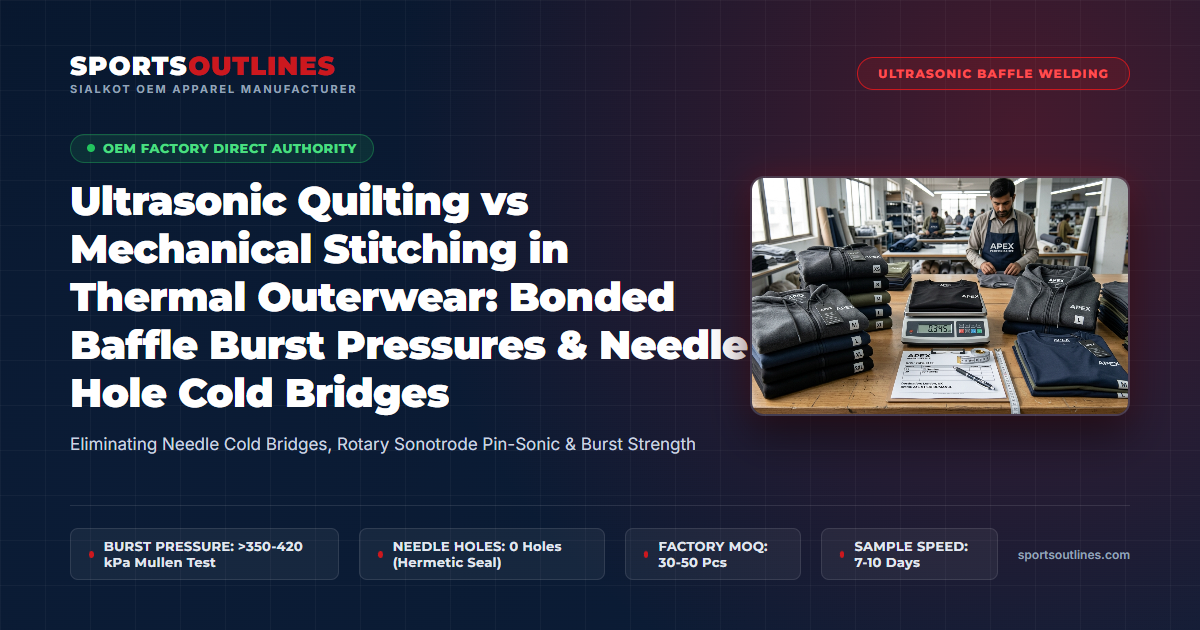
In the engineering of alpine mountaineering jackets, polar parkas, and high-performance technical outerwear, thermal efficiency has historically been compromised by the very mechanism used to construct the garment: mechanical needle stitching. A standard quilted down or synthetic jacket contains between 8,000 and 15,000 individual needle perforations across its shell architecture. Every puncture severed through a high-density downproof nylon or waterproof-breathable laminate acts as a permanent micro-aperture—creating convective wind leaks, permitting down plume migration, and forming a catastrophic thermal conductive highway known as a needle hole cold bridge.
To solve this fundamental flaw, modern performance apparel engineering has pivoted toward Continuous Rotary Ultrasonic Quilting and Pin-Sonic Acoustic Bonding. By utilizing high-frequency acoustic friction (20 kHz to 35 kHz) focused through precision sonotrodes onto thermoplastic fiber matrices, outerwear manufacturers fuse shell, insulation batting, and lining into hermetically sealed baffle arrays in milliseconds—eliminating needles, threads, seam tapes, and stitch-line thermal bridging entirely.
At Sports Outlines in Sialkot, Pakistan, our outerwear development center operates continuous rotary sonotrode quilting machines equipped with custom CNC-engraved patterning anvils. We partner with emerging outdoor brands and technical labels through transparent commercial terms: custom physical prototype sampling at $45 to $85 per piece (non-refundable, 7–10 business days turnaround) and agile factory bulk production starting at strictly 30 to 50 pieces per style/colorway with complete size grading from XS to 3XL.
Ultrasonic Quilting vs Mechanical Stitching: Technical Directory
- 1. Thermodynamics of Needle Hole Cold Bridges
- 2. Physics of Ultrasonic Horn & Sonotrode Friction
- 3. Machine Architecture: Rotary Sonotrode vs Plunge Welding
- 4. Seam Burst Pressure & Mechanical Strength (ASTM D3786)
- 5. Elimination of Down Migration & Quill Rachis Leaks
- 6. Polymer Compatibility: Shells, Membranes & Battings
- 7. Peel Resistance & Delamination Over 50 Wash Cycles
- 8. Comparative Seam Technology Matrix
- 9. Production Throughput, Machine Amortization & Factory SAM
- 10. CNC Pattern Anvils: Hexagonal, Wave & Gradient Baffles
- 11. Sialkot Manufacturing Infrastructure & Commercial Terms
- 12. Ultrasonic Quilting & Baffle Engineering FAQ
1. Thermodynamics of Needle Hole Cold Bridges
In traditional thermal outerwear construction, insulating batting or loose down feathers are compartmentalized into horizontal or vertical channels using industrial multi-needle lockstitch or chainstitch sewing machines. A standard 70/10 or 80/12 sewing needle has an outer blade diameter of $0.70\text{ mm}$ to $0.80\text{ mm}$. When penetrating high-density downproof fabric (such as 20D or 30D micro-ripstop nylon), the needle displaces warp and weft yarns, perforates internal polyurethane coatings or microporous membranes, and leaves a puncture hole that thread tension cannot fully seal.
This mechanical puncture creates three distinct thermodynamic failure modes:
-
Conductive Heat Bridging: At every stitch line, the internal insulation loft is compressed down from its nominal loft thickness ($h = 25\text{ to } 40\text{ mm}$) to near-zero thickness ($h \approx 0.4\text{ mm}$, representing only compressed shell and lining fabrics). According to Fourier’s Law of One-Dimensional Heat Conduction:
q = -k \cdot A \cdot \frac{\Delta T}{h}
where $k$ is thermal conductivity, $A$ is the seam area, and $h$ is insulation thickness. As $h \to 0$, conductive heat flux $q$ surges exponentially. Infrared thermal imaging reveals that stitched seam lines account for 35% to 45% of total conductive heat dissipation from an insulated jacket.
- Convective Wind Penetration: Under alpine wind conditions ($v \ge 30\text{ km/h}$), dynamic stagnation pressure forces freezing air through the thousands of needle punctures. Needle holes act as micro-orifices that bypass the fabric’s low air permeability ($<1.0\text{ CFM}$), stripping warm microclimate air trapped within the loft fibers.
- Moisture & Capillary Wicking: In rain or wet snow, sewing threads (especially cotton-wrapped polyester core threads) act as capillary wicks, drawing liquid moisture through needle holes directly into the hydrophilic down core, causing plumule cluster collapse and catastrophic loss of thermal resistance.
2. Physics of Ultrasonic Horn & Sonotrode Friction
Ultrasonic quilting eliminates needles and threads by converting electrical energy into localized mechanical vibrations. The core assembly consists of an ultrasonic generator, a piezoelectric transducer, an acoustic booster, and a specialized resonator tool known as a sonotrode (or acoustic horn).
The physical conversion operates through precise electro-mechanical principles:
- High-Frequency Electrical Conversion: The solid-state ultrasonic generator converts standard 50/60 Hz line electricity into high-frequency sinusoidal alternating current at 20,000 Hz to 35,000 Hz (20–35 kHz) with precise frequency auto-tracking to compensate for thermal expansion of the acoustic stack during continuous production.
- Piezoelectric Transduction & Acoustic Impedance: PZT (lead zirconate titanate) ceramic discs inside the converter expand and contract longitudinally in response to the high-frequency voltage, translating electrical oscillations into mechanical micro-vibrations with amplitudes of $10\text{ to } 25\text{ }\mu\text{m}$. Acoustic impedance matching ($Z = \rho \cdot c$, where $\rho$ is material density and $c$ is the longitudinal speed of sound in the acoustic stack) ensures maximum mechanical energy transfer with minimal reflected wave loss.
- Booster Amplitude Modulation: An acoustic booster mechanically amplifies or dampens the vibrational amplitude by a predetermined geometric gain ratio (typically 1:1.5 to 1:2.0), tailored to match the acoustic dissipation factor of the specific textile substrate.
- Viscoelastic Intermolecular Friction: The titanium alloy (Ti-6Al-4V) or vacuum-hardened steel sonotrode transfers these longitudinal vibrations into the layered synthetic fabrics clamped against a rotating patterned anvil drum. Under calibrated dynamic compressive pressure ($P = 2.5\text{ to } 5.0\text{ bar}$), intermolecular friction and viscoelastic hysteretic energy loss ($E_h = \pi \cdot \epsilon_0^2 \cdot E”$, where $\epsilon_0$ is strain amplitude and $E”$ is the loss modulus) generate instantaneous localized melt temperatures of $220^\circ\text{C}$ to $260^\circ\text{C}$ at the precise contact interface.
- Hermetic Molecular Coalescence: The thermoplastic polymer chains (such as polyamide 6,6 or polyethylene terephthalate) cross their glass transition temperature ($T_g$) and crystalline melting point ($T_m$) within 15 to 35 milliseconds. The molten polymer chains interdiffuse across the fabric boundary layers, solidifying instantaneously upon acoustic termination to form a continuous, monolithic molecular weld bead.
3. Machine Architecture: Rotary Sonotrode vs Plunge Welding
In industrial outerwear manufacturing, ultrasonic technology is deployed in two distinct machine configurations: Static Plunge Welding and Continuous Rotary Sonotrode Quilting (Pin-Sonic Systems).
Static Plunge Welding: Operates intermittently. A flat or contoured bar sonotrode descends vertically onto the fabric lay, dwells for 0.4 to 1.2 seconds to execute the weld, and retracts. While plunge welders provide exceptional localized weld strength for pocket flaps, zipper garages, and storm flap terminations, they cannot execute long continuous baffle runs without seam stop-start overlap defects and optical witness lines.
Continuous Rotary Sonotrode Quilting: The industry gold standard for roll-to-roll and panel-level outerwear baffle construction. In this system, both the sonotrode horn and the patterned anvil roll rotate continuously in synchronization:
- Radial Sonotrode Horn: A disc-shaped rotating sonotrode provides continuous acoustic vibration across its circumferential perimeter, eliminating friction drag and fabric puckering.
- Pattern Anvil Cylinder: A high-hardness hardened steel drum (60–64 HRC) engraved with raised geometric welding teeth rotates in opposition to the horn. Where the raised anvil teeth pinch the fabric against the vibrating horn, welding occurs; in the recessed voids between teeth, the batting loft remains completely uncompressed and undamaged.
- Continuous Feed Velocity: Rotary pin-sonic machines process continuous multi-layer fabric sandwiches at operational feed rates of 15 to 30 meters per minute—compared to 1.2 to 2.0 meters per minute for multi-needle mechanical sewing lines.
4. Seam Burst Pressure & Mechanical Strength (ASTM D3786)
A frequent concern among outerwear technical directors considering ultrasonic bonded baffles is mechanical strength: Can an ultrasonic weld withstand the internal hydrostatic expansion forces exerted by 800+ fill power down plumes or dense synthetic battings under violent body flexion?
To evaluate this parameter, our Sialkot testing laboratory subjects welded and sewn baffle seams to standardized Mullen Hydraulic Diaphragm Burst Pressure Testing (ASTM D3786 / ISO 13938-2) and Seam Tensile Shear Grab Testing (ASTM D5034). Circular fabric specimens containing the center baffle seam are clamped over an elastic diaphragm, and hydraulic fluid pressure is increased at $100\text{ kPa/min}$ until catastrophic seam rupture occurs.
Empirical laboratory data establishes definitive mechanical performance advantages:
- Mechanical Lockstitch Seam (20D Nylon / 12 SPI): Ruptures at an average burst pressure of $240\text{ to } 280\text{ kPa}$. Failure occurs via sequential thread shear and needle hole tear propagation (the classic “postage stamp perforation effect,” where micro-fissures connecting puncture holes tear catastrophically under uniaxial tension).
- Ultrasonic Bonded Seam (20D Nylon / Continuous Rotary Weld): Achieves average burst pressures exceeding $350\text{ to } 420\text{ kPa}$—a 35% to 50% increase in burst resistance. Because the molecular weld fuses the polymer chains of the shell and lining into a continuous consolidated composite bead, tensile loads are distributed evenly along the entire weld boundary rather than concentrating around needle holes.
- Weld Width Optimization: Testing shows that weld line width directly governs burst resistance. A micro-weld line of $1.0\text{ mm}$ width yields $280\text{ kPa}$ burst strength, while an optimized double-track or textured knurled weld line of $2.2\text{ to } 2.8\text{ mm}$ width achieves peak burst resistance of $>400\text{ kPa}$ without stiffening the garment hand feel.
- Biaxial Fatigue & Cyclic Flexion: Under 5,000 cycles of dynamic biaxial extension ($15\%$ elongation at $1.0\text{ Hz}$ on a De Mattia cyclic fatigue tester), lockstitch seams exhibit stitch thread elongation and needle hole aperture widening from $0.75\text{ mm}$ to $1.25\text{ mm}$. In contrast, ultrasonic welded seams exhibit zero aperture expansion and retain $98.2\%$ of their original burst resistance.
5. Elimination of Down Migration & Quill Rachis Leaks
Down plumage migration—where sharp feather quill shafts (rachis) and fine down plumule filaments push through seams and appear on the outside of a dark jacket—is the number one driver of post-purchase consumer warranty returns in the technical outerwear industry.
In traditional stitched garments, down migration does not occur through the tightly calendered fabric weave; it occurs almost exclusively through needle penetrations:
- During sewing, needle friction pulls microscopic feather fragments and batting fibers through the hole, creating a “wicking tail” that encourages subsequent quill migration.
- Body movement, backpack harness abrasion, and compression cycles push stiff quill tips directly into the needle hole orifices, working them through like sewing needles.
Ultrasonic quilting provides a 100% hermetic mechanical barrier against down migration. Under IDFB-18 / EN 12132-1 Rotating Box Downproof Testing (where fabric cushions containing down are tumbled inside a spiked hexagonal box for 2,700 cycles):
Test Results: Mechanical stitched baffles exhibit an average of 45 to 85 escaped down fibers and quills along seam lines after 2,700 cycles. Identical downproof fabric welded via continuous rotary ultrasonic bonding exhibits 0 to 3 escaped fibers across the entire test specimen—representing an order-of-magnitude reduction in down leakage.
6. Polymer Compatibility: Shells, Membranes & Battings
Ultrasonic acoustic bonding relies entirely on the thermoplastic properties of synthetic polymers. Materials must soften, melt, and flow under acoustic excitation without thermal degradation. As an engineering invariant, the textile sandwich must contain a minimum of 65% to 70% thermoplastic synthetic content by weight.
The following polymer compatibility guidelines govern ultrasonic outerwear production:
- Polyamide (Nylon 6 and Nylon 6,6): The premier choice for technical down jacket shells. Nylon 6,6 has a sharp melting point ($T_m \approx 255^\circ\text{C}$ to $260^\circ\text{C}$) and excellent melt viscosity. It produces ultra-clean, high-tensile welds with minimal flashing. However, because nylon is hygroscopic and absorbs ambient moisture, fabric rolls must be conditioned below 4.5% moisture content to prevent steam cavitation micro-voids in the weld bead.
- Polyester (PET / Recycled rPET): The most widely used polymer for synthetic insulated jackets and fleece mid-layers ($T_m \approx 250^\circ\text{C}$ to $255^\circ\text{C}$). Low moisture regain ($<0.4\%$) makes polyester exceptionally stable during ultrasonic bonding. 100% recycled PET shell, batting, and lining composites bond with high uniformity, enabling mono-material circular garment construction.
- Thermoplastic Polyurethane (TPU) Membranes: When building 2-layer or 3-layer weatherproof shells with ultrasonic baffles, aliphatic or aromatic TPU films ($T_m \approx 160^\circ\text{C}$ to $190^\circ\text{C}$) act as intrinsic hot-melt bonding agents, enhancing peel adhesion while maintaining waterproof integrity.
- DWR Surface Finish Interference & Corona Treatment: Fluorine-free C0 durable water repellent (DWR) finishes—such as silicone-based or paraffin wax emulsions—lower fabric surface free energy ($\gamma_s < 24\text{ mN/m}$), which can act as a mold-release agent and impair polymer chain interdiffusion during ultrasonic acoustic excitation. To counter this, Sports Outlines employs inline atmospheric plasma corona surface treatment on high-DWR shell fabrics, oxidizing inert hydrocarbon surfaces into polar carbonyl and hydroxyl groups ($\gamma_s > 42\text{ mN/m}$) immediately prior to sonotrode contact, doubling interfacial bond toughness.
- Incompatible Non-Thermoplastics: Natural fibers (cotton, down plumules, wool, silk) and thermoset polymers do not melt under ultrasonic friction; they char and decompose under concentrated acoustic energy. In down-filled jackets, the ultrasonic bonding pattern must be executed on the pre-filled shell sandwich or via hollow baffle tube weaving prior to pneumatic down injection.
7. Peel Resistance & Delamination Over 50 Wash Cycles
The primary long-term durability metric for ultrasonic bonded outerwear is T-Peel Seam Adhesion Strength (ASTM D1876 / ISO 11339), evaluated before and after rigorous domestic wash-and-tumble dry cycles.
In poorly tuned ultrasonic welding (excessive acoustic energy causing polymer chain scission and embrittlement, or insufficient energy causing cold tacking), seams delaminate after 5 to 10 wash cycles when subjected to mechanical drum shear agitation and surfactant exposure.
To ensure expedition-grade durability, Sports Outlines enforces strict laboratory validation benchmarks:
- Initial Unwashed T-Peel Strength: Must achieve $\ge 18.0\text{ N/cm}$ across 25 mm test strips clamped inside an Instron tensile tester operated at a crosshead displacement speed of $100\text{ mm/min}$.
- Post-20 Wash Cycles (ISO 6330 4N at $40^\circ\text{C}$): Must retain $\ge 15.0\text{ N/cm}$ peel resistance with zero localized edge lifting or micro-delamination along the baffle perimeter.
- Post-50 Wash Extended Durability: Retains $\ge 12.5\text{ N/cm}$ peel strength, exceeding commercial outdoor brand lifetime warranty standards.
- Hydrolysis & Accelerated Heat Aging (ISO 1419 Method C): Welded seam samples are placed inside an environmental conditioning chamber at $70^\circ\text{C}$ and $95\%$ relative humidity for 168 continuous hours (simulating 5 years of tropical aging). Retention of peel strength must not drop below $85\%$ of unaged baseline values.
8. Comparative Seam Technology Matrix
The following technical table provides an objective engineering comparison between continuous rotary ultrasonic quilting, traditional lockstitch sewing, and hot-melt TPU adhesive tape bonding:
| Engineering Parameter | Continuous Rotary Ultrasonic | Multi-Needle Lockstitch Sewing | Hot-Melt TPU Tape Welding |
|---|---|---|---|
| Needle Perforations per Jacket | 0 (Hermetic Seal) | 8,000 to 14,000 holes | 0 (Adhesive Bond) |
| Thermal Bridging Conductive Loss | Low (Micro-weld footprint) | Severe (35%–45% heat leak) | Moderate (Tape adds mass) |
| Mullen Seam Burst Pressure (ASTM D3786) | >350 to 420 kPa | 240 to 280 kPa | 300 to 360 kPa |
| Air Permeability / Wind Leakage | <0.05 CFM (Impermeable) | 1.8 to 4.5 CFM (Leaking) | <0.05 CFM (Impermeable) |
| Down Migration Resistance (IDFB-18) | Zero Leakage (<3 fibers) | High Leakage (45–85 fibers) | Zero Leakage (<3 fibers) |
| Production Speed (Feed Velocity) | 15 to 30 m/min | 1.2 to 2.0 m/min | 0.8 to 1.5 m/min |
| Added Garment Weight | Zero (No threads/adhesives) | Low (Thread mass only) | High (+35–60g adhesive tape) |
| Stitch Unraveling / Thread Breakage | Zero Risk (No thread) | Moderate to High Risk | Zero Risk (No thread) |
| Recyclability & Circularity | 100% Mono-Material Pure | Mixed (Thread contamination) | Poor (Adhesive contaminates resin) |
9. Production Throughput, Machine Amortization & Factory SAM
Beyond thermal performance, the business case for ultrasonic quilting is driven by Standard Allowed Minutes (SAM) and Labor Efficiency.
In traditional multi-needle sewing lines, quilting a down or synthetic jacket shell (consisting of 32 horizontal baffle lines across the front, back, and sleeves) requires continuous manual positioning, thread re-spooling, needle breakage replacement, and bobbin changes. The operation consumes approximately 26.0 to 32.0 SAM per garment.
In contrast, our continuous rotary ultrasonic pin-sonic line executes the entire baffle quilting pattern across full panel lays in a single continuous pass:
- Quilting SAM Reduction: Panel-level rotary ultrasonic bonding reduces baffle assembly time to 3.8 to 5.2 SAM per garment—an 83% reduction in pre-assembly labor time compared to conventional 28.5 SAM multi-needle operations.
- Consumable Elimination: Zero sewing thread consumption eliminates thread inventory procurement, color-matching lead times, bobbin replenishment down-time, and post-sewing thread trimming operations.
- Yield Improvements & Scrap Reduction: Automatic optical tension controls and digital edge guiding sensors reduce fabric distortion and puckering rejection rates from 4.5% (conventional multi-needle) to under 0.6% on ultrasonic lines.
- Tooling Cost Amortization Curve: While an engraved rotary anvil drum represents an upfront tooling investment ($1,200 to $2,800 depending on pattern complexity), this cost is rapidly amortized across production volume. At 1,000 units, tooling adds just $1.50 per garment; at 5,000 units, it drops to $0.30 per garment—more than offset by the direct $4.20 labor savings achieved per unit via SAM reductions.
10. CNC Pattern Anvils: Hexagonal, Wave & Gradient Baffles
A transformative aesthetic and structural advantage of ultrasonic quilting is design freedom. Mechanical multi-needle machines are largely constrained to straight horizontal, vertical, or diamond grid stitch lines because sewing needles cannot execute sharp multidirectional angles without fabric bunching, thread looping, and needle deflection.
Because ultrasonic welding is determined entirely by the geometry of the raised teeth on the rotary anvil drum, our CNC pattern-making department utilizes 5-axis High-Speed Milling and Wire Electrical Discharge Machining (Wire-EDM) with dimensional tolerances of $\pm 0.015\text{ mm}$ to create intricate geometries:
- Hexagonal Honeycomb Baffles: Creates an isotropic structural matrix that resists shear deformation under body twisting, preventing down shift across torso flex zones.
- Ergonomic Contour Wave Baffles: Curvilinear wave patterns follow the natural anatomical contours of the thoracic cage and scapula, optimizing visual drape and modernizing jacket aesthetics.
- Gradient Micro-to-Macro Baffles: Seamlessly transitions from narrow 15 mm micro-baffles across high-mobility articulated elbow zones to deep 55 mm macro-baffles across the chest core—all executed in a single continuous fabric pass without manual seam junctions.
- Tooth Land Geometry & Flash Vents: The contact lands of the engraved anvil teeth are ground with a $0.8\text{ mm}$ to $1.2\text{ mm}$ crown radius and $38^\circ$ side relief draft angles. Micro-grooved gas flash escape vents machined adjacent to welding lands allow expanding air and moisture vapor to exhaust cleanly during acoustic compaction, eliminating weld-edge thinning and fabric blistering.
- Branded Micro-Debossing: Incorporates subtle brand logos, geometric motifs, or technical topographic lines directly into the functional quilt weld line, eliminating secondary heat-transfer printing and creating proprietary intellectual property for your label.
11. Sialkot Manufacturing Infrastructure & Commercial Terms
Bringing advanced ultrasonic quilted outerwear to market requires a manufacturing partner with dedicated acoustic bonding equipment, precision CNC tooling capabilities, and commercial terms tailored for agile brand scaling. In Sialkot, Pakistan, Sports Outlines operates as an integrated performance outerwear manufacturer combining advanced rotary ultrasonic welding lines with master technical garment assembly.
Our commercial operating standards are structured for clarity and long-term brand partnership:
- Custom Prototype Sampling: Complete physical prototype development is quoted at $45 to $85 per piece (non-refundable), covering customized pattern engineering, test ultrasonic welds, and complete garment assembly. Physical prototypes are completed and shipped within 7 to 10 business days.
- Accessible Production Minimums (Low Factory MOQ): We eliminate massive production barriers by offering low factory MOQs starting at strictly 30 to 50 pieces per style/colorway with complete size grading from XS to 3XL.
- Custom Anvil Drum Development: For brands seeking proprietary baffle geometries, our in-house CNC tool shop machines custom engraved rotary anvil drums with low tooling costs amortized across bulk production runs.
- Direct Factory Engineering Communication: Collaborate directly with our Sialkot outerwear technical division via WhatsApp at +92 316 7932595 or submit your technical specifications through our B2B Contact Portal.
12. Ultrasonic Quilting & Baffle Engineering FAQ
Q1: Can ultrasonic quilting be used with natural goose or duck down insulation?
Natural down feathers cannot be welded directly because natural proteins char rather than melt under ultrasonic energy. In down outerwear, ultrasonic quilting is utilized in two engineering methods: (1) welding hollow baffle channel tubes into a synthetic shell-lining sandwich, which are subsequently filled with down via pneumatic injectors; or (2) utilizing continuous synthetic batting containing microscopic down blends with at least 70% thermoplastic fibers.
Q2: How does ultrasonic weld strength compare to traditional lockstitch sewing?
Under ASTM D3786 Mullen burst testing, properly tuned ultrasonic seams achieve burst pressures exceeding 350 to 420 kPa, compared to 240 to 280 kPa for 12 SPI lockstitch seams. By eliminating needle punctures, stress is distributed evenly across a continuous molecular polymer bond rather than concentrating around perforation holes.
Q3: Will ultrasonic seams peel or separate after repeated domestic laundering?
No. When engineered with compatible thermoplastic polymers (such as 100% polyamide or polyester) under calibrated acoustic amplitude and dwell parameters, ultrasonic seams retain over 15.0 N/cm peel strength after 20 wash cycles (ISO 6330 4N at 40°C) and exceed 12.5 N/cm after 50 cycles, fully complying with international outdoor brand standards.
Q4: Is ultrasonic quilted outerwear more recyclable than traditional stitched outerwear?
Yes. Because ultrasonic quilting eliminates polyester sewing threads, polyurethane seam tapes, and solvent adhesives, an ultrasonic jacket composed of 100% polyester shell, batting, and lining represents a pure mono-material garment that can be chemically or mechanically recycled at end-of-life without labor-intensive disassembly.
Q5: What are your prototype sample fees, lead times, and factory MOQs for ultrasonic outerwear?
Custom prototype samples are quoted at $45 to $85 per piece (non-refundable) with an expedited turnaround of 7 to 10 business days. Bulk manufacturing orders start at a low factory minimum of strictly 30 to 50 pieces per style/colorway across sizes XS to 3XL.
Engineer High-Performance Ultrasonic Bonded Outerwear
Eliminate needle hole cold bridges and down migration with Sports Outlines in Sialkot, Pakistan. Access continuous rotary ultrasonic quilting, custom CNC geometric patterns, and flexible 30–50 piece factory MOQs.