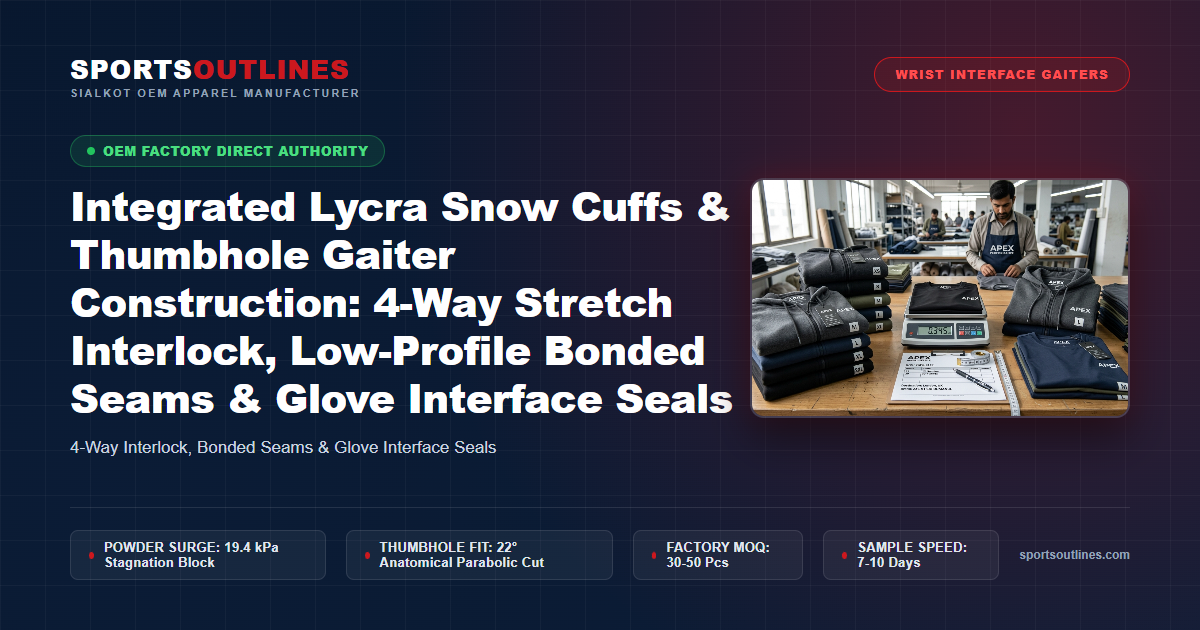
In alpine ski racing, freeride backcountry descents, and high-latitude mountaineering, the anatomical interface between the jacket sleeve cuff and the technical winter glove represents one of the most vulnerable thermal and moisture breach points on the human body. Even if an alpine shell is constructed from world-class 3-layer laminates boasting hydrostatic head ratings exceeding $28,000\text{ mm } H_2O$, a poorly engineered wrist closure will systematically fail during dynamic movement. When an athlete plants ski poles, reaches for overhead ice holds, or takes a high-speed fall into deep powder snow, the sleeve rides up the forearm, opening a gap that funnels freezing wind and spindrift straight into the garment interior.
The physiological consequence of wrist exposure is severe: the radial and ulnar arteries pass within mere millimeters of the volar skin surface at the carpal tunnel, making the wrist a massive heat radiator. Exposing the wrist to sub-zero temperatures rapidly triggers vasoconstriction in the digital microvasculature, cutting peripheral blood flow to the fingers and inducing debilitating numbness, loss of grip dexterity, and early frostbite. The definitive solution in modern technical outerwear is the integrated Lycra® snow cuff with anatomical thumbhole gaiter.
However, manufacturing a high-performance wrist gaiter requires resolving intricate biomechanical and material contradictions. A gaiter must maintain high compressive elasticity to block fine powder snow, yet possess low enough modulus to avoid constricting blood circulation or pinching the median nerve; it must provide complete coverage across the palm and dorsum, yet feature ultra-flat, bonded seams that fit seamlessly inside tight glove gauntlets without creating painful blister-inducing pressure points. At Sports Outlines in Sialkot, Pakistan, we engineer expedition-grade alpine cuffs using 4-way stretch interlock knits, ultrasonic edge bonding, Framis elastomeric thermal welding, and floating storm draft baffles. We support technical brands from initial CAD prototyping through scalable commercial manufacturing: complete physical prototype development at $45 to $85 per piece (non-refundable, 7–10 business days turnaround) and scalable factory production starting at strictly 30 to 50 pieces per style/colorway with comprehensive CAD size grading from XS to 3XL.
Integrated Lycra Snow Cuffs & Thumbhole Gaiters: Technical Directory
- 1. Physiological Biomechanics: Carpal Heat Loss & Powder Surge Physics
- 2. Fabric Engineering: 4-Way Polyamide/Elastane Interlock & DWR Finishes
- 3. Anatomical 3D Thumbhole Drafting: First Web Space Ergonomics
- 4. Anthropometric Carpal Sizing & CAD Negative Ease Grading
- 5. Low-Profile Bonded Construction: Ultrasonic Welds vs. Overlock Seams
- 6. Elastomeric Thermal Film Rheology & Pneumatic Press Calibration
- 7. Sleeve Integration: The Floating Storm Draft Baffle System
- 8. Outer Shell Synergy: Molded TPU Tabs & Micro-Injection Hook Closures
- 9. Technical Snow Cuff Architecture Specification Matrix
- 10. Laboratory Validation: Sub-Zero Flex Fatigue & Martindale Abrasion
- 11. Direct Factory Commercial Terms: $45–$85 Samples & 30–50 Piece MOQs
- 12. Snow Cuff & Thumbhole Gaiter Sourcing FAQ
1. Physiological Biomechanics: Carpal Heat Loss & Powder Surge Physics
The human wrist is an anatomical choke point where high metabolic heat dissipation intersects with extreme joint mobility:
A. Carpal Microvascular Heat Loss
The distal forearm and carpal tunnel lack insulating adipose tissue. The radial and ulnar arteries, which deliver oxygenated blood at $37^\circ\text{C}$ to the palmar arches, lie within $2.0\text{ to }4.0\text{ mm}$ of the skin surface. When convective wind chill or wet powder snow contacts this uninsulated zone, conductive heat transfer occurs at rates up to $120\text{ W/m}^2$. The body’s autonomic nervous system responds by initiating rapid vasoconstriction in the digital arteries to protect core body temperature. Studies in thermal ergonomics demonstrate that allowing cold air to circulate around the wrists can reduce finger surface temperatures by up to $14^\circ\text{C}$ in under 15 minutes, causing severe pain and degrading manual grip strength by $>40\%$.
B. Dynamic Powder Snow Surge Dynamics
During high-speed freeride skiing or snowboarding ($50\text{ to }70\text{ km/h}$), passing through deep powder creates high-velocity spray that impacts the hands and sleeves. According to fluid stagnation dynamics:
With powder snow spray density averaging $\rho_{\text{snow}} \approx 120\text{ kg/m}^3$ at $v = 18\text{ m/s}$ ($65\text{ km/h}$), dynamic impact pressure reaches approximately $19.4\text{ kPa}$. If a jacket cuff merely relies on an outer hook-and-loop strap, dynamic arm flexion stretches the cuff opening, creating micro-funnels where this high-pressure snow spray forces its way inside. An internal elastic gaiter creates a secondary barrier directly against the skin, decoupling the outer shell’s movement from the wrist seal.
2. Fabric Engineering: 4-Way Polyamide/Elastane Interlock & DWR Finishes
Selecting the correct knit construction for snow cuffs is a precise science. Using cheap polyester single-jersey knits or standard rib-knits results in rapid product failure: single jerseys curl at raw edges, absorb water like a sponge, and suffer from permanent bagging (plastic deformation), while heavy rib knits add excessive bulk under glove gauntlets.
At Sports Outlines, our standard snow gaiter cuffs are constructed from premium 4-way stretch polyamide/elastane interlock knits:
Technical Specification of High-Performance Snow Cuff Textiles:
- Yarn Blend & Fiber Chemistry: $78\%\text{ to }82\%\text{ Polyamide 6.6}$ (Nylon) combined with $18\%\text{ to }22\%\text{ Lycra® / Creora® Elastane}$. Polyamide 6.6 provides superior tensile abrasion resistance against glove linings compared to polyester, while high-denier elastane filaments deliver exceptional power-stretch recovery.
- Areal Weight (GSM): Strictly $220\text{ to }260\text{ GSM}$. A lighter knit ($<180\text{ GSM}$) lacks structural body and tears along thumbhole stress points; a heavier knit ($>280\text{ GSM}$) creates excessive bulk that restricts wrist flexion inside tight gloves.
- Interlock Double-Knit Structure: Unlike single-jersey fabrics with distinct face and back surfaces, an interlock knit is produced on a 2-needle-track circular knitting machine, creating two interlocking rib structures with smooth, non-curling faces on both sides. This provides identical smooth glide against both bare skin and glove interiors.
- Hydrophobic C0 DWR & Quick-Dry Chemistry: The knit is treated with a durable fluorocarbon-free C0 water-repellent finish on the outer face and an anti-microbial, capillary-wicking finish on the skin-contact face. Water droplets bead up and roll off the gaiter, preventing melt-water absorption when putting on or removing wet gloves.
- Sub-Zero Modulus Stability: Standard elastanes stiffen and lose elasticity below $0^\circ\text{C}$. Our selected technical Lycra® formulations retain $>92\%$ of their ambient stretch modulus at $-25^\circ\text{C}$, maintaining consistent wrist seal compression throughout freezing mountain ascents.
3. Anatomical 3D Thumbhole Drafting: First Web Space Ergonomics
The most common complaint from skiers regarding thumbhole cuffs is painful cutting or webbing pinch across the first interdigital web space (the skin fold between the thumb and index finger). When an amateur pattern maker simply slits a straight $30\text{ mm}$ hole in the side seam of a tubular cuff, the circular tension of the sleeve exerts continuous diagonal shear against the thumb joint whenever the arm extends forward to plant a ski pole. Over a full day of skiing, this causes friction blisters, restricted thumb abduction, and ischemic numbness.
Biomechanical 3D Pattern Drafting Principles:
- Anatomical Oval Aperture Geometry: Rather than a straight slit, the thumbhole is drafted as a 3D parabolic ellipse ($42\text{ mm}$ longitudinal length $\times 18\text{ mm}$ lateral width). The apex of the ellipse is angled at $22\text{ degrees}$ toward the thenar eminence (the fleshy base of the thumb), mirroring the natural resting angle of human thumb abduction.
- Differential Dorsal vs. Palmar Extension: The gaiter fabric extends further down the dorsal (back) face of the hand ($65\text{ to }75\text{ mm}$ past the wrist bone) to protect the carpal extensor tendons from cold, while the palmar face is curved inward ($40\text{ to }45\text{ mm}$ length) to prevent fabric bunching under the palm when gripping ski poles or ice axes.
- Stress-Relief Reinforcement Bartacks: The proximal and distal corners of the thumbhole aperture receive CNC micro-bartacks ($28\text{ stitches}$ over $4.0\text{ mm}$) using elastic texturized polyester thread (Gütermann Mara 120), eliminating tear propagation under sudden pole-snagging loads ($>220\text{ N}$ pull resistance).
4. Anthropometric Carpal Sizing & CAD Negative Ease Grading
Because the Lycra snow cuff must grip the wrist firmly without constricting capillary blood flow, CAD pattern engineers cannot draft cuffs with neutral or positive ease. The pattern must incorporate calibrated negative ease based on the modulus curve of the 4-way stretch interlock knit.
Negative Ease Formula & Circumferential Targets:
Where $C_{\text{carpal}}$ is the anatomical carpal wrist circumference. For an optimal balance between snow sealing and vascular comfort, the negative ease ratio is maintained strictly between $12\%\text{ and }16\%$:
- Size XS/S: Anatomical wrist circumference $15.5\text{ cm}$ $\rightarrow$ Pattern finished width $13.2\text{ cm}$ (negative ease $-14.8\%$).
- Size M/L: Anatomical wrist circumference $17.5\text{ cm}$ $\rightarrow$ Pattern finished width $15.0\text{ cm}$ (negative ease $-14.3\%$).
- Size XL/XXL: Anatomical wrist circumference $19.5\text{ cm}$ $\rightarrow$ Pattern finished width $16.6\text{ cm}$ (negative ease $-14.9\%$).
- Size 3XL: Anatomical wrist circumference $21.5\text{ cm}$ $\rightarrow$ Pattern finished width $18.2\text{ cm}$ (negative ease $-15.3\%$).
5. Low-Profile Bonded Construction: Ultrasonic Welds vs. Overlock Seams
Traditional athletic cuffs utilize 4-thread overlock (serging) stitches or flatlock seams. While acceptable on standalone yoga garments, traditional sewn seams are fatal inside a ski glove. An overlock seam creates a raised fabric ridge measuring $1.8\text{ to }2.4\text{ mm}$ thick. When compressed tightly beneath the rigid leather palm and foam padding of an alpine ski glove, this ridge presses directly against the styloid process of the ulna and median nerve, causing acute pressure points within an hour of skiing.
At Sports Outlines, we engineer snow cuffs using ultrasonic cutting and elastomeric thermal bonding:
The 3-Step Low-Profile Bonded Assembly Workflow:
- Ultrasonic Slitting: Thumbhole openings and distal cuff hems are cut using a $35\text{ kHz}$ ultrasonic cutting wheel. The ultrasonic energy simultaneously shears the knit fibers and fuses the polyamide filaments, creating a clean, completely flat edge with zero edge curl and zero fraying.
- Elastomeric Film Binding (Framis Italia / Bemis Sewfree®): The perimeter of the thumbhole and the distal edge of the gaiter are bound using a low-modulus polyurethane elastic bonding tape (e.g., Bemis 3415 or Framis Portofino). The film is applied with a pneumatic edge-folding press at $140^\circ\text{C}$ and $2.8\text{ bar}$ pressure for $10\text{ seconds}$.
- Ultra-Flat Bonded Lap Seams: The longitudinal cuff closure seam is formed by overlapping the fabric edges by $6.0\text{ mm}$ with an inter-ply thermal adhesive film, producing a total seam thickness of only $0.6\text{ to }0.8\text{ mm}$ (a $65\%$ reduction in seam bulk compared to traditional overlock stitching).
6. Elastomeric Thermal Film Rheology & Pneumatic Press Calibration
Bonding an elastomeric knit to a thermal film requires matching the stretch-recovery modulus of the adhesive to that of the fabric. If an engineer uses a standard rigid thermoplastic polyurethane film (such as those formulated for hardshell seam taping), the bonded seam will form an inelastic band that snaps when the user stretches the cuff to insert their hand.
Key Elastomeric Film Specifications (Bemis 3415 / Framis Portofino):
- Elongation at Break: Strictly $>450\%$, matching the high-extension capability of Lycra interlock knits.
- 100% Modulus (Stress at 100% Stretch): Low modulus calibrated at $1.8\text{ to }2.4\text{ MPa}$, ensuring the seam stretches effortlessly under hand insertion tension ($<15\text{ N}$ pull force).
- Pneumatic Press Dwell Parameters: Upper heat bar calibrated to $138^\circ\text{C} \pm 2^\circ\text{C}$, lower platen preheated to $55^\circ\text{C}$, pneumatic pressure at $2.6\text{ bar}$, and dwell time of $11\text{ seconds}$, followed by a chilled clamp step. This prevents thermal degradation of the Lycra elastane core filaments.
7. Sleeve Integration: The Floating Storm Draft Baffle System
A frequent design blunder in technical jackets is directly stitching the Lycra cuff into the outer shell sleeve’s bottom hem seam. Direct hem attachment has two fatal flaws:
- When water rolls down the outer hardshell sleeve, it drains directly onto the Lycra cuff, where capillary action wicks moisture straight up the sleeve and into the wearer’s base layers.
- It couples the movement of the inner gaiter to the outer shell. When the skier bends their elbow, the outer sleeve pulls the Lycra cuff backwards, tugging painfully on the thumbhole.
The Floating Internal Draft Baffle Solution:
To decouple movement and prevent moisture wicking, Sports Outlines implements a floating internal attachment baffle:
Anatomy of the Floating Storm Baffle:
- Recessed Attachment Plane: The upper root of the Lycra gaiter is anchored to the internal lining or a lightweight 30D ripstop polyester draft baffle located $60\text{ to }80\text{ mm}$ up inside the sleeve, well above the outer hem line.
- Independent Outer Shell Canopy: The waterproof 3-layer outer hardshell sleeve extends freely downward, forming a protective canopy that overhangs the inner cuff by $40\text{ to }50\text{ mm}$. Any surface rainwater rolls off the outer shell and drips clear of the glove, never contacting the Lycra gaiter.
- Kinematic Bellows Float: Because the gaiter is attached via a flexible internal baffle, the outer hardshell sleeve can slide forward and backward by $50\text{ mm}$ during overhead pole planting without transmitting any pulling force to the thumbhole or wrist seal.
- Hydrophobic Capillary Break: The attachment seam between the 30D baffle and the Lycra gaiter is sealed internally using a lightweight $10\text{ mm}$ PU seam tape. This acts as an impermeable physical capillary break, guaranteeing that even if the exterior cuff is submerged under slush or wet spring snow, moisture cannot travel upwards along the knit yarns into the sleeve insulation.
Sleeve Length Grading & Forearm Articulation
In standard apparel grading, sleeves are lengthened uniformly along the hem line. However, for outerwear with integrated thumbhole snow cuffs, forearm articulation requires differential grading. When a skier flexes their elbow at a 90-degree angle to grip a ski pole, the outer dorsal circumference of the arm extends by $35\text{ to }48\text{ mm}$, while the inner volar elbow compresses. Our CAD patterns incorporate pre-curved sleeve panels with a curved elbow dart and $+2.5\%$ micro-overfeed along the posterior seam, ensuring the thumbhole remains anchored comfortably around the thenar eminence without dragging the shoulder seam downward.
8. Outer Shell Synergy: Molded TPU Tabs & Micro-Injection Hook Closures
The inner Lycra snow gaiter represents only half of the complete wrist closure system. The outer shell cuff must adjust smoothly to seal over low-profile glove gauntlets or cinch tight beneath large mountaineering gauntlets.
Key Hardware & Closure Parameters:
- Molded TPU Wrist Adjustment Tabs: Rather than folding shell fabric over a plastic buckle (which is bulky and freezes stiff), we use custom injection-molded thermoplastic polyurethane (TPU) adjustment tabs ($1.2\text{ mm}$ thickness). TPU retains complete flexibility at $-35^\circ\text{C}$ and features textured thumb ridges that provide non-slip grip even when wearing wet gloves.
- Ultrasonic Welded Micro-Injection Hook (YKK PowerHook™): Traditional woven hook-and-loop fasteners suffer from high pile snagging, catching on knitted hats and fraying expensive base layers. We utilize molded micro-injection hook tape, which has microscopic mushroom-shaped heads that grip securely onto loop patches without snagging neighboring fabrics.
- Pleated Gusset Expansion: Beneath the adjustment tab, a triangular waterproof gusset constructed from high-flex 70D 3-layer laminate expands to allow the cuff opening to widen by $65\text{ mm}$. This allows users to easily slide hands wearing thick liners in and out before cinching the tab closed.
9. Technical Snow Cuff Architecture Specification Matrix
Below is our comprehensive engineering matrix comparing the materials, construction methods, thumbhole geometries, and application profiles across four distinct snow cuff systems manufactured at Sports Outlines:
| Cuff System Style | Fabric Construction & GSM | Thumbhole Geometry | Seam & Edge Assembly | Sleeve Baffle Architecture | Target Outerwear Application |
|---|---|---|---|---|---|
| 1. Minimalist Bonded Alpine Loop | 80/20 Polyamide/Lycra interlock (220 GSM) | Laser-cut 35mm oval loop with micro-bartacks | Ultrasonic edge, Bemis 3415 bonded welt | Floating 50mm recessed baffle | Fast-and-light mountaineering & ice climbing shells |
| 2. Freeride 4-Way Powder Gaiter | 78/22 Polyamide/Elastane DWR interlock (250 GSM) | 3D parabolic ellipse (42mm x 18mm) at 22° angle | Framis bonded lap seam (0.7mm total thickness) | 70mm recessed floating storm baffle | Big mountain freeride ski & snowboard jackets |
| 3. Polar Thermal Double-Cuff | Brushed microfleece backed Lycra (280 GSM) | Full palm coverage mitt extension with split thumb | Elasticized thermal binding + reinforced web bar | 80mm deep baffle with internal Lycra gasket | Sub-zero arctic expedition parkas & 8,000m shells |
| 4. Modular Zip-Off Removable Gaiter | 82/18 Polyamide/Lycra quick-dry knit (240 GSM) | Standard 38mm contoured thumb slot | Flatlock seam with soft texturized thread | Concealed YKK #3 micro-zipper track at cuff root | All-mountain resort ski jackets & versatile shells |
10. Laboratory Validation: Sub-Zero Flex Fatigue & Martindale Abrasion
Because snow cuffs undergo continuous stretching, friction against leather glove gauntlets, and exposure to perspiration, factory quality assurance must validate durability across multiple mechanical axes:
A. Cyclic Elastic Recovery & Modulus Testing (ASTM D4964)
Sample wrist gaiters are mounted in an Instron tensile tester inside our sub-zero environmental chamber at $-20^\circ\text{C}$. The gaiter is cycled between $0\%$ and $100\%$ elongation for 10,000 continuous cycles at a crosshead speed of $500\text{ mm/min}$. Our quality threshold mandates unrecovered set (permanent bagging) of $\le 3.5\%$, ensuring the cuff maintains its snug wrist seal throughout multiple ski seasons.
B. Martindale Abrasion Resistance (ISO 12947-2)
The outer face of the knit gaiter rubs continuously against the rough interior lining and hook-and-loop straps of ski gloves. Samples are tested on a Martindale abrasion machine using standard abrasive cloth under a $9\text{ kPa}$ load. The Polyamide 6.6 interlock knit must endure $\ge 50,000\text{ rubs}$ without yarn breakage, hole formation, or severe pilling (grade 4-5).
C. Hydrophobic Water Spray Testing (AATCC 22)
To prevent snow melt absorption, the DWR-treated knit is subjected to AATCC 22 spray rating tests before and after 20 commercial wash cycles. The gaiter must maintain a spray rating of $\ge 90\text{ points}$, confirming that water drops continue to bead and roll off rather than saturate the knit matrix.
D. Acidic & Alkaline Perspiration Fastness (ISO 105-E04)
Human wrist perspiration contains lactic acid, urea, and sodium chloride, which degrade poor-quality elastane polymers. Samples of the bonded cuff are soaked in artificial acidic ($pH\ 5.5$) and alkaline ($pH\ 8.0$) perspiration solutions under $37^\circ\text{C}$ incubation for 4 hours. The bonded adhesive seam must maintain $\ge 90\%$ peel strength retention with zero color transfer or elastane embrittlement.
11. Direct Factory Commercial Terms: $45–$85 Samples & 30–50 Piece MOQs
For emerging alpine outerwear labels and boutique technical designers, manufacturing precision snow cuffs with bonded thumbholes and floating baffles often hits a roadblock: large East Asian production plants demand minimum order quantities of 500 to 1,500 pieces per style and charge exorbitant sampling fees with 6-week turnaround times.
At Sports Outlines in Sialkot, Pakistan, we believe technical innovation should be agile and accessible. We support technical brands across the globe—including our partners in the USA, the UK, Germany, and Australia—with clean, direct commercial parameters:
Sports Outlines Alpine Outerwear Commercial Parameters:
- Prototype Sampling Fee: Strictly $45 to $85 per piece (non-refundable development fee covering CAD pattern digitization, ultrasonic cutting setup, elastomeric bonding calibration, and complete physical sample fabrication).
- Sample Turnaround: Rapid 7 to 10 business days from confirmed tech pack and fabric specification.
- Minimum Order Quantity (MOQ): Scalable bulk production starting at strictly 30 to 50 pieces per style/colorway.
- Full Size Grading: Comprehensive CAD size grading from XS to 3XL, with custom sleeve length and wrist circumference grading tailored to European and North American fit standards.
- Bonded Global Logistics: Export dispatch via Sialkot Dry Port Trust (SDPT) and Sialkot International Airport (SKT), with DDP, FOB, and air courier shipping directly to your distribution center.
12. Snow Cuff & Thumbhole Gaiter Sourcing FAQ
Why do thumbhole cuffs often pinch or cut into the thumb during skiing?
Pinching occurs when pattern makers cut a simple straight slit on the side seam rather than drafting an anatomical 3D parabolic ellipse angled at 22 degrees toward the thumb base. Straight slits create diagonal tension that cuts into the first web space between the thumb and index finger whenever the arm extends forward to plant a ski pole.
Why are bonded seams superior to traditional overlock stitches for wrist gaiters?
Traditional overlock stitches create a raised ridge (1.8 to 2.4 mm thick) that presses painfully against the ulnar bone and median nerve when clamped inside tight ski gloves. Ultrasonic cutting combined with Framis/Bemis elastomeric bonding creates an ultra-flat seam measuring only 0.6 to 0.8 mm thick—reducing bulk by over 65% and eliminating pressure blisters.
What is the purpose of the floating internal draft baffle inside the sleeve?
A floating internal baffle anchors the Lycra gaiter 60 to 80 mm up inside the sleeve rather than directly to the outer hem. This creates a protective outer canopy that prevents rain runoff from wicking into the Lycra knit, and decouples sleeve movement so the jacket shell can slide freely without pulling backward on the thumbhole.
Why is Polyamide 6.6 preferred over polyester for technical snow cuffs?
Polyamide 6.6 (Nylon) provides dramatically higher tensile abrasion resistance (lasting >50,000 Martindale rubs) against the rough leather linings and Velcro hooks of ski gloves compared to polyester. Combined with 18% to 22% high-denier elastane, it delivers superior power-stretch retention and sub-zero modulus stability down to -25°C.
What are your factory sample lead times and minimum order quantities?
Sports Outlines provides complete physical prototype development at $45 to $85 per piece (non-refundable development fee) with an expedited turnaround of 7 to 10 business days. Following prototype sign-off, our bulk production minimum order quantity (MOQ) is strictly 30 to 50 pieces per style/colorway across sizes XS to 3XL.
Engineer High-Performance Alpine Cuffs for Your Brand
Partner with Sports Outlines to manufacture custom ski and mountaineering jackets featuring anatomical 3D thumbhole gaiters, bonded low-profile seams, and weather-tested sleeve baffles. Prototyping at $45–$85 per piece with flexible 30–50 piece bulk MOQs.
Explore Our Global Technical Sourcing Hubs:
USA Ski Apparel Manufacturing |
UK Winter Sportswear Sourcing |
Canada Cold Weather Apparel |
Germany Alpine Outerwear Production |
Australia Technical Outerwear Sourcing
Related Technical Outerwear Engineering Guides:
Mechanical Stretch Waterproof Fabrics (#349) |
Technical Powder Skirt Engineering (#340) |
Sports Outlines Technical Outerwear Catalog