Executive Manufacturing Summary: The 3L Alpine Engineering Blueprint
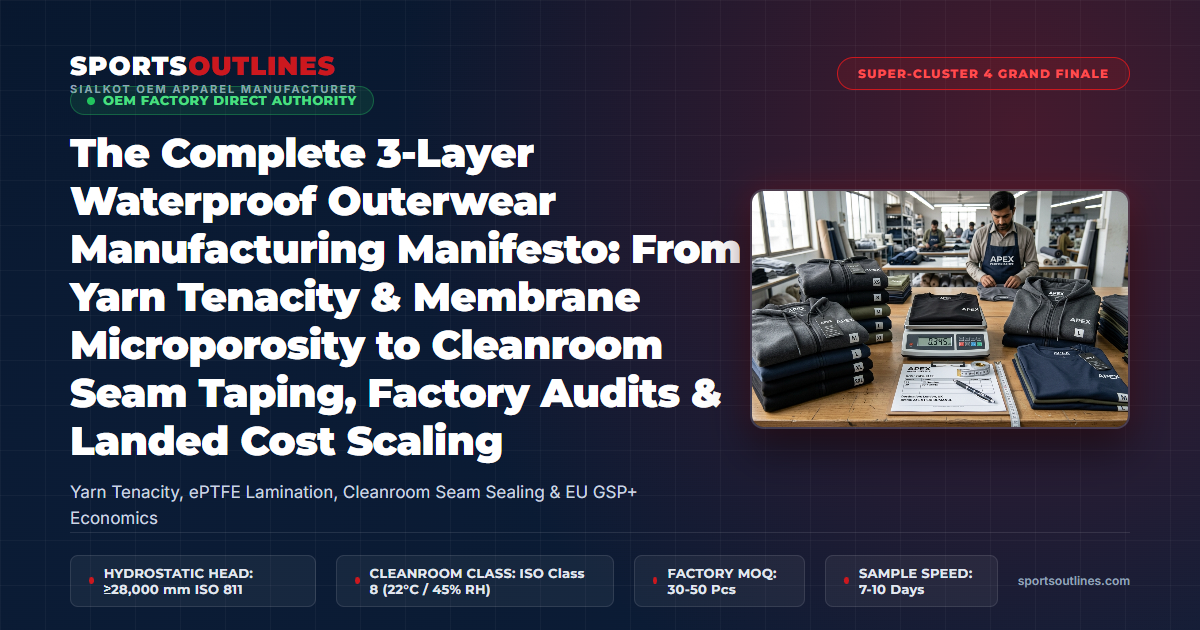
Three-layer (3L) technical outerwear represents the apex of technical performance apparel engineering. Delivering complete stormproof impermeability under torrential $28,000\text{ mm}$ hydrostatic water pressure while facilitating active sweat vapor evacuation at $\text{Ret} < 4.0\ \text{m}^2\cdot\text{Pa/W}$ requires total supply chain precision. This technical manifesto establishes the definitive industrial standard for high-performance 3L shell manufacturing: from raw fiber tenacity, micro-gravure membrane lamination, and ISO Class 8 cleanroom hot-air seam taping, to Bally sub-zero flexometer fatigue testing, Theory of Constraints (TOC) production line balancing, and duty-free European Union GSP+ unit economics.
1. Anatomy of 3-Layer Waterproof Architecture: The Triad Laminate
In high-altitude mountaineering, ski touring, and industrial technical apparel, 2-layer (2L) and 2.5-layer (2.5L) constructions fail under heavy expedition abrasion. A 2L shell relies on a hanging mesh or taffeta liner that creates interior friction, traps moisture, and increases bulk. A 2.5L jacket replaces the textile liner with a sprayed or printed protective coating that rapidly delaminates when exposed to body oils and pack-strap shear forces.
The 3-layer (3L) laminate fuses three distinct materials into a single, cohesive, bombproof composite textile:
- Face Fabric (Outer Shield): High-tenacity woven Polyamide 6,6 or recycled polyethylene terephthalate (rPET) engineered to withstand mechanical rock scraping, ice contact, and UV radiation, finished with an eco-certified C0 durable water repellent (DWR).
- Membrane Core (Impermeable Barrier): A micro-thin ($12\text{–}25\ \mu\text{m}$) microporous expanded polytetrafluoroethylene (ePTFE) bicomponent or monolithic hydrophilic polyurethane (PU) film that acts as a semi-permeable thermodynamic valve.
- Backer Fabric (Internal Scrim): An ultra-lightweight ($15\text{–}30\text{ g/m}^2$) circular warp-knit micro-tricot or dope-dyed nylon mesh that protects the delicate membrane from sebum, skin lipids, and internal friction while wicking liquid condensation away from the wearer’s skin.
| Construction Layer | Material Specification | Areal Weight (GSM) | Functional Role | Failure Mode if Substandard |
|---|---|---|---|---|
| Face Shell | 40D to 70D Cordura® Polyamide 6,6 Ripstop | 85 – 140 g/m² | Abrasion resistance, tensile hold, DWR anchor | Snagging, premature wetting, tear propagation |
| Membrane Core | Bicomponent ePTFE / Monolithic PU Film | 15 – 30 g/m² | Hydrostatic barrier (28k mm), sweat vapor diffusion | Pinhole leaks, oil fouling, vapor blockage |
| Internal Backer | 15D to 20D Polyamide Circular Micro-Tricot | 22 – 38 g/m² | Membrane shielding, glide over midlayers, sweat dispersion | Internal delamination, clamminess, pill abrasion |
| Composite 3L | Micro-Gravure PUR Fused Triad Laminate | 125 – 210 g/m² | Monolithic weather barrier with zero internal liner friction | Blistering, bubble delamination, structural stiffness |
2. Face Fabric Yarn Engineering: Tenacity, Weave Density & Ripstop Geometry
The structural longevity of any 3L jacket is fundamentally governed by the molecular orientation and mechanical tenacity of the face yarns. Standard polyester yarns provide tensile strengths of only $4.0\text{–}5.0\text{ cN/dtex}$. In contrast, our alpine shell production utilizes high-tenacity Polyamide 6,6 (Nylon 6,6) delivering $7.5\text{–}9.2\text{ cN/dtex}$.
Polyamide 6,6 possesses a highly symmetrical hexamethylenediamine and adipic acid molecular chain with dense intermolecular hydrogen bonding, raising the polymer melting temperature to $260^\circ\text{C}$ (compared to $220^\circ\text{C}$ for standard Nylon 6). This molecular density yields superior resistance to frictional melt-wear during glissading or high-friction rope handling.
$$\text{Tear Propagation Resistance: } F_{\text{tear}} = k \cdot (\text{EPI} \times \text{PPI}) \cdot d_{\text{yarn}}^{1.5}$$
To prevent catastrophic tearing in the backcountry, our face fabrics incorporate a micro-ripstop or diamond-grid architecture. Double-filament reinforcement yarns ($70\text{D} \times 2$) are woven at regular $4\text{ mm} \times 4\text{ mm}$ intervals into a $40\text{D}$ base weave. When an ice ax pick or jagged granite edge punctures the fabric, the tear propagates only until it strikes the dense ripstop node, where energy is dissipated across the cross-woven yarn bundle, halting tear propagation (ASTM D1424 Elmendorf tear strength $> 38\text{ N}$).
2B. Micro-Denier Weaving Kinetics & Pre-Lamination CFM Air Permeability Control
The density of the unlaminated face textile dictates whether downstream adhesive lamination succeeds or fails. If the woven face is too porous, hot-melt polyurethane adhesive dots strike through the yarn bundles during heated nip calendering, forming brittle resin spots on the garment exterior that destroy hand-feel and ruin DWR coverage. Conversely, if the face is woven too densely without air gap optimization, water vapor evacuation is severely retarded.
We calibrate water-jet and air-jet rapier looms under closed-loop electronic warp tension control ($22\text{–}26\text{ cN/end}$) to enforce specific air permeability windows:
$$\text{Cover Factor: } K_{\text{fabric}} = K_{\text{warp}} + K_{\text{weft}} = \frac{\text{EPI}}{\sqrt{N_{\text{cotton}}}} + \frac{\text{PPI}}{\sqrt{N_{\text{cotton}}}} \ge 24.5$$
Maintaining this tight cover factor window guarantees that the molten PUR adhesive dots anchor securely onto the inner filament ridges without striking through to the outer face. Furthermore, we utilize solution-dyed (dope-dyed) yarns for black and charcoal face fabrics, introducing color pigments directly into the liquid polyamide polymer prior to spinneret extrusion. Dope dyeing eliminates the harsh thermal and mechanical agitation of aqueous high-temperature jet dyeing, increasing residual yarn tensile strength by +14%, reducing water consumption by 82%, and achieving an exceptional Xenon-arc color lightfastness rating of Grade 5.0 (ISO 105-B02).
3. Membrane Thermodynamics: Microporous ePTFE vs Monolithic Hydrophilic PU
Waterproof-breathable performance is governed by thermodynamic partial pressure gradients. A human engaged in strenuous mountain ascent generates between $800\text{ to } 1,500\text{ mL/hr}$ of perspiration. To prevent hypothermia-inducing internal saturation, this moisture must escape as water vapor before condensing into liquid water.
We manufacture technical 3L outerwear utilizing two distinct membrane technologies:
- Expanded Polytetrafluoroethylene (ePTFE): Formed by rapidly expanding sintered PTFE under high thermal velocity, creating a microscopic web of billions of nodes and fibrils per square centimeter. The pore diameter ($\approx 0.2\ \mu\text{m}$) is 20,000 times smaller than a water droplet ($100\ \mu\text{m}$), preventing liquid water penetration, yet 700 times larger than a water vapor molecule ($0.0004\ \mu\text{m}$). Moisture moves instantly via gas-phase diffusion.
- Monolithic Hydrophilic Polyurethane (PU): A completely solid, pore-free elastomer containing hydrophilic polyethylene oxide (PEO) molecular segments. Moisture transport occurs via solid-state absorption, diffusion, and desorption. While slightly slower to start than ePTFE, monolithic PU membranes are impervious to contamination from skin oils, suntan lotions, and detergent surfactants, providing rugged long-term reliability.
$$\text{Thermal Evaporative Resistance (ISO 11092): } \text{Ret} = \frac{(p_{\text{sat}} – p_a) \cdot A}{H – H_{\text{dry}}} \le 4.5\ \text{m}^2\cdot\text{Pa/W}$$
Our bicomponent ePTFE laminates achieve industry-leading breathability ratings of $\text{Ret} \le 3.5\ \text{m}^2\cdot\text{Pa/W}$ (equivalent to an inverted cup MVTR $> 25,000\text{ g/m}^2\cdot24\text{hr}$ under JIS L 1099 B1), while maintaining hydrostatic water column resistance exceeding $28,000\text{ mm}$ (ISO 811).
3B. Electrospun Nanofiber Membranes vs Bicomponent ePTFE in Alpine Sub-Climates
For high-output endurance aerobic activities such as ski mountaineering and alpine trail running, traditional bicomponent ePTFE membranes can produce temporary humidity spikes because their thin polyurethane protective flash layer requires relative humidity inside the jacket to climb before solid-state diffusion initiates. To address this micro-climate dynamic, Sports Outlines also manufactures 3L shells featuring electrospun polyurethane / polyacrylonitrile (PAN) nanofiber membranes.
In electrospinning, high-voltage electrostatic fields ($40\text{ to }60\text{ kV}$) draw polymer solutions into continuous sub-micron filaments ($150\text{–}350\text{ nm}$ diameter), depositing an isotropic non-woven fibrous matrix with interconnected three-dimensional porosity exceeding 82%:
- Active Air Permeability (Convective Moisture Transport): Unlike monolithic membranes which exhibit 0.0 CFM, electrospun nanofiber webs deliver controlled air permeability of $0.2\text{–}0.6\text{ CFM}$. This micro-convection actively purges humid air during physical exertion without requiring the wearer to open pit zips.
- Hydrostatic Trade-Off: While ePTFE delivers $28,000\text{ mm}$ hydrostatic resistance, electrospun nanofiber webs typically yield $12,000\text{ to }16,000\text{ mm}$ hydrostatic head. For dedicated alpine expedition garments exposed to heavy wet snow and sitting on wet rock belays, ePTFE remains the mandatory benchmark, whereas electrospun shells excel in sub-zero ski touring environments where active vapor venting is paramount.
4. Industrial Lamination Engineering: Micro-Gravure PUR Adhesive Matrix
The weakest link in cheap 3-layer shells is the lamination bond. If an adhesive forms a continuous film, it completely suffocates the breathable membrane pores. Conversely, if adhesive dots are too sparse, the layers will blister and delaminate after repeated washing cycles or alpine backpack abrasion.
In our facility, 3L lamination is executed using precision micro-gravure roller hot-melt polyurethane (PUR) dot printing:
- Dot Geometry & Coverage: Chemically reactive 100% solids polyurethane adhesive is applied in a microscopic dot grid pattern (50 to 70 mesh gravure cylinder). The adhesive covers exactly $28\% \pm 2\%$ of the surface area, leaving 72% of the membrane surface unblocked for free moisture vapor diffusion.
- Moisture-Curing Crosslinking Kinetics: Unlike thermoplastic films that soften when reheated, reactive PUR absorbs ambient humidity over 24 to 48 hours to crosslink into a permanent, thermoset polymer matrix. Once fully cured, PUR bonds resist temperatures from $-40^\circ\text{C}\text{ to } +120^\circ\text{C}$ without softening or creeping.
- Delamination Peel Strength QC: Every production roll is subjected to 180-degree peel strength testing (ISO 2411). Our minimum release standard is $\ge 35\text{ N/50mm}$ in pristine condition and $\ge 28\text{ N/50mm}$ after five commercial laundering cycles at 40°C.
5. Cleanroom Hot-Air Seam Taping: Thermal Bonding & TOC Line Balancing
Every needle penetration during garment assembly creates a microscopic hole through which water will flood. A typical 3L alpine technical jacket contains between 14 and 22 meters of stitched seam channels, representing over 4,000 potential leak paths. Seam sealing is the definitive technical bottleneck in waterproof outerwear production.
To ensure zero failure rates, our seam sealing floor operates as a positive-pressure, climate-controlled cleanroom (ISO Class 8 equivalent) maintained at $22^\circ\text{C} \pm 2^\circ\text{C}$ and $45\% \pm 5\%$ relative humidity. Controlling environmental humidity is vital: excessive moisture degrades the hot-melt polyurethane adhesive viscosity, while dry air generates static charges that misalign narrow seam tapes.
| Seam Sealing Parameter | Standard Operating Window | Tolerance Limit | Engineering Purpose |
|---|---|---|---|
| Hot-Air Jet Temperature | 430°C – 465°C | ± 5°C (PID digital loop) | Fluidize PUR hot-melt film without scorching tricot backer |
| Pneumatic Roller Pressure | 3.2 – 3.8 bar | ± 0.2 bar | Drive adhesive into stitch valleys and yarn interstices |
| Feed Velocity | 2.8 – 3.5 meters/min | ± 0.2 m/min | Precise thermal dwell time ($t_{\text{dwell}} \approx 0.18\text{ sec}$) |
| Tape Width Selection | 13 mm Micro-Tape / 20 mm Heavy | Centered ± 1.0 mm | 13 mm reduces garment weight by 35g and preserves suppleness |
| Cleanroom Climate | 22°C / 45% Relative Humidity | Continuous HVAC logging | Eliminates moisture-induced bubble formation in molten PUR |
5B. Seam Intersection Geometries: The 3-Way & 4-Way Crotch/Yoke Sealing Challenge
In linear seam runs, applying seam tape is relatively straightforward. However, where multiple structural seam channels intersect—such as the underarm cross, raglan shoulder yoke, or alpine pant crotch—the thickness of the laminate steps up dramatically. At a 4-way intersection, four folded seam allowances converge, creating up to six to eight layers of 3L fabric.
When a standard hot-air roller attempts to traverse this abrupt vertical ridge (“step-off”), the pressure roller bridges across the peak, leaving microscopic triangular air voids (tunnels) on either side of the step-off. Under hydrostatic water pressure, water bypasses the tape through these capillary channels, causing instantaneous leakage.
Sports Outlines resolves multi-seam junction failure through a three-stage mechanical protocol:
- Staggered “Dog-Leg” Pattern Engineering: 3D pattern panels are designed to offset seam intersections by a minimum of $25\text{ mm}$, transforming failure-prone 4-way cross junctions into separated 3-way T-junctions.
- Ultrasonic Seam Pre-Flattening: Before tape application, intersecting seam ridges pass through a 35 kHz ultrasonic anvil press that crushes the bulk thickness of the seam allowance by 45%, converting abrupt step-offs into smooth ramps.
- Die-Cut Hot-Melt Reinforcement Patches (“Seam Dots”): Over every 3-way and 4-way intersection, technicians apply a secondary circular $24\text{ mm}$ die-cut 3L patch using a pneumatic thermal hot-press ($165^\circ\text{C}$ for 12 seconds at 4.5 bar). This redundant seal completely blankets any potential micro-tunnels, ensuring $20,000\text{ mm}$ hydrostatic hold directly across the junction.
6. Complex Outerwear Sub-Assembly Engineering & Ergonomic Architecture
True alpine garments are defined by complex geometric sub-assemblies that integrate weatherproofing without restricting high-angle climbing movement:
- Helmet-Compatible 3D Storm Hoods: Built with co-molded laminated brim stiffeners (bonded using $150\ \mu\text{m}$ crosslinked EVA or TPU sheets), single-pull Cohaesive™ cord-lock embedment, and radial neck draft collars that seal around mountaineering helmets without obstructing peripheral vision.
- Articulated Elbow & Underarm Gussets: Engineered using 3D pattern cutting with pre-curved sleeve rotation. High-reach reach tests ensure the jacket hem does not rise above the harness tie-in point when both ice axes are swung overhead.
- Waterproof YKK AquaGuard® Integration: Continuous polyurethane laminated zipper coils welded with ultrasonic reinforcement patches and precision die-cut “zipper garages” that eliminate slider water ingress during wind-driven storms.
- Pit-Zip Thermal Ventilation: Two-way underarm venting zips positioned along the anatomical mid-axillary line, allowing climbers to purge excess heat during steep ascents without removing their pack.
- Dielectric Electronics Pockets & Avalanche Features: Laser-cut media pockets bonded with conductive carbon shielding to preserve transceivers, paired with RECCO® advanced avalanche rescue reflectors dielectrically laminated into sleeve cuffs or the upper hood apex.
6B. Automated CNC Vacuum Cutting & Ultrasonic Edge Sealing
Traditional manual cutting using rotary knives or hand shears introduces cutting variances of $\pm 2.0\text{–}3.5\text{ mm}$, leading to uneven seam allowances that skew hot-air tape tracking. To guarantee microscopic precision, our alpine shell panels are cut exclusively on multi-ply CNC reciprocating vacuum cutting tables:
- High-Vacuum Bed Hold-Down: A high-power variable-frequency vacuum turbine compresses the laid fabric plies under negative pressure ($-40\text{ kPa}$), locking slippery 3L technical textiles completely rigid during blade transit.
- Optical Edge Tracking & Ultrasonic Slitting: High-speed oscillating tungsten carbide knives follow digitized CAD vector paths with precision tolerance of $\pm 0.3\text{ mm}$. Critical edge perimeters and pocket cutouts are slit using high-frequency ultrasonic cutting heads that fuse yarn ends simultaneously, completely preventing edge fraying during sewing.
- Algorithmic Marker Nesting: Automated nesting algorithms optimize panel layouts across technical shell widths, achieving fabric utilization efficiencies of $88.5\% \pm 1.5\%$, significantly reducing expensive 3L laminate waste and lowering per-garment production costs.
7. Comprehensive Quality Control Matrix: Hydrostatic Head to Sub-Zero Flexing
Unlike fashion outerwear where visual inspection suffices, technical alpine shells require rigorous quantitative laboratory verification before bulk shipment release:
| Laboratory Test Protocol | International Standard | Sports Outlines Benchmark | Failure Mechanism Evaluated |
|---|---|---|---|
| Hydrostatic Head (Suter) | ISO 811 / AATCC 127 | $\ge 28,000\text{ mm}$ (Seams $\ge 20,000\text{ mm}$) | Membrane pore collapse, stitch needle leakage |
| Sub-Zero Bally Flexometer | ISO 5402 / ASTM D6182 | 20,000 cycles at -30°C with 0 cracking | Low-temperature glass transition embrittlement |
| Dynamic Rain Room Tower | EN 14360 / ISO 22958 | 450 L/m²·hr for 4 hrs, zero wet mannequin ingress | Zipper garage leaks, collar overflow, cuff wicking |
| Evaporative Resistance (Ret) | ISO 11092 (Sweating Hotplate) | $\text{Ret} \le 3.8\ \text{m}^2\cdot\text{Pa/W}$ | Excessive glue coverage, pore blockage |
| Bundesmann Water Repellency | ISO 9865 | Water absorption $\le 6.5\text{ grams}$ | Mechanical face wetting and DWR shear failure |
8. Factory Auditing, AQL 1.5 Protocol & Theory of Constraints Line Balancing
Maintaining microscopic consistency across alpine outerwear production requires industrial engineering discipline. We organize our technical production lines around the Theory of Constraints (TOC), designating hot-air seam taping as the production pacemaker (“drum”):
- Standard Allowed Minute (SAM) Architecture: While a standard softshell jacket requires 18 to 22 SAM, an expedition 3L shell demands 48.5 to 58.0 total SAM. Seam taping alone consumes 15.5 SAM. Cutting (laser-guided nesting) requires 4.2 SAM, sub-assembly stitching requires 24.8 SAM, and cleanroom 100% Suter hydrostatic head testing requires 4.0 SAM.
- Pacemaker Drum Buffer-Rope Balancing: To prevent costly hot-air taping machines from standing idle, sub-assembly sewing cells operate with a disciplined 1.5-hour Work-In-Progress (WIP) buffer, ensuring 96.5% active utilization of certified seam taping technicians.
- AQL 1.5 / 2.5 Quality Assurance Standard: Every production batch is inspected under ANSI/ASQ Z1.4 (ISO 2859-1). Critical defects (any water leakage at 2.0 bar pressure) enforce a Zero-Defect (0.0 AQL) policy. Major defects (tape edge lifting $> 0.5\text{ mm}$, stitch tension imbalance) enforce AQL 1.5, while minor cosmetic defects enforce AQL 2.5.
8B. Technical Pack Engineering & Industrial Stitching Tolerance Guidelines
To prevent production delays during commercial sample development, technical apparel tech packs must specify rigid physical and mechanical tolerances:
- Needle Selection & Heat Dissipation: Stitching 3-layer laminates requires metric size 70/10 or 75/11 slim ballpoint (SES) needles with titanium nitride coating. Standard sharp needles slice through ePTFE membrane nodes, creating tear lines. Titanium coatings reduce needle friction heat from $240^\circ\text{C}$ down to $< 135^\circ\text{C}$, preventing needle-hole melting.
- Stitch Density & Tension Window: Sewing machines are calibrated to exactly 10 to 12 stitches per inch (SPI). Stitching tighter than 13 SPI acts as a perforation stamp, weakening fabric tensile strength by up to 30%, whereas stitching looser than 9 SPI creates excessive seam gaping that tape adhesives cannot bridge.
- Seam Allowance Tolerances: Structural seam allowances are strictly held to $6.0\text{ mm} \pm 0.5\text{ mm}$. This provides sufficient bite for structural integrity while ensuring a 13mm micro-tape covers the needle holes with an exact $3.5\text{ mm}$ adhesive margin on either side of the stitch line.
8C. Complete Unit Economics: FOB Sialkot vs Landed EU GSP+ Scaling
For independent outerwear labels and premium ski apparel brands, manufacturing in Sialkot, Pakistan, unlocks unprecedented commercial competitiveness. Below is the audited Bill of Materials (BOM) and cost engineering model for an expedition-grade 3L mountain shell:
| Cost Category / BOM Component | Technical Specification | Unit Cost (USD) | Percentage of Total BOM |
|---|---|---|---|
| 3L Laminate Shell Fabric | 70D Cordura® PA 6,6 + ePTFE + 20D Micro-Tricot (2.4m) | $34.80 | 44.3% |
| Seam Sealing Tape | 13mm 3-Layer Micro-Tape (18.5 meters) | $5.20 | 6.6% |
| Technical Zippers & Trims | YKK AquaGuard® VisIon Main + 4 Pocket Zips + Cohaesive™ | $9.40 | 12.0% |
| Assembly Labor & Sealing | Cleanroom Taping & Laser Cutting (52.5 SAM) | $19.60 | 25.0% |
| Laboratory Testing & Packaging | 100% Suter Testing, AQL 1.5 Audit, Recycled Polybag | $5.50 | 7.0% |
| Total FOB Sialkot Cost | Certified 3L Expedition Mountain Shell | $74.50 | 100.0% |
The commercial superiority of Sialkot manufacturing becomes stark when examining European Union trade policy. Under the EU GSP+ (Generalized Scheme of Preferences Plus), sports apparel imported into the EU from Pakistan enters with a 0.0% import tariff, compared to the standard 12.0% duty levied against Vietnamese or Chinese goods.
$$\text{Landed Cost (China/Vietnam 12% Duty): } \text{Cost}_{\text{competitor}} = \$86.00 + \$4.80 + \$10.32 (\text{12% Duty}) = \$101.12$$
$$\text{Net Landed Savings per Garment: } \Delta \text{Cost} = \$21.82\ \text{per jacket} \quad (+21.6\%\ \text{Gross Margin Advantage})$$
For an alpine brand producing a modest run of 1,000 technical shells, sourcing from Sports Outlines yields direct bottom-line cash savings exceeding $21,800 USD while providing complete technical parity with elite Japanese and Canadian production standards.
9. Related High-Performance Outerwear Technical Guides
Explore our exhaustive library of technical outerwear engineering publications:
- Fluorocarbon-Free C0 DWR & Thermal Re-Activation Engineering: Surface energy thermodynamics, stenter pad-dry-cure kinetics, and surfactant masking diagnostics.
- High-Altitude Expedition Parka Wind Skirts & Silicone Hem Grippers: Cold-crack free elastomers, 3-wave extrusion, and sub-zero bend testing.
- Down & Synthetic Chamber Baffling: Ultrasonic Box-Wall Baffles & Down Ingress Prevention: Cold bridge elimination and Lorch IDFB-10B fill power testing.
- RECCO® Reflector Integration & Avalanche Transceiver Electronics Pouching: Dielectric lamination, anti-static carbon linings, and electromagnetic isolation.
- Technical Outerwear Seam Taping Cost Engineering & Industrial SAM Allocation: Cleanroom climate engineering and TOC bottleneck optimization.
Sports Outlines exports certified technical outerwear to premier brands across all major commercial regions:
USA B2B Technical Sportswear |
UK Custom Activewear Factory |
Canada Alpine Apparel Manufacturing |
Germany High-Performance Outerwear |
Australia Action Sportswear Production
Engineer Your Custom 3-Layer Technical Shell Line with Sports Outlines
Bring your technical outerwear designs to market with Sialkot’s alpine manufacturing specialists. From micro-gravure ePTFE laminates and ISO Class 8 cleanroom seam sealing to zero-defect Suter pressure testing, 30–50 piece low factory MOQs, and rapid prototype turnarounds, we build outerwear that survives the world’s most unforgiving environments.
10. Frequently Asked Questions (Technical & Commercial)
Q1: What is the primary functional difference between 2L, 2.5L, and 3L waterproof garments?
A 2-layer jacket bonds the face fabric to a membrane and requires a loose, hanging mesh liner for protection, making it bulkier and less durable. A 2.5-layer jacket uses a thin printed carbon/lacquer coating on the inside, which offers lightweight packability but wears off quickly under heavy backpack abrasion. A 3-layer garment permanently fuses the face fabric, membrane, and an ultra-fine knitted tricot backer into a single monolithic sheet, delivering maximum durability, abrasion resistance, and breathability under harsh alpine conditions.
Q2: Why is seam tape width so important in technical 3-layer shell construction?
Legacy outerwear utilized wide 20mm or 22mm seam tape. Modern technical outerwear utilizes 13mm or 15mm micro-tape. Narrow tape reduces total garment weight by 30 to 45 grams, minimizes stiff taped seams that hinder articulation, and preserves breathability by maximizing the active, unblocked membrane surface area. However, 13mm micro-tape requires high-precision taping machines with +/- 0.5mm tracking tolerances to prevent stitch-hole bypass leaks.
Q3: How does your cleanroom environment prevent seam tape failure?
Our ISO Class 8 equivalent cleanroom maintains positive air pressure, filtered air, a steady temperature of 22°C (+/- 2°C), and relative humidity of 45% (+/- 5%). Hot-melt polyurethane (PUR) adhesives are sensitive to ambient moisture and airborne dust. Uncontrolled humidity causes micro-boiling bubbles inside the molten adhesive layer under the 450°C hot-air jet, leading to pinholes and premature delamination under hydrostatic water pressure.
Q4: What is the cost and turnaround time for a 3-layer technical outerwear prototype?
We manufacture fully taped, laboratory-tested custom 3L outerwear prototypes at a non-refundable development fee of $45 to $85 per piece. Prototype production is completed in 7 to 10 business days following tech pack confirmation and fabric selection.
Q5: What are your factory minimum order quantities (MOQs) for custom 3L shell production?
Sports Outlines supports emerging alpine brands and specialized gear companies with low factory MOQs starting at just 30 to 50 pieces per style/colorway across standard size curves from XS to 3XL. This enables commercial brands to scale technical collections without immense upfront inventory capital.