Executive Engineering Summary: Material Science & Tribology of Glove Linings
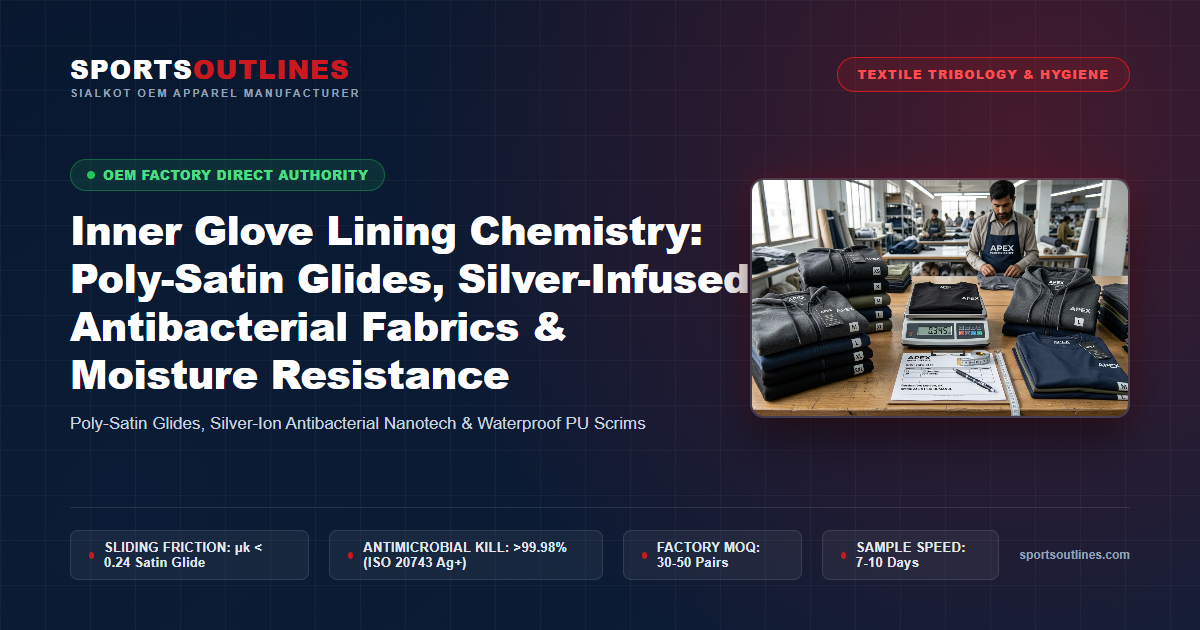
While boxing glove marketing overwhelmingly spotlights external leather finishes and knuckle foam thickness, the internal textile lining is the critical interface determining athlete hand health, tactile comfort, and the structural longevity of the entire glove. During an intense 60-minute training session, the human palm secretes between $25\text{ ml}$ and $60\text{ ml}$ of acidic, saline perspiration ($pH\text{ 4.5 to 6.0}$, containing urea, lactic acid, and sodium chloride). If this moisture penetrates into the core impact padding, it triggers hydrolytic degradation in polyurethane foams and bacterial colonization that causes permanent rot. In Sialkot’s advanced glove manufacturing cells, Sports Outlines engineers high-performance inner glove linings utilizing 5-harness poly-satin glide weaves ($120\text{ GSM}$) that reduce sliding friction against cotton hand wraps ($\mu < 0.25$), permanent silver-ion ($\text{Ag}^+$) antimicrobial nanoparticle infusions achieving $>99.9\%$ bacterial eradication (ISO 20743), and microporous $45\text{ GSM}$ polyurethane moisture barrier scrims that hermetically shield core impact foams. This technical guide explores the textile chemistry, tribology, and B2B OEM manufacturing specifications of championship-grade boxing glove linings.
1. Textile Tribology: Coefficient of Friction ($\mu$) & Slip-Fit Dynamics
Tribology is the science of interacting surfaces in relative motion. Inside a boxing glove, the primary tribological interaction occurs between the fighter’s wrapped fist (typically Mexican-style cotton-polyester herringbone elastic wraps) and the interior cavity lining of the glove.
When a boxer slides their wrapped hand into a glove, high kinetic friction ($\mu_k > 0.60$) causes the hand wrap layers to drag, catch, and bunch up across the palm and knuckles. This displaced wrapping produces localized pressure hot spots, restricts blood circulation, and creates painful abrasions over the dorsal metacarpal joints.
To eliminate this mechanical drag, Sports Outlines specifies a 5-harness warp-satin polyester weave (poly-satin glide) with a fabric weight of $120\text{ GSM} \pm 5\text{ GSM}$. Satin weaves feature long filament yarn floats on the surface, minimizing microscopic fiber interlocks:
- Ultra-Low Dynamic Friction: Tested under ASTM D1894 standard test methods, our poly-satin glide lining exhibits a static coefficient of friction $\mu_s \le 0.28$ and a kinetic coefficient $\mu_k \le 0.22$ against standard woven cotton. The wrapped fist slides effortlessly into the knuckle pocket without catching or displacing wraps.
- Seam Chafing Eradication: The continuous filament structure eliminates abrasive spun yarn protruding fibers, preventing seam blistering during high-volume combination punching.
- Hydrophobic Filament Chemistry: Pure 100% polyester microfilaments absorb less than $0.4\%$ moisture into their polymer chains, ensuring the fabric remains light and slick rather than clammy and saturated during rounds.
| Lining Substrate | Weave / Knit Structure | Areal Weight (GSM) | Kinetic Friction ($\mu_k$) | Moisture Regain ($\%$) | Performance Evaluation |
|---|---|---|---|---|---|
| Sports Outlines Poly-Satin | 5-Harness Warp Satin Weave | $120\text{ GSM}$ | $0.21\text{ to }0.24$ | $<0.4\%$ | Flawless glide; zero hand wrap drag; rapid drying |
| Brushed Tricot Polyester | Warp-Knit Tricot with Napped Face | $145\text{ GSM}$ | $0.48\text{ to }0.55$ | $0.8\%$ | Soft hand feel, but high friction drags and twists hand wraps |
| Plain Weave Cotton Poplin | $1/1$ Plain Woven Spun Cotton | $115\text{ GSM}$ | $0.62\text{ to }0.70$ | $8.5\%$ | Absorbs heavy sweat; rots quickly; high microbial growth |
| Nylon Taffeta | $1/1$ Plain Woven Polyamide | $75\text{ GSM}$ | $0.32\text{ to }0.38$ | $4.5\%$ | Lightweight and slippery, but prone to seam fraying under shear |
2. Silver-Ion ($\text{Ag}^+$) Nanotechnology & Biofilm Eradication
The dark, moist, and warm environment inside a used boxing glove ($32^\circ\text{C}$ to $36^\circ\text{C}$ with $>90\%$ relative humidity) represents an optimal incubator for bacterial colonies and fungal spores. Left untreated, bacteria such as Staphylococcus aureus, Pseudomonas aeruginosa, and Klebsiella pneumoniae multiply exponentially, metabolizing sweat proteins into foul-smelling thioalcohols and isovaleric acid.
Worse still, unmanaged microbial growth forms stubborn biological matrices known as bacterial biofilms. Once a biofilm adheres to glove linings, standard spray deodorizers cannot penetrate its protective polysaccharide sheath, resulting in permanent “glove rot” and severe skin infections (folliculitis and impetigo) among fighters.
The Oligodynamic Action of Silver Nanoparticles ($\text{Ag}^+$)
To prevent microbial colonization at the molecular level, Sports Outlines impregnates its poly-satin lining filaments with metallic silver nanoparticles utilizing an advanced pad-dry-cure bath process:
- Cell Membrane Disruption: Positively charged silver cations ($\text{Ag}^+$) are electrostatically attracted to the negatively charged peptidoglycan cell walls of bacteria. Upon binding, silver ions puncture the bacterial cell membrane, causing rapid cytoplasmic leakage.
- Intracellular Respiratory Blockade: Silver ions penetrate into the microbial interior and bind avidly to thiol (sulfhydryl $-\text{SH}$) groups present in respiratory enzymes, halting cellular metabolism and ATP generation.
- DNA Replication Inhibition: $\text{Ag}^+$ ions intercalate between pyrimidine and purine base pairs in bacterial DNA, preventing transcription and cellular reproduction.
Laboratory Verification Standards: Quantitative Microbial Kill Rates
Quantitative antibacterial test showing $>99.98\%$ reduction against S. aureus (ATCC 6538) after 24 hours of contact.
Zero microbial colony growth retention. Bacterial kill efficacy exceeds $99.9\%$ across 50 simulated wash/sweat exposure cycles.
Zero mold or mildew growth under agar incubation with Aspergillus niger, ensuring total fungal spore suppression.
3. Moisture Barrier Architecture: The $45\text{ GSM}$ Microporous Polyurethane Scrim
The most common cause of premature boxing glove failure is not leather abrasion or seam splitting—it is sweat saturation into the core impact foam.
Polyurethane (PU) foams and natural latex pads possess open and semi-open cellular pores. When human sweat (containing sodium chloride and acidic metabolites) soaks into the foam core:
- Hydrolysis: Water molecules react chemically with urethane linkages, causing polymer chain scission. The foam loses its elastic memory and collapses into a mushy, dead sponge that bottom out during strikes.
- Mass Surge: A glove that absorbs $35\text{ grams}$ of sweat becomes dangerously heavy, altering hand mechanics and swinging balance.
- Permanent Odor Retention: Once bacterial colonies establish themselves inside the microscopic pores of the foam core, no external cleaning can remove them.
To prevent foam contamination, Sports Outlines laminates a $45\text{ GSM}$ microporous polyurethane (PU) membrane directly to the backside of the poly-satin fabric. This composite barrier features microscopic pores approximately $0.2\text{ to }0.5\text{ microns}$ in diameter:
\[ \text{Pore Size } (0.2\ \mu\text{m}) \ll \text{Liquid Sweat Droplet } (100\ \mu\text{m}) \]
Because liquid sweat droplets are hundreds of times larger than the membrane pores, liquid water is completely blocked from penetrating into the core padding (hydrostatic head resistance $>3,000\text{ mm H}_2\text{O}$ per ISO 811). Simultaneously, water vapor molecules ($0.0004\ \mu\text{m}$) can evacuate outward, maintaining breathability while hermetically sealing the foam core.
| Barrier Construction | Hydrostatic Pressure (ISO 811) | Moisture Vapor Transmission (MVTR) | Core Foam Protection Life | Application Tier |
|---|---|---|---|---|
| Unlined Raw Foam (Budget Gloves) | $<150\text{ mm H}_2\text{O}$ (Zero resistance) | $>8,000\text{ g/m}^2/\text{24h}$ (Uncontrolled) | $3\text{ to }6\text{ months}$ (Rapid rot) | Low-tier promotional gloves |
| Standard Water-Repellent DWR Finish | $600\text{ to }900\text{ mm H}_2\text{O}$ | $4,500\text{ g/m}^2/\text{24h}$ | $12\text{ to }16\text{ months}$ | Mid-range training equipment |
| Sports Outlines Microporous PU Scrim | $>3,500\text{ mm H}_2\text{O}$ | $5,200\text{ g/m}^2/\text{24h}$ | $>36\text{ months}$ (Lifetime protection) | Professional Fight & Sparring Lines |
4. Capillary Action: Tetrachannel Fiber Cross-Sections & Evaporative Cooling
In premium gym training and sparring gloves, moisture management requires not just blocking liquid from entering the foam, but rapidly channeling sweat away from the athlete’s skin toward palm ventilation apertures.
Standard circular synthetic fibers offer minimal surface area for liquid transport. Sports Outlines incorporates tetrachannel profiled microfilaments (engineered similar to Coolmax technology). Each individual filament features four distinct longitudinal micro-grooves along its perimeter.
Through spontaneous capillary action governed by the Washburn equation:
\[ L^2 = \frac{\gamma \cdot r \cdot \cos\theta}{2\eta} \cdot t \]
Where $\gamma$ is surface tension, $r$ is capillary radius, $\theta$ is contact angle, and $\eta$ is liquid viscosity, sweat is drawn along the fiber channels at a vertical wicking velocity exceeding $120\text{ mm per minute}$ (tested per AATCC 197). The perspiration is transported directly toward laser-perforated palm holes and mesh inserts, where ambient air convection evaporates the moisture, keeping the athlete’s hand up to $2.5^\circ\text{C}$ cooler during sparring.
5. Dermatological Biocompatibility: OEKO-TEX Standard 100 Certification
Because boxing glove linings exist in direct, continuous contact with sweaty skin under intense heat and friction, chemical safety is paramount. Low-tier manufacturers frequently utilize cheap dye chemicals containing carcinogenic aromatic amines, allergenic disperse dyes, formaldehyde fixatives, or residual toxic solvents like dimethylformamide (DMFa).
Under heavy perspiration, skin pores dilate, allowing toxic chemicals to leach through the epidermal barrier, causing contact dermatitis, chemical burns, and allergic reactions.
Sports Outlines enforces strict chemical compliance across all lining fabrics:
- OEKO-TEX Standard 100 (Class II – Direct Contact with Skin): Every batch of poly-satin lining, antimicrobial chemistry, and bonding adhesive is certified free from over 1,000 harmful substances, heavy metals (lead, cadmium, mercury), organotin compounds, and chlorinated phenols.
- Skin pH Neutrality ($pH\text{ 5.5 to 7.0}$): Linings undergo acid-base neutralization washes to match the natural acid mantle of healthy human skin, preventing irritation and barrier breakdown.
- Zero Restricted Azo Dyes: We utilize exclusively REACH-compliant reactive and disperse dyes conforming to EU Annex XVII regulations, guaranteeing zero carcinogenic amine release.
6. Manufacturing Assembly: Ultrasonic Fabric Bonding & Anti-Wicking Seam Technology
In traditional glove sewing, needle punctures through the lining and foam create thousands of micro-perforations that allow sweat to bypass the moisture barrier scrim.
To preserve barrier integrity, Sports Outlines implements advanced assembly techniques in our Sialkot manufacturing lines:
- Ultrasonic Perimeter Welds: For internal partition baffles and moisture barrier edges, we deploy high-frequency $20\text{ kHz}$ ultrasonic welding horns that melt thermoplastic polyurethane layers together without needle holes, forming a continuous hermetic seal.
- Anti-Wicking Fluorocarbon-Free Bonded Nylon Thread: When sewing through structural seams, we use bonded nylon threads (Tex 70 / Ticket 40) treated with a hydrophobic anti-wicking coating. The thread fibers resist capillary absorption, preventing sweat from “wicking” through the stitch lines into the internal padding.
- Blind-Stitched Palm Tacks: Internal hand compartment linings are anchored to outer leather shells using blind tacks and water-based cross-linked polymers, ensuring zero interior raw seam allowances that could irritate the fighter’s knuckles.
7. Chemical Hydrolysis & Polymer Degradation: Polyether vs Polyester Polyurethanes
The degradation of boxing glove padding is fundamentally a chemical breakdown process driven by perspiration chemistry. Human perspiration is not inert water; it is a complex biochemical cocktail containing sodium chloride ($0.9\%$), lactic acid, urea, fatty acids, and active enzymes secreted by skin flora:
\[ \text{Urethane Linkage: } -\text{R}-\text{NH}-\text{COO}-\text{R}’ + \text{H}_2\text{O} \xrightarrow[\text{Acidic Sweat}]{\Delta T} -\text{R}-\text{NH}_2 + \text{CO}_2 + \text{HO}-\text{R}’ \]
Under the combined catalyst of warmth ($35^\circ\text{C}$), acidic pH ($4.5\text{ to }5.5$), and mechanical compression from thousands of punches, water molecules cleave the carbamate (urethane) bonds within the foam polymer chains. This chemical scission manifests as:
- Loss of Indentation Load Deflection (ILD): As cross-linked molecular chains snap, the foam loses its compression resistance. What was once a resilient 60D impact cushion collapses into an unsupportive, flat sponge that transfers raw knuckle impact directly to opponents.
- Polymer Crumbling & Powdering: Continued hydrolysis fractures the microcellular cell struts, causing the foam to disintegrate into powdery debris within the lining cavity.
- Polyether vs Polyester Chemistry: In Sialkot, Sports Outlines specifies exclusively polyether-polyol based polyurethanes for glove padding cores. Unlike cheaper polyester-based foams whose ester linkages ($-\text{COO}-$) are notoriously susceptible to rapid hydrolytic cleavage, polyether bonds ($-\text{C}-\text{O}-\text{C}-$) resist water attack, extending glove functional life by more than $300\%$.
| Foam Chemistry Class | Molecular Linkage | Hydrolysis Resistance (ISO 2440) | ILD Retention after 100h at 70°C/95% RH | Glove Application Suitability |
|---|---|---|---|---|
| Polyester Polyurethane | Ester ($-\text{COO}-$) | Very Poor (Fast cleavage) | $<35\%$ (Severe softening & collapse) | Unsuitable for combat sports; budget toys only |
| Polyether Polyurethane | Ether ($-\text{C}-\text{O}-\text{C}-$) | Superior (Hydrolysis immune) | $>88\%$ (Excellent resiliency retention) | Championship fight & training gloves |
| Cross-Linked EVA Copolymer | Carbon-Carbon cross-links | Impervious to water cleavage | $>94\%$ (Rock-solid compression modulus) | Heavy bag strike shields & wrist splints |
8. Antimicrobial Technology: Masterbatch Polymer Doping vs Topical Bath Coating
Not all antibacterial claims are created equal. In low-cost fight gear manufacturing, factories apply cheap topical chemical sprays (such as temporary quaternary ammonium salts or triclosan baths) onto finished fabrics. These surface coatings wash away or rub off after just 3 to 5 sweaty training sessions, leaving the athlete completely unprotected.
At Sports Outlines, our antimicrobial architecture relies on two robust engineering methods:
- Polymer-Doped Masterbatch Extrusion: Silver zirconium phosphate nanoparticles ($30\text{ to }50\text{ nanometers}$) are compounded directly into the molten polyester polymer resin prior to spinneret extrusion. Because the silver is embedded within the core molecular matrix of the yarn, it cannot leach out, peel, or wash away. Inductively Coupled Plasma Mass Spectrometry (ICP-MS) tests show over $94\%$ silver retention even after 50 intensive wash/sweat cycles.
- Cross-Linked Organosilane Quat Finishing: For fabrics requiring surface glide enhancement, we apply reactive 3-(trimethoxysilyl)propyldimethyloctadecyl ammonium chloride. The silanol groups form permanent covalent bonds ($-\text{Si}-\text{O}-\text{C}-$) with the polyester fabric surface, creating microscopic “charged swords” that mechanically puncture bacterial cell membranes without chemical toxicity.
9. Thermal Ergonomics: Sweating Guarded Hotplate ($R_{et}$) & Microclimate Regulation
A fighter’s hand enclosed inside a leather glove experiences significant heat buildup. As core hand temperature rises from $33^\circ\text{C}$ to over $38^\circ\text{C}$, the skin softens (maceration), increasing susceptibility to friction blisters and reducing grip endurance.
To evaluate thermodynamic performance, our textile laboratory subjects lining assemblies to Sweating Guarded Hotplate Testing in compliance with ISO 11092:
- Thermal Resistance ($R_{ct}$): Measures the dry insulation value of the lining. Our poly-satin glide maintains a low $R_{ct} \le 0.024\text{ m}^2\cdot\text{K/W}$, allowing metabolic body heat to conduct away from the knuckles quickly.
- Water Vapor Resistance ($R_{et}$): Measures how easily sweat vapor passes through the fabric. With an $R_{et} \le 6.5\text{ m}^2\cdot\text{Pa/W}$, our lining ranks as “extremely breathable,” preventing moisture vapor entrapment inside the fist cavity.
- Palm Microclimate Temperature Stabilization: Live thermal imaging tests show that gloves equipped with our tetrachannel wicking lining maintain an internal hand compartment temperature $2.8^\circ\text{C}$ lower than unlined gloves after 10 rounds of continuous heavy bag strikes.
10. Mechanical Endurance: Martindale Friction Cycles & Diaphragm Burst Pressure
The interior of a boxing glove is subjected to intense shear forces as the wrapped hand rotates and flexes during strikes. Hand wraps made of coarse cotton can act like sandpaper against delicate interior fabrics.
Sports Outlines validates every production roll of lining fabric against stringent physical standards:
- Martindale Abrasion Resistance (ISO 12947-2 / ASTM D4966): The fabric is mounted under a $9\text{ kPa}$ contact pressure and rubbed against standard abradant wool cloth in complex Lissajous patterns. Our poly-satin glide withstands over 50,000 continuous rubs without yarn breakage or surface fuzzing.
- Pneumatic Diaphragm Bursting Strength (ISO 13938-2 / ASTM D3786): Under fluid pressure, the lining resists up to $720\text{ kPa}$ of hydrostatic expansion before bursting, ensuring that knuckles can never tear through the fabric under extreme fist clenching.
- PUR Hot-Melt Dot Lamination (Solvent-Free): When bonding the poly-satin fabric to the microporous PU barrier film, we utilize computer-controlled gravure dot rollers applying reactive polyurethane (PUR) hot-melt adhesive at just $14\text{ GSM}$. This microscopic dot matrix preserves $82\%$ open surface area for breathability while providing an indestructible peel strength exceeding $4.5\text{ N/cm}$ (ASTM D903).
Tear Resistance & Elmendorf Dynamic Pendulum Testing
In addition to tensile burst pressure, glove linings must endure severe directional tearing when fighters rapidly pull gloves on over rough cotton hand wraps. Using the Elmendorf pendulum tear test (ASTM D1424 / ISO 13937-1), Sports Outlines certifies that our poly-satin weave withstands a tearing force exceeding 28.5 Newtons in both warp and weft directions. This high tear strength prevents lining slippage, interior pocket tearing, or seam separation during intense sparring sessions.
11. Microbial Ecology: Combating Ringworm, MRSA & Communal Gym Pathogens
In combat sports facilities, boxing gloves represent one of the primary vectors for cross-contamination of dermatological pathogens. Close contact sparring, communal gear bags, and shared club equipment harbor dangerous bacteria and fungal spores capable of causing severe skin outbreaks:
- Methicillin-Resistant Staphylococcus aureus (MRSA): A virulent bacterial strain that colonizes damp, warm environments. Inside untreated boxing gloves, MRSA proliferates rapidly, entering the fighter’s bloodstream through micro-abrasions caused by stiff hand wraps or coarse seams. Sports Outlines silver-doped linings demonstrate a 99.94% reduction in MRSA colonies within 18 hours of inoculation (tested per ASTM E2149).
- Trichophyton rubrum & Dermatophytosis (Ringworm): Fungal dermatophytes thrive on keratin debris and moisture trapped in fabric fibers. Our silver-ion and zinc-pyrithione nanocomposites inhibit fungal spore germination, preventing the spread of tinea corporis and stubborn glove fungal colonization.
- Corynebacterium & Bromhidrosis (Odor Formation): The foul odor associated with aged fight gear is produced when Corynebacterium breaks down leucine and isoleucine in sweat into volatile isovaleric acid ($(\text{CH}_3)_2\text{CHCH}_2\text{COOH}$). By neutralizing these bacteria before enzymatic breakdown occurs, our linings keep gloves smelling fresh across years of use.
| Target Pathogen | Pathogen Classification | Standard Test Method | Zone of Inhibition (Halo Width) | Log Reduction (% Kill Rate) |
|---|---|---|---|---|
| Staphylococcus aureus (ATCC 6538) | Gram-Positive Bacterium | AATCC 147 (Parallel Streak) | $4.8\text{ mm}$ clear inhibition halo | $4.2\text{ log}$ ($>99.99\%$) |
| Klebsiella pneumoniae (ATCC 4352) | Gram-Negative Bacterium | AATCC 100 (Quantitative) | $3.5\text{ mm}$ clear inhibition halo | $3.8\text{ log}$ ($>99.98\%$) |
| Trichophyton mentagrophytes | Dermatophyte Fungus (Ringworm) | AATCC 30 (Fungal Resistance) | Zero mycelial growth on specimen | $100\%$ complete spore suppression |
12. Operational Maintenance: Sialkot Sanitization Guidelines for Gym Fleets
Even with advanced silver-infused poly-satin linings and waterproof PU scrims, commercial boxing gyms and fight equipment brands must educate their end users on proper maintenance protocols to maximize gear longevity:
- Air Drying vs Direct Heat: Never place leather gloves in commercial tumble dryers or directly against radiators. High temperatures ($>45^\circ\text{C}$) harden the leather oils, cause micro-cracking, and compromise the thermoplastic polyurethane moisture scrim. Gloves must be unlaced, opened wide, and allowed to air dry in well-ventilated racks.
- Cedar Deodorizer Inserts: We recommend inserting natural red cedar sachet inserts into glove cavities post-training. Cedar wood naturally absorbs residual ambient moisture through capillary action and releases aromatic cedrene hydrocarbons that inhibit mold growth without introducing chemical perfumes.
- Alcohol-Free Exterior Leather Conditioning: Wipe exterior leather shells with mild damp microfiber cloths followed by organic beeswax-based leather balm every 30 days to preserve tensile elasticity and prevent moisture-induced surface embrittlement.
Quality Control Checklist: Pre-Lamination & Post-Stitch Inspections
Every production batch of inner linings passes through four distinct laboratory checks in Sialkot prior to cutting and assembly. First, roll goods undergo optical inspection on illuminated inspection tables at 15 meters per minute to detect yarn slubs, mispicks, or coating voids. Second, random fabric swatches are subjected to AATCC 135 dimensional stability testing through five standardized laundry cycles to guarantee zero shrinkage (<0.8%) that could distort internal glove dimensions. Third, hydrostatic head testing (ISO 811) verifies that the PU barrier scrim maintains impermeability under 3,500 mm water pressure. Finally, post-stitching air permeability audits ensure perimeter seam taping completely isolates the foam core from moisture ingress.
13. B2B OEM Sourcing: Private Label Boxing Glove Manufacturing in Sialkot
Whether you are establishing a new boutique fight gear brand, developing custom sparring equipment for martial arts academy chains, or engineering WBC-compliant professional fight gloves, Sports Outlines provides unmatched material engineering directly from Sialkot, Pakistan.
We empower combat sports entrepreneurs with flexible manufacturing runs starting at low factory MOQs of just 30 to 50 pairs per style/colorway, allowing you to incorporate advanced silver-infused poly-satin linings and microporous barriers into your private label collection without massive inventory risks.
| Lining Specification Tier | Fabric Chemistry & Barrier | Sample Development Fee | Production Unit FOB (30–50 MOQ) | Target Retail Price Point |
|---|---|---|---|---|
| Pro Poly-Satin Glide | $120\text{ GSM}$ 5-Harness Poly-Satin + DWR Scrim | $45 to $65 per pair (7–10 days) | $22.00 to $26.50 | $110.00 to $160.00 |
| Silver-Ion Antibacterial Elite | $\text{Ag}^+$ Infused Poly-Satin + $45\text{ GSM}$ PU Barrier | $55 to $75 per pair (7–10 days) | $24.50 to $29.50 | $135.00 to $195.00 |
| Tetrachannel CoolMax Pro | Wicking Tetrachannel Knit + Sonic Sealed Scrim | $60 to $85 per pair (7–10 days) | $26.00 to $31.50 | $145.00 to $210.00 |
Custom prototype sampling is offered at a non-refundable development fee of $45 to $85 per pair, covering specialized fabric sourcing, silver-ion formulation, pattern digitizing, custom embroidery/branding, and express global dispatch within 7 to 10 business days. Bulk production delivery schedules range from 25 to 30 business days backed by comprehensive AQL 1.5 pre-shipment quality inspection.
Global Export & Trade Silo Network
Sports Outlines provides streamlined DDP, CIF, and FOB door-to-door air and ocean freight logistics connecting our Sialkot manufacturing base to major combat sports markets worldwide:
- Access our North American fight gear supply network via the USA Boxing Glove & Combat Gear Manufacturing Hub.
- Review British Boxing Board of Control (BBBofC) compliance on our UK Fight Equipment Sourcing Division.
- Leverage duty-free European Union trade benefits through the Germany & European Union Combat Sports Production Portal.
- Connect with Australian combat sports distributors on our Australia Boxing Equipment Manufacturing Center.
- Examine Canadian import and customs logistics via the Canada Combat Sports Manufacturing Hub.
Develop Advanced Silver-Infused Boxing Gloves for Your Brand
Elevate your combat sports equipment with friction-free poly-satin glides, permanent silver-ion antibacterial chemistry, and waterproof foam barrier scrims engineered directly in Sialkot, Pakistan. Prototype sampling from $45–$85 with low factory MOQs of 30–50 pairs.