
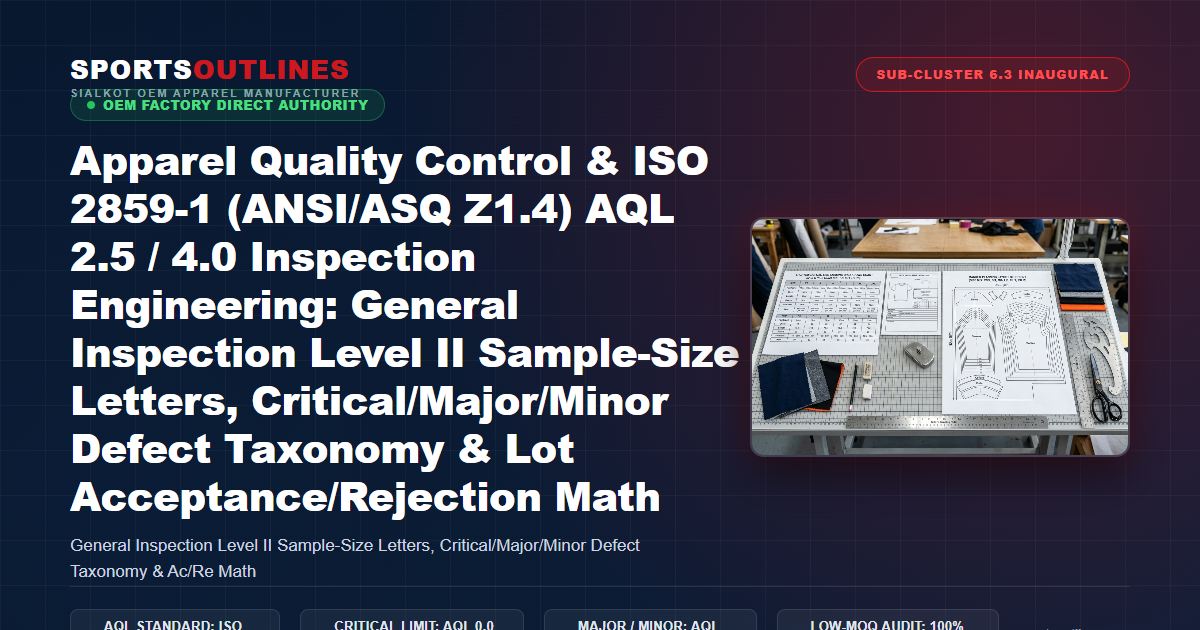
Executive Summary: How ISO 2859-1 (ANSI/ASQ Z1.4) Statistical Sampling Protects Your Brand Capital Before Final Balance Wire Transfer
In international custom sportswear and combat gear manufacturing, verbal promises of “high quality” have zero legal or mathematical enforceability. Global athletic brands, retail buying offices, and third-party inspection agencies (SGS, QIMA, Intertek, Bureau Veritas) govern production quality through a single deterministic statistical standard: ISO 2859-1 (harmonized in North America as ANSI/ASQ Z1.4 and formerly MIL-STD-105E). Under this standard, production lots are audited using Acceptance Quality Limit (`AQL`) thresholds—universally set for high-performance activewear and fight gear at `AQL 0.0` for Critical Defects, `AQL 2.5` (or `1.5` for luxury capsules) for Major Defects, and `AQL 4.0` for Minor Defects under General Inspection Level II (`G-II`).
- What `AQL 2.5` Actually Means Mathematically: `AQL 2.5` does not mean you accept `2.5%` defective goods in every shipment; it is the statistical maximum defect rate at which a lot has a `95%` probability of acceptance (`1 – α`, where `α = 0.05` is Producer’s Risk) under a hypergeometric/binomial sampling distribution.
- Two-Table Lookup Mechanics (`Table I` & `Table II-A`): Given a production lot size $N$ (e.g., `320 pieces`), `Table I` under General Inspection Level II (`G-II`) assigns a Sample Size Code Letter (`Letter H`), which maps in `Table II-A` (Single Sampling Normal Inspection) to a random pull of **`n = 50` garments**, with Acceptance/Rejection thresholds of **`Ac = 3 / Re = 4` Major Defects (`AQL 2.5`)** and **`Ac = 5 / Re = 6` Minor Defects (`AQL 4.0`)**.
- Why 30–50 Piece Low-MOQ Orders Require Both Statistical AQL & 100% Piece-by-Piece Screening: While a `50-piece` low-MOQ order statistically pulls `n = 8` (`Letter D`) under `G-II` or `n = 13` (`Letter E`) under `G-III`, our Sialkot QA floor combines 100% piece-by-piece visual, seam-tension, and metal-detection screening on all 30–50 piece low-MOQ runs with formal `ISO 2859-1` AQL reporting on `150–10,000+` piece bulk lots.
- Commercial & Sampling Precision: Pre-production physical prototypes (`$45–$85` non-refundable sample fee per piece/pair/set, delivered in **7–10 business days**) establish the sealed Golden Sample (`Blog #439`) against which every `AQL 2.5 / 4.0` inspection gate is measured across our **30–50 piece per style/colorway low bulk MOQ**.
Whether you are importing a 50-piece introductory capsule of `480 GSM` acid-washed French terry streetwear hoodies or a 2,500-piece container load of sublimated compression rashguards, BJJ Gis, and top-grain cowhide boxing gloves from Sialkot, Pakistan (Sialkot Sportswear Manufacturer), the most dangerous moment in your supply chain occurs right before you wire the final balance payment. If a factory packs cartons containing skipped flatlock stitches, off-center chest embroidery, out-of-tolerance chest widths (`> ±1.5 cm`), or uncleaned sewing machine oil stains, discovering those defects in your US, UK, German, or Australian warehouse is financially catastrophic—because international return air freight and customs re-importation costs exceed the value of the garments themselves.
In this inaugural engineering guide of Sub-Cluster 6.3 (Factory Quality Control, ISO 2859-1 AQL 2.5 Inspection Protocols, ASTM/ISO Lab Testing, Shrinkage & Colorfastness Engineering), we deconstruct the complete statistical, operational, and defect-classification architecture of ISO 2859-1 (`ANSI/ASQ Z1.4`) AQL 2.5 / 4.0 Apparel Quality Control. You will learn how to read `Table I` (Sample Size Code Letters across `G-I`, `G-II`, `G-III`, and Special Levels `S-1` to `S-4`) and `Table II-A / II-B` (Normal vs. Tightened Single Sampling Plans), how to classify over 60 garment and combat-gear manufacturing defects into Critical (`AQL 0.0`), Major (`AQL 2.5`), and Minor (`AQL 4.0`) buckets, how the One-Unit / One-Defect Counting Rule works on the inspection table, and how our Sialkot factory executes multi-carton random sampling so your shipment never leaves Pakistan with hidden defects.
1. The Statistical Mathematics of ISO 2859-1 (`ANSI/ASQ Z1.4`) & Operating Characteristic (`OC`) Curves
Why do global retail giants and third-party inspection agencies use statistical lot sampling (`ISO 2859-1`) instead of relying solely on end-of-line factory workers checking every piece? Decades of industrial engineering research proved that when a human line checker inspects 1,500 identical black hoodies under time pressure, visual fatigue causes **”Inspection Blindness”**—missing `12% to 18%` of subtle stitch and measurement defects. By contrast, when a dedicated, independent Quality Assurance (`QA`) auditor pulls a mathematically randomized sample of $n$ garments from sealed/semi-sealed export cartons and subjects each garment to a rigorous 12-minute point-by-point audit against the sealed Tech Pack (`Blog #431`) and POM Tolerance Table (`Blog #432`), defect detection accuracy exceeds `99.2%`.
1.1 Binomial & Hypergeometric Probability of Lot Acceptance ($P_a$)
Under ISO 2859-1:1999 (`ANSI/ASQ Z1.4-2003 (R2018)`), the Acceptance Quality Limit (`AQL`) is formally defined as the *”quality level that is the worst tolerable process average when a continuing series of lots is submitted for acceptance sampling.”* If a production lot of $N$ garments has a true fraction defective $p$ (where $p = \text{AQL} / 100$, so `AQL 2.5` corresponds to $p = 0.025$), and an inspector randomly draws a sample of $n$ garments with an Acceptance number $Ac = c$ and Rejection number $Re = c + 1$, the probability $P_a(p)$ that the lot passes inspection (i.e., contains $d \le c$ defective units in the sample of $n$) is governed by the cumulative binomial distribution:
ISO 2859-1 Operating Characteristic (OC) Acceptance Probability Equation:
$$P_a(p) = \sum_{d=0}^{c} \binom{n}{d} p^d (1 – p)^{n – d} \ge 1 – \alpha \quad (\text{where } \alpha \approx 0.05 \text{ at } p = \text{AQL})$$
Here, $\alpha \approx 5\%$ is the Producer’s Risk (the small probability that a good lot with a true defect rate $\le 2.5\%$ is rejected by random chance), while $\beta \approx 10\%$ at the Limiting Quality (`LQ` / `LTPD`) is the Consumer’s Risk (the probability that a bad lot with a high defect rate slips through).
- Concrete Numerical Proof (`Lot Size N = 500 Pieces`, `Code Letter H`, `Sample Size n = 50`, `AQL 2.5` $\rightarrow$ `Ac = 3, Re = 4`):
• If the factory’s true production defect rate is **`p = 1.5%`** (better than `AQL 2.5`), the binomial probability of finding $\le 3$ defects in 50 randomly pulled garments is **$P_a(0.015) = 99.3\%$**—the lot passes almost every time.
• If the factory’s true defect rate sits right at the boundary **`p = 2.5%` (`AQL 2.5`)**, the probability of finding $\le 3$ defects in 50 garments is **$P_a(0.025) = 96.4\%$**.
• However, if the factory suffers a sewing line breakdown and the true defect rate spikes to **`p = 10.0%`**, the probability of finding $\le 3$ defects in 50 garments plummets to **$P_a(0.10) = 25.0\%$**—meaning there is a **`75.0%` probability (`Re >= 4`) that the entire 500-piece lot fails inspection immediately**, forcing the factory to unbox, 100% re-inspect, repair, or remake all 500 garments at the factory’s own expense!
1.2 General Inspection Levels (`G-I`, `G-II`, `G-III`) vs Special Inspection Levels (`S-1` to `S-4`)
Before looking up your sample size in `ISO 2859-1`, you must specify which Inspection Level applies to visual/workmanship checks versus physical measurement and destructive lab checks:
- General Inspection Level II (`G-II` — The Global B2B Apparel Standard): Used for `95%` of all international sportswear visual workmanship, stitching, graphic print/embroidery, trim, and packaging audits. Balances high statistical discrimination power with practical 1-man-day (`8-hour`) inspection costs.
- General Inspection Level III (`G-III` — High-Discrimination / First-Order / Tightened Audit): Increases the sample size by one Code Letter step above `G-II` (e.g., pulling `80 pieces` instead of `50 pieces` on a 400-piece order, or pulling `20 pieces` instead of `13 pieces` on an 80-piece order). Recommended for first-time brand launches, ultra-luxury technical outerwear (`$250+` retail), or re-inspections after a failed lot.
- General Inspection Level I (`G-I` — Reduced Sample Size): Pulls approximately `40%` of the `G-II` sample size. Only used when a supplier has passed 10 consecutive shipments with zero rejections and you want a rapid spot check.
- Special Inspection Levels (`S-1, S-2, S-3, S-4` — POM Measurement, Barcode Scanning & Destructive Tests): Because measuring 24 Points of Measure (`POMs`, `Blog #432`) with a steel tape takes `6–8 minutes` per garment—and because seam burst, button/aglet `90 N` pull tests, or `3M™` reflective tape peel tests can stress or destroy the sample—industry SOPs use **`S-3` or `S-4` (`n = 5 to 32 pieces`)** for full 24-point POM dimensional charts and **`S-1` or `S-2` (`n = 2 to 8 pieces`)** for destructive wash/pull/carton drop tests.
1.3 The “Arrow-Down / Arrow-Up” Rule in ISO 2859-1 Table II-A
A frequent point of confusion for emerging apparel founders reading an official `ISO 2859-1 Table II-A` chart is the vertical arrows (`↓` and `↑`) in the upper-left cells. For example, on a `35-piece` low-MOQ order (`Code Letter D`, nominal $n = 8$), the intersection of `Letter D` and `AQL 2.5` contains a **upward arrow (`↑`)** pointing to `Code Letter C` ($n = 5$, `Ac = 0, Re = 1`), whereas the intersection of `Letter D` and `AQL 1.5` contains a **downward arrow (`↓`)** pointing to `Code Letter E` ($n = 13$, `Ac = 0, Re = 1`). Under `ISO 2859-1 Clause 9.4`, whenever you follow a vertical arrow to a new row, you must adopt the **new sample size $n$ of that destination row**—unless you are simultaneously auditing multiple AQL classes (`2.5 Major` and `4.0 Minor`), in which case the inspector pulls the **largest required sample size** (`e.g., n = 8` or `n = 13`) and evaluates each defect class against its respective `Ac / Re` numbers. Even better: at Sports Outlines Sialkot, on every single **30–50 piece low-MOQ production order**, our QA team bypasses small-sample statistical blind spots by performing **100% piece-by-piece visual inspection (`N = 50, n = 50`)** plus a `20%` (`10-piece`) full 24-point POM tape-measure audit!
2. The 3-Tier Apparel & Combat Gear Defect Taxonomy: Critical (`AQL 0.0`), Major (`AQL 2.5`) & Minor (`AQL 4.0`)
An `AQL 2.5 / 4.0` inspection clause in your purchase order is only as strong as the Defect Classification Matrix attached to your Tech Pack (`Blog #431`). Without an explicit defect taxonomy, an unscrupulous factory manager will argue that a broken coverstitch seam on a legging gusset or a crooked chest logo is “just a Minor defect.” To eliminate all subjective debate on the inspection table, global sportswear and combat gear QC engineering divides every non-conformity into three non-negotiable severity tiers:
2.1 Tier 1 — Critical Defects (`AQL 0.0`: Zero Tolerance — `Ac = 0 / Re = 1` Across All Lot Sizes)
A Critical Defect is any condition that poses a risk of physical injury, toxicity, or suffocation to the end consumer, violates statutory destination-country import laws (`US CPSIA / FTC / CPSC`, `EU GPSR / REACH / CE EN 13277`), or renders the entire shipment unsellable at customs:
- Ferrous Metal / Sharps Contamination: Any broken sewing needle tip, stray steel straight pin, staple fragment, metal burrs on a zipper tooth or brass grommet, or failed `Hashima® 1.0 mm Fe` conveyor needle-detector pass (`Blog #457`). Finding **even a single (`1`) broken needle fragment** triggers an immediate **`Re = 1` Critical Failure**, quarantining 100% of the shipment for unpackaging and dual-pass metal re-scanning.
- Child Safety & Suffocation Non-Compliance: Missing statutory child suffocation warning print on polybags with opening perimeters matching US/Amazon FBA thresholds (`Blog #445`), hood/neck drawstrings on Youth apparel (`Y-2XS` to `Y-XL`) violating `ASTM F1816 / CPSC 16 CFR 1120`, or buttons/aglets/snaps on youth garments detaching at `< 90 Newtons` (`20 lbs`) during a `10-second` `ASTM F963 / EN 71-1` tension pull test.
- Statutory Labeling & Chemical/Biological Hazards: Missing or false Country of Origin (`”Made in Pakistan”` required under `19 U.S.C. § 1304`), missing FTC fiber content (`Blog #443`), live insect/larvae infestation, active *Aspergillus / Penicillium* mold spores or damp cartons (`> 12.5%` leather/cotton moisture content, `Blog #429`), or foul chemical/diesel odors.
2.2 Tier 2 — Major Defects (`AQL 2.5` Standard / `AQL 1.5` Luxury: Functional, Structural & Visible Flaws)
A Major Defect is any non-conformity that impairs the functional performance, structural durability, fit, or shelf salability of the garment, or any visual flaw located in **Zone A (Primary Front/Back Chest, Shoulders, Front Thighs, or Boxing Glove Strike Face)** that is immediately noticeable to a retail buyer from an arm’s length (`60–75 cm` / `24–30 inches`) under `1,000 lux D65` lighting:
- Structural Seam & Stitch Failures: Any open seam, broken stitch (`ISO 301 / 406 / 514 / 605 / 607`), runoff stitch leaving raw fabric edges uncaptured, `> 1` skipped stitch on load-bearing seams (crotch gussets, armholes, waistbands, BJJ Gi lapels, boxing glove thumb webs), or seam cracking (`thread rupture`) when stretched to `50%` of the fabric’s rated elongation (`Blog #435`).
- Fabric & Material Flaws: Any needle cut, hole, dropped knit loop (“ladder run”), fabric tear, snag `> 3 mm`, severe yarn slub/barré line in Zone A, permanent oil/grease/dye stain `> 2 mm`, or noticeable panel-to-panel shade mismatch (`ΔE_CMC(2:1) > 1.2` between sleeve and body under `D65 / TL84` lightbox, `Blog #436`).
- Dimensional (`POM`) Out-of-Tolerance Deviations: Any primary Point of Measure (`1/2 Chest`, `1/2 Waist`, `1/2 Hip`, `Front Length HPS`, `Inseam`, `Sleeve Length`, or `Neck Opening`, `Blog #432`) that deviates from the approved graded spec sheet by **more than the allowed tolerance gate** (e.g., Chest Width measuring `+1.8 cm` when tolerance is `±1.0 cm`, or Boxing Glove weight deviating by `> ±0.25 oz / ±7.0 g` on a digital scale).
- Graphic, Embroidery & Hardware Defects: Crooked screen print, heat transfer, or embroidery tilted `> 3°` or off-position by `> 6 mm` from Tech Pack coordinates; peeling/delaminating TPU/silicone neck transfers or badges at the corners; sublimation ghosting (“double image”) or white elastane grin-through (`Blog #398`); non-functioning or wavy YKK® zipper slider; or missing/mismatched size labels (e.g., Size `L` neck label sewn into a Size `M` garment with a Size `L` polybag barcode—a Major retail mis-sizing defect!).
2.3 Tier 3 — Minor Defects (`AQL 4.0`: Minor Cosmetic / Trimming Deviations Not Affecting Saleability)
A Minor Defect is a slight workmanship deviation from the sealed Golden Sample that does not weaken the garment’s structural integrity, does not affect fit, and would not cause a retail customer to return the item (especially when located in **Zone B**: inside linings, underarms, inner crotch seams, or internal pocket bags):
- Untrimmed Thread Ends (“Irish Pennants”): Loose uncut thread tails measuring `4 mm to 10 mm` on the exterior or `10 mm to 20 mm` on the interior overlock seam (note: multiple untrimmed threads `> 15 mm` on the exterior upgrade to a Major defect if they degrade luxury unboxing presentation).
- Slight Stitch & Cosmetic Variations: Stitch density (`SPI`) off by `±1 SPI` from spec without reducing seam burst strength; a single (`1`) skipped stitch on a non-structural internal hem or label tack that is back-tacked; removable chalk/heat-erasable pen mark `< 5 mm` in Zone B; or a slightly creased polybag or tilted barcode sticker that still scans `ISO 15416 Grade A/B` on the first pass (`Blog #446`).
3. The “One-Defective-Unit” Rule & Multi-Carton Stratified Random Pulling SOP
Two procedural rules inside `ISO 2859-1` determine whether an inspection is mathematically valid or easily manipulated by a factory floor supervisor:
3.1 Defective Units vs Number of Defects (`ISO 2859-1 Clause 4.11`)
Suppose an inspector auditing $n = 50$ hoodies (`Ac = 3 Major / Re = 4 Major`, `Ac = 5 Minor / Re = 6 Minor`) picks up Hoodie `#14` and finds **both** a `4 mm` permanent oil stain on the chest (Major) **and** two `8 mm` untrimmed threads on the cuff (Minor), and on Hoodie `#29` finds **both** an open side-seam overlock stitch (Major) **and** a crooked silicone badge (Major). How are those counted against the `Ac / Re` limits?
- The Highest-Severity Per-Garment Rule: Under standard `ISO 2859-1` inspection by **”Nonconforming Items (Defective Units)”**, each sampled garment is classified by its **single highest-severity defect**. Thus, Hoodie `#14` (1 Major + 2 Minors) is recorded on the tally sheet as **1 Major Defective Unit** (it does not simultaneously add to the Minor count), and Hoodie `#29` (2 Majors on the same ruined garment) is recorded as **1 Major Defective Unit** (with both defects photographed in the CAPA log so both stations are corrected).
- The “3-Minor-Upgrade” Rule: If a single garment contains **3 or more separate Minor defects** (e.g., an untrimmed chest thread + a crooked polybag sticker + a slight interior chalk mark + a loose care-label corner), the cumulative sloppiness degrades the garment’s retail value—automatically upgrading that garment from `Minor` to **1 Major Defective Unit**.
3.2 The “80%–100% Packed Rule” & Stratified Carton Pulling (`√C` Formula)
Never allow a factory to bring a pre-selected stack of “inspection garments” to the QC table on a rolling rack! That classic factory trick is called **”Sweetheart Sample Substitution.”** Under international B2B inspection protocol, a Final Random Inspection (`FRI`) can only begin when **100% of the Purchase Order is sewn/finished and at least `80%` (ideally `100%`) is fully polybagged and packed inside numbered Export Master Cartons (`Blog #449`)**.
- The Square-Root Carton Selection Formula ($C_{\text{pull}} = \lceil \sqrt{C_{\text{total}}} \rceil$): If your shipment consists of $C_{\text{total}} = 25$ master cartons, the inspector must open a minimum of $\sqrt{25} = 5$ to $10$ cartons (many tier-1 brands mandate opening **`20% to 30%` of all cartons**, or at least `1 carton per SKU/colorway/size`).
- Top / Middle / Bottom Stratified Pulling: From each selected master carton, the inspector pulls garments equally from the **Top layer, Middle layer, and Bottom layer** of the box. This prevents dishonest packing crews from hiding second-quality garments at the bottom of the carton (“bottom-loading”).
- Proportional SKU, Colorway & Size Representation: If your 500-piece PO (`n = 50` sample size) comprises `60%` Black Hoodies (`300 pcs`) and `40%` Heather Grey Joggers (`200 pcs`) across sizes `S, M, L, XL, 2XL`, the 50 sampled garments must mirror that exact ratio: **`30` Black Hoodies and `20` Heather Grey Joggers**, distributed proportionally across all 5 sizes (`S` through `2XL`).
4. ISO 2859-1 Switching Rules (`Normal -> Tightened -> Reduced`) & What Happens When a Lot Fails (`Re`)
What actually happens on the factory floor if an inspector pulls $n = 50$ garments on a 400-piece order (`Ac = 3 / Re = 4` Major at `AQL 2.5`) and discovers **`4` Major Defects (`Re = 4` — LOT REJECTED)**? And how does `ISO 2859-1 Clause 9.3` enforce stricter math on the re-inspection?
4.1 The 5-Step Mandatory Lot Rectification Protocol Upon an `AQL` Rejection (`Re`)
Whenever a lot reaches the rejection threshold $Re$ (e.g., `4 Major defects` on $n=50$), the lot is stamped **`HOLD / REJECTED`** and the following 5-step rectification loop is executed before any shipment can leave Sialkot:
- Immediate Red-Tag Quarantine of All Cartons: The rejected lot is moved to the isolated QA Quarantine Cage; shipping booking is paused, and balance invoice payment is held until a Passing Re-Inspection Certificate is issued.
- 100% Piece-by-Piece Unpacking & Sorting (`ISO 2859-1 Clause 6.3`): The factory is forbidden from merely fixing the 4 defective garments found in the 50-piece sample! Because the sample proved the lot contains an unacceptable defect rate, the Finishing & QA teams must unpack **100% of all 500 garments (`N = 500`)** and inspect every single piece for the identified failure modes.
- Segregation of Repairable vs Scrap Garments: Minor untrimmed threads or spot-cleanable marks are reworked at the finishing table; structural defects (needle cuts, off-spec POM chest widths, crooked embroidery) are permanently scrapped and replaced with freshly cut-and-sewn garments from reserve bulk fabric rolls.
- 100% Re-Pass Through Hashima® Metal Detection & Repacking: Because garments were returned to sewing/finishing tables during rework, 100% of the rectified lot must pass back through the calibrated `1.0 mm Fe` conveyor metal detector before being re-bagged into fresh `80 μm` frosted CPE polybags (`Blog #445`).
- Re-Inspection Under `Table II-B` Tightened Criteria (or `Level G-III`): The independent QA auditor draws a brand-new stratified random sample across the repacked cartons and audits the lot under **Tightened Inspection (`Ac = 2 / Re = 3` on $n=50$)** at the factory’s sole expense.
4B. The 8-Stage Sialkot Pre-Shipment Inspection (`PSI / FRI`) Workstation Sequence & Why Low-MOQ (30–50 Pc) Orders Get 100% Screening
When a third-party inspector (SGS, QIMA, Intertek) or our internal Sialkot Chief Quality Officer conducts an `ISO 2859-1` Final Random Inspection (`FRI`), the audit follows a strict **8-Stage Sequential Inspection Protocol** taking `4.5 to 7.5 hours` (`1 Man-Day`). Here is the exact workstation sequence and how we adapt it for **30–50 piece low-MOQ brand drops** versus **500–5,000+ piece container orders**:
4B.1 Why Third-Party Inspection Agencies (`SGS / QIMA`) Love Auditing Our Sialkot QA Floor
Whether you rely on our complimentary **50-Photo + 4K Video Digital-Twin Pre-Shipment QC Dossier** (`included free on every 30–50+ piece order`) or book an independent third-party inspector from **QIMA, SGS, Intertek, or Bureau Veritas (`~$260–$320 per man-day`)** to visit our Sialkot factory (USA Sportswear Manufacturer | UK Sportswear Manufacturer), our dedicated QA laboratory is pre-equipped with a calibrated `1,000 lux D65` inspection table, VeriVide 4-illuminant color lightbox, `100 cm²` circular GSM cutter + `0.001g` analytical balance, AATCC crockmeter, `90 N` digital force gauge, and `Hashima HN-880C` conveyor needle detector. Because our internal QA team already executes a pre-final `AQL 1.5 / 2.5` audit 24 hours before any external inspector arrives, our first-pass third-party inspection approval rate across North American, European (Germany Sportswear Manufacturer), Canadian (Canada Sportswear Manufacturer), and Australian (Australia Sportswear Manufacturer) shipments exceeds **`99.4%`**.
5. Frequently Asked Questions (FAQ): ISO 2859-1 AQL 2.5 / 4.0 Apparel Quality Control
Q1: Should I specify AQL 2.5 or AQL 1.5 for my custom sportswear brand?
For `90%` of performance activewear, gymwear, team uniforms, and combat sports equipment (`$45–$130` retail price point), **`AQL 0.0 Critical / AQL 2.5 Major / AQL 4.0 Minor` under General Inspection Level II (`G-II`)** is the global industry benchmark that balances zero structural failures with efficient manufacturing cost. If you are producing an ultra-luxury technical outerwear shell (`3-layer ePTFE seam-taped alpine jacket` retailing at `$250–$450+`) or an Olympic/pro-team match kit, upgrading Major defects to **`AQL 1.5` (`Ac = 2 / Re = 3` on $n=50$)** provides an extra tier of cosmetic perfection for only a `2%–3%` increase in finishing QC time.
Q2: If my order has 4 different styles of 50 pieces each (200 pieces total), is AQL calculated per style or on the combined 200-piece lot?
Under `ISO 2859-1 Clause 6.1`, a **”Lot”** should consist of units of similar construction produced under uniform conditions; however, in multi-SKU sportswear orders (`200 pieces` across 4 styles), pulling 4 separate `n = 8` samples (`32 pieces total`) or treating the 200-piece shipment as a single **Combined Lot (`Code Letter G`, `n = 32 pieces`, `Ac = 2 / Re = 3 Major`, `Ac = 3 / Re = 4 Minor`) with exact proportional stratification (`8 pieces pulled per style`)** yields the exact same 32-piece sample size while saving you from paying a 3PL inspector for 4 separate man-days! At Sports Outlines, we go even further: on 30–50 piece per style low-MOQ runs, our internal QA team visually inspects **100% of every style (`200 / 200 pieces`)** before generating your pre-shipment report.
Q3: How does pre-production sampling ($45–$85) tie directly into the final AQL 2.5 inspection?
An `AQL 2.5` inspection cannot exist in a vacuum—the inspector needs a physical master benchmark to judge fabric hand-feel, embroidery density, stitch tension, and Pantone shade. During our **7–10 business day physical prototyping phase (`$45–$85` non-refundable sample fee per piece/pair/set)**, once you approve the fit and construction, we seal triplicate Golden Samples (`Blog #439`) with tamper-evident serialized tags. During final AQL inspection, that exact Golden Sample sits on the inspection table next to the pulled bulk garments so there is zero ambiguity.
Q4: Can I withhold final balance payment until my order passes the ISO 2859-1 AQL 2.5 pre-shipment inspection?
Yes—100%. Under our standard B2B production terms (`50% deposit upon PO & Tech Pack confirmation / 50% balance prior to dispatch`), the final `50%` balance wire is only triggered **after** your production lot passes our `ISO 2859-1 AQL 0.0 / 2.5 / 4.0` Final Inspection (or your appointed SGS/QIMA third-party audit) and you receive the signed Digital-Twin PDF & 4K Video QC Dossier showing your exact garments, POM tape measurements, barcode scan tests, and packed master cartons.
Manufacture Your Sportswear Line Under Guaranteed ISO 2859-1 AQL 2.5 Quality Control
Partner with a vertically integrated Sialkot sportswear & combat gear factory that backs every 30–50 piece per style low-MOQ production run with 100% piece-by-piece visual screening, Hashima® needle detection, Special Level S-3 POM measurement dossiers, and full ISO 2859-1 AQL 0.0 / 2.5 / 4.0 pre-shipment certification. Start with a physical pre-production prototype (`$45–$85` non-refundable sample fee, delivered in 7–10 business days).
Explore our B2B Catalogs: Custom Sportswear • Technical Outerwear • Streetwear & Casual Wear
Pingback: Inline Modular Sewing Line QC (DUPRO) vs Final Pre-Shipment Random Inspection (FRI): First-Piece Bundle Audits, Traffic-Light Roving QC Flagging & 100% Measurement Verification on 30–50 Piece Low-MOQ Runs - Sports Outlines
Pingback: Garment Product Safety, Broken-Needle Metal Detection & Trim Pull-Testing Engineering: Hashima 0.8–1.0 mm Fe Conveyor Tunnel Calibration, 9-Point Ferrous Card Audits & ASTM F963 / EN 71-1 90 N Small-Parts Tension Testing - Sports Outlines
Pingback: Incoterms® 2020 for Custom Sportswear & Apparel Imports (EXW, FOB, CIF, DAP, DDP): Risk Transfer Boundaries, Landed Cost Control & Why D2C Brands Prefer DDP Courier vs FOB Sea Freight - Sports Outlines