
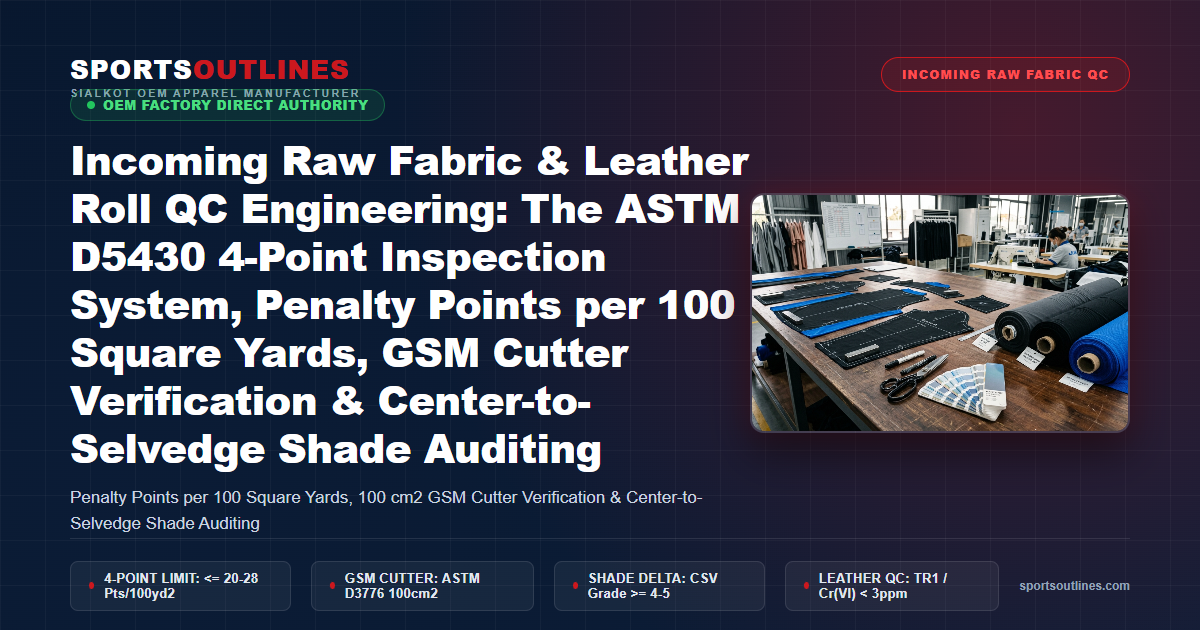
Executive Summary: Why 74% of Final Garment Rejections Originate in Uninspected Incoming Fabric & Leather Rolls
If a knitting mill delivers a roll of `260 GSM` Nylon-Spandex interlock containing horizontal dyeing barré lines, spandex elastomer snap-backs, or a `9%` Center-to-Selvedge (`CSV`) shade gradient—and a factory lays that roll directly onto the CNC cutting table—no amount of sewing skill can save the finished leggings. In industrial apparel manufacturing, a `\$0.40` fabric defect caught on the lighted inspection perch costs almost nothing to splice out; that same defect caught after cutting, sublimation, flatlock sewing, and polybagging destroys a `\$14.00` finished garment (`a 35x cost multiplier`). To prevent defective textiles from ever reaching the cutting room, global sportswear manufacturers enforce ASTM D5430 (The 4-Point Fabric Inspection System) combined with ASTM D3776 Circular GSM Verification and AATCC EP9 / Spectrophotometric Shade Continuity Auditing.
- The ASTM D5430 4-Point Scoring Law: Every warp or weft textile flaw is assigned `1, 2, 3, or 4 penalty points` based on length (`≤ 3″`, `> 3″–6″`, `> 6″–9″`, `> 9″`), capped at a maximum of **`4 points per linear yard`**, and normalized into **Points per `100 Square Yards` (`or 100 m²`)** with strict roll rejection thresholds of **`≤ 20 pts/100 sq yd` for synthetic performance knits** and **`≤ 24–28 pts/100 sq yd` for cotton fleece and Pearl Weave Gi fabrics**.
- 5-Specimen Circular GSM Cutter Metrology (`ASTM D3776 / ISO 3801`): Using a `100 cm²` (`112.84 mm` diameter) 4-blade circular cutter across `Left-Center-Right` diagonal roll positions weighed on a `0.001 g` analytical balance ($\text{GSM} = m_{\text{grams}} \times 100$) to enforce a strict **`±3% to ±5%` GSM mass tolerance**.
- 3-Vector Shade Continuity (`CSV`, `ETV`, and `Roll-to-Roll Shade Banding`): Auditing `Left-Center-Right` (`Center-to-Selvedge Variation`) and `Head-Middle-Tail` (`End-to-End Variation`) swatches under `D65 / TL84` lightboxes (`AATCC Gray Scale ≥ 4–5`, `ΔE_CMC(2:1) ≤ 0.8`) so no garment ever suffers mismatched sleeves and body panels.
- Commercial & Sampling Precision: Every pre-production prototype (`$45–$85` non-refundable sample fee per piece/pair/set, **7–10 business days** turnaround) and every **30–50 piece per style low-MOQ bulk order** is cut exclusively from rolls that have passed our 6-Gate Sialkot Incoming Material Quarantine Lab.
When brands source from low-tier workshops that lack an incoming textile laboratory, the cutting team simply unrolls fabric straight from the dye-house truck onto the spreading table. Two weeks later, during the ISO 2859-1 AQL 2.5 Final Random Inspection (`Blog #451`), the buyer discovers that the left sleeve of a hoodie is noticeably darker than the front chest (`CSV shading`), the `450 GSM` hoodie actually weighs only `395 GSM` (`under-weight mill short-changing`), or white horizontal knit lines (`barré`) run across the glutes of compression leggings.
In this second technical guide of Sub-Cluster 6.3 (Factory Quality Control, ISO 2859-1 AQL 2.5 Inspection Protocols, ASTM/ISO Lab Testing, Shrinkage & Colorfastness Engineering), we open the doors to our Sialkot Raw Material Quarantine & Textile Inspection Laboratory (Sialkot Sportswear Manufacturer). You will master the exact mathematical formulas of the ASTM D5430 4-Point Fabric Inspection System, learn how our lighted `45°–60°` inclined perch machines operate at `12–15 yards/minute`, understand how we execute 5-Disk Circular GSM Verification (`ASTM D3776`) and 3-Vector `CSV / ETV` Shade Banding, and see how we grade incoming **Full-Grain Bovine Cowhide & Microfiber Leather Hides (`TR1 / TR2` usable area grading)** for combat sports gloves, shin guards, and varsity jackets.
1. The ASTM D5430 4-Point Fabric Inspection System: Scoring Rules, Equations & Pass/Fail Thresholds
Codified under ASTM D5430 (Standard Test Methods for Visually Inspecting and Grading Fabrics) and endorsed by the American Apparel & Footwear Association (`AAFA`) and the Association ofSuppliers to the British Clothing Industry (`ASBCI`), the **4-Point System** assigns objective numerical penalty points to visual knitting, weaving, dyeing, and finishing defects as the fabric roll passes over a backlit and top-lit inspection perch.
1.1 The 4-Tier Defect Length & Hole Scoring Rules
As the fabric feeds over the `45° to 60°` inclined frosted-glass inspection table under **`≥ 1,075 lux` (`100 foot-candles`) `D65` cool-white fluorescent/LED illumination** at a controlled linear speed of **`10 to 15 yards/minute` (`9–14 m/min`)**, the inspector measures the length of any defect in either the warp/wale (lengthwise) or weft/course (widthwise) direction and assigns penalty points as follows:
- `1 Penalty Point`: Defect length up to **`3.0 inches` (`≤ 75 mm`)**.
- `2 Penalty Points`: Defect length **`> 3.0 inches up to 6.0 inches` (`76 mm to 150 mm`)**.
- `3 Penalty Points`: Defect length **`> 6.0 inches up to 9.0 inches` (`151 mm to 230 mm`)**.
- `4 Penalty Points`: Defect length **`> 9.0 inches` (`> 230 mm`)**, OR any **pierced hole, tear, or dropped-stitch opening `> 1.0 inch` (`25 mm`)** (note: any visible hole `≤ 1.0 inch` is scored at `2 points`, or `4 points` if located in the main cuttable width of single-layer compression fabric).
- The Mandatory 4-Point Cap Rule (`Per Linear Yard / Meter`): No single linear yard (`or meter`) of fabric can be penalized more than **`4 points` total**, regardless of how many individual flaws appear within that same linear yard. Why? Because in the cutting room, a ruined `1-yard` section of a fabric ply is simply cut out (`spliced`) and discarded once—so penalizing a single ruined yard `16 points` would artificially distort the roll’s usability score.
- Continuous / Running Defects (`Automatic Roll Rejection`): Any continuous warp streak, creel tension line, horizontal knitting barré, pin-stenter oil track, or off-shade selvedge that repeats or runs continuously for **`> 3 consecutive yards`** automatically rejects the entire roll regardless of total point score!
ASTM D5430 Normalized Penalty Points per 100 Square Yards (`& 100 Square Meters`) Equations:
$$\text{Points per } 100\text{ Sq. Yards} = \frac{\text{Total Penalty Points} \times 3,600}{\text{Inspected Roll Length (Yards)} \times \text{Cuttable Fabric Width (Inches)}}$$
$$\text{Points per } 100\text{ Sq. Meters} = \frac{\text{Total Penalty Points} \times 10,000}{\text{Inspected Roll Length (Meters)} \times \text{Cuttable Fabric Width (Centimeters)}}$$
Note: Why `3,600` in the Imperial numerator? Because $1\text{ yard} = 36\text{ inches}$, so $100\text{ square yards} = 100 \times 36 = 3,600\text{ yard-inches}$. Always use the **Cuttable Width (between stenter pin-holes)**, not the gross selvedge-to-selvedge width.
1.2 Worked Sialkot Mill Calculation: Does This Roll Pass or Fail?
Suppose our Sialkot incoming QC lab inspects a roll of **`250 GSM` `78%` Recycled Nylon / `22%` Lycra® Sport Interlock** destined for squat-proof compression leggings (`Blog #111`):
- Roll Parameters: Actual metered roll length = **`82.0 yards`** (`ticketed as 83 yards`); cuttable width between pin-holes = **`60.0 inches` (`152.4 cm`)**.
- Defects Flagged with Colored Metallic Edge Stickers During Perch Run:
• `3` small yarn knots/slubs (`≤ 3″`) = $3 \times 1\text{ pt} = 3\text{ pts}$
• `2` oil smudges (`4.5″` length) = $2 \times 2\text{ pts} = 4\text{ pts}$
• `1` dropped needle line (`7.5″` length) = $1 \times 3\text{ pts} = 3\text{ pts}$
• `2` full-width dye stop-marks (`> 9″`) = $2 \times 4\text{ pts} = 8\text{ pts}$
• **Total Raw Penalty Points** = $3 + 4 + 3 + 8 = \mathbf{18\text{ points}}$. - Normalized Score Calculation:
$$\text{Points per } 100\text{ Sq. Yards} = \frac{18 \times 3,600}{82.0 \times 60.0} = \frac{64,800}{4,920} = \mathbf{13.17\text{ Points / 100 Sq. Yards}}$$ - Verdict: Because the maximum allowable threshold for Synthetic Performance Knits is **`≤ 20.0 Points / 100 Sq. Yards`**, this roll **PASSES (`13.17 ≤ 20.0`)**! Moreover, because the inspector placed high-visibility red metallic edge stickers on the selvedge at each of the `8` defect locations, the CNC spreading operator in the cutting room simply splices out the two 4-point dye marks during ply spreading—ensuring **zero defective panels ever reach the sewing line**.
2. ASTM D3776 / ISO 3801 Circular GSM Cutter Metrology & Roll Width/Length Auditing
When you order a `450 GSM` heavyweight streetwear hoodie or a `260 GSM` squat-proof legging, how do you verify that the knitting mill didn’t over-stretch the fabric on the heat-setting stenter frame—delivering a thinned-out `410 GSM` or `230 GSM` roll while billing for the heavier weight? In our Sialkot textile lab, every incoming dye lot undergoes **ASTM D3776 / ISO 3801 Mass Per Unit Area (`GSM`) Verification** before a single roll is released to cutting.
2.1 The 5-Disk Diagonal Sampling Pattern & `100 cm²` Cutter Physics
- Mandatory 24-Hour Tensionless Conditioning (`ISO 139 / ASTM D1776`): Because fabric rolls wound tightly under tension on cardboard cores are elastically stretched by `2%–4%` (which artificially lowers GSM), we unroll a `1.5-meter` full-width header swatch from the roll and condition it flat and tensionless for `4 to 24 hours` at **`20°C ± 2°C` and `65% ± 4%` Relative Humidity (`RH`)**.
- Precision `100 cm²` Circular Sample Cutter (`Diameter = 112.838 mm`): Using a calibrated 4-blade James Heal / SDL Atlas circular cutter over a self-healing cork rubber mat, the lab technician stamps **5 circular disks (`each exactly 100.0 cm² = 0.01 m²`)** arranged diagonally across the full width of the swatch (`Left Edge [15 cm from selvedge]`, `Left-Center`, `Exact Center`, `Right-Center`, and `Right Edge [15 cm from selvedge]`).
- Analytical Balance Weighing (`±0.001 g` Precision): Each `100 cm²` disk is weighed on a draft-shielded digital analytical balance ($m_1, m_2, m_3, m_4, m_5$ in grams), and the mean mass $\bar{m}$ is multiplied by `100`:
$$\text{Verified Roll GSM} = \left( \frac{1}{5} \sum_{i=1}^{5} m_i \right) \times 100 \quad (\text{Tolerance Gate: } \mathbf{\pm 3.0\%} \text{ Synthetic Knits, } \mathbf{\pm 5.0\%} \text{ Heavy Cotton Fleece/Gi Weaves})$$ - Left-to-Right Density Uniformity Check: If the center disk ($m_3$) of a `450 GSM` French terry roll weighs `4.52 g` (`452 GSM`) while the left/right edge disks ($m_1, m_5$) weigh `4.95 g` (`495 GSM`), the stenter pin-frame over-compressed the edges—alerting our CAD marker team to increase the selvedge buffer from `2.5 cm` to `5.0 cm` so every cut panel has uniform thickness.
- Electronic Meter-Counter Roll Length & Cuttable Width Audit: As the roll runs over the 4-Point perch, a calibrated rotary encoder wheel measures true tensionless roll length (`rejecting or debiting the mill for any roll > 1.5% shorter than the mill ticket`), while a steel rule checks cuttable width at `Head`, `Middle`, and `Tail` (`zero negative width tolerance: -0.0 cm / +2.5 cm`).
3. 3-Vector Shade Continuity Auditing: Center-to-Selvedge (`CSV`), End-to-End (`ETV`) & Roll-to-Roll Shade Banding
Even if a dye lot matches the client’s approved Pantone® TCX lab-dip (`Blog #436`) at the very start of Roll `#1`, industrial jet-dyeing autoclaves and continuous pad-dry-cure stenters can experience subtle temperature or squeeze-roller pressure gradients across a 500-kilogram dye lot. To guarantee that the front left chest, right chest, sleeves, hood, and kangaroo pocket of every garment match seamlessly—and that all garments packed into a retail store rack look identical—our Sialkot lab executes **3-Vector Shade Continuity Auditing (`AATCC EP9` Visual Gray Scale `≥ 4–5` & `X-Rite Ci7800` Spectrophotometric `ΔE_CMC(2:1) ≤ 0.8`)**:
3.1 Why Sequential Cut-Panel Ply Numbering (`Stickering`) Is Mandatory on the Sewing Floor
Even when a fabric roll passes `CSV` and `ETV` with a `4–5` Gray Scale rating, human eyes can detect a `0.3 ΔE` difference when a left front zip-hoodie panel and a right front zip-hoodie panel are sewn directly together down the center-front zipper! Therefore, immediately after CNC cutting, our Sialkot bundling team applies **Sequential Thermal Bundle Stickers (`Roll #3 – Ply #01` through `Roll #3 – Ply #40`)** to the back of every single cut panel (front left, front right, back, left sleeve, right sleeve, hood left, hood right, pocket). On the modular sewing line, the operator is strictly trained to sew `Ply #17` sleeves exclusively onto `Ply #17` body panels—guaranteeing `100.0%` microscopic shade harmony across every seam of the finished garment.
4. Incoming Bovine Cowhide & Microfiber Leather Hide QC Engineering for Combat Sports Gear
Because Sports Outlines Sialkot is a premier manufacturer of both technical performance apparel and professional combat sports gear (`Sub-Clusters 5.1–5.7`: Boxing Gloves, MMA Grappling Gloves, Muay Thai Shin Guards, Curved Thai Pads, and Leather Varsity Jackets), our incoming raw material lab operates a dedicated **Tannery Hide & Coagulated Microfiber Inspection Bay** governed by **ISO 2589, ISO 3377-2, and `TR1 / TR2` Tannery Grading Standards**:
4B. The 6-Gate Sialkot Incoming Raw Material Quarantine SOP & How Many Rolls We Audit Per Lot
How much of an incoming fabric shipment must be inspected under the 4-Point System before cutting is authorized? Industry standard requires inspecting a **minimum of `10% to 20%` of the total yardage/rolls in large mill deliveries (`1,000+ meters`)—and `100% of all rolls` on any low-MOQ (`30–50 piece`) or medium (`100–500 piece`) production order** (since a 50-piece hoodie order consumes only `2 to 3 fabric rolls`!). If the initial `20%` roll sample on a large delivery exceeds the maximum allowable point score, our lab escalates immediately to **100% roll inspection at the knitting mill's expense**.
- Gate 1 — Quarantine Unloading & Roll Barcode Tagging: Incoming rolls are placed on plastic pallets in the Yellow Quarantine Zone (never touching concrete floors) and tagged with a unique `SO-RM-LOT` barcode linking mill batch, Pantone code, and PO number.
- Gate 2 — 24-Hour Tensionless Swatch Conditioning & 5-Disk GSM Check (`ASTM D3776`): Verify GSM within `±3%` (synthetics) or `±5%` (heavy cottons) and verify cuttable width between stenter pinholes.
- Gate 3 — Lighted Perch `ASTM D5430` 4-Point Inspection & Metallic Defect Stickering: Score every warp/weft flaw (`≤ 20 pts/100 sq yd` synthetics; `≤ 28 pts/100 sq yd` heavy cottons) and place red metallic selvedge stickers at every 3-point and 4-point flaw for cutting-table splicing.
- Gate 4 — 3-Vector Shade Continuity Blanket (`CSV`, `ETV` & Roll-to-Roll Shade Banding): Audit `L–C–R` and `Head–Tail` swatches in the `D65 / TL84` lightbox (`Gray Scale ≥ 4–5`, `ΔE_CMC ≤ 0.8`) and assign Shade Band letters (`Band A`, `Band B`).
- Gate 5 — Pre-Cut Shrinkage, Spirality & Sublimation Calendar Test (`Blog #454`): Wash/tumble a `50 × 50 cm` benchmark square (`AATCC 135 / 179`) and run a `204°C` sublimation test strip so Gerber AccuMark® CAD patterns receive exact lot-specific shrinkage compensation before marker plotting.
- Gate 6 — Green-Tag Release to Tensionless Cutting-Table Relaxation Racks: Approved rolls receive a signed **Green QC Release Tag** and rest open-width on multi-tier relaxation racks for `24 hours` prior to CNC spreading (`Blog #439`).
By enforcing this 6-Gate Incoming Raw Material Quarantine across all shipments destined for the USA (USA Sportswear Manufacturer), UK (UK Sportswear Manufacturer), Germany (Germany Sportswear Manufacturer), Canada (Canada Sportswear Manufacturer), and Australia (Australia Sportswear Manufacturer), we eliminate fabric-origin defects before a single blade touches your production yardage.
5. Frequently Asked Questions (FAQ): ASTM D5430 4-Point Fabric Inspection & GSM Auditing
Q1: Why is the ASTM D5430 4-Point System capped at 4 points per linear yard?
In industrial garment cutting, any linear yard of fabric containing a severe defect (`> 9 inches` or multiple smaller flaws clustered together) is cut across the width and overlapped (`spliced`) on the spreading table, resulting in a single `1-yard` fabric loss. Capping the penalty at `4 points per linear yard` ensures that the mathematical score accurately predicts the **percentage of cuttable panel yield lost on the cutting table** rather than allowing a single localized `6-inch` tangle of yarn to fail an otherwise pristine `80-yard` roll.
Q2: Why can a roll with End-to-End (ETV) shading still be used with ply-stickering, whereas a roll with Center-to-Selvedge (CSV) shading must be rejected?
When a roll has mild `End-to-End (ETV)` drift (`e.g., Yard 1 is ΔE 0.0 and Yard 80 is ΔE 0.7`), any single `1.8-meter` garment marker laid on `Ply #12` has practically zero shade difference across its length—so as long as every cut piece of `Ply #12` is sewn together (`sequential bundle ply-stickering`), the finished garment looks 100% uniform. By contrast, when a roll suffers `Center-to-Selvedge (CSV)` shading across its `60-inch` width, the left chest panel (nested near the left selvedge) and the right chest panel (nested in the center of the exact same ply) will have different shades when sewn together!
Q3: How do you verify GSM on a finished prototype garment ($45–$85 sample) without cutting a 100 cm² hole in it?
During our **7–10 business day prototype sampling window (`$45–$85` non-refundable sample fee per piece/pair/set)**, we stamp and weigh a `100 cm²` circular disk from the **exact unsewn fabric remnant of your prototype cut** and photograph that disk sitting on our `0.001 g` digital balance alongside your finished prototype garment on a gram scale—giving you both the verified raw fabric GSM and the exact finished garment weight in grams without damaging your sample!
Q4: Does Sports Outlines run 4-Point and GSM inspection on 30–50 piece low-MOQ orders?
Yes—on `100%` of the rolls used for your order. Because a 30–50 piece per style low-MOQ run consumes `35 to 85 linear meters` (`1 to 3 rolls`), our incoming QC lab inspects **every single meter of those rolls** over the backlit 4-Point perch, verifies GSM across 5 diagonal disks, and logs the `CSV` shade card before releasing the fabric to our CNC cutting room.
Eliminate Fabric Flaws, GSM Short-Changing & Panel Shading Before Cutting Begins
Build your activewear, streetwear, or combat gear collection with a Sialkot manufacturer that enforces ASTM D5430 4-Point Perch Inspection, 5-Disk Circular GSM Verification, and 3-Vector CSV Shade Banding on every roll—even at 30–50 piece per style low MOQs. Order your physical prototype (`$45–$85` non-refundable sample fee, 7–10 business days turnaround) with a photographed `100 cm²` GSM balance certificate today.
Explore our B2B Catalogs: Custom Sportswear • Technical Outerwear • Streetwear & Casual Wear

Pingback: Sportswear Dimensional Stability, Shrinkage & Garment Twisting (Spirality) Lab Testing: AATCC 135 / ISO 6330 Laundering Cycles, AATCC 179 Torque Skewness (≤ 2.5%) & Steam Relaxation Gateways - Sports Outlines
Pingback: Athletic Textile Colorfastness Lab Testing Architecture: AATCC 61 / ISO 105-C06 Wash Fastness, AATCC 8 Wet/Dry Crockmeter Rubbing, AATCC 15 Acid/Alkaline Perspiration & Xenon-Arc UV Light Fastness - Sports Outlines