
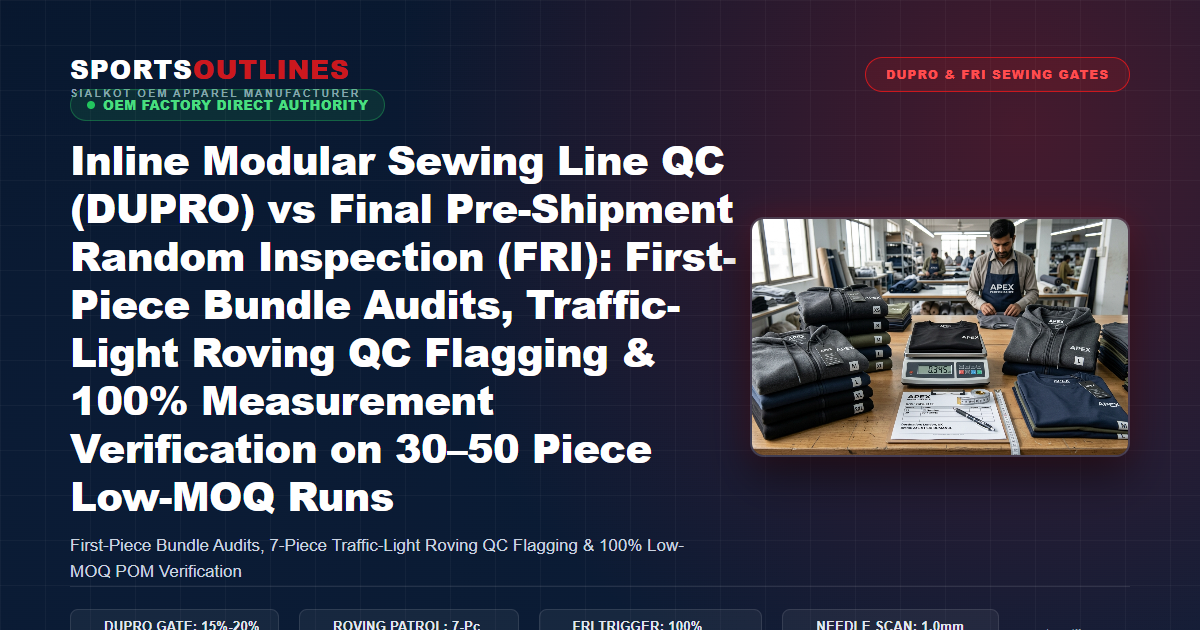
CLUSTER 6.3 TECHNICAL MONOGRAPH • INLINE DUPRO VS FINAL FRI ARCHITECTURE
Why Waiting for Final Pre-Shipment Inspection (FRI) Guarantees Production Delays—And How Inline Modular DUPRO Stops Sewing Defects at the Needle
Discovering a systematic collar puckering defect, an uncalibrated flatlock tension failure, or a 2.2 cm chest width shrinkage drift during a Final Random Inspection (FRI)—when 100% of your garments are already sewn, pressed, polybagged, and sealed inside export cartons—is a supply chain catastrophe. Unpicking and re-sewing finished athletic or heavyweight streetwear garments leaves permanent needle holes, destroys elastane recovery, and delays air-express launches by 2 to 3 weeks. This engineering guide breaks down the exact mechanics of During Production Inspection (DUPRO), First-Piece Bundle Audits, 7-Piece Traffic-Light Roving QC, and why 30–50 piece low-MOQ runs require 100% POM verification rather than statistical sampling.
Technical Monograph Directory
- The 4-Stage Apparel Production Quality Timeline: IPC, Inline Roving, DUPRO & FRI
- First-Piece Bundle Audits & Modular Cell Balancing: Catching Calibration Errors on Garment #1
- The 7-Piece Traffic-Light Roving QC System: Green, Yellow & Red Operator Station Flagging
- DUPRO (15%–20% Completion Gate) vs FRI (100% Sewn / 80% Packed): Corrective Economics
- 100% POM Verification & Metal Detection Protocols on 30–50 Piece Low-MOQ Runs
- Frequently Asked Questions (FAQ) on Inline DUPRO & Final Pre-Shipment QC
1. The 4-Stage Apparel Production Quality Timeline: IPC, Inline Roving, DUPRO & FRI
In high-velocity custom sportswear and heavyweight streetwear manufacturing—serving performance brands across the United States, United Kingdom, and Germany—quality cannot be inspected into a garment after it has already been sewn and packed. It must be engineered into the assembly line through a sequential four-stage quality gate architecture. While ISO 2859-1 (ANSI/ASQ Z1.4) AQL 2.5 and 4.0 statistical sampling defines the mathematical pass/fail criteria for finished lots, the timing of those inspections determines whether a defect costs $0.15 to prevent at the sewing needle or $18.00 per garment in scrapped fabric at the loading dock.
When an apparel factory relies solely on an end-of-line Final Random Inspection (FRI), any machine miscalibration—such as an overlock differential feed ratio set too high on 4-way stretch compression nylon, or an embroidery hoop tension set too tight on 500 GSM French terry—is replicated across hundreds of garments before a single QC inspector touches a tape measure. To eliminate systemic rework, industrial apparel engineering divides quality assurance into four synchronized operational gates:
- Gate 1 — Initial Production Check (IPC / 0% Sewn): Executed before the cutting table knife touches bulk fabric. Covers ASTM D5430 4-Point raw fabric inspection, 100 cm² circular GSM verification, D65 lightbox shade lot sorting, CAD marker shrinkage compensation checks, and pre-shrinking relaxation periods (24–48 hours unrolled relaxation for elastane knits).
- Gate 2 — Inline Modular Roving QC (1% to 100% Continuous Assembly): Executed continuously inside the modular sewing cell. Includes the mandatory First-Piece Bundle Audit at every machine station and hourly 7-Piece Traffic-Light Roving Patrols that audit stitch density (SPI), seam allowance, and needle integrity while panels are still flat.
- Gate 3 — During Production Inspection (DUPRO / 15%–20% Sewn): Executed as soon as the first 15% to 20% of completed garments exit the finishing and steam-pressing line. DUPRO validates that the live production run matches the approved golden prototype sample ($45–$85 development fee, 7–10 business days turnaround) across all graded sizes (XS to 5XL proportional grading), print curing fastness, and garment wash shrinkage before the remaining 80% of the order completes assembly.
- Gate 4 — Final Pre-Shipment Random Inspection (FRI / 100% Sewn & Minimum 80% Packed): The final release lock before freight booking. Verifies final visual workmanship, Point of Measurement (POM) dimensional accuracy, polybag barcode scan accuracy, silica gel anti-mold compliance, needle metal detection logs, and master carton drop-test readiness.
| QC Inspection Gate | Production Completion Trigger | Primary Engineering Focus | Sampling Protocol (Standard vs Low-MOQ 30–50 Pcs) | Rework Cost & Schedule Impact if Failed |
|---|---|---|---|---|
| 1. Initial Production Check (IPC) | 0% Sewn (Raw Material & Cutting Room) | ASTM D5430 4-Point roll audit, GSM cutter weight, D65 shade banding, CAD marker shrinkage allowance | 10%–20% of bulk rolls (100% of rolls on 30–50 pc low-MOQ cuts) | $0 sewing rework; defective roll swapped before knife cutting (0–1 day delay) |
| 2. Inline Modular Roving QC | Continuous (1%–100% Active Sewing Operations) | First-Piece Bundle Audit, SPI stitch density, thread tension, differential feed, seam allowance | Piece #1 of every cut bundle + 7 random pieces per operator every 60 minutes | $0.15–$0.40 per panel; fixed immediately at operator station (Zero schedule delay) |
| 3. During Production Inspection (DUPRO) | 15%–20% Finished Garments Exiting Pressing | Full POM spec verification across size curve, print/embroidery wash test, steam shrinkage validation | ISO 2859-1 Level II on completed stock (First 5–10 finished pcs on 30–50 pc runs) | $1.50–$3.00 per unit; corrective CAPA applied to remaining 80% of unsewn bundles (1-day adjustment) |
| 4. Final Random Inspection (FRI) | 100% Sewn, 100% Ironed, ≥ 80% Packed in Cartons | AQL 2.5 Major / 4.0 Minor visual audit, POM tolerance sign-off, polybag SKU/EAN scan, carton drop check | ISO 2859-1 Level II for bulk; 100% visual & POM audit for 30–50 pc low-MOQ orders | $8.00–$22.00+ per garment (100% unpacking, seam ripping, re-cutting panels, 10–18 day shipment delay) |
2. First-Piece Bundle Audits & Modular Cell Balancing: Catching Calibration Errors on Garment #1
Modern athletic and streetwear manufacturing inside our specialized production cells does not use chaotic nineteenth-century progressive bundle mountains where an operator sews 500 left sleeves into a bin before anyone attaches a collar. Instead, high-precision factories utilize Modular Cellular Manufacturing (Toyota Sewing System / TSS or Lean U-Shaped Cells) paired with small cut bundles of 10 to 25 garments per size and shade lot. To prevent a single setup mistake from contaminating an entire bundle, every sewing cell enforces the First-Piece Bundle Audit Protocol.
2.1 How the First-Piece Bundle Audit Works in Practice
When a cut bundle of panels (for example, 15 Medium heavyweight hoodies in Vintage Washed Charcoal from Shade Lot A) enters the modular sewing line, each machine operator—whether operating a 4-thread overlock (ISO 514), a 5-thread safety stitch (ISO 516), or a 4-needle 6-thread flatlock (ISO 607)—must sew only the very first piece (Piece #1) of that bundle and immediately hold it up for the Inline Cell Quality Supervisor before sewing Piece #2. The supervisor verifies five non-negotiable mechanical parameters against the physical Golden Sealed Sample hanging at the head of the line:
- Stitch Density (SPI — Stitches Per Inch): Checked using a 1-inch (2.54 cm) brass counting gauge window. Performance interlock and compression knits require 12–14 SPI to prevent seamgrinning under 4-way athletic stretch; heavyweight 450–600 GSM French terry requires 10–11 SPI so the needle does not perforate and chop the heavy cotton loop yarns.
- Differential Feed Ratio & Seam Wave Control: On synthetic elastane fabrics (gym and fitness wear), if the front feed dog moves slower than the rear feed dog, the seam stretches into a wavy “lettuce edge.” The first piece is laid completely flat on an inspection table to verify zero seam torque or waviness.
- Cut-Edge Trimmer Allowance: Overlock knives must trim exactly 1.5 mm to 2.0 mm of raw edge without biting into the pattern seam allowance. Biting 4 mm deeper per side across two side seams reduces total chest circumference by 1.6 cm—instantly pushing the garment out of POM tolerance.
- Ply Numbering & Shade Ticket Continuity: Every cut panel carries a removable thermal shade-lot sticker (e.g.,
Roll #04 - Ply #12). The First-Piece Audit confirms the operator is matching identical ply numbers for front body, back body, sleeves, and hood panels, preventing left-to-right metameric color mismatch. - Needle Point Integrity & Thread Looper Balance: Verifies that ballpoint needles (SES/SUK point) are installed for knits to part yarn loops rather than slice them, and that upper needle thread and lower looper thread interlock precisely at the center of the fabric cross-section.
3. The 7-Piece Traffic-Light Roving QC System: Green, Yellow & Red Operator Station Flagging
Even after a sewing machine passes its First-Piece Bundle Audit at 8:00 AM, mechanical drift occurs continuously during production. High-speed overlock and flatlock machines operating at 4,500 to 6,000 RPM generate needle friction heat exceeding 180°C, looper spring tension relaxes as bobbins/cones unwind, and cutting knives dull against abrasive polyester or heavy cotton fleece. To catch mechanical drift in real time, world-class factories deploy the 7-Piece Traffic-Light Roving QC System.
Above every individual sewing machine in the modular line hangs a tri-color steel card holder displaying a Green, Yellow, or Red status placard. A dedicated Roving Inline QC Inspector patrols every workstation on a strict 60-minute rotation, randomly pulling 7 consecutive completed pieces from the operator’s output chute and auditing both visual workmanship and critical sub-assembly measurements (such as neckband rib circumference, zipper placket symmetry, or gusset seam alignment).
| Traffic-Light Status Card | 7-Piece Audit Defect Threshold | Re-Inspection Frequency | Mandatory Floor Action & Line Stoppage Protocol |
|---|---|---|---|
| GREEN STATUS (Calibrated Operation) | 0 Defects found across 7 consecutive audited pieces (0/7) | Standard 60-minute roving patrol cycle | Operator continues normal production; timestamp and 0/7 score logged on station QC matrix card. |
| YELLOW STATUS (Early Drift Warning) | 1 Minor or Major defect found across 7 audited pieces (1/7) | Accelerated 20-minute re-verification cycle | Defective piece tagged for immediate repair; Roving QC audits 100% of pieces sewn since previous hourly check; operator must achieve two consecutive 0/7 checks (40 mins) to return to Green. |
| RED STATUS (Immediate Station Halt) | ≥ 2 Defects found across 7 pieces (2/7+) OR 1 Critical/Systematic POM failure | Line Station Halted until Mechanic & Line Leader sign-off | Machine power switched off immediately; Line Mechanic recalibrates tension/feed dogs/needle; 100% of current bundle quarantined and audited; requires 10 consecutive defect-free pieces to downgrade to Yellow. |
3.1 Critical Inline Sewing Checkpoints by Garment Zone
During a 7-piece roving patrol across custom sportswear and heavyweight streetwear cells, the inspector targets six high-risk assembly operations where 85% of final AQL defects originate:
- Neck Rib & Collar Attachment (Crewnecks, Jerseys, Polos): Auditing quarter-mark notch alignment (Center Front, Center Back, Left/Right Shoulder seams). If the operator stretches the 1×1 or 2×2 cotton/spandex rib unevenly while overlocking, the collar will torque, wave (“bacon neck”), or fail the minimum 30 cm–32 cm Head Pull-Through Extension Test.
- Armhole Scye & Raglan Sleeve Insertion: Verifying apex notch matching and back-shoulder mobilon (clear polyurethane) stay-tape tension. Missing or over-stretched mobilon tape causes shoulder seams to droop by 1.5 cm after the first steam press.
- Crotch Four-Way Intersection (“Cross-Seam” on Leggings, Shorts & Joggers): The four-way inseam/rise intersection (or diamond gusset vertex) must align within ≤ 2.0 mm (0.08 in). Misalignment > 3 mm is classified as a Major Workmanship Defect under ISO 2859-1.
- Flatlock (ISO 607) Activewear Chafe-Free Seams: Auditing the underside looper cover thread on compression leggings and rash guards to ensure the raw fabric cut edges are 100% encapsulated inside the 6-thread stitch matrix without exposed ridges or skipped top-cover spreader threads.
- Zipper Placket & Kangaroo Pocket Symmetry: Measuring left vs. right pocket height at the center zipper join (tolerance: ≤ 1.5 mm variance). Even a 3 mm step misalignment across a full-zip track jacket or hoodie is immediately visible to the naked eye.
- Bottom Hem Coverstitch (ISO 406 / 602): Checking inside looper thread security at the side-seam crossover ridge—the #1 zone for skipped stitches caused by needle deflection when climbing from 2 plies to 6 plies of heavy fleece fabric.
4. DUPRO (15%–20% Completion Gate) vs FRI (100% Sewn / 80% Packed): Corrective Economics
While Inline Roving QC monitors individual sewing operations on flat panels, During Production Inspection (DUPRO) evaluates the holistic, three-dimensional finished garment at the exact moment the first 15% to 20% of the bulk order emerges from final thread trimming, steam pressing, and embellishment curing. By contrast, Final Random Inspection (FRI) is executed only when 100% of the order is completely sewn and pressed, and at least 80% is polybagged and packed into export cartons.
4.1 Why Steam Pressing & Heat Curing Reveal Hidden Defects at DUPRO
A garment panel that measures perfectly flat at the sewing machine frequently shifts dimensions once it passes through high-temperature finishing equipment:
- Steam Tunnel & Vacuum Buck Relaxation: High-pressure steam (110°C–130°C) releases latent knitting tension acquired during fabric finishing and sewing feed-dog pulling. If the CAD pattern maker miscalculated longitudinal steam relaxation by 2.5%, a 74.0 cm body length hoodie will shrink to 72.1 cm after pressing—failing the ±1.5 cm tolerance. Discovering this at DUPRO (when only 15% of the lot is pressed) allows the finishing floor to switch to cold-vacuum framing or adjust bottom-hem folder depth on the remaining 85% of the order immediately.
- Screen Print Dryer & Sublimation Heat-Press Shrinkage: Passing a polyester performance tee or cotton hoodie through a 160°C–175°C infrared conveyor dryer for plastisol/silicone ink curing induces thermal shrinkage of 1.5% to 3.0%. DUPRO executes a live 5-cycle wash test and cross-hatch adhesion tape test on the first 15% of printed units to confirm zero ink cracking or garment shrinkage drift.
- Garment Dye & Enzyme/Acid Wash Calibration: On vintage streetwear batches, the first production dip (DUPRO vat) verifies that enzyme weight loss, potassium permanganate (PP) spray placement, and post-tumble POM measurements match the approved golden sample before the remaining 80% of greige sewn garments enter the industrial rotary washing drums.
| Inspection Parameter | During Production Inspection (DUPRO) | Final Pre-Shipment Random Inspection (FRI) | Strategic Engineering Advantage |
|---|---|---|---|
| Mandatory Completion Threshold | 15%–20% Finished Garments off the line; 80% still in cutting/sewing WIP | 100% Sewn & Pressed; ≥ 80% Polybagged & Packed into Export Master Cartons | DUPRO prevents mass defect propagation; FRI prevents unauthorized “shadow production” or post-audit carton swapping. |
| POM Size Curve Representation | Mandatory first-run output across all ordered sizes (XS–5XL) audited against Tech Pack | Proportional random pull across all packed cartons and size/colorway ratios | DUPRO catches grading step errors or hem folder drift while 80% of hems remain unsewn. |
| CAPA (Corrective & Preventive Action) Scope | Immediate machine recalibration, folder swap, or pressing temperature adjustment on live line | 100% Carton Unpacking + 100% Re-inspection Screening + Re-cutting irreparably damaged units | DUPRO preserves original ex-factory delivery date; FRI failure forces 7–15 day shipping reschedule. |
| Packaging, Barcode & Carton Audit | First-article check of woven neck labels, care tags, hangtags, and polybag suffocation warnings | Full carton assortment audit, EAN/UPC optical scan test, gross weight/CBM check, ISTA 1A carton drop test | FRI guarantees 3PL warehouse fulfillment readiness (Amazon FBA / Shopify 3PL compliance). |
5. 100% POM Verification & Metal Detection Protocols on 30–50 Piece Low-MOQ Runs
A critical mathematical reality of ISO 2859-1 (AQL 2.5 / 4.0) statistical sampling is that it was designed for large industrial lots of 500 to 35,000 units. When emerging athletic and streetwear brands execute agile launches at our 30–50 piece low factory MOQ per style/colorway (following approval of their $45–$85 non-refundable prototype sample delivered in 7–10 business days), standard ISO 2859-1 General Inspection Level II for a 35-piece lot dictates a sample size letter D—inspecting only 8 garments with an AQL 2.5 acceptance limit of Ac = 0, Re = 1.
5.1 Why We Replace Statistical Sampling with 100% Piece-by-Piece Inspection on 30–50 Piece Batches
On a 40-piece boutique production run split across five graded sizes (S: 6 pcs, M: 12 pcs, L: 12 pcs, XL: 6 pcs, 2XL: 4 pcs), pulling only 8 random garments means several sizes may only have 1 garment measured—leaving 32 garments (80% of your entire brand launch inventory) completely unchecked at final inspection. In a D2C drop where every single customer review impacts brand equity, statistical sampling on micro-lots is insufficient. Therefore, our factory QC architecture enforces a 100% Full-Lot Inspection Protocol on all 30–50 piece production runs:
- 100% Visual Workmanship & Trim Audit (Every Single Garment): All 30 to 50 garments are inspected inside-out and right-side-out on illuminated inspection tables for loose thread ends (> 3 mm), oil stains, skipped coverstitches, embroidery backing trim cleanliness, and care label accuracy.
- 100% Primary POM Dimensional Tape Verification: Instead of measuring only 3 to 5 garments per lot, our finishing QC team measures the 6 Primary Anchor POMs (Chest Width, Body Length, Shoulder Width, Sleeve Length, Waist Width, and Inseam/Outseam) on 100% of the 30–50 units, recording any garment that deviates beyond tolerance for immediate re-pressing or panel replacement before polybagging.
- 100% Ferrous Metal Needle Detection Gate (1.0 mm Fe Sensitivity): Broken sewing needle tips represent a Critical Defect (AQL 0.0) carrying severe product liability. First, our sewing floor enforces a strict Broken Needle Fragment Control Log: if an operator breaks a needle, a new needle is only issued by the tool crib after all broken fragments of the old needle are taped to the log sheet and accounted for. Second, before carton sealing, 100% of polybagged garments pass through a calibrated conveyor tunnel metal detector set to 1.0 mm–1.2 mm Ferrous (Fe) sphere sensitivity.
| Order Volume Tier | Inline Roving QC Protocol | DUPRO Trigger & Sample Size | Final Inspection (FRI) Visual Scope | Final POM Measurement Scope |
|---|---|---|---|---|
| 30–50 Pcs (Agile Low-MOQ Launch) | 100% First-Piece Bundle Audit + 7-Piece Traffic-Light Roving Check | First 5–10 finished units (20% gate) across all graded sizes | 100% of Units Inspected (30/30 to 50/50 garments) | 100% Primary POM Check + 2 Full 25-Point Tech Pack Audits per size |
| 51–150 Pcs (Growth Drop Batch) | 100% First-Piece Bundle Audit + Hourly 7-Piece Roving Patrol | 15%–20% completion (Code E/F: 13–20 units audited) | 100% Internal QC Screening + ISO 2859-1 Level II (Code F: 20 pcs, Ac=1/Re=2) | Minimum 3 garments per graded size (15–21 garments full POM matrix) |
| 151–500 Pcs (Mid-Scale Wholesale) | 100% First-Piece Bundle Audit + Hourly 7-Piece Roving Patrol | 15%–20% completion (Code G/H: 32–50 units audited) | ISO 2859-1 Level II (Code G: 32 pcs, Ac=2/Re=3 or Code H: 50 pcs, Ac=3/Re=4) | Minimum 4–5 garments per graded size across all colorways |
| 501–3,200 Pcs (Commercial Volume) | 100% First-Piece Bundle Audit + 60-Min Roving Statistical Control | 15%–20% completion (Code J/K: 80–125 units audited) | ISO 2859-1 Level II (Code J: 80 pcs, Ac=5/Re=6 or Code K: 125 pcs, Ac=7/Re=8) | ISO 2859-1 Special Inspection Level S-3 / S-4 (20–32 full POM audits) |
5.2 The Carton Selection & Photographic Audit Dossier Delivered Before Balance Payment
During Final Random Inspection (FRI), third-party inspectors (such as SGS, QIMA, Intertek, or Bureau Veritas) and our internal Quality Assurance Engineering team strictly verify the 100% Sewn / 80% Packed Rule. Why leave up to 20% in the final packing queue? It allows the inspector to observe live folding, tissue layering, desiccant placement, and metal detector conveyor passage while simultaneously pulling random cartons from the 80% already sealed on pallets. For every order—whether a 30-piece startup drop or a 3,000-piece retail program—brands receive a timestamped Digital QC Inspection Dossier prior to final freight release containing:
- High-Resolution POM Tape Photos: Overhead flat-lay photographs showing the physical fiberglass/steel tape measure resting across Chest Width, Body Length, Waistband, and Inseam for each graded size.
- Embellishment & Trim Macro Shots: Macro close-ups of 3D puff embroidery, high-density silicone heat transfers, woven main labels, wash-care content tags, and custom zipper pullers.
- Grammage & Moisture Verification: Digital scale photo of the garment unit weight and digital hygrometer probe photo confirming packed garment moisture content is ≤ 8% for synthetics and ≤ 10%–12% for heavy cotton prior to ocean or air transit.
- Barcode Optical Scan & Master Carton Check: Smartphone/laser scanner verification of FNSKU/EAN-13 polybag stickers plus external shipping mark photos showing Gross Weight (kg), Net Weight (kg), and Carton Dimensions (L × W × H cm).
6. Frequently Asked Questions (FAQ) on Inline DUPRO & Final Pre-Shipment QC
1. Why is DUPRO performed at 15%–20% production completion instead of 50%?
In modular apparel manufacturing, by the time 50% of finished garments have exited the steam pressing and packing line, the remaining 50% of the order has already been completely cut and 80%–90% sewn inside the modular cells. Conducting DUPRO at the 15%–20% finished mark ensures that the first full size curve (XS to 5XL) has passed through sewing, embellishment curing, and steam pressing while 80% of the bulk bundles are still unsewn, allowing immediate machine, folder, or pressing adjustments with zero mass rework.
2. How does the 7-Piece Traffic-Light Roving QC System prevent sewing defects?
A dedicated Roving QC Inspector visits every sewing machine station once per hour and audits 7 consecutive pieces from the operator’s output chute. Zero defects (0/7) keeps the station on a Green card. One defect (1/7) flips the station to a Yellow warning card, triggering 100% retroactive screening since the previous check and a 20-minute re-inspection cycle. Two or more defects (2/7+) flips the station to a Red halt card, shutting off the machine until a mechanic recalibrates tension, feed dogs, or needles.
3. Why must 100% of garments be sewn and 80% packed before booking a Final Random Inspection (FRI)?
If a factory conducts FRI when only 60% of the order is sewn, the remaining 40% is rushed through the sewing and pressing lines after the inspector leaves—frequently with higher defect rates and zero external oversight. Requiring 100% sewn and at least 80% packed in sealed cartons guarantees that the random sample pulled using the √N carton rule truly represents the exact goods that will be loaded onto the aircraft or ocean container.
4. How do you handle QC inspection on low-MOQ runs of 30–50 pieces per style?
Because ISO 2859-1 Level II only samples 8 pieces on a 30–50 piece lot (Code Letter D), relying purely on statistical sampling leaves 80% of a boutique drop unmeasured. On all 30–50 piece low-MOQ production runs, our factory executes a 100% piece-by-piece visual workmanship audit, 100% Primary POM tape verification, and 100% conveyor metal detection after you approve your $45–$85 prototype sample (7–10 business days turnaround).
Pingback: Third-Party Apparel Inspection Agencies (SGS, QIMA, Intertek, Bureau Veritas) vs Sialkot Factory Digital-Twin Video QC Dossiers: When to Book a $299 Man-Day Audit vs Live 4K Pre-Shipment Walkthroughs - Sports Outlines