
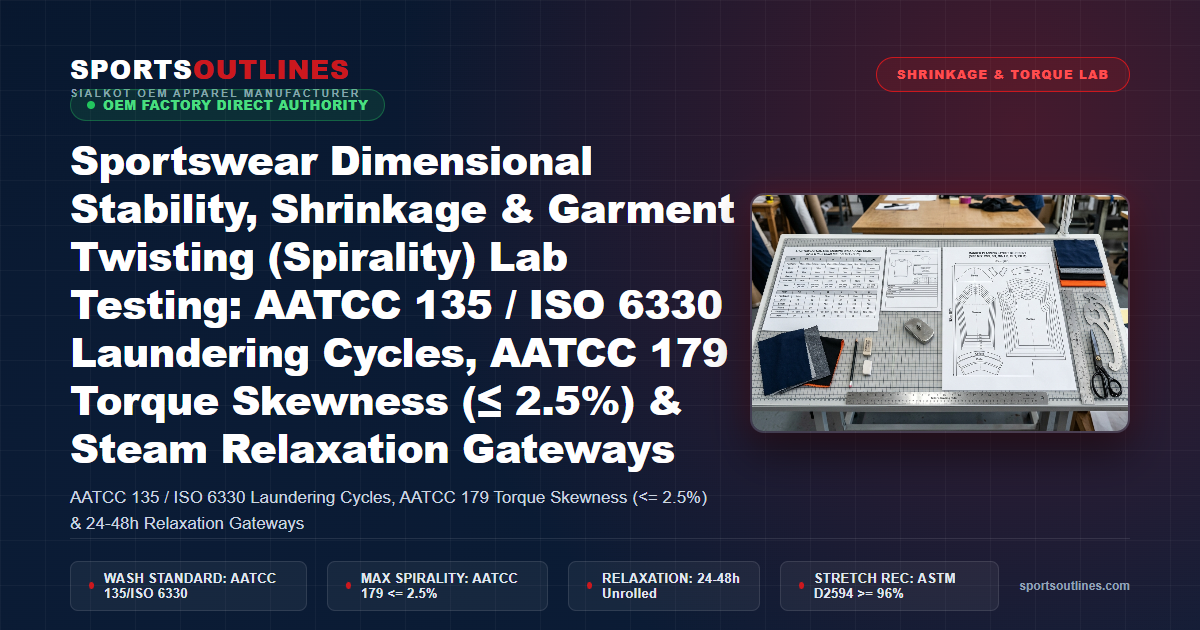
CLUSTER 6.3 TECHNICAL MONOGRAPH • SHRINKAGE & SPIRALITY LAB ENGINEERING
Why Garments Shrink 6% in Length or Twist Around the Torso After One Wash—And How AATCC 135, ISO 6330 & AATCC 179 Lab Protocols Lock In Dimensional Stability
A custom hoodie or athletic tee that fits perfectly out of the polybag but loses 4.5 cm (1.75 in) in body length or twists its side seams 4 cm across the wearer’s stomach after the first home wash destroys customer LTV and triggers immediate chargebacks. In knit textile engineering, post-laundering dimensional failure is governed by two distinct physical forces: relaxation/consolidation shrinkage (measured via AATCC 135 / AATCC 150 in North America and ISO 6330 / ISO 5077 in Europe/UK) and helical yarn torque spirality (measured via AATCC 179 / ISO 16322). This monograph details the exact laboratory test parameters, mathematical formulas, mill compaction gateways, and CAD marker shrinkage compensation rules we enforce on every production lot.
Technical Monograph Directory
- The Physics of Textile Shrinkage: Relaxation vs. Swelling vs. Elastane Thermal Recovery
- AATCC 135 / AATCC 150 vs. ISO 6330 / ISO 5077: Laundering Test Cycles & Benchmark Math
- Garment Twisting & Side-Seam Spirality (Torque): AATCC 179 / ISO 16322 Mechanics (≤ 2.5%–3.0%)
- Mill Compaction, Sanforizing, Heat-Setting & 24–48 Hour Cutting Table Relaxation Gateways
- CAD Pattern Shrinkage Compensation Math & Low-MOQ (30–50 Pc) Wash-Test Verification
- Frequently Asked Questions (FAQ) on Apparel Shrinkage & Spirality Testing
1. The Physics of Textile Shrinkage: Relaxation vs. Swelling vs. Elastane Thermal Recovery
For athletic and streetwear brands scaling across the United States, United Kingdom, and Australia, understanding why a fabric shrinks or grows during laundering is the prerequisite to controlling it. During circular knitting, dyeing, hydro-extraction, and stenter frame drying, textile yarns are subjected to high longitudinal (wale-wise/warp) mechanical tension. Because knit loops are stretched into elongated ovals rather than resting in their lowest-energy circular state, the finished fabric roll stores elastic potential energy known as latent processing strain.
When the consumer submerges that garment into warm water with surfactant detergent and mechanical agitation, followed by heated tumble drying, three physical mechanisms activate simultaneously:
- Relaxation Shrinkage (Mechanical Loop Recovery): Water acts as a plasticizer and lubricant between yarn intersections, allowing the elongated knit loops to snap back toward their equilibrium geometry. Without pre-shrinking compaction at the mill, standard single jersey or French terry knits exhibit -7% to -11% lengthwise relaxation shrinkage on the very first wash.
- Hydrophilic Fiber Swelling Shrinkage (Cellulosic Absorption): Natural cellulosic fibers (100% combed ringspun cotton, organic cotton, modal, and bamboo viscose) absorb water molecules into their amorphous regions, causing the fiber diameter to swell radially by 15% to 25%. Because yarns must bend around thicker swollen intersecting yarns, the overall length of the fabric contracts further.
- Elastane Thermal Recovery & Over-Compaction “Growth” (+% Extension): In synthetic compression fabrics (e.g., 78% Nylon / 22% Lycra® 240 GSM interlock) or over-compacted cotton fleece, if the fabric was over-fed too aggressively into the compacting shoe or improperly heat-set below 190°C, laundering can actually cause the garment to grow (+1.5% to +3.0% widthwise or lengthwise), leading to baggy knee-out or waist sagging.
2. AATCC 135 / AATCC 150 vs. ISO 6330 / ISO 5077: Laundering Test Cycles & Benchmark Math
Before bulk cutting begins—immediately alongside ASTM D5430 4-Point incoming roll inspection—our textile testing laboratory cuts conditioning specimens from every dye lot to measure Dimensional Stability to Washing (DSW). Depending on the target destination market, two primary international laboratory standards govern shrinkage testing:
- North American Standard — AATCC TM135 (Fabrics) & AATCC TM150 (Finished Garments): Utilizes a calibrated top-loading agitator or high-efficiency ballast washer (1.8 kg / 4.0 lb total load with Type 1 or Type 3 ballast sheets and 1993 AATCC Standard Reference Detergent) paired with a stackable tumble dryer or flat screen rack.
- European / UK / ISO Global Standard — ISO 6330 (Washing/Drying Procedures) & ISO 3759 / ISO 5077 (Preparation & Calculation): Utilizes a horizontal-axis front-loading Wascator FOM71 CLS programmable reference washing machine with 2.0 kg dry load (100% polyester multi-layer ballast) and ECE Reference Detergent.
2.1 The 350 mm × 350 mm Three-Pair Benchmark Calculation Formula
Under ISO 3759 and AATCC TM135, a fabric swatch measuring at least 500 mm × 500 mm (20 in × 20 in) is pre-conditioned for a minimum of 4 hours (up to 24 hours) in a standard tropical/temperate laboratory atmosphere of 20°C ± 2°C (68°F) and 65% ± 4% Relative Humidity (ASTM D1776 / ISO 139). Using an indelible acrylic template, the technician marks three parallel pairs of benchmarks in the Length/Wale direction ($L_1, L_2, L_3$) and three parallel pairs in the Width/Course direction ($W_1, W_2, W_3$), each spaced exactly 350.0 mm (or 250.0 mm / 10.0 in) apart and at least 50 mm inside the overlocked specimen edge.
After executing 3 complete wash-and-dry cycles (or 5 cycles for institutional teamwear) and re-conditioning at 20°C / 65% RH, the final distance between each benchmark pair is measured to the nearest 0.5 mm. Dimensional change ($\%DC$) is calculated as:
Example (450 GSM Brushed Fleece Length):
L_0 = 350.0 mm | L_f (after 3 washes + tumble dry) = 339.5 mm
%DC = [ (339.5 – 350.0) / 350.0 ] × 100 = -3.00% Shrinkage (Negative ‘-‘ denotes shrinkage; Positive ‘+’ denotes growth/extension)
| Sportswear / Streetwear Fabric Architecture | Standard Lab Test Method & Cycle | Max Lengthwise (Wale/Warp) Tolerance | Max Widthwise (Course/Weft) Tolerance | Max Spirality / Skewness (AATCC 179) |
|---|---|---|---|---|
| 100% Polyester Interlock / Birdseye Mesh (140–180 GSM) | AATCC 135 (1)III(A)iii / ISO 6330 4N (40°C Normal + Tumble Dry Low) | -2.0% to +1.0% | -2.0% to +1.0% | ≤ 1.5% |
| Nylon/Spandex & Poly/Spandex Compression (220–280 GSM) | AATCC 135 (1)II(A)ii / ISO 6330 3G (30°C Gentle + Line/Flat Dry) | -3.0% to +1.5% | -3.0% to +1.5% | ≤ 2.0% |
| 100% Combed Ringspun Cotton Single Jersey (200–300 GSM) | AATCC 135 (1)III(A)i / ISO 6330 3N (30°C–40°C Wash + Tumble/Line Dry) | -4.5% to +1.0% (-2.5% if Pre-Washed) | -4.5% to +1.0% (-2.5% if Pre-Washed) | ≤ 3.0% (≤ 2.5% Double-Yarn) |
| Heavyweight Cotton French Terry & Fleece (400–600 GSM) | AATCC 150 (1)III(A)iii / ISO 6330 3N (30°C Wash + Flat/Low Tumble) | -4.0% to +1.0% (-2.0% Garment Dyed) | -4.0% to +1.0% (-2.0% Garment Dyed) | ≤ 2.5% |
| 1×1 & 2×2 Cotton/Spandex Cuff & Neck Ribbing (380–520 GSM) | AATCC 135 (1)III(A)iii / ISO 6330 3N | -4.5% to +1.0% | -5.0% to +2.0% (≥ 92% Elastic Recovery) | ≤ 2.5% |
| Woven Ripstop, Taslan Nylon & 4-Way Stretch Shorts (120–190 GSM) | AATCC 135 (1)III(A)ii / ISO 6330 4N | -1.5% to +0.5% | -1.5% to +0.5% | ≤ 1.5% (Bow/Skew) |
3. Garment Twisting & Side-Seam Spirality (Torque): AATCC 179 / ISO 16322 Mechanics (≤ 2.5%–3.0%)
Even when a T-shirt or hoodie passes lengthwise and widthwise shrinkage limits, it can still be completely unwearable due to Spirality (also called Torque or Garment Skewness)—the phenomenon where the vertical side seams of a t-shirt, polo, or jogger pant twist diagonally toward the center front and center back after washing. Under ISO 2859-1 AQL 2.5 defect taxonomy, any garment exhibiting side-seam twisting exceeding 2.5% to 3.0% (or > 1.5 cm linear displacement on a 70 cm body length) is rejected as a Major Defect.
3.1 The 3 Root Causes of Single-Jersey & Fleece Spirality
- Residual Z-Twist Yarn Torque (Twist Multiplier $TM > 3.8$): Conventional ring-spun cotton yarn is spun in a clockwise “Z-twist” direction. When a single Z-twist yarn is knitted into a single-jersey structure (where all loops face the same direction without a counter-balancing back loop like interlock or rib), the yarn attempts to untwist when wetted in the wash, inclining every vertical wale column at an angle $ heta$ away from 90°.
- High-Feeder Circular Knitting Drop Angle (1.5 to 3.2 Feeders per Inch): Modern high-output circular knitting machines utilize 72, 90, or 108 yarn feeders around a 30-inch cylinder so that 90 courses are knitted during a single 360° rotation. This creates a steep helical spiral angle (similar to the threads on a screw), causing the horizontal courses to meet the vertical wales at an acute angle rather than a perpendicular right angle.
- Improper Stenter Pinning & Slitting Off-Grain: When tubular knit fabric is slit open into open-width rolls and fed onto a stenter drying frame, if the optical weft-straightener fails to align the wale columns parallel to the selvedge before heat-setting/compacting, the skew is temporarily pressed flat by steam—only to snap violently back into a diagonal twist during the customer’s first wash.
3.2 AATCC TM179 (Method 1 & Method 2) & ISO 16322-2 / 16322-3 Spirality Equations
Under AATCC TM179 Option 1 (Square Marked Fabric Specimen) and Option 2 (Garment Side-Seam Displacement), spirality/skewness ($\%S$) is quantified after 3 standard laundering cycles using two precise geometric formulas:
% Skewness = [ 2 × | Diagonal AC – Diagonal BD | / (Diagonal AC + Diagonal BD) ] × 100
2. AATCC 179 Method 2 / ISO 16322-3 (Garment Side-Seam Displacement):
% Spirality = ( Horizontal Seam Shift ‘AA'’ in mm / Original Vertical Side-Seam Length ‘AB’ in mm ) × 100
Example: On a 450 mm vertical tee side-seam (armpit to hem), if the bottom hem seam shifts 9.0 mm forward after washing:
% Spirality = (9.0 / 450.0) × 100 = 2.00% (PASS — Within ≤ 2.5%–3.0% Limit)
| Knit Structure & Yarn Engineering Method | Typical Uncontrolled Spirality | Engineered Counter-Torque Mechanism | Achieved Post-Wash Spirality (AATCC 179) |
|---|---|---|---|
| Standard Single-End Z-Twist 100% Cotton Single Jersey (20s/1 or 24s/1) | 5.5% to 9.0% (FAIL) | Low Twist Multiplier ($TM \le 3.5$) + Steam Relaxation + Open-Width Felt Compaction | 2.2% to 2.8% (PASS) |
| S+Z Alternating Feeder or Two-Ply Balanced Yarn Jersey (32s/2 or 40s/2) | 4.0% to 6.5% (if single Z) | Alternating S-twist and Z-twist yarn cones on even/odd knitting feeders or S-on-Z plied yarn torque cancellation | 0.5% to 1.4% (ELITE PASS) |
| 3-End Diagonal Heavyweight French Terry / Brushed Fleece (420–550 GSM) | 3.5% to 5.5% | 2×1 Diagonal Tie-Yarn Balance + Optical Weft-Straightener Stenter Pinning + Compressive Felt Compactor | 1.2% to 2.2% (PASS) |
| Double-Knit Interlock & Ponte Roma Activewear (240–340 GSM) | 1.0% to 2.0% | Inherent symmetrical front-and-back needle bed loop equilibrium + 195°C Elastane Heat-Setting | 0.3% to 1.0% (ELITE PASS) |
4. Mill Compaction, Sanforizing, Heat-Setting & 24–48 Hour Cutting Table Relaxation Gateways
Achieving ≤ 3% shrinkage and ≤ 2.5% spirality requires four deterministic mechanical interventions before a single panel is sewn on the inline modular sewing floor:
- Open-Width Compressive Felt Compaction (For Knits) & Sanforizing (For Wovens): After dyeing and stenter drying, open-width cotton knits pass through a dual-felt Ferraro or Santex compressive compactor with +12% to +18% overfeed under live saturated steam. The heated rubber/felt blanket mechanically pushes the elongated knit courses closer together, pre-consolidating the loops so residual home-wash shrinkage drops from -9% down to -2.5% to -3.5%.
- 190°C–198°C Stenter Thermofixation (Heat-Setting for Elastane/Spandex): For compression gym wear and 4-way stretch fabrics containing 8%–25% elastane (Lycra®/Creora®), the fabric must be heat-set at 190°C–195°C for 45–60 seconds prior to dyeing. Heat-setting below 185°C fails to lock the polyurethane hard segments at the new width, resulting in severe -6% width shrinkage during garment sublimation or washing; heat-setting above 205°C degrades elastane modulus and yellows nylon fibers.
- Industrial Tumble Pre-Shrinking (Zero-Shrink Vintage Streetwear): For ultra-heavyweight 480–600 GSM custom streetwear hoodies and tees marketed as “Pre-Shrunk / Zero Shrinkage,” we either garment-wash the sewn piece in industrial rotary extractors or pass the fabric rolls through a tensionless relaxing tumble dryer prior to cutting, reducing residual consumer shrinkage to ≤ 1.0%–1.5%.
- Mandatory 24–48 Hour Unrolled Cutting Room Relaxation: When fabric rolls are wound onto cardboard tubes under tension at the finishing mill, the fabric stretches by 1.5% to 3.0% on the roll. If a factory unrolls the fabric onto the cutting table and immediately slices it with a vertical knife, the cut panels will shrink by 1.5 cm overnight before reaching the sewing machine! Our cutting room SOP mandates unrolling all knit fabric into tensionless accordion folds (“festooning/book-folding”) on racks for 24 hours (100% cotton/poly knits) to 48 hours (elastane/spandex compression knits) before spreading and cutting.
| Fabric Class & Elastane Content | Mill Pre-Shrinkage Finishing Process | Mandatory Unrolled Relaxation Time | Max Spreading Lay Height (Plies) | Steam Iron / Tunnel Shrinkage Test Gate |
|---|---|---|---|---|
| 100% Polyester Performance Knits (0% Elastane) | 185°C–190°C Stenter Heat-Setting | Minimum 12–24 Hours (Tensionless Fold) | Up to 60–80 Plies (Anti-fusion wax knife) | 50cm × 50cm Sublimation Heat-Press Shrinkage Test (205°C / 35s) |
| 100% Cotton Jersey & French Terry (0% Elastane) | Open-Width Felt Compaction (+15% Overfeed) | Minimum 24 Hours at 20°C / 65% RH | 30–50 Plies (Fleece: 20–30 Plies max) | 50cm × 50cm Vacuum Steam Buck Relaxation Test |
| Cotton/Spandex & Modal/Spandex Blends (4%–8% Elastane) | 192°C Pre-Heat-Set + Felt Compaction | Minimum 36–48 Hours (Flat Rack) | 25–35 Plies (Zero-tension cradle spreader) | Steam Buck + AATCC 135 3-Cycle Wash Verification |
| High-Compression Nylon/Lycra® (18%–28% Elastane) | 195°C Stenter Pin-Frame Thermofixation | Mandatory 48 Hours (Flat Tensionless) | 20–30 Plies Max (Prevents bottom-ply compression) | Steam Relaxation + ASTM D2594 Elastic Recovery Audit |
5. CAD Pattern Shrinkage Compensation Math & Low-MOQ (30–50 Pc) Wash-Test Verification
Even a well-compacted fabric roll can exhibit two distinct shrinkage events inside the garment factory itself: (1) In-Factory Processing Shrinkage (during rotary screen-print tunnel curing at 165°C, full-panel sublimation pressing at 205°C, garment enzyme washing, or final steam-buck pressing), and (2) Post-Purchase Consumer Laundering Shrinkage. If a pattern maker cuts the raw fabric to the exact finished Tech Pack POM dimensions without compensating for in-factory shrinkage, the garment will already be 2 cm too short before it ever enters a polybag.
5.1 The Exact CAD Marker Shrinkage Allowance Formula
In Optitex, Clo3D, and Gerber AccuMark CAD systems, pattern engineers do not simply add the shrinkage percentage—they divide by $(1 – S)$ so that when the cut panel shrinks by $S\%$, it lands strictly on the target finished POM ($D_{target}$):
Worked Production Example (Pigment-Dyed Heavyweight Hoodie Body Length):
• Target Finished HSP Body Length (Size L): 74.0 cm
• Lab-Tested In-Factory Enzyme/Pigment Wash Length Shrinkage: -5.0% (Width Shrinkage: -3.0%)
• Required Net Cut Length (before seam allowance) = 74.0 / (1 – 0.05) = 74.0 / 0.95 = 77.89 cm (+3.89 cm allowance)
• Verification after -5.0% rotary garment wash: 77.89 cm × 0.95 = 74.00 cm (Exact Tech Pack Target Hit!)
| Production Process Pathway | Typical Length Shrinkage ($S_L$) | Typical Width Shrinkage ($S_W$) | Target 74.0 cm Length → Cut Pattern Length | Target 60.0 cm Chest → Cut Pattern Half-Chest |
|---|---|---|---|---|
| Cut-and-Sew Piece-Dyed Fleece (Steam Press Only) | -1.5% (Steam Relaxation) | -1.0% (Steam Relaxation) | 75.13 cm (+1.13 cm buffer) | 60.61 cm (+0.61 cm buffer) |
| Full-Back Plastisol / Puff Print (165°C Conveyor Dryer) | -2.5% (Thermal Cure) | -1.5% (Thermal Cure) | 75.90 cm (+1.90 cm buffer) | 60.91 cm (+0.91 cm buffer) |
| Cut-Panel Dye Sublimation (205°C Calender Roll / Flatbed) | -2.0% to -3.0% (Pre-Cut Roll or Post-Press Cut) | -2.0% to -2.5% | 76.29 cm (or Sublimate Roll First, Then Laser Cut) | 61.54 cm (Zero if Laser-Cut Post-Sublimation) |
| Garment Enzyme / Acid / Pigment Dye Wash (55°C Drum + Tumble) | -5.0% to -7.0% | -3.0% to -4.5% | 77.89 cm to 79.57 cm (+3.89 to +5.57 cm) | 61.86 cm to 62.83 cm (+1.86 to +2.83 cm) |
5.2 How Shrinkage & Spirality Are Validated on $45–$85 Prototypes & 30–50 Piece Runs
Whether you are ordering a 30–50 piece low-MOQ batch per style/colorway or a 2,500-unit commercial run, we eliminate shrinkage guesswork during the $45–$85 non-refundable prototype sampling phase (7–10 business days turnaround). Before sewing your physical prototype, our lab executes a 50 cm × 50 cm (20 in × 20 in) Shrinkage & Spirality Box Test on the exact bulk-equivalent fabric roll—subjecting the swatch to the identical sublimation heat press, screen-print dryer, or garment wash recipe plus a 3-cycle AATCC 135 home laundering simulation. The resulting exact lengthwise and widthwise shrinkage coefficients are locked into your digital CAD pattern file, ensuring your bulk production fits identically both out of the box and after 20 customer washes.
5.3 ASTM D2594 & ASTM D3107 Elastic Stretch, Growth & Recovery Auditing for Compression Activewear
For 4-way stretch compression leggings, cycling bibs, BJJ rash guards, and seamless gym tops, dimensional stability is not limited to hot-water washing shrinkage—it also requires controlling Unrecovered Elastic Growth (Bagging / Sagging) under sustained mechanical tension during athletic movement. If a 250 GSM Nylon/Spandex legging stretches by 60% across the kneecap or glute during a 60-minute squat session and fails to snap back to at least 95% of its original dimension within 60 seconds of removal, the garment develops permanent “knee bags” and waistband roll-down.
To prevent elastic fatigue, our laboratory audits every compression fabric lot under ASTM D2594 (Standard Test Method for Stretch Properties of Knitted Fabrics Having Low Power) and BS EN 14704-1 (Determination of the Elasticity of Fabrics) using an Instron CRE (Constant-Rate-of-Extension) tensiometer and a static dead-weight extension hanger:
- 5-Cycle Dynamic Hysteresis Loop (EN 14704-1): A 50 mm × 250 mm fabric strip (in both Wale/Length and Course/Width directions) is cycled 5 times between zero load and a 15 Newton to 30 Newton target athletic load at 100 mm/min. High-grade 78% Polyamide / 22% Lycra® interlock must demonstrate 110% to 145% elongation in length and 90% to 125% elongation in width without elastane core slippage (“grin-through”).
- Static 2-Hour Extension & 60-Minute Elastic Recovery Rate: The specimen is clamped at a fixed 35% (low-power) or 50% (high-compression) extension for 2.0 hours, released, and measured at 60 seconds and 60 minutes. Our strict acceptance threshold requires ≥ 93.0% immediate recovery at 60 seconds and ≥ 96.5% recovery at 60 minutes (meaning unrecovered fabric growth is strictly ≤ 3.5%).
- 1×1 & 2×2 Heavyweight Streetwear Ribbing Recovery: Hoodie cuffs and waistbands knitted with 95% Combed Cotton / 5% Elastane (450–520 GSM) are stretched to +40% extension for 10 cycles. Any ribbing lot exhibiting more than 5.0% permanent growth is rejected before cuff cutting to prevent blown-out, floppy wrists on heavyweight hoodies.
5.4 Roll-to-Roll Calender Sublimation vs. Cut-Panel Flatbed Heat-Press Shrinkage Control
In custom sublimated teamwear (soccer jerseys, basketball uniforms, rugby kits, and rash guards), polyester fibers are subjected to 202°C to 210°C (395°F–410°F) for 30 to 45 seconds to transition solid disperse ink into a gas that penetrates the amorphous regions of the polyester polymer. If a factory cuts white polyester panels first and presses them on a manual flatbed heat press without pre-shrinking, the panel shrinks unevenly by -2.2% to -3.8% during pressing—causing white unprinted border gaps (“ghost edges”) along the side seams and shrinking a Large jersey down to a Medium.
Our sublimation engineering floor eliminates thermal press distortion using a dual-protocol workflow:
- Pre-Sublimation Blank Roll Calendering (212°C Blank Pass) or Roll-to-Roll Printing + Vision Laser Cutting: For all-over sublimated sportswear, we print roll-to-roll through a continuous oil-heated rotary drum calender at 205°C, allowing 100% of the thermal shrinkage to occur while the fabric is still an uncut roll. Once cooled and relaxed for 12 hours, our overhead optical-camera CNC laser cutter reads the printed registration marks and cuts the exact post-shrunk panel contour—achieving 0.0% thermal sewing distortion and ≤ 1.0% lifetime home-laundering shrinkage.
- Cut-Panel Pre-Shrinking Pass for Cut-and-Sew Placement Sublimation: When individual cut panels must be pressed on a hydraulic flatbed press, the raw white fabric roll is first passed through the 210°C rotary calender cylinder prior to cutting, pre-exhausting thermal shrinkage so the cut panel remains rock-solid during placement transfer pressing.
6. Frequently Asked Questions (FAQ) on Apparel Shrinkage & Spirality Testing
1. What is the difference between AATCC 135, AATCC 150, and ISO 6330 shrinkage testing?
AATCC TM135 measures dimensional stability on flat fabric specimens (typically marked with 350 mm or 250 mm benchmarks), while AATCC TM150 tests complete sewn garments across actual POM points (Chest, Length, Sleeve) using North American top-loading or high-efficiency laundry equipment. ISO 6330 (paired with ISO 3759 and ISO 5077) is the European and global standard utilizing horizontal front-loading Wascator reference washing machines at precise temperatures (30°C, 40°C, or 60°C).
2. What causes a T-shirt side seam to twist (spirality) after washing, and what is the maximum acceptable limit?
Side-seam twisting (spirality/torque) is caused by residual Z-twist spinning torque in single-end cotton yarns combined with the helical drop angle of multi-feeder circular knitting machines and off-grain stenter pinning. Under AATCC TM179 and ISO 16322, premium sportswear and streetwear require post-wash spirality to remain strictly ≤ 2.5% to 3.0% (achieved via S+Z balanced yarns, two-ply yarns, or open-width felt compaction).
3. Why must knit and spandex fabric rolls rest for 24 to 48 hours before cutting?
Rolling fabric onto cardboard cores under winding tension elongates knit loops by 1.5% to 3.0%. Cutting the fabric immediately off the roll causes the cut panels to contract overnight on the sewing floor before assembly. Unrolling knit fabrics into tensionless accordion folds for 24 hours (cotton/polyester) to 48 hours (elastane/spandex compression) allows complete elastic relaxation before the cutting knife touches the lay.
4. Can we achieve zero shrinkage (≤ 1.5%) on 30–50 piece low-MOQ heavyweight hoodies and tees?
Yes. On our 30–50 piece low factory MOQ per style/colorway, we combine open-width pre-compacted fabric with either pre-cut tumble relaxation or post-sew rotary garment washing, calibrated using CAD pattern shrinkage allowances verified during your $45–$85 prototype sample (7–10 business days turnaround).

Pingback: Mechanical Durability Lab Testing for Sportswear & Combat Gear: ASTM D4966 Martindale Abrasion, ICI Box Pilling (ISO 12945), Mullen/Pneumatic Diaphragm Burst (ISO 13938) & Instron Seam Slippage - Sports Outlines