SUB-CLUSTER 6.4 HALFWAY MILESTONE (5/10) • 465TH LIVE TECHNICAL MONOGRAPH
How 35 Liters of Hidden Water Vapor Inside a Sealed Sea Container Turns Into “Container Rain”—And Our 5-Stage Hygroscopic Defense System That Protects Cotton Fleece, Sublimated Knits & Cowhide Boxing Gear Across 35-Day Ocean Voyages
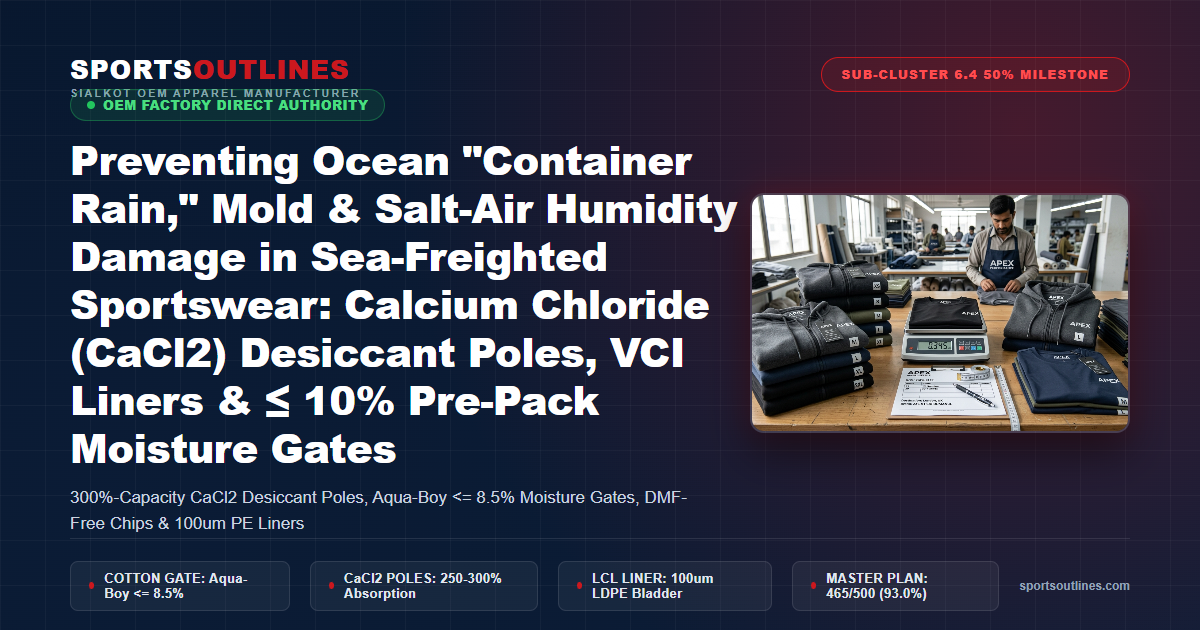
When a brand switches from 4-day Air Express to 32-day Ocean LCL or FCL to save $3.50 per hoodie, the greatest physical threat to the inventory is not rough seas—it is psychrometric condensation (“Container Rain” and “Cargo Sweat”). A container loaded during Pakistan’s July–September monsoon season or steamed on the finishing line without a dehumidified curing room locks up to 30 to 45 liters of bound water inside the cotton fibers, leather hides, and corrugated cardboard walls. As the vessel sails from the `48°C` Arabian Sea / Suez Canal deck temperatures into `5°C` North Atlantic or Pacific night air, the steel container roof crosses the dew point and literally rains condensation droplets onto your top-tier cartons—triggering Aspergillus niger mildew blooms, crushed wet boxes, and oxidized metal zippers. This 465th live engineering monograph details our mandatory 5-stage anti-moisture protocol.
Technical Monograph Directory
- The Psychrometrics of Ocean “Container Rain” & “Cargo Sweat”: Why Sealed Garments Mold During 30-Day Sea Transit
- Gate #1 — Pre-Pack Digital Moisture Meter Auditing (Aqua-Boy / Delmhorst): Enforcing ≤ 8.5% Cotton & ≤ 12% Carton Regain
- Gate #2 — Why Silica Gel Packets Fail at Sea vs. 300%-Absorption Calcium Chloride (CaCl2) + Starch Gel Desiccant Poles
- Gate #3 — EU REACH Compliant (DMF-Free) Anti-Mold Chips & VCI Corrosion Protection for Leather Gear & Metal Hardware
- Gate #4 & #5 — Master Carton 100-Micron LDPE Vapor-Barrier Bladder Liners & FCL Container Dry-Out Pre-Inspection
- Frequently Asked Questions (FAQ) on Preventing Mold & Humidity Damage in Sea-Freighted Apparel
1. The Psychrometrics of Ocean “Container Rain” & “Cargo Sweat”: Why Sealed Garments Mold During 30-Day Sea Transit
Why does a batch of custom 450 GSM cotton-fleece hoodies or drum-dyed cowhide boxing gloves look bone-dry when packed in Sialkot, yet arrive in Los Angeles, Felixstowe, or Hamburg 34 days later smelling of musty fungal spores (`Aspergillus`, `Penicillium`, and `Cladosporium`) with water-stained outer cartons? The phenomenon is governed by hygroscopic equilibrium moisture content (`EMC`) and the psychrometric dew-point curve:
- The Hidden Moisture Reservoir Inside Natural Fibers & Cardboard: Unlike synthetic polyester (`0.4%` moisture regain), combed cotton fibers have a natural moisture regain of `8.0% to 11.0%` at `65%–75%` Relative Humidity (`RH`), vegetable/chrome-tanned cowhide leather holds `12.0% to 16.0%` moisture, and 5-ply corrugated Kraft master cartons (`1.35 kg` per box) hold `10.0% to 14.0%` moisture by weight. In a single `40′ High-Cube` container loaded with 550 cartons of cotton-blend hoodies (`8,500 kg` net textile weight + `740 kg` cardboard weight + `350 kg` plywood container floor), a mere `3%` excess moisture content equals 28.7 liters (7.6 gallons) of liquid water locked inside the cargo!
- Phase 1 — Daytime Solar Desorption (`50°C to 60°C` Container Roof Heat): As the steel container sits at Karachi Port or sails through the Arabian Sea, Red Sea, or Panama Canal under direct tropical sun, internal container temperatures climb to `52°C–60°C`. Warm air holds exponentially more water vapor than cold air (`110 g/m³` at `55°C` vs. `9 g/m³` at `10°C`). The heat bakes the moisture out of the cardboard boxes, plywood floor, and garments into the headspace air until internal absolute humidity skyrockets.
- Phase 2 — Nighttime / Northern-Latitude Dew-Point Crash (“Container Rain”): At night—or as the vessel crosses into cooler North Atlantic, North Sea, or North Pacific waters—the uninsulated `2.0 mm` Corten steel container roof and sidewalls rapidly cool to `6°C–12°C`, dropping below the internal Dew Point temperature. Water vapor instantly condenses into thousands of liquid droplets across the corrugated steel ceiling and drips down onto the top tiers of master cartons (“Container Rain”), soaking the Kraft paper flutes, destroying carton Edge Crush (`ECT`) stacking strength, and creating an `85%+ RH` micro-climate where dormant fungal spores germinate within 72 hours.
| Material / Packaging Substrate | Standard Regain at 65% RH (20°C) | Danger Threshold (Triggers Mold / Rust at Sea) | Sports Outlines Mandatory Pre-Pack Gate | Calibration Instrument Used on Sialkot Floor |
|---|---|---|---|---|
| 100% Cotton & 80/20 Cotton-Poly Heavyweight Fleece | 7.0% – 8.5% | > 10.5% Moisture Content | Strictly ≤ 8.5% before polybagging | Aqua-Boy TEM-I Digital Textile Moisture Meter |
| 100% Polyester / Nylon-Spandex Performance Knits | 0.4% – 3.5% | > 5.0% (Residual steam moisture) | Strictly ≤ 3.5% (4-hour post-steam cool-down) | Aqua-Boy TEM-I Surface Electrode Probe |
| Full-Grain Cowhide Leather Boxing Gloves & Jackets | 11.0% – 13.0% | > 14.5% (White/green mold bloom on fatliquor) | Strictly ≤ 12.0% after 24h dehumidified room cure | Aqua-Boy LM-I Leather Moisture Meter |
| 5-Ply BC-Flute Export Master Carton Corrugated Board | 8.0% – 10.5% | > 14.0% (Loses 50% of ECT stacking strength!) | Strictly ≤ 11.5% at box sealing station | Delmhorst P-2000 Paper/Board Pin Meter |
| Ocean FCL Container Marine Plywood Floor Deck | 10.0% – 13.5% | > 18.0% (Reject container at depot!) | Strictly ≤ 14.0% (5-point floor pin test) | Delmhorst J-2000 Wood Pin Moisture Meter |
2. Gate #1 — Pre-Pack Digital Moisture Meter Auditing (Aqua-Boy / Delmhorst): Enforcing ≤ 8.5% Cotton & ≤ 12% Carton Regain
Why do garments mold inside their individual sealed polybags even when the outer ocean container never leaks a drop of seawater? Because on a poorly managed factory floor, operators take garments straight off the vacuum steam-pressing buck (where high-pressure steam injects `14%–18%` moisture into thick collar ribs, kangaroo pocket seams, and waistband elastic) and immediately slide them into sealed 80-micron CPE polybags while the fabric is still warm!
Once warm steam vapor is trapped inside a sealed plastic bag, that individual polybag becomes a miniature greenhouse. At Sports Outlines, no garment or combat glove is permitted to enter a retail polybag until it passes our Dehumidified Conditioning & Digital Moisture Gate:
- 4-Hour Dehumidified Cooling Rack Cure (`45%–52% RH` Climate-Controlled Packing Room): After final steam pressing and thread trimming, garments hang on open cooling rails inside our industrial dehumidified packing zone for a minimum of 4 hours (and full-grain leather boxing gloves/jackets cure for 24 hours after conditioning wipe-down).
- Aqua-Boy `TEM-I` & `LM-I` Thickest-Seam Probe Audit: Before the folding table releases a bundle to polybagging, our QC inspector presses the calibrated dual-needle electrode of a German Aqua-Boy Digital Moisture Meter into the thickest multi-layer seam junction of the garment (the hood crossover neck seam on a hoodie, the crotch gusset on joggers, or the inner thumb lining of a boxing glove). Any bundle reading above 8.5% on cotton fleece or 12.0% on cowhide leather is automatically routed back to the dehumidification chamber.
3. Gate #2 — Why Silica Gel Packets Fail at Sea vs. 300%-Absorption Calcium Chloride (CaCl2) + Starch Gel Desiccant Poles
Most buyers assume that tossing a 2-gram or 5-gram packet of Silica Gel into a garment polybag protects an ocean shipment. Scientifically, standard silica gel is virtually useless against ocean container rain for two reasons:
- 1. Low Absorption Capacity (`25% to 32%` of Weight): Silica gel adsorbs water physically onto micro-pores and saturates at roughly `28%` of its own weight (`1 kg` of silica gel traps only `280 ml` of water). Worse, when internal container temperatures spike above `45°C` in the Red Sea or Panama Canal, saturated silica gel desorbs (releases) its trapped water vapor right back into the carton air!
- 2. The Calcium Chloride (`CaCl2`) + Modified Amylopectin Starch Gel Revolution (`250% to 300%+` Absorption): For all Ocean LCL master cartons and FCL containers, we deploy industrial 94% Purity Anhydrous Calcium Chloride (`CaCl2`) blended with Modified Starch Gelling Polymer inside one-way breathable DuPont™ Tyvek® membrane pouches and container hanging poles. Calcium chloride reacts chemically with water vapor to form a non-drip, irreversible solid hydrogel, absorbing 250% to 300%+ of its own weight in moisture (`1.0 kg` pole traps up to `3.0 liters` of liquid water!) and never releasing vapor back into the container even at `60°C`.
| Desiccant Technology | Max Absorption Capacity (@ 30°C / 90% RH) | Behavior at 55°C Tropical Container Heat | EU REACH / US EPA Compliance | Sports Outlines Dosing Standard |
|---|---|---|---|---|
| 1. Standard Silica Gel Beads (SiO2) | 25% – 32% of dry weight | Desorbs (sweats back) moisture above 45°C! | Must be Cobalt-Chloride-Free (No blue indicator beads) | Used only for 4-day Air Express dry synthetic polybags |
| 2. Activated Bentonite / Montmorillonite Clay | 28% – 35% of dry weight | Stable up to 50°C; moderate absorption speed | 100% Natural Mineral / Eco-Friendly | 5g–10g Kraft sachets inside retail boxes for eco-brands |
| 3. Calcium Chloride (CaCl2) + Starch Gel Strips (25g / 50g Tyvek) | 250% – 300% of dry weight! | Irreversible chemical gel lock; zero re-evaporation at 60°C | 100% DMF-Free, Non-Toxic, Leak-Proof Tyvek | 2 × 25g strips placed inside every Ocean LCL Master Carton |
| 4. 1.0 kg / 1.4 kg CaCl2 Container Desiccant Hanging Poles | 2.8 – 3.8 Liters of water per pole! | Drops container dew point by 12°C–18°C for 60+ days | ABS armoured hook + Tyvek/PE collector bag | 6–8 Poles per 20′ FCL (18–24L capacity) 12–16 Poles per 40′ HC (36–48L capacity) |
4. Gate #3 — EU REACH Compliant (DMF-Free) Anti-Mold Chips & VCI Corrosion Protection for Leather Gear & Metal Hardware
When exporting genuine cowhide leather boxing gloves, headgear, and lifting belts—or garments featuring custom nickel/brass zippers, snap buttons, and eyelets—desiccants must be paired with active antimicrobial and anti-corrosion vapor barriers:
- Strict Prohibition of Dimethyl Fumarate (`DMF` CAS 624-49-7 ≤ 0.1 mg/kg): Under EU REACH Annex XVII Entry 61 and UK REACH law, old-style Chinese anti-mold sachets containing Dimethyl Fumarate (`DMF`) are strictly banned because DMF causes severe contact dermatitis and triggers immediate customs recalls. As detailed in our Combat Sports Packaging & CE/REACH Compliance Guide, we use exclusively 100% DMF-Free Botanical Monoterpene / Essential-Oil Anti-Mold Chips (`Micro-Pak®` equivalent) inside every leather gear bag, releasing a food-safe vapor phase that ruptures fungal spore cell walls without chemical residue.
- VCI (Volatile Corrosion Inhibitor) Tissue Wrapping on Metal Zippers, D-Rings & Snaps: Ocean salt air (`NaCl` aerosol) accelerates galvanic oxidation on brass, copper, and zinc-alloy zipper pullers and heavy-bag D-rings. Before folding any jacket, hoodie, or gear bag for ocean transit, our trim finishers wrap every exposed metal zipper slider, cord aglet, and steel D-ring in pH-neutral VCI-impregnated tissue paper, forming an invisible monomolecular passivation layer that prevents verdigris green tarnish and rust spots for 12+ months.
5. Gate #4 & #5 — Master Carton 100-Micron LDPE Vapor-Barrier Bladder Liners & FCL Container Dry-Out Pre-Inspection
What happens if you ship **Ocean LCL (Less than Container Load)** where your 15 master cartons share a 40-foot container with another exporter’s damp wooden crates or unconditioned textiles? Since you do not control the other shippers’ cargo inside a shared LCL container, you must isolate your cartons from the ambient container atmosphere!
For every Ocean LCL and Sea-Air shipment leaving Sialkot, we install a 100-Micron Virgin LDPE Master Carton Vapor-Barrier Inner Bladder Liner inside the 5-ply BC-flute 48 ECT master carton. All individually polybagged garments and two `25g CaCl2` desiccant strips are placed inside this giant inner LDPE bladder bag, which is twist-sealed and heat-taped shut before the outer corrugated carton flaps are closed with acrylic waterproof tape and wrapped in 5-layer stretch film. Even if the shared LCL container experiences heavy condensation, zero moisture can penetrate the sealed 100-micron inner bladder!
| Protection Layer | Air Express Courier (3–5 Days) | Ocean LCL Shared Container (28–42 Days) | Ocean FCL 20’/40′ HC Container (28–38 Days) |
|---|---|---|---|
| Layer 1: Garment Pre-Pack Moisture Audit | Aqua-Boy ≤ 8.5% (Cotton) / ≤ 12% (Leather) | Aqua-Boy ≤ 8.0% (Cotton) / ≤ 11.5% (Leather) | Aqua-Boy ≤ 8.0% (Cotton) / ≤ 11.5% (Leather) |
| Layer 2: Retail Polybag Protection | 80μm CPE bag + DMF-free chip (on leather) | 80μm CPE bag + VCI zipper tissue + DMF-free chip | 80μm CPE bag + VCI zipper tissue + DMF-free chip |
| Layer 3: Master Carton Inner Bladder | 120μm PA/PE Vacuum Bundle Pouch | Hermetically Sealed 100μm LDPE Master Liner | Hermetically Sealed 100μm LDPE Master Liner |
| Layer 4: In-Carton Desiccant Dosing | 1 × 10g Clay/Silica sachet per master bundle | 2 × 25g CaCl2-Starch Gel Tyvek Strips per Carton | 1–2 × 25g CaCl2-Starch Gel Strips per Carton |
| Layer 5: Outer Carton / Container Shield | Waterproof acrylic H-taping + PP straps | Water-repellent coated 5-ply carton + pallet stretch wrap | 8–16 × 1.0 kg CaCl2 Container Poles + Top Non-Woven Drip Canopy |
| Container Check # | Inspection Zone on 20′ / 40′ HC Container | Verification Method & Pass Criterion | Action if Failed |
|---|---|---|---|
| 1. Dark-Room Light-Leak Test | Roof panels, corner welds & rear EPDM door gaskets | Inspector steps inside & closes doors for 60s; Zero pinholes of daylight permitted | Reject container back to carrier yard immediately |
| 2. Plywood Floor Moisture Pin Audit | 5 points along 28 mm marine plywood floor planks | Delmhorst wood pin meter must read ≤ 14.0% wood moisture at all 5 points | Reject container or lay 200μm PE floor barrier + +4 extra CaCl2 poles |
| 3. Ventilator Baffle Breathing Check | Upper sidewall labyrinth air vents (2 to 4 vents) | Verify baffle louvers are intact; tape breathable hydrophobic membrane over inner vents in monsoon | Prevents moist sea air ingress while equalizing pressure |
| 4. Ceiling & Sidewall Stand-Off Gap | Top carton layer & corrugated steel sidewalls | Maintain 8 cm ceiling air gap + drape non-woven absorbent blanket canopy over top tier | Prevents direct contact between cartons and cold steel roof |
5.1 Sialkot Monsoon Season (`July 1 to September 30`) Positive-Pressure Dehumidification Protocol
During Pakistan’s summer monsoon months (July, August, and September), outdoor ambient relative humidity in Sialkot and at Karachi Port routinely reaches 82% to 94% RH at `34°C–38°C`. If a factory leaves cut fabric panels, leather hides, or flat-packed cardboard boxes stacked in an open-window warehouse during monsoon rains, the corrugated cardboard alone absorbs up to `16.5%` moisture before a single garment is even packed inside!
To eliminate seasonal monsoon risk, Sports Outlines operates a Closed-Loop Monsoon Finishing & Packing Protocol from June 15 through October 15:
- Industrial Desiccant-Wheel & Refrigerant Dehumidification (`45%–50% RH` Setpoint): Both our finished-garment curing room and our master-carton storage mezzanine are sealed behind double PVC strip airlocks and conditioned 24/7 by industrial dehumidifiers maintaining ambient relative humidity strictly below 50% RH.
- Empty Master Carton Pre-Bake Conditioning: Every 5-ply BC-flute export master carton is staged inside the `48% RH` dehumidified packing zone for 48 hours prior to box erection, bringing corrugated paperboard moisture down to 9.0%–10.5% (verified via Delmhorst `P-2000` pin probe) so the box walls act as a dry buffer rather than a moisture source.
- Covered Dock Loading & Tarpaulin-Sealed Bonded Drayage: During monsoon rain events, cartons are never rolled across an open courtyard; bonded container trucks back directly into our covered loading canopy, and every pallet/carton stack is wrapped in 5 layers of `23-micron` cast co-extruded LLDPE stretch film with overlap top-sheeting.
5.2 USB Psychrometric Temperature & Relative Humidity (`T/RH`) Data Loggers Inside Ocean Shipments
How can your quality assurance and logistics team verify the exact temperature, relative humidity, and dew-point curve experienced by your sportswear consignment across a 34-day ocean voyage from Karachi Port to Los Angeles, Rotterdam, or Sydney? On every FCL container (and upon request in lead cartons of LCL sea shipments), we mount a calibrated Single-Use USB Psychrometric Temperature & Humidity Data Logger (`Sensitech TempTale® / Elitech RC-4HC`) right inside the rear door carton (`Carton #1`). Every 30 minutes from Sialkot factory sealing to your destination 3PL warehouse door, the sensor records internal temperature (`-30°C to +70°C`), Relative Humidity (`0%–99% RH`), and calculated Dew Point. When your warehouse manager plugs the USB logger into any laptop upon unloading, it automatically generates a tamper-proof PDF graph proving that internal carton humidity remained safely below the mold-germination threshold throughout the entire voyage.
5.3 Preventing Screen-Print Plastisol Blocking & Sublimation Dye Resublimation at `55°C` Sea Container Temperatures
High ocean container temperatures (`50°C–58°C`) do not only drive moisture evaporation; they also test the thermal curing integrity of garment graphics. If plastisol screen-print inks were under-cured below `160°C` in the conveyor dryer, or if two printed chest graphics are folded face-to-face under heavy carton stack pressure in a `55°C` sea container, the ink layers can fuse together (“Thermal Ink Blocking”). Similarly, low-energy disperse sublimation dyes can migrate onto adjacent white panels if packed damp at high heat. We prevent thermal blocking in sea-freighted apparel by enforcing 100% Siliconized Acid-Free Tissue Paper Interleaving over every screen-printed, puff-printed, and 3D silicone-badged surface before folding.
5.4 Destination 3PL Warehouse Receiving & ICC-A Marine Insurance Seal Verification Protocol
When your ocean container or LCL pallet arrives at your receiving warehouse in the USA, the UK, Germany, Australia, or Canada, your dock supervisor should execute a standard 3-minute receiving check before signing the trucker’s Proof of Delivery (`POD` / `CMR`): (1) photograph the intact ISO 17712 High-Security Bolt Seal number matching the Ocean Bill of Lading; (2) retrieve the USB T/RH Data Logger from Carton #1 and save the PDF psychrometric curve; and (3) unhook the spent Calcium Chloride (`CaCl2`) hanging poles from the container lashing rings and dispose of the solidified non-toxic hydrogel in standard municipal waste. By combining pre-pack Aqua-Boy digital moisture verification, 100-micron LDPE inner carton bladders, and 300%-absorption `CaCl2` poles, Sports Outlines maintains a 0.0% ocean mildew and humidity claim record across all global sea lanes.
SUB-CLUSTER 6.4 HALFWAY MILESTONE • 465 LIVE TECHNICAL BLOGS
Ship Your Custom Sportswear & Combat Gear by Sea with Our 100% Zero-Mold Hygroscopic Guarantee
Whether you are ordering a $45–$85 physical prototype sample (7–10 business days turnaround), a 30–50 piece low-MOQ air run, or an Ocean LCL/FCL container protected by Aqua-Boy moisture gates, 100-micron LDPE master liners, and 300%-absorption Calcium Chloride desiccant poles, our Sialkot factory guarantees pristine factory-fresh unboxing at your destination warehouse.
6. Frequently Asked Questions (FAQ) on Preventing Mold & Humidity Damage in Sea-Freighted Apparel
1. What causes “Container Rain” inside a sealed ocean shipping container?
During daytime tropical transit, solar heat (`50°C–60°C`) evaporates residual moisture locked inside cotton garments, leather, cardboard cartons, and the container’s wooden floor into the air. At night or in cooler latitudes, the steel container roof cools rapidly below the Dew Point, causing the water vapor to condense into liquid droplets on the ceiling and rain down onto the cartons.
2. Why do you use Calcium Chloride (CaCl2) + Starch Gel desiccants instead of Silica Gel for ocean freight?
Standard silica gel only absorbs 25%–32% of its weight and releases water vapor back into the air above `45°C`. Our Anhydrous Calcium Chloride (`CaCl2`) + Modified Starch Gel strips and container poles absorb 250% to 300%+ of their weight and chemically lock the moisture into an irreversible solid gel that cannot re-evaporate.
3. What maximum moisture percentage is allowed before garments and boxing gloves are packed into polybags?
After a 4-to-24 hour cure in our dehumidified packing room, every bundle is tested at its thickest seam using a calibrated Aqua-Boy Digital Moisture Meter: cotton/fleece garments must read ≤ 8.5%, synthetic performance knits ≤ 3.5%, full-grain cowhide leather gear ≤ 12.0%, and 5-ply export cartons ≤ 11.5%.
4. How are Ocean LCL cartons protected if another shipper’s cargo in the shared container is damp?
Every Ocean LCL master carton we ship is lined with a hermetically sealed 100-micron Virgin LDPE Master Vapor-Barrier Bladder Bag containing two 25g `CaCl2` desiccant strips inside, plus outer waterproof acrylic H-taping and 5-layer pallet stretch wrap—isolating your garments 100% from external container humidity.
5. Why are Dimethyl Fumarate (DMF) anti-mold sachets banned in the EU and UK, and what safe alternative do you use?
Under EU/UK REACH Annex XVII Entry 61, Dimethyl Fumarate (`DMF`) is restricted to ≤ 0.1 mg/kg because it causes severe skin burns and allergic dermatitis. We use 100% DMF-Free Botanical Essential-Oil / Monoterpene Anti-Mold Chips that neutralize fungal spores safely with zero toxic chemical residue.
6. How many 1.0 kg Calcium Chloride desiccant hanging poles are installed inside a 20′ GP vs. a 40′ High-Cube container?
We hang 6 to 8 poles (`1.0 kg` each, absorbing 18–24 liters of water) in a `20′ GP` container and 12 to 16 poles (absorbing 36–48 liters of water) in a `40′ HC` container—increasing the dose by +25% during the July–September monsoon season.
7. How do you prevent metal zippers, eyelets, and heavy-bag D-rings from tarnishing or rusting in salt-air ocean transit?
All custom hardware is specified in corrosion-resistant YKK nickel-free brass/zinc-alloy or 316L stainless steel (verified via 24h `ASTM B117` salt-spray testing) and wrapped in pH-neutral VCI (Volatile Corrosion Inhibitor) tissue paper prior to polybagging.