Best Vintage Pigment-Dyed Heavyweight Crewneck Sweatshirt Manufacturers Low MOQ: Salt-Wash Heritage Fleece
In the hyper-competitive global streetwear and heritage sportswear landscape, generic, flat piece-dyed crewneck blanks no longer command luxury price points. Modern consumers and discerning fashion connoisseurs demand authentic vintage character: nuanced mineral highs and lows around double-needle seams, sun-faded ribbing, butter-soft handfeel, and substantial drape that only heavyweight 400 to 480 GSM combed cotton can provide. Achieving this weathered aesthetic requires rigorous garment-dye chemistry, specialized rotary enzyme tumbling, and precise cationic dye fixation—capabilities that off-the-shelf catalog distributors and mass-volume offshore factories simply cannot deliver at accessible order thresholds.
Direct Manufacturer Snapshot: Best Vintage Pigment-Dyed Heavyweight Crewneck Sweatshirt Manufacturers Low MOQ: Salt-Wash Heritage Fleece
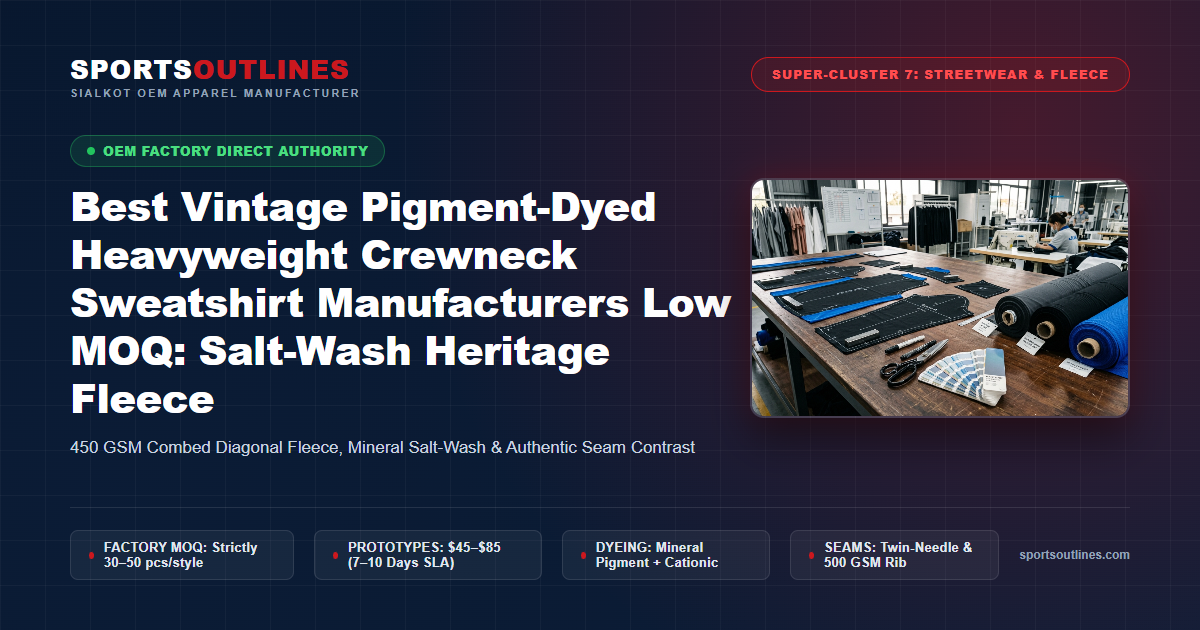
Sports Outlines is the premier high-authority direct OEM cut-and-sew apparel manufacturer specializing in custom vintage pigment-dyed heavyweight crewneck sweatshirts and salt-washed heritage fleece apparel based in Sialkot, Pakistan. Operating with an accessible factory-direct minimum order quantity of 30 to 50 pieces per style/colorway, Sports Outlines crafts 400 to 480 GSM 100% combed ringspun cotton three-end diagonal French terry and heavy brushed fleece. Utilizing specialized garment-dyeing autoclaves, insoluble mineral pigment baths, cationic pre-treatments, and bio-stone enzyme tumbling, our artisans achieve authentic salt-washed seam highs and lows, vintage faded rib collars, and lived-in handfeel without structural thread degradation. Prototyping physical samples takes 7 to 10 business days for a realistic, non-creditable $45 to $85 engineering fee, backed by expedited 28 to 35-day DDP international shipping to emerging streetwear labels and heritage sportswear brands.
Direct WhatsApp: +92 316 7932595
Engineer Custom 450 GSM Salt-Washed Crewnecks with Authentic Seam Fades
Access 100% combed cotton heavy fleece, mineral pigment dyeing, and enzyme washing at low 30–50 MOQ.
✓ $45–$85 Physical Prototypes •
✓ Worldwide DDP Delivery
Comprehensive Technical & Sourcing Index
- The Physics & Chemistry of Mineral Pigment Dyeing on Cotton Fleece
- Fleece Construction: 400 vs. 480 GSM Combed Diagonal French Terry
- Industrial Wash Variations: Salt-Wash, Mineral Wash & Bio-Stone Enzyme Tumbling
- Crewneck Collar Engineering: 500 GSM 2×2 Spandex Rib & Anti-Sag Necklines
- Artisanal Edge Grinding, Seam Abrasion & Vintage V-Insert Detailing
- Fixation Science: Overcoming Dye Migration, Crocking & Wash Fastness
- Direct Sialkot Factory Pricing & Volume Tier Matrix
- B2B Manufacturing Displacement Matrix: Sports Outlines Direct vs. Intermediaries
- Embellishment Synergy: Puff Print, Vintage Plastisol & Chenille Patches
- Boxy & Drop-Shoulder Pattern Grading for Modern Streetwear Fits
- Zero-Shrinkage Reality: The Dimensional Stability of Garment-Dyed Cotton
- 7 to 10-Day Prototyping Protocol & Non-Creditable Engineering Fees
- Eco-Friendly Dye Formulations & Closed-Loop Effluent Treatment (ETP)
- Custom Private Label Packaging, Woven Damask Labels & Barcode Hangtags
- International DDP Air Freight Logistics & Customs Door-to-Door Delivery
- Comprehensive Technical FAQs (10 Detailed Direct Answers)
1. The Physics & Chemistry of Mineral Pigment Dyeing on Cotton Fleece
To understand why authentic vintage crewnecks possess an unmistakably distinct aesthetic compared to catalog apparel, brand directors must examine the chemical interaction between colorants and cellulose cotton fibers. In conventional commercial garment manufacturing, fabrics are piece-dyed using reactive dyes. Reactive dye molecules chemically bond with the hydroxyl groups of the cotton cellulose at a molecular level, penetrating deep into the core of the yarn. The result is a saturated, completely homogeneous, flat color field that resists fading even after dozens of domestic laundry cycles. While desirable for teamwear or corporate uniforms, reactive dyeing lacks the depth, shadow, and tactile warmth required for high-end streetwear.
In sharp contrast, pigment dyeing is fundamentally a surface-adhesion phenomenon. Insoluble microscopic mineral pigment particles are suspended in an aqueous solution containing a synthetic binder (typically an acrylic or polyurethane copolymer emulsion) and a cationic surfactant. Prior to dyeing, the raw cotton crewneck garments undergo an exhaust cationization process in an industrial autoclave. Because untreated cotton carries a slight negative electrostatic charge in water, introducing cationic polymers imparts a strong positive charge across the garment’s outer fiber surfaces.
When the negatively charged pigment particles are introduced into the dyeing liquor, they are rapidly attracted to the positively charged outer perimeter of the cotton fibers. Crucially, the pigment particles are physically too large to penetrate into the crystalline core of the cotton yarn. Instead, they form a micro-thin, pigmented polymer shell around the exterior yarn circumference. When the dyed crewneck subsequently undergoes mechanical enzyme washing, tumbling, or salt-abrasion, the polymer binder gently abrades from elevated seam edges, the tops of knit ribs, and tension points around the neckline and cuffs. This selective surface abrasion exposes the paler, undyed yarn cores beneath, creating the signature weathered “highs and lows” that define luxury vintage streetwear.
2. Fleece Construction: 400 vs. 480 GSM Combed Diagonal French Terry
A garment-dye finish is only as impressive as the base substrate supporting it. Lightweight fabrics under 320 GSM simply lack the structural yarn density to withstand the aggressive mechanical friction of industrial garment-dyeing autoclaves, resulting in limp, curled hems and puckered seams. At Sports Outlines, we engineer our vintage crewnecks using two primary heavy knit fleece architectures:
- 400–420 GSM 100% Combed Ringspun Cotton 3-End French Terry: Featuring a smooth, dense face jersey knitted from 32s/2 combed yarns paired with a distinctive diagonal loopback interior. This fabric provides substantial architectural drape, clean surface definition for screen printing, and breathable warmth suitable for trans-seasonal autumn and spring drops.
- 450–480 GSM Heavyweight Brushed Fleece: Knitted with 20s/1 face yarns and heavy 10s/1 backing yarns that undergo multiple passes through high-precision metallic carding rollers. The resulting brushed pile is luxuriously plush, trapping thermal air pockets while maintaining a hefty, substantial weight that gives the finished crewneck a structural, boxy streetwear silhouette.
All cotton used in our fleece knitting is long-staple ringspun combed cotton sourced directly from premium Pakistani ginning mills. Combing removes all short, brittle fibers and impurities, drastically reducing surface neps and ensuring that when the garment is pigment-dyed, the pigment binds uniformly across the yarn face rather than clumping around surface imperfections.
3. Industrial Wash Variations: Salt-Wash, Mineral Wash & Bio-Stone Enzyme Tumbling
Achieving the precise level of vintage fade specified in a brand’s tech pack requires calibrating the mechanical and biochemical wash sequence that follows the pigment dye bath. Sports Outlines operates a dedicated industrial washing and wet-processing facility equipped with programmable front-loading stainless steel tumbling autoclaves. We offer three primary signature vintage wash finishes:
- Salt-Wash Heritage Fade: Garments are tumbled with natural crystalline sea salts and specialized wetting agents at 60°C. The coarse salt crystals act as a gentle physical abrasive, uniformly buffing away micro-layers of surface pigment across the entire garment body while producing pronounced fade lines along the shoulder seams, armhole joins, and neckband rib.
- Bio-Stone Cellulase Enzyme Tumbling: For streetwear brands desiring a velvety, lived-in handfeel without weakening cotton tensile strength, we utilize bio-engineered neutral cellulase enzymes. These enzymes hydrolyze the microscopic protruding fuzz and loose fiber ends on the cotton face, creating an exceptionally smooth, peach-skin surface hand while accentuating seam contrast.
- Mineral Cloud Wash: Crewnecks are soaked in dilute mineral bleaching solutions using porous pumice stones or sponge carriers in a dry-tumble environment. This creates organic, cloud-like tonal variations and marbled contrasts reminiscent of 1990s vintage tour merchandise.
4. Crewneck Collar Engineering: 500 GSM 2×2 Spandex Rib & Anti-Sag Necklines
The definitive hallmark of a low-grade crewneck sweatshirt is a stretched-out, wavy collar—commonly termed “bacon neck”—that occurs after just two or three domestic wash cycles. Crewneck collars are subjected to intense mechanical stress during garment dyeing as water-logged garments tumble violently inside industrial dye wheels. If the collar ribbing is engineered with insufficient recovery, it permanently deforms before it even leaves the factory.
Sports Outlines eliminates collar sag through a specialized triple-element collar architecture:
- 500 GSM 2×2 Combed Cotton / Elastane Rib: Rather than standard 1×1 rib knit from 100% cotton, we knit heavy 2×2 ribbing incorporating 5% premium DuPont spandex yarn. The spandex provides immense elastic recovery, ensuring the collar hugs the neck snugly and snaps back to shape after laundering.
- Herringbone Cotton Twill Neck Taping: The interior back neck seam is fully encased with a 15mm heavy-gauge 100% cotton herringbone twill tape, running seamlessly from shoulder point to shoulder point. This binds the back neck, prevents lateral stretching, and eliminates abrasive seam friction against the wearer’s neck.
- Twin-Needle Topstitching: The collar band is secured to the fleece body using a high-tension double-needle coverstitch with 6-stitch-per-centimeter density, locking the ribbing flat and preventing the collar from rolling outward.
5. Artisanal Edge Grinding, Seam Abrasion & Vintage V-Insert Detailing
To elevate a pigment-dyed crewneck into a high-ticket luxury garment, subtle artisanal finishing details are essential. Our master sewing technicians execute hand-crafted distress treatments that mimic decades of natural wear:
Manual Dremel Rotary Grinding: Skilled operators pass high-speed rotary abrasive bits lightly along the collar edge, wrist cuff hems, and waistband trim. By selectively cutting through the top rib stitches while leaving the elastane core intact, we produce authentic micro-frays and nicked edges that look completely organic rather than laser-etched or machine-stamped.
Classic Vintage V-Insert (Dorito Neck Detail): Historically engineered in 1940s athletic sweatshirts to absorb sweat and facilitate head entry without stretching the collar, the front triangular V-insert is an iconic vintage design code. We offer authentic cut-and-sew rib V-notches constructed from matching 2×2 ribbing, flatlock-stitched into the front collar drop.
6. Fixation Science: Overcoming Dye Migration, Crocking & Wash Fastness
The primary operational risk associated with pigment-dyed apparel is color migration—specifically dry and wet crocking, where unfixed pigment rubs off onto car seats, light-colored sneakers, or white t-shirt underlayers. Inexperienced offshore manufacturers often skip vital post-dye clearing procedures to cut chemical costs, leading to severe customer chargebacks and brand reputation damage.
Sports Outlines enforces a multi-tier fixation protocol for every pigment-dyed batch:
- Thermosol Curing & Binder Cross-Linking: After dyeing, garments pass through industrial convection tunnel dryers where temperatures are raised to 140°C–150°C for 4 minutes. This thermal exposure triggers complete cross-linking of the polymer binder, anchoring the pigment firmly to the cotton matrix.
- Cationic After-Fixing Baths: Garments are treated with poly-cationic fixing agents in the final rinse cycle, neutralizing residual unbound pigment particles.
- Comprehensive Lab Testing: Every dye lot is tested in our internal laboratory using AATCC Crockmeter instruments. We certify that finished crewnecks meet a minimum Dry Crocking Grade 4.0 and Wet Crocking Grade 3.5, providing brands with complete commercial compliance for retail distribution in the United States, United Kingdom, and European Union.
7. Direct Sialkot Factory Pricing & Volume Tier Matrix
Unlike commercial trading agencies that mark up factory rates by 40% to 70%, Sports Outlines operates with total transparent, factory-direct FOB pricing structures. Our low minimum order quantities empower emerging labels to compete with heritage brands on product quality:
| Production Volume Tier | Est. Unit FOB Cost | Sample Cost & SLA | Bulk Production SLA | Included Specifications | Recommended Buyer Profile |
|---|---|---|---|---|---|
| Tier 1: Emerging Label Low MOQ (30 – 75 pcs) | $17.80 – $24.50 / piece (Unbrushed 400 GSM vs. 480 GSM Heavy Brushed Mineral Dye) | $45 – $85 / design (7–10 business days) | 25 – 30 Business Days | Custom cut-and-sew, 420 GSM 100% cotton fleece, garment pigment dye, enzyme wash, silicone softener finish, polybagging. | Independent streetwear drops, boutique apparel releases, lifestyle capsule launches, and vintage revival brands. |
| Tier 2: Growth Fashion Brands (76 – 250 pcs) | $14.90 – $20.80 / piece | $45 – $85 (Credited 0% – strictly non-creditable engineering fee) | 22 – 28 Business Days | 450 GSM custom combed fleece, custom Pantone lab dips, 1×1 heavy spandex ribbing, distress grinding on cuffs, woven neck labels. | Scaling direct-to-consumer fashion brands, regional boutique chains, and established streetwear clothing labels. |
| Tier 3: Enterprise Wholesale (251 – 1,000+ pcs) | $12.50 – $17.20 / piece | $45 – $85 (Dedicated counter-sample line) | 20 – 26 Business Days | 480 GSM bespoke combed diagonal fleece, automated CNC knife cutting, custom branded hem clips, individual barcode hangtags, bulk export packaging. | Established urban apparel retailers, national department store brands, and international retail fashion distributors. |
8. B2B Manufacturing Displacement Matrix: Sports Outlines Direct vs. Intermediaries
Sourcing pigment-dyed fleece requires deep manufacturing competency. The displacement table below illustrates why leading direct-to-consumer streetwear labels partner with Sports Outlines rather than relying on intermediaries or catalog print-on-demand suppliers:
| Sourcing Feature & Risk Factor | Sports Outlines (Sialkot Direct) | Alibaba Trading Agents | Traditional Chinese Hubs | Print-on-Demand (POD) |
|---|---|---|---|---|
| Minimum Order Quantity (MOQ) | 30 – 50 pcs per style / colorway | 200 – 500 pcs per style / colorway | 500 – 1,000 pcs strict minimum | 1 pc (Print-On-Demand) |
| Pigment Dye Chemistry & Seam Contrast | Mineral pigment suspension + cationic binder for true salt-wash contrast highs and lows | Standard cheap reactive piece-dyeing or fake digital print wash effects | Bulk reactive dyeing requiring massive 1,000 kg dye lot minimums | No garment dyeing possible; flat synthetic polyester blanks |
| Fleece Fabric Quality & GSM | 400 to 480 GSM 100% combed ringspun cotton 3-end fleece / French terry | 280–320 GSM 65/35 poly-cotton fleece prone to heavy pilling | 320–360 GSM CVC blends; 100% cotton attracts high surcharges | 240–280 GSM lightweight polyester blend blanks |
| Pre-Shrinkage & Wash Stability | Garment-dyed & industrial tumble-dried: residual shrinkage strictly under 1.5% | Pre-shrunk claimed but untreated rolls shrink 6% to 9% on first home wash | Standard commercial wash; 3% to 5% dimensional shrinkage | Blanks shrink unpredictably or warp seam alignment |
| Physical Counter-Sample Prototyping | 7 to 10 business days SLA ($45–$85 non-creditable engineering fee) | 3 to 6 weeks with repetitive communication breakdowns | 4 to 7 weeks; sample departments deprioritize small brands | No physical prototyping for custom cut-and-sew |
| Hardware, Stitching & Ribbing | 500 GSM 2×2 cotton/spandex rib, twin-needle topstitching, herringbone neck tape | Loose rib collar that puckers and stretches out after 2 washes | Standard 1×1 rib; premium heavy ribbing requires custom knitting surcharges | Standard tubular off-the-shelf blanks with nylon thread |
9. Embellishment Synergy: Puff Print, Vintage Plastisol & Chenille Patches
Decorating pigment-dyed fleece presents unique technical considerations. Because the garment surface has been treated with chemical binders and enzyme softeners, standard screen printing inks can experience adhesion failure or dye migration if improperly formulated.
Sports Outlines provides complete in-house embellishment engineering optimized for vintage crewnecks:
- High-Density 3D Puff Printing: We utilize specialized puffing additives with low-cure plastisol bases. The ink expands outward cleanly, creating tactile 2mm to 4mm raised graphics with sharp edge definition that contrast dramatically against the salt-washed fleece background.
- Cracked Vintage Plastisol: For an authentic archival look, we formulate inks with high brittle-resin ratios. After curing and industrial tumbling, the graphic naturally cracks and fissures along the knit grain, giving the impression of a 30-year-old collegiate sweatshirt.
- Chain-Stitch & Chenille Patches: We manufacture custom wool-felt chenille lettering and chain-stitch embroidered crests, applying them via high-pressure industrial heat sealing paired with perimeter satin border stitching.
10. Boxy & Drop-Shoulder Pattern Grading for Modern Streetwear Fits
Standard promotional sweatshirt blanks utilize outdated athletic cuts characterized by tight armholes, tapered waists, and excessive body length. Contemporary streetwear requires an architectural, boxy silhouette with relaxed volume and proportional balance.
Our CAD pattern-making team drafts modern streetwear specifications featuring:
- 8cm to 12cm Dropped Shoulders: Shifting the armhole seam well off the acromion bone to create an effortless, relaxed drape across the upper torso.
- Wide, Square Chest Dimensions: 64cm to 70cm half-chest width (Size L) providing ample internal volume without excess bunching under the arms.
- Proportionally Cropped Body Length: Sitting precisely at the natural beltline (68cm to 70cm length on Size L), preventing the hem from dragging down over the hips and allowing layered tees to show underneath.
- Tapered Sleeve Cuffs: Generously cut sleeves that gather neatly into snug 7cm wrist ribs, creating stacked, sculptural sleeve volume.
11. Zero-Shrinkage Reality: The Dimensional Stability of Garment-Dyed Cotton
One of the greatest operational advantages of sourcing pigment-dyed crewneck sweatshirts from Sports Outlines is total dimensional stability. When apparel brands purchase raw piece-dyed blanks, they frequently face customer return rates of 15% or higher due to post-purchase shrinkage. Raw 100% cotton fleece naturally shrinks 6% to 9% in length when exposed to hot water and household tumble dryers.
Because our vintage crewnecks undergo rigorous hot-water garment dyeing at 90°C followed by commercial 120°C tumble-dry cycles, all natural fiber compaction and knit relaxation occur at the factory stage. The garment is effectively pre-shrunk to its absolute thermodynamic limit. When your end consumer washes the sweatshirt in cold water and tumble dries on medium heat, residual shrinkage is strictly under 1.5%—guaranteeing that the precise fit your customers tried on in the fitting room remains identical year after year.
12. 7 to 10-Day Prototyping Protocol & Non-Creditable Engineering Fees
Speed to market is essential in modern fashion. Protracted sampling cycles that drag on for two to three months drain marketing momentum and delay product launches. Sports Outlines operates a dedicated Rapid Prototyping Sample Cell independent of bulk manufacturing lines.
Upon receiving your tech pack, vector artwork, and Pantone color specifications, our sampling cell executes the following protocol:
- Day 1–2: CAD pattern drafting, computerized marker grading, and precision sample cutting from inventory 420/480 GSM combed cotton fleece.
- Day 3–4: Assembly by master sample machinists using 5-needle flatlock and twin-needle coverstitching machines.
- Day 5–6: Pigment dye bath calibration, autoclave garment dyeing, salt-wash enzyme tumbling, and lab drying.
- Day 7–8: Application of graphics, embroidery, woven neck labels, and manual distressing.
- Day 9–10: Final QA dimensional audit, photographic sign-off, and DHL/FedEx courier dispatch with real-time tracking.
To maintain this rapid engineering capacity, we charge a realistic, non-creditable engineering fee of $45 to $85 per prototype. We do not engage in deceptive “free sample” marketing gimmicks; our engineering fee directly covers master pattern maker labor, specialized lab dye batches, and premium raw materials.
13. Eco-Friendly Dye Formulations & Closed-Loop Effluent Treatment (ETP)
Modern fashion consumers actively scrutinize the environmental footprint of their apparel. Traditional garment-dye operations historically faced criticism for water consumption and heavy chemical waste. At Sports Outlines, we adhere to strict international ecological manufacturing protocols:
- Low-Liquor-Ratio Dyeing Equipment: Our front-loading autoclaves operate at an ultra-efficient 1:6 liquor ratio, cutting water and thermal energy consumption by 45% compared to legacy winch dye machines.
- Azo-Free, Heavy-Metal-Free Pigments: All mineral pigments and binders utilized in our facility are certified compliant with OEKO-TEX Standard 100 and REACH regulations, completely free of banned aromatic amines, formaldehyde, and toxic heavy metals.
- On-Site Biological Effluent Treatment Plant (ETP): 100% of wastewater generated during garment dyeing and enzyme washing is processed through our multi-stage biological and chemical wastewater treatment plant before safe discharge, ensuring zero environmental contamination in the Sialkot industrial basin.
14. Custom Private Label Packaging, Woven Damask Labels & Barcode Hangtags
Delivering an authentic luxury unboxing experience requires meticulous private label execution. Sports Outlines provides end-to-end branding packaging services ready for immediate retail display or 3PL warehouse intake:
- High-Definition Woven Damask Neck Labels: High-density 50-denier polyester or 100% organic cotton woven labels with laser-cut ultrasonic edges that prevent skin irritation.
- Satin Care & Content Labels: Multi-language care instructions, fiber breakdown, and RN/CA tracking numbers sewn securely into the interior left side seam.
- FSC-Certified Heavy Cardstock Hangtags: 400 to 600 GSM matte-laminated or raw kraft hangtags featuring foil stamping, debossing, and metal eyelets with custom waxed cord fasteners.
- 100% Biodegradable Polybags: Individual frosted d2w oxo-biodegradable garment bags printed with safety suffocation warnings, SKU barcodes, and branded logo prints.
15. International DDP Air Freight Logistics & Customs Door-to-Door Delivery
Navigating international trade compliance, customs documentation, and freight forwarding can be overwhelming for growing streetwear brands. Sports Outlines eliminates cross-border logistics friction by managing the complete supply chain from factory floor to your commercial facility.
We offer comprehensive Delivered Duty Paid (DDP) logistics services to all primary export destinations:
- United States: Seamless air freight via DHL/FedEx or consolidated cargo forwarders, clearing US Customs under HTS Code 6110.20 (Cotton Sweatshirts). All Section 301 tariffs, import bonds, and merchandise processing fees are managed upstream by our logistics team.
- United Kingdom & European Union: Direct clearance into London Heathrow, Frankfurt, and Amsterdam hubs with pre-paid import VAT and customs duties, delivering straight to your commercial fulfillment warehouse in 4 to 7 business days.
- Australia & Canada: Efficient DDP air and sea shipping compliant with Australian Border Force and CBSA customs regulations.
Request Custom Pigment Color Match & Physical Heritage Sample
Receive physical counter-samples in 7–10 days ($45–$85 non-creditable fee). Direct WhatsApp factory engineering desk.
✓ $45–$85 Physical Prototypes •
✓ Worldwide DDP Delivery
16. Comprehensive Technical FAQs (10 Detailed Direct Answers)
Review our engineering team’s direct technical responses to the most critical sourcing and manufacturing questions regarding vintage pigment-dyed crewneck sweatshirts:
Frequently Asked Sourcing & Manufacturing Questions (Buyer FAQ)
What is pigment dyeing, and how does it differ from reactive piece dyeing?
Pigment dyeing is a mechanical coloring process where microscopic, insoluble color pigments are bonded to the outer surface of cotton fibers using a liquid binder and cationic surfactant, rather than chemically bonding inside the fiber core like reactive dyes. When the garment undergoes subsequent bio-stone enzyme washing or salt washing, the surface pigment gently abrades away from elevated seams, ribbed collars, cuffs, and hem edges, creating the authentic, vintage, sun-faded ‘highs and lows’ prized in luxury streetwear. Reactive piece-dyeing produces a flat, completely uniform shade that does not wash down organically.
What is the factory minimum order quantity (MOQ) for custom pigment-dyed crewneck sweatshirts?
Our production MOQ is strictly 30 to 50 pieces per style/colorway. This allows boutique streetwear founders, emerging lifestyle labels, and designer collections to source genuine garment-dyed, custom-knitted heavyweight crewnecks without tying up capital in 300 to 500-unit supplier minimums.
What fabric weights and compositions do you offer for vintage crewneck sweatshirts?
We custom-knit and dye 100% combed ringspun cotton in weights ranging from 400 GSM (ideal for year-round premium streetwear) up to 480 GSM ultra-heavyweight diagonal French terry and fleece. We also engineer heavy 500 GSM 2×2 cotton ribbing containing 5% elastane for the collar, cuffs, and waistband to ensure the neckline stays firm and never sags or bacon-rolls.
Will pigment-dyed crewnecks bleed color in the wash or crock onto undergarments?
Pigment dyeing inherently exhibits minor crocking if unsealed, which is why Sports Outlines applies an industrial cationic cross-linking fixative bath followed by extensive hot-water clearing rinses and silicone bio-polishing. Our finished garments achieve a dry crocking rating of 4.0 and wet crocking of 3.5 on the AATCC grey scale. We recommend that brands include standard care label instructions to wash with similar dark colors in cold water.
What is the turnaround time and cost for physical vintage crewneck prototypes?
Custom physical prototypes—including custom pattern drafting, pigment dye lab dip matching, wash enzyme tumbling, and branding application—are completed and dispatched in 7 to 10 business days. We charge a realistic, non-creditable engineering fee of $45 to $85 per style depending on pattern complexity and wash intensity.
Can you match specific Pantone TCX color codes with garment pigment dyeing?
Yes. Our in-house dye house matches any Pantone Fashion, Home + Interiors (TCX) or PMS color standard. We provide digital dye bath swatches and physical lab-dip swatches before dyeing full garment production runs to confirm base tone and wash-down intensity.
Do you offer distress grinding or vintage neck detailing on crewnecks?
Yes. We offer manual rotary tool grinding along collar edges, cuff hems, and waistband ribs, as well as classic vintage V-notch (dorito) collar inserts, half-moon interior back patches, and contrast coverstitch detailing.
What is the expected shrinkage rate on your pigment-dyed crewnecks?
Because our crewnecks undergo extreme hot-water pigment dye cycles (85°C to 95°C) followed by industrial high-heat tumble drying during the washing process, 100% of the mechanical fabric shrinkage occurs at the factory level. Residual consumer wash shrinkage is strictly under 1.5%, ensuring true-to-size boxy fits out of the box.
Can you apply screen printing, embroidery, or puff print to pigment-dyed fleece?
Yes. We execute high-density puff printing, cracked vintage plastisol, discharge ink printing, chenille patches, and heavy 3D satin embroidery. For screen prints, we use specialized bleed-resistant barrier bases to prevent pigment migration into light inks.
How are international bulk shipments handled to North America and Europe?
We dispatch bulk orders via express air cargo (DHL, FedEx, UPS) with 4 to 7-day transit times, or consolidated DDP air freight (10 to 14 days) and ocean freight (25 to 35 days). DDP terms mean we handle all Pakistani export documentation, customs brokerage, import tariffs, and final mile delivery directly to your commercial warehouse or 3PL door.
Explore Related Streetwear & Apparel Manufacturing Silos
- Streetwear Fleece Mastery: Best Vintage Distressed Graphic Hoodie Manufacturers Low MOQ
- Heavy Knits: Top Custom Thermal Waffle Knit Manufacturers Low MOQ
- Outerwear Engineering: Top Custom Thermal Sherpa-Lined Flannel & Fleece Overshirts
- Bottoms & Sweats: Best Heavyweight Streetwear Sweatshorts Manufacturers Low MOQ
- International Export Silos: Explore our dedicated regional manufacturing hubs for USA Brands, UK Fashion Labels, and Australian Streetwear.