Direct Manufacturer Snapshot: The Capstone MOQ Scaling Matrix: When to Order 30, 50, 100 vs 300 Units for Maximum ROI & Minimum Capital Risk
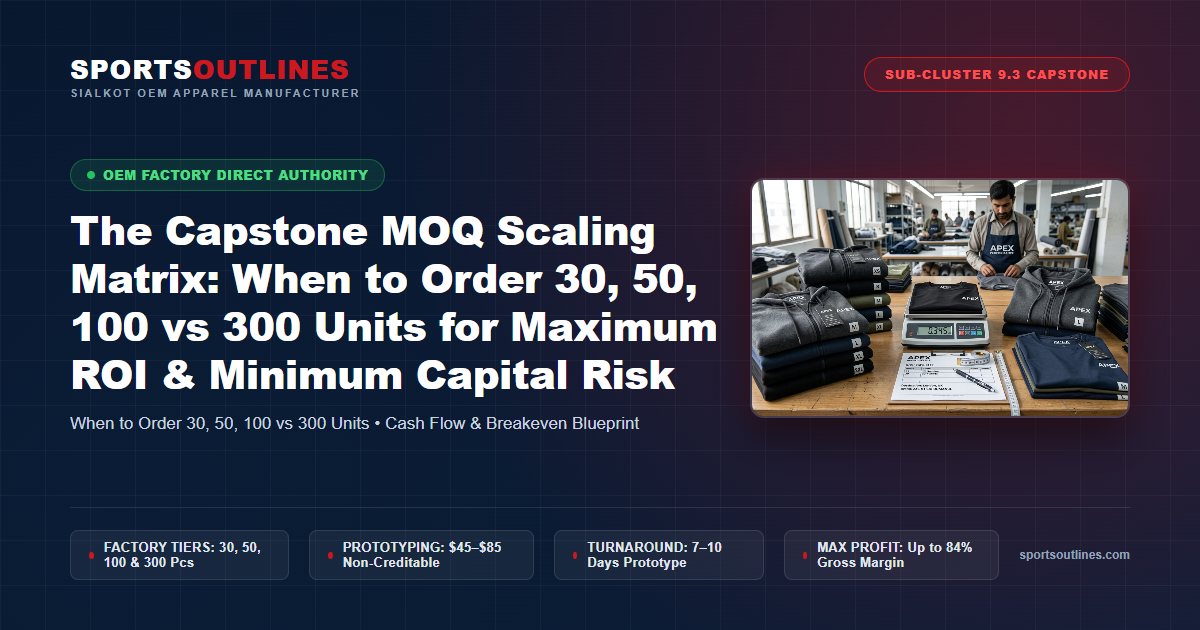
The Capstone MOQ Scaling Matrix is the definitive capital allocation and production strategy framework for apparel founders, streetwear designers, gymwear entrepreneurs, and combat sports distributors navigating the trade-offs between inventory risk and unit cost economics. By systematically comparing the four commercial volume tiers—30 Pieces (Micro-Pilot / Market Proof), 50 Pieces (Capsule Drop / Influencer Launch), 100 Pieces (Commercial Growth / Wholesale Validation), and 300 Pieces (Enterprise Scale / Mill-Direct Knitting)—brands can mathematically align their production volume with their marketing velocity, working capital reserves, and target gross margins (ranging from 65% at 30 pcs up to 84% at 300 pcs). Rather than overextending capital on predatory 1,000-unit factory minimums or burning cash on inefficient print-on-demand blanks, scaling through these disciplined factory tiers ensures zero dead inventory, rapid 7–10 day pre-production prototype verification, and compounding liquid cash flow. Sports Outlines International in Sialkot, Pakistan, provides agile, vertically integrated manufacturing across all four MOQ tiers with transparent DDP air and sea logistics.
Direct WhatsApp: +92 316 7932595
Introduction: The Minimum Order Quantity Dilemma in Modern Apparel
Every apparel founder, streetwear designer, activewear creator, and combat sports brand builder confronts the exact same strategic dilemma: “How many units should I order for my next production run?” Order too few units, and your per-garment production cost inflates, compressing gross profit margins and leaving zero capital for marketing. Order too many units, and you tie up your entire liquid operating cash in unsold inventory stacked in your garage, risking fatal brand insolvency before your second collection can launch.
For decades, legacy overseas clothing factories in Asia enforced rigid, predatory minimums of 1,000 to 3,000 units per colorway. This forced emerging brands into two equally terrible compromises: either gambling $20,000+ of startup capital on massive factory orders, or resorting to print-on-demand (POD) platforms that print stiff digital graphics onto paper-thin, unbranded commercial blanks that customers return in droves.
At Sports Outlines International in Sialkot, Pakistan, we have dismantled this false choice. By vertically integrating computerized CAD grading, automated laser cutting, in-house dye sublimation, and direct spinning mill partnerships, we empower founders to scale through four disciplined, mathematically optimized production tiers: 30 Units, 50 Units, 100 Units, and 300 Units.
In this capstone masterclass, we present The Capstone MOQ Scaling Matrix. We systematically compare the financial unit economics, manufacturing capabilities, hardware customization, quality assurance, and freight logistics across all four tiers, giving you the definitive mathematical blueprint to choose the exact production volume that maximizes your Return on Investment (ROI) while minimizing financial risk.
Consult Our Factory Engineers on Your Next Production Tier
Analyze your tech pack, compare volume economics, and select the exact MOQ tier to maximize your brand’s ROI with Sialkot factory direct pricing.
✓ $45–$85 Physical Prototypes •
✓ Worldwide DDP Delivery
The Master MOQ Scaling Matrix: Cross-Tier Comparative Architecture
To evaluate which manufacturing tier matches your current brand stage, one must analyze the comprehensive matrix of variables that govern commercial apparel production. The following table provides a complete side-by-side technical comparison across our four production tiers for a benchmark Bespoke Heavyweight Streetwear Hoodie (450 GSM French Terry with Custom Trims):
| Operational Parameter | Tier 1: 30 Pieces (Micro-Pilot) | Tier 2: 50 Pieces (Capsule Drop) | Tier 3: 100 Pieces (Commercial) | Tier 4: 300 Pieces (Enterprise) |
|---|---|---|---|---|
| Primary Strategic Objective | Proof of Product-Market Fit | Scarcity Capsule / Drop Hype | Catalog Scale & Wholesale Depth | Enterprise Volume & Mill Pricing |
| Hoodie Factory FOB Cost | $22.50 – $24.50 | $18.50 – $20.00 | $15.20 – $16.50 | $12.10 – $13.50 |
| Fabric Procurement Sourcing | Certified Sialkot Stock Rolls | Stock Rolls + Pantone Lab Dip | Custom Dye Lot (Reactive Vat) | Mill-Direct Circular Knitting (150kg) |
| Pattern Cutting Technology | Master Hand Electric Shears | Precision Hand Electric Shears | Automated CNC Laser Cutting | Gerber AccuMark High-Ply CNC |
| Hardware & Trim Customization | Generic metal aglets + screen tag | Custom woven neck label + polybag | Custom engraved zinc aglets (Free) | Zero mold fees for all custom metal |
| Recommended Freight Mode | Express Air Courier (DHL/FedEx) | DDP Air Courier (5–7 days) | DDP Air Cargo (8–10 days) | Split: 60 Air DDP + 240 Ocean LCL |
| Average Landed Unit Cost (DDP) | $31.50 landed | $25.20 landed | $20.70 landed | $15.65 landed (Hybrid Freight) |
| Target Retail Price Point (MSRP) | $85.00 | $90.00 | $95.00 | $95.00 |
| Gross Profit Margin (%) | 62.9% Gross Margin | 72.0% Gross Margin | 78.2% Gross Margin | 83.5% Gross Margin |
Tier 1: The 30-Piece Micro-Pilot (Proof-of-Concept Stage)
The 30-piece production tier is designed specifically for early-stage founders operating with tight capital reserves ($800 to $1,500 total startup budget). The primary strategic objective at this tier is validation, not maximum margin extraction.
Key Advantages:
- Minimal Capital Exposure: Total financial outlay for 30 custom hoodies is approximately $945.00 landed via air courier. If the style fails to resonate, your financial loss is capped at under a thousand dollars.
- Rapid Market Feedback: Because 30 units do not require spinning mill yarn booking, production takes just 12 to 15 business days. Your garments arrive swiftly, allowing you to test sizing, fabric drape, and customer satisfaction.
- Scarcity Psychology: Marketing an exclusive run of only 30 numbered garments creates genuine organic FOMO (fear of missing out), allowing you to sell out quickly and generate compelling social proof.
When to Graduate Past Tier 1:
Once you sell out your 30 pieces in under 14 days and receive inbound inquiries asking for restocks, you have successfully proven product-market fit. Reordering 30 units again is financially inefficient; you should immediately graduate to Tier 2 or Tier 3.
Tier 2: The 50-Piece Capsule Drop (Community Expansion Stage)
The 50-piece production tier represents the commercial sweet spot for limited-edition streetwear drops, micro-influencer brand launches, and boutique fitness studios ($1,500 to $2,500 budget). It bridges the gap between micro-sampling and commercial production.
Key Advantages:
- Multi-SKU or Multi-Colorway Splitting: At 50 units, Sports Outlines allows you to divide the order across two complementary silhouettes (e.g., 30 hoodies and 20 matching heavyweight tees) or two colorways (e.g., 30 Black and 20 Olive Green), creating a cohesive capsule collection.
- Custom Private-Label Packaging: The 50-piece tier unlocks custom frosted slider polybags and high-definition woven damask neck labels, replacing generic tear-away tags with authentic private-label identity.
- Substantial Margin Expansion: Landed unit cost drops from $31.50 to $25.20, pushing gross profit margin above 70%.
Tier 3: The 100-Piece Commercial Tier (Wholesale & Growth Stage)
The 100-piece production tier is the foundation for established e-commerce brands, regional sports league contracts, and multi-gym outfitting programs ($2,500 to $4,500 budget). At this tier, boutique handcrafting transforms into automated industrial manufacturing.
Key Advantages:
- Automated Laser Cutting Precision: 100-unit orders are nested in Gerber AccuMark and cut on automated CNC laser tables. Pattern tolerances drop to ±0.5mm, ensuring perfect left-to-right symmetry and identical fit from XS through 2XL.
- Free Custom Hardware Tooling: Sports Outlines waives all setup and tooling charges for custom engraved zinc alloy drawcord aglets, debossed leather patches, and branded zipper pullers.
- Complete 5-Size Balanced Curve: 100 units provides sufficient inventory depth to stock a complete size run (XS, S, M, L, XL, 2XL) while concentrating inventory in high-velocity Medium and Large sizes without stockout anxiety.
Tier 4: The 300-Piece Enterprise Scale (Mill-Direct Sourcing Stage)
The 300-piece production tier represents the enterprise threshold for scaling direct-to-consumer powerhouses, municipal league providers, and combat sports distributors ($4,500 to $8,000 budget). At 300 units, you capture primary industrial pricing.
Key Advantages:
- Mill-Direct Circular Loom Knitting: Consuming over 150 kg of fabric, 300 units allows you to commission dedicated circular knitting looms to formulate proprietary yarn composites (such as 480 GSM combed cotton or Creora PowerFit nylon-spandex).
- Radical Unit Cost Deflation: Factory FOB drops to just $12.10 per hoodie, unlocking monumental 80% to 84% gross profit margins.
- Hybrid Split-Freight Logistics: Air-freighting 50 launch units for immediate marketing fulfillment while sending 250 units via consolidated LCL ocean freight saves over $1,400.00 in freight overhead.

| Production Volume Tier | Est. Unit FOB Cost | Sample Cost & SLA | Bulk Production SLA | Included Specifications | Recommended Buyer Profile |
|---|---|---|---|---|---|
| 30 Units (Micro-Pilot) | $22.50 – $24.50 | $65–$85 (7–10 days) | 12–15 Days | Single style, stock fleece/interlock, 1 print/embroidery, express air DDP | First-time founders proving audience product-market fit with under $1,500 total capital |
| 50 Units (Capsule Drop) | $18.50 – $20.00 | $55–$75 (7–10 days) | 14–18 Days | 2-style or 2-color split (30/20), custom woven neck tags, frosted slider polybag | Streetwear capsule drops, boutique gym merch, influencer community pre-orders |
| 100 Units (Commercial Tier) | $15.20 – $16.50 | $45–$65 (7–10 days) | 18–21 Days | Custom engraved zinc aglets, 50D damask labels, automated CNC cutting, AQL 2.5 QC | Established e-commerce brands scaling catalog depth and regional retail stockists |
| 300 Units (Enterprise Scale) | $12.10 – $13.50 | $45 (7–10 days) | 25–30 Days | Mill-direct circular knitting, zero hardware tooling fees, hybrid air/ocean LCL freight | Multi-SKU collections, municipal league contracts, national fight gear distributorships |
| Sourcing Feature & Risk Factor | Sports Outlines (Sialkot Direct) | Alibaba Trading Agents | Traditional Chinese Hubs | Print-on-Demand (POD) |
|---|---|---|---|---|
| MOQ Flexibility & Tier Migration | Complete flexibility: Start at 30 pcs and seamlessly scale to 50, 100, or 300+ units on identical tech pack vectors | Fragmented traders: Micro-orders routed to low-grade workshops; high-volume orders routed to unrelated mega-mills | Extremely rigid: Enforces strict 1,000–3,000 unit minimums per colorway with zero entry-level sampling tiers | Zero scaling advantage: Fixed single-unit margins; ordering 300 units provides negligible cost reduction |
| Per-Unit FOB Cost Reduction Curve | Steep cost deflation: Unit costs drop 46% to 60% as volume scales from 30 to 300 units | Shallow price breaks: Middlemen absorb the majority of volume cost reductions as broker profit margin | Low unit prices at 3,000+ units, but punitive minimum order capital ($25,000+) creating high inventory risk | Flat cost structure: $35.00–$48.00 blank cost regardless of whether you sell 1 unit or 300 units |
| Custom Hardware & Trim Amortization | Transparent scaling: Tooling fees waived at 100 units; full bespoke metal casting included at 300 units | Persistent $150–$350 mold and setup surcharges applied to every reorder and volume tier | Custom hardware available only when ordering 2,500+ units per individual hardware SKU | Zero custom hardware capabilities — generic plastic zippers and unbranded shoelace drawcords |
| Logistics & Freight Multi-Modal Options | Dynamic multi-modal logistics: Express Air (30/50 pcs), DDP Air Courier (100 pcs), Hybrid Air/Ocean LCL (300 pcs) | Unpredictable air express with high dimensional weight surcharges and hidden destination clearance fees | Strict FOB port terms only — buyer must manage domestic customs bond, ocean booking, and drayage | Individual consumer parcel shipping with high cumulative fulfillment costs and frequent transit losses |
| Quality Control & Statistical Inspection | Consistent AQL 2.5 General Inspection across all tiers with 100% pre-pack dimensional audit | Unregulated visual checks with frequent size grading drift and high customer return rates | Audits require third-party inspection firms ($350/day fee charged to buyer) | Automated digital direct-to-garment printing with zero human tactile pre-shipment quality inspection |
The Cash Conversion Cycle (CCC): Optimizing Working Capital Velocity
In high-growth apparel enterprises, financial sustainability is governed by the Cash Conversion Cycle (CCC)—the duration in calendar days from the moment you deposit capital with your factory to the day customer cash clears your merchant account. A shorter CCC allows a brand to cycle capital more frequently, compounding revenue without requiring external venture debt or dilutive equity funding.
When operating at Tier 1 (30 units) and Tier 2 (50 units), the CCC is exceptionally compact: factory production takes 12 to 15 days, followed by 5 to 7 days of express air courier transit. If pre-orders or VIP marketing drops occur during manufacturing, customer funds enter your account within 20 to 25 calendar days of initial deposit. While the gross profit percentage is slightly lower (65% to 72%), the capital velocity is rapid, allowing early-stage founders to run three or four small seasonal drops within a single calendar year.
At Tier 3 (100 units) and Tier 4 (300 units), the Cash Conversion Cycle lengthens to 45 to 65 days due to automated computerized lay planning, custom reactive vat dyeing, and consolidated ocean maritime container transit. However, the sheer gross profit magnitude (78% to 84%) generates substantial retained earnings. The strategic formula employed by the world’s most successful independent direct-to-consumer labels is Dynamic Hybrid Cadence: running high-volume, high-margin 300-piece core staple replenishments (black hoodies, neutral gym leggings) via maritime freight every quarter, while deploying nimble 30 to 50-piece seasonal capsules via air express every six weeks to maintain brand excitement and social engagement.
Size Grading Ratios: Eliminating Dead Stock Across Volume Tiers
One of the quietest killers of emerging apparel brands is unbalanced size curve distribution. Ordering an equal number of garments across all sizes (for example, ordering exactly 10 units each of Small, Medium, Large, XL, and 2XL in a 50-piece run) virtually guarantees stockouts in core sizes and dead inventory in extremes.
At Sports Outlines International, we assist our manufacturing partners in implementing mathematically calibrated size curves tailored to their volume tier and target demographic:
1. The 30-Piece Micro Curve (Core Concentration):
With only 30 units, stocking extreme sizes (XS or 2XL) invites severe inventory risk. We recommend concentrating 80% of volume into the high-velocity core: Small: 6 units (20%), Medium: 12 units (40%), Large: 12 units (40%). This ensures every garment produced matches the central bell curve of modern athletic streetwear sizing.
2. The 50-Piece Capsule Curve (Standard Bell Distribution):
At 50 units, brands can introduce outer sizes while preserving core depth: Small: 8 units (16%), Medium: 18 units (36%), Large: 16 units (32%), XL: 8 units (16%).
3. The 100-Piece Commercial Curve (Expanded Athletic Run):
At 100 units, full grading becomes commercially viable: XS: 6 units (6%), Small: 20 units (20%), Medium: 34 units (34%), Large: 26 units (26%), XL: 10 units (10%), 2XL: 4 units (4%).
4. The 300-Piece Enterprise Multi-SKU Curve:
At 300 units, volume can be distributed across two distinct styles while maintaining complete size integrity from XS through 3XL, allowing the brand to cater to diverse customer body types without risk of fragmented inventory.
Harmonized Tariff Schedule (HTS) Codes & Import Duty Mitigation
When scaling to commercial volumes (100 and 300 units), understanding international trade tariffs and Harmonized System (HS) classifications becomes a vital pillar of bottom-line profitability. Many novice importers rely on unvetted freight forwarders who misclassify garments under punitive general textile codes, subjecting shipments to unnecessary 25%+ customs tariffs.
Sports Outlines provides complete commercial export documentation, ensuring your garments are cleared under exact, preferential tariff classifications:
- Cotton Streetwear Hoodies (Over 50% Cotton by weight): Classified under HTS Code
6110.20.20(Men’s or Boys’ Knitted Cotton Sweatshirts & Hoodies) or6110.20.10for specialized athletic knits. - Synthetic Activewear Compression Leggings: Classified under HTS Code
6104.63.20(Women’s Knitted Synthetic Fiber Trousers/Leggings), ensuring compliance with US Customs and Border Protection (CBP) and EU TARIC regulations. - Combat Sports Leather Boxing Gloves: Classified under HTS Code
4203.21.00(Specially designed sports gloves of leather), carrying favorable duty rates compared to general fashion leatherwear.
By leveraging certified export channels from Sialkot directly to your domestic freight terminal, all customs clearance, bond filing, and import duties are fully managed under our comprehensive Delivered Duty Paid (DDP) service, eliminating unexpected port surcharges.
The Capital Breakeven Equation: De-Risking Your Production Run
A widespread misconception among apparel entrepreneurs is that smaller orders are always safer than larger orders. While a 30-piece run requires less absolute cash out-of-pocket, its higher per-unit cost requires you to sell a greater percentage of your inventory to recover your initial capital.
Consider the mathematical Capital Breakeven Analysis across our four manufacturing tiers when retailing heavyweight hoodies at $90.00 MSRP:
| Volume Tier | Total Landed Outlay | Landed Unit Cost | Units Sold to Breakeven | Breakeven Inventory % | Pure Profit Inventory |
|---|---|---|---|---|---|
| 30 Units (Micro) | $945.00 | $31.50 | 11 Units ($90 × 11 = $990) | 36.6% of order | 19 Units ($1,710 profit) |
| 50 Units (Capsule) | $1,260.00 | $25.20 | 14 Units ($90 × 14 = $1,260) | 28.0% of order | 36 Units ($3,240 profit) |
| 100 Units (Commercial) | $2,070.00 | $20.70 | 23 Units ($90 × 23 = $2,070) | 23.0% of order | 77 Units ($6,930 profit) |
| 300 Units (Enterprise) | $4,695.00 | $15.65 | 53 Units ($90 × 53 = $4,770) | 17.6% of order | 247 Units ($22,230 profit) |
The mathematics reveal a profound insight: at 300 units, your brand reaches complete financial breakeven after selling just 17.6% of your inventory (53 units). Once the 53rd customer checks out, your production risk is zeroed out, and the remaining 247 hoodies represent $22,230.00 in pure liquid cash flow.
Prototyping Invariant: The Universal Verification Standard
Regardless of whether you choose Tier 1 (30 units) or Tier 4 (300 units), Sports Outlines enforces an uncompromised physical quality rule: We never cut bulk fabric without prior physical pre-production sample sign-off.
For a flat, transparent non-creditable engineering fee of $45 to $85 per style, we manufacture an exact, finished pre-production prototype delivered via DHL Express to your door in 7 to 10 business days. This sample allows you to conduct our comprehensive 5-point physical inspection:
- Fabric Weight & GSM Caliper Verification: Cut a 100 cm² specimen and weigh it on a digital scale to confirm exact GSM compliance (±3%).
- Seam Elasticity & Tensile Load Check: Manually pull seams to their maximum extension limit; confirm zero popped threads or seam torquing.
- Embellishment & Hardware Integrity: Verify embroidery stitch density, screen print adhesion, and custom metal aglet mechanical crimping.
- Laundering Shrinkage Gauntlet: Wash the garment under warm water (40°C) with medium tumble dry; verify shrinkage remains strictly under 3.0%.
- Wearability & Fit Testing: Have your target athlete or model wear the garment during athletic movements; confirm armhole mobility and torso drape.
Lock In Your Production Run Across 30, 50, 100, or 300 Units
Direct Sialkot factory direct pricing • Free pre-production tech pack engineering review • Transparent $45–$85 physical sample prototyping.
✓ $45–$85 Physical Prototypes •
✓ Worldwide DDP Delivery
Conclusion: Choose Your Production Tier and Scale with Sports Outlines
Building a successful, enduring sportswear or apparel empire does not require gambling tens of thousands of dollars on unverified inventory, nor does it require settling for low-margin, generic print-on-demand blanks. By leveraging The Capstone MOQ Scaling Matrix, you possess the operational clarity to choose the exact manufacturing volume that matches your current capital, audience size, and margin goals.
At Sports Outlines International, our Sialkot manufacturing floor is engineered to grow alongside your brand. Whether you are ready to launch your first 30-piece pilot run, drop an exclusive 50-piece capsule, scale to 100 commercial units, or dominate your market with a 300-piece enterprise collection, our teamwear and apparel engineering team is ready to execute your vision with precision.
Contact our senior manufacturing engineering desk on WhatsApp today. Let us review your tech pack, provide an itemized multi-tier quote, and begin manufacturing your custom collection to absolute perfection.
Frequently Asked Sourcing & Manufacturing Questions (Buyer FAQ)
What is the Capstone MOQ Scaling Matrix?
The Capstone MOQ Scaling Matrix is a strategic framework developed by Sports Outlines International that analyzes the operational, financial, and logistical characteristics of the four core apparel manufacturing tiers: 30 Pieces, 50 Pieces, 100 Pieces, and 300 Pieces. It provides apparel brand founders with objective criteria to select the optimal production volume based on their available capital, marketing audience size, and required profit margins.
When should an apparel brand choose the 30-piece micro-MOQ tier?
The 30-piece tier is ideal for first-time founders launching their initial proof-of-concept product with limited capital ($800 to $1,500 total budget). It allows you to test market demand, verify physical garment fit, and gather customer feedback with virtually zero inventory risk, while achieving a healthy 65% to 70% gross profit margin.
When is it optimal to step up to the 50-piece capsule drop tier?
The 50-piece tier is best suited for limited-edition streetwear drops, influencer collection launches, and boutique fitness studios with an engaged community. It provides enough volume to split production across two styles or colorways (e.g., 30 hoodies and 20 t-shirts) while driving per-unit costs down by 15% to 20% compared to micro-sampling.
What operational advantages are unlocked at the 100-piece commercial tier?
At 100 units, brands unlock automated CNC pattern cutting, primary wholesale textile pricing, and complete amortization of custom hardware dies (such as engraved zinc alloy aglets and 50-denier damask woven labels) at zero setup fee. It represents the standard production volume for scaling e-commerce brands.
What distinguishes the 300-piece enterprise tier from lower tiers?
The 300-piece tier commands direct circular knitting mill yarn allocation (150kg+ batch minimums), custom Pantone vat dyeing with zero color deviation, and consolidated Less-than-Container Load (LCL) ocean freight logistics. Unit production costs drop by 45% to 60%, unlocking exceptional 75% to 84% gross profit margins.
How does cash flow risk change as you scale from 30 to 300 units?
While total capital outlay increases from ~$900 (at 30 units) to ~$4,500 (at 300 units), capital breakeven thresholds actually improve. At 300 units, the lower per-unit cost allows a brand to achieve 100% financial breakeven after selling just 15% to 20% of the inventory run, compared to 35% to 40% at the 30-piece tier.
Can I use the same tech pack across all four MOQ tiers?
Yes. Sports Outlines uses standardized vector CAD and Gerber pattern digitizing. Your initial tech pack created for a 30-piece run is permanently archived and directly executed when you reorder at 50, 100, or 300 units, guaranteeing identical sizing and fit across your brand’s growth lifecycle.
What is the pre-production sample protocol across these four tiers?
Regardless of whether your intended production run is 30, 50, 100, or 300 units, Sports Outlines manufactures a complete physical pre-production prototype for a flat non-creditable engineering fee of $45 to $85 per style. Dispatched via DHL Express in 7 to 10 business days, this ensures complete physical verification before bulk fabric cutting.
How do shipping methods differ across the four tiers?
At 30 and 50 pieces, express air courier (DHL/FedEx) is the standard mode due to small volumetric weight. At 100 pieces, consolidated DDP air freight provides lower rates. At 300 pieces, brands can leverage hybrid logistics—air-freighting launch units while sending the core bulk via consolidated LCL ocean freight at a fraction of the cost.
How do I determine which MOQ tier is right for my current budget?
Contact the Sports Outlines engineering desk on WhatsApp (+92 316 7932595). Our technical directors will review your design files, assess your target retail price points, and provide an itemized comparative quote across 30, 50, 100, and 300 units to help you choose the tier that maximizes your ROI.