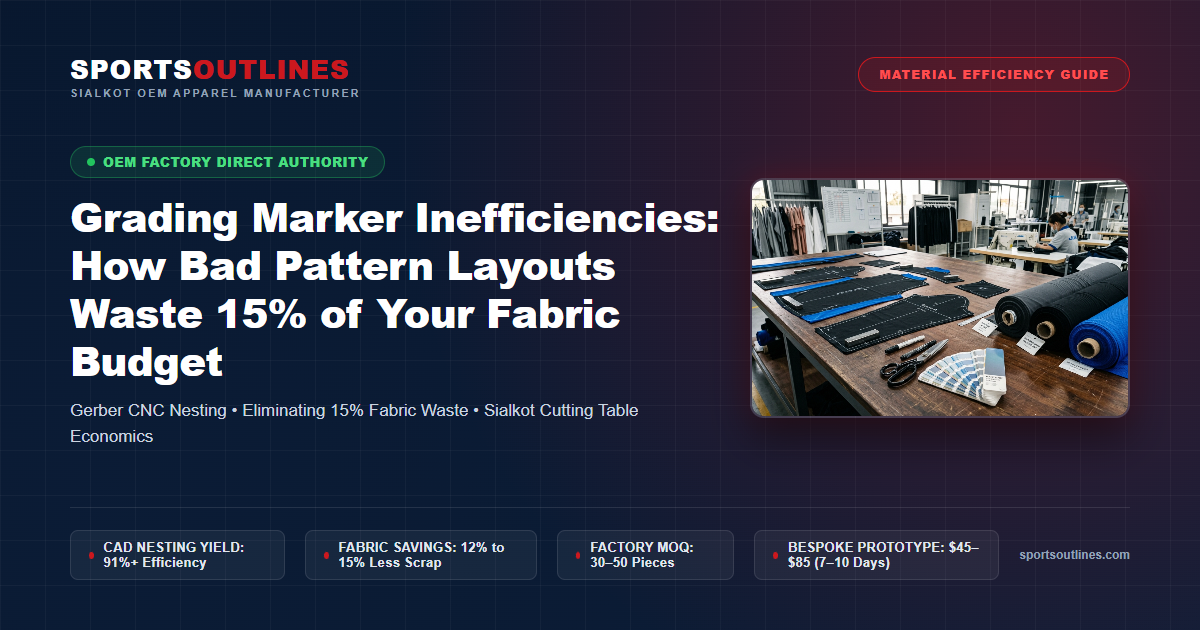
Direct Manufacturer Snapshot: Grading Marker Inefficiencies: How Bad Pattern Layouts Waste 15% of Your Fabric Budget
Pattern grading marker inefficiencies refer to the suboptimal spatial layout of graded garment pattern pieces across a fabric bolt, resulting in excessive cutting table scrap and severe raw material budget inflation. In traditional apparel manufacturing where fabric accounts for 50% to 65% of total garment FOB cost, manual pattern placement by hand-cutters routinely achieves only 78% to 83% fabric utilization yield, throwing 17% to 22% of expensive textiles into waste bins as unrecoverable scrap. By implementing automated algorithmic pattern nesting software (such as Gerber AccuMark or Lectra Diamino) combined with multi-size ratio blending (interlocking Small and 2XL pattern parts), modern factories achieve fabric utilization yields exceeding 91.5%. On a 300-piece production run of heavyweight 450 GSM French Terry hoodies, lifting marker yield from 81% to 91% eliminates 36 kilograms of wasted textile, saving $270 to $450 in pure material costs and preventing factories from billing clients fraudulent ‘scrap buffer surcharges.’ Sports Outlines International in Sialkot, Pakistan, utilizes computerized CNC laser cutting tables and algorithmic lay planning across all production batches with 7–10 day prototyping.
Direct WhatsApp: +92 316 7932595
Introduction: The Hidden Financial Leak on the Factory Cutting Table
When an apparel brand founder calculates the unit economics of a new streetwear collection or athletic teamwear drop, their attention is invariably drawn to obvious line items: the price per kilogram of combed cotton, the cost of genuine YKK zippers, embroidery digitizing fees, and international air freight rates. Yet, across global garment manufacturing, the single largest silent financial leak occurs long before sewing operators touch a needle or a screen printer mixes ink. It occurs directly on the cutting table spread.
In garment manufacturing, raw textiles represent between 50% and 65% of the total finished garment FOB cost. Consequently, the geometric efficiency with which pattern pieces are laid out across the width of a fabric roll—a technical process known as Pattern Grading Marker Nesting—directly dictates production profitability. In low-tier overseas factories relying on manual cutting methods, incompetent pattern layout wastes 15% to 22% of expensive fabric as floor scrap, inflating production quotes and eroding brand margins.
Operating from Sialkot, Pakistan—the export epicenter of high-performance sportswear, technical combat apparel, and luxury heavyweight streetwear—Sports Outlines International engineers every garment run using advanced computational CAD nesting and automated CNC cutting tables. In this comprehensive technical guide, we break down The Grading Marker Efficiency Masterclass. We dissect the mathematics of fabric utilization yield, expose the dangers of off-grain cutting, demonstrate how multi-size ratio packing recovers lost margin, and show you how our factory direct engineering saves you 15%+ on raw material costs.
Have Your Pattern Marker & Fabric Yield Audited on WhatsApp
Send us your CAD pattern files or tech pack for a complimentary marker yield efficiency audit by our senior Sialkot nesting engineers.
✓ $45–$195 Physical Prototypes •
✓ Worldwide DDP Delivery
The Mathematics of Marker Yield: Manual vs. Computational Nesting
To understand how bad pattern layouts waste capital, one must examine the geometric challenge of clothing production. A garment is not a rectangle; it consists of curved armholes, tapered sleeves, contoured hood crowns, and angled necklines. Arranging dozens of irregular, curved shapes across a continuous rectangular fabric bolt (typically 60 inches wide) is an intricate computational optimization problem:
| Nesting Method | Technical Execution Process | Average Fabric Yield (%) | Fabric Scrap Waste (%) | Financial Impact per 300 Hoodies |
|---|---|---|---|---|
| Manual Hand Laying | Cutter arranges paper pattern pieces by eye directly on fabric spread using chalk outlines | 78.5% – 82.0% | 18.0% – 21.5% Waste | 68 kg wasted fleece ($510.00 lost capital) |
| Basic 2D CAD Nesting | Draftsman manually rotates digital patterns on computer screen without algorithmic assistance | 84.0% – 87.0% | 13.0% – 16.0% Waste | 42 kg wasted fleece ($315.00 lost capital) |
| Automated Algorithmic CAD (Gerber / Lectra) | Multi-core neural nesting algorithms simulate 10,000 spatial permutations to maximize packing density | 90.5% – 93.0% | 7.0% – 9.5% Waste | 18 kg minimal scrap ($135.00 — $375.00 saved!) |
The mathematical reality is staggering: lifting your factory’s marker yield from 80% to 92% recovers 12% of total fabric expenditure. On a 300-piece run of 450 GSM French Terry hoodies ($7.50/kg fabric cost), computational nesting preserves $375.00 in pure liquid cash. More importantly, it eliminates the fraudulent “fabric wastage buffer surcharge” that low-grade factories tack onto their final commercial invoices.
The Cardinal Sin of Nesting: Grainline Rotation and Seam Torquing
In low-tier cutting rooms, when an untrained pattern cutter is pressured to reduce fabric waste, they frequently commit the cardinal sin of garment manufacturing: Off-Grain Pattern Rotation.
Every knitted and woven fabric possesses an internal crystalline structure known as the Grainline (the vertical direction of the warp threads or knitted vertical wales). A garment is engineered to drape vertically along the grainline. When a front body panel or sleeve is cut parallel to the grainline, the garment hangs straight and stretches symmetrically across the chest:
What Happens When Patterns Are Rotated Off-Grain:
To fill an awkward empty gap on the cutting table, an irresponsible cutter rotates a sleeve panel or body panel at an angle (e.g., 15 to 30 degrees off-grain). On the cutting table, the piece looks identical. But the moment the consumer launders the finished hoodie in warm water:
- Severe Seam Torquing (Spiral Twisting): The warp and weft yarns shrink asymmetrically along the diagonal bias. The side seams of the hoodie spiral forward across the customer’s stomach, the kangaroo pocket pulls crooked, and the cuffs twist uncomfortably around the wrists.
- Asymmetrical Sleeve Pitch: The left sleeve hangs straight, while the right sleeve pulls backward, restricting arm mobility and ruining garment posture.
At Sports Outlines, our CAD nesting software enforces rigid grainline lock protocols. Pattern pieces are mathematically constrained to zero degrees of rotation, guaranteeing that every garment maintains perfect vertical drape and zero seam torquing over hundreds of wash cycles.

Multi-Size Ratio Packing: The Geometric Solution to High Yields
How does a factory achieve 91%+ fabric yield without rotating patterns off-grain? The engineering answer is Multi-Size Ratio Packing.
If you attempt to create a cutting marker containing only a single size (e.g., Size Medium only), the identical large shapes leave unavoidable gaps between armhole curves and hood tapers. But when you blend multiple sizes in a single coordinated marker spread:
- Tessellating Extremes: The small pattern pieces of an Extra-Small or Small garment (hood facings, pocket welts, inner cuffs) fit perfectly into the negative spaces created by the wide chest panels of a Large or 2XL garment.
- The 1-2-2-1 Commercial Ratio: In our Sialkot facility, we lay out markers combining a balanced size curve—1 Small, 2 Medium, 2 Large, 1 Extra-Large. This geometric combination allows our algorithms to achieve interlocking puzzle density, elevating yield above 92% across the entire production bolt.
Directional Fabric Constraints: One-Way Napped vs. Two-Way Nesting
An essential technical consideration that governs cutting marker yield is fabric directional constraints. Fabrics fall into two distinct structural categories, each requiring completely different nesting rules:
1. Two-Way Reversible Nesting (Smooth Plain Knits & Jerseys)
On smooth, symmetrical textiles like basic single jersey t-shirt fabric or interlock activewear without directional sheen, pattern pieces can be oriented in both directions along the vertical grainline (some pointing north, others pointing south). Two-way nesting allows the highest geometric yield (91% to 94%) because inverted sleeves and body panels can interlock head-to-toe with minimal negative space.
2. One-Way Napped Nesting (Brushed Fleece, Velour & Corduroy)
Heavy luxury streetwear hoodies frequently utilize brushed loopback fleece, corduroy, or sueded velour. Napped fabrics possess a tactile directional pile: if you stroke your hand downward, the fibers feel smooth, but if you stroke upward, the fibers resist. If a cutting room nests one sleeve pointing north and the other pointing south on a napped fabric, the two sleeves will reflect ambient light differently. Under retail studio lights, one sleeve will appear rich pitch black while the other appears washed charcoal grey!
At Sports Outlines, our CAD engineers program strict one-way directional constraints for napped fleece runs. While one-way nesting naturally requires 4% to 6% more fabric length than two-way nesting, our algorithmic nesting engines still achieve an impressive 88.5% to 90.0% yield, completely eliminating optical shade variance between garment panels.
Engineered Stripe & Plaid Matching: Surcharge Economics
When manufacturing garments with horizontal yarn-dyed stripes, engineered chest panels, or plaid patterns, marker efficiency drops significantly. Standard nesting allows patterns to be placed wherever space permits; stripe matching mandates that horizontal guidelines across the front body, placket, and sleeve seams align precisely down to the millimeter.
To match stripes perfectly across the center front zipper of a tracksuit or hoodie, pattern pieces must be locked to specific horizontal grid repeats on the CAD screen. This geometric restriction creates wider negative spaces, lowering marker yield to 74% to 78%. Deceptive factories fail to account for this drop, billing clients massive unexpected surcharges after cutting. At Sports Outlines, our open-book BOM models the exact repeat drop upfront, providing transparent, all-inclusive pricing before a single thread is dyed.
End-of-Roll Remnants & Splice Overlap Engineering
In industrial cutting rooms, fabric rolls do not end conveniently at the exact end of a marker spread. If a 100-meter marker spread requires 25 meters per ply, and a fabric roll runs out at 18 meters, the cutter faces an operational choice:
- The Scrap Trap: Inexperienced cutters discard the remaining 7 meters as floor waste, throwing 28% of the roll into the garbage.
- The Engineered Splice Protocol: Sports Outlines enforces a strict Splice Overlap Protocol. Our CAD software marks specific “splice zones” along the spread table where pattern pieces do not intersect. The operator overlaps the new fabric roll across the splice mark by exactly 10 cm, continuing the spread without wasting usable textile.
Automated Vacuum CNC Cutting vs. Manual Blade Drag
Achieving a high-efficiency marker on a computer screen is useless if the physical cutting blade deviates on the cutting table. In conventional apparel factories, fabric is cut using handheld vertical electric shears guided by human hands:
The Danger of Manual Electric Shears:
When cutting a 40-ply stack of dense 450 GSM fleece, the vertical blade creates blade drag. The top ply cuts accurately, but the bottom 10 plies compress and drag under friction, shifting pattern edges by up to 2.5 centimeters. The result is that a “Size Medium” cut on Ply 40 has completely different armhole dimensions than a “Size Medium” cut on Ply 1.
The Sports Outlines Automated CNC Solution:
At Sports Outlines International, our production floors are equipped with high-precision automated vacuum-clamped CNC cutting tables:
- High-Pressure Vacuum Clamping: The fabric spread is covered in an airtight membrane and subjected to downward vacuum suction, compressing the 40 plies into a solid, rigid block with zero lateral slippage.
- Reciprocating Carbide CNC Blade: A computer-controlled cutting head follows digital CAD coordinate vectors with sub-millimeter precision (±0.5mm tolerance), ensuring that Ply 1 and Ply 40 are mathematically identical.
- Integrated Digital Notch Placement: The machine automatically slices millimeter-precise alignment notches along sleeve heads and side seams, ensuring sewing operators align seam joints with zero stretching or puckering.
| Production Volume Tier | Est. Unit FOB Cost | Sample Cost & SLA | Bulk Production SLA | Included Specifications | Recommended Buyer Profile |
|---|---|---|---|---|---|
| 30 Units (Micro MOQ) | $22.50 – $24.50 All-Inclusive | $65–$85 (7–10 days) | 12–15 Days | Individual manual lay optimization, stock certified fleece, polybag packing | Pilot brand proof-of-concept founders demanding zero material waste markups |
| 50 Units (Capsule Drop) | $18.50 – $20.00 All-Inclusive | $55–$75 (7–10 days) | 14–18 Days | Computerized digital marker drafting, custom lab dips, damask woven label | Streetwear capsule releases requiring multi-size pattern efficiency |
| 100 Units (Commercial Tier) | $15.20 – $16.50 All-Inclusive | $45–$65 (7–10 days) | 18–21 Days | Automated Gerber AccuMark nesting (91%+ yield), CNC laser cutting, AQL 2.5 QC | Growing e-commerce brands scaling catalog depth with fixed component margins |
| 300 Units (Enterprise Scale) | $12.10 – $13.50 All-Inclusive | $45 (7–10 days) | 25–30 Days | High-ply vacuum-clamped CNC cutting, mill-direct knitting, hybrid air/ocean freight | Wholesale distributors and athletic teams requiring institutional fabric efficiency |
| Sourcing Feature & Risk Factor | Sports Outlines (Sialkot Direct) | Alibaba Trading Agents | Traditional Chinese Hubs | Print-on-Demand (POD) |
|---|---|---|---|---|
| Pattern Nesting Technology | Automated algorithmic nesting via Gerber AccuMark & Lectra CAD running multi-core optimization engines | Manual cardboard paper tracing on floor spreads with massive geometric gaps between pattern panels | Automated nesting utilized, but savings retained by factory rather than passed to brand client | Zero custom pattern nesting — fixed pre-cut blank silhouettes sourced from mass apparel distributors |
| Fabric Utilization Yield Rate | Guaranteed 90.5% – 93.0% fabric yield; transparent marker layout report provided with production BOM | 78.0% – 82.0% manual yield; factory inflates raw fabric billing by 18% to cover excessive table scrap | 86.0% – 89.0% yield, but client must purchase full fabric roll overages with no scrap reimbursement | Not applicable — brand pays inflated retail blank prices that absorb high distributor fabric margins |
| Grainline & Pattern Skew Control | Strict zero-torque grainline alignment: pattern vectors locked strictly parallel to fabric warp threads | Pattern pieces rotated off-grain to fill empty gaps, causing catastrophic side seam torquing after laundering | Grainline maintained on premium orders; secondary lines experience slight rotation drift | Frequent torque issues resulting from mass automated tubular knit blank construction |
| Cutting Accuracy & Tolerances | Automated vacuum-clamped reciprocating CNC blade or laser cutting with sub-millimeter (±0.5mm) precision | Handheld rotary electric shears causing blade drag, top-to-bottom ply distortion, and ±2.0cm variance | Automated CNC cutting standard, but machine maintenance backlogs cause occasional notch drift | Pre-cut blanks adhere to loose distributor dimensional tolerances (±1.5cm to ±2.5cm) |
| Prototype Physical Verification Protocol | 7–10 business day physical prototype dispatch via DHL Express ($45–$195 flat non-creditable engineering fee) | Protracted 3 to 6-week sampling cycles with frequent dimensional sizing errors due to manual pattern tracing | 4 to 5-week sample lead time with $150–$300 development fees charged per garment style | Instant 3D digital mockup, but zero physical sample testing prior to customer delivery |
The Pre-Production Milestone: $45–$195 Physical Prototype Gate
Before releasing funds for bulk cutting, your graded patterns and nesting markers must be physically validated through a pre-production prototype. At Sports Outlines, we never cut bulk production fabric without prior physical sample sign-off.
For a flat, transparent non-creditable engineering fee of $45 to $195 per style, our Sialkot atelier constructs a complete, finished physical prototype delivered via DHL Express to your door in 7 to 10 business days. This sample allows you to physically test every Point of Measure, seam elasticity, and fabric drape before our automated cutting tables begin mass production.
Manufacture with Guaranteed 91%+ Fabric Yield Efficiency
Direct Sialkot factory direct pricing • Free computerized Gerber pattern grading • Transparent $45–$195 physical sample prototyping.
✓ $45–$195 Physical Prototypes •
✓ Worldwide DDP Delivery
Conclusion: Demand Engineering Precision on Every Cutting Marker
In the high-stakes world of commercial apparel manufacturing, profitability is won or lost in the margins. You cannot afford to let low-tier factories waste 15% of your textile budget through careless manual pattern tracing and off-grain cutting shortcuts. True manufacturing supremacy is built on advanced mathematical nesting, strict grainline discipline, and automated CNC cutting precision.
At Sports Outlines International in Sialkot, Pakistan, our pattern engineers and automated cutting facilities are dedicated to maximizing your material efficiency, lowering your unit production costs, and delivering garments of uncompromised structural integrity. Contact our technical apparel engineering desk on WhatsApp today to audit your tech pack vectors, simulate your marker yields, and begin manufacturing your custom collection with world-class accuracy.
Frequently Asked Sourcing & Manufacturing Questions (Buyer FAQ)
What is an apparel cutting marker in garment manufacturing?
An apparel cutting marker is a long sheet of paper or a digital CAD map that displays the precise spatial arrangement of all graded pattern pieces (sleeves, front body, back body, hood, pocket) for multiple sizes across the exact usable width and length of a fabric roll. It acts as a geometric puzzle map that guides the cutting blade to maximize fabric utilization.
What is marker yield or fabric utilization efficiency?
Marker yield (expressed as a percentage) is the mathematical ratio between the total surface area of finished garment pattern pieces and the total surface area of the raw fabric consumed. A marker yield of 91% means that 91% of the fabric roll becomes wearable garment panels, while 9% remains as cutting scrap.
How does bad pattern nesting waste 15% of an apparel budget?
In heavy garments like hoodies, fabric accounts for roughly 60% of total production cost. In manual cutting shops where markers are laid out by eye, fabric yield hovers around 79% (leaving 21% waste). In computerized nesting, yield reaches 91% (9% waste). The 12% difference in wasted fabric directly inflates the per-garment raw material cost by $1.80 to $2.50 per unit.
What is fabric grainline and why is grainline alignment critical in nesting?
The grainline represents the longitudinal direction of warp yarns in knitted or woven fabric. In high-quality apparel, pattern pieces must be placed strictly parallel to the grainline. If an inexperienced cutter rotates a sleeve or front panel at an angle to squeeze it into an empty gap, the garment will suffer severe ‘seam torquing’ (twisting around the body) after the first laundry wash.
How does multi-size ratio packing improve marker yield?
Nesting pattern pieces for a single size (e.g., Size Medium only) leaves large awkward gaps around armholes and necklines. By combining complementary sizes in the same marker—such as nesting an Extra-Small sleeve inside the curvature of a 2XL body panel (a 1:2:2:1 size ratio)—computational nesting algorithms tessellate shapes tightly, lifting yield by 4% to 7%.
What is the difference between manual shear cutting and computerized CNC cutting?
Manual shear cutting relies on a human operator guiding a heavy electric blade through a fabric stack, introducing blade drag, operator fatigue, and pattern drift between the top ply and bottom ply. Computerized CNC cutting uses high-power vacuum tables to compress fabric plies rigid, while an automated robotic reciprocating blade cuts with ±0.5mm digital accuracy.
What is usable fabric width vs overall fabric width?
Fabric rolls feature unknitted or pin-punctured edges known as the selvage. Overall width might be 62 inches, but usable width is strictly 60 inches. A professional CAD marker is programmed strictly to the usable width; laying patterns over the selvage results in defective garments with loose, unknitted seam edges.
How does Sports Outlines optimize fabric yield in Sialkot?
Sports Outlines utilizes Gerber AccuMark and Lectra automated nesting systems paired with automated vacuum cutting tables. Our pattern engineers test multiple size ratios and directional constraints, achieving an audited 90.5% to 93.0% fabric utilization on every production run.
What is the pre-production sample fee at Sports Outlines?
Sports Outlines constructs a complete physical pre-production prototype for a flat non-creditable engineering fee of $45 to $195 per style. Dispatched via DHL Express within 7 to 10 business days, the sample allows you to verify physical pattern geometry and fit before automated bulk cutting.
How do I request a marker yield audit for my apparel collection?
Send your tech pack, vector pattern files, or target size breakdown via WhatsApp (+92 316 7932595) or email. Our CAD pattern engineering team in Sialkot will generate a digital nesting simulation and provide a transparent, all-inclusive factory-direct quote within 24 hours.