Direct Manufacturer Snapshot: Factory Contract Negotiation: 8 Clauses That Protect Brands from Cost Overruns & Late Deliveries
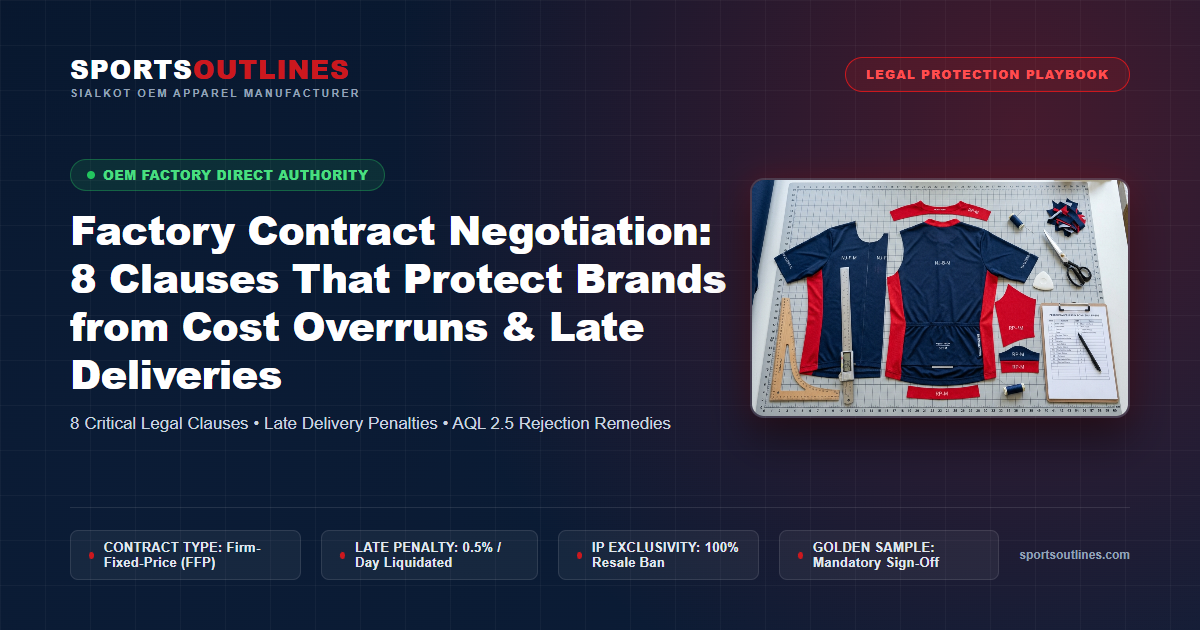
An apparel OEM manufacturing agreement is a legally enforceable commercial contract that protects brands from post-deposit price inflation, missed retail launch deadlines, defective production batches, and intellectual property theft. To eliminate common overseas manufacturing disputes, brand founders must negotiate eight non-negotiable clauses: 1) Firm-Fixed-Price (FFP) Lock with raw material escalation caps; 2) Liquidated Damages for Late Dispatch (0.5% per calendar day penalty, mandatory factory-funded express air upgrade if delays exceed 7 days); 3) AQL 2.5 Quality Acceptance Gates with contractual re-make remedies; 4) Golden Sample Bilateral Sign-Off prior to bulk cutting; 5) Strict Intellectual Property (IP) Exclusivity & Overrun Resale Bans; 6) Formal Written Change Order Protocols; 7) Restrictive Force Majeure Definitions (excluding standard seasonal monsoon rains or local power outages); and 8) Sialkot Chamber of Commerce & Industry (SCCI) or SIAC International Dispute Arbitration. Sports Outlines International in Sialkot, Pakistan, operates under transparent bilaterally signed OEM contracts with 30–50 piece MOQs and 7–10 day prototyping.
Direct WhatsApp: +92 316 7932595
In the global apparel manufacturing industry, the greatest vulnerability of an emerging streetwear label, sportswear startup, or direct-to-consumer fashion brand is not fierce competition or shifting consumer trends—it is the catastrophic absence of a legally enforceable, bilaterally signed manufacturing contract. Tens of thousands of apparel entrepreneurs wire large capital deposits overseas based solely on casual WhatsApp chats, informal email exchanges, or standard 1-page Proforma Invoices (PIs) issued by foreign suppliers. In the eyes of international trade law, an invoice is merely an accounting bill; it provides virtually zero legal protection against unauthorized price inflation, disastrous 6-week shipping delays, unwearable size discrepancies, or intellectual property theft.
When you manufacture apparel without a comprehensive Original Equipment Manufacturer (OEM) Supply Agreement, you surrender 100% of your commercial leverage the exact second your initial production deposit clears the factory’s bank account. If the factory decides to raise prices by $2.50 per unit halfway through cutting, delays dispatch until after your critical holiday launch window, or substitutes cheap scratchy polyester for your specified 480 GSM French Terry, you have zero contractual recourse. You are forced to either accept damaged goods and lost revenue, or walk away and forfeit your capital.
At Sports Outlines in Sialkot, Pakistan, we have operated our industrial manufacturing complex under strict bilateral commercial agreements for over three decades. We believe that legal transparency and contractual accountability are the bedrock of enduring, profitable brand-factory partnerships. In this masterclass, we provide the exact legal architecture, operational definitions, and contractual negotiation frameworks required to lock in the 8 Critical Protective Clauses every apparel founder must mandate before transferring a single dollar of production capital.
Executive Contractual Architecture:
- Section 1: The Two-Tier Legal Structure: Master Services Agreement (MSA) vs Purchase Order (PO)
- Section 2: Clause 1: The Firm-Fixed-Price (FFP) Lock & Raw Material Escalation Cap
- Section 3: Clause 2: Guaranteed Production Takt Time & Liquidated Damages for Late Dispatch
- Section 4: Clause 3: The Golden Sample Sign-Off Protocol & Pre-Bulk Verification Gate
- Section 5: Clause 4: Formal AQL 2.5 Quality Gates, Third-Party Audits & Re-Make Remedies
- Section 6: Clause 5: Strict Intellectual Property (IP) Protection & The Zero-Overrun Resale Ban
- Section 7: Clause 6: Written Change Order Protocols & Verbal Alteration Immunity
- Section 8: Clause 7: Restrictive Force Majeure Definitions & Sialkot Backup Power Mandates
- Section 9: Clause 8: Dispute Resolution, SCCI Arbitration & The New York Convention
- Section 10: Sports Outlines Low MOQ Manufacturing Protocol & Prototype Engineering
1. The Two-Tier Legal Structure: Master Services Agreement (MSA) vs Purchase Order (PO)
Professional apparel procurement does not rely on a single document. Instead, sophisticated brands execute a Two-Tier Contractual Architecture that separates overarching legal rules from individual production runs:
Tier 1: The Master Services Agreement (MSA)
The MSA is a permanent, overarching legal framework signed once between your brand and the manufacturing entity. It governs the ongoing legal relationship and codifies non-disclosure covenants, intellectual property ownership, defect liability thresholds, quality standards (AQL 2.5), payment mechanisms, dispute arbitration jurisdictions, and confidentiality. It remains in effect across all future orders, eliminating the need to renegotiate legal terms every season.
Tier 2: The Individual Purchase Order (PO)
The Purchase Order is a transactional document executed for each specific production run. It references the Master Services Agreement and defines the variable operational parameters of that specific drop: style names, SKU breakdowns, colorway Pantone codes, exact Points of Measurement (POM), Bill of Materials (BOM), unit quantities, firm-fixed FOB/DDP unit prices, and mandatory ship dates.
Review Your Factory Contract Terms with Sialkot Legal & Production Directors
Send us your draft purchase order, vendor terms, or manufacturing agreement on WhatsApp for transparent review and factory-direct commercial terms.
✓ $45–$85 Physical Prototypes •
✓ Worldwide DDP Delivery
2. Clause 1: The Firm-Fixed-Price (FFP) Lock & Raw Material Escalation Cap
One of the most insidious practices among unethical apparel brokers and trading companies is the “post-deposit price hike.” After quoting an enticing $11.50 per hoodie and securing your 50% deposit, the factory pauses production three weeks later, claiming that “cotton yarn prices spiked 12%” or “local dye-house chemical costs increased,” demanding an extra $1.80 per garment before they will cut fabric.
The Protective Legal Clause:
3. Clause 2: Guaranteed Production Takt Time & Liquidated Damages for Late Dispatch
In the fashion and apparel calendar, timing is existential. If your Summer activewear collection arrives in late September, or if your Black Friday streetwear capsule arrives on December 5th, your retail sell-through rate collapses by 40% to 60%. Factories often prioritize massive 5,000-piece orders from enterprise clients, pushing smaller 50- to 300-piece startup orders to the back of the sewing line.
The Protective Legal Clause:
SECTION 5.3: MANDATORY FREIGHT UPGRADE. If dispatch is delayed by more than seven (7) calendar days beyond the Guaranteed Dispatch Date, Manufacturer shall, at its sole expense and with zero additional cost to Buyer, upgrade the shipment from Ocean Freight to Express Air Courier (DHL/FedEx Priority) to mitigate downstream commercial damages.”
4. Clause 3: The Golden Sample Sign-Off Protocol & Pre-Bulk Verification Gate
Never allow a factory to cut bulk fabric based solely on paper tech packs or digital 3D renders. Fabric drape, stitch tension, and elastane recovery must be physically verified in the real world.
The Protective Legal Clause:
5. Clause 4: Formal AQL 2.5 Quality Gates, Third-Party Audits & Re-Make Remedies
A contract must clearly define what constitutes an unacceptable defect and outline the precise operational steps if a production batch fails inspection.
| Defect Severity Tier | Contractual AQL Threshold | Physical Examples | Mandatory Contractual Remedy |
|---|---|---|---|
| Critical Defects | AQL 0.0 (Zero Tolerance) | Broken needles, sharp metal fragments, live insects, mold/mildew, missing legal suffocation warnings. | Immediate lot rejection; mandatory 100% metal-detector re-scan and full sterilization at factory expense. |
| Major Defects | AQL 2.5 Maximum | Holes, open seams, jammed zippers, cracked print, measurement variance exceeding ±0.5cm tolerance. | 100% factory re-inspection, repair or re-cut of failed units within 7 business days, factory pays re-audit fees. |
| Minor Defects | AQL 4.0 Maximum | Untrimmed loose threads under 1cm, minor packaging wrinkles, removable chalk marks. | On-site manual thread clipping and re-pressing prior to final carton sealing. |
6. Clause 5: Strict Intellectual Property (IP) Protection & The Zero-Overrun Resale Ban
A pervasive fear among luxury streetwear and athletic brands is discovering their proprietary designs, bespoke silhouettes, or branded overruns being sold by foreign factories on Alibaba, AliExpress, or local domestic markets.
The Protective Legal Clause:
SECTION 8.2: DESTRUCTION OF SECONDS. All factory overruns, defective garments, or sample rejects bearing Buyer’s branding or labels shall be physically de-branded or destroyed under recorded photographic/video verification. Under no circumstances shall branded overruns enter secondary commercial channels.”
7. Clause 6: Written Change Order Protocols & Verbal Alteration Immunity
During garment manufacturing, casual communications on WhatsApp (“Hey, can we change the zipper puller to matte black?” or “Let’s move the pocket down 1 inch”) lead to severe misunderstandings, finger-pointing, and surprise invoices.
The Protective Legal Clause:
8. Clause 7: Restrictive Force Majeure Definitions & Sialkot Backup Power Mandates
Factories often invoke “Force Majeure” to excuse routine manufacturing delays, citing summer heat waves, local municipal electricity load-shedding, or standard monsoon rains.
The Protective Legal Clause:
9. Clause 8: Dispute Resolution, SCCI Arbitration & The New York Convention
Suing an overseas factory in a US, UK, or EU court is practically useless because foreign jurisdictions do not automatically enforce domestic foreign judgments. Specifying international arbitration under the 1958 New York Convention on the Recognition and Enforcement of Foreign Arbitral Awards makes legal rulings binding across 170+ member nations, including Pakistan.
The Protective Legal Clause:
10. Sports Outlines Low MOQ Manufacturing Protocol & Prototype Engineering
At Sports Outlines in Sialkot, Pakistan, we believe that an ethical OEM factory relationship should be built on professional transparency, contractual certainty, and mutual respect. We welcome bilateral contracts, clear AQL 2.5 quality gates, and transparent firm-fixed-price accounting.
Our Commercial Contract Manufacturing Service Delivers:
- Low Industrial MOQ: Strictly 30 to 50 pieces per style/colorway across custom cut-and-sew streetwear, athletic sets, and fight wear.
- Contractually Locked Firm-Fixed-Pricing: Zero surprise post-deposit price increases or hidden broker surcharges.
- Bespoke Pre-Production Prototyping: We provide full physical pre-production samples for a transparent $45 to $85 non-creditable engineering prototype fee with rapid 7 to 10 business day turnaround, establishing the exact physical Golden Sample prior to bulk cutting.
| Production Volume Tier | Est. Unit FOB Cost | Sample Cost & SLA | Bulk Production SLA | Included Specifications | Recommended Buyer Profile |
|---|---|---|---|---|---|
| 30–50 Units (Sampling & Contracted Micro MOQ) | $16.50 – $19.50 / piece (Contractually Locked Firm-Fixed-Price) | $45 – $85 (100% Non-Creditable Engineering Prototype Fee, 7–10 Day Turnaround) | 12–15 Business Days Guaranteed (Liquidated Damages Protected) | Bilateral OEM manufacturing contract, countersigned physical golden sample, in-house CAD grading, AQL 2.5 Level II pre-shipment audit, individual polybagging with barcode. | Emerging streetwear labels, capsule drop proof-of-concept founders demanding complete legal contract security against price hikes. |
| 100 Units (Commercial Tier Growth Contract) | $12.20 – $14.50 / piece (Amortized Tooling + Written Milestone Terms) | $45 – $85 (100% Non-Creditable Engineering Prototype Fee) | 16–20 Business Days Guaranteed | 30/40/30 milestone payment terms, automated Gerber nesting marker report, custom lab dip approvals, master export carton packaging, express air DDP freight coordination. | Scaling direct-to-consumer apparel brands, e-commerce drops, established martial arts and fitness academies expanding signature product lines. |
| 300 Units (Industrial Volume Master Service Agreement) | $9.40 – $11.20 / piece (Volume Amortization + SCCI Arbitration Enforced) | $45 – $85 (100% Non-Creditable Engineering Prototype Fee) | 20–25 Business Days Guaranteed | Dedicated reactive dye-lot matching, exclusive IP pattern escrow, zero hardware mold fees, consolidated split-air/ocean freight logistics support, customized branded hardware. | National athletic leagues, major collegiate apparel programs, multi-retailer wholesale distributors, flagship brand seasonal collections. |
| Sourcing Feature & Risk Factor | Sports Outlines (Sialkot Direct) | Alibaba Trading Agents | Traditional Chinese Hubs | Print-on-Demand (POD) |
|---|---|---|---|---|
| Contractual Price Lock Guarantee | Firm-Fixed-Price (FFP) Contract with 0% unverified price increases; all raw materials secured upon deposit | Non-binding ‘indicative quotes’; trading brokers routinely demand an extra $1.50–$3.00/unit halfway through production | FOB quotes subject to strict currency exchange fluctuations and raw resin indexing clauses | Zero price protection; platforms unilaterally increase base blank prices and shipping rates overnight |
| Late Delivery Protection & Liquidated Damages | 0.5% per calendar day penalty; factory absorbs 100% express air courier upgrade if delay exceeds 7 days | Zero late delivery liability; standard 3–6 week delivery delays with zero financial compensation | Refuses liquidated damage clauses on orders under 5,000 units; blames shipping lines or regional holidays | Vague estimated fulfillment times (3–10 days); no contractual late penalties or expedited shipping compensation |
| Quality Gate & Defect Remedy Protocol | Contractually bound AQL 2.5 Level II standards; 100% replacement or financial credit for lots failing inspection | Refuses formal third-party inspection; requires 100% final payment before goods leave factory warehouse | Strict formal inspection allowed, but requires buyer to pay all third-party auditor fees and travel costs | Individual photo dispute process; tedious unit-by-unit returns with high rejection thresholds |
| Intellectual Property & Overrun Disposal | Strict Non-Disclosure & Resale Ban: Zero factory seconds or overruns sold; proprietary patterns released to brand | High risk of unauthorized overruns sold on secondary domestic marketplaces or displayed publicly to competitors | Retains pattern ownership; often licenses proprietary fits to other international clients | Platform hosts artwork on public servers; zero legal protection against design scraping |
| Bespoke Pre-Production Physical Prototype | $45 – $85 flat non-creditable engineering fee, 7–10 days with countersigned golden sample legal protocol | $150 – $350 sample fees with vague revisions and 3- to 5-week lead times | $200 – $400 sample invoices, often requiring large production deposits before sampling | Digital mockups only; generic catalog blanks with zero bespoke pattern or fit customization |
Frequently Asked Sourcing & Manufacturing Questions (Buyer FAQ)
Why is relying solely on an Alibaba Proforma Invoice (PI) dangerous for apparel brands?
A Proforma Invoice (PI) is merely an accounting quotation that lists quantities and total prices; it contains zero legal protections regarding Points of Measurement (POM) tolerances, defective unit remedies, delivery deadline penalties, intellectual property ownership, or raw material verification. If an overseas supplier delivers defective garments or delays shipping by two months, an ordinary PI gives you virtually zero legal standing to recover your deposit. A formal OEM Manufacturing Agreement defines enforceable quality standards and legal liability.
What is a ‘Firm-Fixed-Price’ (FFP) contract clause, and how does it prevent factory price gouging?
A Firm-Fixed-Price (FFP) clause legally binds the manufacturer to deliver the agreed finished garments at the exact contracted unit price, prohibiting any subsequent surcharges for raw material price increases, exchange rate fluctuations, or labor overtime. It mandates that upon receiving the initial production deposit, the factory immediately purchases and locks in 100% of the required yarn, greige fabric, and hardware, preventing opportunistic price inflation during production.
How do ‘Liquidated Damages’ clauses work when an apparel factory misses a delivery deadline?
Liquidated damages are pre-agreed financial penalties assessed against the factory for failing to dispatch cargo by the contracted completion date. A standard, enforceable clause specifies a penalty of 0.5% of the total purchase order value for every calendar day of delay past the agreed delivery date, typically capped at 10% to 15%. Crucially, the clause must also mandate that if production is delayed past 7 calendar days, the factory must upgrade ocean freight shipments to Express Air Freight at their sole expense.
What is a ‘Golden Sample’ sign-off clause, and why is it legally essential?
The Golden Sample clause establishes that the factory is strictly forbidden from cutting bulk fabric yardage until two identical physical pre-production prototypes are manufactured, inspected, and formally countersigned by both the brand and the factory. One sample is retained by the brand as the physical benchmark, while the other remains on the factory cutting floor. Legally, the bulk production run must match the Golden Sample in fabric hand-feel, stitch quality, color, and fit within agreed AQL 2.5 tolerances.
How does Sports Outlines protect client intellectual property, CAD patterns, and design files?
Our standard OEM manufacturing contract includes strict Non-Disclosure and IP Protection covenants: 1) We guarantee 100% client ownership of all digitized Gerber AccuMark pattern files (.DXF/.RUL), graded markers, and tech packs; 2) We enforce a strict ban on manufacturing or selling factory seconds, overruns, or rejected units to domestic brokers or third-party platforms; and 3) Damaged or defective branded garments are physically destroyed on-site under recorded supervision.
What constitutes a legitimate ‘Force Majeure’ event in an apparel manufacturing contract?
A professionally drafted contract narrowly defines Force Majeure to include only catastrophic, unpredictable acts of God—such as massive earthquakes, wartime blockades, or international port strikes. It explicitly excludes predictable local operational occurrences—such as standard summer monsoon rainfall, routine national holidays, scheduled municipal electrical load-shedding (our Sialkot factory maintains heavy-duty industrial diesel backup generators), or routine customs inspections.
What is the contractual remedy if a production batch fails pre-shipment AQL 2.5 inspection?
The Quality Acceptance clause dictates that if an independent third-party auditor or the brand’s designated inspector discovers defects exceeding AQL 2.5 thresholds (e.g., more than 3 major defects in a 50-unit sample), the factory must: 1) Re-inspect 100% of the entire lot at the factory’s expense; 2) Repair or replace all defective garments within 7 business days; and 3) Pay for the cost of the secondary re-inspection.
Why should international apparel contracts specify arbitration in Sialkot or Singapore rather than local domestic courts?
Enforcing a judgment from a US, UK, or EU municipal court against a foreign manufacturing facility is practically impossible and prohibitively expensive. Specifying arbitration through the Sialkot Chamber of Commerce & Industry (SCCI) or the Singapore International Arbitration Centre (SIAC) under the New York Convention on the Recognition and Enforcement of Foreign Arbitral Awards provides a swift, binding, and internationally enforceable legal remedy with minimal legal overhead.
What is a ‘Written Change Order’ clause, and why is it necessary during apparel manufacturing?
During garment development, brands frequently make verbal or casual chat requests—such as altering a drawcord color or shifting a pocket placement by 1 inch. A Written Change Order clause dictates that no modification to tech-pack specifications, BOM components, delivery timelines, or unit pricing is legally binding unless documented in a formal, countersigned written Change Order PDF, preventing communication breakdowns and unauthorized cost overruns.
How does Sports Outlines charge for pre-production prototypes under our manufacturing agreement?
We charge a transparent $45 to $85 non-creditable engineering prototype fee per piece with a 7 to 10 business day turnaround. This engineering fee covers master pattern drafting in Gerber AccuMark, single-unit cutting, machine re-threading, embellishment strike-offs, and express worldwide air courier delivery. We maintain 100% open-book pricing and do not offer speculative sample rebates that inflate bulk manufacturing quotations.
Manufacture with Guaranteed Legal Contract Protection
Direct Sialkot OEM factory floor • Contractual AQL 2.5 quality gates • Guaranteed delivery timelines • 30–50 unit MOQs • $45–$85 bespoke prototyping.
✓ $45–$85 Physical Prototypes •
✓ Worldwide DDP Delivery