Direct Manufacturer Snapshot: Payment Milestone Protection: 30/40/30 vs 50/50 Terms & Escrow Mechanics in Sialkot
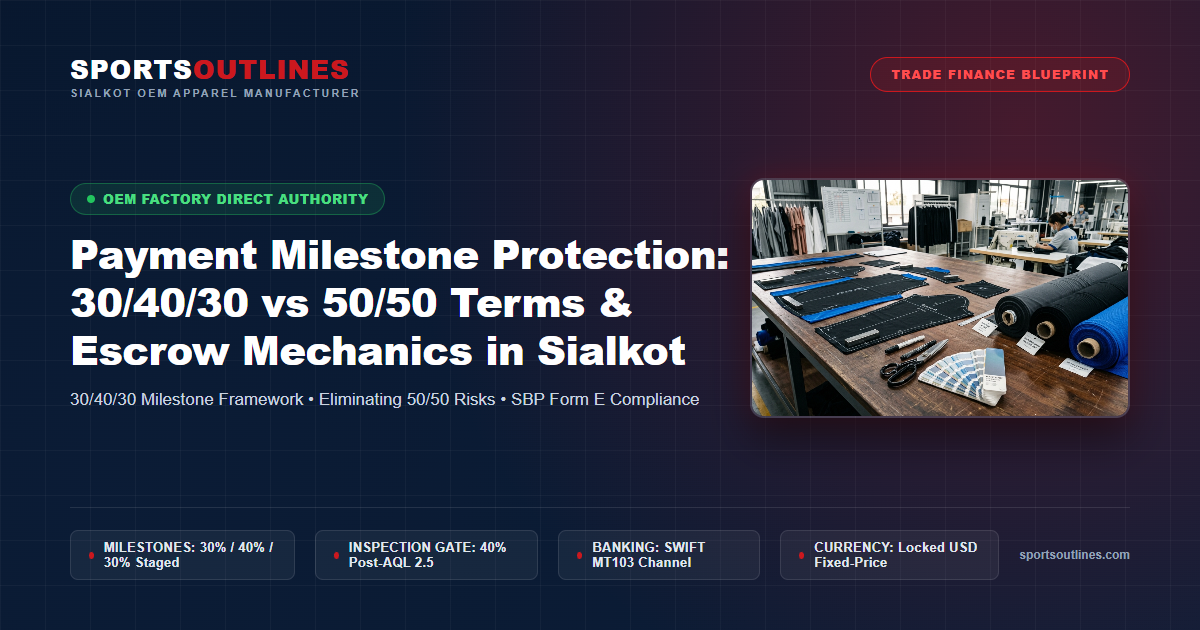
Structuring manufacturing payment milestones is the single most critical financial risk control for apparel brand founders. The traditional 50% deposit / 50% before dispatch model heavily favors the supplier, transferring 100% of financial risk to the buyer before goods are inspected or shipped. In professional garment procurement, the industry benchmark is the 30/40/30 Milestone Framework: 1) 30% Upfront Deposit (allocates raw yarn, custom dye-lots, and CAD pattern digitizing); 2) 40% Mid-Production / Post-Inspection Tranche (released ONLY upon passing formal AQL 2.5 pre-shipment quality audit); and 3) 30% Final Balance (released upon receipt of Bill of Lading (B/L) tracking confirmation or final warehouse delivery). For enterprise orders over $30,000, Irrevocable Letters of Credit (LC at Sight governed by UCP 600) provide total bank-guaranteed escrow. Sports Outlines International in Sialkot, Pakistan, operates transparent milestone billing via official banking channels (SWIFT MT103 / SBP Form E) on 30–50 piece factory MOQs.
Direct WhatsApp: +92 316 7932595
In the financial architecture of an apparel brand, cash flow is oxygen. For emerging streetwear founders, direct-to-consumer fashion startups, and technical sportswear developers, manufacturing inventory represents the single largest allocation of working capital. Yet, astonishingly, thousands of brand owners routinely surrender 100% of their financial leverage to overseas suppliers by agreeing to flawed, high-risk payment terms that offer zero contractual escrow protection. The most prevalent—and dangerous—payment structure in global trade is the classic “50% upfront deposit, 50% balance before factory dispatch.”
Under the 50/50 payment model, the buyer pays the remaining 50% balance while the finished garments are still sitting thousands of miles away inside an overseas warehouse, based solely on static, carefully staged factory photos. The moment that final wire transfer clears the supplier’s bank account, your financial leverage drops to zero. If the shipping container arrives at your warehouse with crooked screen printing, sleeves that are 2 inches out of tolerance, or mismatched ribbing colors, you have zero leverage. The factory has already collected 100% of their money. Demanding refunds or re-cuts at that stage is an exercise in futility.
At Sports Outlines in Sialkot, Pakistan, we believe that sustainable manufacturing partnerships are grounded in financial alignment, mutual risk sharing, and absolute transparency. In this masterclass, we break down the economics of the 30/40/30 Milestone Framework, compare it against traditional Letter of Credit (LC) trade finance mechanisms, decode the official State Bank of Pakistan (SBP) Form E export declaration system, and provide the exact contractual terms required to protect your working capital across every stage of apparel manufacturing.
Executive Financial Architecture:
- Section 1: The Spectrum of Apparel Manufacturing Payment Terms
- Section 2: Deconstructing the 50/50 Trap: Why Emerging Brands Lose Leverage
- Section 3: The 30/40/30 Milestone Framework: The Professional Industry Benchmark
- Section 4: Irrevocable Letters of Credit (LC at Sight): Enterprise Trade Finance Mechanics
- Section 5: Banking Protocols in Sialkot: SWIFT MT103 Wire Discipline & SBP Form E
- Section 6: Pre-Shipment Quality Verification Gates: QIMA, Top-Samples & Live Video Audits
- Section 7: Currency Dynamics & Exchange Rate Hedging (USD vs PKR Contracts)
- Section 8: Sports Outlines Low MOQ Manufacturing Protocol & Prototype Engineering
1. The Spectrum of Apparel Manufacturing Payment Terms
International trade finance operates along a spectrum of risk. On one extreme, the buyer assumes 100% of the risk; on the opposite extreme, the manufacturer assumes 100% of the risk. Understanding where your payment structure sits on this continuum is essential to safeguarding your business.
| Payment Term Structure | Buyer Risk Level | Factory Risk Level | Commercial Industry Assessment |
|---|---|---|---|
| 100% Upfront Wire Transfer | 100% Extreme Risk | 0% Risk | Never Accept: High probability of supplier abandonment or massive uncorrected defects. |
| 50% Deposit / 50% Before Dispatch | High Risk | Low Risk | The Alibaba Default: Leaves buyer with zero leverage if goods fail quality standards after full payment. |
| 30% Deposit / 40% Post-QC / 30% Balance | Balanced & Fair | Balanced & Fair | The Gold Standard: Funds raw materials while protecting quality verification gates prior to final payment. |
| Irrevocable Letter of Credit (LC at Sight) | Bank Protected | Bank Protected | Enterprise Benchmark: Bank releases funds only against conforming third-party inspection documents. |
| Open Account (Net 30 / Net 60 Days) | 0% Risk | 100% Extreme Risk | Enterprise Only: Reserved for institutional retailers with audited credit ratings and trade insurance. |
Structure Your Production Milestones with Sialkot Financial Directors
Send us your production budget, target order volume, or payment terms on WhatsApp to establish a secure 30/40/30 milestone manufacturing contract.
✓ $45–$195 Physical Prototypes •
✓ Worldwide DDP Delivery
2. Deconstructing the 50/50 Trap: Why Emerging Brands Lose Leverage
Why do overseas brokers and unvetted factories push aggressively for 50/50 payment terms? Because it aligns perfectly with their internal cash flow while transferring all production liability to the buyer:
The Anatomy of the 50/50 Breakdown:
- The 50% Deposit Covers Actual Direct Cost of Goods Sold (COGS): In typical garment manufacturing, raw materials (yarn, fabric knitting, dyeing) and cutting labor represent approximately 45% to 55% of the total factory quotation. Therefore, your initial 50% deposit completely covers the factory’s out-of-pocket operational cash expenditure! The factory is essentially running zero personal financial risk.
- The Pre-Shipment 50% Balance Captures Their Profit: Before the factory dispatches the shipment, they require the remaining 50% balance. When you wire that final balance, the factory has collected 100% of their revenue, gross profit margin, and overhead recovery.
- Zero Incentive for Post-Shipment Rectification: If the garments arrive at your destination warehouse and you discover that 15% of the hoodies have distorted neck drops or open pocket seams, the factory has already banked their profit. At best, they will offer an insulting “$100 discount on your next order.” At worst, they stop responding to WhatsApp messages entirely.
3. The 30/40/30 Milestone Framework: The Professional Industry Benchmark
The definitive structural solution for apparel collections between 50 and 500 units is the 30/40/30 Milestone Framework. This model creates a synchronized, milestone-driven financial architecture that keeps both parties commercially motivated until the goods are fully verified.
Milestone 1: 30% Initial Production Deposit
- Trigger Event: Bilateral signing of the OEM Manufacturing Agreement, approval of tech packs, and issuance of the formal Purchase Order.
- Factory Operational Deliverable: Purchase of certified raw cotton/polyester yarn, initiation of custom circular knitting, laboratory dip color formulations, and master CAD pattern digitizing in Gerber AccuMark.
- Buyer Protection: Locks in the Firm-Fixed-Price (FFP) contract and establishes the official delivery schedule clock.
Milestone 2: 40% Mid-Production / Post-Inspection Tranche
- Trigger Event: Completion of 100% of garment sewing, pressing, and packaging, followed by formal execution and approval of an AQL 2.5 Pre-Shipment Quality Inspection Audit.
- Factory Operational Deliverable: Provision of full AQL 2.5 inspection certificates, digital caliper measurement logs, high-resolution photographic evidence, and carton packing lists.
- Buyer Protection: The Ultimate Leverage Gate! You do NOT release this 40% tranche until the goods are mathematically and visually confirmed to meet tech-pack POM tolerances. If defects exceed AQL 2.5 thresholds, the factory must repair or re-cut the defective units before seeing a single dollar of this second payment.
Milestone 3: 30% Final Balance Release
- Trigger Event: Formal confirmation of export carrier dispatch.
- Factory Operational Deliverable: Provision of the live, scannable Express Air Courier Master Tracking Number (DHL Express or FedEx Priority) or the formal ocean Bill of Lading (B/L) with Telex Release confirmation.
- Buyer Protection: Ensures that cargo is physically in the custody of an international freight carrier and in transit to your destination before your final working capital is transferred.
4. Irrevocable Letters of Credit (LC at Sight): Enterprise Trade Finance Mechanics
When an apparel brand scales production to 300 to 1,000+ units per collection (purchase order values exceeding $15,000 to $30,000), managing multi-stage wire transfers becomes cumbersome. At this enterprise tier, the universal global standard is an Irrevocable Documentary Letter of Credit (LC at Sight) governed by the International Chamber of Commerce (ICC) Uniform Customs and Practice for Documentary Credits (UCP 600).
How an Apparel Letter of Credit Functions:
- Contract Execution: The brand and Sports Outlines agree on a commercial contract stipulating payment via 100% Irrevocable Letter of Credit at Sight.
- LC Issuance: The brand’s commercial bank (Issuing Bank) opens the LC in favor of Sports Outlines through our designated corporate banking partner in Sialkot (Advising/Confirming Bank, e.g., Habib Bank Limited or Standard Chartered).
- Documentary Conditions Encoded: The LC legally stipulates that funds will be released to the factory IF AND ONLY IF the factory presents the exact required documents:
- Clean On-Board Ocean Bill of Lading or Air Waybill (AWB).
- Commercial Invoice matching the exact PO price and HTS codes.
- Comprehensive Packing List itemizing carton breakdowns.
- Certificate of Origin issued by the Sialkot Chamber of Commerce & Industry (SCCI).
- Independent Quality Inspection Certificate issued by an accredited inspection body (QIMA, SGS) confirming the lot passed AQL 2.5 inspection.
- Bank-Guaranteed Escrow: The bank acts as an impartial escrow agent. The factory knows their payment is 100% guaranteed by an international financial institution once they manufacture conforming goods; the brand knows their capital cannot be touched unless the goods are 100% inspected and shipped!
5. Banking Protocols in Sialkot: SWIFT MT103 Wire Discipline & SBP Form E
When transferring funds to garment manufacturers in Pakistan, brand directors must adhere strictly to formal international banking channels. Avoid intermediaries who request payments via personal accounts, third-party fintech apps, or cryptocurrency.
A. The SWIFT MT103 Wire Format
All legitimate commercial bank wire transfers generate a standardized SWIFT MT103 transaction report. To ensure absolute contractual protection, brand finance teams must ensure that Field 70 (Remittance Information) of the MT103 contains specific legal references:
This formal entry legally ties the capital transfer to your specific contract, establishing an airtight documentary audit trail under international commercial law.
B. State Bank of Pakistan (SBP) Form E Compliance
Pakistan’s central bank mandates that all physical merchandise exported from the country must be backed by an electronic Form E (Regulatory Export Declaration) filed through the Pakistan Single Window (PSW) customs portal. Legitimate industrial OEM factories like Sports Outlines operate 100% in compliance with SBP Form E regulations, ensuring that all exported shipments clear Pakistan customs instantly without regulatory holds or anti-money-laundering audits.
6. Pre-Shipment Quality Verification Gates: QIMA, Top-Samples & Live Video Audits
Under our milestone framework, the release of the 40% mid-production payment tranche is contingent upon passing a pre-shipment quality verification gate. How can an apparel founder based in Los Angeles, London, or Sydney verify quality before releasing funds?
Option 1: Accredited Third-Party Quality Inspection (QIMA / SGS)
For orders of 100 to 300+ units, brands can dispatch an independent quality inspector from global auditing firms like QIMA or SGS to our Sialkot factory floor. For a flat fee (typically $280 to $320), a licensed auditor pulls random statistical samples under ISO 2859-1 Level II standards, measures every POM against your tech pack using digital calipers, conducts barcode scan tests, and issues a formal 25-page PDF inspection report with pass/fail ratings.
Option 2: The Production Top-Sample Protocol
For smaller 30- to 75-piece drops, hiring an outside auditor may be cost-prohibitive. In this scenario, Sports Outlines executes the Top-Sample Protocol: one randomly selected, fully finished garment is pulled from the bulk sewing line, packed, and dispatched to your office via DHL Express (3–4 days). You physically try on the garment, inspect the seams, test the zipper glide, and review the wash care labels. Upon your written approval, the 40% tranche is released and the bulk order is dispatched.
Option 3: High-Resolution Live Video POM Audit
For rapid turnaround drops, our quality control team schedules a live, interactive 4K video conference with your technical designer. We lay garments flat on calibrated steel cutting tables, measuring each critical Point of Measurement (HPS length, chest width, sleeve length, neck drop) directly in front of the camera, providing instant visual and dimensional verification with zero courier transit delays.
7. Currency Dynamics & Exchange Rate Hedging (USD vs PKR Contracts)
International apparel manufacturing in Sialkot interfaces with global currency markets. Raw cotton and synthetic polyester chips are international commodities priced globally in US Dollars (USD).
To protect international clients from currency volatility:
- All Contracts Denominated in USD: Sports Outlines quotes and bills all manufacturing orders in US Dollars (or Euros/GBP upon request).
- Firm-Fixed-Price Guarantee: Once the purchase order is signed and the deposit is received, your unit price is permanently locked. If the Pakistani Rupee (PKR) appreciates or if local inflation fluctuates during production, Sports Outlines absorbs 100% of the exchange rate difference. Your landed cost-per-unit remains completely fixed and predictable.
8. Sports Outlines Low MOQ Manufacturing Protocol & Prototype Engineering
At Sports Outlines in Sialkot, Pakistan, we believe that world-class apparel manufacturing must be paired with institutional financial integrity. We welcome transparent milestone contracts, strict AQL 2.5 quality gates, and professional banking discipline.
Our Financial & Manufacturing Standards Deliver:
- Low Industrial MOQ: Strictly 30 to 50 pieces per style/colorway across custom cut-and-sew streetwear, athletic sets, and fight wear.
- Guaranteed Milestone Contract Protection: Flexible 30/40/30 or 50/50 Post-QC Audit milestones with zero unverified post-deposit surcharges.
- Bespoke Pre-Production Prototyping: We provide complete pre-production physical prototypes for a transparent $45 to $195 non-creditable engineering prototype fee with rapid 7 to 10 business day turnaround, delivering complete fit validation before bulk production funds are committed.
| Production Volume Tier | Est. Unit FOB Cost | Sample Cost & SLA | Bulk Production SLA | Included Specifications | Recommended Buyer Profile |
|---|---|---|---|---|---|
| 30–50 Units (Sampling & Micro MOQ Launch) | $16.20 – $19.00 / piece (Secure Milestone Contract) | $45 – $85 (100% Non-Creditable Engineering Prototype Fee, 7–10 Day Turnaround) | 12–15 Business Days | Formal 50% deposit / 50% post-AQL 2.5 inspection milestone structure, master pattern digitizing in Gerber AccuMark, physical pre-production prototype, SWIFT MT103 banking verification. | Emerging streetwear labels, capsule drop proof-of-concept founders demanding verified quality sign-off before final funds release. |
| 100 Units (Commercial Growth Tier) | $12.00 – $14.20 / piece (30/40/30 Milestone Structure) | $45 – $85 (100% Non-Creditable Engineering Prototype Fee) | 16–20 Business Days | 30/40/30 milestone payment terms, independent third-party AQL 2.5 audit rights, automated Gerber nesting marker report, custom lab dips, master export carton packaging. | Scaling direct-to-consumer apparel brands, e-commerce drops, established martial arts and fitness academies expanding signature product lines. |
| 300 Units (Industrial Volume Optimization / Letter of Credit) | $9.10 – $11.00 / piece (Commercial LC at Sight / 30/40/30) | $45 – $85 (100% Non-Creditable Engineering Prototype Fee) | 20–25 Business Days | Irrevocable LC at Sight (UCP 600) or 30/40/30 terms, dedicated reactive dye-lot matching, zero hardware mold fees, consolidated split-air/ocean freight logistics support, customized branded hardware. | National athletic leagues, major collegiate apparel programs, multi-retailer wholesale distributors, flagship brand seasonal collections. |
| Sourcing Feature & Risk Factor | Sports Outlines (Sialkot Direct) | Alibaba Trading Agents | Traditional Chinese Hubs | Print-on-Demand (POD) |
|---|---|---|---|---|
| Payment Milestone Structure | Flexible 30/40/30 or 50/50 Post-QC Audit; final funds released only after verified quality inspection sign-off | Rigid 50% deposit / 50% before dispatch; factory refuses to load boxes until 100% paid without buyer inspection | 30/70 against Bill of Lading (B/L), but strictly requires minimum $20,000 order volumes | 100% Upfront Payment; platform charges credit card immediately upon order submission |
| Pre-Shipment Quality Inspection Gate | Contractually protected AQL 2.5 audit gate; 40% tranche held in escrow until video/physical QA passes | Zero formal QA gate; factory provides staged beauty photos and demands full wire transfer before dispatch | Third-party QA allowed, but buyer must fund all auditor travel and hotel expenses | Zero pre-shipment inspection; buyer only discovers misprints after customer receives retail package |
| Banking Channel Transparency & Compliance | Official Commercial Bank SWIFT (MT103) & State Bank of Pakistan (SBP) Form E export declaration | Informal third-party fintech accounts or personal Western Union/MoneyGram requests carrying zero corporate liability | Official corporate bank accounts, but subject to complex currency exchange surcharges and export tax rebates | Retail e-commerce credit card processing with zero international trade documentation |
| Letter of Credit (LC) Acceptance | Accepted for 300+ unit volume orders ($15k+) via major international banks (Standard Chartered, Habib Bank) | Rejected for orders under $50,000; trading companies demand wire transfer cash flow | Standard for enterprise orders ($50k+), but rigid refusal for low-volume production | Non-existent; strictly automated credit card or secure credit card invoicing billing |
| Bespoke Pre-Production Physical Prototype | $45 – $85 flat non-creditable engineering fee, 7–10 days with official sample receipt and full fit sign-off | $150 – $350 sample fees plus separate hidden shipping surcharges with 3- to 5-week lead times | $200 – $400 sample invoices, often requiring large production deposits before sampling | Digital mockups only; generic catalog blanks with zero bespoke pattern or fit customization |
Frequently Asked Sourcing & Manufacturing Questions (Buyer FAQ)
Why is the traditional 50% deposit / 50% before dispatch payment model dangerous for apparel brands?
Under the 50/50 model, the buyer pays the remaining 50% balance while the goods are still inside the foreign factory warehouse, based solely on factory-provided photos. Once 100% of the funds have cleared the supplier’s bank account, the buyer loses 100% of their commercial and financial leverage. If the shipment arrives overseas containing crooked embroidery, out-of-tolerance measurements, or stained fabrics, the factory has zero financial incentive to issue refunds, cover return shipping, or manufacture replacement units.
How does the 30/40/30 milestone payment structure work in practice?
In a 30/40/30 framework: 1) The brand pays 30% upon signing the purchase order and approving the digital tech pack, funding raw yarn knitting and fabric dyeing; 2) The brand pays 40% after bulk sewing is finished and an independent AQL 2.5 pre-shipment inspection report (or live high-resolution video measurement audit) is formally approved; and 3) The remaining 30% balance is released against proof of export carrier dispatch (e.g., DHL/FedEx master tracking number, ocean Bill of Lading telex release, or Net 15 days upon warehouse receipt).
What is an Irrevocable Letter of Credit (LC at Sight), and when should an apparel brand use one?
An Irrevocable Letter of Credit (LC at Sight) is a formal financial guarantee issued by the buyer’s bank to the seller’s bank under international ICC UCP 600 rules. The issuing bank guarantees that payment will be released to the factory if and only if the factory presents strictly conforming shipping documents (clean on-board Bill of Lading, AQL 2.5 inspection certificate, packing list, certificate of origin). LCs eliminate credit risk for both parties and are commercially recommended for orders exceeding $15,000 to $25,000.
What is a SWIFT MT103 wire transfer, and what details must be included in the transaction reference?
A SWIFT MT103 is the standardized international wire transfer confirmation document generated by commercial banks. When transferring production funds, brand procurement teams must mandate that Field 70 (Remittance Information) includes the exact Purchase Order number, Contract Agreement date, and style code (e.g., ‘PO-2026-084 // Sports Outlines Hoodies’). This creates an unbroken legal audit trail linking the capital transfer directly to the contractual deliverables.
What is the State Bank of Pakistan (SBP) Form E, and why is it legally required for apparel exports?
Form E is an electronic regulatory export declaration mandated by the State Bank of Pakistan and Pakistan Customs. It certifies that the foreign currency payment for the manufactured goods has been routed through authorized commercial banking channels. Legitimate, industrial apparel manufacturers in Sialkot always operate via Form E; unverified intermediaries who ask for personal payments (Western Union or unregulated crypto) evade export controls and leave buyers completely unprotected.
How can an emerging brand safely verify production quality before releasing the final payment tranche?
Brands can verify quality before final funds release through three distinct protocols: 1) Hiring an accredited third-party inspection agency (such as QIMA, SGS, or Bureau Veritas) to conduct an on-site AQL 2.5 audit ($280–$320 flat audit fee); 2) Requesting a ‘Production Top-Sample’ (one random finished garment pulled from the bulk run and shipped via express courier for hands-on review); or 3) Mandating a comprehensive live video measurement call where factory QA leads measure critical POMs on calibrated steel rulers.
How do currency exchange fluctuations between USD and PKR impact apparel manufacturing contracts?
Because global textile raw materials (cotton bales, synthetic polyester chips, chemical dyestuffs, YKK hardware) are traded internationally in US Dollars, professional apparel contracts in Sialkot are denominated firmly in USD. Sports Outlines locks in the agreed USD unit price in a Firm-Fixed-Price contract, absorbing domestic currency fluctuations so the brand never faces exchange rate surcharges.
What are Net 30 or Net 60 payment terms, and at what stage does an apparel brand qualify for them?
Net 30 or Net 60 terms allow a brand to pay for production 30 to 60 days after receiving the physical goods at their destination warehouse. Overseas factories generally only extend open-account Net terms to established corporate clients with proven 12-month payment histories, audited financial statements, or trade credit insurance backing (such as Allianz Trade or Coface). Emerging brands typically start with 30/40/30 milestone terms and transition to partial Net terms as order volume scales.
What should a brand do if a factory demands an unauthorized price increase after receiving the deposit?
If an overseas supplier attempts an unauthorized post-deposit price hike, immediately reference Section 4.1 (Firm-Fixed-Price Lock) of your signed Master Services Agreement. If the factory refuses to honor the agreed terms, notify them in writing that they are in material breach of contract, demand an immediate wire refund of the deposit, and initiate formal dispute proceedings through the Sialkot Chamber of Commerce & Industry (SCCI) Arbitration Committee.
How does Sports Outlines charge for pre-production prototype samples?
We charge a transparent $45 to $195 non-creditable engineering prototype fee per piece with a rapid 7 to 10 business day turnaround. This fee covers master pattern drafting in Gerber AccuMark, single-unit cutting, machine re-threading, embellishment strike-offs, and express worldwide air courier delivery. We maintain 100% open-book pricing and do not offer speculative sample rebates that inflate bulk manufacturing quotations.
Manufacture with Guaranteed Milestone Payment Security
Direct Sialkot OEM factory floor • Official State Bank of Pakistan banking channels • 30–50 piece cut-and-sew MOQs • $45–$195 physical prototype sampling.
✓ $45–$195 Physical Prototypes •
✓ Worldwide DDP Delivery