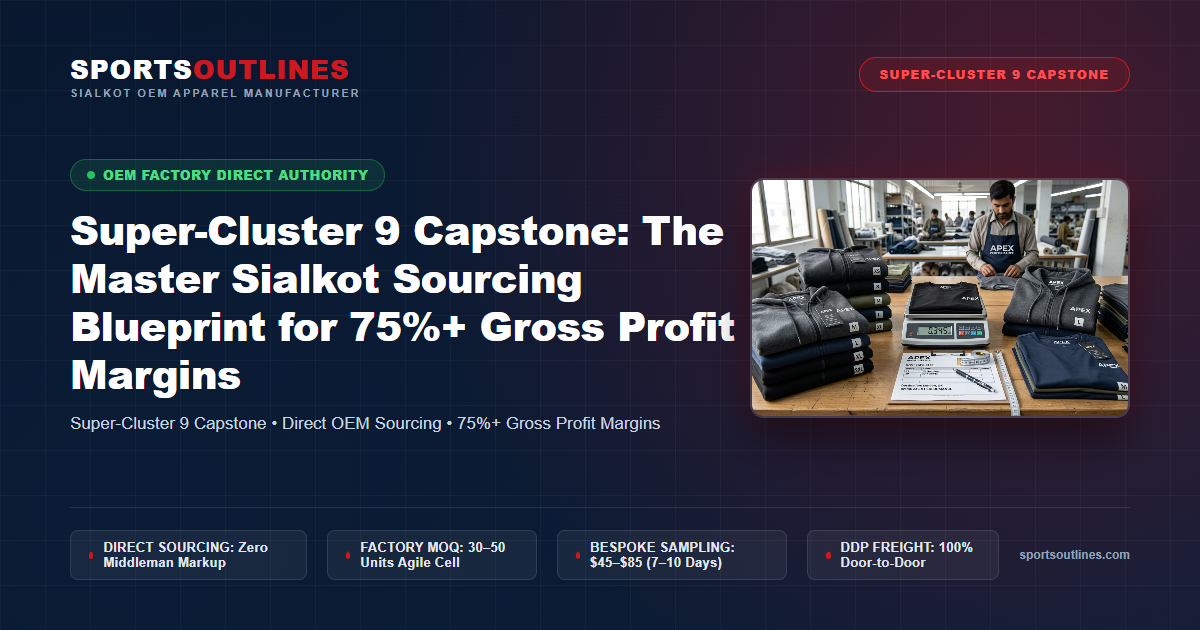
Direct Manufacturer Snapshot: Super-Cluster 9 Capstone: The Master Sialkot Sourcing Blueprint for 75%+ Gross Profit Margins
The Sialkot Apparel Sourcing Blueprint is the comprehensive, industrial framework for brand founders seeking to bypass trading middlemen, eliminate stealth factory surcharges, and achieve sustainable 75% to 83%+ Gross Profit Margins on custom cut-and-sew streetwear, activewear, and combat sportswear. As the world’s premier export manufacturing cluster—supported by the Sialkot Chamber of Commerce & Industry (SCCI), Sialkot Dry Port Trust (SDPT), and Sialkot International Airport (SKT)—Sialkot provides unmatched vertical supply integration from raw Punjab cotton yarn to computerized Tajima embroidery and automated Gerber CNC cutting. The master 10-step sourcing framework unites: 1) 45-point tech-pack pre-flight audits; 2) Open-book 7-layer BOM costing; 3) 30–50 piece flexible cell MOQs; 4) $45–$85 non-creditable bespoke prototyping (7–10 days); 5) Bilateral OEM contracts with liquidated damages; 6) 30/40/30 milestone payments; 7) Mandatory AQL 2.5 quality gates; and 8) Guaranteed door-to-door DDP freight. Sports Outlines International operates an advanced OEM facility in Sialkot, Pakistan, offering 100% transparent factory-direct manufacturing.
Direct WhatsApp: +92 316 7932595
Across the global textile and sportswear industry, there is an open secret understood by multinational athletic conglomerates, elite luxury fashion houses, and Tier-1 combat sports federations: Sialkot, Pakistan, is the undisputed industrial engine of high-performance cut-and-sew apparel manufacturing. Tucked into the historic industrial heartland of Punjab, this single city produces over 70% of the world’s FIFA-certified match soccer balls, more than 60% of the globe’s martial arts combat fight wear, and billions of dollars in precision streetwear, technical compression wear, and athletic outerwear. Yet, for decades, this extraordinary manufacturing ecosystem remained largely inaccessible to emerging independent designers, direct-to-consumer (DTC) startups, and scaling private labels—gated behind impenetrable layers of export trading brokers, retail sourcing agents, and rigid 1,000-piece factory minimum order quantities.
Today, that paradigm has permanently shattered. Welcome to the Super-Cluster 9 Grand Capstone—the definitive synthesis of our 80-part investigation into garment costing, factory quotes, startup budgets, and unit economics. Throughout this master series, we have dismantled the mathematics of raw cotton yarn counts, broken down BOM cost sheets for every major apparel silhouette, revealed how to launch brands on $1.5k to $10k capital kits, modeled the exact economics of 30, 50, 100, and 300-piece volume tiers, exposed 12 stealth factory surcharges, and established airtight AQL 2.5 quality gates and milestone payment contracts.
In this master blueprint, Sports Outlines unites these technical disciplines into a single, cohesive, operational playbook: The Master Sialkot Sourcing Blueprint for 75%+ Gross Profit Margins. Below, we examine the structural advantages of Sialkot’s vertical industrial infrastructure, detail the 10-step execution framework from zero to warehouse delivery, and demonstrate exactly how direct factory OEM partnership transforms your apparel venture from a vulnerable startup into a highly profitable, scalable global enterprise.
Master Capstone Architectural Index:
- Section 1: The Sialkot Industrial Ecosystem: Century-Old Craftsmanship Meets Modern Automation
- Section 2: The Sialkot Institutional Advantage: SCCI, SDPT, and The Private International Airport (SKT)
- Section 3: The 10-Step Master Sialkot Sourcing Playbook: From Creative Concept to 75%+ Gross Margins
- Section 4: Sub-Cluster 9.1 Synthesis: BOM Tear-Downs & The Physical Science of Garment Costing
- Section 5: Sub-Cluster 9.2 Synthesis: Capital Allocation & The Cash Conversion Cycle ($1.5k–$10k Kits)
- Section 6: Sub-Cluster 9.3 Synthesis: The MOQ Scaling Ladder (30, 50, 100, 300 Pcs Crossover Physics)
- Section 7: Sub-Cluster 9.4 Synthesis: Eliminating Stealth Fees, Locking Contracts & Milestone Escrow
- Section 8: The Vendor Displacement Matrix: Direct Sialkot OEM vs Alibaba vs China vs POD
- Section 9: Sports Outlines Low MOQ Manufacturing Protocol & Prototype Engineering
1. The Sialkot Industrial Ecosystem: Century-Old Craftsmanship Meets Modern Automation
To understand why Sialkot consistently out-competes regional manufacturing hubs in Vietnam, Bangladesh, and Turkey, one must understand the unique physical geography and vertical supply concentration of the city. Sialkot is situated directly adjacent to the historic Punjab Cotton Belt—one of the largest contiguous agricultural zones producing long-staple cotton in the world.
A. Raw Cotton to Finished Garment in a 40-Kilometer Radius
In fragmented global supply chains, raw cotton is harvested in one country, spun in a second, knitted in a third, and shipped across oceans to be dyed and assembled. In Sialkot, the entire supply chain is hyper-localized:
- Spinning Mills: High-grade combed ring-spun cotton yarn (from 20s/1 carded to 40s/1 combed compact yarn) is spun in modern spinning facilities in Faisalabad and Gujranwala, arriving at Sialkot factories within hours.
- Circular & Flatbed Knitting: Factories operate specialized Mayer & Cie circular knitting machines capable of producing high-density single jersey (180–300 GSM), interlock, 3-end diagonal French Terry (380–500 GSM), and rib knits with Invista Spandex.
- Eco-Friendly Reactive Vat Dyeing: Local automated dyeing houses utilize European Thies dyeing vessels operating with low liquor ratios and OEKO-TEX Standard 100 eco-passport dyestuffs, ensuring AATCC Level 4-5 wash-fastness and zero azo-dye contamination.
- In-House Embellishment & Assembly: Within our Sports Outlines facility, automated Roq silk-screen carousels, Tajima multi-head computerized embroidery machines, industrial DTF transfer lines, and Gerber CNC cutting tables operate under a single unified roof.
2. The Sialkot Institutional Advantage: SCCI, SDPT, and The Private International Airport (SKT)
Sialkot is not merely an industrial city—it is a monument to private-sector entrepreneurial initiative. It holds the unique global distinction of being the only industrial city in South Asia where the business community independently funded, engineered, and constructed its own international logistics infrastructure:
A. Sialkot Dry Port Trust (SDPT)
Established in 1984 by the Sialkot Chamber of Commerce & Industry (SCCI), the Sialkot Dry Port was the first private dry port in Asia. It allows industrial manufacturers to clear customs and seal ocean containers locally in Sialkot before dispatching them directly via bonded rail and dedicated road transit to Karachi Seaport, eliminating port transit friction and securing bonded container cargo.
B. Sialkot International Airport (SKT)
In the early 2000s, frustrated by air cargo transit delays through Lahore and Islamabad, Sialkot’s export community pooled private capital to construct Sialkot International Airport (SKT). Today, SKT features a 3,600-meter runway capable of handling wide-body commercial Boeing 777 and Airbus A330 cargo freighters operated by Emirates, Qatar Airways, and Turkish Airlines Cargo. This dedicated air gateway enables Sports Outlines to dispatch express air cargo that lands in Chicago, New York, London, or Frankfurt within 4 to 7 business days.
Review Your Apparel Manufacturing Strategy with Sialkot Factory Directors
Send us your designs, tech packs, or target collection quantities on WhatsApp for open-book BOM pricing, $45–$85 bespoke prototyping, and guaranteed DDP freight quotes.
✓ $45–$85 Physical Prototypes •
✓ Worldwide DDP Delivery
3. The 10-Step Master Sialkot Sourcing Playbook: From Creative Concept to 75%+ Gross Margins
For brand directors and apparel founders ready to manufacture directly with Sports Outlines, this 10-step protocol codifies the entire production journey:
| Phase | Sourcing Action Step | Operational Deliverables & Industrial Standards | Key Financial & Quality Invariant |
|---|---|---|---|
| Step 1 | Product Strategy & Niche Definition | Define category focus (luxury streetwear, technical activewear, combat fight gear); establish target retail price ($85–$120). | Target Gross Margin: Minimum 75.0%. |
| Step 2 | 45-Point Tech-Pack Pre-Flight Audit | Audit technical flats, ASTM D6193 seam stitches, POM datum lines (HPS zero), and grading rules across XS–3XL. | Measurement Tolerance: ±0.5cm (±0.2 in). |
| Step 3 | Open-Book 7-Layer BOM Line Costing | Lock in yarn spinning count, fabric GSM (480 GSM French Terry), thread denier (Coats Epic Tex 40), and YKK hardware. | Zero hidden broker surcharges; line-item purity. |
| Step 4 | Flexible Cell MOQ Tier Selection | Select volume tier: 30–50 pcs (Launch), 100 pcs (Growth), or 300 pcs (Scale Optimization). | Factory MOQ: Strictly 30–50 Units. |
| Step 5 | Bespoke Physical Prototyping | Manufacture exact physical prototype using bulk-approved fabrics, trims, and strike-offs; shipped via express courier. | $45 – $85 Non-Creditable Fee (7–10 days). |
| Step 6 | Bilateral OEM Contract Execution | Sign Master Services Agreement with 8 protective clauses: FFP price lock, liquidated damages, IP exclusivity, Golden Sample sign-off. | Late dispatch penalty: 0.5% per calendar day. |
| Step 7 | 30/40/30 Milestone Payment Deposit | Wire 30% initial deposit via SWIFT MT103 (SBP Form E compliant) to trigger circular knitting and greige dyeing. | Firm USD currency lock; zero inflation risk. |
| Step 8 | Pre-Shipment Quality Gate (AQL 2.5) | Execute ISO 2859-1 Level II audit (third-party or live 4K video); verify zero critical defects and AQL 2.5 major limits. | Release 40% tranche ONLY after passing QA. |
| Step 9 | Guaranteed Door-to-Door DDP Freight | Dispatch via Express Air Courier (4–7 days) or Consolidated LCL Ocean (35 days); all import duties and brokerage pre-cleared. | Zero Demurrage Liability; door delivery. |
| Step 10 | Retail Margin Realization & Cash Cycle | Receive barcoded cartons at 3PL; fulfill pre-orders; achieve inventory break-even at 25% sell-through; reinvest liquid profits. | Net Cash Reinvestment for Next Collection. |
4. Sub-Cluster 9.1 Synthesis: BOM Tear-Downs & The Physical Science of Garment Costing
In Blogs #701 through #725, we established the fundamental engineering axiom of apparel manufacturing: Cost is an objective physical function of mass, surface area, and machine cycle time.
- Fabric Density & Yardage: A garment’s cost begins with yarn weight. A 480 GSM French Terry hoodie requires 0.85 kg of yarn, while a 240 GSM t-shirt requires only 0.28 kg. Knowing the raw yarn price ($3.80–$4.20/kg for combed cotton) allows you to audit the factory’s raw material cost with mathematical precision.
- Hardware Metallurgy: Choosing between zinc alloy die casting (Zamak 5) and stamped sheet metal dictates durability. A pair of custom screw-in aglets costs $0.25–$0.35, but adds $15.00 in perceived retail value.
- Embellishment Technology: High-density 3D puff embroidery, soft-hand water-based discharge printing, and digital DTF transfers have distinct volume break-even curves. Screen printing dominates above 80 units; DTF wins on complex multi-color art below 60 units.
5. Sub-Cluster 9.2 Synthesis: Capital Allocation & The Cash Conversion Cycle ($1.5k–$10k Kits)
In Blogs #726 through #745, we dismantled the myth that launching a luxury cut-and-sew brand requires $50,000 in seed capital. We modeled complete, launch-ready capital kits:
- The $1,500 Micro-Capsule Kit: Funds 50 luxury heavyweight tees (280 GSM) or 35 gym shorts with custom neck tags and DDP express shipping, yielding $3,500 in retail revenue and $2,000 in liquid gross profit.
- The $2,500 Streetwear Drop Kit: Funds 60 bespoke French Terry hoodies with 3D puff embroidery, achieving full retail launch readiness.
- The $5,000 Multi-SKU Collection Kit: Funds a complete synchronized 3-piece capsule (Hoodie + Sweatpant + Graphic Tee) across 150 total units.
- The $10,000 Wholesale & DTC Scale Kit: Funds 300+ units with split air/ocean logistics, driving landed unit costs down to industrial minimums and unlocking 82%+ gross margins.
6. Sub-Cluster 9.3 Synthesis: The MOQ Scaling Ladder (30, 50, 100, 300 Pcs Crossover Physics)
In Blogs #746 through #765, we mapped the operational inflection points that occur as production volume scales:
- At 30–50 Units: Production runs in agile flexible cells. Setup costs are amortized; express air freight delivers instant market validation with minimal capital at risk.
- At 100 Units: Automated CNC cutting markers achieve 90%+ fabric yield. Cutting labor drops 35%; screen printing becomes the undisputed margin leader.
- At 300 Units: The brand crosses the Circular Knitting Threshold (consuming 250+ kg of raw yarn). This unlocks dedicated custom yarn-spinning ratios (e.g., custom cotton/modal blends or Creora spandex activewear), full reactive vat dye matching, zero hardware mold fees, and consolidated LCL ocean freight ($1.65/kg).
7. Sub-Cluster 9.4 Synthesis: Eliminating Stealth Fees, Locking Contracts & Milestone Escrow
In Blogs #766 through #779, we established the legal and operational protections required to preserve your profit margins:
- Auditing the 12 Hidden Surcharges: Eliminating surprise invoices for pattern grading, screen burns, digitizing, polybagging, and inland trucking through open-book contracts.
- The 45-Point Tech-Pack Audit: Eliminating POM datum confusion and ensuring strict ±0.5cm tolerances.
- Bilateral Contract Protection: Mandating Firm-Fixed-Price locks, liquidated damages (0.5%/day), IP exclusivity, and Golden Sample sign-offs.
- 30/40/30 Milestone Framework: Holding the 40% mid-production tranche in escrow until an independent AQL 2.5 inspection formally clears the lot.
- True Cost-Per-Unit (TCPU) Accounting: Factoring in all 6 landed cost components to ensure retail pricing guarantees 75%+ gross margins.
8. The Vendor Displacement Matrix: Direct Sialkot OEM vs Alibaba vs China vs POD
To summarize the strategic landscape, the comparison matrix below contrasts the four primary manufacturing pathways available to apparel brands today.
| Sourcing Feature & Risk Factor | Sports Outlines (Sialkot Direct) | Alibaba Trading Agents | Traditional Chinese Hubs | Print-on-Demand (POD) |
|---|---|---|---|---|
| Sourcing Architecture & Supply Chain Directness | Direct Factory OEM Floor: In-house knitting, CAD nesting, Roq screen printing, Tajima embroidery, and DDP export logistics | Multi-layer trading companies & brokers adding 35% to 50% markups while subcontracting to unvetted cottage shops | High-capacity factories, but rigid 1,000+ unit minimums and impersonal customer service for emerging Western brands | Third-party fulfillment aggregators charging extortionate $22–$35 base blank prices with zero brand asset ownership |
| Minimum Order Quantity (MOQ) Flexibility | Agile Flexible Cells: 30 – 50 pieces per style/colorway across custom cut-and-sew streetwear, activewear, and fight gear | Misleading ‘1 piece MOQ’ ads that secretly escalate to 300–500 units once custom colors, tags, or sizing are requested | Strict 500 – 1,000 piece minimums per colorway, making multi-size capsule collections cost-prohibitive | 1 piece minimum, but crippled by non-existent profit margins and zero custom hardware or custom silhouettes |
| Gross Profit Margin Realization (at $95 MSRP) | 75% to 83%+ Gross Profit Margin (Landed unit cost: $16.10–$22.80 including all DDP freight and customs tariffs) | 55% to 62% Gross Margin after accounting for hidden brokerage markups, defective units, and surprise port surcharges | 72% to 76% Gross Margin, but requires massive $30,000+ upfront cash commitments that strain working capital | 25% to 40% Gross Margin; completely unviable for paid digital advertising campaigns on Meta or TikTok |
| Quality Gate & Legal Contract Enforcement | Contractual AQL 2.5 Level II standards, liquidated damages for late delivery, and 30/40/30 milestone payment terms | Informal Proforma Invoices (PIs); 100% payment demanded before shipping with zero legal recourse for defects | Formal contracts, but dispute resolution strictly governed by domestic Chinese courts with high legal barriers | Platform Terms of Service only; individual photo dispute processes with zero commercial manufacturing warranty |
| Bespoke Pre-Production Physical Prototyping | $45 – $85 flat non-creditable engineering fee, 7–10 days with exact fabrics, trims, and golden sample sign-off | $150 – $350 sample fees with 3- to 5-week lead times and frequent bait-and-switch quality variances | $200 – $400 sample invoices, often requiring large production deposits before sampling commences | Digital mockups only; generic catalog blanks with zero bespoke pattern or fit customization |
9. Sports Outlines Low MOQ Manufacturing Protocol & Prototype Engineering
At Sports Outlines in Sialkot, Pakistan, we have built our entire industrial manufacturing infrastructure to serve as the direct bridge between ambitious apparel designers and world-class garment manufacturing. We eliminate middlemen, ban hidden surcharges, and provide transparent, open-book manufacturing partnerships.
Our Direct Manufacturing Service Delivers:
- True Low MOQ Production: Strictly 30 to 50 pieces per style/colorway across custom cut-and-sew streetwear, athletic sets, and fight wear.
- 100% Open-Book Costing: Complete line-item transparency on fabric, trims, labor, and DDP freight.
- Bespoke Pre-Production Prototyping: We provide full physical pre-production samples for a transparent $45 to $85 non-creditable engineering prototype fee with rapid 7 to 10 business day turnaround, delivering exact fit validation and landed cost confirmation before bulk production funds are committed.
- Guaranteed Door-to-Door DDP Freight: All customs duties, tariffs, and express courier transit fully pre-cleared with zero demurrage risk.
| Production Volume Tier | Est. Unit FOB Cost | Sample Cost & SLA | Bulk Production SLA | Included Specifications | Recommended Buyer Profile |
|---|---|---|---|---|---|
| 30–50 Units (Sampling & Micro MOQ Launch) | $15.50 – $18.50 / piece (Includes In-House CAD Digitizing + POM Verification) | $45 – $85 (100% Non-Creditable Engineering Prototype Fee, 7–10 Day Turnaround) | 12–15 Days Production + 4–6 Days Express Air Door-to-Door | 45-point tech pack pre-flight audit, master pattern digitizing in Gerber AccuMark, physical pre-production prototype, AQL 2.5 quality control inspection, individual polybagging with barcode, DHL Express DDP delivery. | Emerging streetwear labels, capsule drop proof-of-concept founders demanding zero pattern sizing errors and 68%–72% gross margins on boutique retail pricing ($90–$110). |
| 100 Units (Commercial Tier Growth) | $11.80 – $13.90 / piece (Optimized Nesting Marker + Open-Book BOM) | $45 – $85 (100% Non-Creditable Engineering Prototype Fee) | 16–20 Days Production + 8–11 Days Consolidated Air Freight | Automated CNC laser cutting, custom dyed ribbing and drawcords, high-density damask woven labels, master carton packing, consolidated air DDP freight coordination. | Scaling direct-to-consumer apparel labels, gym chains, martial arts academies launching signature teamwear targeting 75%+ DTC gross margins. |
| 300 Units (Industrial Volume Optimization) | $8.80 – $10.50 / piece (Maximum Pattern Yield + Batch Hardware Amortization) | $45 – $85 (100% Non-Creditable Engineering Prototype Fee) | 20–25 Days Production + 32–38 Days LCL Ocean Container | Dedicated reactive dye-lot matching, 91%+ fabric yield nesting marker, custom embossed Zamak 5 hardware, consolidated LCL ocean DDP freight logistics. | National athletic leagues, collegiate sports programs, multi-retailer wholesale distributors demanding institutional manufacturing precision and 82%+ gross margins. |
Frequently Asked Sourcing & Manufacturing Questions (Buyer FAQ)
Why is Sialkot, Pakistan, the global epicenter for sports apparel and combat gear manufacturing?
Sialkot represents one of the world’s most sophisticated and concentrated industrial manufacturing ecosystems. Spanning over a century of artisanal craftsmanship and industrial engineering, Sialkot produces more than 70% of the world’s hand-stitched athletic match balls, over 60% of global combat martial arts and boxing gear, and billions of dollars in premium technical sportswear and luxury streetwear. The cluster features complete vertical integration—from raw Punjab cotton spinning and circular knitting to in-house computerized embroidery, sublimation printing, die-casting hardware, and dedicated dry-port export infrastructure.
How does Sports Outlines achieve low MOQs of 30 to 50 pieces without inflating unit costs?
We achieve low MOQs through our proprietary ‘Flexible Cell Manufacturing Architecture.’ Rather than running high-speed 50-operator continuous assembly lines that require 1,000 units to reach operational efficiency, we organize our Sialkot factory floor into modular 6-to-8 operator agile cells. These skilled multi-machine operators specialize in rapid style changeovers, computerized CAD marker nesting, and cut-panel embellishments, allowing us to produce 30 to 50 bespoke garments at true industrial factory-floor pricing.
What is the complete 10-step roadmap for sourcing apparel from Sialkot?
The 10-step sourcing roadmap is: 1) Product Niche & Silhouette Definition; 2) 45-Point Tech-Pack Pre-Flight Audit; 3) Open-Book 7-Layer BOM Line-Item Costing; 4) Production Volume Tier Selection (30, 50, 100, or 300 units); 5) Bespoke Pre-Production Physical Prototyping ($45–$85 fee, 7–10 days); 6) Bilateral OEM Manufacturing Agreement Execution with 8 protective clauses; 7) 30/40/30 Milestone Payment Deposit; 8) Pre-Shipment Quality Gate (AQL 2.5 Level II audit); 9) Guaranteed Door-to-Door DDP Freight Dispatch; and 10) Warehouse Receiving, Barcode Scanning, and 75%+ Retail Margin Realization.
What are the 12 hidden factory surcharges that brands must eliminate when reviewing quotes?
The 12 stealth factory surcharges are: 1) CAD pattern grading and marker generation fees; 2) Lab dip and strike-off sampling surcharges; 3) Screen mesh burn and film separation fees; 4) Underbase screen penalties on dark garments; 5) Embroidery Wilcom digitizing fees; 6) Fabric shrinkage buffer markups (12–18%); 7) Individual polybagging and warning text fees; 8) Barcode sticker application fees; 9) Master export carton packing fees; 10) Domestic inland drayage from factory to airport/seaport; 11) Destination port terminal handling charges (THC); and 12) Currency exchange transfer spreads. Sports Outlines eliminates all 12 through transparent, all-inclusive open-book quotations.
Why is an open-book Bill of Materials (BOM) essential for margin protection?
An open-book Bill of Materials legally locks in every single raw component—including fabric areal weight (GSM), yarn spinning count, fiber composition, thread denier (Coats Epic Tex 40), and zipper specifications (YKK #8 metal). By defining these exact specifications in your contract, you prevent the factory from substituting cheaper carded cotton or generic pot-metal zippers, ensuring that your delivered garments match the exact quality of your approved Golden Sample.
How does DDP freight protect emerging apparel brands from financial loss?
Under Delivered Duty Paid (DDP) terms, the manufacturer and its licensed freight forwarder assume 100% legal and financial responsibility for export customs declarations in Pakistan, international air/ocean freight, US/UK/EU import tariffs, customs brokerage clearance, and final-mile delivery directly to your door. This completely shields you from unexpected destination brokerage bills, $200/day port demurrage fees, and $5,000 late ISF filing penalties.
What is the ‘Golden Sample’ and why is bulk cutting strictly forbidden before its approval?
The Golden Sample is a complete physical pre-production prototype manufactured using the exact bulk-approved fabrics, ribbing, threads, zippers, and embellishments. Two identical Golden Samples are produced: one is shipped to the brand for physical fit and hand-feel sign-off, while the second remains on the factory cutting table. The contract legally dictates that bulk cutting cannot begin until the Golden Sample is countersigned, establishing a legally binding physical benchmark for the entire production run.
What is the difference between AQL 2.5 and AQL 4.0 inspection standards?
Under ISO 2859-1 sampling tables: Critical Defects (sharp broken needles, mold) have an AQL threshold of 0.0 (zero tolerance); Major Defects (open seams, zipper jamming, holes, measurements exceeding ±0.5cm tolerances) are governed by AQL 2.5; and Minor Defects (loose threads under 1cm, minor packing creases) are governed by AQL 4.0. In a 100-piece lot, an auditor inspects 20 random garments and rejects the entire lot if more than 1 major defect is discovered.
How does Sports Outlines charge for bespoke pre-production prototypes?
We charge a transparent $45 to $85 non-creditable engineering prototype fee per piece with a rapid 7 to 10 business day turnaround. This engineering fee covers master pattern drafting in Gerber AccuMark, single-unit CNC cutting, machine re-threading, embellishment strike-offs, and express worldwide air courier delivery. We maintain 100% open-book pricing and do not offer speculative sample rebates that inflate bulk manufacturing quotations.
How does an apparel brand get started manufacturing direct with Sports Outlines in Sialkot?
Getting started is seamless: 1) Send your tech packs, reference garments, or sketches to our direct engineering desk via WhatsApp at +92 316 7932595; 2) Our master pattern makers conduct an immediate free 45-point pre-flight audit and provide an open-book line-item quote; 3) Order your bespoke physical prototype for $45–$85 (delivered in 7–10 days); 4) Sign your bilateral OEM agreement with milestone payment terms; and 5) Receive your custom manufactured collection delivered directly to your door via guaranteed DDP freight.
Manufacture Direct with the Premier Sialkot OEM Partner
Direct factory floor execution • In-house CAD pattern digitizing • 30–50 piece cut-and-sew MOQs • 75%+ gross profit margins • $45–$85 physical prototype sampling.
✓ $45–$85 Physical Prototypes •
✓ Worldwide DDP Delivery