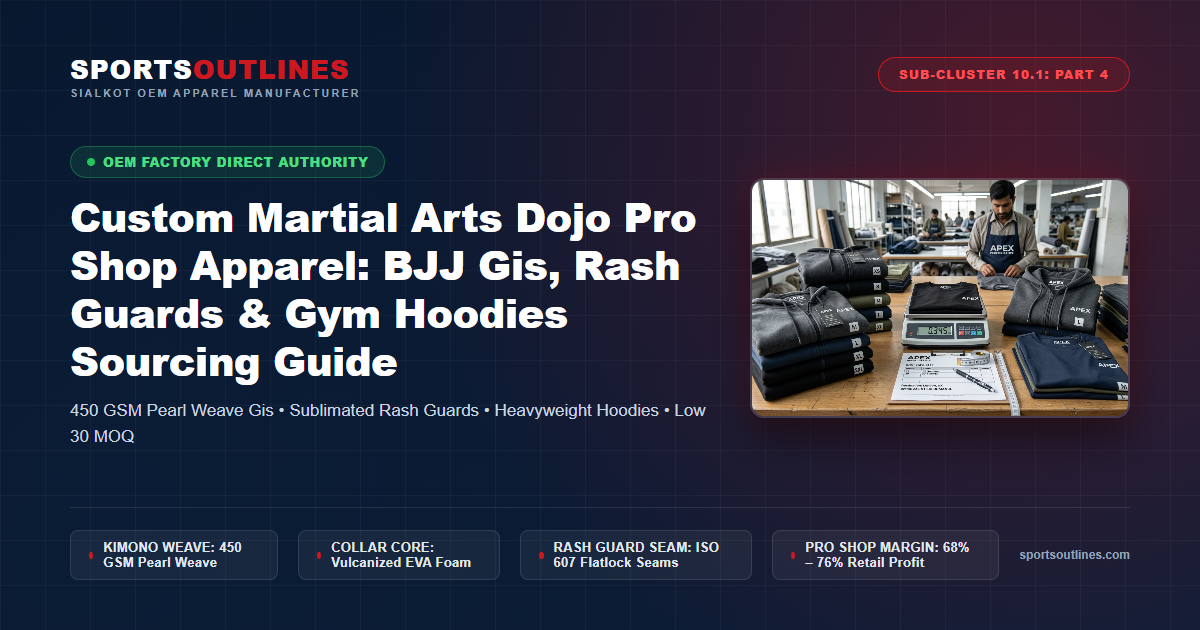
For martial arts dojos, Brazilian Jiu-Jitsu (BJJ) academies, and MMA training centers, the on-site pro shop represents the single highest-margin revenue stream outside of monthly student tuitions. Yet, the vast majority of school owners and head coaches remain trapped in an outdated distribution model: purchasing generic, unbranded kimonos or overpriced white-label fightwear from domestic catalog middlemen at 40% to 60% markups. When an academy pays $85 to $100 for a wholesale BJJ Gi and resells it to a student for $150, they capture a modest $50 profit while carrying significant inventory risk. By bypassing trading intermediaries and partnering directly with Sports Outlines International—a premier combat sports and activewear OEM manufacturing facility in Sialkot, Pakistan—academy directors can source custom-engineered, competition-grade 450 GSM Pearl Weave kimonos at $28.50 to $36.50 per unit and fully sublimated compression rash guards at $8.20 to $10.50. This direct manufacturing transformation elevates academy pro shop gross margins from 33% to over 75%, turning every student uniform into a walking billboard and an immediate high-yield profit center.
Direct Manufacturer Snapshot: Custom Martial Arts Dojo Pro Shop Apparel: BJJ Gis, Rash Guards & Gym Hoodies Sourcing Guide
Operating a highly profitable martial arts dojo or Brazilian Jiu-Jitsu (BJJ) academy pro shop requires transitioning from domestic wholesale distributors to direct Sialkot OEM factory manufacturing. Key technical specifications include: 1) Custom Brazilian Jiu-Jitsu Kimonos (Gis): 450 GSM 100% pre-shrunk Pearl Weave cotton jackets engineered with vulcanized anti-bacterial EVA foam rubber collars, paired with 10oz military-grade ripstop or heavyweight cotton drill pants featuring 6-point drawstring loops and reinforced triple-needle lap-felled stress seams. 2) Compression Rash Guards & Grappling Spats: 240 GSM 4-way stretch 85% Polyester / 15% Spandex or 80/20 Polyamide blend, constructed with ISO 607 flatlock 6-thread anti-chafe seams, internal anti-slip silicone waist gel grippers, and 100% full-bleed sublimation printing with Italian zero-bleed inks. 3) Heavyweight Dojo Warmup Hoodies: 400–450 GSM French Terry or brushed fleece cotton featuring high-density direct embroidery, tackle twill academy crests, and reinforced ribbing. 4) Direct OEM Economics: Cutting out domestic middlemen drops custom Gi production costs from $85–$110 to $28.50–$36.50, and rash guards to $8.20–$10.50, unlocking 68% to 76% retail pro shop profit margins ($160–$200 Gi MSRP). Sports Outlines International in Sialkot, Pakistan, provides agile 30–50 piece low MOQs per style, $45–$85 physical prototype engineering with 7–10 day turnaround, and pre-cleared DDP global air freight.
Direct WhatsApp: +92 316 7932595
Engineer Custom BJJ Gis & Academy Rash Guards with Sialkot Fightwear Specialists
Submit your academy logo, belt rank artwork, or kimono tech-pack on WhatsApp for instant open-book factory BOM pricing and physical fabric swatches.
✓ $45–$85 Physical Prototypes •
✓ Worldwide DDP Delivery
1. The Commercial Economics of Dojo Pro Shop Merchandising
In traditional martial arts business operations, retail merchandise is often treated as an administrative afterthought—an inconvenient operational task handled by ordering a dozen random Gis from a domestic reseller whenever the storage closet runs dry. However, top-tier martial arts business consultants and franchise networks recognize that an active student base of 150 to 300 practitioners generates massive, predictable, and recurring apparel turnover. Every new student requires a baseline uniform kit upon enrollment, while active color-belt practitioners regularly purchase competition kimonos, ranked rash guards for no-gi grappling, sparring shorts, and casual heavyweight academy hoodies for lifestyle wear outside the gym.
Consider the comparative unit economics between traditional domestic wholesale distributors and a direct Sialkot OEM factory partnership across an annual volume of 300 student uniform kits:
- Domestic Wholesale Distributor Pipeline: The academy purchases basic white kimonos with generic chest embroidery at $88.00 wholesale plus $7.50 inbound shipping per unit ($95.50 landed cost). Retailing the uniform at $155.00 yields a gross profit of $59.50 per student (38.4% gross margin). Across 300 students, the academy generates $17,850.00 in gross profit.
- Direct Sialkot OEM Factory Pipeline (Sports Outlines): The academy sources custom-tailored 450 GSM Pearl Weave kimonos featuring bespoke woven seam tape, three direct-embroidered academy crests, sublimated interior neck lining, and 10oz ripstop pants with bungee drawstrings at $27.80 FOB plus $5.40 consolidated DDP air freight ($33.20 landed cost). Because the product features premium bespoke branding and superior textile engineering, the academy commands an elevated retail price of $165.00. This yields a gross profit of $131.80 per uniform (79.8% gross margin). Across 300 students, the academy generates $39,540.00 in gross profit—an immediate net profit surge of +$21,690.00 that flows directly to the academy’s bottom line without expanding student enrollment.
2. Technical Anatomy of a Competition-Grade BJJ Kimono (Gi)
Martial arts kimonos are structural athletic garments subjected to extreme mechanical stresses. During high-intensity grappling, guard passing, and sleeve-grip battles, a Gi jacket experiences violent multidirectional tensile forces exceeding 150 kilograms of localized dynamic load. Sourcing inferior uniforms manufactured from cheap open-end carded cotton results in ripped armpits, shredded lapels, and disastrous 10% to 15% fabric shrinkage that renders the uniform illegal under IBJJF (International Brazilian Jiu-Jitsu Federation) uniform compliance rules.
At Sports Outlines, our fightwear engineering division constructs professional BJJ Gis to exacting competition specifications:
| Kimono Component | Standard Catalog Reseller Specs | Sports Outlines Sialkot Factory OEM Standards | Functional Mat Durability Benefit |
|---|---|---|---|
| Jacket Weave & GSM | 350 GSM Single Weave carded cotton | 450 GSM 100% Combed Cotton Pearl Weave (Pre-shrunk) | Resists grip stretching while maintaining lightweight breathability; under 2% residual wash shrinkage. |
| Collar Core Material | Compressed cotton batting or open-cell PU foam | Vulcanized Closed-Cell EVA Foam Rubber Core | Impermeable to perspiration and bacteria (anti-staph/anti-ringworm); maintains stiff choke defense without warping. |
| Collar Wrapping Fabric | Basic 8oz poly-cotton twill | 10oz Military-Grade Ripstop or 12oz Heavyweight Canvas | Resists collar fraying and abrasive friction burns on the athlete’s neck during collar chokes. |
| Reinforced Stress Points | Single-line overlock at side slits and armpits | Triple-Needle Lap-Felled Seams + Bar-Tacked Armpits & Vents | Completely prevents seam blowouts during violent guard breaks and heavy throws. |
| Pants Construction | 8oz lightweight poly-cotton blend with 2 flat loops | 10oz 100% Cotton Ripstop with 6-Point Belt Loop System | Tear-resistant grid architecture prevents mat rips; cylindrical high-density bungee cord eliminates waist untying. |
| Knee Reinforcement | Single extra fabric patch ending above shin | Dual-Layer Quilted Padding Extending to Lower Ankle Hem | Absorbs continuous friction impact against the canvas mat, extending pant lifespan by over 300%. |
| Interior Seam Taping | Exposed rough seams or basic polyester ribbon | Custom Woven Jacquard Soft-Finish Cotton Seam Ribbon | Prevents skin chafing along sleeve cuffs and jacket skirt while displaying custom academy typography. |
3. Sublimated Compression Rash Guards & Grappling Spats
With the explosive global growth of No-Gi Brazilian Jiu-Jitsu, ADCC submission grappling, and mixed martial arts, custom compression wear has evolved into the fastest-selling category in dojo pro shops. Practitioners require multiple rash guards per week to comply with gym hygiene rules mandating clean training apparel for every session.
Engineering high-performance grappling rash guards requires mastering three critical textile parameters:
A. Elastic Fabric Composition and Basis Weight
Cheap commercial rash guards sold by generic print-on-demand services utilize flimsy 160–180 GSM polyester that turns sheer and translucent when stretched over the shoulders and back. When soaked with sweat, these low-density fabrics cling uncomfortably, trap heat, and snag violently against hook-and-loop velcro closures on fight shorts.
Sports Outlines utilizes heavy-duty 230 to 250 GSM four-way stretch interlock knit, formulated from 85% high-filament Polyester and 15% Creora Spandex (or an optional 80% Polyamide / 20% Elastane compression blend). This high-density warp-knit substrate delivers graduated muscular compression to reduce muscle oscillation during explosive movements, provides certified UPF 50+ ultraviolet protection, and remains 100% opaque regardless of the athlete’s body shape or stretch tension.
B. ISO 607 Flatlock Seam Architecture
Traditional athletic tops rely on ISO 504 three-thread or four-thread overlock seams. On a grappling mat, an overlock seam creates a raised, abrasive internal ridge. When an opponent applies tight crossface pressure or secures a body triangle, this internal ridge grinds against the practitioner’s ribs and shoulders, causing painful abrasions and lacerations known as “mat burn.”
Every compression rash guard and grappling spat manufactured at our Sialkot facility is stitched exclusively with ISO 607 4-needle 6-thread flatlock machines. By utilizing premium bonded nylon core-spun thread, our flatlock seams lie completely flat against the skin, creating an ultra-smooth seam profile with zero internal chafing. Furthermore, the seam architecture provides 35% higher tensile elongation than standard chain stitches, ensuring that seams never snap during maximum dynamic extension.
C. Anti-Slip Silicone Gel Waistband Technology
The number-one complaint from grappling practitioners regarding inferior rash guards is that the shirt continually rides up toward the armpits during active sparring. This exposes the practitioner’s lower back and abdomen to abrasive mat surfaces and bacterial accumulation. Sports Outlines solves this structural flaw by integrating a custom-molded 25mm to 30mm vulcanized silicone gel gripper band directly into the interior bottom hem of every rash guard. The tacky silicone strip adheres securely to grappling shorts or spats, anchoring the garment firmly in place through the most chaotic scrambles.
4. Dojo Warmup Hoodies & Combat Streetwear Collections
While Gis and rash guards serve as functional performance equipment on the mats, dojo hoodies, joggers, and heavyweight oversized tees generate substantial revenue by bridging the gap between academy training and everyday streetwear. Modern martial arts practitioners proudly represent their gym affiliations in casual social settings, making premium combat lifestyle apparel an invaluable marketing asset.
To command premium retail price points of $75.00 to $95.00 for an academy hoodie, the garment must avoid looking or feeling like a cheap promotional screen-printed sweatshirt. Sports Outlines engineers bespoke dojo lifestyle apparel utilizing:
- 400–450 GSM Heavyweight French Terry & Brushed Fleece: 100% combed cotton or 80/20 cotton-poly fleece engineered with tight zero-shrinkage yarn counts, providing substantial structural drape, plush hand-feel, and enduring warmth.
- Multi-Dimensional Embellishments: Direct high-density 3D puff embroidery, laser-cut tackle twill vintage chest appliqués, and chenille embroidery patches that mimic classic varsity and heritage combat athletics.
- Heavy-Duty Hardware: Matte black metal aglets, dual-layer lined structural hoods that stand upright, and chunky antique brass or molded YKK zippers that withstand rugged daily use.
- Custom Private Label Trims: Custom-woven damask neck labels, laser-etched silicone hem tags, and personalized satin inner pocket linings featuring the academy’s core creed or student oath.
5. IBJJF Rank Progression & Member Onboarding Capsule Systems
The most successful martial arts academies don’t just sell individual shirts; they implement systematic apparel programs tied directly to student retention, rank advancement, and onboarding milestones:
- The New Student Onboarding Package: When a new member enrolls in an annual martial arts agreement, the academy bundles an onboarding apparel package: 1 Custom White Gi with academy patches, 1 Short-Sleeve White Belt Ranked Rash Guard, and 1 Heavyweight Canvas Dojo Gear Bag. By sourcing this complete bundle directly from Sports Outlines for under $48.00 total manufacturing cost, the dojo can easily charge a $150.00 onboarding equipment fee or absorb it into a premium membership tier while enjoying an immediate $102.00 equipment margin on day one.
- IBJJF-Ranked No-Gi Gear Capsules: In Brazilian Jiu-Jitsu, IBJJF competition rules mandate that athletes wear rash guards displaying at least 10% of their current belt rank color (White, Blue, Purple, Brown, or Black). Sports Outlines enables dojos to order a single 50-piece low MOQ rash guard production run split dynamically across all five belt ranks. This ensures academy coaches always have appropriate ranked uniforms on hand when awarding belt promotions to dedicated students.
- Competition Team Exclusives: Reward active tournament competitors and coaching staff with specialized gold-embroidered or limited-edition black-out kimonos and tracksuits reserved exclusively for active tournament medalists, building intense internal prestige and team unity.
6. Direct Factory Sialkot Sourcing vs. Trading Middlemen
Sialkot, Pakistan, is the recognized global epicenter of martial arts equipment and combat sports apparel manufacturing, producing over 70% of the world’s high-grade BJJ kimonos, boxing gloves, and martial arts equipment. When academy owners purchase from domestic brands or Alibaba trading companies, they are almost universally buying products originating from Sialkot factories that have been routed through multiple markups.
By establishing a direct OEM partnership with Sports Outlines International, dojo owners unlock significant competitive advantages:
- Complete Tech-Pack Customization: You are not restricted to slapping a vinyl transfer onto an existing stock blank. We manufacture your kimonos from the raw cotton yarn up—customizing weave density, pantone dye matching, contrast lapel stitching, interior sublimated rash guard lining, and bespoke measurement sizing (including slim, tall, and husky cuts).
- Low 30–50 Piece Production Minimums: Unlike large industrial factories that demand 300 to 500 units per colorway, our agile manufacturing cells cater specifically to growing martial arts academies with realistic 30–50 piece batch minimums.
- Zero Middleman Markups: Eliminate importer, broker, and domestic wholesale distribution fees, redirecting 35% to 50% in margin back to your academy’s balance sheet.
- Guaranteed Door-to-Door DDP Air Freight: We handle all customs brokerage, import documentation, and express courier logistics, delivering master cartons directly to your dojo door with all tariffs fully prepaid.
| Production Volume Tier | Est. Unit FOB Cost | Sample Cost & SLA | Bulk Production SLA | Included Specifications | Recommended Buyer Profile |
|---|---|---|---|---|---|
| 30–50 Pieces (Dojo Starter & Rank Capsule) | $31.50 – $36.50 / Gi (450 GSM Pearl Weave) // $9.80 – $11.50 / piece (Sublimated Rash Guard) | $45 – $85 (100% Non-Creditable Engineering Prototype Fee, 7–10 Day Turnaround) | 14–18 Days Production + 4–6 Days Express Air Door-to-Door | Custom dyed 450 GSM pearl weave jacket, 10oz ripstop pants with bungee cord drawstring, vulcanized EVA collar, 3 embroidered academy patches, sublimated inner neck yoke lining, individual custom polybag. | Independent martial arts dojos, single-location BJJ academies, and karate dojos testing member demand for custom-branded school uniforms. |
| 100 Pieces (Multi-Academy Seasonal Restock) | $26.80 – $29.90 / Gi // $7.90 – $9.20 / piece (Rash Guard) | $45 – $85 (100% Non-Creditable Engineering Prototype Fee) | 18–22 Days Production + 8–11 Days Consolidated Air Freight | Automated CAD pattern nesting, woven inner seam taping with academy motto, sublimated belt-rank sleeve patches, custom woven kimono labels, master carton packing. | Regional martial arts affiliations, multi-branch MMA academies, and collegiate grappling teams running quarterly student enrollment packages. |
| 300 Pieces (Franchise Dojo Network Scale) | $22.50 – $25.20 / Gi // $6.20 – $7.40 / piece (Rash Guard) | $45 – $85 (100% Non-Creditable Engineering Prototype Fee) | 22–26 Days Production + 32–38 Days LCL Ocean Container | Custom mill-dyed pantone colors, zero embroidery digitizing surcharges, pre-shrunk mercerized cotton treatment, consolidated ocean DDP door-to-door freight, retail barcode packaging. | National martial arts franchises, tournament circuits, and established fightwear brands seeking maximum commercial margins exceeding 75%. |
| Sourcing Feature & Risk Factor | Sports Outlines (Sialkot Direct) | Alibaba Trading Agents | Traditional Chinese Hubs | Print-on-Demand (POD) |
|---|---|---|---|---|
| Kimono Fabric Quality & Weave Options | Authentic 350–550 GSM Pearl Weave, Gold Weave, Ripstop & 10oz Canvas; pre-shrunk mercerized cotton | Generic bleached duck canvas or low-grade coarse weave with unpredictable 8–12% shrinkage | Standard single weave or polyester-blend imitation fabrics; rigid stiff hand-feel | Not available; print-on-demand services cannot manufacture structural martial arts kimonos |
| Collar & Lapel Engineering | Vulcanized anti-bacterial EVA foam rubber core wrapped in ripstop or heavyweight cotton twill; rapid-drying & anti-mold | Recycled cardboard or open-cell PU sponge prone to flattening, molding, and softening after 5 washes | Standard foam padding lacking heat resistance; curls after commercial tumble drying | Not available; zero technical combat hardware assembly capabilities |
| Compression Seam Classification | ISO 607 4-needle 6-thread flatlock seams utilizing bonded nylon/polyester core-spun thread | Cheap 3-thread overlock prone to unraveling under high-friction mat scuffing and guard pulling | Standard flatlock using brittle polyester thread causing thread pops under explosive isometric tension | Standard single-needle overlock; seams pop during active grappling and live sparring |
| Sublimation Durability & Ink Safety | Italian thermal dye-sublimation; 205°C deep-fiber molecular infusion; OEKO-TEX Standard 100 certified non-toxic | Solvent-based industrial inks that release foul chemical odors and bleed color onto training partners’ white Gis | Generic sublimation papers causing dull pastel saturation and premature surface cracking | Direct-to-garment (DTG) or thin surface heat transfers that peel and crack within 3 wash cycles |
| Minimum Order Quantity (MOQ) | Low 30–50 pieces per style across full size range (A00–A5, F1–F4, Kids M0–M4) | Advertises 5 pcs, then forces 150–200 pcs for custom woven patches, custom embroidery, and dyed lapels | Strict 200–500 pcs per colorway; prohibitive for independent martial arts academies | 1 piece minimum, but unit cost exceeds $42 for a basic rash guard and lacks anti-slip waist silicone |
| Dojo Profit Margin Potential | Direct factory pricing yields 68% to 76% gross profit margins on Gi and rash guard pro shop sales | Middleman markups, unexpected shipping surcharges, and rework costs degrade net margins below 42% | Moderate margins (50–55%) but massive tied-up working capital in 500-unit dead stock inventory | Extremely low margins (15–25%); wholesale pricing is barely below retail market pricing |
Frequently Asked Sourcing & Manufacturing Questions (Buyer FAQ)
What is the best fabric weight and weave for custom BJJ academy Gis?
For daily academy training and competition durability, the gold standard is 450 GSM 100% Cotton Pearl Weave. Pearl Weave combines the structural tensile strength of a heavy Gold Weave with the lightweight breathability of a Single Weave, preventing excessive water absorption during intense sparring sessions. For hot-weather academies or travel-friendly competition uniforms, 350–380 GSM lightweight Pearl Weave is recommended. The pants should always be constructed from 10oz military-grade 100% cotton ripstop or 10oz heavyweight cotton drill with triple-reinforced knee padding from mid-thigh down to the ankle hem.
Why is an EVA foam collar critical for Brazilian Jiu-Jitsu Gis?
An EVA (Ethylene-Vinyl Acetate) collar uses a vulcanized closed-cell foam rubber core rather than traditional compressed cotton batting. Traditional cotton lapels absorb liters of perspiration, harbor fungal and bacterial dermatological infections (such as ringworm and staph), and become heavy and distorted over time. A vulcanized EVA collar is completely impermeable to moisture, dries rapidly, retains its crisp structural thickness to resist opponent grip breaks, and does not shrink or warp under 60°C laundry washes.
What seam construction is required for grappling rash guards to prevent mat burn and tears?
Grappling rash guards must be constructed exclusively with ISO 607 4-needle 6-thread flatlock stitching utilizing high-tenacity bonded nylon or continuous filament polyester thread. Unlike overlock seams that create an abrasive internal ridge, flatlock stitching lies completely flush against the athlete’s skin on both sides, eliminating friction-induced mat burns. Furthermore, the seam provides 35% greater elongation than conventional seams, allowing the garment to stretch synchronously with 4-way elastic textiles during explosive maneuvers without popping threads.
How does Sports Outlines prevent custom rash guards from riding up during sparring?
We engineer an internal 25mm to 30mm vulcanized anti-slip silicone gel waistband strip along the interior bottom hem of every custom rash guard. When the athlete is locked in closed guard, executing wrestling takedowns, or scrambling on the canvas, the tacky silicone ring anchors the garment securely against the grappling spats or fight shorts, preventing the shirt from rolling up to the chest and exposing bare skin to mat burns and bacteria.
What is the difference between wholesale martial arts distributors and direct Sialkot factory sourcing?
Domestic wholesale fightwear distributors purchase generic blank or branded inventory from Pakistan and China, add a 40% to 60% distribution markup, and resell them to dojo owners at $75 to $95 per Gi. Sourcing directly from Sports Outlines in Sialkot, Pakistan, gives academy owners direct access to the actual manufacturing floor at $28.50 to $36.50 per custom Gi. This direct pipeline eliminates intermediate importer margins, unlocks full customization (bespoke woven seam tapes, custom embroidery, sublimated neck yokes, and personalized sizing), and increases academy retail gross profit from $45 to over $110 per uniform sold.
What size distribution should a martial arts dojo order for its initial pro shop stock?
For a standard 50-piece custom Gi starter order across an adult co-ed academy, an optimal statistical distribution is: A1 (20% / 10 pcs), A2 (35% / 17 pcs), A2L or A2H (15% / 8 pcs), A3 (20% / 10 pcs), and A4 (10% / 5 pcs). For youth academies, sizes M0 through M4 follow standard youth height increments. Sports Outlines allows complete size breakdown flexibility within our 30–50 piece minimum order quantity, including specialized long (L) and husky (H) cut variations.
Can we incorporate belt progression rank colors into our custom academy rash guards?
Yes. We offer ranked rash guard manufacturing adhering strictly to IBJJF (International Brazilian Jiu-Jitsu Federation) competition guidelines, which mandate that at least 10% of the rash guard must display the athlete’s belt rank color (White, Blue, Purple, Brown, or Black), along with ranked sleeves or side torso panels. You can order a 50-piece total batch split across multiple rank colorways (e.g., 20 White, 15 Blue, 10 Purple, 5 Brown/Black) under a single consolidated production setup.
How do you ensure custom dyed kimono fabrics do not bleed onto white training mats or Gis?
All cotton yarns for our Black, Royal Blue, Military Green, and Navy Gis undergo specialized reactive vat dyeing followed by an acid neutralization and fixation bath. This chemical treatment binds the dye molecules permanently inside the cellulosic cotton fiber matrix. We test every production dye-lot under ISO 105-C06 commercial wash colorfastness standards and AATCC 8 wet and dry crocking tests, achieving a certified Grade 4.5+ fastness rating to ensure zero bleeding onto mats, Gis, or skin.
What embroidery and patch embellishments can be added to custom dojo hoodies?
Our heavyweight 400–450 GSM French Terry dojo hoodies can be customized with high-density direct 3D puff embroidery, laser-cut tackle twill vintage chest lettering, chenille academy mascot patches, and high-detail woven damask sleeve labels. For oversized rear back logos, we utilize breathable water-based discharge screen printing or high-density silicone transfer to maintain garment softness without creating a rigid, uncomfortable plastic backing.
What is the prototype sampling timeline and fee structure for dojo pro shop apparel?
Our pre-production prototype service incurs a $45 to $85 non-creditable engineering fee per physical garment (covering digital pattern grading, embroidery digitizing, CNC fabric laser cutting, and specialized flatlock technician labor). Physical prototypes are precision-engineered and dispatched via express air courier within 7 to 10 business days, allowing head coaches and academy owners to stress-test the garment on the mats for fit, durability, and shrinkage prior to authorizing bulk manufacturing.
Maximize Your Dojo Pro Shop Profits with Factory-Direct Sialkot Sourcing
Direct OEM combat sports factory • 450 GSM Pearl Weave Gis • 240 GSM sublimated rash guards • 30–50 piece low MOQs • 70%+ academy profit margins • $45–$85 physical sample prototyping.
✓ $45–$85 Physical Prototypes •
✓ Worldwide DDP Delivery