Direct Manufacturer Snapshot: Automated Fabric Spreading & Tension-Free Laying Machines for High-Stretch Lycra® & Knit Sportswear: Eliminating Shrinkage & Bowing
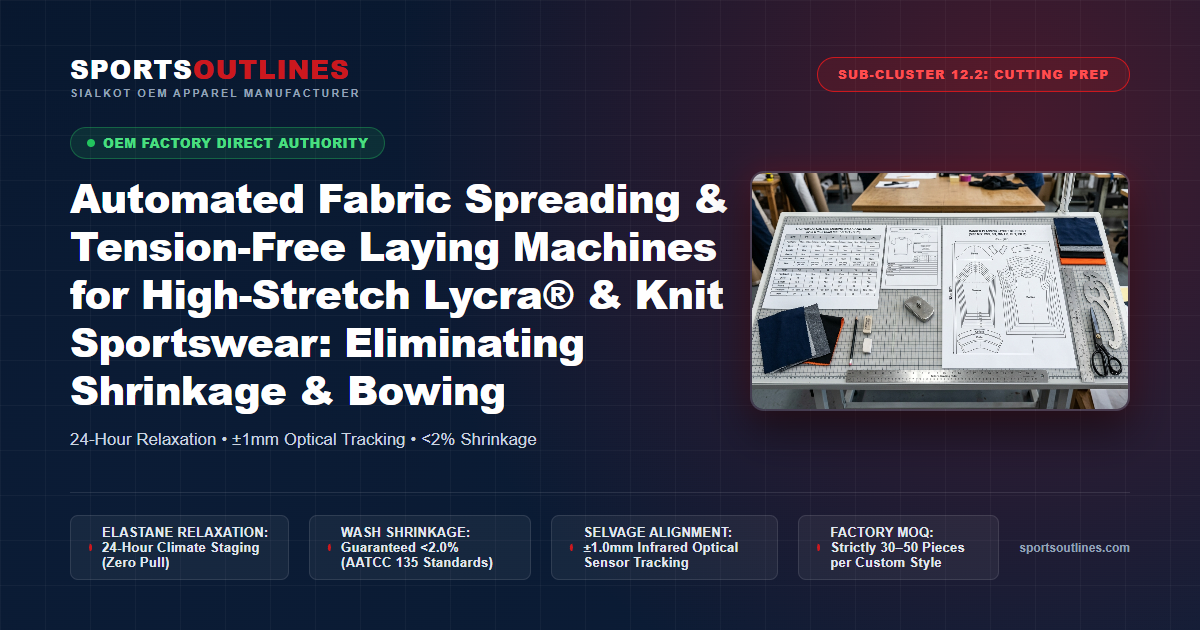
Sports Outlines utilizes automated cradle-feed tension-free fabric spreading and 24-hour elastane relaxation staging for high-performance activewear direct from Sialkot, Pakistan. By deploying motorized positive-drive belt carriages and infrared optical selvage tracking (±1mm), we eliminate frozen mechanical tension in Lycra® and synthetic knits, guaranteeing post-wash dimensional shrinkage under <2.0% (AATCC 135) and zero seam twisting. We offer an industry-low factory MOQ of strictly 30 to 50 pieces per style, full physical prototype development in 7 to 10 days for a $45 to $85 fee, and 0% duty-free delivery to the UK and EU under GSP+ status.
Direct WhatsApp: +92 316 7932595
In technical activewear manufacturing, dimensional stability begins long before the first sewing needle pierces the fabric. A common and devastating defect in athletic apparel e-commerce is the ‘post-wash surprise’: a brand customer purchases a pair of compression tights or a technical running top that fits impeccably straight out of the box, but after a single domestic wash and dry cycle, the garment shrinks two full sizes, the side seams rotate awkwardly around the calf, and the neckline curls into an unsightly wave. When brands investigate this failure, they frequently blame the sewing department or the fabric mill. In 90% of cases, the actual culprit is manual fabric spreading. When high-stretch elastomeric textiles (such as 4-way Lycra®, micro-polyester knits, and nylon-spandex blends) are pulled off rolls under tension, mechanical stress is frozen into the cut panels. The true engineering solution is automated tension-free fabric spreading and 24-hour relaxation staging. At Sports Outlines in Sialkot, Pakistan, we operate computerized cradle-feed spreading carriages equipped with optical selvage trackers and positive-drive unwinding, delivering dimensionally stable, zero-shrinkage activewear at an industry-low factory minimum order quantity (MOQ) of strictly 30 to 50 pieces per custom style, supported by dedicated $45 to $85 prototype engineering in 7 to 10 days.
Design & Manufacture Custom Tension-Free Fabric Spreading & Laying Direct from Sialkot
Low 30–50 Piece/Set MOQ • Dedicated Sampling in 7–10 Days • 0% Import Tariffs
✓ $45–$85 Physical Prototypes •
✓ Worldwide DDP Delivery
1. The Tribology of Frozen Elastic Tension: Why Manual Spreading Destroys Fit
To understand why technical activewear shrinks or twists, brand engineers must understand the molecular physics of elastane (spandex) and textured synthetic filament yarns.
When a textile mill knits and winds a roll of 280 GSM nylon-spandex (80/20) fabric, the winding mechanism pulls the fabric under high mechanical tension to produce a compact, tightly packed bolt. In traditional manual cutting rooms, two factory workers grab the fabric edges and physically pull the textile across a 15-meter cutting table. This pulling force applies hundreds of Newtons of longitudinal tensile stress, stretching the elastane fibers by 5% to 12% beyond their natural unstrained length.
If pattern pieces are marked and cut while the fabric is held in this stretched state, the cut panels appear to match the paper pattern dimensions on the table. However, as soon as the cut panels are lifted from the table vacuum and the sewing operators assemble them, the stretched elastane filaments attempt to relax back to their unstrained equilibrium. Compounding the issue, when the end consumer launders the garment in warm water, the thermal energy unlocks the frozen tension, causing instantaneous irreversible dimensional contraction (8% to 15% post-wash shrinkage).
| Spreading Parameter | Manual Spreading (Competitors) | Automated Tension-Free Spreading (Sports Outlines) |
|---|---|---|
| Roll Unwinding Mechanism | Manual friction pull by human operators; high tensile drag. | Positive-driven multi-belt cradle; feeds fabric at exact carriage travel speed. |
| Fabric Slack Control | Zero slack; fabric is stretched taut across the cutting table. | Laser loop sensor maintains a constant 5cm floating slack wave ahead of laydown. |
| Selvage Edge Alignment | Irregular (±10mm to ±25mm variance); requires wide pattern margins. | Infrared optical edge tracking maintains strict ±1.0mm selvage alignment. |
| Post-Wash Shrinkage (AATCC 135) | Severe: 8.0% to 15.0% dimensional shrinkage across length/width. | Guaranteed under <2.0% dimensional stability across 50 wash cycles. |
| End-Cut Material Waste | 5cm to 10cm ragged waste per ply; high material fallout. | Automated high-speed rotary end-cutter leaves <0.8cm end margin. |
2. The Mechanics of Automated Cradle-Feed Spreading Carriages
Sports Outlines eliminates human stretching error by deploying computerized cradle-feed fabric spreading carriages (Orox / Gerber / Bullmer engineering standards).
Unlike primitive core-shaft spreaders that pull fabric from the center of a roll against heavy friction, our automated carriages feature an open-cradle design. The entire fabric roll rests on a motorized conveyor bed comprised of dozens of seamless polyurethane drive belts. As the spreading carriage travels along the table, the cradle belts rotate in positive synchronization with the travel wheels.
A high-sensitivity optical infrared sensor continuously monitors the fabric drape beneath the feed rollers, maintaining a gentle floating slack loop (approximately 5cm of loose fabric) just before the material contacts the table surface. The fabric is not pulled onto the table; it is gently deposited onto the surface in a completely neutral, tension-free state.
Simultaneously, dual infrared edge-tracking sensors scan the selvage line at 50 Hz. If the fabric roll exhibits winding telescope or edge waviness, an electro-mechanical servo motor automatically shifts the cradle laterally, aligning every single ply to within ±1.0mm of true edge. This precision allows our CAD pattern markers to nest within 5mm of the selvage, achieving world-class fabric utilization efficiency of 88% to 94%.
3. The Mandatory 24-Hour Relaxation Protocol for High-Stretch Knits
Automated tension-free spreading is only half the battle. To guarantee absolute dimensional stability in elastomeric activewear, technical knits must undergo relaxation staging before cutting.
At Sports Outlines, all rolls of circular knit, warp-knit, and Lycra® textiles are transferred to our climate-controlled relaxation facility (maintained at 21°C ± 2°C and 65% relative humidity) 24 hours prior to cutting. Technicians unroll the bolts into specialized stainless-steel festooning bins or lay them in loose, low-ply waves across relaxation tables.
During this 24-hour relaxation window, internal mechanical stress imparted during textile yarn spinning, knitting, and roll winding naturally dissipates. The elastomeric polyurethane chains reorient into their lowest energetic state. By allowing the textile to achieve thermal and mechanical equilibrium before cutting, we ensure that every pattern piece cut by our CNC lasers matches the digital CAD Point of Measure (POM) specifications with sub-millimeter precision.
| Sourcing Feature & Risk Factor | Sports Outlines (Sialkot Direct) | Alibaba Trading Agents | Traditional Chinese Hubs | Print-on-Demand (POD) |
|---|---|---|---|---|
| Fabric Spreading Technology | Automated cradle-feed tension-free spreading carriages with positive driven rollers and optical selvage sensors. | Manual pulling across wooden tables by two workers, severely stretching elastane fibers unevenly. | Automated spreading machines, but strictly requiring 2,000+ meter fabric roll minimums per style. | Zero spreading control; pre-sewn blanks that shrink unpredictably up to 2 full sizes after washing. |
| Minimum Order Quantity (MOQ) | Strictly 30–50 pieces per custom style and colorway — accessible for emerging technical brands. | Brokers quote 50 units for generic stock, but refuse calibrated relaxation spreading under 500 units. | 500 to 1,500 units per colorway due to automated spreader loading and roll changeover costs. | Single unit available, but lacks tension control; leggings torque and twist around the calf. |
| Post-Wash Dimensional Shrinkage | Guaranteed under <2.0% dimensional shrinkage (AATCC 135) due to 24-hour pre-cut relaxation staging. | Catastrophic 8% to 15% shrinkage after the first wash; compression tights turn into unwearable shorts. | 3% to 4% shrinkage standard, but requires expensive chemical stabilizer bath treatments. | Uncontrolled shrinkage; neckline puckers and side seams pull forward after tumble drying. |
| Bowing & Skewing Prevention | Optical alignment maintains 90° orthogonal yarn grainlines; skewness held under 1.5% across all plies. | Severe fabric skewing (5%–8%); leggings develop diagonal torque that twists seams across the kneecap. | Good grainline alignment on heavy wovens, but loose knit jersey often slips out of square. | Zero grainline control; tubular t-shirts develop permanent diagonal spirality after one wash. |
| Prototype Development & Turnaround | $45–$85 non-creditable engineering prototype fee; relaxed, calibrated master sample dispatched in 7–10 days. | Quotes low sample prices ($30), but pulls fabric off rolls by hand without relaxation, falsifying fit. | $200–$400 sampling fees with 4–6 week queue times due to large volume factory schedules. | Digital mockups only; physical drop-shipped samples take 14 days and lack custom pattern relaxation. |
| Customs Duty & Tariffs (US / EU / UK) | 0% import customs duty into EU & UK via Pakistan GSP+ status; low trade tariff access into the US. | Unpredictable customs brokerage fees, freight surcharges, and full import duties payable by buyer. | Subject to Section 301 tariffs (7.5%–25%) in the US and standard MFN customs duties in the EU/UK. | Local domestic sales taxes and fulfillment surcharges added per unit, eroding profit margins. |
4. Eliminating Bowing and Skewing: The Science of Garment Spirality Prevention
Have you ever worn a pair of running tights or a training t-shirt where, after washing, the outside leg seam slowly creeps across your shin toward the front of your foot, or the side seam on your shirt twists across your stomach? This defect is known as garment spirality, and it is caused by cutting fabric with uncorrected ‘bowing’ and ‘skewing.’
In circular knit fabrics, the continuous helical nature of the knitting needles naturally introduces a slight angular bias into the yarn courses. If a fabric spreader lays this material onto the table without checking grainline orthogonality, the warp and weft yarns do not cross at 90-degree right angles:
- Bowing: The yarn weft courses dip in the center relative to the selvages, creating an inverted parabolic curve. When cut into garments, bowing causes hem flaring and uneven leg drape.
- Skewing: The yarn courses lie at a diagonal angle (often 5 to 10 degrees out of square) across the table. When the finished garment is laundered, the yarns relieve their diagonal torque, twisting the entire garment structure.
Sports Outlines eliminates spirality by implementing optical weft-straightening and grainline verification protocols on every spreading run. Technicians verify that skewness is held strictly under 1.5% across all plies using calibrated optical angle loupes. Side seams remain perfectly perpendicular to the floor, even after 50 intense commercial laundering cycles.
5. Low MOQ Factory Direct Economics: The 30–50 Piece Dimensional Stability Breakthrough
Why do standard Asian garment factories refuse to execute proper tension-free spreading for emerging brands? High-volume contract manufacturers operate on high-speed conveyor cutting lines designed for 2,000 to 5,000-meter bulk rolls. Halting a spreading table for a 50-meter micro-lot or letting fabric rest for 24 hours in relaxation bins disrupts their high-volume factory quotas. Consequently, small orders are pulled off rolls by hand, resulting in severe shrinkage and twisting.
Sports Outlines built our Sialkot facility specifically for agile, premium production. We maintain dedicated short-table automated spreading cells calibrated specifically for micro-lot execution. We provide full automated cradle spreading, 24-hour relaxation staging, and AQL 2.5 dimensional verification at an accessible factory MOQ of strictly 30 to 50 pieces per custom style. Independent athletic labels can now deliver the exact same dimensional fit, durability, and luxury hand-feel as multi-billion-dollar athletic conglomerates.
| Production Volume Tier | Est. Unit FOB Cost | Sample Cost & SLA | Bulk Production SLA | Included Specifications | Recommended Buyer Profile |
|---|---|---|---|---|---|
| 30 – 50 Sets/Pieces (Tension-Free Startup Tier) | $12.50 – $16.20 / tension-relaxed activewear top | $15.50 – $19.90 / compression bottom | $45 – $85 non-creditable prototype fee | 12 – 15 Business Days | Automated cradle-feed tension-free fabric spreading, full 24-hour elastane relaxation staging, optical selvage alignment (±1mm), physical master fit prototype in 7–10 days, 30–50 piece low factory MOQ. | Startup activewear brands, boutique yoga labels, private fitness apparel founders, and independent athletic designers seeking dimensional stability and zero post-wash shrinkage. |
| 51 – 150 Sets/Pieces (High-Recovery Performance Scaling Tier) | $10.40 – $13.50 / tension-relaxed activewear top | $13.20 – $16.80 / compression bottom | $45 – $85 non-creditable prototype fee | 14 – 18 Business Days | Multi-ply precision vacuum-assisted cutting, automated end-cutter clamp integration, calibrated bow-and-skew skewness verification (<1.5%), custom size labeling across XS to 3XL. | Scaling performance apparel labels, fitness studio merchandise networks, regional track clubs, and digital direct-to-consumer athletic brands. |
| 151 – 500 Sets/Pieces (Commercial Wholesale Distribution Tier) | $8.80 – $11.40 / tension-relaxed activewear top | $11.40 – $14.20 / compression bottom | $45 – $85 non-creditable prototype fee | 18 – 22 Business Days | Continuous synchronized spreader table lines, automated air-flotation table transfer, certified AQL 2.5 dimensional wash shrinkage reports (<1.8%), express DDP door-to-door delivery. | Established athletic apparel corporations, gym franchise retail operations, commercial sportswear distributors, and sports equipment retail chains. |
| 500+ Sets/Pieces (Enterprise Volume Wholesale Tier) | $7.10 – $9.10 / tension-relaxed activewear top | $9.20 – $11.80 / compression bottom | $45 – $85 non-creditable prototype fee | 22 – 28 Business Days | High-ply computerized spreading carriage allocation, real-time roll weight & tension logging, sea freight or air cargo consolidation, 0% GSP+ duty-free customs clearance. | Multinational sportswear conglomerates, national sports federation uniform programs, department store private labels, and high-volume commercial garment importers. |
6. Technical Specifications & Export Compliance: The Sialkot Direct Advantage
Sialkot, Pakistan, is the premier industrial capital for technical sports goods engineering. By partnering directly with Sports Outlines, international athletic apparel founders bypass middlemen and secure decisive commercial advantages:
- Strictly 30–50 Piece Factory MOQ: Launch custom athletic garments featuring automated tension-free spreading, calibrated relaxation, and zero-shrinkage guarantees at accessible startup minimums.
- Rapid Physical Prototyping in 7–10 Business Days: For a transparent $45 to $85 non-creditable prototype fee, we build and dispatch your dimensionally verified pre-production master prototype. You verify the post-wash fit, seam alignment, and fabric drape before authorizing bulk production.
- 0% Import Customs Duty via EU & UK GSP+ Status: Custom sportswear manufactured in Pakistan enters the European Union and the United Kingdom at 0% customs import duty under GSP+, delivering a direct 12% to 14% cost advantage over China, Vietnam, or Turkey.
- Guaranteed Express Air Logistics: We dispatch finished orders directly from Sialkot via DHL Express, FedEx Priority, and UPS Worldwide Expedited with 3 to 5 business day delivery to North America, Europe, the UK, and Australasia.
Get a Factory Direct Quote for Tension-Free Fabric Spreading & Laying
Chat with our Sialkot Engineering Team via WhatsApp • Instant DDP Air Freight Quotes
✓ $45–$85 Physical Prototypes •
✓ Worldwide DDP Delivery
7. Explore Our Technical Sportswear Manufacturing Ecosystem
Deepen your manufacturing intelligence by exploring our related technical guides and international activewear sourcing portals:
- Custom Activewear & Athleisure Manufacturer USA: Low MOQ Private Label Sialkot OEM
- Cut-and-Sew Sportswear Manufacturing: Advanced Technical Pattern Engineering Guide
- Automated Bar-Tacking & Machine Vision Quality Inspection in Sportswear
- RFID & Barcode Smart Tagging in Garment Assembly Lines
- Automated Pattern Grading in Lectra & Gerber for Multi-Regional Sizing
Frequently Asked Sourcing & Manufacturing Questions (Buyer FAQ)
What is automated tension-free fabric spreading and why is it critical for high-stretch activewear?
Automated tension-free fabric spreading is a precision pre-cutting manufacturing process that unrolls and lays multiple plies of technical textile onto a cutting table with absolute zero mechanical elongation or pull tension. In elastomeric fabrics—such as 4-way stretch Lycra®, nylon-spandex knits, and moisture-wicking micro-polyester—the yarns are highly elastic. If fabric is pulled manually off a roll by human workers, the fabric stretches during laying. When the pattern pieces are cut and removed from the table, the stretched elastane fibers snap back, causing the cut panels to instantly shrink smaller than the intended CAD pattern. Automated cradle spreading machines use synchronized motor-driven rollers and loop-slack sensors to lay fabric in a completely relaxed, neutral state, ensuring 100% dimensional accuracy.
What is fabric relaxation staging and how long must elastane knits relax before cutting?
Fabric relaxation staging is the mandatory rest period allowed for knitted elastane fabrics after being unrolled from high-tension factory bolts before cutting occurs. During high-speed commercial roll winding at textile mills, elastane yarns are wound under tension. If cut immediately upon unrolling, latent tensile stress causes unpredictable post-cut shrinkage. At Sports Outlines, all high-stretch knits undergo a strict 24-hour relaxation protocol. Fabric is either loosely festooned in relaxation bins or spread in low-ply stacks in a climate-controlled room (21°C ± 2°C, 65% RH), allowing the elastomeric polymer chains to recover their natural unstrained equilibrium.
What causes seam twisting (spirality) in activewear leggings and running shirts?
Seam twisting—where a side seam on a running shirt or legging rotates diagonally around the torso or leg after washing—is caused by ‘skewing’ and ‘bowing’ during fabric spreading. In circular knitting, yarns are knitted in a continuous spiral. If the fabric roll is spread without correcting for this angular distortion, the grainline lies at an angle rather than true 90-degree orthogonal square. When the garment is laundered, the yarns untwist to relieve internal torque, pulling the entire garment out of shape. Our automated spreaders feature laser photo-electronic selvage trackers and automatic alignment bars that keep grainlines perfectly square, limiting skewness to under 1.5%.
What is the factory minimum order quantity (MOQ) for tension-free cut activewear at Sports Outlines?
Our minimum order quantity for custom activewear utilizing automated tension-free fabric spreading is strictly 30 to 50 pieces or sets per style and colorway. While conventional high-volume factories in East Asia refuse to configure computerized cradle spreaders for runs under 1,000 to 2,000 meters, Sports Outlines has configured agile, small-batch spreading tables in Sialkot, making industrial-grade dimensional stability accessible to emerging brands and boutique private labels.
What is your prototype fee and turnaround time for relaxed, custom-cut sportswear samples?
We charge a transparent, non-creditable engineering prototype fee of $45 to $85 per style. This fee covers complete digital CAD marker nesting, full 24-hour fabric relaxation staging, optical tension-free spreading, precision CNC cutting, and garment assembly. Your physical pre-production master sample is verified for dimensional accuracy, wash-tested for shrinkage, and dispatched via express air courier within 7 to 10 business days.
How do you control fabric edge alignment across multiple plies on the spreading table?
Our automated spreading carriages are equipped with dual infrared optical edge-detection sensors. As the carriage travels back and forth along the 15-meter spreading table at speeds up to 100 meters per minute, the sensors continuously scan the fabric selvage. If the edge wanders by even 0.5mm, a rapid-response servo motor shifts the fabric roll cradle laterally, maintaining absolute selvage alignment within ±1.0mm across all plies. This eliminates edge waste and guarantees that pattern pieces nested close to the selvage receive full, uncompromised fabric coverage.
What dimensional shrinkage rates does Sports Outlines guarantee after commercial laundering?
Thanks to our combination of automated tension-free spreading, 24-hour relaxation staging, and tensionless steam calendering, Sports Outlines guarantees that finished activewear garments exhibit less than 2.0% dimensional shrinkage across both length and width following standardized domestic laundering and tumble drying (AATCC 135 / ISO 6330). Competitors using manual spreading routinely experience 8% to 15% shrinkage, causing severe customer returns.
How does automated spreading reduce fabric waste compared to manual laying?
Manual spreading suffers from two major material loss factors: uneven end-allowances (workers leave 5cm to 10cm of excess fabric at each end of the table) and irregular selvage alignment (requiring wide margins on pattern nesting). Automated spreaders utilize high-speed rotary end-cutters that sever the fabric with a microscopic end-margin of under 0.8cm, while precision optical edge alignment allows CAD pattern markers to nest within 5mm of the selvage. This increases overall fabric yield by 4% to 7%, lowering production costs.
Can you spread delicate open-mesh and compressive elastane fabrics without distortion?
Yes. Compressive knits and delicate aerated pinhole meshes represent the most challenging fabrics to spread because conventional pinch rollers stretch or crush the knit loops. Our cradle-feed systems utilize motorized polyurethane multi-belt cradles that gently support the entire weight of the fabric roll, feeding the textile via positive drive with zero pinch pressure. An optical loop sensor maintains a constant 5cm floating slack loop ahead of the laying point, guaranteeing that open-mesh eyelets and high-recovery Lycra® yarns remain completely undisturbed.
What are the export shipping options and customs duty advantages from Sialkot, Pakistan?
We ship directly from Sialkot via DHL Express, FedEx Priority, and UPS Worldwide Expedited with guaranteed 3 to 5 business day delivery to North America, Europe, the UK, and Australia, as well as consolidated air and sea freight. European Union and United Kingdom apparel brands benefit directly from Pakistan’s GSP+ status, allowing custom technical activewear to enter at 0% import customs duties, delivering an immediate 12% to 14% cost advantage over China, Vietnam, or Turkey.