Direct Manufacturer Snapshot: Digital Fabric Swatch Databases, Spectrophotometer Color Formulation & Lab-Dip Quality Control in Sialkot OEM
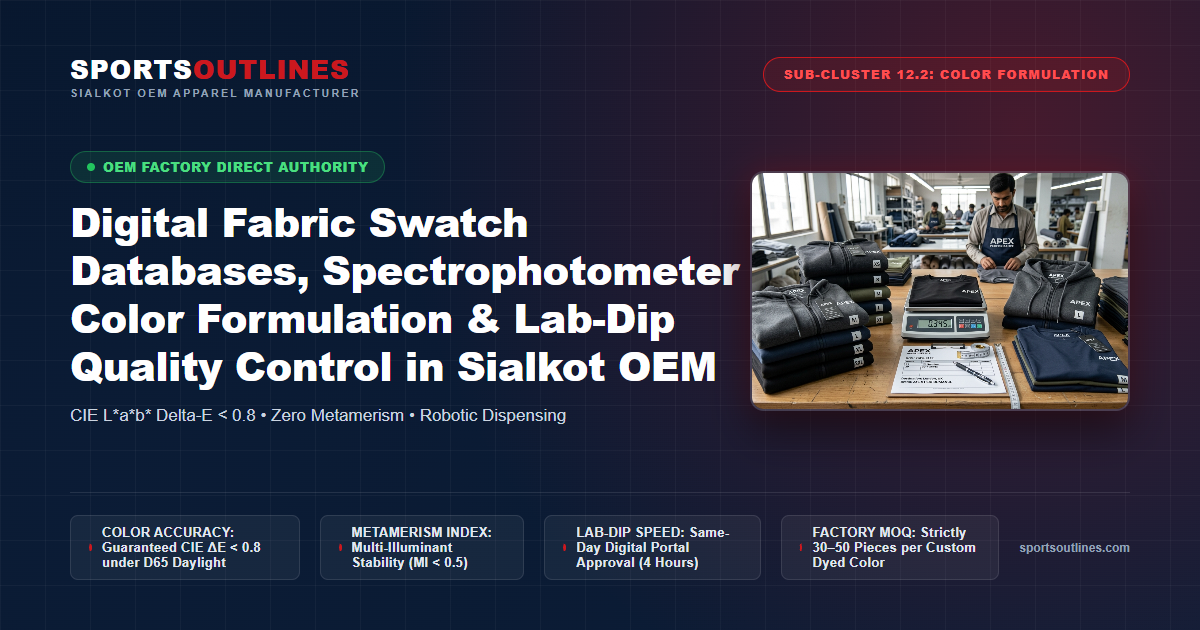
Sports Outlines delivers scientific color formulation and lab-dip quality control for technical sportswear direct from Sialkot, Pakistan, deploying calibrated industrial spectrophotometers (Datacolor® / X-Rite®) and computerized robotic dye dispensing. We guarantee numerical CIE L*a*b* color precision with Delta-E < 0.8 and multi-illuminant metamerism index verification (D65, CWF, Illuminant A). We offer an industry-low factory MOQ of strictly 30 to 50 pieces per custom dyed colorway, full physical prototype development in 7 to 10 days for a $45 to $85 fee, and 0% duty-free delivery to the UK and EU under GSP+ status.
Direct WhatsApp: +92 316 7932595
In the competitive world of high-end activewear, luxury athleisure, and teamwear, color is the primary driver of consumer purchasing decisions and brand identity. A signature brand shade—whether it is a signature mineral slate, a vibrant neon lime, or a rich terracotta—defines a label’s seasonal collection. Yet in global contract apparel manufacturing, achieving precise, repeatable fabric color is notoriously difficult. For decades, foreign apparel sourcing has relied on subjective human visual inspection under erratic factory ceiling lights, accompanied by agonizingly slow physical lab-dip swatches mailed back and forth across oceans via international couriers. When production finally ships, brands are routinely devastated to discover that their sports bras and leggings do not match, or that fabrics shift from olive green to brown when moving from daylight into a gym. The modern scientific cure to this supply chain vulnerability is industrial spectrophotometer color formulation, digital fabric swatch databases, and robotic dye dispensing. At Sports Outlines in Sialkot, Pakistan, we combine calibrated Datacolor® and X-Rite® spectrophotometers with cloud-based digital lab-dip workflows. We guarantee laboratory-certified color accuracy (CIE $\Delta E < 0.8$) and zero metamerism at an industry-low factory minimum order quantity (MOQ) of strictly 30 to 50 pieces per custom style and colorway, supported by dedicated $45 to $85 prototype engineering in 7 to 10 days.
Design & Manufacture Custom Digital Color Formulation & Lab-Dips Direct from Sialkot
Low 30–50 Piece/Set MOQ • Dedicated Sampling in 7–10 Days • 0% Import Tariffs
✓ $45–$85 Physical Prototypes •
✓ Worldwide DDP Delivery
1. The Physics of Color Science in Sportswear: Metamerism, D65 Illuminants & The Subjective Eye Trap
Why do color disasters occur so frequently in contract sportswear manufacturing?
The root problem is that traditional apparel factories rely on the human eye as their primary quality control tool. A dye master in a factory inspects a wet fabric swatch, holds it up to a window or a fluorescent ceiling bulb, and says, “It looks close enough.”
However, human vision is physiologically subjective and highly unstable. An individual’s color perception changes with ocular fatigue, age, ambient humidity, background wall color, and cognitive bias. Furthermore, standard factory lighting contains uneven spectral peaks that distort how dyes absorb and reflect light waves.
The most devastating optical failure in sportswear is metamerism. Two fabrics dyed with different dye recipes may look identical when inspected under standard noon daylight, but when an athlete steps into an indoor gym illuminated by cool white fluorescent (CWF) lamps or enters an evening yoga studio lit by tungsten incandescent bulbs, the chemical dye molecules reflect light at different wavelengths. The sports bra and leggings—supposedly a matching set—instantly appear as two entirely different, clashing shades.
Sports Outlines eliminates subjective visual inspection by anchoring all color formulation to standardized optical physics. We evaluate all color signatures under standardized CIE Illuminants:
- CIE Illuminant D65: Standard daylight simulation with a correlated color temperature of 6504 K, representing natural northern sky daylight across the full visible spectrum.
- Illuminant CWF / TL84: Commercial retail and athletic facility cool white fluorescent lighting (4000 K), essential for store display and indoor gym verification.
- Illuminant A: Domestic tungsten incandescent illumination (2856 K), ensuring garments maintain color harmony in domestic home environments.
2. Industrial Spectrophotometry & CIE L*a*b* Color Space: Numerical Precision vs Guesswork
Rather than relying on human opinions, Sports Outlines measures color through calibrated industrial spectrophotometers. A spectrophotometer projects standardized illumination onto the fabric sample inside a barium-sulfate coated integrating sphere, measuring the percentage of light reflected at every 10-nanometer interval across the visible spectrum (400nm to 700nm).
The instrument converts this physical spectral reflectance curve into Cartesian coordinates within the 3D CIE $L^*a^*b^*$ color space (defined by the International Commission on Illumination):
- $L^*$ (Lightness Axis): Scales vertically from 0 (absolute black) to 100 (pure diffuse white).
- $a^*$ (Red-Green Axis): Positive values indicate red hue saturation; negative values indicate green hue saturation.
- $b^*$ (Yellow-Blue Axis): Positive values indicate yellow hue saturation; negative values indicate blue hue saturation.
By comparing the sample’s coordinate ($L^*_s, a^*_s, b^*_s$) against the target digital standard ($L^*_t, a^*_t, b^*_t$), the software calculates the exact mathematical color difference: Delta-E ($\Delta E$).
| Color Quality Metric | Traditional Dye House (Competitors) | Industrial Spectrophotometry (Sports Outlines) |
|---|---|---|
| Measurement Methodology | Subjective visual inspection by eye under fluctuating ambient ceiling lights. | Calibrated spectrophotometer measuring full spectral reflectance curves. |
| Commercial Color Tolerance | Unregulated; color variance ($\Delta E$) routinely exceeds 2.5 to 4.0. | Guaranteed $\Delta E < 0.8$ (virtually imperceptible to the human eye). |
| Metamerism Verification | Zero testing; garments shift color unpredictably under indoor gym lights. | Multi-illuminant spectral verification (D65, CWF, Illuminant A; MI < 0.5). |
| Lab-Dip Approval Lead Time | Physical swatches mailed via courier; consumes 14 to 21 business days. | Same-day digital portal sign-off via spectral reflectance files (under 4 hours). |
| Minimum Dye Lot Requirement | 1,500 to 3,000 kg per color (roughly 3,000 to 6,000 garments). | Pilot-scale jet dyeing vessels supporting strictly 30 to 50 pieces per color. |
3. Digital Fabric Swatch Databases: Spectral Reflectance & Virtual Swatchbooks
In modern athletic apparel engineering, physical fabric swatchbooks are rapidly becoming obsolete. Paper swatch cards fade over time due to UV oxidation, accumulate oil and dirt from handling, and cannot be integrated into digital design software.
Sports Outlines maintains an exhaustive Digital Fabric Swatch Database connected directly to our client portal:
- Digital Spectral Reflectance Files (.QDT / .CXF): Every fabric in our inventory—from 180 GSM brushed poly-spandex to 320 GSM compressive interlock—is digitally mapped with its exact spectral curve, refractive index, and optical scattering coefficients.
- Seamless CLO 3D & Browzwear Integration: Designers can download our digital fabric swatch assets and import them directly into 3D CAD design software. The virtual fabric in CLO 3D renders with physically accurate color, sheen, and surface texture under any simulated lighting environment, ensuring that the 3D rendering matches the final physical production unit with 100% fidelity.
- Lot-to-Lot Historical Archiving: Every dyed roll is permanently recorded in our cloud database. When a brand places a re-order six months later, our computerized dyeing systems retrieve the exact historical recipe and spectral curve, guaranteeing seamless shade continuity across multiple production seasons.
| Sourcing Feature & Risk Factor | Sports Outlines (Sialkot Direct) | Alibaba Trading Agents | Traditional Chinese Hubs | Print-on-Demand (POD) |
|---|---|---|---|---|
| Color Formulation & Measurement | Industrial Datacolor® / X-Rite® spectrophotometers; numerical CIE L*a*b* Delta-E < 0.8 color variance standard under D65 daylight. | Subjective visual inspection by eye under fluctuating factory ceiling fluorescent lights; severe shade variance between rolls. | Spectrophotometers utilized for massive dye lots, but small orders (<1,000 pcs) are dyed using rough visual approximations. | Basic CMYK digital print conversion; dark colors shift muddy, neon shades clip, and pastel tones print washed out. |
| Minimum Order Quantity (MOQ) | Strictly 30–50 pieces per custom dyed colorway and style — accessible for boutique athletic brands. | Demands 1,000 to 2,000 units per colorway for custom vat dyeing, or forces buyer into picking from limited stock fabric cards. | 1,500 to 3,000 kg minimum dye lot requirements (roughly 3,000 to 6,000 t-shirts) to run commercial jet dye vessels. | Single unit available, but cannot provide custom yarn-dyed knits, piece-dyed fleece, or matched ribbing trims. |
| Lab-Dip Approval Velocity | Same-day digital lab-dip portal approval via spectral reflectance graphs; eliminates 14 days of international swatch shipping. | Mails physical lab-dip swatches via regular post (takes 2 to 3 weeks); if rejected, delays production by another month. | Physical swatches dispatched via DHL, but sampling queue takes 3 to 4 weeks due to massive factory order priority. | Zero lab-dip process; what prints on the fabric is what ships, with no opportunity for buyer pre-approval. |
| Metamerism Index Testing | Multi-illuminant spectral verification (D65 daylight, CWF store fluorescent, Incandescent A home tungsten); guarantees color stability under any lighting. | Zero metamerism testing; olive green tops appear brown under gym lights and purple in sunlight. | Basic light booth visual audit, but rarely provides numerical multi-illuminant delta metrics to small buyers. | Non-existent; severe digital metamerism across poly-blend and cotton-blend fabrics. |
| Prototype Development & Turnaround | $45–$85 non-creditable engineering prototype fee; spectrophotometer-verified master prototype dispatched in 7–10 days. | Promises cheap samples ($35), but delivers off-shade swatches with no technical spectrophotometer data. | $250–$500 sampling fees with 5–7 week queue times due to large volume factory schedules. | Digital mockups only; physical drop-shipped blanks take 14 days and lack custom color calibration. |
| Customs Duty & Tariffs (US / EU / UK) | 0% import customs duty into EU & UK via Pakistan GSP+ status; low trade tariff access into the US. | Unpredictable customs brokerage fees, freight surcharges, and full import duties payable by buyer. | Subject to Section 301 tariffs (7.5%–25%) in the US and standard MFN customs duties in the EU/UK. | Local domestic sales taxes and fulfillment surcharges added per unit, destroying profitability. |
4. The 4-Hour Digital Lab-Dip Loop: Slashing 14 Days from Pre-Production
In conventional apparel supply chains, approving custom fabric colors is a grueling logistical bottleneck. The factory dyes three physical fabric swatches (lab-dips A, B, and C), packs them in an envelope, and ships them via international courier. The brand receives the envelope 5 days later, inspects the swatches under office lighting, emails an approval, and waits for bulk dyeing. If the swatches are rejected, the entire cycle repeats, delaying production by 3 to 4 weeks.
Sports Outlines accelerates color approvals into a 4-hour digital workflow:
- Digital Recipe Matching: When you provide a Pantone TCX code or physical reference color, our spectrophotometer calculates the optimal combination of disperse, acid, or reactive dyes required to hit the target.
- Pilot Laboratory Dyeing: Our automated lab dispensing system prepares micro-dye baths and dyes test swatches in computerized high-pressure dyeing machines.
- Spectrophotometer Optical Audit: The dyed swatch is conditioned, dried, and scanned under the spectrophotometer. The software calculates the CIE $L^*a^*b^*$ coordinates and $\Delta E$ score relative to your standard.
- Instant Cloud Portal Transmission: The spectral reflectance data, chromaticity coordinates, and a high-resolution calibrated digital swatch rendering are pushed directly to your client portal within four hours of dye extraction. When $\Delta E$ is verified under 0.8, your team authorizes color clearance digitally with a single click, completely eliminating international swatch shipping delays.
5. Color Fastness Testing Protocols: ISO 105 Standards for Sportswear Durability
Achieving the correct color shade is only half the engineering challenge; the color must also survive the intense physical demands of athletic performance. High-performance sportswear is subjected to aggressive friction, sweat acidity, chlorinated pool water, and harsh laundering detergents.
Sports Outlines subjects every custom-dyed fabric lot to rigorous standardized laboratory audits under international ISO 105 and AATCC protocols:
- ISO 105-C06 (Color Fastness to Domestic Laundering): Fabric samples are laundered at 40°C with standard ECE detergent and stainless steel balls. We require a minimum fastness rating of Grade 4.5 to 5.0 on the Grey Scale for Staining, guaranteeing zero color bleed onto adjacent white panels or contrasting trims.
- ISO 105-E04 (Color Fastness to Perspiration): Samples are immersed in synthetic human sweat solutions (both acidic pH 5.5 and alkaline pH 8.0) and placed under 12.5 kPa pressure at 37°C for 4 hours. Dyes must not degrade or stain multi-fiber test strips.
- ISO 105-X12 (Color Fastness to Crocking / Rubbing): Evaluated using a motorized AATCC Crockmeter under both wet and dry friction conditions across 20 cycles, ensuring high-friction athletic surfaces (such as cycling shorts and running tights) resist color transfer.
- ISO 105-B02 (Color Fastness to Artificial Light / UV): Samples are exposed to high-intensity Xenon arc lamps simulating solar radiation. Our outdoor sports fabrics achieve a minimum rating of Grade 6.0+, preventing sunlight fading and photo-oxidation.
6. Computerized Automated Dye Dispensing: Eliminating Human Measurement Errors
Why do different production runs from traditional factories end up with different color shades?
In conventional small-scale dye houses, factory workers measure liquid dyes and powder chemicals by hand using plastic measuring cups, spoons, and scales. A 2% human measurement error on a potent red disperse dye can shift a delicate pastel pink into a harsh magenta.
Sports Outlines eliminates human measurement variance through robotic computerized dye dispensing systems. Guided by the master spectrophotometer recipe, robotic micro-pipettes measure dyestuffs, leveling agents, and pH buffers with a precision of 0.001 grams. This robotic automation guarantees that Batch #1 and Batch #10 achieve identical chemical dye concentration, holding shade consistency across repeat production runs.
7. Low MOQ Factory Direct Economics: Solving the Custom Color Startup Dilemma
Historically, independent activewear designers, boutique athleisure labels, and startup athletic brands were forced to settle for boring stock colors (black, white, heather grey, and navy) because overseas textile mills refuse to run custom dye lots under 1,500 kilograms. Emerging brands could not afford to buy 3,000 garments just to get their custom brand color.
Sports Outlines has solved this limitation. By operating pilot-scale high-temperature sample jet dyeing vessels in Sialkot, Pakistan, we provide custom Pantone TCX and TSX color-matched activewear at a low factory MOQ of strictly 30 to 50 pieces per custom style and colorway. Startup founders and boutique athletic brands can now launch unique, signature seasonal palettes that stand out in crowded e-commerce marketplaces without committing to thousands of unwanted units.
Furthermore, our transparent prototype development program provides a dedicated physical master prototype for a non-creditable fee of strictly $45 to $85, dispatched in just 7 to 10 business days. Sourcing directors and athletic founders can inspect the custom-dyed fabric, audit the hand-feel, and test the color fastness in their hands before committing to bulk production.
| Production Volume Tier | Est. Unit FOB Cost | Sample Cost & SLA | Bulk Production SLA | Included Specifications | Recommended Buyer Profile |
|---|---|---|---|---|---|
| 30 – 50 Sets/Pieces (Digital Color Startup Tier) | $12.80 – $16.50 / custom color-matched activewear top | $15.80 – $20.50 / bottom | $45 – $85 non-creditable prototype fee | 12 – 15 Business Days | Digital spectrophotometer Pantone TCX/TSX matching, CIE L*a*b* color difference audit (Delta-E < 0.8), digital lab-dip portal sign-off, physical master prototype in 7–10 days, 30–50 piece low factory MOQ. | Startup activewear brands, boutique athleisure labels, collegiate athletic programs, and technical designers requiring exact seasonal color palette fidelity without large-batch dye minimums. |
| 51 – 150 Sets/Pieces (Seasonal Palette Scaling Tier) | $10.50 – $13.80 / custom color-matched activewear top | $13.40 – $16.90 / bottom | $45 – $85 non-creditable prototype fee | 14 – 18 Business Days | Automated computerized dye dispensing, certified ISO 105 colorfastness testing (wash, sweat, friction), cross-batch lot consistency tracking, custom heat-seal branding, full size curve grading (XS to 3XL). | Scaling athletic performance brands, CrossFit affiliate collections, martial arts apparel lines, and e-commerce activewear brands launching multi-colorway seasonal capsules. |
| 151 – 500 Sets/Pieces (Commercial Wholesale Distribution Tier) | $8.90 – $11.50 / custom color-matched activewear top | $11.50 – $14.20 / bottom | $45 – $85 non-creditable prototype fee | 18 – 22 Business Days | Dedicated high-temperature sample jet dyeing line, metamerism index certification (D65 vs CWF vs Incandescent A), digital AQL 2.5 color inspection reports, express DDP door-to-door delivery. | Established athletic apparel corporations, professional sports team uniform suppliers, commercial sportswear distributors, and fitness retail chains. |
| 500+ Sets/Pieces (Enterprise Volume Wholesale Tier) | $7.20 – $9.20 / custom color-matched activewear top | $9.30 – $11.80 / bottom | $45 – $85 non-creditable prototype fee | 22 – 28 Business Days | Continuous computerized color formulation integration, closed-loop water-recycled dyeing, ocean freight or air cargo consolidation, 0% GSP+ duty-free customs clearance. | Multinational sportswear conglomerates, department store private athletic lines, international sports federation uniform contracts, and high-volume commercial garment importers. |
8. Technical Specifications & Export Compliance: The Sialkot Direct Advantage
Sialkot, Pakistan, stands as the premier global engineering center for technical sports equipment and apparel, manufacturing for Olympic federations, international combat sports organizations, and premier athletic brands. Partnering directly with Sports Outlines provides decisive commercial benefits:
- Strictly 30–50 Piece Factory MOQ: Launch custom color-matched technical activewear with certified spectrophotometer precision (CIE $\Delta E < 0.8$) at accessible startup minimums.
- Full Physical Prototyping in 7–10 Business Days: For a transparent $45 to $85 non-creditable prototype fee, we manufacture and dispatch your color-verified pre-production master prototype. You verify construction and shade accuracy in your hands before bulk production.
- 0% Import Customs Duty via EU & UK GSP+ Status: Custom sportswear manufactured in Pakistan enters the European Union and the United Kingdom at 0% customs import duty under GSP+, delivering a direct 12% to 14% landed margin benefit over China, Vietnam, or Turkey.
- Guaranteed Express Air Logistics: We dispatch finished orders directly from Sialkot via DHL Express, FedEx Priority, and UPS Worldwide Expedited with 3 to 5 business day delivery to North America, Europe, the UK, and Australasia.
Get a Factory Direct Quote for Digital Color Formulation & Lab-Dips
Chat with our Sialkot Engineering Team via WhatsApp • Instant DDP Air Freight Quotes
✓ $45–$85 Physical Prototypes •
✓ Worldwide DDP Delivery
9. Explore Our Technical Sportswear Manufacturing Ecosystem
Expand your athletic apparel production knowledge by reviewing our dedicated technical guides and international activewear sourcing portals:
- Custom Activewear & Athleisure Manufacturer France: Low MOQ Sialkot OEM
- ERP & PLM Software Integration for Sportswear Supply Chains
- Zero-Waste Pattern Engineering (ZWPE) in Sportswear Manufacturing
- Automated Template Sewing & Programmable Jigs in Sportswear
- Lean Modular Manufacturing Cells vs Bundle Systems in Sportswear
- Automated Polybag Packaging & Barcode Labeling in Sportswear OEM
Frequently Asked Sourcing & Manufacturing Questions (Buyer FAQ)
What is an industrial spectrophotometer and how does it measure fabric color in garment manufacturing?
An industrial spectrophotometer (such as Datacolor® 800 series or X-Rite® Ci7800) is an ultra-precise optical instrument that measures the exact spectral reflectance curve of a dyed textile across the visible light spectrum (from 400nm violet to 700nm deep red). Unlike the subjective human eye—which is easily deceived by eye fatigue, optical illusions, and ambient lighting conditions—a spectrophotometer projects standardized CIE calibrated light onto the fabric sample inside an integrating sphere. The reflected light is split into micro-wavelength bands and detected by photodiodes, translating the physical color into universal Cartesian coordinates within the 3D CIE $L^*a^*b^*$ color space. This generates an immutable mathematical signature of the dye lot that can be compared against a target standard with sub-millimeter precision.
What is Delta-E (ΔE) and what numerical tolerance is required for commercial activewear production?
Delta-E ($\Delta E$, specifically calculated using the CIE $\Delta E^*_{\text{cmc}}$ or $\Delta E_{00}$ mathematical formula) represents the total perceived difference in color between a dyed fabric sample and the master digital standard, factoring in differences in lightness ($L^*$), chroma ($C^*$), and hue ($h^*$). In the apparel industry, a $\Delta E$ score greater than 1.5 is readily noticeable to the untrained human eye and results in mismatched garment sets (e.g., an activewear bra and leggings that appear noticeably different in shade). High-tier luxury sportswear brands enforce a strict commercial tolerance of $\Delta E < 0.8$, which represents a color difference that is virtually imperceptible to the human eye even when two panels are held side-by-side in direct sunlight. Sports Outlines guarantees $\Delta E < 0.8$ across all custom piece-dyed and sublimated technical apparel.
What is metamerism and how do you prevent athletic garments from shifting color under different lights?
Metamerism is an optical phenomenon where two dyed fabric samples appear to be an identical color match under one specific light source (such as standard daylight), but appear completely different when viewed under another light source (such as gym fluorescent lights or home tungsten incandescent bulbs). In sportswear, this is a catastrophic defect: a matching set of technical leggings and a sports bra might look perfectly cohesive inside the factory, but when a customer steps inside a fitness studio under cool white fluorescent (CWF) lighting, the leggings appear navy blue while the sports bra appears purple. Sports Outlines prevents metamerism by analyzing the spectral reflectance curve across three primary standardized illuminants: CIE D65 (average noon daylight), CWF (cool white commercial fluorescent, 4000K), and Illuminant A (tungsten incandescent, 2856K). Our automated computerized recipe formulation software selects dye molecule combinations that exhibit a Metamerism Index (MI) of less than 0.5, ensuring absolute color consistency in any environment.
How does your digital fabric swatch database and lab-dip workflow eliminate 14-day international shipping delays?
In legacy apparel manufacturing, approving custom color lab-dips is an agonizingly slow process: the factory dyes three small fabric squares (options A, B, and C), places them in an international courier envelope, and ships them from Asia to North America or Europe. The brand waits 4 to 6 business days, reviews the physical swatches, selects one, and emails the factory. If all three options are rejected due to poor color match, a second round of lab-dips must be dyed and shipped, adding three to four weeks to the production timeline. Sports Outlines replaces this obsolete physical bottleneck with our **Cloud Digital Swatch Database**. When our laboratory dyes a sample, the spectrophotometer scans the fabric and generates the full spectral reflectance curve and high-resolution calibrated digital swatch rendering. The digital file is pushed directly to your secure client portal within hours of dye extraction. If the numerical $\Delta E$ is verified under 0.8, you can authorize lab-dip approval digitally with a single click, shaving 10 to 14 days off your pre-production lead time.
What is the factory minimum order quantity (MOQ) for custom color-matched activewear at Sports Outlines?
Our minimum order quantity for custom technical sportswear dyed to your specific Pantone TCX or Polyester TSX color standards is strictly 30 to 50 pieces or sets per style and colorway. Conventional textile dyeing mills in China and Vietnam enforce massive minimum dye lot requirements of 1,500 to 3,000 kilograms of fabric per color (equivalent to 3,000 to 6,000 garments) because their large-scale industrial jet dyeing vessels cannot process smaller batches efficiently. In contrast, Sports Outlines operates dedicated pilot-scale atmospheric and high-temperature sample jet dyeing vessels in Sialkot, allowing us to dye small custom yardages economically for boutique athletic labels and startup founders.
What is your prototype fee and turnaround time for custom color-matched activewear samples?
We charge a transparent, non-creditable engineering prototype fee of $45 to $85 per style. This fee includes spectrophotometer digital recipe calculation, pilot-scale lab-dip dyeing, spectrophotometer $\Delta E$ validation, CAD pattern cutting, and full physical garment assembly. Your custom color-matched pre-production master prototype is delivered via express air courier within 7 to 10 business days, allowing you to touch the fabric, evaluate the hand-feel, and verify color fastness before bulk production commences.
What standardized color fastness tests are conducted on your dyed performance fabrics?
All custom dyed fabrics undergo rigorous international laboratory testing under ISO and AATCC standards: 1) Color Fastness to Washing (ISO 105-C06 / AATCC 61): Evaluated over 5 cycles at 40°C to ensure Grade 4.5–5.0 fastness with zero bleeding onto adjacent white fibers; 2) Color Fastness to Perspiration (ISO 105-E04): Tested against synthetic acidic and alkaline sweat solutions to guarantee the dye will not stain skin or migrate during high-intensity workouts; 3) Color Fastness to Crocking / Rubbing (ISO 105-X12): Tested under wet and dry friction conditions to guarantee Grade 4.0+ resistance on cycling shorts and compression leggings; and 4) Color Fastness to Light / UV (ISO 105-B02): Tested under high-intensity Xenon arc lamps to guarantee outdoor solar UV stability (Grade 6.0+).
Can you match specialized neon athletic shades, reflective finishes, and heathered multi-color yarns?
Yes. Our digital color formulation laboratory handles complex technical sportswear finishes: 1) High-Visibility Neon Fluorescents: We utilize optical brighteners and specialized fluorescent disperse dyes calibrated under UV-included spectrophotometer modes to prevent neon shades from appearing dull; 2) Heather & Melange Knits: We use dual-fiber cationically dyeable polyester (CDP) combined with standard polyester, controlling dye bath temperatures to achieve precision two-tone melange effects; and 3) Tone-on-Tone Multi-Panel Matching: We ensure that shiny stretch mesh inserts, brushed fleece trims, and flat matte face fabrics match perfectly across different fiber cross-sections.
How does computerized automated dye dispensing prevent shade variations across production batches?
In traditional small-scale dye houses, technicians manually measure liquid dyes and chemical auxiliaries using plastic measuring cups and spoons—a method prone to significant human measurement errors (±5% to ±10%), resulting in visible shade variations between fabric rolls. Sports Outlines operates robotic computerized dye dispensing systems. Guided by the master spectrophotometer recipe, robotic micro-pipettes measure dyestuffs, leveling agents, and pH buffers with a precision of 0.001 grams. This robotic automation guarantees that Batch #1 and Batch #10 achieve identical chemical dye concentration, holding shade consistency across repeat production runs.
What are the export shipping options and customs duty advantages from Sialkot, Pakistan?
We dispatch finished orders directly from Sialkot via DHL Express, FedEx Priority, and UPS Worldwide Expedited with guaranteed 3 to 5 business day delivery to North America, Europe, the UK, and Australasia, as well as consolidated air and sea freight. European Union and United Kingdom apparel brands benefit directly from Pakistan’s GSP+ status, allowing custom technical activewear to enter at 0% import customs duties, delivering an immediate 12% to 14% bottom-line advantage over sourcing from China, Vietnam, or Turkey.