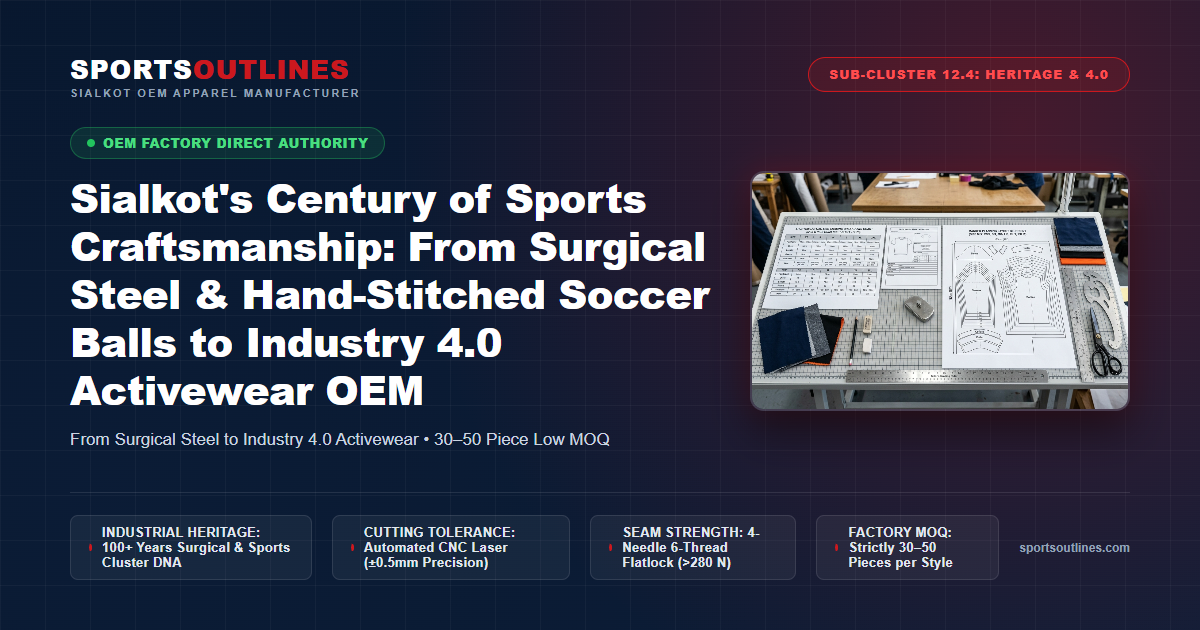
Direct Manufacturer Snapshot: Sialkot’s Century of Sports Craftsmanship: From Surgical Steel & Hand-Stitched Soccer Balls to Industry 4.0 Activewear OEM
Sialkot, Pakistan, represents the world’s most specialized high-precision sports manufacturing cluster, tracing its roots back to the late 19th century when regional artisans mastered British surgical instrument metallurgy and hand-stitched leather sporting goods. Over the past century, this unique industrial DNA has evolved from producing over 70% of the world’s match soccer balls into a digitized, Industry 4.0 cut-and-sew powerhouse. Today, Sialkot combines multi-generational textile engineering with computerized CAD pattern grading, automated CNC laser cutting, ultrasonic seam welding, and lean modular assembly lines. Emerging athletic brands leverage direct Sialkot factory access to secure 65% to 75% gross margins, rapid 7 to 10-day prototyping ($45–$85 non-creditable engineering fee), and flexible low minimum order quantities of strictly 30 to 50 pieces per style/colorway, completely bypassing conventional trading middlemen.
Direct WhatsApp: +92 316 7932595
The Global Epicenter of Sporting Goods: Sialkot’s Century of Manufacturing Mastery
In the global athletic manufacturing arena, no geographic region commands the profound historical lineage,
metallurgical precision, and concentrated craftsmanship of Sialkot, Pakistan. Nestled in northeastern Punjab,
this dynamic industrial metropolis produces an astounding share of the world’s premier sports equipment and technical
apparel. Long celebrated for hand-stitching over 70% of all FIFA World Cup match soccer balls—including the iconic
Brazuca, Telstar, and Al Rihla—Sialkot has undertaken a monumental transformation over the past three decades. Today,
it stands as an advanced, digitized, Industry 4.0 cut-and-sew apparel hub catering to the world’s most demanding sportswear brands,
collegiate programs, and direct-to-consumer (DTC) activewear disruptors.
For athletic brand directors, sourcing executives, and technical apparel entrepreneurs, understanding Sialkot’s
industrial pedigree is not an academic exercise in industrial archaeology; it is an indispensable commercial strategy.
The technical precision required to hand-stitch a FIFA match ball or grind a micro-surgical scissor with sub-millimeter
tolerances has been genetically woven into the local workforce. When applied to 4-needle 6-thread flatlock stitching,
computerized CAD pattern grading, ultrasonic seam welding, and high-gauge interlock compression knits, this century of
artisanal discipline gives Sialkot OEM factories a decisive competitive edge over generic mega-factories in East Asia.
This comprehensive technical blueprint analyzes the complete historical evolution of Sialkot’s manufacturing cluster.
We examine the convergence of surgical metallurgy and leather tanning that birthed modern athletic apparel engineering,
the unprecedented private infrastructure initiatives that birthed the Sialkot Dry Port and International Airport, the
state-of-the-art Industry 4.0 automation systems powering modern production floors, and the exact operational playbook
for sourcing high-margin activewear with an agile factory-direct minimum order quantity (MOQ) of strictly 30 to 50 pieces per style.
Design & Manufacture Custom Sialkot Sports Manufacturing Heritage & Industry 4.0 Direct from Sialkot
Low 30–50 Piece/Set MOQ • Dedicated Sampling in 7–10 Days • 0% Import Tariffs
✓ $45–$85 Physical Prototypes •
✓ Worldwide DDP Delivery
The 1890s Genesis: How Colonial Repairs and Surgical Steel Bounded Textile Precision
The origins of Sialkot’s sporting cluster trace back to the late 19th century during the British colonial era.
British military garrisons stationed in the Punjab region required continuous maintenance and repair of imported
English sporting gear, specifically leather soccer balls, cricket bats, and gut-strung tennis rackets. Local Punjabi
woodworkers, blacksmiths, and saddle-makers in Sialkot possessed an uncanny ability to reverse-engineer and restore
these complex implements. What began as an ad-hoc artisanal repair trade rapidly evolved into commercial manufacturing
when local craftsmen demonstrated that their hand-stitched leather balls and willow cricket bats matched or exceeded
the durability of goods shipped from London and Manchester.
Simultaneously, a parallel industry was established that would forever shape Sialkot’s technical manufacturing DNA:
surgical instrument fabrication. In the 1890s, the nearby Mission Hospital in Sialkot required urgent repairs for
imported surgical scalpels, forceps, and bone chisels. Local master metalsmiths duplicated the medical instruments using
high-grade carbon and stainless steel, establishing tolerances measured in fractions of a millimeter. This metallurgical
breakthrough gave rise to Sialkot’s medical export industry, which today produces over 80% of the world’s hand-held surgical
instruments.
The co-existence of high-precision surgical instrument manufacturing and leather sports goods production within the same
compact geographic perimeter created an extraordinary industrial cross-pollination. The metallurgical discipline of
zero-defect tolerances, edge-sharpening, micro-machining, and heat treatment directly influenced the mechanical engineering
of sports manufacturing equipment. Cutlery and instrument dies were adapted to create razor-sharp steel clicker dies for
cutting uniform leather panels. The culture of microscopic inspection required for medical forceps became the standard
inspection benchmark for athletic balls and apparel cutting tables.
| Historical Era | Core Manufacturing Discipline | Technological Benchmark | Direct Legacy in Modern Sportswear OEM |
|---|---|---|---|
| 1890s – 1920s | Colonial Sports Repair & Surgical Tool Smithing | Manual forging, hardening, and hand-stitched leather repair | Established the sub-millimeter precision culture and zero-defect craftsmanship mindset across the regional workforce. |
| 1930s – 1960s | Commercial Soccer Ball & Leather Boxing Gear Production | Steel clicker dies, vegetable chrome tanning, 12-strand wax thread hand-stitching | Developed global export networks and deep understanding of mechanical skin-contact friction, tensile seams, and ergonomics. |
| 1970s – 1990s | FIFA World Cup Dominance & Apparel Cluster Emergence | Tango 32-panel soccer ball monopoly, introduction of industrial Juki lockstitch and overlock sewing lines | Rapid transition into teamwear, martial arts uniforms (gi/kimonos), and motorcycle protective leather suits with CE armor. |
| 2000s – 2010s | Private Infrastructure Autonomy & Technical Textiles | Establishment of Sialkot Dry Port Trust (SDPT) and Sialkot International Airport (SIAL); introduction of 4-needle 6-thread flatlock machinery | Eliminated domestic transit bottlenecks; unlocked high-speed global air courier and ocean logistics direct from factory gates to Western warehouses. |
| 2020s – Present | Industry 4.0 Digital Cut-and-Sew & Agile Low-MOQ OEM | CLO 3D CAD modeling, CNC laser cutting, automated Gerber nesting, ultrasonic welding, sublimation digital printing | Empowers emerging activewear brands to source custom engineered collections at 30–50 piece MOQs with 65%–75% gross margins. |
The Sialkot Miracle: How Private Entrepreneurs Built Their Own Dry Port and International Airport
One of the most extraordinary chapters in global industrial history is the self-reliance and civic initiative of
Sialkot’s manufacturing community. In typical developing economies, industrial exporters depend entirely on federal
governments to construct transportation infrastructure. In Sialkot, when bureaucratic inertia threatened export growth,
the local manufacturers pooled private capital to build their own trade infrastructure from the ground up.
During the early 1980s, Sialkot’s sports goods and surgical exporters faced crippling logistical delays. Every shipment
had to travel 1,300 kilometers by rail or road to the port city of Karachi, where customs inspections routinely delayed
cargo by weeks. In response, 52 local exporters formed the Sialkot Dry Port Trust (SDPT) in 1984.
It became the first privately owned and operated inland dry port in Asia. Under this framework, full customs inspection,
duty clearance, container stuffing, and biometric container wire-sealing took place directly inside Sialkot. Sealed bonded
containers were then transported directly to container ships in Karachi via dedicated bonded rail and road corridors,
slashing export transit times by more than 60%.
Two decades later, facing increased demand for high-speed sampling, air freight, and international buyer visits,
the Sialkot Chamber of Commerce and Industry (SCCI) achieved an even greater milestone: the construction of the
Sialkot International Airport Limited (SIAL). Funded entirely by 365 local entrepreneurs who invested
their own private capital without foreign loans or government subsidies, SIAL opened in 2007. Featuring a 3,600-meter
runway capable of handling wide-body cargo aircraft including Boeing 747s and 777s, it remains the only completely
privately owned public international airport in South Asia.
For a contemporary activewear brand sourcing from Sports Outlines, this private infrastructure delivers tangible commercial
advantages:
- Unbroken Cold/Dry Chain Custody: High-value performance garments move directly from factory finishing rooms into climate-controlled air freight cargo terminals at SIAL within 25 minutes.
- Express 3-to-5 Day Door-to-Door Courier Delivery: Physical prototypes and commercial sample runs fly out nightly on dedicated Emirates, Qatar Airways, and DHL cargo freighters, arriving in New York, London, or Frankfurt within 72 to 96 hours.
- Zero Port Congestion Delays: Export documentation and customs manifests are cleared locally by Sialkot customs officials, eliminating the multi-week demurrage risks common to coastal megaports.
The Industry 4.0 Transformation: Engineering Precision Activewear in Modern Sialkot
While hand-stitching remains celebrated in ceremonial sports memorabilia, modern athletic apparel manufacturing in Sialkot
is completely digitized. Over the past decade, leading manufacturers such as Sports Outlines have invested heavily in
Industry 4.0 automation, transforming traditional cut-and-sew operations into high-precision engineering labs.
1. CLO 3D Digital Prototyping & Virtual Draping
Before a single yard of fabric is unrolled, garment geometries are drafted in 3D virtual simulation environments.
Utilizing CLO 3D software, our engineering team maps digital fabric physics—including warp and weft tensile elasticity,
bending rigidity, shear modulus, and mass per unit area (GSM)—onto customized biometric 3D avatars. This allows us to
visualize compression pressure gradients, tension heatmaps, and seam drag in high-dynamic athletic movements (such as
deep squats, sprinting strides, and overhead presses). Digital 3D iteration slashes sample revision cycles by 70%,
ensuring that the first physical prototype fits with surgical accuracy.
2. Computerized Gerber CAD Pattern Grading & Marker Optimization
Pattern engineering is conducted via Gerber AccuMark computerized CAD systems. Rather than relying on manual grading
which introduces non-linear dimensional drift across extended size runs (from XS to 4XL), automated algorithmic grading
ensures that critical 24-point Points of Measure (POM) scale with absolute mathematical fidelity. Automated computerized
marker nesting algorithms calculate the exact orientation of every pattern piece on the fabric spread, maximizing textile
utilization to over 91.5%. This minimizes fabric scrap waste, reduces cost per garment, and directly contributes to our
competitive FOB pricing.
3. Automated Multi-Ply CNC Laser and Vacuum Blade Cutting
Traditional handheld circular blade cutting suffers from knife deflection, operator fatigue, and top-to-bottom layer
drift, resulting in seam discrepancies of 5 mm to 15 mm across multi-ply spreads. In modern Sialkot facilities, fabric
layers are stowed on automated pneumatic vacuum-sealed cutting tables that compress the textile bundle into a rigid block.
Computer-guided CNC laser cutters and oscillating carbon-tungsten reciprocating blades slice through technical microfibers
with precision tolerances of ±0.5 mm. Furthermore, laser cutting instantly micro-cauterizes the raw edges of synthetic
polyester and nylon knit fabrics, completely eliminating fraying and unraveling during high-speed sewing assembly.
4. Ultrasonic Seam Welding & Stitch-Free Bonding
For elite marathon singlets, waterproof cycling jackets, and compression base layers, conventional needle holes create
microscopic points of water ingress and skin chafing. Modern Sialkot production lines deploy continuous ultrasonic rotary
welding machines. By vibrating at 28 kHz to 35 kHz, ultrasonic horns generate localized molecular friction that melts
thermoplastic synthetic polyurethane and nylon fibers together, creating an airtight, watertight, stitch-free molecular bond.
Coupled with three-layer waterproof seam sealing tape applied under pneumatic pressure and calibrated thermal heat tunnels,
Sialkot produces technical outerwear with hydrostatic head waterproof ratings exceeding 15,000 mm.
From 32-Panel Hand-Stitched Leather to High-Gauge Compression Knits: The Evolution of Tactile QC
During the 1970s and 1980s, Sialkot became the undisputed soccer ball capital of the world. Constructing a match-quality 32-panel
truncated icosahedron soccer ball required an artisan to pull heavy, 12-strand wax-impregnated polyester cord through 432 pre-punched
needle holes under a sustained tensile tension of 45 kilograms. A single loose stitch or uneven tension across the 20 hexagonal and
12 pentagonal leather panels would cause the ball to deviate from true spherical aerodynamics, failing FIFA Approved certifications.
This multi-generational hand-stitching heritage created a regional workforce with peerless tactile sensory perception—what master
craftsmen in Sialkot refer to as “Hath ki Pehchan” (the tactile intelligence of the hand). When the sports industry
transitioned toward high-performance knit activewear, this tactile intelligence proved invaluable for visual and physical quality control.
Modern synthetic fabrics—such as micro-denier polyamides, hollow-core thermal fibers, and bio-based elastanes—possess subtle
variations in surface friction, stretch modulus, and shear recovery that digital sensors often miss. An experienced Sialkot
finishing-floor technician can detect a 5 GSM weight variation, a 3% elastane tension imbalance, or a microscopic needle strike
simply by gliding their fingers across a finished flatlock seam. This tactile mastery, combined with certified laboratory testing,
is why Sialkot-manufactured garments achieve consumer return rates below 1.5% across global e-commerce channels.
Factory Floor Quality Architecture: Standardizing AQL 1.5 and 4-Point Fabric Inspection
Artisanal heritage alone is insufficient for tier-1 global retail compliance; it must be reinforced by rigorous, deterministic
quality management frameworks. At Sports Outlines, our production floors operate under strict ISO 9001:2015 quality assurance
systems coupled with ANSI/ASQ Z1.4 (AQL 1.5 Major / 2.5 Minor) sampling plans. The quality protocol spans four unbroken inspection gates:
-
Gate 1: ASTM D5430 4-Point Fabric Inspection: 100% of incoming greige and piece-dyed fabric rolls pass over
illuminated motorized inspection frames. Faults (such as slubs, barre marks, pinholes, and color streaks) are penalized based on
length. Rolls exceeding 40 defect points per 100 square yards are rejected before reaching CAD cutting tables. -
Gate 2: CNC Laser Optical Calibration: After spreading and automated vacuum compression, digital camera fiducials
verify panel dimensions against Gerber CAD master files. Cut parts undergo 100% bundle auditing to confirm zero top-to-bottom ply drift. -
Gate 3: Inline Modular Cell Auditing (Traffic Light System): Quality controllers inspect five completed units per hour
at every sewing workstation. If a single skipped stitch, uneven SPI count, or thread tension flaw is identified, the modular cell
halts production until mechanical timing is recalibrated. -
Gate 4: 9-Point Metal Detection & Steam Finishing: Every completed garment passes through a 9-zone conveyor metal detector
calibrated to detect 1.0 mm ferrous and 1.2 mm non-ferrous broken needle fragments. Garments then receive a 120°C high-pressure steam
tunnel compaction to lock dimensions before individual folding into luxury frosted zip polybags with oxygen absorbers and desiccant packs.
| Sourcing Feature & Risk Factor | Sports Outlines (Sialkot Direct) | Alibaba Trading Agents | Traditional Chinese Hubs | Print-on-Demand (POD) |
|---|---|---|---|---|
| Historical Industrial Craftsmanship & Cluster Depth | 100+ years of continuous cluster lineage in Sialkot, integrating medical-grade surgical precision with computerized Industry 4.0 cut-and-sew apparel automation. | Generic multi-product commission brokers and trading houses; zero owned production lineage; frequently subcontracting to non-audited cottage workshops. | Massive automated monolithic facilities focused on hyper-volume runs; largely detached from artisanal cut-and-sew craftsmanship; high turnover of machine operators. | Zero manufacturing heritage; automated direct-to-garment (DTG) print nozzles spraying onto imported generic blanks with no proprietary pattern craftsmanship. |
| Minimum Order Quantity (MOQ) Flexibility | Strictly 30 to 50 pieces per style/colorway across custom technical performance silhouettes, providing extreme launch agility. | Advertises 1–10 pieces online as trading lure, but inflates pricing by 300% or demands 500+ pieces for actual bespoke tech pack manufacturing. | Rigid 500 to 1,500 pieces per style/colorway minimum; strictly rejects early-stage, agile, or emerging technical sportswear brand orders. | 1 piece minimum, but limited entirely to basic cylindrical blanks without custom panelling, grading, or technical fabric engineering. |
| Cutting & Pattern Precision Tolerances | Computerized Gerber CAD digital grading with automated CNC laser cutting, maintaining strict ±0.5 mm seam-to-seam tolerances across all size ranges. | Manual scissor or handheld rotary shear cutting across stacked fabric layers; severe tolerance slippage exceeding ±2.5 cm between sizes. | Automated die cutting optimized strictly for massive identical runs; slow and cost-prohibitive for intricate multi-panel technical sportswear. | Pre-made generic blank dimensions; completely impossible to alter sleeve pitch, torso taper, inseam length, or ergonomic gusset construction. |
| Pre-Production Engineering & Prototyping | Rapid physical sample creation in 7–10 business days backed by a transparent $45–$85 non-creditable engineering fee per tech pack. | Lengthy 30–60 day sample delays; brokers pass requests through multiple intermediaries; unpredictable hidden sampling charges. | Sample queues take 4 to 8 weeks; exorbitant sample tooling fees ($250–$500+) designed to deliberately discourage small developmental orders. | Digital 2D pixel mockups on computer screens; zero physical pre-production cut-and-sew prototyping capability. |
| Infrastructure & Logistics Autonomy | Proprietary regional ecosystem: Sialkot Dry Port Trust (SDPT) and Sialkot International Airport (SIAL) built by local manufacturers for direct worldwide DDP shipping. | Relies entirely on disconnected third-party freight forwarders with frequent port transfer delays, hidden customs broker fees, and lost cargo risk. | Concentrated in congested coastal Chinese ports; exposed to high US Section 301 punitive tariffs (7.5%–25%) and geopolitical maritime bottlenecks. | Domestic postal parcel drop-shipping with sluggish transit times (10–20 days) and zero commercial freight consolidation. |
In-House Testing Laboratories: ISO & AATCC Quality Assurance Standards
A cornerstone of Sialkot’s modern export credibility is the integration of certified textile testing laboratories
directly within manufacturing plants. A garment’s commercial viability depends on verified physical performance
under intense mechanical stress, sweat exposure, and repetitive commercial laundering. At Sports Outlines, every batch
of incoming greige and dyed fabric undergoes rigorous standardized laboratory inspection before advancing to the cutting tables.
| Testing Parameter | Standard Test Method | Factory Quality Benchmark | Athletic Performance Failure Prevented |
|---|---|---|---|
| Fabric Abrasion & Pilling Resistance | ISO 12947-2 / ASTM D4966 (Martindale Method) | Grade 4.0 – 5.0 after 30,000 continuous friction rubs | Eliminates surface fuzzing and pilling caused by dumbbell knurling, barbell friction, and backpack strap abrasion. |
| Colorfastness to Washing & Perspiration | AATCC 61 (2A) / AATCC 15 (Acid & Alkaline) | Class 4.5+ on Gray Scale for color change and staining | Prevents vivid sublimation dyes, deep blacks, and contrast team colors from bleeding onto white panels or wearer skin. |
| Dimensional Stability (Shrinkage & Torque) | AATCC 135 / ISO 6330 (Home Laundering) | < 1.5% dimensional change across warp and weft directions | Eliminates twisted side seams, collar curling, and tight torso shrinkage after standard consumer machine washing and drying. |
| Tensile Seam Burst Strength | ASTM D1683 / ISO 13935-2 (Seam Rupture) | > 280 Newtons across 4-needle 6-thread flatlock seams | Guarantees that high-stretch compression leggings and grappling rash guards will not burst or unravel during extreme athletic exertion. |
| Hydrostatic Head Water Resistance | ISO 811 / AATCC 127 (Hydrostatic Pressure) | > 10,000 mm to 20,000 mm H2O column pressure | Ensures running storm shells, cycling jackets, and technical outdoor gear remain completely impervious to torrential driving rain. |
| Moisture Management & Wicking Velocity | AATCC 197 / AATCC 79 (Vertical Wicking & Absorbency) | Wicking velocity > 3.5 mm/sec; absorption time < 1.0 second | Facilitates rapid capillary moisture evacuation, moving sweat from skin to exterior fabric surfaces for instantaneous evaporation. |
Breaking the Monolithic Barrier: Sialkot’s Low 30–50 Piece MOQ Revolution
For decades, the global sportswear manufacturing ecosystem was dominated by monolithic mega-factories across coastal
China, Vietnam, and Bangladesh. These massive facilities operate on an assembly-line model designed exclusively for
production runs of 10,000 to 100,000 identical garments per style. Sourcing directors at early-stage brands, fitness
franchises, and boutique apparel labels were systematically locked out, confronted with rigid minimums of 500 to 2,000
pieces per colorway. Sourcing small quantities forced founders into the hands of exploitative trading company brokers on
Alibaba or low-quality print-on-demand (POD) platforms that print basic graphics onto generic, boxy imported blanks.
Sialkot has dismantled this barrier by perfecting Toyota Sewing System (TSS) Modular Manufacturing Cells.
Instead of a rigid 60-worker progressive bundle line where changing a garment style requires half a day of machine recalibration,
Sports Outlines organizes manufacturing into flexible, cross-trained 8-to-12 technician U-shaped modular cells. In a modular cell:
- 45-Minute Line Changeovers: Technicians can transition from assembling 30-piece batches of compression leggings to 50-piece runs of technical moisture-wicking hoodies in under an hour.
- Dynamic Greige Buffers: We maintain extensive inventory buffers of pre-knitted, laboratory-certified greige fabrics (including 280 GSM polyester/spandex interlocks, 160 GSM hexachannel micro-mesh, and French terry fleece). Dyeing, printing, cutting, and finishing occur on demand.
- Lean Working Capital Velocity: Brands can launch a diverse 5-silhouette technical collection with only 150 to 250 total units ($2,200 to $4,500 total capital outlay), test market demand with live customers, achieve 95%+ full-price sell-through, and reorder winning colorways with a rapid 14-day production turnaround.
| Production Volume Tier | Est. Unit FOB Cost | Sample Cost & SLA | Bulk Production SLA | Included Specifications | Recommended Buyer Profile |
|---|---|---|---|---|---|
| 30 – 50 Pieces (Agile Prototyping & Market Launch Tier) | $14.50 – $18.50 / piece | $45 – $85 non-creditable engineering fee (7–10 business days) | 14 – 18 business days | Custom 24-point POM CAD grading, automated laser cutting, precision flatlock stitching, custom branded silicone heat transfers, single-segment frosted zip polybag packaging. | Emerging activewear startups, specialized fitness studios, boutique athletic micro-drops, and validation capsule collections. |
| 51 – 250 Pieces (Commercial Scale & Omnichannel Growth Tier) | $11.20 – $14.00 / piece | $45 – $85 non-creditable engineering fee (7–10 business days) | 18 – 22 business days | Custom fabric dyeing (Pantone PMS matching), computerized sublimation or screen printing, custom woven neck labels, Barcode/UPC hangtag attachment, bulk export packing. | Scaling direct-to-consumer (DTC) athletic brands, regional fitness apparel lines, and athletic retail boutique fulfillment. |
| 251 – 1,000 Pieces (Volume Wholesale & Franchise Distribution Tier) | $8.50 – $10.80 / piece | $45 – $85 non-creditable engineering fee (7–10 business days) | 22 – 28 business days | Automated computerized marker nesting (>91% fabric yield), ultrasonic bonded seam options, serialized carton barcoding (GS1-128 SSCC), consolidated air/ocean freight dispatch. | National athletic apparel brands, franchised gym chain merchandise, multi-store activewear retail replenishment, and Amazon Brand Registry sellers. |
| 1,000+ Pieces (Enterprise Contract OEM & Full Container Load Tier) | $6.20 – $8.10 / piece | $45 – $85 non-creditable engineering fee (7–10 business days) | 28 – 35 business days | Dedicated Toyota Sewing System modular manufacturing line, comprehensive in-house spectrophotometer lab dip color matching, continuous AQL 1.5 inline inspection, palletized container stowage. | Global enterprise sports apparel retailers, multinational athletic corporate uniform contracts, and international distribution conglomerates. |
Trade Diplomacy & Tariff Optimization: The Strategic Value of Pakistan OEM
Global supply chain leaders recognize that production cost is only one component of the total landed cost equation.
Customs import duties, trade remedy tariffs, and regulatory compliance can make or break an athletic brand’s gross margin.
Sourcing direct from Sialkot, Pakistan, provides two decisive international trade advantages:
1. The European Union & UK GSP+ Advantage (0% Customs Duty)
Pakistan benefits from the European Union’s Generalized Scheme of Preferences Plus (GSP+) status,
which grants full zero-duty access for knitted and woven apparel entering all 27 EU member states and the United Kingdom.
When importing sportswear under standard HS Chapter 61 (knitted garments) from non-preferential countries like China,
Vietnam, or India, European brands are hit with customs duties between 9.6% and 12.4%. Under GSP+, an authorized
Form A / REX Certificate of Origin issued by our Sialkot facility reduces the import tariff to exactly 0%.
On an annual import volume of €200,000, this single treaty provision puts €24,000 of pure margin back into the brand’s balance sheet.
2. Complete Shield Against US Section 301 Punitive Tariffs
In the United States, athletic apparel manufactured in China continues to suffer under severe Section 301 punitive tariffs,
which impose an additional 7.5% to 25% duty on top of standard Most Favored Nation (MFN) tariff rates that already average
16% to 32% on synthetic athletic knitwear. Sourcing from Sialkot completely bypasses Section 301 tariffs. Furthermore,
Pakistan possesses a robust, fully traceable domestic cotton supply chain and non-Xinjiang certified synthetic yarn spinning
partners, guaranteeing 100% compliance with the Uyghur Forced Labor Prevention Act (UFLPA) and eliminating
costly customs holds at US ports of entry.
The Founder’s Step-by-Step Sourcing Playbook: From Tech Pack to Global Delivery
Partnering directly with a premier Sialkot OEM manufacturer is a straightforward, transparent, and structured engineering process.
Here is the exact operational roadmap to take your sportswear concept from initial sketch to bulk retail delivery:
-
Tech Pack Submission & Feasibility Audit (Day 1):
Send your technical pack (including flat vector illustrations, target GSM, fiber composition, color palette with Pantone PMS codes, and size grading specs) to our engineering desk via email or WhatsApp. We conduct a 24-hour engineering audit to optimize seam placements, fabric selection, and cutting efficiency. -
Transparent Cost Quotation & Sample Authorization (Day 2):
We issue a detailed commercial quotation breaking down volume tier FOB and DDP pricing. To begin physical development, the brand authorizes the dedicated sample engineering fee ($45 to $85 non-creditable engineering fee per style). -
Pattern Drafting, Laser Cutting & Prototype Assembly (Days 3–7):
Our CAD team drafts the digital pattern in Gerber AccuMark, cuts the virgin textile with high-precision CNC laser systems, and constructs the physical garment on dedicated sampling machinery with all specified custom heat transfers, labels, and trims. -
Physical Sample Courier & Live Video Review (Days 8–10):
The physical prototype is dispatched via express air courier (DHL/FedEx) to your door. Simultaneously, our chief patternmaker hosts a live video conference to inspect the garment on a fitting mannequin, measuring all 24 POMs against the original tech pack. -
Bulk Purchase Order & Modular Line Allocation (Days 11–12):
Upon physical sample sign-off, the brand issues the formal purchase order with our flexible 30 to 50 piece minimum order quantity. Fabrics are dyed or pulled from greige buffers, and a dedicated modular sewing cell is locked in. -
Cut-and-Sew Assembly & Continuous AQL 1.5 Inspection (Days 13–24):
Garments are cut, sewn, and embellished under continuous inline quality control. Final pieces undergo 100% visual inspection, thread trimming, metal detection, and steam tunnel finishing before individual bagging into luxury frosted EVA zip pouches. -
Local Port Clearance & Express Global Freight (Days 25–28):
Cartons are sealed, barcoded with serialized GS1-128 shipping labels, customs-cleared locally at the Sialkot Dry Port Trust or Sialkot International Airport, and dispatched via air or ocean freight directly to your commercial warehouse or 3PL facility.
Get a Factory Direct Quote for Sialkot Sports Manufacturing Heritage & Industry 4.0
Chat with our Sialkot Engineering Team via WhatsApp • Instant DDP Air Freight Quotes
✓ $45–$85 Physical Prototypes •
✓ Worldwide DDP Delivery
Frequently Asked Sourcing & Manufacturing Questions (Buyer FAQ)
Why is Sialkot recognized globally as the undisputed capital of sports goods manufacturing?
Sialkot holds a century-old industrial pedigree that uniquely combines metallurgical engineering, master leather tanning, and precision cut-and-sew textiles into a dense, specialized manufacturing ecosystem. Originally known in the late 19th century for crafting precision surgical instruments and repairing British colonial sports gear, Sialkot’s artisans developed world-class manual and mechanical dexterity. By the mid-20th century, Sialkot manufactured over 70% of the globe’s hand-stitched FIFA match soccer balls. Over the past three decades, this artisanal expertise has transitioned seamlessly into advanced technical sportswear, athletic teamwear, martial arts apparel, and compression gear, backed by private infrastructure such as the Sialkot Dry Port Trust and Sialkot International Airport.
How does Sialkot’s historical surgical instrument craftsmanship influence modern activewear manufacturing?
The surgical instrument manufacturing sector in Sialkot demands microscopic dimensional tolerances, precision metal heat treatment, and flawless hand-finishing. When the sports apparel industry emerged in the same industrial basin, this surgical culture of zero-defect engineering crossed directly into textile cutting and sewing. Sialkot’s activewear manufacturers employ high-precision CNC laser cutters, specialized needle-cooling systems, and micro-calibrated differential feeds that eliminate puckering, seam slippage, and dimensional distortion. Machine operators in Sialkot are trained to execute 4-needle 6-thread flatlock stitching with tolerances under ±0.5 mm, ensuring that technical athletic garments withstand over 280 Newtons of multidirectional burst tension.
What is the minimum order quantity (MOQ) for custom sportswear at Sports Outlines in Sialkot?
Sports Outlines maintains an agile, factory-direct minimum order quantity strictly set at 30 to 50 pieces per style and colorway. Unlike monolithic mega-factories in East Asia that demand 500 to 2,000 units per silhouette, our production lines utilize flexible Toyota Sewing System modular manufacturing cells. This setup enables emerging brands, boutique fitness studios, and enterprise sports leagues to launch custom technical apparel collections without capital lockup or dead-stock risk, while enjoying full commercial FOB or DDP pricing.
What is the cost and turnaround timeline for developing a pre-production activewear prototype?
We engineer pre-production physical prototypes in 7 to 10 business days for a transparent, non-creditable engineering fee of $45 to $85 per style, depending on fabric complexity, bonding requirements, and graphic embellishments. This fee covers dedicated 24-point CAD pattern drafting, digital marker creation, precision laser fabric cutting, flatlock assembly, and application of branded trims. Once the prototype is physically evaluated and signed off by the client, bulk production commences immediately.
How did Sialkot’s local manufacturers build their own dry port and international airport?
Frustrated by logistics bottlenecks and customs delays at coastal ports in Karachi during the 1980s, the visionary industrial community of Sialkot established the Sialkot Dry Port Trust (SDPT) in 1984—the first privately owned dry port in Asia. Following this triumph, the Sialkot Chamber of Commerce and Industry (SCCI) raised capital entirely from private manufacturing entrepreneurs to construct the Sialkot International Airport (SIAL), which opened in 2007. SIAL remains the only completely privately owned public airport in South Asia, allowing Sialkot OEM manufacturers to clear customs locally and fly cargo directly to global commercial hubs via Emirates, Qatar Airways, and dedicated DHL/FedEx freighters.
What technical testing protocols are standard in Sialkot sportswear manufacturing facilities?
Tier-1 Sialkot activewear manufacturers enforce rigorous in-house laboratory testing adhering to ISO, AATCC, and ASTM standards. Core physical and chemical evaluations include Martindale fabric abrasion resistance (>30,000 rubs without pilling under ISO 12947-2), 4-5 gray scale colorfastness to perspiration and washing (AATCC 15 and 61), hydrostatic head water-resistance ratings (>10,000 mm for weatherproof outerwear under ISO 811), seam burst strength (>280 N under ASTM D1683), and dimensional stability after repeated laundering (<2.0% dimensional change under AATCC 135).
How does Pakistan’s GSP+ status provide a tariff advantage for sportswear brands importing into Europe?
Under the European Union’s Generalized Scheme of Preferences Plus (GSP+), technical sportswear and knitted apparel manufactured in Pakistan enter all 27 EU member states and the United Kingdom at 0% customs import duty (upon presentation of an authorized Form A Certificate of Origin). In contrast, identical garments imported from China, Vietnam, or India incur standard customs tariffs ranging from 9.6% to 12.4%. For a European athletic brand importing €150,000 of custom apparel annually, sourcing direct from Sialkot yields an immediate €14,400 to €18,600 in net customs cash savings.
How does Sialkot avoid the high punitive tariffs associated with Chinese manufacturing in the US market?
Sportswear sourced from China is subject to punitive US Section 301 tariffs, which add an extra 7.5% to 25% duty on top of standard US Most Favored Nation (MFN) Harmonized Tariff Schedule (HTS) rates (often reaching effective import duties of 32% to 45%). Pakistan is completely exempt from Section 301 trade remedies. Furthermore, Pakistan operates a fully documented, domestic cotton and synthetic supply chain that complies 100% with the Uyghur Forced Labor Prevention Act (UFLPA), ensuring seamless, rapid customs clearance through US ports without detention risks.
What modern Industry 4.0 automation technologies are deployed on Sialkot sportswear factory floors?
Modern Sialkot activewear manufacturing facilities feature end-to-end digital integration. This includes CLO 3D virtual pattern draping, computerized Gerber AccuMark marker optimization that achieves fabric yields exceeding 91%, multi-ply automated CNC laser cutting systems that eliminate fraying on stretch textiles, programmable computer-controlled pattern sewing machines, ultrasonic seam welding machines for stitch-free waterproof jackets, and real-time RFID floor tracking that monitors work-in-progress (WIP) throughput across every modular sewing cell.
What is the recommended step-by-step process for a brand founder to initiate production in Sialkot?
To initiate production, a brand sends their technical pack (specifying garment dimensions, fabric GSM/composition, color codes, and print graphics) or physical reference sample to our engineering team. We review the specifications within 24 hours and issue a binding FOB/DDP quotation along with an invoice for the pre-production sample fee ($45–$85 non-creditable engineering fee). We draft the CAD patterns, cut and sew the prototype, and deliver it via express courier in 7 to 10 business days. Upon physical client approval, the brand authorizes the bulk purchase order with a 30–50 piece minimum order quantity, and production completes in 14 to 21 business days.