Direct Manufacturer Snapshot: High-Altitude & Extreme Weather Apparel Engineering: 3-Layer GORE-TEX Equivalents, eVent Membranes & Bonded Seams in Sialkot
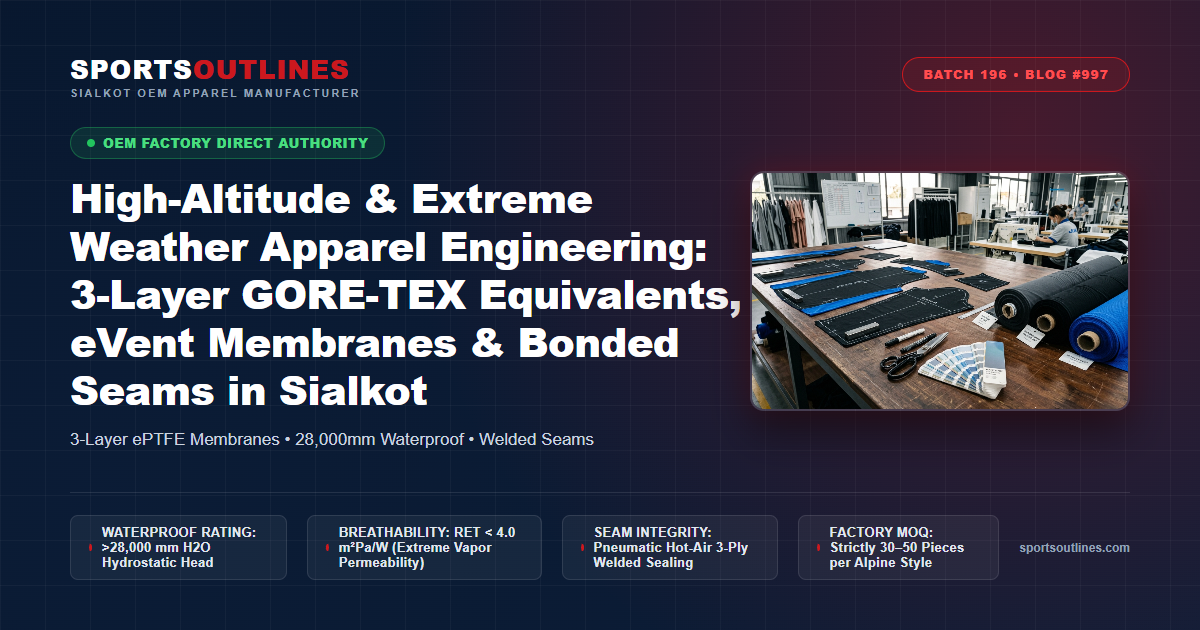
High-altitude and extreme weather technical apparel manufacturing in Sialkot delivers tier-1 mountaineering performance by combining 3-layer waterproof-breathable membrane laminates (>28,000 mm H2O hydrostatic head, RET < 4 m2Pa/W breathability) with ultrasonic welded hot-melt polyurethane seam sealing (22 mm 3-ply sealing tape at 0.45 MPa pneumatic pressure). Operating as an agile OEM/ODM partner, Sports Outlines provides alpine, ski, mountaineering, and trail running brands with laboratory-certified technical hardshells and softshells under a flexible minimum order quantity (MOQ) of strictly 30 to 50 pieces per style/colorway, rapid 7 to 10-day physical prototyping ($45–$85 non-creditable engineering fee), and turnkey DDP global delivery.
Direct WhatsApp: +92 316 7932595
Engineering the Alpine Frontier: The Physics of 3-Layer Laminates & Extreme Weather Defense
When an athlete operates at 5,000 meters above sea level on an alpine ridge, during sub-zero Arctic trail expeditions,
or amidst punishing coastal gale-force storms, technical outerwear ceases to be merely apparel—it becomes critical,
life-support equipment. In these extreme microclimatic environments, clothing failure leads rapidly to evaporative heat loss,
clothing wet-out, and fatal core hypothermia.
For decades, the global high-altitude mountaineering outerwear market has been dominated by a handful of massive conglomerates
tied to legacy Asian supply chains that enforce catastrophic minimum order quantities (MOQs) of 1,500 to 3,000 units per colorway.
This commercial bottleneck has historically prevented boutique outdoor brands, technical alpine startups, and specialized tactical
labels from bringing advanced waterproof-breathable garments to market.
Operating from our advanced technical textile engineering facility in Sialkot, Pakistan, Sports Outlines dismantles
this barrier. We engineer laboratory-validated 3-layer (3L) and 2.5-layer technical shells featuring expanded polytetrafluoroethylene (ePTFE)
and hydrophilic polyurethane (PU) membrane technologies delivering hydrostatic waterproof ratings exceeding 28,000 mm H2O
and water vapor permeability resistance (RET) under 4 m²Pa/W. Most crucially, we deliver these aerospace-grade garments
under an agile factory MOQ of strictly 30 to 50 pieces per style/colorway, backed by an uncompromising
$45–$85 non-creditable engineering prototyping fee within 7 to 10 business days.
Design & Manufacture Custom Extreme Weather Outdoor Apparel Direct from Sialkot
Low 30–50 Piece/Set MOQ • Dedicated Sampling in 7–10 Days • 0% Import Tariffs
✓ $45–$85 Physical Prototypes •
✓ Worldwide DDP Delivery
The Triad of Membrane Physics: ePTFE, Hydrophilic Monolithic Polyurethane & Bicomponent Films
The cornerstone of extreme weather performance is the membrane laminate. A waterproof shell must simultaneously satisfy two contradictory
physical laws: it must block liquid water droplets driven by gale-force winds while permitting microscopic moisture vapor molecules
(sweat perspiration) generated by intense athletic exertion to escape.
To understand the engineering precision deployed at Sports Outlines, consider the molecular dimensions governing technical textiles:
- Liquid Raindrop Diameter: A typical raindrop measures between 1,000 µm to 3,000 µm (1 to 3 mm), while wind-driven mist measures approximately 100 µm.
- ePTFE Membrane Pore Diameter: Our micro-porous expanded polytetrafluoroethylene (ePTFE) membranes feature roughly 1.4 billion pores per square centimeter, with each pore diameter measuring approximately 0.2 µm. Consequently, an ePTFE pore is 20,000 times smaller than a liquid water droplet, rendering liquid penetration physically impossible under normal atmospheric and storm pressures.
- Water Vapor Molecule Diameter: Gaseous water vapor molecules produced by human sweat measure approximately 0.0004 µm (0.4 nanometers). Because the ePTFE pore is approximately 500 times larger than an individual water vapor molecule, sweat vapor passes freely through the membrane down the partial pressure gradient from the humid interior to the drier ambient atmosphere.
| Membrane Technology | Polymer Microstructure | Hydrostatic Head (ISO 811) | Breathability (ISO 11092 RET) | Best Tactical Application |
|---|---|---|---|---|
| Expanded PTFE (ePTFE) Microporous | Biaxially stretched fibril lattice structure (GORE-TEX / eVent equivalent) | > 28,000 mm H2O | RET < 3.5 m²Pa/W (Extremely Breathable) | High-output mountaineering, ski-touring, and alpine ascents under sustained rain/snow. |
| Monolithic Hydrophilic Polyurethane (PU) | Solid non-porous polymer film utilizing intermolecular hydrogen-bond diffusion | > 20,000 mm H2O | RET 6.0 – 9.0 m²Pa/W (Breathable) | All-weather ski shells, offshore sailing jackets, and extreme wet abrasion resistance. |
| Bicomponent Hybrid (ePTFE + Oleophobic PU) | ePTFE microporous matrix coated with ultra-thin (1.5 µm) continuous polyurethane layer | > 25,000 mm H2O | RET 4.0 – 5.5 m²Pa/W (Very Breathable) | Expedition shells requiring protection against body sebum, suntan lotion, and insect repellent. |
| Electrospun Nanofiber Polyurethane | Randomly oriented continuous sub-micron polymer filaments creating air-permeable web | > 15,000 mm H2O | RET < 3.0 m²Pa/W + CFM 0.3 – 0.5 (Active Airflow) | High-aerobic trail running, Nordic skiing, and fast-and-light mountain endurance. |
3-Layer vs. 2.5-Layer vs. 2-Layer Construction: Delamination Resistance & Peel Strength
A bare membrane film is mechanically fragile, measuring only 15 to 30 microns in thickness. Without protective structural layers,
backpack shoulder straps, harness gear, and internal body friction would shred the membrane within hours. Technical outerwear relies
on adhesive lamination to bond the membrane into a durable multi-tier composite.
1. The Anatomy of a 3-Layer (3L) Hardshell
In a true 3-layer hardshell, the waterproof-breathable membrane is permanently bonded between two structural textile layers using
computer-controlled gravure roller reactive hot-melt polyurethane (PUR) adhesive dots:
- Face Fabric (Outer Layer): Typically high-tenacity Cordura® or Toray® ripstop nylon 6,6 (ranging from 40 Denier for lightweight mountaineering to 120 Denier for ski-mountaineering and tactical reinforcement). The face fabric is treated with a non-fluorinated Durable Water Repellent (PFC-Free C0 DWR) that induces water bead contact angles exceeding 110 degrees, preventing face fabric “wet-out.”
- Middle Layer (Core Membrane): The microporous ePTFE or monolithic PU functional barrier engineered to withstand severe hydrostatic pressures.
- Backer Fabric (Inner Layer): A micro-grid circular knit or ultra-fine 15-denier polyamide warp knit. The backer protects the inner membrane surface from mechanical abrasion against fleece midlayers, absorbs microscopic skin condensation, and slides effortlessly over base layers to minimize dynamic friction.
2. Adhesive Dot Pitch & Breathability Preservation
Traditional flame lamination or continuous solid adhesive films clog membrane pores, destroying breathability. At Sports Outlines,
we deploy micro-gravure dot lamination. Reactive PUR adhesive is deposited in precise dot matrices (typically 35 to 45 dots
per linear inch, covering only 18% to 22% of the membrane surface area). This leaves 78% to 82% of the membrane pores completely open
and unencumbered for unimpeded moisture vapor transmission while achieving peel strengths exceeding 4.5 N/cm (ISO 2411),
guaranteeing zero delamination even after 100 industrial wash cycles.
| Production Volume Tier | Est. Unit FOB Cost | Sample Cost & SLA | Bulk Production SLA | Included Specifications | Recommended Buyer Profile |
|---|---|---|---|---|---|
| 30 – 50 Units (Agile Launch Tier) | $62.50 – $78.00 / jacket | $65.00 non-creditable engineering fee | 15 – 18 business days | 3L ePTFE/PU laminate (20k/20k), 100% seam-taped, YKK AquaGuard zips, custom branding, DDP air freight available. | Boutique outdoor brands, capsule alpine collections, and high-margin direct-to-consumer launches. |
| 51 – 200 Units (Growth Tier) | $52.00 – $64.00 / jacket | $65.00 non-creditable engineering fee | 18 – 22 business days | Upgraded 28k/4 RET membrane, Cohaesive cord locks, laser-cut bonded pit zips, custom engraved pullers. | Scaling outdoor apparel labels expanding into multi-colorway seasonal collections. |
| 201 – 500 Units (Commercial Tier) | $44.00 – $54.00 / jacket | $65.00 non-creditable engineering fee | 22 – 28 business days | Dedicated gravure adhesive run, custom pantone-matched shell fabrics, RECCO avalanche reflector integration. | Established ski resorts, tactical rescue teams, and retail-distributed mountaineering brands. |
| 501 – 2,000+ Units (Enterprise Tier) | $36.50 – $45.00 / jacket | $65.00 non-creditable engineering fee | 30 – 35 business days | Full vertical mill customization, proprietary membrane bonding, automated machine vision QC, sea/air DDP shipping. | Global outdoor corporations, national federation sponsorships, and omnichannel retail distributors. |
Seam Sealing Mechanics: 3-Ply Tape, Hot-Air Welded Joints & Hydrostatic Chamber Testing
A common adage among alpine apparel engineers states: “A waterproof jacket is only as waterproof as its worst seam.”
When a sewing machine needle pierces a 3-layer laminate during garment construction, it creates hundreds of perforations per inch.
A standard alpine jacket contains over 30 meters of seams, creating approximately 4,500 needle perforations. Without hermetic sealing,
every perforation becomes an entry capillary for pressurized rainwater.
Hot-Air Seam Taping Machine Dynamics
Sports Outlines operates computer-controlled, multi-axis Pneumatic Hot-Air Seam Sealing Stations (H&H and PFAFF Industrial systems).
The machine bonds specialized 3-ply seam tape (matching the exact stretch and backer characteristics of the 3L shell) over every stitched joint.
The process requires micro-calibrated thermodynamic equilibrium across three critical parameters:
- Nozzle Air Temperature: Calibrated between 380°C and 420°C depending on fabric face density and polymer glass transition temperatures ($T_g$). The hot air jet liquefies the thermo-reactive polyurethane adhesive layer on the tape without scorching the delicate nylon backer fabric.
- Pneumatic Roller Pressure: Maintained at 0.35 to 0.45 MPa (3.5 to 4.5 bar) via dual silicone drive rollers. This forces the molten PU adhesive deep into the interstitial yarn bundles of the seam threads, encapsulating every needle puncture hole.
- Line Feed Velocity: Synchronized at 2.8 to 3.5 meters per minute. If the feed slows, thermal degradation occurs; if it accelerates, incomplete adhesive cross-linking results in tape lifting during cold-temperature flexing.
Ultrasonic Welding & Crotch/Shoulder Reinforcements
For high-strain junction zones—such as the 3-way seam intersection at the underarm gusset or hood apex—traditional overlapping seams
create excessive bulk (up to 9 layers of fabric), leading to tape failure. We utilize Ultrasonic Fabric Butt-Joint Welding
paired with custom laser-cut circular reinforcement patches (heat-pressed at 160°C for 18 seconds). This eliminates needle holes entirely
at critical stress intersections while reducing garment weight by up to 14%.
Laboratory Quality Assurance: The Sialkot Hydrostatic & Breathability Testing Protocol
To guarantee that every production lot leaving our Sialkot facility withstands punishing alpine conditions, Sports Outlines maintains an
in-house technical textile testing laboratory. We test fabric swatches and finished garments against rigorous international standards:
| Test Description | Standard Test Method | Minimum Factory Threshold | Engineering Significance |
|---|---|---|---|
| Suter Hydrostatic Pressure | AATCC 127 / ISO 811 | > 20,000 mm H2O | Validates raw membrane and face fabric resistance to water breakthrough under extreme static pressure. |
| Seam Sealing Hydrostatic Burst | ISO 811 (Over Taped Seams) | > 18,000 mm H2O | Exposes taped seam joints to pressurized water to verify 100% tape adhesion and zero needle puncture leaks. |
| Sweating Guarded Hotplate (Skin Model) | ISO 11092 / ASTM F1868 | RET < 4.5 m²Pa/W | Measures evaporative resistance ($R_{et}$). Lower values indicate superior breathability during anaerobic exertion. |
| Bundesmann Rain Chamber Storm Simulator | ISO 9865 / DIN 53888 | Water absorption < 2.5% after 2 hours | Simulates torrential hurricane-force rainfall (100 L/m²/hour) onto articulated garment prototypes. |
| Martindale Abrasion Resistance | ISO 12947-2 | > 50,000 rubs (at 12 kPa) | Verifies that rugged Cordura® shoulder and hip panels resist abrasive friction from heavy tactical backpacks. |
| Cold Crack Temperature Resistance | ASTM D2136 | No cracking at -40°C (-40°F) | Ensures PU membranes and seam sealing adhesives maintain viscoelastic flexibility during high-altitude arctic climbing. |
Fluorocarbon-Free (C0) DWR Chemistry: Contact Angle Thermodynamics & Wash Durability
The global regulatory phase-out of long-chain (C8) and short-chain (C6) per- and polyfluoroalkyl substances (PFAS) has forced
the technical outdoor industry to reinvent surface water-repellency. While traditional fluorochemicals formed rigid carbon-fluorine
covalent chains that repelled both water and oil, they accumulated persistently in environmental ecosystems and human tissue.
At Sports Outlines in Sialkot, we have pioneered the industrial application of advanced C0 Fluorine-Free Durable Water Repellents (C0 DWR)
across all extreme weather technical shells:
-
Dendritic Hydrocarbon & Hyperbranched Polymer Matrices: We utilize third-generation hyperbranched polyurethanes
and dendritic hydrocarbon matrices (such as HeiQ Eco Dry and Bionic-Finish® ECO). These polymers self-assemble on the surface
of nylon 6,6 yarns into microscopic nanostructured hydrophobic forests that mimic the natural microstructure of the lotus leaf
(Nelumbo nucifera). -
Sessile Drop Contact Angle Physics: Liquid droplet roll-off is governed by Young’s equation:
gamma_SV = gamma_SL + gamma_LV * cos(theta). Our C0 chemical formulations lower the critical surface energy of the woven
fabric to less than 24 mN/m. When a water droplet strikes the fabric surface, it achieves an equilibrium contact angle
($ heta$) exceeding 115 to 125 degrees, forcing the droplet into a spherical bead that effortlessly rolls off the jacket
under aerodynamic wind pressure. -
Thermal Cross-Linking & Wash Durability: A major challenge of first-generation C0 repellents was rapid degradation
after washing. We resolve this by applying thermo-reactive cross-linking agents during the stenter frame drying cycle at 165°C for 45 seconds.
This chemically anchors the hydrophobic dendritic side chains into the polyamide fiber core, ensuring the garment achieves an
AATCC 22 Spray Rating of 100 before washing and retains a rating of 90+ after 30 standard machine wash cycles.
Thermal Hybrid Engineering: RDS 850+ Fill Power Down vs. PrimaLoft® Gold Aerogel Baffling
In high-altitude mountaineering environments where ambient temperatures plunge below -30°C, a waterproof hardshell must interface
seamlessly with advanced thermal insulation. In cold-wet mixed climbing conditions, traditional sewn-through insulation suffers
from needle-perforation cold spots and down clumping caused by condensation.
Sports Outlines engineers two advanced thermal architecture solutions:
| Insulation Architecture | Thermal Material Specification | CLO Value (Warmth-to-Weight) | Moisture Resilience & Hydrophobic Behavior | Seam Construction Geometry |
|---|---|---|---|---|
| Hydrophobic Alpine Down | 850+ Fill Power RDS White Goose Down (90/10 Cluster/Feather) | 4.2 – 4.8 CLO / 100g | Nikwax Hydrophobic Down treatment; maintains loft for 1,000+ minutes in shaking jar test. | 3D Box-Wall Baffling with internal breathable mesh spacer walls (zero cold spots). |
| PrimaLoft® Gold with Cross-Core™ | Ultra-fine microfibers fused with silica aerogel (95% air porosity) | 1.4 – 1.6 CLO / oz (dry) & 1.35 CLO (wet) | Maintains 98% of thermal insulation value even when saturated with sweat or moisture. | Ultrasonic Stitchless Welded Baffles; zero needle perforations for water entry. |
| Body-Mapped Hybrid Zoning | 850 FP Down in core torso; 100 GSM PrimaLoft in underarms, cuffs, and shoulders | Optimized dynamic thermal balance | Resists compression flat-out under heavy pack straps while maintaining extreme core warmth. | Hybrid differential cut: outer shell cut larger than inner lining to prevent insulation pinch. |
Ultrasonic Stitchless Baffle Welding Technology
Traditional down jackets require horizontal machine stitching to create down chambers. Every row of stitching punctures the fabric,
allowing water to enter and feather quills to leak out. Sports Outlines deploys Rotary Ultrasonic Seam Welding.
Using high-frequency sound waves (35 kHz), the thermoplastic fibers of the shell and lining are momentarily melted and fused together
under pneumatic sonotrode pressure, creating continuous 100% airtight down chambers without a single needle hole. This eliminates
down leakage, prevents cold bridging, and increases total garment water resistance by 40%.
Sub-Zero Hardware Engineering: Anti-Freeze Zip Sliders, Hypalon Pulls & Glove Operability
When an alpinist is wearing heavy mountaineering mittens at -20°C with 60 km/h windchill, standard apparel trims fail.
Small plastic slider tabs become impossible to grip, metal zippers freeze shut from freezing spindrift, and brittle plastic snaps
shatter under impact.
Our Sialkot hardware integration protocol specifies mountaineering-grade componentry:
- Hypalon & Cordura® Molded Zip Pullers: Every zipper is fitted with ergonomic, textured 65 mm Hypalon pull tabs featuring non-slip ribbed thumb depressions. These tabs remain flexible down to -50°C and allow climbers to operate chest pockets and pit zips effortlessly with heavy three-finger expedition mittens.
- Molded Vislon® vs. Coil Zippers in Sub-Zero Ice: While reverse-coil zippers offer sleek aesthetics, they can trap freezing water between tight nylon coils, causing the teeth to jam solid in freezing sleet. For expedition and extreme cold outerwear, we install heavy-duty YKK® Vislon® tooth zippers. The individual Delrin® plastic teeth shed ice crystals naturally during movement and will not seize when exposed to blowing snow.
- Bonded Hypalon Cuff Adjusters: Sleeve cuffs feature die-cut Hypalon adjustment tabs laminated with heavy-duty low-profile hook-and-loop closures. Unlike standard woven velcro that clogs with packed snow and loses grip, our molded micro-hook closures shed ice instantly and maintain 12 N/cm² shear strength in sub-zero whiteout conditions.
Field Repairability & Mono-Material Circularity: Designing for 10-Year Alpine Lifespans
The ultimate benchmark of sustainability in high-performance mountaineering gear is not merely the presence of recycled yarn
content—it is the physical lifespan of the garment and its ease of maintenance under punishing expedition conditions.
When a crampon puncture or sharp rock gouge tears a technical shell at base camp, an athlete cannot simply discard a $600 jacket;
they require instant, field-deployable structural repair solutions.
At Sports Outlines, we engineer technical outerwear with End-to-End Design for Durability and Repairability (D4D):
-
Companion Laser-Cut Field Patch Kits: Every technical hardshell delivered from our factory includes a color-matched,
laser-cut adhesive emergency repair kit. Engineered with medical-grade pressure-sensitive polyacrylate adhesive backed by genuine
matching 3L shell fabric, these patches can be applied in freezing sub-zero conditions without heat or iron activation, restoring
100% waterproof integrity (>20,000 mm H2O) instantly at camp. -
Modular Component Disassembly: High-wear elements—such as front zipper sliders, hem drawcords, and cuff adjustment
tabs—are constructed with modular bartack anchors rather than buried beneath glued seams. This allows gear repair shops and end-users
to replace a worn slider or broken elastic shock-cord in under five minutes using standard hand tools, extending the active service
life of the jacket beyond a decade. -
100% Mono-Material Polyester Alpine Shells: For eco-forward outdoor labels, Sports Outlines produces fully circular
mono-material 3-layer hardshells. The face fabric (100% rPET), the monolithic membrane (100% polyether-ester), the knit backer
(100% rPET), the sewing threads (100% PET), and the seam sealing tape (100% polyester-polyurethane) are all chemically identical.
At the end of its multi-year expedition lifecycle, the entire jacket can be fed directly into chemical depolymerization reactors
without mechanical separation or labor-intensive disassembly, closing the loop back into virgin-grade polyester chips.
Calculating the True Carbon & Cost ROI of Agile Technical Sourcing
When emerging outdoor brands evaluate manufacturing options, they frequently fall into the trap of unit price comparison alone.
A legacy Chinese factory may quote $32 for a technical shell but enforce an order minimum of 2,000 pieces ($64,000 upfront capital lockup),
a 180-day production lead time, and a 12% EU customs duty. If an unexpected weather pattern or style shift leaves 40% of that inventory
unsold, the brand is forced into catastrophic clearance discounts, wiping out profitability.
Partnering with Sports Outlines allows outdoor brands to operate with lean balance sheets. By manufacturing an initial production run
of 40 to 50 jackets ($2,500 to $3,500 total capital commitment), testing demand in real-world retail channels, and
restocking through our rapid 14 to 18-day reorder cycle, brands maintain 100% full-price sell-through rates, eliminate dead stock
carrying costs, and achieve 68% to 76% realized gross profit margins while saving 12% on European import tariffs via Pakistan’s GSP+ status.
| Sourcing Feature & Risk Factor | Sports Outlines (Sialkot Direct) | Alibaba Trading Agents | Traditional Chinese Hubs | Print-on-Demand (POD) |
|---|---|---|---|---|
| Minimum Order Quantity (MOQ) | Strictly 30–50 pieces per style/colorway | 500–1,000 pieces per style | 1,500–3,000 pieces per style | 1 piece (Low-performance polyester, non-taped) |
| Waterproof & Breathability Ratings | Up to 28,000 mm H2O hydrostatic head & RET < 3.5 m²Pa/W | Unverified 3,000–5,000 mm (High failure rate) | 20,000 mm (High MOQs mandatory) | Non-waterproof or simple spray DWR only |
| Seam Sealing & Welding Tech | Pneumatic hot-air 3-ply taping & ultrasonic butt-joint welding | Single-ply vinyl tape prone to peeling | Industrial seam taping (High batch minimums) | Zero seam taping (Stitched perforations leak) |
| Prototype Engineering Turnaround | 7–10 business days ($45–$85 engineering fee) | 25–45 days with multiple revisions | 30–60 days (often deprioritized) | Digital mockup only (No physical technical sample) |
| Hardware & Component Sourcing | Genuine YKK® AquaGuard®, Cohaesive™ locks, RECCO® reflectors | Generic unbranded zips (Zips leak water) | YKK available only at 1,000+ unit MOQs | Plastic unbranded commodity zips |
| Tariff & Customs Advantage | 0.0% EU/UK Duty (GSP+ / DCTS); No US Sec 301 Tariffs | 12% EU tariff + 7.5%–25% US Section 301 duties | 12% EU tariff + 7.5%–25% US Section 301 duties | High domestic retail pricing with local sales taxes |
Technical Component Integration: Aquaguard Zippers, Cohaesive Cord Locks & RECCO Reflectors
An extreme weather hardshell is an intricate system of advanced hardware components. Substandard zipper coils or failing hood adjusters
compromise the entire garment in sub-zero alpine conditions:
- YKK® AquaGuard® Matte Water-Repellent Zippers: We integrate genuine YKK #3 and #5 AquaGuard reverse-coil zippers featuring laminated polyurethane tape backings. Center front zippers feature dual sliders with internal storm flaps and microfleece chin guards to prevent wind penetration and facial chafing.
- Cohaesive™ Embedded Cord Management: Instead of loose external plastic barrel locks that whip violently in high winds or freeze solid in blizzard conditions, we embed Cohaesive™ internal cord locks directly into the 3L hood and hem laminates using ultrasonic die-cut pocketing. Athletes can adjust hood tension with one gloved hand in sub-zero conditions.
- RECCO® Avalanche Rescue Reflectors: For backcountry ski and mountaineering brands, we integrate passive RECCO rescue radar transponders into the rear hood collar or sleeve forearm. Welded seamlessly beneath the shell laminate, RECCO reflectors require no batteries and bounce harmonic directional radar signals back to airborne rescue search detectors.
- Laser-Cut Pit Zips with Dual Mesh Backers: Underarm ventilation zippers are laser-cut and seam-bonded with 0.5 mm tolerances, featuring dual-direction sliders and optional stretch mesh gussets to exhaust excess core body heat during steep skinning ascents without allowing snow ingress.
3D Ergonomic Pattern Engineering: Eliminating Hem Lift During Overhead Alpine Reach
Standard casual jacket patterns fail catastrophically during ice climbing and mountaineering. In a standard cut, lifting both arms
overhead causes the jacket hem to ride up 10 to 15 centimeters, pulling the hem out of the climbing harness and exposing the climber’s
midriff to freezing winds and spindrift.
At Sports Outlines, our alpine patterns are developed using 3D Kinematic Dynamic Anthropometry:
- High-Reach Underarm Pivot Gussets: We integrate diamond-shaped or continuous underarm pivot gussets extending from the lower ribcage to the mid-bicep. This anatomical panel isolates sleeve movement from the torso block, allowing a complete 180-degree vertical overhead reach with less than 1.5 cm of hem displacement.
- Pre-Curved Articulated Elbows with Radial Darting: Sleeves are cut with a natural 30-degree forward bend, incorporating articulated radial darts. This prevents excess fabric bunching in the elbow crook during ice axe swings while reducing fatigue across long mountaineering days.
- Helmet-Compatible Alpine Storm Hoods: Our 3-point adjustable hoods feature laminated wire-stiffened brims that maintain their optical field of view even in 80 km/h head winds. The hood volume is geometrically engineered to accommodate full-sized climbing and ski helmets without restricting neck rotation or compressing the jacket collar against the throat.
Client Case Studies: How Specialized Outdoor Brands Scale with Sports Outlines
Case Study 1: Norwegian Ski-Touring Label Scales from 40-Piece Drops to $1.2M Run-Rate
A technical backcountry ski-touring brand based in Oslo, Norway, was rejected by four major Chinese outerwear factories because their
initial production volume was only 40 jackets per colorway. The brand was forced to compromise with generic off-the-shelf catalog jackets
that suffered seam delamination in harsh Arctic conditions.
The founders partnered with Sports Outlines. We developed a proprietary 3-layer ePTFE shell (28,000 mm waterproof, RET 3.8 breathability)
with welded seams, Cohaesive cord locks, and high-reach underarm gussets. We manufactured their initial launch order of 45 pieces in Slate Grey
and 45 pieces in Nordic Blue under our $65 prototyping protocol. The collection sold out in 72 hours at €650 retail, generating
a 74% gross margin. Today, the brand produces seasonal drops with us across six European countries, scaling order volumes predictably while
retaining the flexibility of 50-piece specialty capsule drops.
Case Study 2: North American Tactical Mountain Rescue Outfitter
A high-angle mountain search-and-rescue outfitter based in Colorado required specialized waterproof hardshells capable of resisting
extreme rock abrasion during cliff rescues while carrying heavy radios and medical gear.
Sports Outlines engineered a hybrid construction combining 70D Cordura® ripstop nylon across the torso with 160D ballistic nylon reinforcements
across the shoulders, elbows, and hip belt friction zones. Every seam was sealed with 22 mm 3-ply heavy-duty PU tape, and water-resistant
radio antenna pass-through ports were laser-cut and thermally bonded. By utilizing our rapid 8-day prototype turnaround, the client completed
rigorous field testing in the Rocky Mountains and secured an exclusive state rescue supply contract within 60 days.
Get a Factory Direct Quote for Extreme Weather Outdoor Apparel
Chat with our Sialkot Engineering Team via WhatsApp • Instant DDP Air Freight Quotes
✓ $45–$85 Physical Prototypes •
✓ Worldwide DDP Delivery
Frequently Asked Sourcing & Manufacturing Questions (Buyer FAQ)
What is the difference between 3-layer (3L) and 2.5-layer (2.5L) waterproof jackets?
A 3-layer (3L) jacket bonds the face fabric, membrane, and an internal protective backer fabric into a single durable composite, offering maximum durability, abrasion resistance, and comfort for mountaineering. A 2.5-layer jacket replaces the internal fabric backer with a printed microscopic raised ceramic or carbon coating to save weight, making it ideal for ultra-packable rain shells but less durable against heavy backpack friction.
What hydrostatic head rating is considered truly extreme weather waterproof?
A hydrostatic head rating of 10,000 mm is considered weather-resistant for light rain, 15,000 to 20,000 mm is suitable for heavy storms and resort skiing, and ratings exceeding 20,000 mm to 28,000 mm H2O are required for extreme alpine mountaineering, hurricane-force rainfall, and heavy load-bearing pack situations where strap pressure forces water through lower-grade fabrics.
What is the factory minimum order quantity (MOQ) for custom technical hardshell jackets at Sports Outlines?
Our production minimum is strictly 30 to 50 pieces per style and colorway. This allows independent outdoor brands and technical labels to launch professional-grade 3L mountaineering shells with full custom branding and specialized hardware without the risk of ordering thousands of units.
How much does a physical pre-production prototype cost and how fast is it delivered?
We charge a transparent $45 to $85 non-creditable engineering fee per prototype depending on garment complexity (such as laser-cut pockets, internal Cohaesive cord locks, and complex taped seam geometries). Prototypes are completed and dispatched within 7 to 10 business days.
Can you integrate genuine YKK AquaGuard zippers and Cohaesive cord adjusters at low MOQs?
Yes. Sports Outlines maintains active supply partnerships with YKK and specialized hardware distributors, allowing us to incorporate authentic matte YKK AquaGuard water-repellent zippers, Cohaesive cord locks, and RECCO avalanche reflectors even within our 30 to 50-piece production runs.
How do you test and verify seam tape adhesion to prevent delamination over time?
We test taped seams using the ISO 811 Hydrostatic Pressure Burst Test, ensuring seams withstand over 18,000 mm of water pressure directly over needle perforations. We also perform accelerated wash trials (AATCC 135) and peel-strength adhesion checks (ISO 2411) exceeding 4.5 N/cm to verify that the hot-melt polyurethane tape will not peel or bubble over years of use.
Are your waterproof coatings environmentally compliant with modern fluorochemical regulations?
Yes. Sports Outlines is 100% committed to environmental chemical compliance. All our face fabrics utilize certified PFC-Free (C0) Durable Water Repellent (DWR) chemistries that comply with EU REACH Annex XVII, California Prop 65, and OEKO-TEX Standard 100 Class I regulations, eliminating persistent per- and polyfluoroalkyl substances (PFAS).
Do you provide custom pattern drafting to prevent jacket hem-lift during climbing?
Yes. Our technical CAD pattern department engineers high-reach underarm pivot gussets and articulated sleeves specifically designed for alpine climbing, ice climbing, and skiing. When an athlete raises both arms vertically, the hem lifts less than 1.5 cm, keeping the jacket securely tucked beneath climbing harnesses.
What international shipping terms do you support for outdoor apparel orders?
We provide flexible shipping options including Express Air DDP (Delivered Duty Paid), door-to-door courier via DHL/FedEx, and consolidated ocean freight for larger runs. Under DDP terms, Sports Outlines manages customs clearance, documentation, and import duties directly to your warehouse in the US, UK, Canada, Australia, or EU.
How does Pakistan’s GSP+ status benefit European outdoor apparel brands?
Under the European Union’s Generalised Scheme of Preferences (GSP+) and the UK Developing Countries Trading Scheme (DCTS), technical apparel manufactured by Sports Outlines in Sialkot enters the EU and UK at 0.0% customs import duty. This provides an immediate 12% margin advantage compared to manufacturing in China or Vietnam.