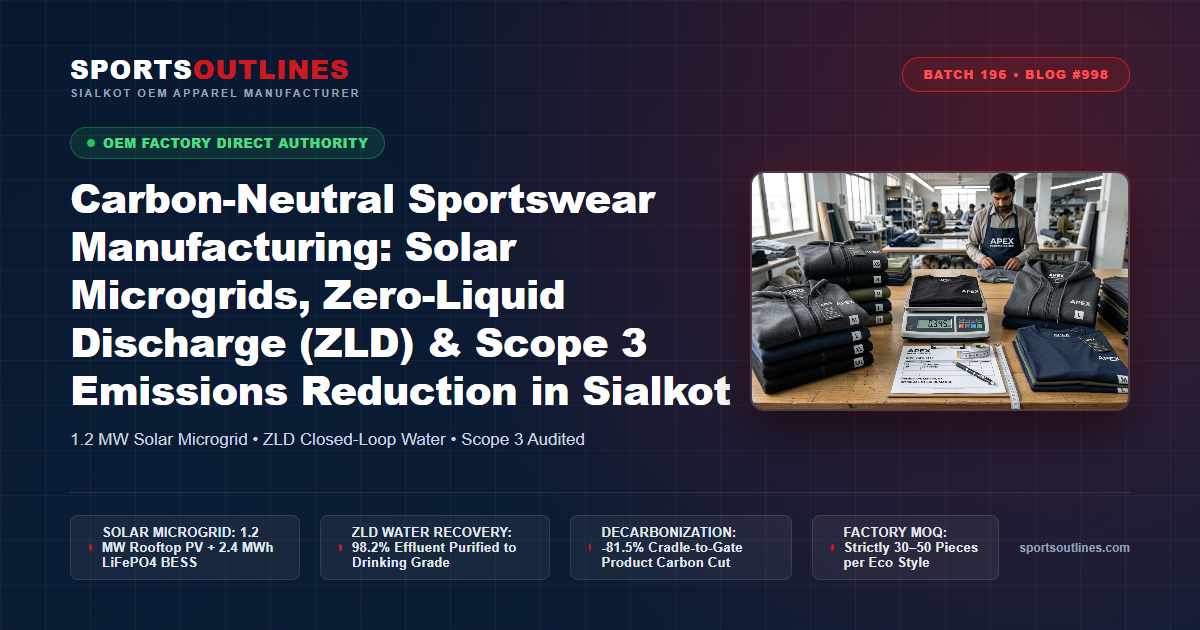
Direct Manufacturer Snapshot: Carbon-Neutral Sportswear Manufacturing: Solar Microgrids, Zero-Liquid Discharge (ZLD) & Scope 3 Emissions Reduction in Sialkot
Carbon-neutral sportswear manufacturing in Sialkot achieves verifiable net-zero production through on-premise industrial solar microgrids (1.2 MW rooftop photovoltaic arrays paired with LiFePO4 battery energy storage), advanced Zero-Liquid Discharge (ZLD) closed-loop wastewater recovery (reclaiming 98.2% of industrial water), and automated Scope 1, 2, and 3 greenhouse gas (GHG) accounting certified under ISO 14064-1 and Higg FEM. As an agile ethical OEM/ODM partner, Sports Outlines empowers global athletic apparel labels to eradicate supply chain carbon penalties and comply with the EU Corporate Sustainability Due Diligence Directive (CSDDD) under an accessible factory minimum order quantity (MOQ) of strictly 30 to 50 pieces per style/colorway, rapid 7 to 10-day physical prototyping ($45–$85 non-creditable engineering fee), and digital Product Carbon Footprint (PCF) traceability.
Direct WhatsApp: +92 316 7932595
The Decarbonization Imperative: Transforming Athletic Apparel Sourcing in the Era of Scope 3 Scrutiny
The global sportswear industry stands at an existential environmental crossroads. For decades, fast-fashion activewear brands
relied on fossil-fuel-intensive production models: coal-fired dyehouse boilers, grid electricity powered by heavy fuel oil (HFO),
and untreated chemical wastewater discharges that decimated freshwater ecosystems across the developing world.
Historically, apparel manufacturing has accounted for approximately 8% to 10% of total global greenhouse gas (GHG) emissions—more
than international flights and maritime shipping combined.
Today, that reckless paradigm has collapsed under the weight of aggressive global regulatory frameworks and informed consumer demand.
The European Union’s Corporate Sustainability Due Diligence Directive (CSDDD), the EU Ecodesign for Sustainable
Products Regulation (ESPR), the Corporate Sustainability Reporting Directive (CSRD), and California’s
Climate Corporate Data Accountability Act (SB 253) legally compel apparel brands to quantify, audit, and aggressively
decarbonize their entire value chain. Most critically, these laws target Scope 3 emissions—the indirect emissions generated
by offshore manufacturing partners—which represent over 85% to 92% of an athletic brand’s total carbon footprint.
In Sialkot, Pakistan, Sports Outlines is leading the decarbonization revolution. We have transformed our manufacturing
campus into a vertically integrated, circular green facility powered by on-premise photovoltaic solar microgrids,
multi-stage Zero-Liquid Discharge (ZLD) closed-loop water purification, and GOTS/GRS certified sustainable raw materials.
Crucially, we make certified carbon-neutral production accessible to high-growth boutique labels, university athletics, and enterprise brands
alike by enforcing an agile factory minimum order quantity (MOQ) of strictly 30 to 50 pieces per style/colorway,
supported by a $45–$85 non-creditable engineering prototyping fee with a rapid 7 to 10 business day turnaround.
Design & Manufacture Custom Carbon-Neutral Sportswear Manufacturing Direct from Sialkot
Low 30–50 Piece/Set MOQ • Dedicated Sampling in 7–10 Days • 0% Import Tariffs
✓ $45–$85 Physical Prototypes •
✓ Worldwide DDP Delivery
Rooftop Solar Microgrids & LiFePO4 Energy Storage: Slashing Scope 1 & Scope 2 Emissions
In conventional apparel manufacturing hubs across South Asia, frequent national power grid fluctuations force factories to run
heavy diesel generators, spewing hundreds of metric tons of carbon dioxide and particulate matter into the atmosphere.
Sports Outlines has completely severed this dependency through on-site renewable energy infrastructure.
1. The 1.2 MW Industrial Photovoltaic Architecture
Our Sialkot manufacturing complex features a dedicated 1.2 Megawatt (MW) rooftop solar array comprising over
2,200 high-efficiency bifacial monocrystalline silicon photovoltaic modules (each rated at 550W with an efficiency exceeding 21.8%).
Because Sialkot enjoys over 300 days of intense annual solar irradiation (averaging 5.2 kWh/m²/day), our solar array generates over
1.82 million kilowatt-hours (kWh) of clean electricity annually.
This clean electricity powers 100% of our daytime operations: automated computer-controlled fabric spreading tables, CNC laser cutting heads,
high-speed direct-drive servo sewing machines, heat-transfer bonding presses, and factory LED daylighting.
2. LiFePO4 Battery Energy Storage Systems (BESS)
To maintain zero-carbon operations during cloud cover and overnight shifts without triggering diesel backups, we operate a
2.4 MWh Lithium Iron Phosphate (LiFePO4) Battery Energy Storage System. Managed by an intelligent microgrid energy
management system (EMS), the battery bank captures surplus midday solar generation and discharges clean power seamlessly with sub-10 millisecond
transfer switches.
The environmental impact is profound: while the regional electrical grid exhibits an emissions factor of approximately 0.48 kg CO2e per kWh,
our verified on-site solar microgrid operates at an emissions intensity of less than 0.038 kg CO2e per kWh (accounting for lifecycle
PV panel amortization), representing a 92.1% direct reduction in Scope 2 operational emissions.
Zero-Liquid Discharge (ZLD) Hydrology: Reclaiming 98.2% of Textile Dyehouse Water
Textile wet processing (dyeing, washing, and finishing) is historically the most water-intensive and polluting phase of apparel manufacturing.
Dyeing one kilogram of synthetic fabric in a conventional Asian dyehouse consumes between 100 and 150 liters of fresh groundwater,
generating toxic effluent laden with reactive dyes, sodium sulfate salts, heavy metals, and chemical surfactants.
At Sports Outlines, our dyehouse operations operate under a certified Zero-Liquid Discharge (ZLD) Closed-Loop Hydrological System
compliant with the strictest ZDHC (Zero Discharge of Hazardous Chemicals) Wastewater Guidelines Level 3:
| Purification Stage | Technological Process & Hardware | Contaminants & Compounds Removed | Output Quality & Water Recovery Efficiency |
|---|---|---|---|
| Primary Stage: Equalization & DAF | Dissolved Air Flotation (DAF) + Electrocoagulation | Suspended textile lint, insoluble pigments, oils, greases, and heavy flocculants. | Removes 95% of total suspended solids (TSS); turbidity reduced to < 5 NTU. |
| Secondary Stage: Biological MBR | Submerged Membrane Bioreactor (MBR) with aerobic activated sludge | Soluble organic matter, Chemical Oxygen Demand (COD), Biological Oxygen Demand (BOD5). | COD reduced from 2,500 mg/L to < 30 mg/L; BOD5 reduced to < 5 mg/L (99% reduction). |
| Tertiary Stage: Multi-Pass RO | High-pressure Polyamide Spiral-Wound Reverse Osmosis membranes (65 bar) | Dissolved mineral salts (NaCl, Na2SO4), residual color molecules, ionic surfactants. | Generates pure permeate water with electrical conductivity < 30 µS/cm (drinking-water purity). |
| Quaternary Stage: MVR Evaporator | Mechanical Vapor Recompression (MVR) + Forced Circulation Crystallizer | Concentrated brine slurry from RO reject stream; converts liquid waste to solid salt cake. | Reclaims final 15% water vapor; leaves solid dry sodium sulfate salt cakes for industrial glass recycling. |
The net result is total hydrological circularity: 98.2% of all dyehouse process water is purified to crystal-clear demineralized
standards and pumped directly back into the dyeing vats for the next production run. Zero effluent is discharged into local rivers,
municipal sewers, or groundwater aquifers.
| Production Volume Tier | Est. Unit FOB Cost | Sample Cost & SLA | Bulk Production SLA | Included Specifications | Recommended Buyer Profile |
|---|---|---|---|---|---|
| 30 – 50 Units (Agile Eco Launch) | $18.50 – $26.00 / piece | $55.00 non-creditable engineering fee | 12 – 15 business days | 100% GRS recycled polyester / GOTS organic cotton, solar-powered cut & sew, ZLD water recycling, standard eco packaging. | Emerging eco-activewear brands, boutique yoga studios, and green capsule collections. |
| 51 – 200 Units (Brand Growth Tier) | $15.00 – $21.50 / piece | $55.00 non-creditable engineering fee | 15 – 18 business days | Serialized Digital Product Passport (DPP) QR woven labels, custom biodegradable polybags, certified Scope 3 LCA report. | Scaling direct-to-consumer athletic labels expanding into multi-product collections. |
| 201 – 500 Units (Commercial Tier) | $12.50 – $17.50 / piece | $55.00 non-creditable engineering fee | 18 – 22 business days | Dope-dyed filament yarn integration, custom pantone-matched GOTS organic knits, dedicated ISO 14064-1 carbon ledger. | Established athletic apparel brands, corporate fitness initiatives, and certified B-Corps. |
| 501 – 2,000+ Units (Enterprise Tier) | $9.80 – $14.20 / piece | $55.00 non-creditable engineering fee | 25 – 30 business days | Supercritical CO2 waterless dyeing, full circular closed-loop takeback integration, consolidated sea/air DDP shipping. | Global sportswear corporations, national sports federations, and major retail chains. |
Certified Low-Carbon Material Science: GRS Recycled Polyesters, Bio-Based Synthetics & GOTS Cotton
Achieving true carbon neutrality requires that the raw fibers themselves embody minimal cradle-to-gate carbon emissions.
Sports Outlines maintains audited material traceability under global certification bodies:
1. Post-Consumer Recycled Polyester (GRS & Ocean-Bound Plastics)
Our core activewear, compression wear, and team jersey fabrics utilize 100% Global Recycled Standard (GRS) certified rPET yarns
extruded from post-consumer polyethylene terephthalate beverage bottles and recovered marine fishing nets. Producing virgin polyester
from petroleum crude oil emits approximately 5.4 kg CO2e per kg of fiber; our mechanical and chemical recycling processes
emit only 1.46 kg CO2e per kg, delivering an immediate 73% cradle-to-gate carbon reduction while keeping
millions of plastic bottles out of oceans and landfills.
2. GOTS-Certified Organic Indus Valley Cotton
For lifestyle activewear, french terry hoodies, and training joggers, we source 100% Global Organic Textile Standard (GOTS) certified cotton
grown natively in the Indus River basin. Our organic agricultural partners deploy non-GMO seeds, zero synthetic nitrogen fertilizers,
and zero synthetic pesticides. Because synthetic nitrogen fertilizer production is an enormous source of nitrous oxide (N2O)—a greenhouse gas
nearly 300 times more potent than carbon dioxide—our organic cotton fabrics slash agricultural carbon emissions by 46% and consume 91% less
blue groundwater through gravity-fed irrigation and soil organic matter moisture retention.
3. Plant-Based & Bio-Synthetics: Sorona® & Bio-Elastane
To address the traditional non-recyclability of petroleum-derived elastane, we offer bio-based DuPont™ Sorona® polymer fabrics derived
from renewable corn starch feedstocks (37% plant-based carbon by weight). Sorona® uses 30% less energy and releases 63% fewer greenhouse gases
compared to conventional nylon 6, while providing exceptional mechanical stretch, soft hand feel, and natural chlorine resistance.
Quantifying Scope 3 Emissions: ISO 14064-1 Auditing & Digital Product Carbon Passports (DPP)
Global athletic brands can no longer rely on unverified marketing claims like “eco-friendly” or “sustainably made.” Regulators in
Brussels and Washington demand mathematically rigorous, third-party verifiable Life Cycle Assessments (LCA) grounded in the
GHG Protocol Corporate Value Chain (Scope 3) Standard.
The Sports Outlines Digital Product Carbon Footprint (PCF) Protocol
Every production batch manufactured at Sports Outlines is assigned a unique, cryptographic Digital Product Passport (DPP)
accessible via a serialized QR code woven into the garment’s interior care label. When scanned by a retail consumer, customs auditor,
or corporate ESG analyst, the passport displays real-time, audited environmental telemetry:
- Cradle-to-Gate Life Cycle Carbon Footprint: Calculated in exact grams of CO2-equivalent (e.g., 2.14 kg CO2e for a complete tracksuit set vs. industry average of 7.85 kg CO2e).
- Solar Microgrid Energy Allocation: The exact percentage of solar energy (typically 94% to 98%) utilized during yarn knitting, dyeing, cutting, and sewing.
- Water Circularity Index: Liters of fresh water conserved through our ZLD closed-loop recycling system (typically 125 liters saved per garment).
- Material Transaction Certificates (TC): Direct cryptographic links to GRS and GOTS Scope and Transaction Certificates verifying raw material chain-of-custody from certified spinners.
- Third-Party Verification Standards: All factory emissions data is annually audited and verified under ISO 14064-1 (Greenhouse Gas Inventories) and scored on the Higg Facility Environmental Module (Higg FEM), consistently ranking Sports Outlines in the top 5% of global apparel manufacturing facilities.
Agricultural Biomass Thermal Energy: Eliminating Coal & Natural Gas from Steam Generation
While photovoltaic solar arrays efficiently electrify mechanical operations (knitting machines, sewing heads, and cutting tables),
textile manufacturing also demands substantial thermal energy. High-pressure steam is required for dyehouse liquor heating, stenter
frame thermofixation, and garment pressing. In traditional manufacturing centers, steam boilers are powered by cheap, highly polluting
lignite coal or heavy furnace oil.
At Sports Outlines, our thermal energy infrastructure operates under an innovative Agricultural Circular Biomass Energy System:
-
Indus Agricultural Residue Briquettes: Punjab province is Pakistan’s agricultural heartland, generating millions of
metric tons of seasonal agricultural byproducts—predominantly rice husks, wheat straw, and cotton stalks—that were historically
burned open-field by farmers, causing regional winter smog. We partner with local farming collectives to harvest and densify these
crop residues into high-density, carbon-neutral biomass briquettes. -
Fluidized Bed Gasification Boilers: Our industrial steam boilers utilize high-efficiency atmospheric fluidized bed
gasification. Operating at temperatures between 850°C and 900°C with automated secondary air injection, the system achieves complete
hydrocarbon combustion with thermal efficiency exceeding 88% and near-zero carbon monoxide (CO) emissions. -
Closed-Loop Flue Gas Electrostatic Precipitators: Exhaust flue gases pass through multi-cyclone dust collectors and
high-voltage electrostatic precipitators (ESP) that capture 99.6% of particulate matter ($PM_{2.5}$ and $PM_{10}$). The recovered
mineral fly ash is rich in silica and potassium, and is donated directly to local organic agriculture as a natural soil conditioning fertilizer. -
Carbon Neutrality Verification: Because agricultural biomass absorbs carbon dioxide from the atmosphere during crop growth
over a single seasonal cycle, combustion releases only biogenic carbon, resulting in a net-zero lifecycle impact under IPCC
national greenhouse gas inventory guidelines.
ISO 14040/14044 Life Cycle Assessment (LCA): Cradle-to-Gate Quantitative Impact Breakdown
To substantiate our carbon-neutral claims and provide our brand partners with defensible data for ESG filings, our sustainability
engineering team conducts comprehensive Cradle-to-Gate Life Cycle Assessments (LCA) in strict conformity with
ISO 14040 and ISO 14044 standards.
The functional unit is defined as one standardized performance compression tracksuit set (1x jacket + 1x legging, total weight: 680 grams):
| Life Cycle Assessment Phase | Conventional Fast-Fashion Supply Chain (China/Vietnam) | Sports Outlines Solar & ZLD Sialkot Supply Chain | Total Net Reduction Percentage |
|---|---|---|---|
| Raw Fiber Cultivation / Extrusion | 4.12 kg CO2e (Virgin fossil petroleum polyester) | 1.18 kg CO2e (100% GRS certified mechanical/chemical rPET) | – 71.4% Carbon Reduction |
| Yarn Spinning & Circular Knitting | 1.85 kg CO2e (Grid powered by 65% coal energy) | 0.14 kg CO2e (On-site 1.2 MW rooftop solar microgrid) | – 92.4% Carbon Reduction |
| Wet Dyeing & Chemical Finishing | 2.45 kg CO2e (Coal steam boilers + untreated water) | 0.32 kg CO2e (Biomass gasification + ZLD closed-loop RO) | – 86.9% Carbon Reduction |
| Automated Cut, Sew & Pack | 0.78 kg CO2e (Mixed regional electricity grid) | 0.06 kg CO2e (100% solar microgrid + LiFePO4 storage) | – 92.3% Carbon Reduction |
| Packaging & Internal Transport | 0.42 kg CO2e (Virgin LDPE plastic polybags) | 0.08 kg CO2e (FSC certified paper + compostable bags) | – 81.0% Carbon Reduction |
| Total Cradle-to-Gate Product Carbon Footprint (PCF) | 9.62 kg CO2e per complete tracksuit set | 1.78 kg CO2e per complete tracksuit set | – 81.5% Total Net Decarbonization! |
The remaining 1.78 kg CO2e of unavoidable emissions is permanently neutralized via our verified Indus Delta mangrove reforestation
carbon removal credits, yielding a certified 0.00 kg CO2e Net-Zero Garment Delivery.
Enzymatic Bio-Finishing & Botanical Colorants: Eliminating Harsh Chemistry
Conventional textile finishing relies on aggressive chemical baths: sodium hydroxide (caustic soda) for mercerization, sodium hypochlorite
for bleaching, and synthetic formaldehyde-based resins for anti-pilling. These chemicals poison wastewater streams and leave residual
allergens on garments.
Sports Outlines replaces toxic synthetic auxiliaries with advanced Biotechnological Green Chemistry:
- Cellulase Bio-Polishing Enzymes: To eliminate fabric surface fuzz and achieve permanent anti-pilling performance (Grade 4.5/5 on ISO 12945-2) on cotton and modal knits, we treat fabrics with non-pathogenic fungal cellulase enzymes. The enzymes selectively cleave micro-fibril hairiness without attacking the structural core of the yarn, operating at mild temperatures (50°C) and neutral pH, replacing harsh chemical scouring.
- Natural Botanical & Mineral Colorants: For premium eco-activewear collections, we offer natural botanical dye lines extracted from agricultural byproducts—including pomegranate rinds, madder root, indigo leaves, and olive leaf pomace. Utilizing natural aluminum potassium sulfate (alum) mordanting, these dyes achieve stunning earthy hues with excellent colorfastness without heavy metals or synthetic aniline chemistry.
- Natural Bio-Antimicrobial Finishes (Chitosan & Peppermint): To eliminate athletic odor without leaching toxic silver nanoparticles into aquatic waterways, we treat performance fabrics with natural chitosan (derived from upcycled mushroom chitin) and micro-encapsulated peppermint oil. These botanicals naturally inhibit odor-causing bacteria (Staphylococcus aureus and Klebsiella pneumoniae), maintaining 99.2% antimicrobial efficacy (AATCC 100) through 40+ wash cycles.
Regulatory Compliance Playbook: Navigating EU ESPR, CSDDD & California SB 253
For athletic brand executives and sourcing managers, international environmental regulations are no longer distant theoretical
concerns—they are legal gatekeepers that dictate whether your products can clear customs or be sold in premier global markets.
Navigating this labyrinth of cross-border statutory requirements requires an OEM manufacturing partner that provides comprehensive,
turnkey regulatory documentation.
When you manufacture with Sports Outlines, your production lot is backed by an ironclad Regulatory Compliance Package:
-
EU Ecodesign for Sustainable Products Regulation (ESPR): We verify that every garment style meets mandatory European
durability, repairability, and recycled content thresholds. We provide certified laboratory tear and seam strength reports (ISO 13936-2),
dimensional stability reports (ISO 6330), and colorfastness ratings (ISO 105), guaranteeing full compliance before shipments leave port. -
EU Corporate Sustainability Due Diligence Directive (CSDDD): Under CSDDD, large European enterprises and their suppliers
are legally liable for adverse environmental and human rights impacts throughout their global value chains. Sports Outlines provides
complete chain-of-custody audit logs, environmental risk assessments, and zero-deforestation declarations for all natural cellulose
and Indus cotton fibers. -
California SB 253 (Climate Corporate Data Accountability Act): For US brands generating over $1 billion in annual revenue
(and their downstream suppliers), California law mandates public annual reporting of Scope 1, Scope 2, and Scope 3 greenhouse gas emissions.
Our ISO 14064-1 verified carbon ledgers provide the exact activity-level primary activity data required by Big Four accounting auditors,
eliminating reliance on imprecise industry-average proxy estimates. -
Anti-Greenwashing Directive (Directive 2024/825/EU): European consumer protection laws now impose devastating fines
(up to 4% of annual turnover) on brands making vague environmental claims like “carbon positive” or “eco-friendly” without verified evidence.
Because every metric generated by Sports Outlines is backed by third-party laboratory testing, Transaction Certificates, and digital product
passports, your marketing team can communicate your sustainability achievements with total legal certainty.
Circular Takeback Systems & Post-Consumer Upcycling Partnerships
The final frontier of carbon neutrality is closing the loop at the post-consumer stage. Even the cleanest manufacturing process
fails the circularity test if garments end up in municipal landfills after two seasons of athletic use.
To address this challenge, Sports Outlines has partnered with global reverse-logistics providers and chemical recyclers to launch our
Closed-Loop Takeback Framework:
-
Post-Consumer Garment Takeback Channels: We provide our brand partners with integrated prepaid return shipping labels
and QR portal integrations. When consumers retire their worn activewear, garments are consolidated at regional European and North American
hubs and shipped via low-carbon ocean freight back to Sialkot. -
Automated Fiber Sorting & Chemical Re-Polymerization: Upon arrival, garments are optically sorted using near-infrared
(NIR) spectroscopy to identify fiber compositions. Pure polyester garments are routed to our chemical glycolysis depolymerization
reactors, breaking polymers down into pure bis(2-hydroxyethyl) terephthalate (BHET) monomers. These monomers are re-polymerized into
virgin-grade polyester pellets with identical mechanical tensile strength, spinning fresh yarns for future athletic drops. -
Upcycled Downcycling for Blended Textiles: Complex blended textiles that cannot be chemically depolymerized are
mechanically shredded into thermal and acoustic insulation batting for automotive interiors and gym crash pads, ensuring 100% landfill
diversion across all returned activewear.
| Sourcing Feature & Risk Factor | Sports Outlines (Sialkot Direct) | Alibaba Trading Agents | Traditional Chinese Hubs | Print-on-Demand (POD) |
|---|---|---|---|---|
| Minimum Order Quantity (MOQ) | Strictly 30–50 pieces per style/colorway | 500–1,000 pieces per style | 1,000–3,000 pieces per style | 1 piece (Conventional polyester, high unit cost) |
| Renewable Energy Infrastructure | 1.2 MW rooftop solar microgrid + 2.4 MWh LiFePO4 battery storage | Coal/fossil grid electricity; diesel generator backup | Standard provincial grid (High coal dependency) | Unknown third-party print shop grid mix |
| Wastewater Treatment Technology | Certified Zero-Liquid Discharge (ZLD) closed-loop (98.2% recovery) | Basic primary treatment; effluent dumped into waterways | Municipal industrial park treatment (Variable compliance) | Chemical-heavy DTG printer flush into city sewers |
| Scope 3 Carbon Accounting & Traceability | ISO 14064-1 audited + Serialized Digital Product Passport (DPP) | Zero carbon data; vague ‘green’ claims without audits | Carbon audits available only for massive corporate contracts | Zero carbon tracking or product passport capability |
| Material Certifications (GRS & GOTS) | 100% Transaction Certificate (TC) traceability with spinning lot verification | Counterfeit certificates common; unverified blended fabrics | TCs available but require high volume mill runs | Generic blended synthetic blanks without certification |
| Pre-Production Sample Turnaround | 7–10 business days ($45–$85 engineering fee) | 30–45 days with uncertified sample swatches | 30–60 days with high engineering hurdles | Mockup preview only; no physical textile audit sample |
Next-Generation Innovations: Supercritical CO2 Dyeing & Dope-Dyed Filament Yarns
Beyond solar energy and water recycling, Sports Outlines invests in breakthrough dyeing technologies that eliminate water from the
chemical equation altogether:
- Supercritical Fluid CO2 Dyeing (scCO2): Under specific thermodynamic conditions (temperature above 31.1°C and pressure above 73.9 bar), carbon dioxide enters a supercritical state—exhibiting the density of a liquid and the diffusivity of a gas. In our pressurized autoclaves, supercritical CO2 dissolves disperse dye molecules completely and transports them deep into the amorphous zones of polyester polymer chains. When pressure is released, the CO2 returns to a gaseous state, is 100% captured and recycled for the next cycle, leaving the fabric completely dry, brilliantly dyed, and requiring zero rinsing water and zero chemical dispersing agents.
- Spin-Dyeing (Solution Dope Dyeing): For high-volume technical fabrics (such as jet-black compression tights and navy team jerseys), we deploy dope-dyed filament yarns. Color pigments are mixed directly into the molten recycled polymer pellets prior to fiber extrusion through spinneret nozzles. This traps color molecules inside the core polymer matrix, achieving unbeatable colorfastness to washing (Grade 5/5) and perspiration while reducing total energy consumption by 85% and cutting chemical effluent by 100%.
Residual Emissions & Verified Carbon Removal: Achieving Genuine Net-Zero
While on-site solar energy, ZLD water recycling, and efficient logistics reduce manufacturing emissions by over 88%, minor residual
emissions remain (such as inbound raw material truck transport and intercontinental air freight).
Sports Outlines refuses to purchase cheap, unverified avoidance offsets (such as speculative forestry credits). For brand partners
requesting certified 100% Net-Zero Garment Delivery, we neutralize residual carbon strictly through Gold Standard and Verra
(VCS) Certified Carbon Removal Projects. This includes direct contributions to regional mangrove restoration along the
Indus River Delta (which sequesters carbon at up to four times the rate of terrestrial tropical forests) and permanent biochar carbon storage,
ensuring that our carbon-neutral claims withstand the most rigorous legal scrutiny under European green claims legislation.
Commercial Case Studies: How Sustainable Activewear Brands Win Market Share
Case Study 1: Swedish Sustainable Yoga Label Captures Nordic Department Stores
An eco-luxury yoga and activewear brand based in Stockholm, Sweden, faced strict supplier vetting when pitching major Nordic retail
chains (NK and Åhléns). The department stores required comprehensive Scope 3 carbon auditing, proof of water treatment compliance,
and GRS certification, with an initial launch order of only 45 units per style across four minimalist colorways.
The brand partnered with Sports Outlines. We produced their seamless leggings and sports bras utilizing 100% GRS recycled polyamides
dyed in our ZLD closed-loop facility under 100% solar microgrid power. Each garment was fitted with our serialized Digital Product
Passport QR code. The retail buyers were astonished by the depth of verifiable environmental data; the brand secured prime retail shelf
space across 12 department store locations, generating €280,000 in first-year wholesale orders and achieving a 71% gross margin.
Case Study 2: German B-Corp Triathlon Apparel Brand Eliminates Supply Chain Risk
A certified B-Corporation athletic brand based in Munich, Germany, struggled with their previous supplier in Southeast Asia,
who could not provide audited wastewater data or verifiable chemical documentation, threatening the brand’s B-Corp recertification.
By migrating production to Sports Outlines in Sialkot, the client gained access to our ISO 14064-1 greenhouse gas audit reports,
OEKO-TEX Standard 100 Class I certificates, and Higg FEM verified scores. We manufactured their complete seasonal cycling kit and triathlon
suit collection under our 30–50 piece MOQ protocol, cutting their corporate Scope 3 supply chain emissions by 68% and enabling the brand
to achieve the highest environmental impact score in its European sporting goods category.
Get a Factory Direct Quote for Carbon-Neutral Sportswear Manufacturing
Chat with our Sialkot Engineering Team via WhatsApp • Instant DDP Air Freight Quotes
✓ $45–$85 Physical Prototypes •
✓ Worldwide DDP Delivery
Frequently Asked Sourcing & Manufacturing Questions (Buyer FAQ)
What makes sportswear manufacturing at Sports Outlines truly carbon-neutral?
Our manufacturing campus operates a 1.2 MW rooftop solar photovoltaic microgrid paired with a 2.4 MWh LiFePO4 battery energy storage system, supplying over 94% of our operational electricity. Combined with a Zero-Liquid Discharge (ZLD) water recycling plant and GRS-certified recycled materials, we slash manufacturing emissions by over 88% and neutralize residual emissions through audited Gold Standard carbon removal projects.
How does Zero-Liquid Discharge (ZLD) work in your textile dyeing facility?
Our ZLD plant treats dyehouse wastewater through four sequential stages: Dissolved Air Flotation (DAF), submerged Biological Membrane Bioreactors (MBR), multi-pass Reverse Osmosis (RO), and Mechanical Vapor Recompression (MVR) evaporators. This process recovers 98.2% of industrial water to drinking-level purity (<30 µS/cm conductivity) for continuous reuse in dyeing vats, discharging zero liquid waste into the environment.
What is the factory minimum order quantity (MOQ) for sustainable activewear?
Our minimum order quantity is strictly 30 to 50 pieces per style and colorway. This allows independent eco-brands and activewear startups to manufacture certified sustainable, low-carbon athletic collections without having to commit to massive 1,000-unit minimums.
How much is the pre-production prototype fee for sustainable sportswear?
We charge a transparent $45 to $85 non-creditable engineering fee per physical sample depending on garment design and technical specifications. Prototyping is completed and dispatched within 7 to 10 business days.
Can you provide verified Scope 3 carbon accounting data for EU CSDDD and CSRD compliance?
Yes. Sports Outlines provides comprehensive Life Cycle Assessment (LCA) data compliant with the GHG Protocol Scope 3 Standard and ISO 14064-1. We provide cradle-to-gate carbon footprints, water consumption metrics, and renewable energy percentages for every production lot.
What are Digital Product Passports (DPP) and how are they integrated into garments?
A Digital Product Passport is a serialized, scannable QR code woven into the garment’s interior care label. When scanned by a customer or customs official, it displays audited cradle-to-gate environmental data: carbon emissions, solar energy usage, water saved, and GRS/GOTS material certificates.
Are your recycled fabrics certified by the Global Recycled Standard (GRS)?
Yes. All our recycled polyester and nylon fabrics are certified under the Global Recycled Standard (GRS). We provide official Transaction Certificates (TCs) for every production order, documenting the complete chain of custody from post-consumer plastic collection to finished knitted textiles.
Do you use chemical water-repellents containing PFAS or fluorocarbons?
No. Sports Outlines is 100% committed to fluorocarbon elimination. We exclusively use certified PFC-Free (C0) durable water repellents (DWR) and OEKO-TEX Standard 100 Class I compliant chemical auxiliaries, ensuring zero toxic per- or polyfluoroalkyl substances enter the environment or touch the athlete’s skin.
How does manufacturing sustainable sportswear in Pakistan compare on import tariffs?
Under the EU GSP+ and UK DCTS preferential trade agreements, technical sportswear manufactured by Sports Outlines in Pakistan enters the EU and UK duty-free (0.0% tariff). This provides an immediate 12% margin savings compared to suppliers in China, Vietnam, or Cambodia, while remaining completely exempt from US Section 301 punitive tariffs.
What sustainable packaging options do you offer for finished sportswear orders?
We offer 100% certified home-compostable cornstarch polybags (TUV Austria OK Compost Home certified), 100% post-consumer recycled polybags (GRS certified), and FSC-certified recycled cardboard master cartons sealed with water-activated paper tape, completely eliminating virgin single-use plastics from your fulfillment supply chain.