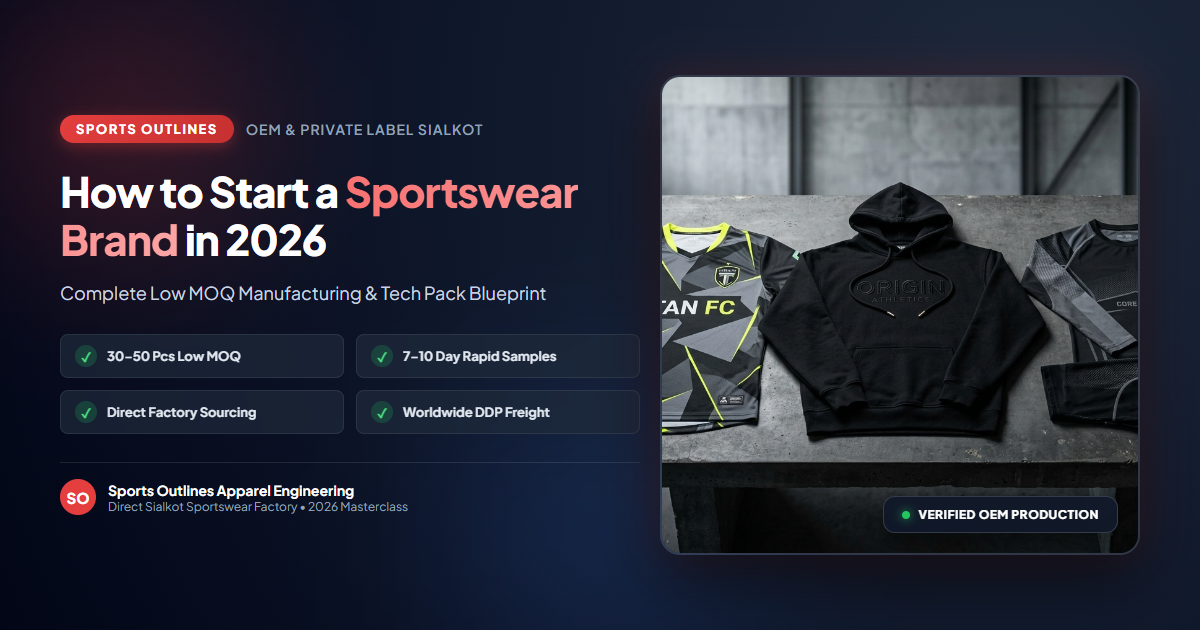
The global athletic apparel market is projected to surpass $450 billion by 2028. Yet, over 70% of emerging fitness and sportswear founders stall during the manufacturing phase—paralyzed by excessive minimum order quantities (MOQs), confusing technical jargon, and unreliable trading middlemen. This comprehensive guide provides a practical, factory-direct blueprint for launching your custom sportswear brand in 2026 with manageable minimums, premium fabrics, and high profit margins.
📌 In This Guide:
- Step 1: Defining Your Sportswear Niche & Customer Persona
- Step 2: Building Production-Ready Tech Packs (Without Fashion Degrees)
- Step 3: Fabric Selection & GSM Demystified (Polyester, Interlock, French Terry)
- Step 4: Vetting Direct-from-Factory OEM Manufacturers vs Middlemen
- Step 5: Navigating Low MOQ Programs (30–50 Pieces for Startups)
- Step 6: The Sampling Protocol: Lab Dips, Fit Samples & Revisions
- Step 7: Private Label Customization (Tags, Hangtags & Branded Polybags)
- Step 8: International Freight, Customs Clearance (DDP) & Launch Logistics
Step 1: Define Your Sportswear Niche & Value Proposition
The biggest mistake beginner founders make is trying to be “the next Nike” on day one. Nike, Gymshark, and Lululemon cater to massive audiences with multi-million dollar marketing budgets. Emerging brands succeed by targeting hyper-focused athletic niches:
- Performance Teamwear: Custom sublimated kits for amateur soccer, rugby, baseball, or basketball leagues.
- Functional Fitness & CrossFit: High-abrasion cordura-blend shorts, breathable triblend tees, and sweat-wicking compression layers.
- Luxury Heavyweight Streetwear: 400+ GSM French Terry hoodies, oversized acid-wash tees, and structured fleece joggers.
- Women’s Sculpt Activewear: Non-sheer, squat-proof 4-way stretch poly-spandex leggings with bonded waistbands and seamless sports bras.
- Combat Sports & MMA: 4-way stretch fight shorts, sublimated rashguards, and BJJ training apparel.
Step 2: Building Production-Ready Tech Packs
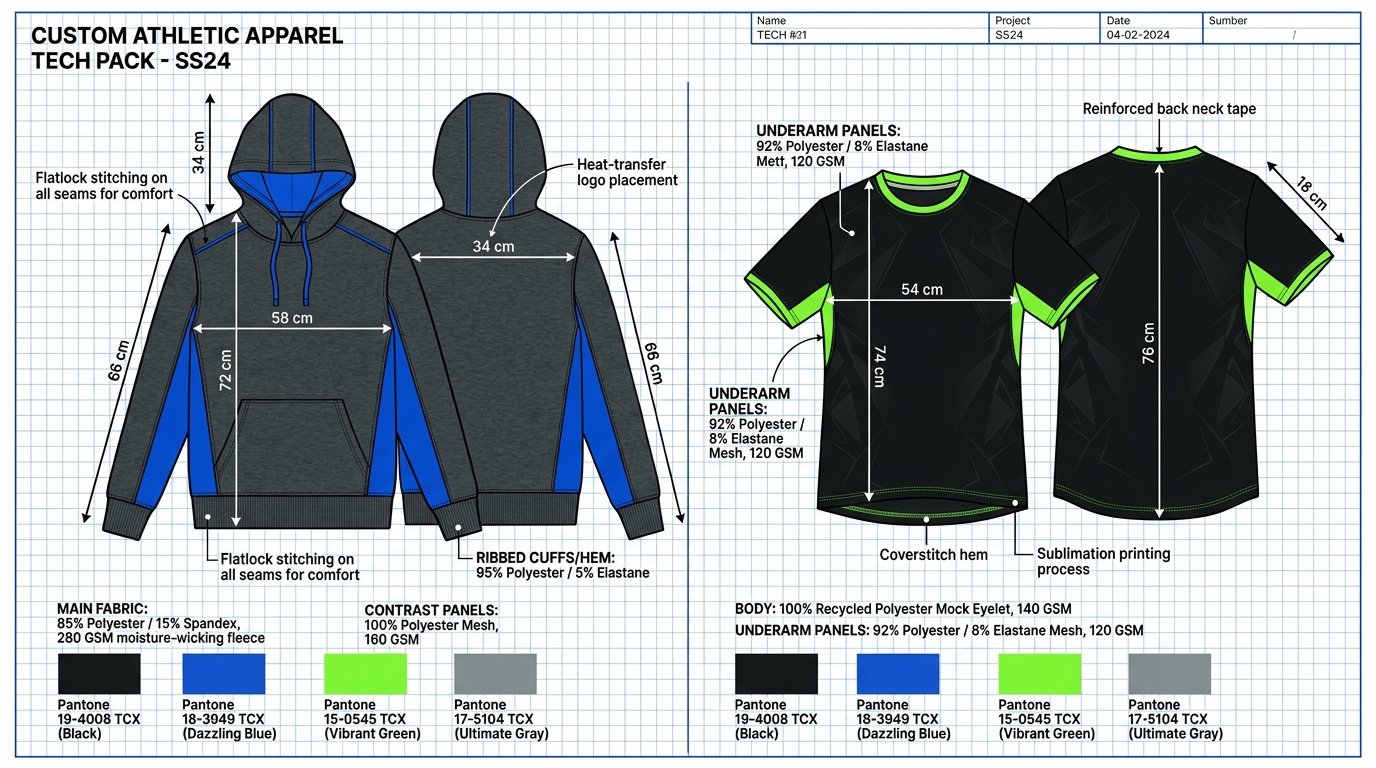
A Tech Pack (Technical Package) is your blueprint for the factory. Sending a factory a generic screenshot from Pinterest with the message “make this in black” guarantees sizing mistakes, improper fabrics, and wasted sample budgets.
A professional apparel tech pack must contain:
- Flat Vector Sketches: Front, back, and side views with callouts for seam placements.
- Measurement Specification Sheet (Grading Table): Exact measurements in inches or centimeters across all target sizes (XS, S, M, L, XL, 2XL) for chest width, body length, sleeve length, collar opening, and leg inseam.
- Bill of Materials (BOM): Fabric composition (e.g. 85% Polyester / 15% Spandex), GSM weight (e.g. 240 GSM), thread type, zipper brand (e.g. YKK), and drawstring specifications.
- Colorway Specifications: Exact Pantone PMS color codes (e.g. Pantone 19-4052 Classic Blue) to ensure the factory dyes the exact shade.
- Artwork & Logo Placement: Vector AI/PDF artwork indicating dimensions, placement coordinates (e.g. 7cm below collar), and decoration method (sublimation, screen print, 3D silicone puff, or embroidery).
\n\n
Factory Pro-Tip: At Sports Outlines, our in-house apparel engineering department helps early-stage founders convert simple design concepts and benchmark samples into production-ready digital tech packs.
Step 3: Fabric Selection & GSM Demystified
In athletic apparel, fabric is 80% of your customer’s perceived value. GSM (Grams per Square Meter) dictates fabric thickness, weight, and drape:
| Garment Type | Recommended Fabric | Ideal GSM | Key Feature |
|---|---|---|---|
| Team Soccer/Running Jersey | Interlock Micro-Poly | 140 – 160 GSM | Rapid moisture dispersion, lightweight |
| Squat-Proof Gym Leggings | Poly / Spandex (80/20) | 240 – 280 GSM | High compression, non-sheer opacity |
| Luxury Streetwear Hoodie | 100% Combed French Terry | 380 – 450 GSM | Heavy drape, structured boxy silhouette |
| Performance Golf/Tennis Polo | Cotton / Poly Pique | 200 – 220 GSM | Anti-curl knit collar, breathable knit |
Step 4: Factory-Direct vs Trading Middlemen
When searching for manufacturers on platforms like Alibaba or Google, you will encounter two entities:
- Trading Companies (Middlemen): Agents who take your order, add a 30% to 50% commission markup, and outsource production to third-party factories. They often have poor quality control and cannot customize fabric blends.
- Direct OEM/ODM Factories: Facilities that actually own knitting, cutting, printing, and sewing machinery. Partnering directly with a direct factory source—such as our manufacturing base in Sialkot, Pakistan—gives you direct communication with engineers, transparent cost pricing, and strict inline QA.
Step 5: The Power of Low MOQ Manufacturing (30–50 Pieces)
Historically, garment factories demanded 500 to 1,000 pieces per style. For a founder launching 4 styles in 4 sizes, this required ordering 8,000 to 16,000 units—a $50,000+ upfront inventory gamble that kills 9 out of 10 startups.
In 2026, the modern approach is Lean Agile Launching:
With a low MOQ partner like Sports Outlines, you can produce as few as 30 to 50 pieces per style with mixed sizes (e.g. 5x Small, 12x Medium, 15x Large, 10x XL, 5x 2XL). This allows you to launch with under $1,500 – $2,500 total investment, test market demand, and reorder winning designs quickly.
Step 6: The Sampling Protocol (7–10 Days)
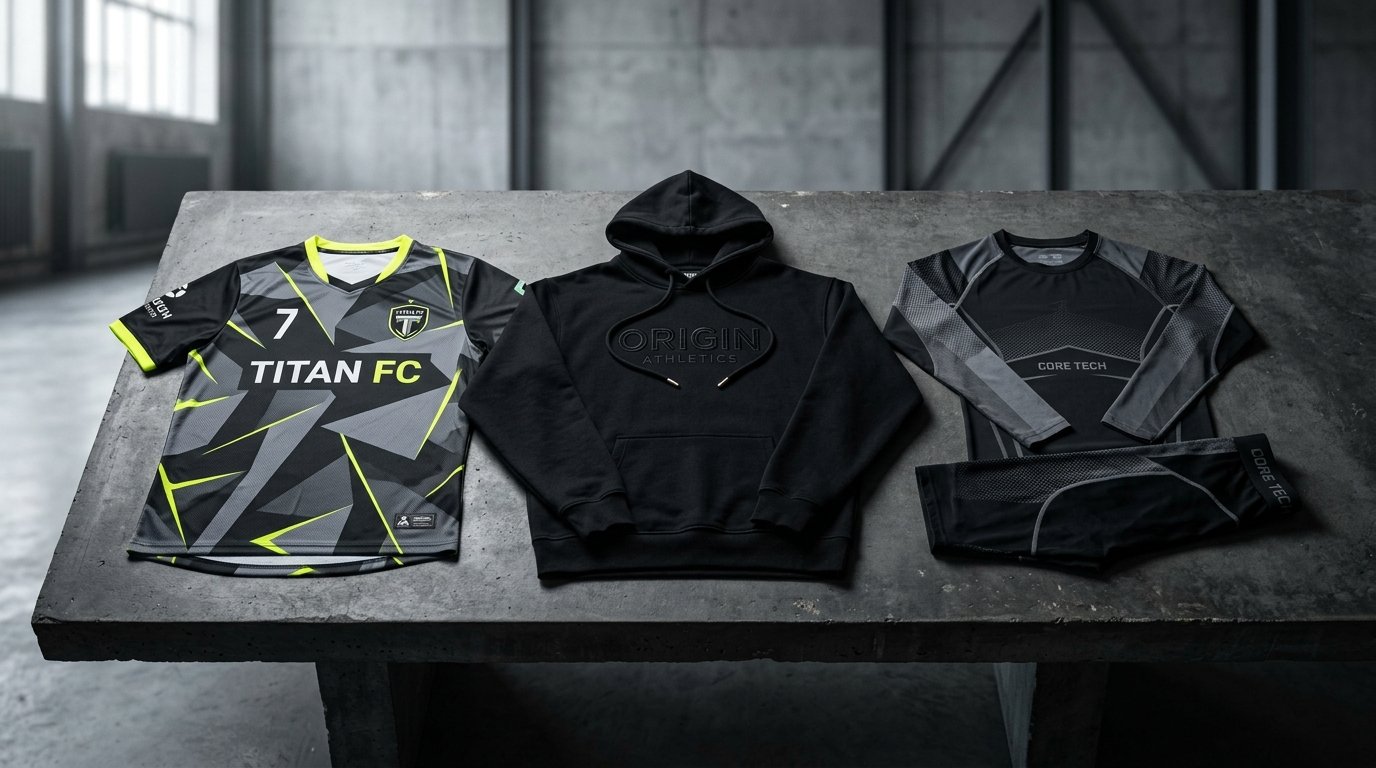
Never approve bulk manufacturing without testing a physical pre-production sample. The sampling phase allows you to inspect:
- Fit & Sizing: Put the prototype on an athletic model or wear it during intense workouts to evaluate range of motion.
- Seam Integrity: Stretch the seams vigorously. Are they 4-needle flatlock stitched? Do any threads pop under tension?
- Color Accuracy: Inspect the print and dye under natural daylight against your approved Pantone swatch.
- Wash Resistance: Wash and tumble-dry the sample 3 times. Measure dimensional shrinkage (it should be under 3%) and check for dye bleeding.
\n\n
Step 7: Complete Private Label Customization Suite
To charge premium retail prices ($60 – $120 per hoodie or legging), your garments must look like established luxury athletic brands:
- Tagless Heat-Transfer Neck Labels: Crisp, scratch-free brand branding, size indicator, and care instructions printed inside the collar.
- Custom Debossed Hangtags: Heavyweight 400 GSM cardstock with foil stamping, safety pin, and retail UPC barcodes.
- Branded Frosted Zipper Polybags: High-end matte EVA bags printed with your logo, social handles, and recycling compliance symbols.
- Custom Hardware: Branded rubber aglets, metal drawcord tips, and custom-embossed YKK zipper pullers.
Step 8: Global Shipping & Customs Logistics (DDP)
Shipping apparel internationally can be daunting if you don’t know the Incoterms. Always request DDP (Delivered Duty Paid) terms from your manufacturer:
- Express Air Courier (DHL, FedEx, UPS): 4 to 6 business days transit directly to your door in the USA, United Kingdom, Australia, Canada, or Europe. Best for orders under 200kg.
- Air Cargo: Cost-effective airport-to-airport freight for orders between 200kg and 500kg.
- Sea Freight (LCL & FCL): 25 to 35 days container shipping for large bulk production (1,000+ units), offering the lowest shipping cost per unit.
Launch Your Custom Sportswear Brand with Sports Outlines
Work directly with our factory team in Sialkot, Pakistan. Access flexible 30–50 pcs minimums, rapid 7-day physical prototyping, and worldwide door-to-door shipping.