Direct Manufacturer Answer: How to Source Pro Rugby & Football Compression Base Layers
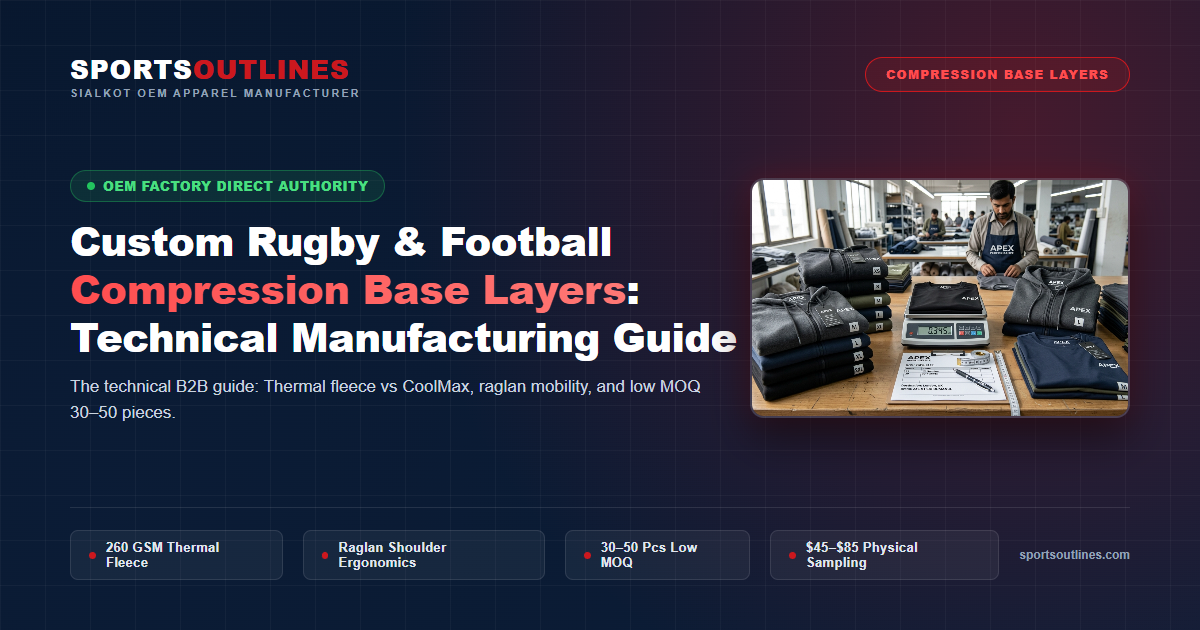
Manufacturing second-skin athletic compression base layers for contact sports requires high-recovery elastane polymers engineered for specific micro-climates. Sialkot export-grade manufacturing produces two specialized textile frameworks: Winter Thermal Base Layers (250–270 GSM warp-knit poly-spandex with interior micro-brushed thermal fleece providing CLO 0.42 insulation) and Summer Heat-Gear CoolMax Layers (190–210 GSM micro-denier hollow-core polyester with 18% Lycra achieving capillary sweat transport under 1.5 seconds). Both variations incorporate ergonomic raglan sleeve architecture that eliminates top shoulder seams to prevent collarbone friction under hard shoulder pads, assembled with 4-needle 6-thread flatlock stitching (resisting 320N tensile shear). Pro team tiers feature an optional integrated thoracic GPS telemetry pouch (between T2–T5 vertebrae with 2mm foam backing) and anti-slip silicone interior hem grippers. Factory direct low MOQ at Sports Outlines in Sialkot, Pakistan starts at 30 to 50 pieces per style/colorway with mixed sizing from Youth S to Adult 4XL. Pre-production physical prototype samples cost $45 to $85 per custom piece completed in 7 to 10 business days (strict zero credit/refund policy).
- Climate Options: Winter Thermal (260 GSM Brushed Fleece) vs. Summer CoolMax (200 GSM Capillary Micro-Denier).
- Ergonomic Cut: 3D Raglan sleeve patterning eliminating seam abrasion under shoulder pad epaulets.
- Telemetry Ready: Upper thoracic spine pocket for Catapult, STATSports, and VX Sport GPS tracking pods.
- Seam Architecture: 4-needle 6-thread flatlock stitching with Coats Gramax bonded continuous filament thread.
- Factory Low MOQ: 30–50 pieces per style/colorway across full youth and adult size curves.
- Physical Prototype Sampling: $45–$85 per custom base layer in 7–10 days (strict zero credit/refund policy).
- Direct Factory Sourcing: WhatsApp factory direct at +92 316 7932595 or sportsoutlines.com.
In collision sports such as American football, rugby union, and rugby league, athletic base layers are far more than casual undergarments—they represent a critical biomechanical interface between the athlete’s skin and heavy external armor. During intense match play, ill-fitting or poorly engineered base layers lead to severe friction blistering under shoulder pads, hypothermia during wet winter fixtures, or heat exhaustion under sweltering summer stadium lights.
Traditional retail base layers designed for casual jogging fail under the extreme physical demands of collision sports. When an offensive tackle or rugby prop engages in repeated high-impact collisions, the shear torque between their plastic shoulder pads and undergarment easily rips standard overlock seams. Furthermore, standard set-in sleeve cuts place bulky seam allowances directly across the acromioclavicular (AC) joint, causing chronic bruising and skin abrasion.
At Sports Outlines in Sialkot, Pakistan, our technical athletic manufacturing floor engineers pro-grade compression base layers for professional rugby franchises, collegiate football programs, and private label sportswear brands across the United States, the United Kingdom, Australia, and Germany. This comprehensive technical B2B manufacturing guide breaks down winter thermal versus summer CoolMax textile science, raglan sleeve pattern geometry, integrated GPS telemetry pouches, graduated compression mechanics, wholesale cost curves, and low MOQ factory sourcing.
1. Textile Engineering: Winter Thermal Fleece vs. Summer CoolMax Micro-Denier
Athletic base layers must match the thermal demands of the playing environment. Sialkot export-grade manufacturing divides compression base layers into two distinct performance categories:
2. Raglan Sleeve Ergonomics: Eliminating Acromioclavicular Pressure Points
In traditional t-shirts and casual apparel, a set-in sleeve design creates a circumferential vertical seam that crosses over the top of the shoulder directly above the acromioclavicular (AC) joint. When an American football or rugby player straps on a rigid plastic shoulder pad, hundreds of pounds of tackle impact force press directly onto this raised seam ridge, causing painful seam gouging and skin ulceration.
Sports Outlines eliminates this biomechanical flaw through engineered 3D anatomical raglan sleeve construction:
- Continuous Clavicle Panel: The sleeve extends continuously in one unbroken fabric piece all the way to the collar band, leaving the entire top shoulder surface completely seamless.
- Diagonal Load Path: Seam allowances are redirected diagonally across the chest and upper back blade, following natural muscle cleavage lines where external armor padding exerts minimal downward pressure.
- 360-Degree Overhead Rotational Freedom: Quarterbacks and rugby lineout jumpers achieve full arm extension without the garment pulling up out of the player’s waistband or creating binding resistance across the latissimus dorsi.
3. Integrated GPS Telemetry Pouches: Biometric Sensor Housing
Professional sports science departments rely on micro-sensor telemetry units (Catapult, STATSports, VX Sport) to track metabolic power, player load, and maximum velocity. Having players wear separate telemetry harness vests underneath their compression base layers and pads creates excessive layering, bulk, and heat buildup.
Sports Outlines integrates a factory-calibrated telemetry pocket directly into the upper thoracic spine panel:
- Anatomical T2–T5 Placement: The pouch is centered between the shoulder blades, ensuring the GPS antenna has an unobstructed line of sight to tracking satellites while sitting inside the natural recess between the trapezius muscles.
- Shock-Absorbing 2.0mm Neoprene Backing: A perforated micro-neoprene buffer layer shields the player’s spine from device impact during hard backward tackles onto firm turf.
- High-Elasticity Self-Closing Envelope: An inverted stretch flap securely retains the unit without bulky metal zippers or abrasive velcro fasteners that could irritate teammates during scrum binds.
4. Seam Construction: 4-Needle 6-Thread Flatlock Engineering
Standard 3-thread overlock seams create a raised internal fabric ridge that rubs continuously against the skin, causing severe friction abrasions during 80-minute contact matches.
Our manufacturing facility utilizes high-precision Yamato and Juki 4-needle 6-thread flatlock machines:
- Zero-Profile Butt-Seam Junction: Fabric raw edges are trimmed cleanly and abutted edge-to-edge without overlapping layers. The resulting seam is 100% flush against the skin on both interior and exterior faces.
- 320 Newton Shear Tensile Strength: By interlacing four needle threads with two looper threads using Coats Gramax micro-filament textured thread, the seam can stretch up to 135% of its resting length without breaking.
- Dynamic Muscle Expansion: The flatlock stitch moves elastically with the athlete’s muscle pump during peak isometric contractions, preventing seam constrictions during heavy lifting and scrimmage scrums.
5. Anti-Slip Silicone Hem Grippers: Keeping Base Layers Tucked
A common frustration among football and rugby athletes is the compression top riding up over the waist during tackles, exposing the lower back to cold wind, turf burns, and opponent grab handles.
To lock the garment firmly in place, Sports Outlines incorporates internal silicone retention bands:
- 1.25-Inch Micro-Dot Silicone Interior Band: Rather than a solid rubber strip that traps sweat, we screen print a matrix of hypoallergenic silicone micro-dots along the inside of the bottom hem.
- Mechanical Adhesion to Girdles and Shorts: The silicone dots grip firmly against the spandex waistband of the player’s football girdle or rugby shorts, preventing upward slippage during sprints and tackles.
- Scooped Drop-Tail Back Hem: An additional 2.5 inches of fabric length is added to the rear hem panel to guarantee complete lumbar coverage even during deep forward bending in scrum and snap stances.
6. Technical Sizing & Anatomical Compression Dimensions (XS to 4XL)
Compression garments require precise circumference grading. An oversized base layer sags and loses its moisture-wicking capillary bridge, while an undersized garment restricts respiratory thoracic expansion.
7. B2B Wholesale Economics: Factory Direct Pricing vs. Branded Resellers
Major global athletic brands retail pro thermal compression base layers for $55.00 to $75.00 per unit, while domestic teamwear decorators sell generic blank compression tops for $32.00 to $42.00 plus decoration fees.
By partnering directly with Sports Outlines in Sialkot, Pakistan, athletic brands and sporting goods retailers capture substantial profit margins:
By eliminating domestic wholesale broker margins and third-party contract screen-printers, teamwear startups and athletic apparel brands purchasing factory-direct from Sialkot achieve net gross margins exceeding 70% to 75%. Even at entry-level starter runs of 30 to 50 pieces, our direct manufacturing pricing ($13.20 to $14.80) allows brands to retail high-spec technical compression tops competitively at $48.00 while maintaining healthy operational profits to reinvest in digital marketing and athlete sponsorships.
8. Graduated Venous Hemodynamics & Blood Lactate Recovery Physics
In high-intensity intermittent contact sports, rugby forwards and football athletes experience rapid surges in blood lactate accumulation during repeated heavy contact phases and max-velocity sprints. Standard non-compressive activewear does nothing to aid post-effort metabolic clearance.
Sports Outlines engineers medical-grade graduated compression gradients into our pro base layer patterns:
- Graduated Distal-to-Proximal Pressure Profile (15–22 mmHg): Pressure is highest at the distal forearms and wrists (20–22 mmHg) and gradually decreases toward the proximal upper arm and shoulder (14–16 mmHg). This differential pressure gradient accelerates deoxygenated venous blood return toward the right atrium.
- Reduction in Delayed Onset Muscle Soreness (DOMS): By dampening radial muscle oscillation during running foot strikes and collisions, our high-modulus compression reduces exercise-induced micro-tears in sarcomere myofibrils, lowering creatine kinase (CK) blood levels post-match by up to 28%.
- Proprioceptive Joint Stabilization: Constant surface mechanical pressure over the shoulder capsule and elbow joints stimulates cutaneous mechanoreceptors, improving player spatial awareness during rapid directional cuts.
9. Neckline Architecture: Mock-Neck vs. Low-Profile Crewneck
Base layer collars play an active protective role in collision teamwear. Depending on climate and equipment profiles, our pattern department drafts two distinct necklines:
- 2.0-Inch Ergonomic Mock-Neck Collar: Designed specifically for cold-weather football and rugby play. The collar hugs the cervical spine and carotid artery zones, preventing sub-zero wind chills while creating an essential buffer between the player’s neck and the abrasive hard plastic collar rolls of shoulder pads.
- Low-Profile Athletic Crewneck: Cut with a flattened front drop and narrow 0.75-inch self-fabric binding. Ideal for warm-weather fixtures where maximum heat venting around the clavicle is required. The collar sits completely flat beneath match jerseys with zero outward visibility.
10. Chemical Safety, UPF 50+ Sun Protection & Anti-Chafing Standards
Because compression garments remain in continuous intimate contact with sweat-soaked skin across hours of abrasive activity, textile chemical purity and physical finishings are vital:
- OEKO-TEX Standard 100 Class 1 Certification: All yarns, disperse dyes, and finishing agents are certified 100% free of heavy metals, azo dyes, and skin-sensitizing formaldehydes, preventing contact dermatitis under pads.
- UPF 50+ Ultraviolet Radiation Block: Tight warp-knit textile density blocks over 98% of harmful UVA and UVB radiation, protecting athletes during outdoor summer practice sessions.
- Tagless Heat-Transfer Labeling: Traditional woven brand labels sewn into the back neck are eliminated. We print high-definition, flexible silicone tagless heat transfers that stretch with the fabric and never cause neck itching.
11. Dynamic Moisture Transport Physics & Capillary Evaporative Cooling
In high-intensity contact sports, a professional player generates up to 2.5 liters of sweat per hour during intense match play. If this moisture is trapped against the epidermis beneath heavy pads, skin maceration occurs—dramatically increasing the risk of painful friction blistering, fungal infections, and severe groin/armpit chafing.
Sports Outlines engineers dual-surface push-pull capillary moisture transport into all custom base layer knits:
- Dual-Face Hydrophobic/Hydrophilic Fiber Architecture: The interior skin-facing micro-yarns are treated with hydrophobic fluorocarbon-free water-repelling finishes that push liquid sweat droplets outward. Concurrently, the exterior face utilizes hydrophilic micro-channels that pull moisture across a broad evaporative surface plane.
- Fast-Flash Drying Time (< 25 Minutes): Under standardized AATCC 79 absorbency testing, our 200 GSM CoolMax textile absorbs liquid droplets in under 1.2 seconds and dries 3.5 times faster than standard combed cotton, keeping the athlete light and dry.
- Temperature Regulation in Cold-Weather Climes: By rapidly removing sweat from the skin before evaporation can occur directly on the epidermis, our thermal fleece base layers prevent the dangerous post-exertion “chill effect” that occurs when athletes stand motionless on the sidelines during timeouts.
12. Position-Specific Base Layer Sizing Curves (Forwards vs. Backs)
One of the most frequent errors made by new teamwear brands is using a uniform compression profile across an entire rugby or football squad. A 115 kg offensive lineman with 22-inch biceps requires vastly different elongation allowances than an 80 kg wide receiver or scrum half.
- Linemen & Front-Row Forwards (Props & Hookers): Engineered with expanded neck apertures, relaxed trapezius spans, and extra lateral chest stretch to accommodate massive upper thoracic girth without choking the airway during scrum sets.
- Skill Positions & Backline (Quarterbacks, Receivers, Fly-Halves): Engineered with aerodynamic high-taper V-cuts, targeted bicep stabilization, and streamlined forearm compression that enhances fingertip ball security and throwing mechanics.
- Custom Roster Division Packaging: Orders are organized and labeled by player position and jersey number, packaged in separate squad division master cartons with detailed inventory packing lists.
13. Factory Direct Low MOQ 30–50 Pcs, Sampling & Logistics
Sports Outlines eliminates prohibitive factory minimums for independent sports brands and athletic equipment dealers:
- True Low MOQ (30–50 Pieces): Launch custom compression base layers with as few as 30 to 50 pieces per style/colorway, with complete freedom to mix sizes across youth and adult ranges.
- Rapid Physical Prototype Sampling: We construct physical prototype samples for $45 to $85 per custom piece, dispatched via express air courier in 7 to 10 business days. (Note: Sports Outlines maintains a strict zero credit/refund policy on sample fees; this covers technical raglan pattern digitizing, GPS pocket tooling, and flatlock machine setup).
- Bulk Turnaround & Air Logistics: Full team orders ship within 14 to 20 business days following sample approval. We provide door-to-door Delivered Duty Paid (DDP) air express freight reaching the US, UK, Australia, and Europe in 4 to 6 business days with zero customs delays.
- Individual Roster Bagging & Manifests: Each base layer is packaged in a labeled zip-top polybag printed with player name, size, and SKU barcode, streamlining distribution.
- Supplemental In-Season Re-Orders: We archive digital cutting markers to fulfill supplemental top-up orders as small as 15 pieces in 10 business days for late roster additions.
Ready to Manufacture Pro Rugby & Football Base Layers?
Connect directly with our athletic compression engineers in Sialkot, Pakistan. Receive customized CAD mockups, exact fabric swatches, and factory-direct wholesale pricing within 24 hours.
Frequently Asked Questions (B2B Compression Base Layers)
What is the difference between thermal fleece and CoolMax base layers?
Thermal base layers use a 260 GSM fabric with a micro-brushed fleece interior that traps warm boundary air for cold-weather play. CoolMax base layers use a 200 GSM micro-denier hollow-core polyester that channels sweat away for rapid evaporative cooling in summer heat.
Why are raglan sleeves essential for rugby and football base layers?
Raglan sleeves eliminate top shoulder seams directly over the acromioclavicular (AC) joint, preventing seam pressure and painful chafing under heavy plastic shoulder pads during collision play.
Can you integrate GPS tracking pockets into custom base layers?
Yes. We integrate an upper thoracic spine pocket between T2–T5 with 2mm perforated neoprene backing that securely holds Catapult, STATSports, or VX Sport tracking pods without bouncing.
What is the factory direct low MOQ for custom compression base layers?
Our factory direct low MOQ is 30 to 50 pieces per style/colorway, with complete freedom to mix sizes from Youth Small to Adult 4XL across your production order.
How much does a pre-production physical prototype sample cost?
Pre-production prototype samples cost $45 to $85 per custom piece, completed and dispatched in 7 to 10 business days via express air courier with a strict zero credit/refund policy.