Direct Manufacturer Answer: How to Manufacture Custom Muay Thai Shorts
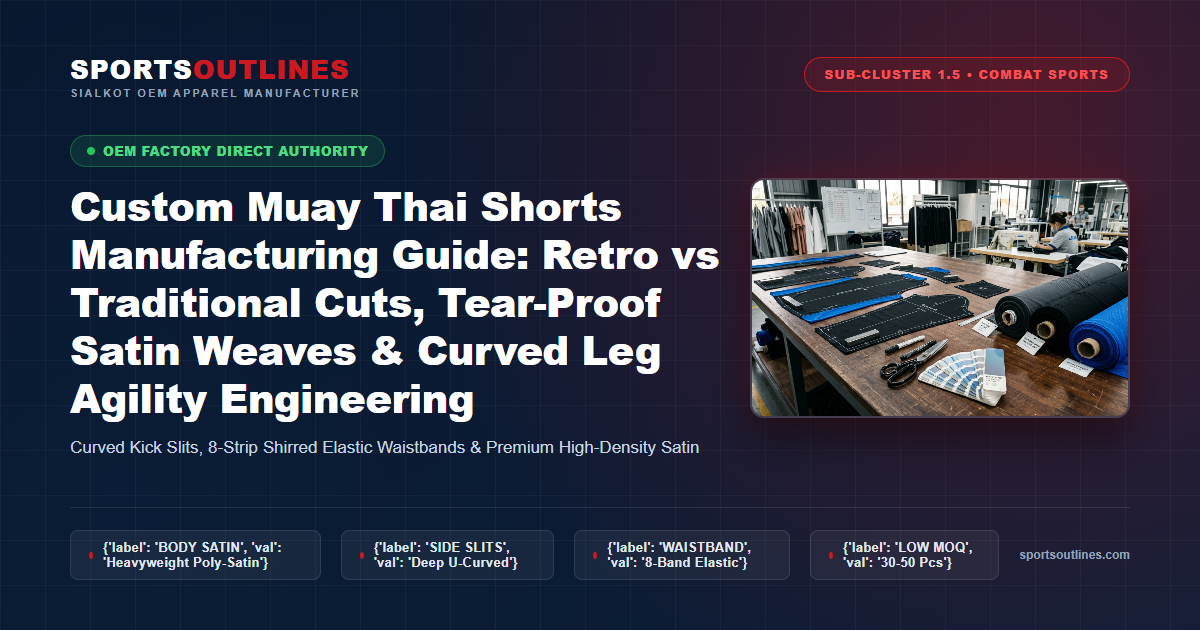
Manufacturing authentic custom Muay Thai shorts requires precision athletic tailoring engineered for unrestricted 180-degree hip rotation, explosive head kicks, and deep clinch work. Professional fight shorts are crafted from 220 to 240 GSM heavy polyester satin (featuring a dense plain weave, tear resistance exceeding 340 Newtons, and zero static cling) or microfiber poly-satin for modern sublimated graphics. The defining structural element is the 8-strip or 6-strip shirred elastic waistband, constructed with high-modulus natural rubber elastic bands secured with multi-needle chain-stitching and an internal flat woven drawcord. This waistband locks firmly onto the hips without rolling down during violent knee strikes. Leg openings feature dramatic U-shaped curved side slits bound in folded contrast satin or PU piping, completely freeing the quadriceps from friction. Modern production bifurcates into two distinct cuts: the Traditional Stadium Cut (wide, flared leg openings with 8 waistband bands) and the trending Retro Bangkok Cut (shorter 4-inch inseam, narrower leg silhouette, and deep curved side vents). Factory direct low MOQ at our Sialkot facility starts at 30 to 50 pieces per style/design across adult (XS–4XL) and youth sizes. Pre-production physical prototype samples cost $45 to $85 per custom piece completed in 7 to 10 business days.
- Body Fabric: 220–240 GSM Heavyweight Duchesse Poly-Satin or Carbon-Fiber textured micro-satin.
- Waistband Engineering: 8-strip (Traditional) or 6-strip (Retro) shirred elastic with internal flat drawcord.
- Curved Agility Slits: Deep U-curved or scalloped side vents with 15 mm contrast piping and heavy bar-tack anchors.
- Embellishment Methods: Hand-cut tackle twill Thai calligraphy, metallic gold PU leather appliques, direct embroidery.
- Cut Profiles: Traditional Lumpinee Cut (wide flare, 5.5″ inseam) vs. Retro Bangkok Cut (shorter 3.5″–4.0″ inseam).
- Factory Low MOQ: 30–50 pieces per model/colorway with mixed waist sizing (26″ to 42″).
- Physical Prototype Sampling: $45–$85 per custom piece in 7–10 days (strict zero credit/refund policy).
- Direct Factory Sourcing: WhatsApp factory floor direct at +92 316 7932595 or sportsoutlines.com.
In Muay Thai (the “Art of Eight Limbs”), an athlete’s shorts are sacred cultural equipment and tactical combat armor. From the historic stadium lights of Rajadamnern and Lumpinee in Bangkok to ONE Championship global broadcasts and Western kickboxing promotions, a Nak Muay’s shorts must facilitate explosive, uninterrupted striking power: flying knees, spinning back kicks, low calf kicks, and sweeping teeps.
For fight gym owners, martial arts academies, and private label combat apparel founders in the USA, UK, Australia, and Germany, sourcing custom Muay Thai shorts has traditionally been plagued by quality defects: thin 130 GSM costume satins tearing along the groin during high kicks, rubber waistband threads snapping and turning limp after five washes, stiff non-breathable embroidery backings scratching thighs, and poorly angled side slits restricting full hip extension.
At Sports Outlines in Sialkot, Pakistan, our specialized combat sports tailoring lines produce authentic, competition-ready Thai boxing shorts for international promotions, fight camps, and martial arts apparel brands worldwide. This comprehensive technical B2B manufacturing guide explains the precise textile physics of tear-proof heavy satins, traditional vs. retro pattern geometries, multi-needle shirred waistband mechanics, authentic Thai script embroidery digitizing, size grading, wholesale unit economics, and factory direct low MOQ sourcing.
1. Textile Engineering: Heavy Duchesse Satin vs. Micro-Satin Blends
In Muay Thai, the garment’s textile must withstand high-speed angular friction when an opponent’s shin or heel grazes the thigh during checking kicks or sweep defenses. Low-cost fashion satins fail immediately under this stress. We manufacture our fight shorts using three performance-engineered fabrics:
Yarn Denier & Tensile Physics of 240 GSM Duchesse Satin
In textile engineering, satin is formed by floating warp yarns over multiple weft yarns to produce an ultra-smooth face. Cheap satins use low-twist 50-denier yarns that easily snag, pull, and unravel when rubbed against velcro or coarse shin guard straps. We weave our Duchesse satin using 75D/144F micro-denier warp yarns paired with 150D high-tenacity polyester weft cords in an 8-harness satin construction. Under ASTM D2261 tongue tear testing, this textile withstands over 340 Newtons of cross-directional pulling force before fiber rupture occurs.
Furthermore, our fight satins are finished with a microscopic hydrophobic Teflon DWR coating that forces sweat to roll off the surface. During a 5-round stadium fight, a fighter will throw dozens of roundhouse kicks. If the shorts become drenched in sweat, standard satin clings to the quadriceps, generating up to 15% frictional drag that measurably slows down kick snap. Our DWR finish creates a surface tension barrier that eliminates fabric drag completely.
2. Traditional Lumpinee Cut vs. Modern Retro Bangkok Cut
Muay Thai short design has undergone a major stylistic revolution over the last five years. While traditionalists revere the classic stadium look, modern western fighters and ONE Championship athletes predominantly favor the streamlined Retro cut:
The Biomechanics of the Deep U-Curved Side Slit
In traditional straight-slit shorts, lifting the knee into a high guard or roundhouse chamber causes the front panel fabric to catch against the rectus femoris quadriceps muscle. In our Retro cut patterns, the side vent is cut with an exaggerated scalloped U-curve extending 12 to 14 cm upward toward the waistband. The curved hem is reinforced with double-row folded contrast binding and anchored with heavy 42-stitch bar-tacks. This geometry allows the fighter to chamber their knee flush against their chest without the fabric pulling or resisting movement.
3. Multi-Needle Shirred Elastic Waistband Engineering
The iconic ruffled waistband of Muay Thai shorts is known as a “shirred” elastic waistband. In cheap souvenir shorts, factories sew this waistband with a single piece of wide, cheap elastic that stretches out and dies after a month. At Sports Outlines, we build authentic competition waistbands using dedicated Kansai Special multi-needle chain-stitch machinery:
- Independent High-Tensile Rubber Strips: We thread 6 to 8 separate 10 mm braided natural rubber elastic cords through parallel channels. Even if one channel suffers wear, the remaining channels maintain full clamping force.
- Dual-Chainstitch Shirring: Each channel is secured with a 2-thread chain-stitch. Unlike standard lockstitch which snaps when stretched, chain-stitch expands synchronously with the elastic, providing infinite stretch cycles.
- Integrated Tubular Drawcord: An internal flat polyester drawstring is threaded through the center channel, exiting through reinforced interior buttonholes, allowing athletes to lock the waist firmly over athletic cups.
- Contrast Center Shield Patch: An 8 cm x 9 cm satin patch is topstitched onto the front center waistband, providing the traditional canvas for hand-cut Thai calligraphy or custom brand heraldry.
Elastic Modulus Physics: 8-Channel Natural Rubber Tension & Kansai Multi-Needle Mechanics
The biomechanical demand placed on a Muay Thai waistband during a five-round fight is severe. As a fighter breathes heavily during the aerobic intensity of clinching, the abdominal wall expands up to 15% in circumference. Simultaneously, opponent knee strikes deliver concussive downward impacts against the waistband rim. If the elastic tension is too rigid (high modulus), it constricts the athlete’s diaphragm and accelerates anaerobic fatigue. If the tension is too slack (low modulus), the shorts slide down over the iliac crest, exposing the groin guard.
At Sports Outlines, our waistbands are calibrated using premium natural Malaysian rubber elastic cores with a specialized elongation recovery index of 180%. Each of the 8 individual rubber channels operates under an engineered resting tension of 4.2 Newtons per channel, totaling approximately 33.6 Newtons of circumferential clamping force distributed across a 10 cm vertical band. This multi-tiered distribution exerts gentle, continuous pressure over the lumbar fascia without pinching. Our dedicated Kansai Special DLR-1508 multi-needle chainstitch machines insert 16 parallel threads simultaneously with differential bottom feed dog timing, ensuring the satin casing gathers into uniform, symmetrical ruffles that never roll over or twist inside the waistband casing.
4. Traditional Embellishment: Hand-Cut Tackle Twill, Gold PU & Embroidery
Muay Thai shorts are renowned for their intricate, flamboyant front chest panels. Our Sialkot ateliers combine computer-controlled Tajima embroidery with artisanal hand-applique craftsmanship:
Thai Typography Vectorization, Kerning & Laser-Cut Edge Cauterization
Replicating traditional Thai script (such as “มวยไทย” — Muay Thai, or custom club names translated into Thai phonetic characters) is a specialized art form. Cheap overseas suppliers frequently botch Thai typography by using automated translation software that scrambles the vowel diacritics placed above and below root consonants, resulting in offensive or nonsensical letterforms.
Our pre-press graphics department utilizes authentic Thai typographic vector libraries with manual kerning adjustment to ensure 100% cultural and linguistic accuracy. Each letterform is vector-cut from heavyweight 280 GSM polyester twill or metallic mirror PU leather using sealed CO2 laser cutters operating at 0.05 mm beam diameter. The laser’s focused thermal energy instantaneously cauterizes the raw synthetic fibers along the cut perimeter, preventing micro-fraying. Once laser-cut, the appliques are bonded to the front satin panels using thermoplastic polyamide adhesive web activated at 165°C (329°F) under 3.5 bar pneumatic pressure, followed by high-density Tajima satin zigzag embroidery (0.4 mm pitch, 2.5 mm column width) anchoring every contour.
5. Anatomical Sizing Matrix & Measurement Standards
Authentic Muay Thai sizing historically ran 1 to 2 sizes smaller than Western apparel sizing. At Sports Outlines, our patterns are graded specifically to Western International Standard (US/EU/AU specs) so your customers receive an accurate, predictable fit:
6. Private Label Trims, Custom Branding & Packaging Standards
To command premium retail pricing ($60–$75 MSRP) in Western and Australian e-commerce markets, the presentation of your fightwear must rival established heritage brands like Fairtex, Yokkao, and Primo. We produce bespoke private label trim packages for every collection:
- High-Density Damask Woven Center Waist Patch: 7 cm x 8 cm woven emblem with up to 8 colors and metallic Lurex border merrowing. Hand-stitched squarely over the center waistband seam.
- Side Vent Woven Tab Labels: Folded 15 mm damask woven micro-tags inserted into the left side slit seam, showcasing your brand crest.
- Heavyweight Custom Hangtags: 400 GSM matte-laminated rigid cardstock with metallic foil stamping, embossed brand typography, and eyelet with black braided waxed cord.
- Frosted Zipper Polybags: 0.12 mm frosted EVA biodegradable polybags with slide zipper closures and micro-ventilation punch holes to prevent humidity buildup during international DHL/FedEx air freight.
7. Quality Assurance: AQL 2.5 Seam Burst & Elastic Resilience Testing
Because Muay Thai movements put immense multi-directional strain on the groin inseam and side slit apexes, our quality assurance protocols enforce three strict mechanical testing gates prior to final packing:
- Groin Seam Tensile Pull Test: Sample garments from every production lot are mounted on an Instron tensile tester. The center crotch seam must withstand 300 Newtons of lateral tension without stitch slippage or needle perforation failure.
- Waistband Snapback Elasticity Audit: The shirred waistband is stretched to 200% of its relaxed width for 50 continuous cycles. Permanent elastic deformation must not exceed 2.0%.
- Applique Edge Peel Inspection: Tackle twill and PU leather appliques are audited under 25 N of vertical peeling force. The heat-activated polyamide bonding web combined with dense satin zigzag stitching guarantees zero edge lifting.
Points of Measure (POM) Quality Tolerance Standards & ASTM D5034 Tensile Specs
Consistency across production batches is what distinguishes amateur merchandise from professional fight apparel. Every completed production run at Sports Outlines is audited against strict Points of Measure (POM) tolerance windows:
In addition to dimensional consistency, our 240 GSM Duchesse satin is validated under ASTM D5034 (Breaking Force and Elongation of Textile Fabrics — Grab Test). Under hydraulic tensile testing, our woven satin exhibits a warp breaking strength of 640 Newtons and a weft breaking strength of 510 Newtons. This exceptional tensile threshold ensures that even during violent clinch scuffles, corner wrestling, and takedowns, the garment fabric will never shred or unravel.
8. Sourcing Economics: Unit Costs, Sampling Rules & Low Factory MOQ
At Sports Outlines, we empower martial arts gyms, combat promotions, and startup fightwear labels with factory direct low MOQ starting at only 30 to 50 shorts per style/design with mixed size curves.
Sampling Protocol: $45–$85 Physical Prototypes in 7–10 Days
We mandate physical prototype approval prior to bulk production. Physical prototypes cost $45 to $85 per custom piece. This fee covers digital vector digitizing for Thai calligraphy, laser cutting appliques, multi-needle Kansai Special waistband shirring, curved slit assembly, and hand-finishing over 7 to 10 business days. We maintain a strict zero-refund and zero-credit policy on sample fees. Once approved, the physical sample serves as the golden standard for bulk manufacturing.
Manufacture Custom Muay Thai Shorts with Low MOQ
Bring your combat sports line to life with authentic Muay Thai shorts engineered in Sialkot. From 240 GSM heavy Duchesse satins to 8-strip shirred waistbands, curved kick slits, and metallic appliques, we deliver stadium-level durability with 30–50 pieces low MOQ and fast 7–10 days physical sampling.
9. Frequently Asked Questions (FAQ) — Muay Thai Shorts Manufacturing
1. What is the difference between Traditional and Retro Muay Thai shorts?
Traditional shorts feature an 8-strip waistband, wide bell-flare leg openings, and a longer 5.5″ inseam. Retro cuts feature a sleeker 6-strip waistband, shorter 3.5″ to 4.0″ inseam, tailored thigh fit, and deep U-curved side slits engineered for maximum kicking mobility and a modern athletic silhouette.
2. Why do Muay Thai shorts use an 8-strip shirred elastic waistband?
The 8-strip shirred waistband uses multiple independent high-tension rubber channels sewn with chain-stitching. This distributes clamping pressure evenly over the hips without restricting breathing, prevents rollover during knee strikes, and ensures the shorts stay anchored firmly even during intense clinch fighting.
3. Can you customize traditional Thai lettering and gold metallic appliques?
Yes. Our Sialkot facility specializes in laser-cut hand-sewn tackle twill Thai script, high-shine metallic mirror gold PU leather piping, direct Tajima embroidery, and full digital dye sublimation for modern collections.
4. What is your minimum order quantity (MOQ) for custom Muay Thai shorts?
Our factory direct low MOQ is 30 to 50 pieces per style. You can split this quantity across standard adult sizing (XS to 2XL) or include youth Nak Muay sizes within the same production run.
5. How much does a physical sample prototype cost, and what is the turnaround time?
A physical custom prototype sample costs $45 to $85 per piece depending on embroidery and applique complexity. Turnaround time for custom pattern drafting, embroidery digitizing, and assembly is 7 to 10 business days, followed by 4 to 6 business days for DHL/FedEx Express air delivery directly from Sialkot.
6. How do you prevent satin fraying along the curved side slit seams during high kicks?
We bind the raw edges of the U-curved leg slits with folded 15 mm contrast satin or PU piping, folded double and sewn with twin-needle chainstitching. The apex of the slit is anchored with a heavy 42-stitch bar-tack reinforcement, preventing seam separation under maximum leg extension.
7. Can you combine dye-sublimated graphics with traditional tackle twill center lettering?
Yes. Our hybrid production combines all-over sublimation on 220 GSM micro-satin side panels with heavy 240 GSM Duchesse satin front/back bodies and hand-cut raised tackle twill lettering across the center chest panel for the ultimate hybrid aesthetic.
Explore Related Combat Sports & Teamwear Manufacturing Guides:
Complete your fightwear arsenal with our factory guides on Custom Boxing Trunks & Robes, Custom MMA Fight Shorts, or explore our Factory Sportswear Catalog.