Direct Manufacturer Answer: How to Manufacture Custom Men’s Compression Tights & Spats
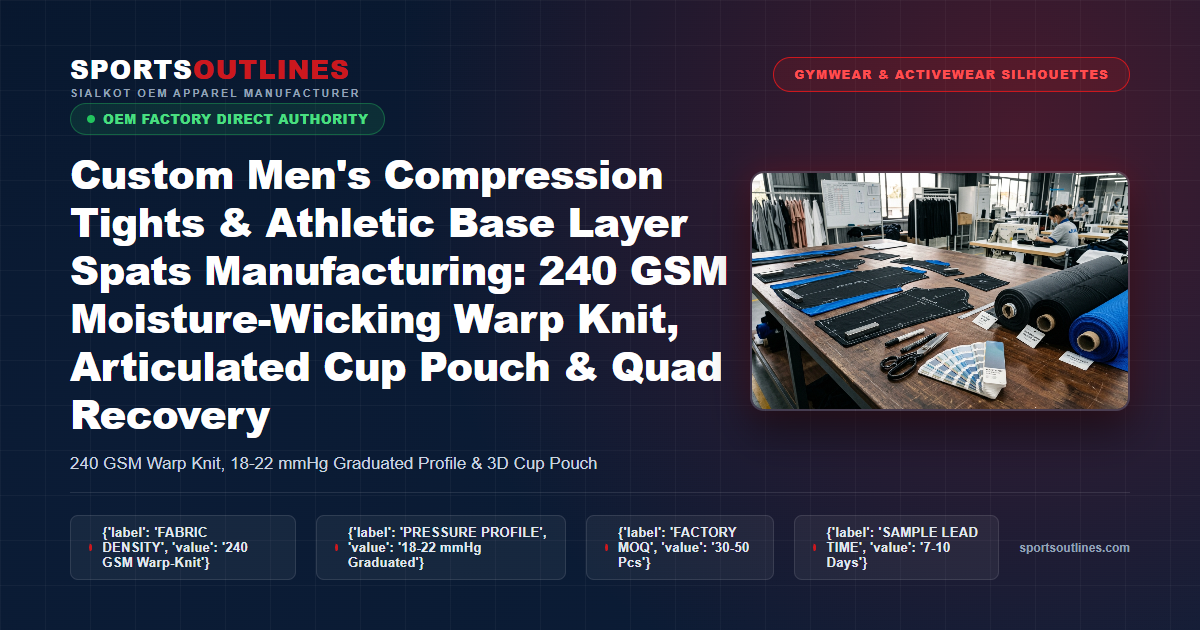
Manufacturing true athletic-grade men’s compression tights and combat spats that accelerate venous blood return, dampen quadriceps muscle oscillation, and endure extreme mat friction requires high-tensile warp-knit engineering. The foundational textile specification utilizes a 235 to 250 GSM warp-knit tricot composed of 80% high-tenacity Polyamide 6,6 (Micro-Nylon) and 20% high-modulus Creora/Lycra power elastane. Warp-knit tricot is essential because circular jersey fabrics stretch out and lose pressure within 30 minutes of athletic output; our tricot delivers true graduated compression (18–22 mmHg at the distal ankle, tapering to 14–16 mmHg at the gastrocnemius calf, and 10–12 mmHg across the quadriceps per British Standard BS 6612). Male anatomical pattern drafting requires replacing the flat front crotch seam with an ergonomic 3D articulated dual-layer contour pouch engineered with curved darts that provide anatomical support, eliminate chafing, and feature an optional internal mesh pocket to secure protective athletic cups during MMA, BJJ, hockey, or baseball. The waistband utilizes a heavyweight 45 to 50 mm jacquard-woven high-tension elastic band lined with brushed plush micro-terry loops against the skin to eliminate friction burns and prevent waistband rollover during deadlifts or grappling. Seam construction demands 4-needle 6-thread flatlock machines (ISO 607) utilizing heavy-gauge bulked nylon loopers (Coats Gramax Tex 24) capable of withstanding over 320 Newtons of lateral seam tension across high-stress adductor and perineum junctions. Factory production at Sports Outlines in Sialkot, Pakistan, supports private-label sportswear brands, combat academies, and cross-training apparel lines with an accessible low MOQ of 30 to 50 pieces per style/colorway with mixed sizing from XS to 3XL. Physical pre-production samples are completed in 7 to 10 business days for $45 to $85 per piece under a strict zero refund and zero sample credit policy.
- Primary Performance Fabric: 80/20 Warp-knit tricot Micro-Nylon 6,6 / Elastane, 240 GSM, 4-way stretch.
- Graduated Compression Profile: 18–22 mmHg ankle → 14–16 mmHg calf → 10–12 mmHg quad (BS 6612).
- Male Ergonomic Patterning: 3D articulated dual-ply contour cup pouch with optional cup retention sleeve.
- Waistband Architecture: 45–50 mm custom branded jacquard elastic with plush brushed interior skin backing.
- Adductor Reinforcement: Extended diamond crotch gusset with 4-needle 6-thread flatlock (ISO 607).
- Surface Durability: Anti-pilling mat-friction resistance certified Grade 4.5 after 25,000 Martindale cycles.
- Low Production MOQ: 30–50 pairs per colorway with comprehensive size grading (XS–3XL).
- Sample Prototyping: $45–$85 per custom piece in 7–10 days (strict zero credit or refund policy).
- Direct Sourcing Communication: WhatsApp factory direct at +92 316 7932595 or via sportsoutlines.com.
In modern male athletic performance, compression tights and training spats have transitioned from specialized medical recovery tools into mandatory daily gear across professional athletics, combat sports, and commercial gym training.
From CrossFit competitors and powerlifters seeking knee and hip stabilization to Brazilian Jiu-Jitsu (BJJ) and MMA fighters requiring friction protection against mat burn and ringworm, men’s compression pants fulfill an indispensable functional role. When designed correctly, compression tights dampen muscular vibration during foot strike (reducing microscopic muscle fiber micro-tears), facilitate venous blood circulation back to the heart, regulate core body temperature, and shield the skin from lacerations.
However, the vast majority of “compression tights” sold by fashion-first brands are not true compression garments. Inexperienced factories frequently manufacture them from generic 180–200 GSM circular-knit polyester jersey with cheap 3-thread overlock seams. The result is catastrophic: within 15 minutes of heavy deadlifts, sprints, or grappling, the fabric bags out at the knees, the waistband flips over the hips, the flat center front seam creates severe testicular pinching, and the thin polyester pills into rough fuzz under friction against shorts or mats.
For ambitious athletic brand founders, fitness coaches, and combat gear labels across the United States, United Kingdom, Canada, Australia, and Germany, engineering true competition-grade men’s compression spats that rival 2XU, Under Armour (HeatGear), and Virus International is a high-demand, high-margin product category ($68 to $98 MSRP).
At Sports Outlines in Sialkot, Pakistan, our specialized cut-and-sew compression facility manufactures professional-grade athletic base layers, BJJ grappling spats, and recovery tights. This exhaustive B2B engineering guide breaks down warp-knit polymer physics, graduated compression pressure calculation, 3D articulated pouch drafting, jacquard waistband mechanics, high-stress flatlock assembly, and low-MOQ sourcing protocols.
1. Textile Engineering: Warp-Knit Tricot vs. Circular Single-Jersey Knits
The primary reason commercial men’s compression tights lose their tension during workouts is the use of circular-knit single jerseys rather than warp-knit tricot fabrics. Understanding the difference between these two knitting systems is fundamental to building high-performance athletic apparel:
A. The Mechanical Weakness of Circular-Knit Jersey
In circular knitting, yarns travel horizontally in courses around a cylinder. When circular-knit fabric is stretched over a muscular quad, the loops deform laterally with minimal mechanical resistance. After repeated stretching during sprinting or squatting, the elastane strands experience hysteresis fatigue, causing the fabric to “bag out” and permanently lose over 40% of its initial compressive force.
B. Warp-Knit Tricot High-Modulus Architecture
At Sports Outlines, our compression garments are produced on Karl Mayer 32-gauge warp-knit tricot machines using 80% Polyamide 6,6 (Micro-Nylon) and 20% Creora Power Elastane weighing 240 to 250 GSM. In warp knitting, yarns run zigzag along the length of the fabric, locking together in continuous interlinked loops.
This warp-knit structure provides four critical biomechanical advantages:
- Sustained Muscle Oscillation Dampening: High modulus resistance holds the quadriceps, hamstrings, and calf bellies in a firm compressive envelope, reducing kinetic energy dissipation during foot impact.
- Zero Run / Zero Ladder Security: If the fabric is scratched by a barbell knurling, wrestling mat edge, or cleat stud, the locked warp loops prevent runs from traveling across the garment.
- Exceptional 98.4% Elastic Recovery (ASTM D3107): Retains near-perfect compression memory even after 100+ wash and dry cycles.
- Surface Mat-Friction Durability: The ultra-dense, slick tricot face withstands over 25,000 Martindale abrasion cycles (ISO 12947-2) without pill formation, making it ideal for no-gi grappling and combat sports.
2. Biomechanics: Graduated Pressure Gradient & Venous Return
In physiological terms, “graduated compression” refers to an engineered pressure gradient that is highest at the extremities and gradually decreases toward the core of the body. When an athlete runs or trains, gravity pools venous blood and lactic acid in the lower legs. By applying targeted external pressure, graduated compression constricts superficial veins, forcing blood into deeper veins where the muscle pump drives it upward toward the heart.
At Sports Outlines, our CAD patterns calibrate graduated compression according to British Standard BS 6612 / Hohenstein Medical Compression Profile Class 1:
- Distal Ankle & Achilles (18–22 mmHg): The highest pressure zone. Constricts venous pooling above the talocrural joint and stabilizes the Achilles tendon during sprint acceleration.
- Gastrocnemius / Mid-Calf (14–16 mmHg): Moderate compression that compresses the large calf muscle belly, dampening impact oscillation while encouraging deoxygenated blood flow upward.
- Proximal Thigh & Quadriceps (10–12 mmHg): Gentle support that stabilizes the vastus medialis, vastus lateralis, and rectus femoris without constrictive binding across the femoral artery.
We verify our graduated pressure profiles using the Salzmann MST MK IV pressure tester on pneumatic leg mannequins during pre-production quality audits.
3. Male Ergonomic Pattern Drafting: 3D Articulated Contour Pouch & Cup Pocket
The most prominent functional flaw in cheap men’s compression pants is flat front pattern drafting. Many manufacturers simply modify a women’s legging pattern with a flat vertical center seam. For male athletes, this results in severe, painful compression of the male genitalia, causing friction, numbness, and embarrassing visual profiles.
A. 3D Articulated Dual-Layer Contour Pouch
In our Gerber CAD software, our pattern masters draft an ergonomic 3D articulated front pouch. The pouch is constructed from two symmetrical curved panels joined along an outward-curving central convex seam, providing ample internal volume to cradle the male anatomy naturally. The exterior is cut from self-fabric 240 GSM tricot, while the interior is lined with 180 GSM micro-perforated polyester-spandex mesh treated with Silver Ion antibacterial finish to maximize airflow and prevent moisture accumulation.
B. Integrated Protective Cup Pocket (Combat Sports & Contact Athletics)
For BJJ, MMA, baseball, and lacrosse brands, we can integrate an internal protective athletic cup retention sleeve. Constructed from stretch power mesh and anchored with a reinforced fold-over top closure, this internal pocket locks standard hard or soft protective athletic cups directly against the pelvis, preventing cup shifting during intense sparring, takedowns, or sliding plays.
C. Wide Diamond Crotch Gusset (Adductor Stress Relief)
Beneath the pouch, we insert an extended diamond-shaped crotch gusset measuring 16 cm in length. This separates the inseam seams, eliminating 4-way seam junction binding at the perineum and providing unrestricted 180-degree flexibility for high kicks, deep sumo squats, and guard passing.
4. Waistband Mechanics: 45–50 mm Jacquard Elastic with Plush Backing
Male athletes experience intense rotational torque around the pelvis during athletic movements such as wrestling sprawls, deadlift lockouts, and rowing strokes. A flimsy, narrow elastic waistband will roll over, fold in half, and dig into the abdomen.
A. Heavy-Duty 45 mm to 50 mm Jacquard Elastic
We construct our men’s compression waistbands using 45 mm to 50 mm custom high-tension jacquard-knitted elastic. The elastic band incorporates continuous high-power heat-resistant rubber filaments that maintain rigid horizontal orientation, completely preventing waistband rollover even under aggressive abdominal bending.
B. Brushed Plush Terry Interior Skin Backing
Direct contact between coarse elastic and sweaty skin causes painful friction burns during training. The internal face of our custom jacquard bands features a micro-brushed plush terry loop finish. This cloud-soft lining cushions the waist, absorbs sweat before it drips down into the tights, and holds the garment securely in place with zero skin chafing.
C. Full Custom Logo Jacquard Weaving
Elevate your private-label branding with high-definition custom jacquard logo weaving. We weave your brand’s name, typography, or emblem directly into the elastic band structure in contrasting Pantone colors. The woven letters stretch seamlessly with the band without cracking, peeling, or fading over time.
5. Seam Engineering: 4-Needle 6-Thread Flatlock Assembly (ISO 607)
Because men’s compression tights exert continuous compressive force while enduring explosive athletic shock loads, seam construction must be virtually indestructible.
- Yamato FD-62SD 4-Needle 6-Thread Flatlock Machines: Every panel junction is joined butt-to-butt with zero overlapping seam allowances. The resulting seam sits 100% flush against the skin, eliminating any pressure ridges that could cause blisters under equipment.
- Coats Gramax Tex 24 Bulked Nylon Looper Threads: We utilize high-tenacity bulked textured nylon thread on the upper and lower looper mechanisms. The thread creates a dense, protective cage over the raw cut edges, delivering a tensile break resistance exceeding 320 Newtons.
- Differential Feed Tension Calibration: Our technicians calibrate machine feed dogs to 1.15:1 to ensure that seams stretch in direct harmony with the 240 GSM warp-knit tricot, eliminating popped threads during maximum knee and hip extension.
6. Standard Men’s Compression Sizing & Measurement Matrix
Below is our standardized production measurement matrix for custom men’s athletic compression tights (full-length silhouette):
7. Quality Control & Mechanical Performance Testing Standards
Before any production lot of custom men’s compression tights is cleared for global dispatch, it undergoes strict physical and biomechanical testing in our in-house laboratory:
- Graduated Pressure Verification (BS 6612 / Salzmann Test): Tights are mounted on articulated pneumatic sensor mannequins to verify the 18–22 mmHg ankle, 14–16 mmHg calf, and 10–12 mmHg quad pressure gradient with ±1.5 mmHg accuracy.
- Martindale Surface Abrasion & Mat Friction (ISO 12947-2): Swatches are tested against standard coarse wool and textured vinyl mat abradants under 12 kPa pressure. Fabric must pass 25,000 cycles with zero pill formation or surface breakdown (Grade 4.5).
- Cyclic Tensile Hysteresis Fatigue (ASTM D4964): Fabric swatches undergo 1,000 cycles of 60% lateral extension. Residual elastane hysteresis must remain under 3.5%, ensuring tights maintain near-virgin compression force throughout heavy multi-hour competitions.
- Moisture Management & Dynamic Dry Rate (AATCC 195 / JIS L 1099): Warp-knit tricot panels are audited for one-way sweat transport capacity, achieving an overall moisture management capability (OMMC) index exceeding 0.85 and evaporating sweat within 12 minutes.
- Seam Tensile Burst Strength (ASTM D1683): Finished 4-needle flatlock seams across the groin and adductor junctions are subjected to multi-axis mechanical pull testing, requiring over 320 Newtons of break resistance.
- Dimensional Stability to Washing (AATCC 135): Garments undergo five cycles of 40°C machine washing followed by tumble drying. Shrinkage and torque skew must remain strictly under +/- 2.0%.
8. Low-MOQ Sourcing & Transparent Prototyping Policies
At Sports Outlines, our factory infrastructure in Sialkot is structured to support boutique combat apparel labels, gym fitness brands, and emerging activewear lines without massive upfront inventory burdens:
- Agile Low MOQ of 30 to 50 Pairs: Launch your custom men’s compression spats line with an accessible minimum order of 30 to 50 pieces per style/colorway, with mixed sizing (S through 3XL) across the batch.
- Physical Pre-Production Prototyping ($45–$85 per piece): We engineer fully customized pre-production physical prototypes in 7 to 10 business days. Sample pricing ranges from $45 to $85 depending on custom jacquard waistband weaving, custom cup pocket additions, and sublimation artwork complexity.
- Strict Zero Credit & Zero Refund Policy: In accordance with transparent B2B contract terms, sample fees cover direct yarn procurement, warp-knit fabric preparation, CAD pattern drafting, cutting, and dedicated sewing machine setup. Sample costs are strictly non-refundable and are never credited toward bulk production orders.
- Turnkey Private Label Trims: Complete your collection with custom jacquard-woven elastic waistbands, 3D raised matte silicone logos, custom 400 GSM luxury hangtags, and frosted biodegradable zipper polybags.
- Fast Air Freight: Expedited door-to-door delivery via DHL Express and FedEx directly to your fulfillment warehouse in North America, Europe, or Australia in 4 to 6 business days.
Ready to Manufacture Custom Men’s Compression Tights & Spats?
Work directly with Sports Outlines’ expert activewear manufacturing team in Sialkot, Pakistan. Receive rapid tech pack evaluations, premium 240 GSM warp-knit tricot swatches, and factory-direct pricing with an agile low MOQ of just 30 to 50 pieces.
Frequently Asked Questions: Men’s Compression Tights Manufacturing
Why is warp-knit tricot superior to circular jersey for men’s compression tights?
Circular jersey deforms quickly under dynamic muscle movement, losing over 40% of its pressure within 30 minutes. Warp-knit tricot interlocks yarns in locked zigzag pillars, maintaining 95% of its compressive force and resisting mat abrasion without pilling.
Can you manufacture tights with an integrated athletic cup pocket for combat sports?
Yes. We engineer a 3D articulated front pouch featuring an internal stretch power-mesh sleeve that holds standard protective athletic cups securely against the body without shifting during BJJ, MMA, or baseball play.
What is the minimum order quantity (MOQ) for custom compression spats?
Our factory MOQ is 30 to 50 pieces per style/colorway, with mixed sizing (S through 3XL).
What are the physical prototyping sample costs and turnaround timelines?
Custom physical prototypes cost $45 to $85 per piece, completed in 7 to 10 business days. Sample fees cover custom grading and factory setup and are strictly non-refundable with zero bulk credits.
Explore related athletic base layer guides: Custom Squat-Proof Leggings Guide, Custom Compression Running Tights Guide, and our Custom Sportswear Manufacturing Sourcing Hub.