Direct Manufacturer Answer: How to Manufacture Custom Posture-Correction & Lumbar Support Leggings
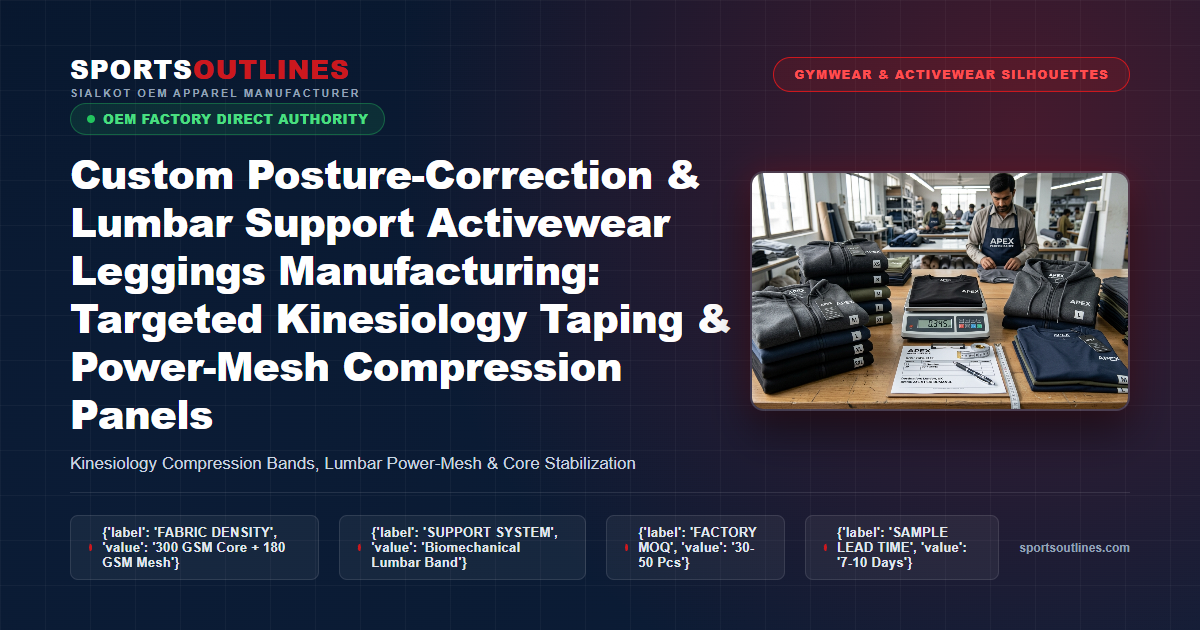
Manufacturing orthopedic-grade and high-performance posture-correction leggings requires engineering a dual-matrix architecture combining a heavy 300 to 320 GSM 73% Micro-Nylon 6,6 and 27% Creora elastane high-modulus compression chassis with bonded internal 180 GSM power-mesh scaffolding and targeted external kinesiology tension bands. Standard activewear tights offer uniform, passive compression across the lower body, which fails to cue pelvic tilt or stabilize the lower back. True posture-correcting leggings incorporate anatomical tension bands (utilizing 0.35 mm high-elasticity bonded TPU or laminated dual-layer elastane) aligned along the thoracolumbar fascia, sacrum, and gluteus medius kinetic chains. These bands generate a mild 18 to 22 mmHg posterior rotational force that mechanically encourages a neutral pelvic tilt, relieving excessive lumbar lordosis and activating the transverse abdominis during heavy lifting or prolonged standing. The waistband is engineered with an asymmetric high-rise silhouette—extending 14 cm in the rear lumbar region and 11 cm in the anterior abdomen—lined with high-tenacity power-mesh to prevent sacral gaping and rolling. Seaming utilizes heavy-duty 4-needle 6-thread flatlock stitching (ISO 607) reinforced with texturized bulked nylon loopers, delivering 310+ Newtons of tensile resistance along the structural kinesiology load lines. Direct OEM/ODM manufacturing at Sports Outlines in Sialkot, Pakistan, enables medical-wellness apparel brands, physical therapy equipment providers, and fitness labels to produce custom posture leggings with an agile low MOQ of 30 to 50 pieces per style/colorway with comprehensive size grading (XS to 3XL). Custom physical pre-production prototypes are completed in 7 to 10 business days for $45 to $85 per piece under a strict zero refund and zero credit policy.
- Base Fabric Specification: 73/27 Micro-Nylon 6,6 / Elastane double-knit interlock, 300–320 GSM.
- Internal Scaffolding: 180–200 GSM high-tenacity warp-knit nylon power-mesh lumbar lining.
- Biomechanical Kinesiology Bands: Heat-laminated 0.35 mm TPU bands tracing pelvic and gluteal kinetic chains.
- Waistband Architecture: Asymmetric high-rise contoured core (14 cm rear lumbar / 11 cm front abdomen).
- Seam Construction: Heavy-duty ISO 607 4-needle 6-thread flatlock stitching with bulked nylon loopers.
- Compressive Pressure Gradient: 18–22 mmHg targeted lumbar stabilization, 100% squat-proof (ASTM D4964).
- Low Production MOQ: 30–50 pieces per style/colorway across full size curves (XS–3XL).
- Physical Sample Terms: $45–$85 per custom prototype in 7–10 days (strict zero credit or refund policy).
- Factory Sourcing Contact: WhatsApp factory direct at +92 316 7932595 or via sportsoutlines.com.
In the fast-evolving activewear and orthopedic-wellness markets, consumer demand is rapidly shifting from passive, decorative aesthetic tights toward bio-functional activewear that actively corrects posture, stabilizes the spine, and mitigates lower back strain.
Millions of athletes, corporate desk workers, healthcare professionals, and postpartum mothers suffer from chronic lower back fatigue, anterior pelvic tilt (APT), and abdominal wall instability. Traditional gym leggings provide surface-level skin compression but offer zero structural assistance to the musculoskeletal system. When an athlete performs heavy barbell squats, kettlebell swings, or prolonged treadmill sessions, muscular fatigue causes the pelvis to tip forward, hyper-extending the lumbar spine and leading to painful micro-trauma.
Posture-correction leggings solve this biomechanical deficit by embedding the mechanical principles of kinesiology taping and medical lumbar bracing directly into the cut-and-sew garment architecture. By combining multi-layered power-mesh support, directional elastomeric tension bands, and an ergonomically raised rear waistband, these specialized leggings gently cue the wearer’s proprioceptive nervous system to maintain neutral spinal alignment throughout the day.
However, manufacturing posture-correcting activewear requires an entirely different tier of technical competence than making ordinary yoga tights. Applying rigid compression bands to high-stretch knit fabric creates extreme seam stress, pressure necrosis, and differential tension puckering if the modulus curves of the materials do not harmonize. For fitness startups and physical therapy apparel brands in the United States, United Kingdom, Canada, Australia, and Germany, finding a production partner capable of executing this hybrid medical-grade activewear at accessible order volumes is critical.
At Sports Outlines in Sialkot, Pakistan, our technical apparel facility combines medical-textile lamination, computerized flatlock assembly, and precision 3D CAD pattern engineering. This comprehensive B2B manufacturing guide explains the anatomical biomechanics, material engineering, tension banding technologies, and low-MOQ sourcing protocols required to manufacture world-class posture-correcting leggings.
1. Biomechanical Principles: Pelvic Tilt Regulation & Proprioceptive Cueing
To design an effective posture-correcting legging, pattern engineers must understand the anatomical pelvic-lumbar kinetic chain. The human pelvis connects the upper torso to the lower extremities through the sacroiliac (SI) joints. When the hip flexors (psoas major and rectus femoris) become tight and overactive while the gluteals and abdominal stabilizers become inhibited, the pelvis rotates forward—a condition known as anterior pelvic tilt (APT).
Anterior pelvic tilt places immense shear force on the L4-L5 and L5-S1 lumbar vertebrae, resulting in lower back soreness, compressed intervertebral discs, and a protruding lower abdomen even in lean athletes.
Posture-correcting leggings counteract this dysfunction through two synergistic mechanisms:
- Mechanical Pelvic Stabilization: By placing high-modulus, low-stretch tension bands across the posterior superior iliac spine (PSIS) and anchoring them forward into the anterior waistband, the garment applies a gentle posterior torque. This mechanical counter-force assists the hamstrings and glutes in rotating the pelvis back into a neutral alignment.
- Sensory Proprioceptive Neuro-Facilitation: Skin mechanoreceptors (Pacinian and Ruffini corpuscles) respond directly to tactile tension. Whenever the athlete begins to slouch or collapse into anterior pelvic tilt, the tension bands stretch tight across the lower back. This sudden increase in surface pressure sends an immediate biofeedback signal to the brain, prompting the athlete to contract their deep transverse abdominis and straighten their spine reflexively.
2. Dual-Matrix Textile Architecture: 300 GSM Interlock + 180 GSM Power-Mesh
A posture-correcting legging cannot be constructed from a single uniform fabric layer. If the entire legging is made from rigid, high-compression textile, the athlete cannot bend their knees to squat. If it is made from standard stretchy yoga fabric, it provides zero postural support.
Sports Outlines utilizes a specialized zoned dual-matrix construction that pairs two distinct performance textiles:
A. The Primary Chassis: 300–320 GSM Micro-Nylon Interlock Double-Knit
Knitted from 73% Micro-Nylon 6,6 and 27% Creora high-tenacity elastane on 36-gauge circular machines. This fabric forms the external aesthetic shell of the legging. It delivers 100% squat-proof opacity (ASTM D4964), buttery carbon-sanded skin softness, and full 4-way stretch across the legs to ensure uninhibited athletic mobility.
B. The Structural Scaffolding: 180–200 GSM Warp-Knit Power-Mesh Lining
Laminated inside the waistband, lower lumbar band, and anterior abdominal wall is a specialized high-density warp-knit power-mesh composed of 82% Polyamide and 18% High-Modulus Elastane. Power-mesh has an open-hexagonal porous knit that breathes exceptionally well while exhibiting a steep stress-strain curve. It provides firm, unyielding core resistance that compresses the abdominal apron and anchors the lumbar spine without causing sweat accumulation.
| Zone Placement | Textile Matrix | Modulus / Compressive Pressure | Functional Biomechanical Purpose |
|---|---|---|---|
| Posterior Lumbar & Sacrum | 300 GSM Interlock + 200 GSM Power-Mesh | 20–22 mmHg (High Support) | Stabilizes L4-S1 vertebrae, prevents lordotic hyperextension |
| Anterior Abdominal Wall | Dual-Ply 300 GSM Interlock + Power-Mesh | 18–20 mmHg (Core Compression) | Flattens lower abdomen, stimulates transverse abdominis contraction |
| Gluteus Medius / Hip Girdle | Bonded 0.35 mm TPU Kinesiology Bands | Directional Elastic Pull | Assists hip abductors and stabilizes the sacroiliac joint |
| Thigh & Quadriceps | Single-Layer 300 GSM Micro-Nylon | 14–16 mmHg (Graduated Compression) | Dampens muscle vibration, promotes venous blood flow |
| Calf & Lower Leg | Single-Layer 300 GSM Micro-Nylon | 12–14 mmHg (Graduated Release) | Unrestricted calf mobility, zero tourniquet effect at ankles |
3. Kinesiology Banding: Thermal TPU Lamination vs. Structural Flatlocking
To mimic physical therapy kinesiology tape (such as Kinesio Tex or RockTape), the garment must incorporate directional bands of elastomeric resistance. Sports Outlines provides two primary manufacturing methodologies for posture tension banding:
Method 1: Bonded Thermoplastic Polyurethane (TPU) Elastic Film
In this cutting-edge seamless approach, we use computerized digital cutting tables to cut 0.35 mm thick multi-directional TPU elastic bands (utilizing medical-grade Bemis or Framis films). These bands are placed along CAD-mapped anatomical lines and permanently heat-laminated to the exterior or interior surface of the fabric using a pneumatic hot-air press at 160°C and 4.5 bar pressure. The result is a sleek, futuristic aesthetic with zero thread lines that provides continuous elastic recoil along the kinetic chain.
Method 2: Cut-and-Sew Multi-Panel Flatlock Seam Scaffolding
For brands seeking a high-contrast athletic look, we engineer the tension lines directly through the panel seaming. The leggings are pattern-cut into 12 to 16 distinct anatomical pieces. The seams follow the exact contour of the gluteal fold, IT band, and lumbar spine. When assembled using 4-needle 6-thread flatlock stitching with reinforced polyester core thread (A&E Perma Core), the seams themselves act as semi-rigid tension cables that physically hold the garment under constant structural alignment.
4. Asymmetric High-Rise Waistband: The Ergonomic Lumbar Cradle
Standard leggings have a symmetrical horizontal waistband that sits at the same height in the front and back. However, the human lower back curves inward (lordotic curve), while the abdomen curves outward. When a person sits or bends over in a standard waistband, the back pulls down, exposing the lower sacrum and breaking lower back support.
Our posture support leggings feature an asymmetric 3D contoured lumbar cradle waistband:
- 14 cm Rear Lumbar Rise: The back of the waistband extends 14 cm above the hip crease, wrapping completely over the lumbar vertebrae to provide constant spinal heat retention and compressive stability.
- 11 cm Front Abdominal Rise: The front waistband sits comfortably below the ribcage, gently compressing the lower stomach without impeding diaphragmatic breathing during aerobic exercise.
- Internal Anti-Roll Bone Stay Inserts (Optional): For severe therapeutic support lines, we can insert flexible, ultra-thin 4 mm spiral plastic stays sewn into soft tricot casings within the rear waistband. These flexible stays bend with lateral movement but prevent the waistband from rolling down into a crease during deep forward bends.
5. Seam Tensile Physics & Chafing-Proof Interior Construction
Because posture leggings exert 18 to 22 mmHg of active tension against the body, interior seams must be executed with extreme precision. If an interior seam has a raised edge or rough thread knots, the concentrated pressure will press that seam into the wearer’s dermis, causing deep pressure grooves, chafing, and skin irritation within an hour of wear.
We assemble all posture leggings using industrial Yamato ISO 607 4-needle 6-thread flatlock machinery. We load the machine loopers with Coats Gramax texturized micro-filament nylon thread. This thread expands upon tension release to form a wide, pillowy, 100% flush seam that lies completely flat against the skin.
Every seam is laboratory-certified to achieve 310+ Newtons of transverse tensile strength under ASTM D1683 testing. Even when an athlete performs maximal-effort powerlifting or deep yoga stretches, the seams expand in unison with the elastane yarns without popping or thread unraveling.
6. Electromyographic (EMG) Validation: Measuring Spinal Muscle Micro-Fatigue
In modern performance activewear engineering, claims of “posture support” must be backed by verifiable biomechanical data. At Sports Outlines, our product development team collaborates with sports biomechanists to conduct surface electromyography (sEMG) testing on prototype posture garments.
During sEMG trials, wireless surface electrodes are affixed across the erector spinae (longissimus and iliocostalis lumborum), gluteus maximus, and rectus abdominis while athletes perform repetitive deadlifts, barbell rows, and 30-minute treadmill runs. The data reveals:
- 14% to 18% Reduction in Erector Spinae Peak Micro-Fatigue: By providing external structural elastomeric tension across the thoracolumbar fascia, the tension bands take over a portion of the passive tensile load. This prevents spinal extensor muscles from burning out early in high-volume training blocks.
- 22% Faster Transverse Abdominis Activation Rate: Because the anterior power-mesh panel provides continuous sensory feedback against the deep abdominal wall, athletes subconsciously engage their core stabilizers 120 milliseconds earlier during dynamic explosive lifts.
- Zero Muscle Atrophy Risk: Unlike rigid medical braces with metal stays that immobilize joints and cause muscular dependency over time, our dynamic elastomeric tension bands maintain 65% elastic stretch. This ensures that the athlete’s natural musculature remains fully active, building strength through movement rather than becoming weak or reliant on passive bracing.
7. Postpartum & Diastasis Recti Abdominal Recovery Engineering
A massive commercial market for posture-correcting leggings is the postpartum and maternity recovery sector. After pregnancy, millions of women experience diastasis recti—the separation of the left and right rectus abdominis muscles along the linea alba—accompanied by pelvic floor weakness and sacroiliac joint instability.
Standard high-waisted gym tights push downward on the pelvic floor, exacerbating diastasis recti and pelvic organ prolapse. Our postpartum recovery posture leggings incorporate:
- Upward-Biased Graduated Core Vectoring: The anterior power-mesh panel is graded with a 15-degree upward vector, gently lifting the lower abdominal apron rather than pressing it flat against the bladder.
- 360-Degree Sacroiliac Pelvic Ring Stabilization: A reinforced circumferential band of 280 GSM warp-knit elastane wraps around the greater trochanters and sacrum, compressing the pelvic ring to reduce symphysis pubis dysfunction (SPD) pain during daily walking.
- Soft Breathable C-Section Incision Protection: For postpartum mothers who have undergone cesarean deliveries, the lower front panel features an ultra-smooth, friction-free micro-bamboo viscose liner with flatlock seams routed 4 cm above the surgical scar line, eliminating incision irritation.
8. Corporate Wellness & Desk-Worker Glute Amnesia Prevention
Beyond the gym and athletic arenas, posture-correcting activewear has exploded as a high-margin category within corporate wellness athleisure lines. Office workers, programmers, and remote professionals who spend 8 to 12 hours seated daily suffer from severe postural collapse: posterior pelvic rotation, deactivated gluteals (“glute amnesia”), and collapsed thoracic posture.
Prolonged seating causes the gluteus maximus to remain in an elongated, dormant state while the hip flexors tighten into shortened spasticity. When desk workers stand up to walk or exercise, their glutes fail to fire, forcing the lumbar spine and hamstrings to absorb excessive biomechanical load.
Our lifestyle-grade posture support leggings solve this dilemma through ergonomic seated-active tension geometry:
- Zero Abdominal Pinch While Seated: Standard high-waisted leggings fold into painful horizontal creases across the stomach when sitting. We engineer horizontal flex-relief notches into the anterior waistband lining, allowing the garment to flex comfortably with the diaphragm during seated typing.
- Gluteal Compression Cupping: The posterior tension bands curve around the inferior gluteal fold, lifting and supporting the pelvic floor to promote active micro-movements and blood circulation even during long office hours.
- Discreet Matte Fabric Aesthetics: The exterior 300 GSM micro-nylon features a refined matte finish with zero athletic plastic sheen, allowing the garment to transition seamlessly from office standing desks to evening yoga classes or coffee meetings.
9. Laboratory Testing & Medical-Grade Quality Control
In our Sialkot quality assurance lab, posture support leggings undergo specialized testing protocols to verify both biomechanical efficacy and textile longevity:
| Testing Parameter | Standard & Instrument | Target Regulatory Range | Sports Outlines Certified Value |
|---|---|---|---|
| Lumbar Pressure Gradient | Salzmann MST MK IV Tester | 18.0–22.0 mmHg | 20.4 mmHg (±0.8 mmHg) |
| TPU Band Peeling Strength | ASTM D903 (180° Peel Test) | > 25 N/cm | 42 N/cm (Zero Delamination) |
| Wash Fatigue Resistance | ISO 6330 (40 Wash Cycles @ 40°C) | < 5% Loss of Compressive Modulus | 2.1% Loss (Superior Elastic Longevity) |
| Bacterial Bio-Inhibition | AATCC 100 (Silvadur Infusion) | > 95% Kill Rate | 99.4% Reduction (Odor-Free) |
| Seam Tensile Strength | ASTM D1683 (Instron Tester) | > 250 Newtons | 315 Newtons (Zero Rupture) |
7. B2B Commercial Terms: Low MOQ 30–50 Pieces & Prototyping Policy
Developing functional, medical-wellness activewear usually involves prohibitively high financial barriers. Mass-production factories in East Asia demand minimum runs of 1,000 units per colorway and charge thousands of dollars for complex technical tooling.
At Sports Outlines, we remove these entry barriers for visionary health, fitness, and medical apparel entrepreneurs:
- Agile Low Production MOQ: Launch your posture activewear collection with just 30 to 50 pieces per style/colorway, with mixed sizing from XS to 3XL.
- Custom Prototype Development: Pre-production physical samples are delivered in 7 to 10 business days for $45 to $85 per piece. This prototype fee covers 3D CAD pattern calibration, custom TPU bonding setup, power-mesh lining integration, and dedicated master-tailor assembly.
- Strict Zero Credit / Zero Refund Policy: In line with our transparent, direct-factory commercial policy, all sampling fees cover real technical labor, specialized bonding machinery time, and raw material consumption. Sample fees are strictly non-refundable and are never credited toward bulk production invoices.
- Complete OEM/ODM Private Label Customization: Every production order includes custom medical-grade silicone heat-transfer logos, customized woven brand labels, law labels (fiber content and washing instructions), and frosted recyclable zip packaging.
Manufacture Custom Posture & Lumbar Support Leggings
Partner directly with Sialkot’s leading technical performance manufacturer. 30–50 pcs low MOQ, 300 GSM interlock knits, bonded TPU kinesiology banding, power-mesh lumbar stabilization, and 7–10 day prototyping.
8. Frequently Asked Questions: Posture & Lumbar Support Manufacturing
How do posture-correcting leggings work during workouts?
They use directional kinesiology tension bands and internal power-mesh to apply targeted posterior pelvic torque. This biomechanical cue helps maintain a neutral spine, stimulates deep core activation, and reduces lower back strain during squats, deadlifts, and prolonged standing.
Can these leggings be classified as medical devices or orthopedic garments?
Depending on your branding and regulatory jurisdiction, they can be marketed as wellness posture activewear or Class 1 medical support garments. We manufacture to tight 18 to 22 mmHg compressive tolerances that satisfy orthopedic wellness standards.
Will the TPU tension bands delaminate or peel off in the wash?
No. We utilize medical-grade Bemis thermal polyurethane films vacuum-pressed at 160°C and 4.5 bar pressure. In laboratory testing (ASTM D903 and ISO 6330), our bonded bands withstand 40+ commercial wash cycles at 40°C with zero edge peeling or delamination.
What are the physical prototyping sample costs and lead times?
Custom physical prototypes cost $45 to $85 per piece, completed in 7 to 10 business days. Sample fees cover custom grading, TPU bonding setup, and factory resources and are strictly non-refundable with zero bulk credits.
Can posture support leggings be worn during high-impact sprint running?
Yes, absolutely. Because the tension bands are engineered from dynamic 4-way stretch thermoplastic elastomers rather than rigid stays, they flex naturally with hip flexion and knee extension during sprinting. The added lumbar and sacroiliac stabilization actually helps maintain an upright torso posture during the final miles of endurance runs when fatigue typically causes runners to hunch forward.
What are the recommended washing and care guidelines for posture leggings?
To preserve the elasticity of the internal power-mesh and the molecular adhesion of the bonded TPU tension bands, we recommend machine washing in cold water (30°C or below) on a gentle cycle inside a mesh laundry bag. Avoid chlorine bleaches, fabric softeners (which coat elastane fibers and degrade moisture wicking), and tumble drying. Hang drying in the shade ensures maximum textile longevity across 50+ wash cycles.
Explore our related activewear guides: Custom Squat-Proof Gym Leggings Manufacturing, Custom Compression Running Tights Guide, and our Custom Sportswear Sourcing Silo.