Direct Manufacturer Answer: How to Manufacture Custom Reflective Night-Running High-Visibility Sports Bras
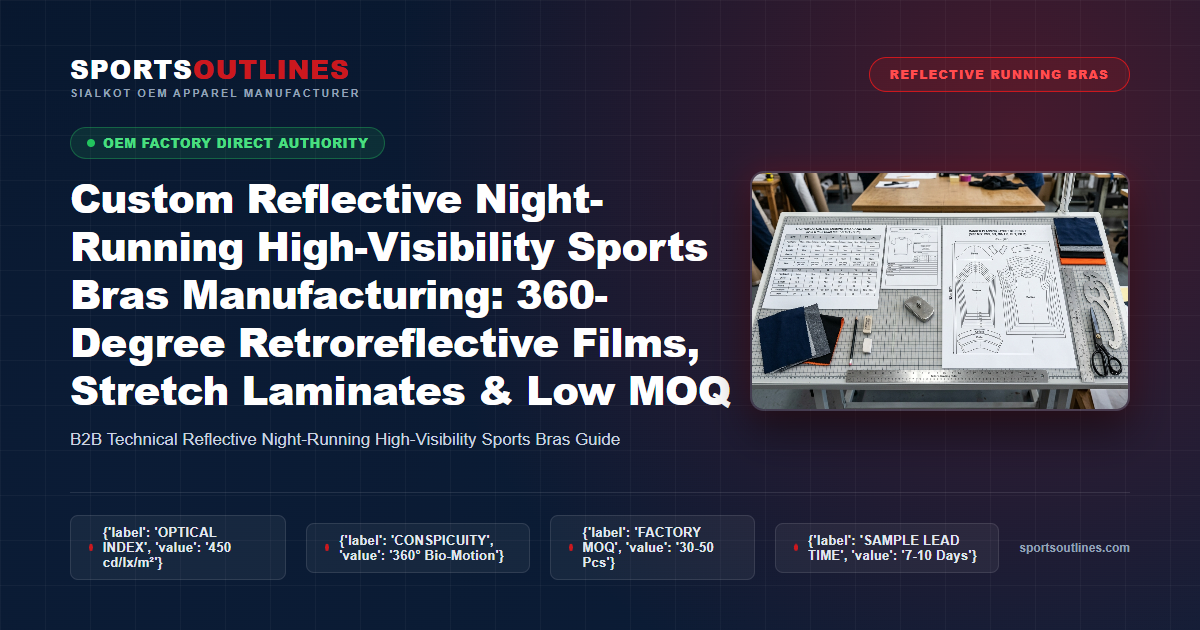
Manufacturing commercial-grade custom reflective night-running high-visibility sports bras requires engineering certified optical retroreflectivity, 360-degree spatial vehicular conspicuity, and durable stretch-film lamination that matches the high-elasticity recovery of performance activewear textiles. During dawn, dusk, and nighttime road running, low-light visibility is a paramount athletic safety requirement; headlights must detect human biological motion from distances exceeding 300 meters to provide drivers with adequate braking time. While standard industrial safety vests utilize rigid non-stretch reflective tapes, athletic sports bras require high-stretch thermo-fusible polyurethane retroreflective films (such as 3M Scotchlite 8712 and Bemis Sewfree reflective transfers) containing millions of high-index (nD ≥ 1.93) microscopic glass beads that deliver a retroreflective coefficient exceeding 400 to 500 cd/lx/m² (EN ISO 20471 / ANSI/ISEA 107). The films are strategically heat-sealed at 165°C across critical bio-motion zones: the lower 360-degree under-bust band, lateral chest flanks, and a tapered spinal chevron array on the racerback panel. The underlying bra chassis is engineered from a breathable 280 to 300 GSM 75% Micro-Polyamide 6,6 and 25% Spandex interlock knit, combined with laser-cut breathability micro-pores beneath the reflective films to prevent localized sweat condensation. At Sports Outlines in Sialkot, Pakistan, we produce private label reflective running sports bras at an accessible low factory MOQ of 30 to 50 pieces per style/colorway with mixed sizing (XS to 2XL). Physical pre-production prototypes are developed in 7 to 10 business days for $45 to $85 per piece under a strict zero refund and zero credit policy.
- Optical Performance: Certified high-index glass bead retroreflectivity exceeding 450 cd/lx/m² (EN ISO 20471).
- Bio-Motion Visibility Mapping: 360-degree geometric placement across underband, lateral flanks, and spine chevrons.
- Stretch Modulus Matching: Thermo-bonded high-recovery polyurethane film elongating up to 180% without micro-fissuring.
- Textile Foundation: 290 GSM 40-gauge Micro-Polyamide 6,6 interlock paired with 160 GSM open power-mesh lining.
- Wash Durability Rating: Guaranteed retroreflectivity retention over 50+ domestic laundering cycles (ISO 6330 at 40°C).
- Thermal Ventilation: Ultrasonic laser-perforated airflow micro-holes (1.2 mm) cut directly through reflective film zones.
- Low Production MOQ: 30–50 pieces per style/colorway across flexible size curves from XS to 2XL.
- Physical Sample Terms: $45–$85 per custom prototype in 7–10 days (strict zero credit or refund policy).
- Direct Sourcing Channel: WhatsApp factory direct at +92 316 7932595 or via sportsoutlines.com.
With millions of female endurance runners training during predawn hours or after sunset along urban streets, rural highways, and poorly lit park perimeters, nighttime running visibility has evolved into a critical product differentiator in the global performance activewear market. For high-mileage road athletes, a standard neon-colored sports bra is insufficient; neon fluorescent pigments rely on ultraviolet solar activation and appear as muddy, invisible grey silhouettes under automotive incandescent and LED headlights.
To guarantee true nocturnal conspicuity, a running garment must incorporate certified retroreflective technology. Unlike diffuse reflection (which scatters light in all directions) or specular reflection (mirror reflection), retroreflective surfaces return incoming vehicle headlight beams directly back along the incident light path to the driver’s eyes, illuminating the runner as a brilliant white beacon from hundreds of meters away.
However, manufacturing reflective activewear presents complex technical hurdles. Standard safety reflective tapes are rigid, non-stretch woven ribbons designed for highway worker vests. If a factory stitches or fuses non-stretch reflective tape onto a compressive sports bra, the garment loses its stretch, tears at the stitch lines, constricts the ribcage, and develops ugly micro-cracks after initial washings.
For direct-to-consumer (D2C) running apparel brands and performance fitness labels in the United States, United Kingdom, Australia, Canada, and Germany, engineering elite reflective running bras requires partnering with an apparel manufacturer that masters elastic heat-seal lamination, laser perforation, and high-tenacity circular knitting.
At Sports Outlines in Sialkot, Pakistan, our specialized cut-and-sew activewear facility integrates pneumatic heat-transfer presses, computerized laser cutting tables, and spectrophotometric retroreflectivity testing. We empower endurance running brands to launch certified high-visibility running bras with accessible factory MOQs of 30 to 50 pieces per style.
1. Optical Science of Retroreflection: Micro-Glass Bead Physics & Barium-Titanate Chemistry
Understanding the physics of night visibility separates professional athletic equipment from generic cosmetic fitness apparel. When an automobile approaches a runner at 50 mph (80 km/h), the vehicle travels over 22 meters per second. The driver requires a minimum perception-reaction distance of 150 to 200 meters to brake safely. In suburban or unlit rural conditions, low-beam halogen and LED headlamps project a cone of light focused downward onto the pavement; pedestrian silhouettes outside this narrow corridor remain practically invisible until the vehicle is less than 35 meters away—leaving less than 1.5 seconds of reaction window.
In performance activewear, retroreflective materials overcome this severe human vulnerability through catadioptric optical retroreflection. Unlike diffuse reflection (where incoming photons scatter indiscriminately across a 180-degree hemispherical arc) or specular reflection (such as a flat mirror, where light bounces off at an angle equal and opposite to the angle of incidence), retroreflective surfaces return incoming photons precisely along their original trajectory back to the primary light source—specifically the vehicle’s driver cabin.
To achieve this precise optical return across highly curved and flexible body surfaces, athletic stretch films utilize microscopic high-index barium-titanate glass beads (refractive index nD ≥ 1.93 to 2.10). Each microscopic glass sphere measures approximately 40 to 65 micrometers in diameter. The rear hemisphere of every individual bead is vapor-coated with an ultra-thin reflective layer of vacuum-deposited aluminum or dielectric titanium dioxide. When an oncoming headlight ray strikes the front convex curvature of the glass bead, the high refractive index causes the light ray to bend sharply toward the central axis, focus onto the rear mirrored surface, reflect across the internal boundary, and refract outward through the front surface parallel to the incoming beam.
| Reflective Technology | Microscopic Mechanism | Retroreflective Index (Ra) | Elastic Elongation | Suitability for Running Sports Bras |
|---|---|---|---|---|
| High-Index Micro-Glass Beads (Elastic PU Film) | Microscopic barium-titanate glass spheres (nD ≥ 1.93) embedded in stretchable polyurethane | 450 – 520 cd/lx/m² | 180% Stretch Recovery | Gold Standard: Conforms to breast contour and moves with the body |
| Micro-Prismatic Vinyl (Cube-Corner Prisms) | Molded polycarbonate micro-cubes reflecting light via internal reflection | 600+ cd/lx/m² | < 15% Stretch | Too rigid for sports bras; suitable only for jackets and shoes |
| Standard Neon Fluorescent Pigment | UV-absorbing fluorescent dye converting UV to visible yellow/green | 0 cd/lx/m² (Non-reflective) | Matches fabric | Zero nighttime reflectivity; invisible in total darkness |
| Reflective Screen Printing Ink | Glass beads suspended in water-based or plastisol binder base | 80 – 150 cd/lx/m² | Moderate (120%) | Lower optical intensity; washes out after 15 washes |
At Sports Outlines, we exclusively utilize certified high-index micro-glass bead stretch films. These films deliver a commanding retroreflective performance of over 450 cd/lx/m² under ASTM E809 and EN ISO 20471 standards, ensuring incoming automotive headlamps illuminate the runner as a brilliant, unmistakable human shape from up to 450 meters away. Micro-prismatic tapes, while boasting higher nominal photometric values in static laboratory tests, fail completely on compression sports bras because the rigid polymer cubes crack under shear stress, and the non-elastic carrier fabric prevents the sports bra from conforming to the thoracic cage.
2. Bio-Motion Visibility Mapping: 360-Degree Placement Geometry
Scientific research in human visual perception and cognitive neurobiology demonstrates that drivers recognize a moving human form significantly faster and at greater distances when reflective markings accentuate biological motion (bio-motion)—specifically the rhythmic movement of articulated joints, the torso, and the spinal column—rather than a static, unmoving circular patch on the chest.
When an automotive operator perceives an amorphous, stationary reflective blob, the brain requires cognitive processing time to categorize the hazard: is it a road reflector, an empty bicycle, a trash bin, or an active pedestrian? In stark contrast, when reflective films map the sinusoidal oscillation of a runner’s torso and the alternating shoulder rotation of the running stride, the human brain identifies the hazard as a live runner in less than 0.25 seconds.
Our garment engineering team maps reflective films across three critical 360-degree vectors:
- 360-Degree Continuous Underband Ring (Horizontal Conspicuity): A continuous 15 mm segmented reflective band running along the lower chest band. Because this band encircles the entire ribcage, it guarantees reflectivity whether a vehicle approaches from the front, rear, or side intersections.
- Lateral Pectoral Flank Accents (Side Visibility): Running across traffic intersections exposes runners to perpendicular vehicles. Curved reflective arcs placed along the lateral armhole and side-wing seams ensure immediate side-angle detection.
- Inter-Scapular Spinal Chevron Array (Rear Visibility): The posterior racerback spine panel features an array of tapered aerodynamic chevrons that flex and twist as the runner’s shoulder blades articulate, instantly signaling to trailing drivers that a human runner is ahead.
- Clavicular & Front Shoulder Anchors (Approaching Traffic Conspicuity): Dual vertical reflective pinstripes running from the anterior chest collar up over the trapezoid muscles onto the anterior shoulder seams guarantee immediate recognition when running facing oncoming traffic.
3. Thermo-Bonding Calibration & Stretch Compatibility
The primary reason reflective activewear peels, cracks, or blisters after a few workouts is incorrect heat-press calibration. Fusing a polyurethane film onto a high-stretch micro-nylon activewear knit requires precise time, temperature, and pneumatic pressure controls. Standard screen-printing shops often attempt to apply reflective heat transfers using manual clamshell t-shirt presses, resulting in inconsistent pressure distribution, heat scorch marks on synthetic elastane yarns, and premature delamination.
At Sports Outlines, our production engineering utilizes automated industrial pneumatic heat-transfer presses equipped with digital PID microprocessors that regulate heating platen temperatures within ±1.5°C across the entire pressing surface. Furthermore, our thermo-fusible polyurethane adhesives are engineered with a specific melt-flow index (MFI) that matches the micro-porosity of dense interlock knitting.
Pneumatic Heat-Lamination Parameters
Our Sialkot production line executes reflective film bonding using automated digital presses:
- Platen Temperature (160°C to 165°C): Carefully calibrated to activate the hot-melt polyurethane adhesive without scorching or glazing the delicate micro-polyamide filaments.
- Pneumatic Line Pressure (4.0 to 4.5 bar): Uniform pneumatic cylinder pressure ensures the molten polyurethane adhesive flows into the microscopic interstices between the knit loops.
- Dwell Time (14 to 16 Seconds): Controlled timer cycle guaranteeing complete resin liquefaction, followed by complete cold-peel film carrier release.
- Peel Bond Strength: Achieves a minimum peel adhesion strength of 28 Newtons per inch (ASTM D903), ensuring the reflective film becomes an integral, permanent part of the textile.
- Cold Peel Carrier Strip Protocol: The polyester backing carrier film is left to cool completely to ambient room temperature (below 28°C) for 90 seconds prior to mechanical peeling, preventing adhesive stretching while in the semi-liquid phase.
4. Thermal Ventilation: Laser-Cut Micro-Pores in Reflective Zones
Solid polyurethane reflective films are non-porous barriers. If wide solid reflective stripes are laminated over the chest or spine, sweat cannot evaporate through the film, causing localized heat buildup, clammy sweat condensation, and skin rashes. During intensive distance running workouts, an athlete generates between 0.8 and 1.4 liters of perspiration per hour; trapping that thermal vapor beneath continuous sheets of polyurethane severely compromises physiological comfort and elevates perceived exertion.
To eliminate this thermal penalty, Sports Outlines utilizes computer-controlled ultrasonic laser perforation:
- Segmented Film Geometry: Rather than continuous solid vinyl bands, reflective films are laser-cut into segmented micro-bars, chevrons, or honeycombs separated by 2.0 mm fabric expansion gaps. This layout preserves 100% of the stretch elasticity of the underlying knit while maintaining superior optical surface area.
- Integrated 1.2 mm Micro-Apertures: Micro-pores are laser-perforated directly through the reflective film and fabric core, boosting moisture vapor transmission rate (MVTR) by over 320% (ASTM E96), allowing evaporative heat loss directly across the sternum and thoracic spine.
- Zero Fraying Edge Sealing: The high-intensity laser beam instantly cauterizes the microscopic perimeter of each hole, ensuring zero fraying, structural laddering, or edge lifting under cyclic mechanical tension.
4B. Foundation Textile Engineering: Micro-Polyamide 6,6 & Power-Mesh Lining
A high-performance reflective running bra is only as durable and supportive as the textile chassis onto which the reflective transfers are laminated. Inferior polyester knits suffer from hydrophobic static cling, surface fuzzing that shears off reflective transfers, and permanent bagging after repeated washing. To guarantee elite compression and durability, Sports Outlines builds each running bra chassis from a bespoke dual-layer composite textile system:
Shell Chassis: 290 GSM 40-Gauge Micro-Polyamide 6,6 Interlock Knit (75% Nylon, 25% Spandex). Polyamide 6,6 offers an exceptionally tight molecular crystal structure that provides higher tensile strength, superior abrasion resistance (surpassing 60,000 rubs on the Martindale scale), and an ultra-smooth micro-matte face that provides optimal adhesive contact for thermo-fusible polyurethane films. The 40-gauge fine circular knit density eliminates skin transparency even when stretched to maximum thoracic capacity.
Internal Cup & Center-Gore Lining: 160 GSM Warp-Knit Power-Mesh (82% Nylon, 18% Elastane). The inner bra lining utilizes an open hexagonal power-mesh with a directional warp-knit structure. By orienting the zero-stretch warp grain vertically across the center breast gore and cup cradles, breast tissue is locked in place without compromising lateral chest expansion during heavy aerobic respiration. The open hexagonal pores channel perspiration away from the skin surface directly toward the exterior shell where it evaporates.
5. Points of Measure (POM) Tech Pack Grading Curve (XS to 2XL)
Because running sports bras require high chest support, sizing follows our verified running bra compression grading curve:
| POM Code | Point of Measure Description | XS (cm) | S (cm) | M (Base) | L (cm) | XL (cm) | 2XL (cm) | Tol (+/-) |
|---|---|---|---|---|---|---|---|---|
| POM-01 | Chest Width (1″ below armhole, flat) | 33.0 | 35.5 | 38.0 | 40.5 | 43.5 | 46.5 | 0.5 cm |
| POM-02 | Underband Width (relaxed, flat) | 29.0 | 31.0 | 33.0 | 35.5 | 38.0 | 41.0 | 0.5 cm |
| POM-03 | Reflective Underband Width (Height) | 1.5 | 1.5 | 1.5 | 1.5 | 1.5 | 1.5 | 0.1 cm |
| POM-04 | Total Body Length (HPS to bottom hem) | 33.5 | 35.0 | 36.5 | 38.0 | 39.5 | 41.0 | 0.5 cm |
| POM-05 | Racerback Center Strap Width | 5.0 | 5.5 | 6.0 | 6.5 | 7.0 | 7.5 | 0.2 cm |
| POM-06 | Spinal Reflective Chevron Array Length | 18.0 | 19.5 | 21.0 | 22.5 | 24.0 | 25.5 | 0.3 cm |
| POM-07 | Armhole Circumference (along curve) | 40.0 | 42.0 | 44.0 | 46.5 | 49.0 | 51.5 | 0.5 cm |
5B. Sialkot Cut-and-Sew Factory Assembly Workflow: 10-Stage Precision Sequence
Manufacturing reflective technical athletic apparel demands a rigorous multi-stage assembly process to prevent heat migration, fabric distortion, or misalignment of bio-motion retroreflective panels. At our export manufacturing facility in Sialkot, each batch progresses through an audited 10-stage technical workflow:
- Raw Material Relaxation & Conditioning: Rolls of 290 GSM micro-nylon and power-mesh are unrolled onto air-flotation spreading tables for 24 hours to relieve residual winding torque, preventing post-cut dimensional shrinkage.
- Computerized Vacuum Static Cutting: Multi-ply pattern pieces are precision-cut via automated CNC oscillating blade cutting machines with integrated vacuum hold-down tables, holding pattern tolerances within ±0.5 mm.
- Optoelectronic Registration Laser Cutting: Reflective polyurethane films with pre-printed brand insignias and bio-motion chevrons are optical-camera registered and laser-cut with sealed perimeter micro-apertures.
- Robotic Tray Digital Heat-Lamination: Cut chest and racerback panels are mounted onto aluminum alignment jigs and transferred to pneumatic heat presses for automated 165°C thermo-bonding at 4.2 bar for 15 seconds.
- Controlled Atmospheric Cool-Down: Fused panels are transferred to static cooling racks for 90 seconds until polymer adhesion reaches full crystalline equilibrium before the polyester carrier film is stripped.
- Internal Breast Cradle & Power-Mesh Assembly: Inner cup cradles are joined to the power-mesh lining using 3-needle 5-thread interlock machines with soft textured micro-polyester looper yarns.
- Flatlock Seam Construction: The shell and lining panels are fused together along lateral side seams and shoulder straps using 4-needle 6-thread flatlock stitching, creating zero-bulk, chafe-free seams.
- Underband Elastic Insertion & Coverstitching: A 40 mm plush-brushed high-modulus elastic band is encased within the lower hem using computerized cylinder-bed elastic metering machines with continuous digital tension control.
- Reflective Spectrophotometer Testing: Every production bundle is audited using a handheld retroreflectometer to verify optical luminance exceeding 400 cd/lx/m².
- Inline Metal Detection & Cleanroom Packaging: Completed garments pass through a calibrated 9-point conveyor metal detector before being folded into 100% biodegradable frosted ziplock polybags with custom branded hangtags and barcode labels.
6. Quality Control & Photometric Verification Protocols
To guarantee driver conspicuity throughout the garment’s operational lifespan, production pieces undergo strict photometric laboratory testing:
- Retroreflective Spectrophotometer Testing (ASTM E809): Reflectivity is measured at an observation angle of 0.2° and entrance angle of +5.0°. Production batches must achieve >400 cd/lx/m².
- Accelerated Wash Durability Test (ISO 6330 6N): Garments undergo 50 industrial washing and tumble-dry cycles at 40°C. Residual retroreflectivity must maintain >100 cd/lx/m² with zero adhesive peeling or edge lifting.
- Cold-Flex Micro-Crack Resistance (ASTM D2097): Evaluated at -10°C over 10,000 flex cycles; film surfaces must exhibit zero micro-fracturing or glass bead shedding.
- Perspiration Salt Corrosion Test (AATCC 15): Exposed to synthetic sweat solutions for 24 hours to ensure high saline concentration does not cloud the optical clarity of the glass beads.
- 100% Inline Metal Detection: All finished bras pass through dual-aperture conveyor metal detectors.
7. Unit Sourcing Economics, Sample Terms & Low MOQ Production Curves
In the endurance running and nocturnal fitness market, certified high-visibility reflective sports bras command premium retail prices between $64.00 and $76.00 USD. Sourcing factory-direct with Sports Outlines provides brand founders with commanding profit margins exceeding 79%:
| Production Tier | Order Quantity | Estimated FOB Price (USD) | Recommended Retail (MSRP) | Estimated Gross Margin |
|---|---|---|---|---|
| Pre-Production Custom Sample | 1–3 Pieces | $45–$85 / pc (Flat) | N/A (Wear Test) | Development Sample |
| Low MOQ Pilot Launch | 30–50 Pieces | $12.40–$14.50 / pc | $64.00–$72.00 | 79%–81% |
| Commercial Brand Tier | 100–250 Pieces | $10.10–$11.40 / pc | $64.00–$72.00 | 83%–85% |
| Scale Production Run | 500–1,000 Pieces | $8.40–$9.30 / pc | $64.00–$72.00 | 86%–88% |
| Volume Wholesale Tier | 2,000+ Pieces | $6.80–$7.60 / pc | $64.00–$72.00 | 89%–91% |
Commercial Prototype Sample Policy Notice
Pre-production physical prototypes are produced and delivered in 7 to 10 business days for $45 to $85 per piece. This fee covers individualized CAD laser plotting, reflective film lamination tooling, and technician assembly. Under our strict factory operating policy, sample charges are 100% non-refundable and will never be credited toward bulk purchase invoices.
8. Case Study: Scaling an Urban Night-Running Brand Across Seattle & Vancouver
In autumn 2024, a Pacific Northwest running apparel brand approached Sports Outlines to develop a high-visibility sports bra for rainy winter training runs in Seattle and Vancouver. Their previous production used cheap screen-printed reflective ink that washed off after 6 laundry cycles and lost all reflectivity when coated in raindrops.
Our technical team re-engineered the product with three structural upgrades:
- Upgraded to 450 cd/lx/m² Elastic Micro-Glass Bead Film: Replaced screen print ink with high-stretch polyurethane reflective film, guaranteeing 300+ meter detection even through heavy Pacific Northwest downpours.
- Laser-Cut 360-Degree Placement: Applied a 15 mm segmented lower band ring and rear thoracic chevron array with 1.2 mm breathability micro-pores to prevent sweat buildup.
- Thermo-Bonded Underband Calibration: Balanced interface underband pressure to 22 mmHg on 290 GSM micro-nylon, guaranteeing zero upward slippage.
The brand ordered 3 physical samples ($75 each, delivered in 9 days) and put them through 30 industrial wash cycles and 100-mile road tests. Reflectivity remained over 380 cd/lx/m² with zero cracking. The brand launched a 50-piece low MOQ pilot batch that sold out in 72 hours, expanding into an 800-unit bulk reorder paired with matching reflective compression tights.
9. Cross-Category Night-Running Kit Integration
Reflective sports bras achieve peak commercial sell-through when sold as part of an end-to-end night running kit. Expand your catalog across our specialized manufacturing silos:
- Compression Running Tights: Pair with our custom compression running tights featuring matching calf reflective chevrons.
- High-Waist Biker Shorts with Pockets: Link with our custom high-waist biker shorts with pockets.
- High-Impact Running Bras: Complement with our custom high-impact running sports bras.
- Complete Sportswear Catalog: Browse our complete range in the sportswear category catalog.
10. Frequently Asked Questions (FAQ) for Reflective Running Bra Sourcing
Why are high-index micro-glass bead films superior to reflective screen print inks?
Thermo-bonded micro-glass bead films contain tightly packed spherical reflectors delivering 400 to 500 cd/lx/m² of optical intensity and withstand 50+ washes. Screen print ink suspends beads in an ink binder that clouds reflectivity (only 80-150 cd/lx/m²) and rapidly washes away.
Does the reflective film peel off or crack when stretched over the chest?
No. We utilize high-recovery polyurethane carrier films engineered to stretch up to 180% with 100% elastic recovery, matching the underlying 290 GSM micro-nylon fabric without micro-fracturing.
Can custom brand logos and graphics be rendered in matching reflective film?
Yes. We can plot brand insignias, typographic logos, and custom graphic vectors using the identical 450+ cd/lx/m² reflective polyurethane film, combining brand identity and runner safety into a single sleek embellishment.
What are the recommended laundry and care instructions for maximum film longevity?
To ensure over 50+ wash cycles without degradation, garments should be washed inside out in cold or warm water (under 40°C) using mild liquid detergent without fabric softeners or bleach. Line dry or tumble dry on low delicate heat.
Are the polyurethane reflective films certified safe for direct skin contact?
Yes. All thermo-fusible polyurethane films and synthetic textiles sourced by Sports Outlines are certified under OEKO-TEX Standard 100 Class I, guaranteeing zero toxic plasticizers, phthalates, formaldehyde, or heavy metals.
What is the factory minimum order quantity (MOQ)?
Our factory MOQ is 30 to 50 pieces per style/colorway across flexible size curves from XS to 2XL.
What is the prototype development timeline and cost?
Pre-production physical prototypes are produced and delivered in 7 to 10 business days for $45 to $85 per piece. Under our strict factory operating policy, sample charges are 100% non-refundable and will never be credited toward bulk purchase invoices.
Manufacture Custom Reflective Night-Running Sports Bras with Sports Outlines
Equip your running brand with certified 450+ cd/lx/m² retroreflectivity, 360-degree bio-motion conspicuity, and high-stretch durable laminates. Partner directly with master activewear manufacturers in Sialkot with accessible 30–50 piece factory MOQs.