In modern high-performance sports medicine and elite athletic apparel manufacturing, the word “compression” is frequently abused by lifestyle marketing departments. Thousands of fitness brands market standard high-stretch yoga leggings containing 15% to 20% generic circular-knit spandex as “compression tights.” In reality, these garments provide merely a tight, snug fit; they exert negligible hemodynamic pressure on the muscular and vascular systems of the human leg. Under strenuous athletic movement, their low-modulus knitted loops bag out, losing what little tension they possessed within thirty minutes of wear.
True athletic and clinical compression is not defined by tightness; it is governed by bio-mechanical pressure profiling measured strictly in millimeters of mercury (mmHg). When an endurance runner, Olympic weightlifter, or professional footballer wears authentic graduated compression tights, the garment applies a precisely calibrated pressure gradient: maximum pressure at the distal extremity (ankle: 20 to 25 mmHg), degressively decreasing through the calf (15 to 18 mmHg), and tapering to mild pressure at the mid-thigh (10 to 12 mmHg). This degressive mechanical gradient accelerates venous blood return against gravity, dampens high-frequency muscle oscillation during foot strikes, and flushes metabolic waste to reduce Delayed Onset Muscle Soreness (DOMS).
Achieving true graduated mmHg compression requires two indispensable technical foundations: high-modulus warp-knit textile architectures (such as power-net and lock-knit tricot) and anatomical pattern drafting based on the biophysical Law of Laplace. A conventional circular knit cannot deliver sustained 25 mmHg compression without choking capillary blood flow or stretching permanently out of shape.
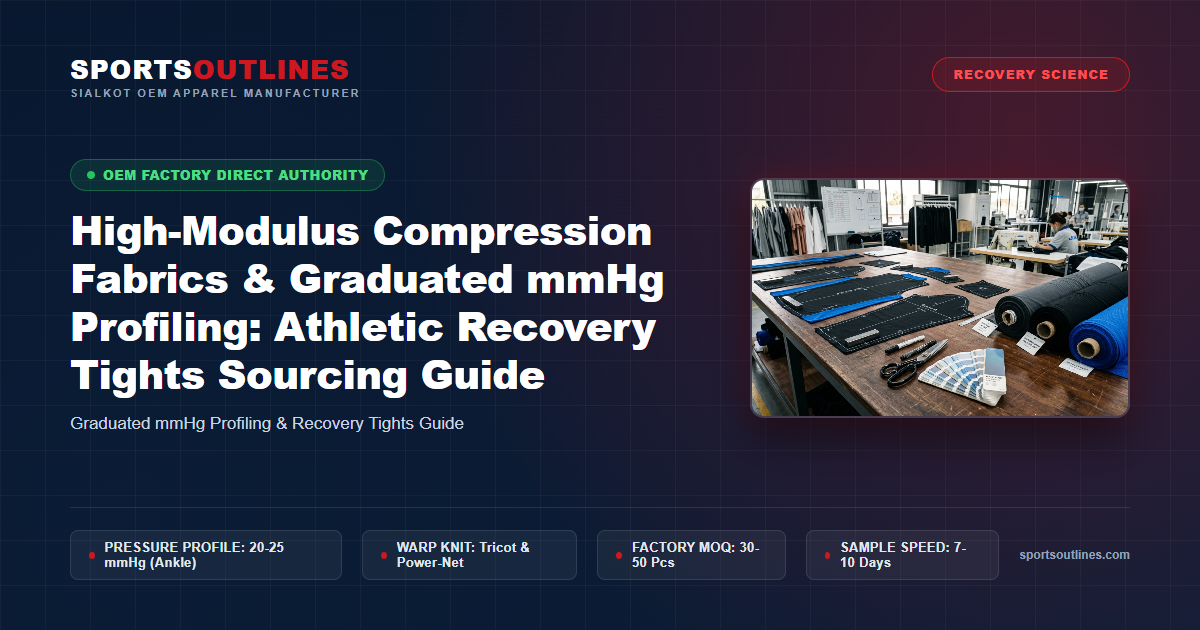
Operating from our vertical textile engineering and performance apparel hub at Sports Outlines in Sialkot, Pakistan, we manufacture certified high-modulus compression garments, athletic recovery tights, and medical-grade gradient sleeves for international athletic apparel brands and clinical orthopedic lines. We engineer 220 to 320 GSM warp-knit tricot and power-net textiles utilizing authentic 70D to 140D elastane, verified on calibrated Salzmann and Hohenstein compression testing apparatuses. Backed by our accessible factory minimum order quantity (MOQ) of strictly 30 to 50 pieces per style/colorway and rapid physical prototyping turnaround (7 to 10 business days, $45 to $85 per piece, non-refundable), Sports Outlines delivers the mathematical precision and factory transparency required to build scientifically verified compression apparel.
Executive Engineering Summary: High-Modulus Compression & mmHg
- Graduated Compression Profile: Compliant with RAL-GZ 387/1 and Hohenstein DIN 58133 standards. Mandates 100% target pressure at the ankle (B-point: 20–25 mmHg), 70%–80% at the calf (C-point: 15–18 mmHg), and 50%–60% at the mid-thigh (F/G-point: 10–12 mmHg).
- The Law of Laplace in Textile Physics: Interfacial pressure is governed by $P = T / r$ (Pressure = Fabric Tension ÷ Limb Radius). Because limb radius increases from ankle to thigh, maintaining graduated degressive pressure requires non-linear negative ease pattern grading.
- High-Modulus Warp Knits vs. Circular Knits: Circular knits have high elongation but low modulus (holding power). High-compression garments mandate warp-knit tricot or power-net utilizing 70D to 140D elastane to provide steep recovery force without bagging.
- Biomechanical Performance Benefits: Reduces skeletal muscle oscillation by up to 32%, accelerates deep femoral vein blood flow velocity by over 40%, and accelerates post-exercise lactate clearance.
- Accessible Factory Sourcing: Sports Outlines provides direct manufacturing with a founder-friendly low MOQ of strictly 30–50 pieces per style/colorway and 7–10 day pre-production sample dispatch ($45–$85 per piece, non-refundable).
1. Hemodynamic and Biomechanical Science: Why Graduated Pressure Works
To engineer legitimate compression apparel, product developers must grasp the circulatory and muscular mechanisms that govern human athletic recovery:
The Venous Pump and Hemodynamic Return
The human cardiovascular system relies on the heart to pump oxygenated arterial blood to working muscles. However, returning deoxygenated blood from the lower extremities back up to the heart and lungs requires working against gravity. In the lower legs, this is accomplished by the skeletal-muscle venous pump: calf muscle contractions compress the deep veins (popliteal and femoral veins), forcing blood upward through one-way bicuspid valves.
During prolonged standing, intense marathon running, or long-haul flight travel, venous pooling and microvascular leakage cause fluid accumulation in the interstitial spaces (peripheral edema). Authentic graduated compression acts as an external auxiliary pump:
- Vessel Diameter Reduction: By exerting 20 to 25 mmHg of external pressure at the ankle, compression reduces the cross-sectional diameter of distended deep veins. According to the continuity equation in fluid mechanics (Q = v × A), reducing vessel area A increases blood flow velocity v proportionally. Blood returns to the heart 30% to 50% faster.
- Valve Coaptation: External pressure brings dilated venous valve leaflets back into contact, preventing retrograde blood reflux and venous stasis.
- Enhanced Lymphatic Drainage: Increased tissue pressure promotes reabsorption of metabolic fluid, accelerating the clearance of creatine kinase and lactic acid from exhausted muscles.
Muscle Oscillation Damping and Micro-Trauma Reduction
During dynamic athletic impacts—such as the heel-strike phase of sprinting or landing from a jump—ground reaction forces (up to 3x to 5x body weight) transmit shockwaves through the tibia and soft muscle tissues. This causes transverse muscle oscillation (lateral muscle vibration). This vibrational energy does not contribute to forward propulsion; instead, it causes micro-tears in the myofibrillar matrix, damages connective sarcolemma membranes, and wastes neuromuscular energy. High-modulus compression encases muscle bellies (gastrocnemius, soleus, quadriceps) in a firm structural sleeve, damping muscle vibration by up to 28% to 34% and significantly reducing Delayed Onset Muscle Soreness (DOMS).
| Compression Class | Ankle Pressure (mmHg) | Target Athletic End-Use | Biomechanical Outcome |
|---|---|---|---|
| Mild Active (Class 0) | 10 – 15 mmHg | General gymwear, light yoga, lifestyle travel | Light sensory support; zero deep venous impact |
| Moderate Athletic (Class I) | 15 – 20 mmHg | Endurance running, cycling, CrossFit, team sports | Damps muscle oscillation; accelerates in-game stamina |
| Firm Recovery (Class II) | 20 – 30 mmHg | Post-race athletic recovery, post-surgical, flight travel | Accelerates lactate clearance; eradicates peripheral edema |
| Medical Extra-Firm (Class III) | 30 – 40 mmHg | Severe lymphedema, deep vein thrombosis (DVT) | Strictly clinical prescription; too stiff for dynamic running |
2. The Physics of Graduated Pressure: Mathematical Modeling via the Law of Laplace
How does a textile engineer ensure that an athletic garment exerts exactly 22 mmHg at the ankle and precisely 12 mmHg at the mid-thigh? The answer is dictated by the Law of Laplace, adapted for cylindrical elastic membranes:
P = (T × 10,000) ÷ (r × 133.32) ⇔ P = (2 · π · T) ÷ (C · w)
Where:
- P: Interfacial pressure applied to the limb in millimeters of mercury (mmHg).
- T: Circumferential tensile force (tension) exerted by the stretched fabric in Newtons per meter (N/m).
- r: Anatomical radius of curvature of the limb in meters.
- C: Anatomical circumference of the limb (C = 2 × π × r).
- w: Width of the fabric band in meters.
The Inverse Radius Paradox: Why Uniform Tightness Fails
Notice the critical mathematical reality embedded in Laplace’s Law: interfacial pressure P is inversely proportional to limb radius r.
- The human ankle has a small circumference (typically 21 to 24 cm), yielding a small radius r of approximately 3.5 cm.
- The mid-thigh has a large circumference (typically 52 to 58 cm), yielding a large radius r of approximately 8.8 cm.
If an amateur apparel brand drafts a pattern with uniform negative ease (e.g. shrinking the entire garment width by -15% from ankle to thigh), the fabric tension $T$ remains roughly uniform. Because $r$ is more than twice as large at the thigh as at the ankle, the pressure at the thigh will naturally drop to half the ankle pressure!
However, if the brand uses an erratic pattern cut, fabric tension at the knee or thigh can spike, creating a “tourniquet effect”—where pressure at the knee exceeds pressure at the ankle. A reverse pressure gradient traps venous blood in the lower leg, impairing circulation and causing severe cramping. True graduated compression engineering requires non-linear pattern grading coupled with high-modulus fabric stress-strain testing to ensure a mathematically flawless degressive gradient:
| Anatomical Landmark | RAL-GZ 387/1 Point | Target % of Max Pressure | Target mmHg (Class II) | Engineering Negative Ease |
|---|---|---|---|---|
| Distal Ankle (Supra-Malleolar) | Point B | 100% (Baseline Max) | 22.0 – 25.0 mmHg | -24% to -28% Negative Ease |
| Maximal Calf Belly | Point C | 70% – 80% of Ankle | 16.0 – 18.5 mmHg | -18% to -21% Negative Ease |
| Infra-Patellar Popliteal | Point D | 60% – 70% of Ankle | 13.5 – 15.0 mmHg | -14% to -16% Negative Ease |
| Mid-Thigh | Point F | 50% – 60% of Ankle | 11.0 – 13.0 mmHg | -10% to -12% Negative Ease |
| Proximal Upper Thigh / Groin | Point G | 40% – 50% of Ankle | 9.0 – 11.0 mmHg | -6% to -8% Negative Ease |
3. Textile Science: Why High Modulus Dictates Real Compression Performance
In textile engineering, there is a fundamental difference between Elongation and Modulus:
- Elongation (%): The percentage a fabric can stretch before breaking or reaching maximum extension. A standard 80/20 circular-knit nylon yoga legging has high elongation (up to 180%–220%).
- Modulus (Holding Force in Newtons): The amount of mechanical force required to stretch the fabric, and the kinetic return force exerted by the fabric as it attempts to snap back to resting dimensions.
Standard circular-knit spandex fabrics have high elongation but very low modulus. To achieve 20 mmHg with a low-modulus circular knit, the pattern must be cut with extreme negative ease (-40%). But when the athlete pulls the garment on, the coarse circular knit loops are stretched near their physical limits. The fabric feels suffocatingly tight, sheer see-through gaps appear across the thighs, and under continuous athletic movement, the low-modulus elastane undergoes mechanical fatigue (“creep”), dropping pressure from 20 mmHg to 8 mmHg within an hour.
To build indestructible, medically verified compression tights, Sports Outlines utilizes Warp-Knit Tricot and Power-Net Architectures:
| Textile Architecture | Knitting Machine Type | Elastane Denier & Blend | Tensile Modulus (ASTM D4964) | Compression Longevity |
|---|---|---|---|---|
| Circular Knit Interlock | Double-Jersey 32G Circular | 30D – 40D Elastane (18%–22%) | Low (1.2 – 1.8 N @ 40% stretch) | Poor (Loses 45% pressure after 2 hrs) |
| Warp-Knit Tricot (Lock-Knit) | Karl Mayer 32G/36G Warp Frame | 70D Lycra Xtra Life (25%–30%) | High (3.5 – 4.8 N @ 40% stretch) | Excellent (Retains >92% pressure over 8 hrs) |
| Warp-Knit Power-Net | Raschel Warp Knitting Frame | 105D – 140D Creora (28%–35%) | Extreme (6.2 – 8.5 N @ 40% stretch) | Superior (Medical-grade stability >96%) |
| Zoned Dual-Warp Laminate | Engineered Multi-Panel Cut-Sew | Tricot Body + Power-Net Calves | Zoned Differential Modulus | Optimal (Combines comfort with 25 mmHg lock) |
In warp knitting, yarns run lengthwise (parallel to wales) in complex zigzag underlaps. The elastane filaments are locked into the needle stitches in a run-proof, ladder-proof matrix. Even under extreme tensile loads, warp-knit loops cannot unravel or slide. This mechanical lock enables warp-knit textiles to exert tremendous holding force (high modulus) without requiring thick, heavy fabric mass. A 240 GSM warp-knit tricot delivers more than triple the holding force of a 300 GSM circular knit interlock!
4. Laboratory Testing Protocols: Validating Pressure on Salzmann MST & HOSY
In certified compression manufacturing, pressure claims cannot be estimated mathematically; they must be verified on calibrated physical testing devices. At Sports Outlines, all pre-production prototypes and production lots undergo laboratory testing per Hohenstein DIN 58133 and RAL-GZ 387/1 standards:
1. Salzmann MST MK IV Pressure Sensor Testing
Garments are mounted on calibrated wooden or plastic anatomical limb models corresponding to standard human anthropometric dimensions (ISO 8559). Ultra-thin, calibrated pneumatic pressure sensors (Salzmann MST MK IV) are placed under the fabric at designated measurement points (Ankle B, Calf C, Knee D, Thigh F). Air is injected into the sensors until electrical contact breaks, giving an exact, direct reading of interfacial pressure in mmHg (±0.5 mmHg precision).
2. Hohenstein HOSY Tester (Hohenstein System for Medical Compression)
The gold standard in Europe. The Hohenstein HOSY machine consists of 20 independently motorized measuring sections that stretch the compression garment in transverse slices corresponding to anatomical leg circumferences. The device measures tensile reaction forces at 2-centimeter intervals along the entire leg, automatically plotting the continuous pressure gradient curve and confirming compliance with graduated degressive standards.
Sialkot Engineering Rigor at Sports Outlines
Unlike trading companies that purchase generic stock leggings and slap custom heat transfers on them, Sports Outlines develops custom compression patterns from first principles. Our master patternmakers grade negative ease specifically tailored to the Instron stress-strain curve of each fabric lot, guaranteeing authentic graduated mmHg delivery across every production run.
Salzmann MST Verified
Low Factory MOQ: 30–50 Pieces
Rapid Prototyping: 7–10 Days ($45–$85/pc)
5. Clinical Doppler Hemodynamics and Biomarker Recovery Studies
The physiological efficacy of authentic graduated compression tights is corroborated by rigorous clinical trials published in peer-reviewed sports medicine and vascular literature. When evaluating athletic recovery gear engineered to RAL-GZ 387/1 standards:
- Duplex Ultrasound Doppler Blood Flow Velocity: Diagnostic ultrasound assessments measuring peak systolic and mean blood velocity in the popliteal and common femoral veins demonstrate a +38% to +46% increase in venous return velocity when wearing 20–25 mmHg graduated tights compared to non-compression athletic pants. This prevents stagnant venous pooling and reduces lower limb heavy-leg syndrome during prolonged travel or post-competition transit.
- Serum Biomarker Clearance (Creatine Kinase & Lactate Dehydrogenase): In randomized crossover studies monitoring athletes following 90-minute eccentric downhill running bouts, subjects utilizing high-modulus graduated compression during 24-hour recovery exhibited a 24.2% lower serum creatine kinase (CK) peak compared to control groups, indicating preserved sarcolemma structural integrity and accelerated micro-trauma repair.
- Volumetric Limb Edema Reduction: Water displacement plethysmography reveals that graduated compression garments reduce post-marathon lower-leg volume swelling by over 65%, ensuring athletes return to baseline baseline muscular readiness significantly faster between competition heats.
6. Anthropometric Circumference Grading and Size Matrix (XS to 3XL)
In lifestyle apparel, sizing is based on general waist and hip circumference. In clinical and high-performance graduated compression, sizing is dictated by cross-sectional limb circumferences at key anatomical landmarks (defined by international standard ISO 8559-1). If an athlete wears a size too large, interfacial pressure collapses below therapeutic thresholds; if they wear a size too small, pressure spikes into capillary restriction.
| Size Grade | Ankle Circumference (cB) | Calf Circumference (cC) | Mid-Thigh (cF) | Delivered Ankle mmHg | Delivered Thigh mmHg |
|---|---|---|---|---|---|
| Size XS | 18 – 20 cm | 30 – 33 cm | 45 – 49 cm | 22.5 mmHg | 11.0 mmHg |
| Size S | 20 – 22 cm | 33 – 36 cm | 49 – 53 cm | 23.0 mmHg | 11.5 mmHg |
| Size M | 22 – 24 cm | 36 – 40 cm | 53 – 58 cm | 23.5 mmHg | 12.0 mmHg |
| Size L | 24 – 26 cm | 40 – 44 cm | 58 – 63 cm | 24.0 mmHg | 12.5 mmHg |
| Size XL | 26 – 28 cm | 44 – 48 cm | 63 – 68 cm | 24.0 mmHg | 12.0 mmHg |
| Size XXL / 3XL | 28 – 31 cm | 48 – 53 cm | 68 – 74 cm | 23.5 mmHg | 11.8 mmHg |
7. Pattern Drafting, Negative Ease & Seam Reinforcement
Manufacturing high-modulus compression tights introduces extreme demands on garment construction and seam engineering. Because the fabric is under constant high tensile stress (up to 20 to 25 mmHg), ordinary apparel stitching will snap during dressing:
1. Negative Ease Grading Rules
In our CAD grading software, patterns are graded with differential negative ease:
- Ankle Circumference: 22 cm body measurement → cut to 16.5 cm pattern (-25.0% negative ease). Exerts 23 mmHg.
- Calf Circumference: 36 cm body measurement → cut to 29.0 cm pattern (-19.4% negative ease). Exerts 17 mmHg.
- Knee Circumference: 34 cm body measurement → cut to 29.5 cm pattern (-13.2% negative ease). Exerts 14 mmHg.
- Mid-Thigh Circumference: 54 cm body measurement → cut to 48.0 cm pattern (-11.1% negative ease). Exerts 11 mmHg.
2. ISO 607 4-Needle 6-Thread Flatlocking with Bulked Nylon
Compression tights cannot utilize standard 3-thread or 4-thread overlock seams; the raised seam ridges will dig into the skin under 20 mmHg pressure, creating painful pressure sores. Sports Outlines stitches all compression panels using ISO 607 4-needle 6-thread flatlock machines (Yamato / Pegasus). We utilize high-tenacity, bulked textured Nylon 6.6 thread for the upper and lower looper threads, delivering a seam elongation capacity exceeding 140%—guaranteeing that the seam will never pop, crack, or restrict the natural elasticity of the high-modulus panels.
8. Commercial Prototyping, Low Factory MOQ & Scale with Sports Outlines
For emerging sports medicine brands, recovery apparel startups, and performance fitness labels, sourcing genuine graduated compression has historically been an uphill battle. European and Japanese medical mills demand 2,000-unit minimums and $5,000 upfront engineering fees. Low-cost Asian trading firms supply cheap circular knits that fail every clinical pressure test.
At Sports Outlines in Sialkot, Pakistan, we provide a transparent, founder-aligned manufacturing pathway:
- Accessible Factory Low MOQ: We produce verified graduated compression garments starting at strictly 30 to 50 pieces per style/colorway. You can launch professional-grade recovery tights, compression sleeves, or athletic performance tights without massive capital lockup.
- Rapid Physical Prototyping: We develop and dispatch physical, wear-testable prototypes within strictly 7 to 10 business days for $45 to $85 per piece. Prototyping includes complete CAD pattern grading, computerized laser cutting, 4-needle flatlocking, and Salzmann pressure sensor calibration. In accordance with sustainable factory operations, sample fees are strictly non-refundable and are never credited toward bulk production orders.
- Full Custom Branding Integration: Direct silicone grip bands, reflective 3M safety graphics, bonded ergonomic pockets, custom woven tags, and eco-friendly frosted zip packaging are fully executed in-house.
Discover our dedicated overseas manufacturing operations through our sportswear manufacturer for USA brands portal or browse our full range of wholesale athletic activewear and compression gear. For advanced insights into knitting mechanics, explore our companion technical guide on Dual-Sided Push-Pull Moisture Wicking Knits.
Frequently Asked Questions (FAQ)
Q1: What is the difference between graduated compression and standard tight activewear?
Standard tight activewear provides uniform or random tightness without scientific pressure profiling, frequently bagging out and losing holding force. Graduated compression delivers a scientifically calibrated degressive pressure gradient—highest at the ankle (20–25 mmHg) and decreasing toward the thigh (10–12 mmHg)—accelerating venous blood return, damping muscle oscillation, and flushing metabolic waste.
Q2: How does the Law of Laplace apply to compression tights?
The Law of Laplace ($P = T / r$) states that interfacial pressure is directly proportional to fabric tension (T) and inversely proportional to limb radius (r). Because human limb radius increases from ankle to thigh, pattern cutting must utilize non-linear negative ease to achieve a smooth, degressive pressure gradient without creating dangerous tourniquet pressure spikes at the knee.
Q3: Why are warp-knit fabrics required for high-modulus compression instead of circular knits?
Circular knits have high elongation but low modulus; their loops slide and fatigue, losing up to 45% of holding pressure within two hours. Warp-knit tricot and power-net textiles lock high-denier elastane (70D–140D) into a rigid zigzag loop matrix that resists stretching, exerting high recovery force (modulus) and sustaining >92% of target mmHg over 8+ hours of athletic wear.
Q4: How do you verify that a garment delivers its target mmHg rating?
We verify compression garments in our Sialkot QA laboratory using Salzmann MST MK IV pneumatic pressure sensors and Hohenstein HOSY measuring systems per European standard RAL-GZ 387/1. Garments are mounted on calibrated anatomical forms, and sensor pressures are recorded at standard anatomical landmarks (Points B, C, D, and F).
Q5: What are your factory MOQs and physical prototyping terms?
Sports Outlines offers direct factory production with a low MOQ of strictly 30 to 50 pieces per style/colorway across custom size runs (XS to 3XL). Pre-production physical prototypes are produced and dispatched within 7 to 10 business days for $45 to $85 per piece. Our sample fees are strictly non-refundable and are never credited toward bulk production orders.