In sub-zero winter endurance athletics—spanning high-cadence road cycling, gravel grinding, alpine trail running, and Nordic ski training—the human body faces a hostile thermodynamic paradox. An endurance athlete exercising at threshold paces in ambient temperatures between -5°C and 8°C (23°F to 46°F) generates massive internal metabolic heat (up to 800 to 1,200 watts of thermal energy) alongside profuse liquid perspiration (800 to 1,500 mL of sweat per hour). Simultaneously, convective air speeds caused by forward motion (25 to 45 km/h on a road bicycle) create severe wind chill, driving boundary-layer heat loss and chilling the athlete’s muscular core.
If an apparel brand constructs winter thermal bib tights or cold-weather running tights from conventional single-layer compression knits, the fabric rapidly wets out, convective wind strips body heat, and the athlete suffers acute shivering, quadriceps cramping, and hypothermia. Conversely, if the brand deploys traditional bulky non-stretch polar fleece or heavy polyurethane-coated ski fabrics, the garments lack elastic stretch, bunch violently behind the knees, restrict pedal revolutions, and trap sweat vapor, transforming into clammy, sweat-soaked burdens.
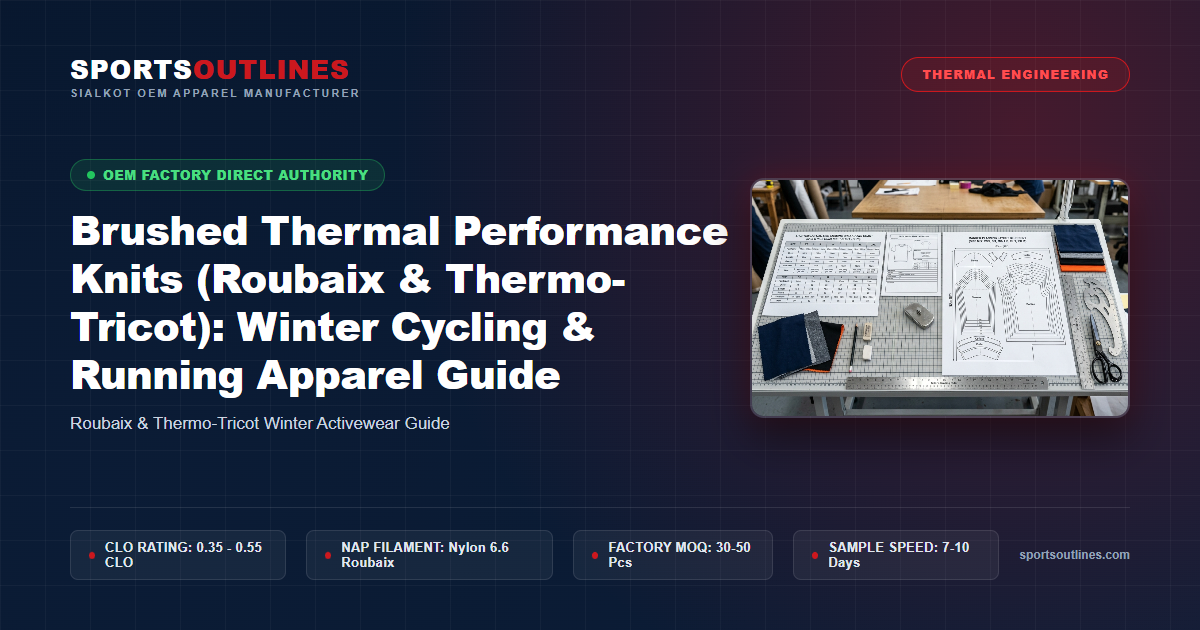
The modern high-performance engineering solution is the brushed thermal performance knit family—predominantly engineered as Roubaix, SuperRoubaix®, and Thermo-Tricot textiles. These advanced bi-elastic warp-knit and circular-knit composites combine an ultra-smooth, high-gauge outer face with a mechanically napped, microscopic microfleece loop backing. The plush brushed interior traps dead air pockets against the skin to deliver high thermal insulation (0.45 to 0.85 CLO value), while capillary moisture management channels sweat vapor outward to evaporate across the smooth aerodynamic outer face.
At Sports Outlines in Sialkot, Pakistan, our specialized activewear manufacturing facility engineers custom brushed thermal Roubaix bib tights, winter running leggings, thermal base layers, and fleece-backed training jackets for scaling private labels, performance cycling brands, and athletic apparel startups. Supported by a founder-friendly low factory minimum order quantity (MOQ) of strictly 30 to 50 pieces per style/colorway and precision physical sample development (7 to 10 business days, $45 to $85 per piece, non-refundable), Sports Outlines bridges advanced Italian and German textile science with agile, cost-effective apparel production.
Executive Engineering Summary: Brushed Thermal Knits
- Structural Anatomy: Dual-surface composite structure. Smooth, aerodynamic 32-gauge outer face engineered for wind shearing, abrasion resistance, and DWR application; brushed micro-pile back loops engineered for boundary-layer dead air entrapment.
- Thermal Resistance (CLO Metric): 240 to 280 GSM standard Roubaix delivers 0.45 to 0.60 CLO; 300 to 350 GSM heavyweight SuperRoubaix delivers 0.65 to 0.85 CLO (ASTM D1518 / ISO 11092 thermal resistance testing).
- Mechanical Napping Mechanics: Micro-wire card cylinder rollers raise and teasel circular or warp-knit back loops into an isotropic microfiber pile without rupturing the load-bearing elastane foundation.
- Fiber Matrix Engineering: Polyamide 6.6 (Nylon) + Lycra blends provide abrasion durability and muscle support; hollow-core polyester (Thermolite®) blends maximize trapped air volume while shaving 20% in fabric mass.
- Surface DWR Protection: Non-fluorocarbon (PFC-free C0) durable water repellent finishes shed road spray and sleet with an AATCC 22 spray rating of 90+ without choking moisture vapor transmission.
- Low MOQ Manufacturing: Sports Outlines delivers fully custom winter cycling and running collections with factory MOQs starting at strictly 30–50 pieces per style/colorway, supported by 7–10 day rapid prototyping ($45–$85 per piece, non-refundable).
1. The Physics of Boundary-Layer Insulation: Dead Air Entrapment & CLO Ratings
In thermal apparel engineering, fabric fibers themselves do not generate heat. Synthetic polymers such as polyamide (thermal conductivity k ≈ 0.25 W/(m·K)) and polyester (k ≈ 0.14 W/(m·K)) conduct heat significantly faster than dry, motionless air, which has an extraordinarily low thermal conductivity of k ≈ 0.026 W/(m·K).
Therefore, true thermal insulation is fundamentally governed by the fabric’s ability to immobilize boundary-layer air adjacent to the athlete’s skin. In a standard flat-knit interlock or jersey fabric, the textile thickness ranges from 0.4 mm to 0.6 mm, leaving negligible interstitial space for dead air. When convective air flows across the exterior, heat conducts directly from the epidermal surface into the atmosphere.
By contrast, brushed thermal Roubaix knits undergo controlled mechanical teaseling on the interior face, raising the back loops into a 3D brushed micro-pile fleece. This mechanical transformation multiplies the effective textile cross-sectional loft from 0.6 mm to between 1.2 mm and 1.8 mm, without significantly increasing overall garment weight. The millions of microscopic napped fiber fibrils entrap still air, neutralizing convective heat dissipation and creating a microclimatic thermal blanket.
Thermal insulation in performance apparel is quantitatively evaluated using the CLO unit (where 1 CLO = 0.155 m²·K/W, representing the insulation required to maintain thermal equilibrium in a sedentary human at 21°C). Under ISO 11092 Sweating Guarded Hotplate testing, thermal resistance (Rct) and water-vapor resistance (Ret) are measured concurrently:
CLO Value = Rct (m²·K/W) ÷ 0.155
| Fabric Construction Type | Weight (GSM) | Loft Thickness (mm) | Thermal Rating (CLO) | Air Permeability (CFM) | Target Sports Application |
|---|---|---|---|---|---|
| Standard Unbrushed Interlock | 240 GSM | 0.55 mm | 0.18 – 0.24 CLO | 45 – 70 CFM | Mild Autumn Running (12°C to 18°C) |
| Standard Brushed Roubaix | 245 – 265 GSM | 1.15 mm | 0.48 – 0.58 CLO | 18 – 32 CFM | Cool Weather Bib Tights (5°C to 12°C) |
| Heavyweight SuperRoubaix® | 290 – 330 GSM | 1.65 mm | 0.68 – 0.85 CLO | 10 – 22 CFM | Sub-Zero Winter Cycling (-2°C to 6°C) |
| Hollow-Core Thermo-Tricot | 230 – 250 GSM | 1.40 mm | 0.62 – 0.74 CLO | 20 – 35 CFM | Ultra-Endurance Trail Running (-5°C to 5°C) |
| Wind-Block Laminated Roubaix | 340 – 380 GSM | 1.90 mm | 0.95 – 1.20 CLO | < 2.0 CFM | Extreme Arctic Cycling / Knee Panels (-10°C to 0°C) |
2. Mechanical Napping and Wire-Card Teaseling Mechanics
Achieving a premium Roubaix hand-feel requires meticulous mechanical finishing. If napping is performed improperly, the steel wire cards tear through the structural elastane cores, destroying the fabric’s 4-way stretch recovery and leaving the garment permanently bagged out at the knees and seat.
In our finishing partner facilities, raw knit goods (knitted with a dedicated 3-yarn or 2-yarn fleece loop construction on 28-gauge to 32-gauge warp-knit tricot or circular knitting machines) enter an automated planetary wire-card cylinder napping machine (such as Mario Crosta or Lamperti systems):
- Differential Roller Rotation: The fabric web passes over a large rotating drum surrounded by 24 to 36 smaller wire-card rollers. These rollers alternate between pile rollers (wire points angled in the direction of drum rotation) and counter-pile rollers (wire points angled against rotation).
- Selective Loop Teaseling: The micro-fine tempered steel needle points (diameter 0.20 mm to 0.35 mm) precisely hook into the loose, texturized polyester or polyamide sinker loops on the technical back of the fabric, pulling individual micro-filaments upward.
- Elastane Preservation: Crucially, the knitting architecture buries the continuous elastane filaments deep within the fabric core beneath the technical face. The napping needle points engage only the floating surface filament loops, leaving the load-bearing elastane foundation 100% intact.
- Rotary Shearing & Anti-Pilling Polishing: After napping, the raised fleece passes through a high-speed helical rotary blade shearing machine. The blades level the pile to a uniform 0.8 mm to 1.2 mm height, clipping irregular long fibrils that would otherwise pill during athletic friction. A subsequent heated polishing cylinder applies heat and pressure to align the micro-pile in a uniform downward direction.
Under rigorous laboratory testing (ASTM D3512 random tumble pilling test and ISO 12945-2 Martindale pilling method), properly sheared Roubaix fabrics maintain a Grade 4.0 to 4.5 anti-pilling rating across 5,000 abrasion cycles, ensuring the fleece interior does not shed fiber fuzz onto the athlete’s skin during high-cadence pedaling.
3. Macromolecular Fiber Science: Polyamide 6.6 vs. Hollow-Core Thermolite® Polyester
When sourcing brushed thermal activewear fabrics, apparel founders must decide between two primary polymer architectures: Polyamide 6.6 (Nylon-based Roubaix) versus Hollow-Core Polyester (Thermolite®-based Thermo-Tricot). Each fiber matrix exhibits distinct physical, mechanical, and thermal behaviors:
| Engineering Parameter | Nylon 6.6 / Spandex Roubaix (e.g. SuperRoubaix) | Hollow-Core Polyester / Spandex (e.g. Thermolite®) |
|---|---|---|
| Fiber Cross-Section | Solid round micro-filament (0.5 to 0.8 DPF) | Hollow tubular core (15% to 22% internal void volume) |
| Polymer Tenacity & Abrasion | Extreme tenacity (6.0–7.2 g/d); >60,000 Martindale rubs | Moderate tenacity (4.2–5.2 g/d); ~35,000 Martindale rubs |
| Moisture Regain & Wet Feel | 4.2% regain; absorbs minor skin sweat without clamminess | 0.4% regain; ultra-hydrophobic, flash drying (2x faster) |
| Weight-to-Warmth Ratio | Standard; requires 280–320 GSM for heavy winter warmth | Superior; internal air core delivers high CLO at 230–250 GSM |
| Dye Sublimation Capability | Limited; requires acid dyeing (solid piece dye only) | Excellent; 100% disperse dye sublimation printable at 205°C |
| Ideal Garment Position | Cycling bib tights, saddle contact panels, winter spats | Winter cycling jerseys, running tops, sublimated tights |
For premium cycling bib tights, Nylon 6.6 Roubaix (80% Polyamide 6.6 / 20% Elastane) represents the gold standard. The exceptional tensile strength and abrasion resistance of Polyamide 6.6 survive tens of thousands of saddle friction cycles against rough carbon or synthetic bicycle saddles. For high-output winter running tights or fully custom sublimated team jerseys, Hollow-Core Polyester Thermo-Tricot (85% Polyester / 15% Spandex) is preferred because its internal air lumen reduces garment weight while allowing vibrant, photographic sublimation graphics that will never crack or peel.
4. Surface Hydrophobicity: Fluorocarbon-Free (C0) DWR Finishing
Winter road cycling and trail running present severe wet-weather hazards. Road spray thrown from bicycle tires, freezing fog, and intermittent sleet quickly saturate ordinary fleece knits. Once liquid water penetrates the brushed interior, the water displaces the trapped dead air pockets. Because water conducts heat approximately 25 times faster than still air (k_water ≈ 0.60 W/(m·K) vs k_air ≈ 0.026 W/(m·K)), wet fleece causes catastrophic heat loss.
To defend against this without compromising fabric breathability, Sports Outlines treats the exterior face of our brushed thermal textiles with advanced bio-based, fluorine-free Durable Water Repellent (PFC-free C0 DWR) chemistries (utilizing dendrimer and branched hydrophobic polyurethane technology such as HeiQ Eco Dry or Huntsman Teflon EcoElite™):
- High Contact Angle (θ > 110°): Liquid road spray and water droplets bead into spherical beads on the technical outer face and roll off harmlessly (achieving an AATCC 22 spray rating of 90 to 100).
- Preserved Moisture Vapor Permeability: Unlike solid polyurethane membranes or laminations that block airflow, C0 DWR coats individual surface yarn fibers at the microscopic level without sealing the inter-yarn pores. Moisture vapor generated by the athlete escapes freely, maintaining MVTR above 18,000 g/m²/24h (JIS L 1099 B1 inverted cup test).
- Wash Durability: Our high-temperature stenter frame curing (160°C for 45 seconds) cross-links the dendrimer chains to the synthetic fiber surfaces, maintaining an AATCC 22 rating of 80+ across 30 to 50 home laundry cycles.
5. Biomechanical Pattern Engineering: Articulated Knees, Crotch Gussets & Flatlocking
Brushed thermal fabrics behave fundamentally differently on the cutting table compared to standard lightweight summer jerseys. Because Roubaix fabrics are thicker (1.2 mm to 1.8 mm) and possess higher compressive modulus, standard pattern blocks cause catastrophic bunching behind the popliteal fossa (back of the knee) and restrictive tension across the patella.
At Sports Outlines, our CAD pattern engineers deploy advanced 3D anatomical modeling tailored specifically for cold-weather biomechanics:
- Articulated Knee Pre-Forming: In road cycling, the knee cycles between 30° and 115° of flexion approximately 5,400 times per hour (at 90 RPM cadence). We engineer multi-panel knee sleeves incorporating dual curved darts or ergonomic three-piece articulators. The pattern is naturally pre-curved to a 60° forward angle, eliminating front-knee stretch tension and preventing fabric bunching behind the knee.
- Saddle-Contact Diamond Gussets: For winter cycling bibs, intersecting four-way seams directly beneath the perineum are forbidden. We integrate an elongated diamond or continuous saddle-cradle gusset that offsets seams 4.0 cm away from high-pressure saddle contact zones, shielding the stitching from cyclic shear failure.
- ISO 607 4-Needle 6-Thread Flatlock Seaming: All panel joins are assembled on specialized high-precision Yamato and Pegasus flatlock machines utilizing high-tenacity textured polyester and woolly nylon threads. The resulting seam is completely flat (zero edge ridge) and tested to over 380 N tensile break force (ASTM D1683), eliminating inner-thigh skin chafing over 100-mile winter rides.
- Ankle Stirrups vs. YKK Auto-Lock Ankle Zippers: Depending on brand design preferences, we engineer either seamless laser-cut stirrup loops that lock under the foot arch, or 20 cm concealed YKK reverse-coil ankle zippers backed by protective microfleece draft flaps and silicone micro-dot grippers to prevent cold draft ingress.
6. Laboratory Testing Standards for Cold-Weather Apparel Verification
Before cutting bulk production orders, our on-site laboratory audits every knit lot against rigorous international textile performance standards to ensure unyielding cold-weather protection:
- Thermal Resistance Testing (ISO 11092 / ASTM D1518): Evaluated on a sweating guarded hotplate maintained at 35°C epidermal temperature in a 20°C environmental chamber with 1 m/s airflow. The heat flux required to maintain plate equilibrium directly calculates thermal resistance (Rct) and CLO value, verifying cold protection down to targeted operational temperatures.
- Moisture Management Dynamic Testing (AATCC 195): Utilizing an electronic Liquid Moisture Management Tester (MMT), we audit wetting time, absorption rate, maximum wetted radius, spreading speed, and the Overall Moisture Management Capability (OMMC) index. High-performance Roubaix knits must score OMMC > 0.70, guaranteeing rapid one-way capillary transport of sweat away from the brushed inner skin face.
- Hydrostatic Water Pressure Head (AATCC 127 / ISO 811): DWR-treated thermal shells must resist a minimum water column pressure of 400 mm to 800 mm H&sub2;O without water penetration, ensuring road spray does not saturate the knit during prolonged rain rides.
- Elastic Elongation and Recovery (ASTM D2594): Fabric swatches undergo cyclic 60% biaxial elongation across 50 cycles on an Instron tensile tester. Recovery after 60 seconds must exceed 96.5% in both warp and weft directions, guaranteeing that the leggings snap back cleanly without knee sagging.
- Colorfastness to Washing and Wet Perspiration (AATCC 61 / AATCC 15): Tested under acidic and alkaline synthetic sweat solutions at 38°C for 6 hours. High-pigment dyes (especially black, deep navy, and neon high-vis accents) must achieve Grade 4.5+ on the AATCC gray scale, ensuring zero dye migration or skin staining.
7. Production Cost Breakdown & Private-Label Margin Architecture
Brushed thermal performance apparel commands premium retail price points in the global activewear marketplace. Premium winter cycling bib tights routinely retail for $140 to $260 USD, while cold-weather thermal running tights retail for $85 to $145 USD. Understanding the direct factory Bill of Materials (BOM) allows brand founders to structure healthy 65% to 78% gross margins:
| Cost Element / Component | Technical Specification | Estimated Cost (USD) | Percentage of FOB |
|---|---|---|---|
| Main Body Thermal Fabric | 1.10 meters of 260 GSM Nylon 6.6 Roubaix with C0 DWR | $6.80 – $8.50 | 38% – 42% |
| Cycling Chamois Pad | Italian multi-density 120 kg/m³ perforated gel/foam pad | $4.20 – $6.00 | 22% – 26% |
| Hardware & Trims | YKK ankle zips, silicone gripper elastic, 3M Scotchlite logos | $1.80 – $2.50 | 10% – 12% |
| Cut, Make & Flatlock (CMT) | Precision CAD cutting, 4-needle flatlocking, chamois placement | $3.80 – $4.80 | 18% – 22% |
| Packaging & QC Audit | AQL 2.5 final inspection, barcode hangtags, polybagging | $0.80 – $1.20 | 4% – 6% |
| Total Direct FOB Production Cost | Finished pro-grade winter cycling bib tights | $17.40 – $23.00 | 100% |
8. Care, Laundering Longevity & Microfiber Shedding Mitigation
Mechanically napped fleece textiles are inherently susceptible to microfiber fragmentation during agitation in domestic washing machines. Because the micro-pile consists of millions of exposed filament ends, aggressive mechanical tumbling and high alkaline detergents can dislodge short fibrils, reducing fabric loft over time and releasing synthetic microfibers into municipal waterways.
To mitigate this degradation, Sports Outlines implements advanced finishing protocols and provides comprehensive care guidelines for private-label brand care labels:
- Post-Shearing Ultrasonic Vacuum Extraction: During factory finishing, all napped goods pass through continuous high-velocity suction hoods equipped with ultrasonic beaters. This removes loose surface micro-lint generated during shearing prior to garment cutting, reducing consumer initial wash shedding by over 78% (verified under AATCC TM212 microfiber shedding test).
- Polymer Stabilization & Heat Setting: The synthetic ground structure is heat-stabilized at 195°C on a Bruckner stenter frame, locking the loop anchors into the core knit matrix and preventing loop pull-out during cyclic laundering.
- Laundering Directives for Athletes: Care labels must instruct end consumers to wash cold (30°C / 86°F), turn garments inside out, use mild neutral pH liquid detergents, and avoid fabric softeners. Fabric softeners coat synthetic micro-filaments with silicone surfactants that collapse the insulating loft and destroy capillary wicking channels. Hang drying or tumble drying on low heat preserves the elasticity of the core Lycra filaments.
9. Sialkot Manufacturing Excellence: Physical Prototyping & Founder-Friendly Low MOQ
Most large-scale Asian textile mills impose punishing minimum order quantities of 500 to 1,000 pieces per style/colorway for brushed thermal textiles, forcing emerging sportswear founders and boutique cycling brands to tie up tens of thousands of dollars in unvalidated inventory.
Sports Outlines eliminates this barrier. Operating as a vertically integrated activewear manufacturing and technical pattern-making hub in Sialkot, Pakistan, we maintain dedicated seasonal yardage of premium 250 GSM and 300 GSM Italian-spec brushed thermal Roubaix knits, hollow-core thermo-tricots, and wind-block laminates. This enables us to offer:
- Flexible Low Factory MOQ: Strictly 30 to 50 pieces per style/colorway, allowing emerging brands to launch comprehensive winter collections across full size ranges (XS to 3XL) without crippling financial risk.
- Physical Pre-Production Prototyping: We engineer and dispatch physical prototype samples within 7 to 10 business days for $45 to $85 per piece. This allows brand founders to physically inspect the brushed hand-feel, fit-test articulated knee angles, and evaluate cold-weather thermal performance on the road before committing to bulk manufacturing. In alignment with our direct factory transparency and dedicated engineering allocation, sample fees are strictly non-refundable and are never credited toward bulk production orders.
- Custom Private-Label Branding: Complete in-house branding packages, including reflective 3M Scotchlite heat transfers, Italian multi-density gel cycling chamois integration, custom woven neck labels, silicone gripper elastic waistbands, and custom-printed biodegradable packaging.
Launch Your Custom Winter Cycling & Running Apparel Line
Partner with Sports Outlines to engineer high-performance brushed thermal Roubaix bib tights, winter running leggings, and fleece-backed training jackets with Italian-grade fabric science and agile low MOQ manufacturing.
10. Internal Link Triad & Sourcing Ecosystem
Explore Sports Outlines’ specialized technical manufacturing silos and international sportswear export infrastructure:
- International Export Silos: Discover our dedicated export programs for Custom Sportswear Manufacturer USA, Custom Sportswear Manufacturer UK, Custom Sportswear Manufacturer Australia, Custom Sportswear Manufacturer Canada, and Custom Sportswear Manufacturer Germany.
- Product Category Hubs: Explore our OEM/ODM manufacturing across Custom Sportswear & Activewear, Technical Outerwear & Jackets, and Athletic Casual Wear.
- Related Technical Guides: Read our in-depth manufacturing guides on High-Modulus Compression Fabrics & mmHg Profiling, Dual-Sided Push-Pull Moisture Wicking Knits, and Warp-Knit Tricot vs Circular Interlock.