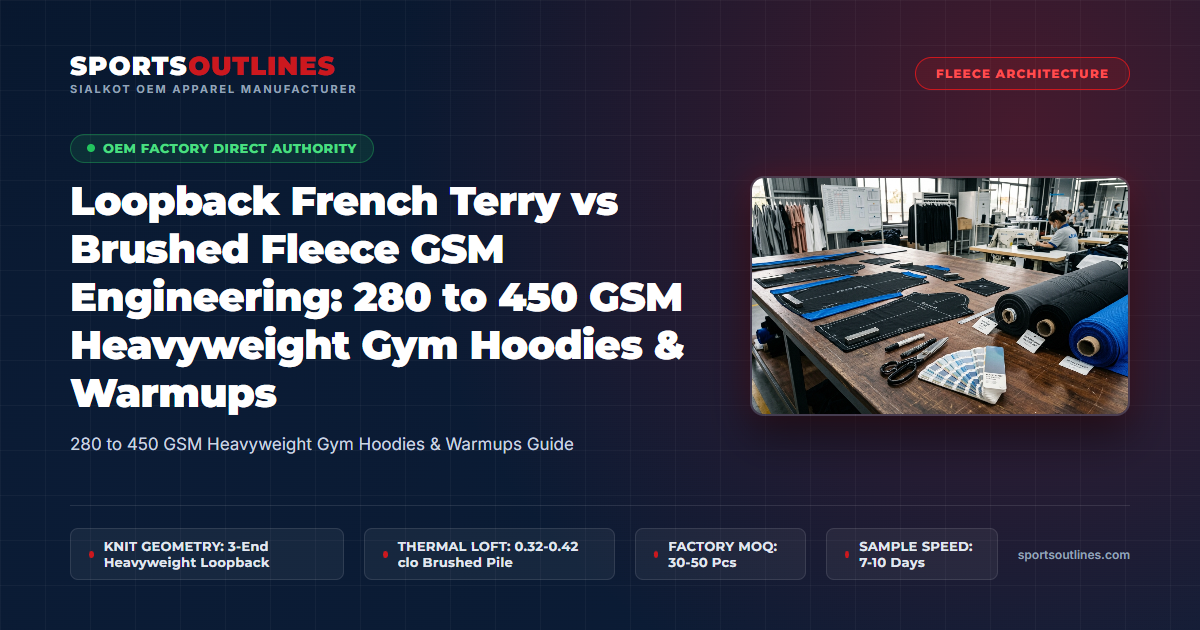
In modern athletic apparel and luxury gymwear, no garment commands greater brand loyalty, higher retail perceived value, or more frequent seasonal reorders than the heavyweight warmup hoodie and training pullover. From boxy, drop-shoulder streetwear gym silhouettes to tailored performance warmups, the core structural foundation of the garment is defined by its fleece architecture. Yet, apparel brand founders, technical designers, and sourcing managers frequently struggle to navigate the technical trade-offs between loopback French terry vs brushed fleece GSM engineering: choosing between unbrushed loopback moisture breathability versus mechanical brushed loft insulation, dialing in yarn count hierarchies across 3-end fleece knitting needles, controlling post-wash dimensional torque, and calibrating fabric density across the 280 to 450 GSM spectrum.
At Sports Outlines, an agile OEM/ODM custom performance apparel manufacturer based in Sialkot, Pakistan, we operate comprehensive circular knitting, industrial napping, dyeing, and precision garment assembly facilities. This definitive manufacturing blueprint provides technical founders and apparel developers with an end-to-end masterclass on fleece engineering. We deconstruct the physics of 3-end knit loop geometry, compare loopback French terry against mechanical brushed fleece across all performance criteria, analyze GSM weight classifications from 280 to 450 GSM, detail industrial wire napping and shearing processes, outline stenter anti-torque stabilization, provide full factory FOB cost transparency, and present our rapid physical prototype sampling program.
1. The Anatomy of 3-End Fleece: Face Yarn, Tie Yarn & Inlay Loop Yarn
To understand how luxury gym hoodies achieve their heavy drape, crisp exterior surface, and plush interior hand-feel, developers must first understand circular fleece knitting architecture. While lightweight sweat tops occasionally use low-cost 2-end fleece (which is prone to loop pullout and face distortion), pro-grade athletic warmups exclusively utilize 3-end fleece circular knitting technology (knitted on specialized circular machines such as Mayer & Cie MBF 3.2 or Terrot S3P 148):
- Face Yarn (Ground Yarn): Spun from fine, high-twist combed ring-spun cotton (typically 30/1s or 32/1s Ne) or compact combed cotton. The face yarn forms the smooth, flat technical jersey exterior visible on the outside of the hoodie. Its tight gauge and low hairiness provide an ultra-clean, uniform canvas for screen printing, direct-to-film (DTF) transfers, high-density silicone prints, and embroidery, while delivering high Martindale abrasion resistance against surface pilling.
- Tie Yarn (Binding / Stitch Yarn): Knitted from fine filament polyester (such as 70D/24F or 75D/36F texturized polyester) or fine cotton yarn (40/1s Ne). The tie yarn functions as the structural internal anchor: it mechanically binds the heavy backing loop yarn directly to the face yarn without penetrating to the outer face. This eliminates the common defect known as “fleece strike-through”—where coarse backing fibers poke through to the exterior surface, ruining print clarity and causing premature pilling.
- Loop Yarn (Backing / Inlay Fleecy Yarn): Spun from heavy, low-twist carded or rotor cotton (ranging from 10/1s to 16/1s Ne). The loop yarn is fed through a specialized lower dial needle that lays the thick yarn into the rear of the knit without forming a full knitted stitch. In unbrushed loopback French terry, this yarn forms neat, orderly diagonal or horizontal loops; in brushed fleece, this low-twist yarn is mechanically shredded into a dense, cloud-like thermal fleece matrix.
| Textile Attribute | Loopback French Terry (Unbrushed) | Brushed Fleece (Napped & Sheared) | 2-End Polar Fleece (100% Poly) |
|---|---|---|---|
| Interior Surface Morphology | Intact, distinct loop arches (pile loops) | Plush, napped fibrous wool-like pile | Double-sided sheared polyester micro-pile |
| Thermal Insulation (Clo Value) | 0.18 – 0.24 clo (Moderate breathability) | 0.32 – 0.42 clo (+75% Dead-Air Loft) | 0.38 – 0.48 clo |
| Moisture Absorption & Wicking | Rapid capillary absorption (<1.2s AATCC 79) | Slower (Fibers trap moisture inside loft) | Hydrophobic (Sweat rolls off surface) |
| Air Permeability (ASTM D737) | 85 – 120 ft³/min/ft² (High airflow) | 35 – 55 ft³/min/ft² (Wind blocking) | 40 – 60 ft³/min/ft² |
| Internal Fiber Shedding / Lint | Zero shedding (Intact loop filaments) | Moderate initial lint (Eliminated by wash) | Low (Synthetic heat-set pile) |
| Primary Ideal Athletic Climate | Spring / Summer / Indoor Gym (4-Season) | Autumn / Sub-Zero Winter Outdoor Warmup | Extreme cold mountaineering midlayer |
2. Unbrushed Loopback French Terry: Breathability & 4-Season Performance
In modern high-end activewear, unbrushed loopback French terry has become the preferred fabric for four-season gym warmups, studio layers, and lifestyle athletic apparel:
- Capillary Loop Absorption Dynamics: Because the backing loops remain intact, they act like miniature sponges. When an athlete begins sweating during intense warmup drills, the large surface area of the cotton loop arches pulls liquid perspiration immediately away from the skin via capillary action (water drop absorption under 1.2 seconds per AATCC 79). This liquid is distributed evenly across the loop network, preventing sweat from pooling on the body.
- Exceptional Dynamic Air Permeability: Unlike brushed fleece, which fills interior voids with a dense blanket of fuzz, loopback French terry maintains clear micro-channels between adjacent loop rows. Fabric air permeability measures between 85 and 120 ft³/min/ft² (ASTM D737). This permits convective airflow during intense indoor training sessions, preventing heat accumulation and allowing athletes to train hard without immediately overheating.
- Zero Interior Lint Shedding: A frequent complaint from consumers wearing new brushed hoodies over white undershirts is “lint shedding”—loose fibers from the brushed backing transferring onto their base layer. Because French terry loops are unbroken and anchored by the tie yarn, it exhibits zero lint transfer from the very first wear.
- Crisp Architectural Silhouette: In high GSM weights (380 to 450 GSM), unbrushed French terry possesses higher structural bending rigidity than brushed fleece. This gives garments the structured, boxy, drop-shoulder silhouette popularized by premium streetwear and modern gym aesthetics.
3. Mechanical Brushed Fleece: Napping Physics, Loft & Thermal Insulation
For true cold-weather warmups, outdoor winter athletics, and cozy sideline apparel, brushed fleece provides unmatched thermal insulation and luxurious tactile softness:
- The Mechanics of Wire Cylinder Napping (Raising): To convert 3-end loopback knit into brushed fleece, dyed rolls are fed through an industrial napping machine (such as a Mario Crosta or Sperotto Rimar wire cylinder napper). The fabric passes over revolving cylinders covered with thousands of angled metallic card wires (wire clothing). These wire needles hook into the soft, low-twist 10/1s or 12/1s cotton loop yarn, fracturing the loop arches and raising millions of individual fiber ends to create a deep, continuous, velvety pile.
- Trapping Dead-Air Pockets (Clo Value Enhancement): Air is one of nature’s best thermal insulators, possessing a thermal conductivity of only 0.026 W/m⋅K. The napped fiber matrix traps vast quantities of immobile “dead air” within its three-dimensional structure. This boosts the thermal insulation value of the fabric by 70% to 85% (achieving 0.32 to 0.42 clo at 350 GSM), shielding the athlete against wind chill and sub-zero temperatures.
- Precision Cylinder Shearing & Anti-Lint Wash: Following wire napping, the raised pile is uneven. Sports Outlines runs the fleece through a precision rotary shearing cylinder equipped with helical ledger blades. The shearing blade trims all raised fibers to an exact, uniform height (typically 1.2 to 1.5 mm). The fabric then undergoes an intensive suction de-linting pass and enzymatic bio-wash to wash away loose micro-fibrils, preventing consumer lint shedding.
4. GSM Weight Classifications: From 280 to 450 GSM Engineering
Calibrating Grams per Square Meter (GSM) is the single most critical engineering decision when developing a custom hoodie line. At Sports Outlines, we engineer four distinct GSM weight tiers tailored to specific athletic and commercial use cases:
| GSM Tier | Yarn Spec (Face / Tie / Loop) | Circular Machine Gauge | Ideal Garment Silhouette | Best Commercial Application |
|---|---|---|---|---|
| 280 – 300 GSM (Light-Mid) | 32/1s Combed + 75D Poly + 16/1s Loop | 24 Gauge (24G) | Slim athletic pullover, running zip-up | Spring warmups, high-intensity crossfit, active running |
| 320 – 350 GSM (Midweight Standard) | 30/1s Combed + 75D Poly + 12/1s Loop | 20 Gauge (20G) | Regular athletic fit, classic gym crewneck | Core teamwear, collegiate athletic merchandising, gym uniforms |
| 380 – 400 GSM (Heavyweight Classic) | 26/1s Combed + 100D Poly + 10/1s Loop | 18 Gauge (18G) | Relaxed athletic drop-shoulder hoodie | Premium DTC activewear, bodybuilding warmups, winter gymwear |
| 420 – 450+ GSM (Super-Heavy Luxury) | 20/1s Combed + 30/1s Cotton + 8/1s Loop | 16 Gauge (16G High-Torque) | Oversized boxy architectural streetwear hoodie | Luxury streetwear gym collections ($120–$180 retail price point) |
5. Anti-Torque Stenter Heat-Setting & Sanforizing Compacting
The most common manufacturing flaw in cheap commercial hoodies is spiral torque (side seam twisting). Because circular knitting machines rotate continuously in one direction, residual twist stresses accumulate within the heavy yarn loops. When the consumer washes the hoodie at home, these internal stresses release, causing the side seams to twist dramatically across the stomach. At Sports Outlines, we eliminate torque through precision finishing:
- Open-Width Stenter Pin-Chain Straightening: Circular knitted fleece rolls are slit open longitudinally and processed in open-width format through our 8-chamber Bruckner stenter frame. Computerized optoelectronic weft-straightening sensors detect yarn course alignment in real time, mechanically skewing the pin chains to correct loop angle deviations. Fabrics are heat-set at 170°C to 180°C under controlled overfeed, permanently locking yarn spirality to under ≤2.0%.
- Rubber-Belt Sanforizing Compacting (Shrinkage Control): Heavyweight fleece can shrink 8% to 14% if left uncompacted. We pass all fleece through heavy-duty rubber belt compressive compactors (such as Ferraro or Monforts) applying 18% to 22% mechanical overfeed under 2.5 bar saturated steam pressure. This forces the loop structures together, pre-shrinking the fabric mechanically so that post-wash domestic shrinkage (AATCC 135) is certified strictly within ±2.5% length and width.
6. Precision Cut & Sew: 2×2 Rib Matching, Double-Layer Hood & Kangaroo Bartacking
Assembling a 400+ GSM heavyweight hoodie requires specialized sewing machinery, reinforced trim specifications, and heavy-duty needle setups:
- Heavyweight 2×2 Ribbing Calibration: A luxury heavyweight hoodie feels cheap if paired with flimsy collar or cuff ribbing. We knit dedicated 420 to 480 GSM 2×2 rib knit spun from 30/2s combed cotton intimately blended with 5% high-modulus Creora® elastane. This ensures that cuffs, bottom waistbands, and side rib gussets snap back tightly without stretching out or bagging after months of wear.
- Double-Layered Ergonomic Crossover Hood: We engineer our hoods with a self-fabric double-layer construction (both outer shell and interior lining are cut from the identical 380–450 GSM fleece). The hood panels feature an ergonomic 3-piece athletic cut with a deep front crossover neckline. This gives the hood structural rigidity, allowing it to stand upright around the neck without collapsing limply onto the shoulders.
- Structural Kangaroo Pocket Bartacking: Front pouch kangaroo pockets experience heavy pull forces when athletes insert their hands or store heavy smartphones. We reinforce all four stress points using computerized CNC electronic bartackers (Juki LK-1900BN), delivering 42-stitch reinforced bartacks that guarantee lifetime pocket seam integrity.
- Reinforced Flatlock & 3-Needle 5-Thread Topstitching: Shoulder seams, armholes, and hood seams are joined using heavy-duty 4-thread overlock followed by twin-needle or 3-needle 5-thread topstitching. This lays the bulky thick seams flat against the body, maximizing wear comfort and reinforcing seam pull strength beyond 450 Newtons (ISO 13935-2).
7. Screen Printing, High-Density Silicone & Puff Ink Parameters
Heavyweight athletic hoodies are the primary vehicle for high-impact brand graphics. Because heavyweight fleece absorbs ink differently than thin jersey, specialized print chemistry is required:
- High-Density (HD) 3D Silicone Printing: For sharp, architectural chest branding, we apply multi-pass high-density silicone inks through thick capillary stencils (200 to 400 μm). Cured at 140°C, these 3D logos feature sharp 90-degree vertical edges and an ultra-matte, non-tacky finish that will never peel, crack, or fade under heavy wash cycles.
- Suede Puff & Micro-Puff Screen Printing: For vintage collegiate and athletic aesthetics, we formulate expandable puff additives mixed into water-based inks. Upon running through conveyor drying ovens at 160°C, the ink expands into a soft, velvety raised 3D texture that complements the heavy fleece substrate.
- Direct-to-Film (DTF) Industrial Transfers: For intricate multi-color illustrative art, we apply cold-peel DTF transfers using heavy-duty polyurethane adhesive powder. Pressed at 145°C for 15 seconds at 4.5 bar pressure, these transfers penetrate deep into the combed cotton face fibers, offering superior wash durability (AATCC 61 4A Grade 4.5).
8. Direct Factory Cost Transparency & DTC Profit Margins
By partnering directly with Sports Outlines’ manufacturing infrastructure in Sialkot, emerging gymwear founders and established brands access true direct-factory pricing:
| Cost Driver | Technical Component Breakdown | Cost Range (USD) | Share of FOB |
|---|---|---|---|
| Heavyweight Fleece Fabric | 400 GSM 80/20 Cotton/Poly 3-End Fleece (0.85 kg per hoodie) | $5.80 – $6.80 | 46% – 48% |
| Matching 2×2 Heavy Ribbing | 450 GSM Cotton/Spandex ribbing for cuffs, waistband & hood rim | $1.20 – $1.50 | 10% – 11% |
| Cut, Make & Trim (CMT) Assembly | Double-layer hood, kangaroo pocket, flatlock seams, bartacking | $2.80 – $3.40 | 22% – 24% |
| Hardware, Drawcords & Trims | Heavy braided round drawcord, engraved metal aglets & eyelets, labels | $1.10 – $1.40 | 8% – 10% |
| Finishing, Quality Audit & Packing | Steam pressing, AQL 2.5 final inspection, polybagging, carton packing | $0.60 – $0.80 | 5% – 6% |
| Total Direct FOB Unit Cost | Complete pro-grade 400 GSM custom heavyweight gym hoodie | $11.50 – $13.90 | 100% |
In premium activewear and streetwear markets, 400+ GSM heavyweight hoodies retail between $85.00 and $130.00. At a direct factory FOB cost of $11.50 to $13.90, brand owners achieve gross margins exceeding 82% to 89%, providing healthy financial resilience to fuel customer acquisition and brand growth.
9. Garment Dyeing, Pigment Washing & Vintage Distressed Finishes
For streetwear gymwear lines and vintage lifestyle collections, piece dyeing (garment dyeing) after CMT assembly produces an authentic washed-down patina that cannot be replicated with standard roll dyeing:
- Garment Pigment Dyeing & High-Abrasion Enzyme Stone Wash: Hoodies are sewn from prepared-for-dye (PFD) raw ecru fleece using 100% cotton sewing thread. Garments are dyed in industrial rotary drum washers using specialized pigment dyes that mechanically adhere to fiber perimeters rather than penetrating the core. Subsequent cellulase enzyme washing abrades the raised seams, kangaroo pocket edges, and hood rim, creating pronounced high-contrast seam highlights, weathered marbling, and a buttery-soft broken-in hand-feel.
- Reactive Garment Dyeing for Deep Solid Hues: When brands require solid, pitch-black, forest green, or rich navy without washed-out fading, we utilize low-temperature bifunctional reactive dyestuffs in rotary machines. Reactive dyes form covalent chemical bonds with the cellulose glucose units, providing superior colorfastness to laundering (ISO 105-C06 Grade 4.5) while ensuring the garment remains fully pre-shrunk.
- Acid / Mineral Wash & Potassium Permanganate Spraying: For 90s athletic aesthetics, garments undergo localized acid washing using pumice stones soaked in potassium permanganate (KMnO4). The stones gently tumble against the heavyweight fleece face, selectively discharging dye along high-contact panel contours before undergoing sodium metabisulfite neutralization and extensive antichlor wash cycles.
10. Laboratory Performance Testing & Quality Certification Standards
Heavyweight athletic warmups must withstand years of intense training, sweat exposure, and industrial gym laundering. Every fleece production lot at Sports Outlines is certified against strict international test criteria:
| Testing Standard | Test Parameter | Factory Tolerance | Quality Guarantee |
|---|---|---|---|
| AATCC 135 / ISO 6330 | Dimensional stability after 5x 40°C wash & tumble dry | ±2.5% length & width | Zero post-purchase shrinkage or torso shortening |
| AATCC 179 / ISO 16322 | Spirality and seam twist skewness in circular knits | <2.0% maximum torque | Side seams remain dead straight down garment flanks |
| ISO 12945-2 (Martindale) | Face pilling resistance under 9 kPa pressure | Grade 4.0 at 5,000 cycles | High pill immunity against seatbelt and gym bag friction |
| ASTM D3786 (Diaphragm) | Hydraulic bursting strength on 400 GSM fleece | >680 kPa | Eliminates blowout tears at elbows and armhole seams |
| AATCC 8 / ISO 105-X12 | Colorfastness to dry and wet crocking (rubbing) | Dry: Grade 4-5 / Wet: Grade 3-4 | Zero color transfer onto white athletic undershirts |
11. Cutting Room Protocols & Static Relaxation for Heavyweight Knits
Cutting heavyweight 380 to 450 GSM fleece presents substantial physical challenges that do not exist with lightweight single jersey. Because heavyweight fleece possesses high thickness and high loop volume, improper cutting practices lead to severe pattern distortion:
- Mandatory 24 to 48-Hour Relaxation Period: When heavyweight fleece is rolled under winding tension at the stenter frame, the loop structures are mechanically stretched. Sports Outlines mandates that all rolls be unrolled into loose accordion folds across air-flotation spreading tables for 24 to 48 hours prior to cutting. This allows the internal elasticity of the yarn loops to fully normalize, preventing panels from shrinking immediately after cutting.
- Restricted Lay Height (≤24 Plies): A common industry mistake is stacking 60 to 80 plies of heavyweight fleece to speed up production. The immense weight of the upper plies compresses the lower plies, causing the lower pattern pieces to cut wider than the top pieces. We restrict lay height to a maximum of 20 to 24 plies, ensuring uniform sizing across every cut garment.
- Chilled CNC Oscillating Knives: High-density fleece generates extreme friction when cut with high-speed automated blades. We utilize computerized CNC reciprocating knife tables fitted with vortex cold-air jet chilling systems. The chilled air prevents blade friction heat from fusing the polyester tie yarn filaments, guaranteeing crisp, square cut edges with pattern tolerances of ±1.0 mm.
12. Factory Quality Control Checklist & AQL 2.5 Inspection Matrix
To guarantee flawless retail-ready execution for our global brand clients, Sports Outlines enforces a multi-tier quality inspection protocol in accordance with ANSI/ASQ Z1.4 (ISO 2859-1) Level II standards:
- 100% In-Line Needle Detection: Before final polybag packing, every finished hoodie passes through calibrated conveyorized multi-head metal detectors (sensitivities: Fe ≥1.0mm, Non-Fe ≥1.2mm, Sus ≥1.5mm) to verify complete freedom from broken needle fragments, ensuring 100% athlete safety.
- Dimensional Spec Sheet Verification: Finished garments are measured across 18 critical points of measure (chest width, body length, sleeve length, hood height, neck drop, cuff opening, pocket placement) with critical tolerances held strictly within ±1.0 cm.
- Pull Test Strength Verification: Metal eyelets, drawcord aglets, and kangaroo pocket bartacks are subjected to calibrated mechanical pull-gauge testing (ASTM D4846) withstanding forces exceeding >90 Newtons without detachment.
- Export Packaging & Moisture Protection: Heavyweight fleece absorbs ambient moisture if transported in ocean freight containers. Each hoodie is folded with acid-free tissue paper, individually packed in recyclable 40-micron polyethylene bags with micro-perforations, and protected with calcium chloride container desiccants, ensuring garments arrive crisp, mold-free, and warehouse-ready.
Manufacture Pro-Grade Heavyweight Hoodies with Sports Outlines
Bring your custom fleece visions to life with Pakistan’s premier athletic apparel manufacturer. We offer an agile low factory Minimum Order Quantity (MOQ) of strictly 30 to 50 pieces per style/colorway with full size grading from XS to 3XL. Experience our fabric weight and construction precision first-hand with physical prototype samples completed within 7 to 10 business days for $45 to $85 per piece (strictly non-refundable with zero bulk credits, reflecting true labor and yarn allocation).
Explore Related Technical Manufacturing Silos & Fabric Guides
Explore Sports Outlines’ specialized technical manufacturing silos and international sportswear export infrastructure:
- International Export Silos: Discover our dedicated export programs for Custom Sportswear Manufacturer USA, Custom Sportswear Manufacturer UK, Custom Sportswear Manufacturer Australia, Custom Sportswear Manufacturer Canada, and Custom Sportswear Manufacturer Germany.
- Product Category Hubs: Explore our OEM/ODM manufacturing across Custom Sportswear & Activewear, Fitness & Gym Apparel, and Athletic Casual Wear.
- Related Technical Guides: Read our in-depth manufacturing guides on Technical Merino Wool & Core-Spun Yarns, Bamboo Viscose Activewear Textiles, and Combed Cotton vs Poly-Cotton Blends (60/40 vs 50/50).