Textile wet processing—specifically the dyeing and finishing of synthetic knits—represents the single most environmentally destructive phase in the entire apparel manufacturing lifecycle. Conventional aqueous coloration of polyester activewear is an extraordinarily resource-intensive, thermodynamically inefficient process: it consumes between 100 to 150 liters of fresh drinking water per kilogram of dyed fabric, requires thousands of tons of hazardous chemical auxiliaries (surfactants, dispersants, leveling agents, and sodium hydrosulfite for reduction clearing), generates toxic industrial effluent that pollutes developing-world river basins, and burns massive quantities of fossil fuel to generate steam for drying wet fabric in gas-fired stenter ovens. For technical athletic apparel brands seeking genuine decarbonization, switching to recycled fibers alone is an incomplete solution if the fabric is subsequently steeped in hundreds of gallons of boiling, chemical-laden water.
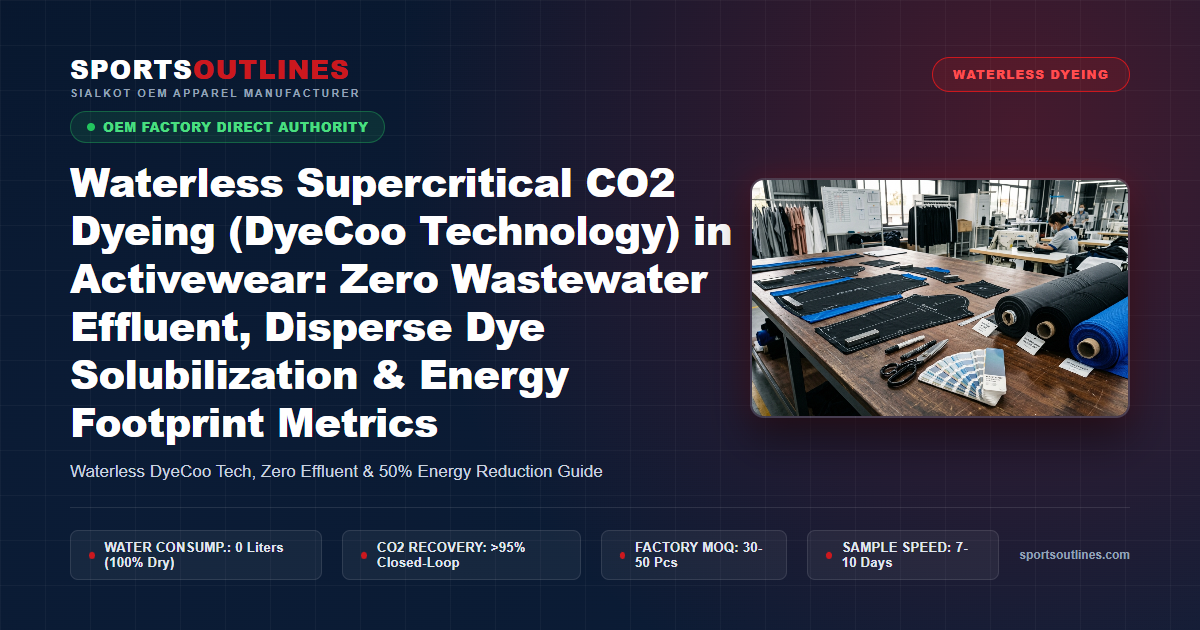
The ultimate industrial revolution in sustainable textile chemistry is waterless supercritical carbon dioxide ($scCO_2$) dyeing, pioneered globally by technologies such as DyeCoo. By exploiting the unique thermodynamics of carbon dioxide elevated past its critical point ($T_c = 31.1^\circ\text{C}$, $P_c = 73.8\text{ bar}$), $scCO_2$ acts as a non-polar solvent that directly dissolves hydrophobic disperse dyestuffs, swells the amorphous regions of polyester filaments, and drives 100% pure dyestuff molecules deep into the fiber core—completely eliminating process water, auxiliary chemicals, and post-dye drying ovens. At Sports Outlines, operating from our advanced athletic manufacturing hub in Sialkot, Pakistan, we lead the integration of waterless, zero-effluent coloration technologies for modern sportswear brands. We provide agile manufacturing solutions with accessible factory minimums of 30 to 50 pieces per style/colorway and dedicated pre-production physical prototype development at $45 to $85 per piece (non-refundable) delivered within 7 to 10 business days.
Technical Sourcing & Supercritical Physics Directory
- 1. The Conventional Aqueous Dyeing Crisis: Water & Effluent
- 2. Physics of Supercritical CO2: Critical Point & Fluid State
- 3. Disperse Dye Solubilization & Fiber Swelling Mechanics
- 4. Closed-Loop Machine Operation: Depressurization & 95% CO2 Recovery
- 5. Elimination of Salts, Dispersants & Reduction Clearing
- 6. Engineering Matrix: Supercritical CO2 vs Aqueous Jet Dyeing
- 7. Life-Cycle Carbon, Energy & Water Savings Metrics
- 8. Low-MOQ Sourcing & Commercial Factory Terms
- 9. B2B Activewear Engineering FAQ
1. The Conventional Aqueous Dyeing Crisis: Water Footprint and Effluent Chemistry
To appreciate the technological necessity of supercritical fluid dyeing, one must examine the severe chemical and thermodynamic inefficiencies of traditional aqueous jet dyeing. Polyethylene terephthalate (PET) is an intrinsically hydrophobic, non-polar polymer with an exceptionally high glass transition temperature ($T_g \approx 75^\circ\text{C} – 80^\circ\text{C}$). Because polyester possesses zero ionic or polar dye-binding receptor sites, it cannot be colored using water-soluble acid, basic, or reactive dyes.
Instead, aqueous dyeing forces hydrophobic disperse dyes into polyester through high-temperature, high-pressure aqueous jet machines operating at 130°C to 135°C and 3.0 to 3.5 bar pressure. However, because disperse dyes are virtually insoluble in water (solubility $< 1.0\text{ mg/L}$), dyehouses must flood the dyebath with massive quantities of synthetic chemical auxiliaries:
- Dispersing Agents: Naphthalene sulfonate formaldehyde condensates or lignin sulfonates added at 2.0 to 4.0 g/L to mechanically suspend insoluble dye particles in water, preventing dye agglomeration and specking.
- Leveling and Carrier Chemicals: Aromatic esters or ethoxylated fatty amines added to retard strike rates and ensure level dye migration across circular knits.
- Harsh Reduction Clearing: Disperse dyes inevitably deposit on the exterior fiber surface as un-fixed surface precipitate. To prevent catastrophic crocking (color rubbing off onto athlete skin), fabrics must undergo aggressive reduction clearing baths containing 2.0 to 4.0 g/L sodium hydrosulfite ($Na_2S_2O_4$) and 3.0 to 5.0 g/L caustic soda ($NaOH$) at 80°C.
This conventional process generates massive ecological destruction: an average dyehouse consumes 100 to 150 cubic meters of fresh water per metric ton of fabric, discharging wastewater with Chemical Oxygen Demand (COD) exceeding 3,000 mg/L, high sulfate loads, and heavy alkalinity into regional waterways. Furthermore, drying wet fabric rolls in gas-fired stenters requires immense thermal energy, accounting for up to 45% of a mill’s total carbon emissions.
Effluent analysis reveals that aqueous dye liquors contain substantial concentrations of dissolved un-hydrolyzed disperse dyes, toxic phenolic leveling agents, and sodium sulfide residues. Even after municipal wastewater treatment, residual micro-pollutants bypass conventional aerobic sludge digesters, altering the pH of freshwater ecosystems, depleting dissolved oxygen levels, and bioaccumulating in aquatic organisms. Transitioning to waterless $scCO_2$ eliminates 100% of this wastewater volume, producing zero gallons of industrial liquid effluent.
2. Thermodynamics of Supercritical CO2: The Supercritical Fluid Phase
Supercritical carbon dioxide dyeing replaces water entirely by harnessing the unique physics of supercritical fluids. Every pure substance possesses a thermodynamic critical point characterized by a critical temperature ($T_c$) and critical pressure ($P_c$). For carbon dioxide ($CO_2$), these parameters are exceptionally mild and industrially accessible:
When carbon dioxide is compressed above 73.8 bar and heated past 31.1°C, the physical boundary between the liquid and gas phases completely disappears. The resulting substance enters the supercritical fluid phase ($scCO_2$), exhibiting an extraordinary hybridization of physical properties:
- Liquid-Like Density ($\rho \approx 0.5 – 0.8\text{ g/cm}^3$): In its supercritical state, $CO_2$ possesses high molecular density comparable to liquid organic solvents, providing powerful solvating capacity to dissolve hydrophobic organic molecules.
- Gas-Like Viscosity and Zero Surface Tension ($\gamma = 0\text{ mN/m}$): Because $scCO_2$ has zero liquid surface tension and gas-like viscosity, it experiences zero capillary resistance. It instantaneously penetrates deep into the densest knitted fabric structures, micro-filament yarn bundles, and tightly wound fabric beams with zero channeling or pressure drop.
- Gas-Like Molecular Diffusivity ($D \approx 10^{-3} – 10^{-4}\text{ cm}^2\text{/s}$): Diffusivity in $scCO_2$ is orders of magnitude higher than in water ($D_{water} \approx 10^{-5}\text{ cm}^2\text{/s}$), enabling dyestuff molecules to migrate into polymer fibers at lightning speeds.
The solvating capacity of supercritical $CO_2$ is mathematically modeled using the empirical Chrastil equation, which relates dye equilibrium solubility ($S$, in g/L) directly to fluid density ($\rho$) and temperature ($T$ in Kelvin):
Where $k$ is an association number representing the average number of $CO_2$ molecules solvating each disperse dye molecule, $a$ is a function of the enthalpy of solvation and vaporization, and $b$ is a constant. Because fluid density $\rho$ is exquisitely sensitive to pressure adjustments around the critical point, mill technicians can modulate dye solubility instantaneously simply by adjusting autoclave pressure valves—without changing bath chemistry or adding salt.
3. Disperse Dye Solubilization and Fiber Swelling Mechanics
The chemical synergy between supercritical $CO_2$ and polyester activewear represents a match of pure physical chemistry. Because carbon dioxide is a non-polar molecule with zero dipole moment (though it possesses a quadrupole moment), it functions as an ideal, non-polar solvent for non-ionic, hydrophobic disperse dyes (such as C.I. Disperse Yellow, Red, and Blue).
The waterless dyeing mechanism operates through four synchronized physical steps:
- Pure Dyestuff Dissolution: Pure, crystalline disperse dyestuff powder—containing zero chemical dispersants, surfactants, or diluents—is placed in a dye dosing vessel. As $scCO_2$ at 120°C and 250 bar circulates through the vessel, the supercritical fluid dissolves the dye, forming a homogenous, clear dye-fluid solution.
- Polymer Plasticization and $T_g$ Depression: As $scCO_2$ penetrates the polyester fabric roll, small $CO_2$ molecules dissolve into the amorphous regions of the polyester polymer matrix. This sorption acts as a molecular plasticizer, increasing free volume and depressing the polymer’s glass transition temperature ($T_g$) by 20°C to 30°C (dropping $T_g$ from ~78°C down to ~50°C).
- Rapid Dyestuff Diffusion: With the polymer chains plasticized and free volume expanded, dissolved disperse dye molecules rapidly diffuse into the fiber core under high concentration gradients. Dye penetration occurs in minutes, compared to hours in aqueous baths.
- Permanent Molecular Entrapment: Dyestuff molecules adsorb onto the polyester chains via van der Waals forces and $\pi-\pi$ aromatic electron interactions.
According to the Vrentas-Duda free volume theory of polymer diffusion, the self-diffusion coefficient of a dye penetrant ($D$) in a glassy polymer scales exponentially with available hole free volume. When $scCO_2$ dissolves into the amorphous domains, it creates micro-voids between polymer chains, increasing the fractional free volume from less than 0.025 up to 0.085. Consequently, the diffusion coefficient of disperse dye in $scCO_2$-swollen polyester accelerates from $10^{-11}\text{ cm}^2\text{/s}$ (in boiling water) up to $10^{-8}\text{ cm}^2\text{/s}$, achieving complete fiber penetration in under 30 minutes.
4. Closed-Loop Machine Operation: Depressurization and 95% CO2 Recovery
The industrial realization of waterless dyeing (commercialized by DyeCoo in their DyeOx systems) utilizes a pressurized beam-dyeing autoclave configured in a completely closed-loop fluid recycling cycle. The operational sequence unfolds with complete automated precision:
- Fabric Loading: Dry polyester fabric (up to 250 to 300 kg per batch) is wound onto a perforated stainless steel beam and sealed inside the high-pressure dye autoclave.
- Pressurization & Dye Circulation: Liquid $CO_2$ from recovery storage tanks is pumped into the vessel and pressurized to 200–250 bar while heating to 100°C–120°C, transitioning into the supercritical phase. The fluid is circulated through the fabric beam from inside-out and outside-in for 60 to 90 minutes.
- Depressurization and Dye Precipitation: At the conclusion of the dyeing cycle, the vessel pressure is reduced from 250 bar down to approximately 50 bar. As pressure drops below the solubility threshold, any remaining un-fixed dyestuff instantly precipitates out of the fluid into a cyclone separator as dry powder, where it is collected for reuse.
- CO2 Condensation and 95% Recovery: Gaseous $CO_2$ exits the separator, passes through condenser refrigeration coils, liquefies, and is pumped back into high-pressure storage tanks. Over 95% to 98% of the carbon dioxide is recaptured and recycled for the subsequent dye batch, with less than 2% to 5% replenishment required.
- Immediate Unloading of Bone-Dry Fabric: When the autoclave is depressurized to atmospheric pressure, the fabric roll emerges completely 100% dry. It requires zero rinsing, zero washing, and zero drying on stenter ovens.
To optimize thermodynamic efficiency, the closed-loop system utilizes plate heat exchangers that capture the heat of compression ($ΔH_{comp}$) generated during the pressurization stage. This thermal energy is stored in insulated heat sinks and transferred to pre-heat the subsequent batch during its fluid circulation phase. By coupling refrigeration condensation with compression enthalpy recovery, total electrical power consumption is stabilized below 1.2 kWh per kilogram of dyed fabric—substantially lower than the electrical and natural gas energy consumed by conventional atmospheric winch or jet dyeing houses.
5. Complete Elimination of Salts, Dispersants, and Reduction Clearing
Beyond saving billions of gallons of water, the profound chemical virtue of supercritical $CO_2$ dyeing is the total elimination of hazardous wet processing chemistry. In conventional aqueous dyeing, commercial disperse dyes contain up to 50% to 60% by weight of inert dispersing agents and lignosulfonates. In $scCO_2$ dyeing, these additives are completely superfluous: only 100% pure dyestuff powder is introduced into the system.
Furthermore, because $scCO_2$ has zero surface tension, un-fixed dyestuff does not smear or precipitate onto the exterior fiber surface as it does in water. When pressure drops during decompression, excess dye drops out in the cyclone separator, leaving the fiber surface immaculately clean. As a result, the aggressive reduction clearing bath (sodium hydrosulfite + caustic soda) is 100% eliminated.
This unlocks unprecedented fabric performance benefits:
- Superior Wash & Rubbing Fastness: Because all dye molecules reside inside the polymer core rather than on the surface, $scCO_2$ dyed fabrics achieve perfect Grade 5 colorfastness to laundering (ISO 105-C06) and Grade 5 dry/wet crocking fastness (ISO 105-X12).
- Preservation of Filament Tenacity: Eliminating caustic alkaline reduction clearing prevents hydrolytic polymer surface degradation, preserving 100% of the fiber’s intrinsic tensile tenacity and tear resistance.
- Flawless Elastane Elasticity Retention: When dyeing poly-spandex blends, aqueous alkaline baths degrade elastane (spandex) cross-links. Supercritical $CO_2$ operates under chemically inert, neutral conditions, preserving 98% of elastane modulus and recovery.
To expand waterless technology to poly-cellulosic hybrid knits (such as 60/40 polyester-cotton gym tees), researchers utilize polar co-solvents (modifiers). By pulsing small fractions of non-toxic bio-ethanol or water micro-emulsions (1.0% to 3.0% by volume) into the $scCO_2$ stream, the fluid’s polarity increases, enabling the simultaneous solubilization and fixation of reactive dyes onto cotton fibers while disperse dyes color the polyester core in a single waterless dye cycle.
6. Comprehensive Technical Engineering Matrix: Supercritical CO2 vs Aqueous Jet Dyeing
The following comparative engineering matrix illustrates the stark operational, physical, and environmental differences between supercritical $CO_2$ dyeing and standard aqueous jet dyeing for activewear polyester fabrics:
| Engineering & Environmental Metric | Supercritical CO2 Dyeing (DyeCoo) | Conventional Aqueous Jet Dyeing | Industry Benefit / Advantage |
|---|---|---|---|
| Fresh Water Consumption | 0 Liters / kg (100% Water-Free) | 100 – 150 Liters / kg | 100% freshwater conservation |
| Wastewater Effluent Discharge | Zero Effluent (0 m³ discharge) | 100 – 150 m³ high-COD toxic effluent | Zero aquatic biome pollution |
| Chemical Auxiliary Additives | 0 g/kg (Pure dyestuff only) | 40 – 80 g/kg (Dispersants, salts, acids) | 100% auxiliary chemical elimination |
| Reduction Clearing Requirement | None Required (Surface is clean) | Mandatory ($Na_2S_2O_4 + NaOH$ at 80°C) | Eliminates caustic sulfur salts |
| Post-Dye Drying Energy | 0 kWh (Emerges 100% dry) | 2.5 – 3.8 kWh/kg (Gas stenter drying) | ~50% total energy reduction |
| Dyeing Cycle Time | 90 – 120 minutes total | 240 – 360 minutes (With wash & dry) | 60% faster factory cycle throughput |
| Colorfastness to Washing & Crocking | Grade 5 / Grade 5 (Perfect) | Grade 4-5 / Grade 4 (Variable) | Zero dye bleed or skin crocking |
This matrix illustrates why supercritical fluid dyeing is universally recognized as the holy grail of sustainable coloration: it completely decouples textile manufacturing from freshwater exploitation while simultaneously cutting energy, cycle time, and chemical loads.
7. Comprehensive Decarbonization and Energy Footprint Metrics
In audited Life-Cycle Assessments (LCA) conducted in compliance with ISO 14040/14044 protocols, waterless supercritical $CO_2$ dyeing delivers astonishing carbon decarbonization metrics:
- 50% Reduction in Thermal Energy Consumption: By eliminating the need to evaporate water from wet fabric rolls (which requires approximately 2,260 kJ of latent heat per kilogram of water), $scCO_2$ coloration slashes overall thermal energy demands in half.
- 40% to 50% Reduction in Operating Greenhouse Gas (GHG) Footprint: Eliminating gas-fired stenter drying ovens and steam boiler fuel combustion directly eliminates approximately 1.5 to 2.2 kg of $CO_2\text{-eq}$ per kilogram of fabric dyed.
- Recycled Carbon Feedstock: The carbon dioxide used in the dyeing machinery is not newly synthesized fossil carbon; it is reclaimed by-product $CO_2$ captured from industrial fertilizer plants and bio-ethanol fermentation facilities, functioning as a non-depleting closed-loop processing medium.
According to audited international Life Cycle Assessments, the cumulative energy demand (CED) of aqueous polyester dyeing stands at approximately 68 to 75 megajoules per kilogram of finished fabric. Waterless supercritical fluid coloration slashes this demand to under 34 megajoules per kilogram—a net 52% reduction in total primary energy consumption. When scaled across high-volume activewear manufacturing runs, this technological transition saves thousands of gigajoules of natural gas and eliminates hundreds of metric tons of scope 1 and scope 2 greenhouse gas emissions.
8. Low-MOQ Sourcing Strategy and Factory Commercial Terms
At Sports Outlines, our mission is to eliminate the technological and commercial barriers that have historically locked independent activewear brands out of revolutionary sustainable innovations. We partner directly with emerging technical athletic apparel founders to deliver waterless, zero-effluent activewear through flexible commercial factory terms:
- Low Production MOQs: Bulk production orders start at just 30 to 50 pieces per style/colorway, enabling brands to produce multi-piece capsule collections across full size ranges (XS to 3XL) with zero excess inventory burden.
- Physical Prototype Development: Dedicated pre-production physical prototype samples are developed at $45 to $85 per piece (non-refundable), encompassing custom pattern development, waterless fabric coloration, and precision assembly within 7 to 10 business days.
- International Export Logistics: Full customs clearance support and streamlined door-to-door freight to brand hubs in the United States, United Kingdom, Australia, Canada, and Germany.
- Comprehensive Product Categories: Full integration across our specialized apparel manufacturing divisions, including technical sportswear, gym & activewear, and athletic casualwear.
On our factory cutting tables, waterless dyed fabrics maintain total dimensional stability with zero residual stretch skewing or edge curling. Because fabrics undergo zero wet immersion or high-tension aqueous jet pulling, warp and weft knits retain their relaxed, un-stretched structural state, ensuring automated pattern grading accuracy within $\pm 1.0\text{ mm}$ across all sizes. Every roll is inspected using automated CIELAB D65 spectrophotometers to guarantee batch color variance below $ΔE < 0.60$ against digital color standards.
To expand your technical knowledge of sustainable textile science and finishing engineering, review our related technical guides on PFC-Free & Bio-Based DWR Finishes, Closed-Loop Chemical Recycling of Polyester, and Ocean-Bound Plastics (OBP) & REPREVE® Our Ocean™.
Ready to Build Zero-Water, Zero-Effluent Activewear with Supercritical CO2 Dyeing?
Differentiate your brand with the cleanest textile coloration technology on Earth. Achieve Grade 5 colorfastness, eliminate toxic dye effluent, and cut carbon emissions by 50%. Collaborate with Sports Outlines to launch your custom collection with our accessible 30–50 piece factory MOQ.
9. Technical Frequently Asked Questions (FAQ) for Activewear Founders
Q1: How does supercritical CO2 dyeing operate without using a single drop of water?
By compressing carbon dioxide above its critical point (31.1°C and 73.8 bar), CO2 enters a supercritical fluid phase where it exhibits the high density of a liquid and the low viscosity and zero surface tension of a gas. In this state, CO2 acts as an ideal solvent for hydrophobic disperse dyes. It dissolves the dye powder, swells the polyester fibers, and drives dye molecules deep into the fiber core without needing water, leveling chemicals, or drying ovens.
Q2: What happens to the carbon dioxide after the dyeing cycle is completed?
The dyeing machinery operates in a completely sealed closed loop. At the end of the dyeing cycle, the vessel is depressurized, causing un-fixed dye to precipitate out into a collection separator. The gaseous CO2 is routed through refrigeration condensers, liquefied, and pumped back into high-pressure storage tanks. Over 95% to 98% of the CO2 is captured and reused for the next dyeing lot, preventing atmospheric greenhouse emissions.
Q3: Does supercritical CO2 dyeing achieve the same colorfastness and vibrancy as traditional aqueous dyeing?
Supercritical CO2 dyeing actually achieves superior colorfastness. Because scCO2 has zero surface tension and high diffusivity, dyestuffs penetrate completely into the polymer crystalline core rather than sitting on the outer surface. Dyed fabrics consistently achieve Grade 5 wash fastness (ISO 105-C06) and Grade 5 dry/wet rubbing fastness (ISO 105-X12), with zero color bleeding onto athlete skin during heavy perspiration.
Q4: Can poly-spandex blends (like leggings and sports bras) be dyed using supercritical CO2 without damaging elastane stretch?
Yes. Traditional aqueous dyeing requires harsh alkaline reduction clearing baths (caustic soda + sodium hydrosulfite) that hydrolyze polyurethane elastane bonds, causing leggings to lose modulus and sag over time. Supercritical CO2 operates in a completely neutral, water-free environment with zero auxiliary chemicals, preserving over 98% of elastane recovery and tensile modulus.
Q5: What are the minimum order quantities (MOQ) and prototype terms for custom waterless dyed activewear at Sports Outlines?
Our low factory production minimum is 30 to 50 pieces per style/colorway across flexible sizing from XS to 3XL. Physical pre-production prototype samples are produced at $45 to $85 per piece (non-refundable), covering dedicated pattern drafting, waterless fabric coloration, and precision garment assembly with a turnaround of 7 to 10 business days before bulk manufacturing.