In performance sportswear engineering—spanning high-impact sports bras, padded protective collision base layers, equestrian safety vests, and technical orthopedic athletic braces—traditional apparel construction has long relied on closed-cell and open-cell polyurethane (PU) and ethylene-vinyl acetate (EVA) foams. For decades, cut-and-sewn or molded PU foam pads served as the default standard for breast modesty and impact attenuation.
However, in high-sweat, dynamic athletic environments, polyurethane foam introduces severe engineering failures. Polyurethane is an inherently dense, insulative polymer that acts as an impermeable thermal vapor barrier. During high-intensity training, sweat vapor cannot escape through the solid foam core, causing sweat to accumulate, soak into the pad matrix like a heavy sponge, and trap body heat. After repeated laundering, PU foam degrades rapidly: it discolors into an unsightly yellow (due to UV photo-oxidation of aromatic diisocyanates), cracks, crumples, and bunches irreversibly inside bra cup pockets.
The modern high-tech revolution replacing solid foam is 3D Spacer Knit technology (also known as compression sandwich textiles). Knitted on sophisticated double-needle bar Raschel warp-knitting machines, 3D spacer fabrics consist of two independent exterior textile faces interconnected by a vertical forest of micro-monofilament pile yarns. This open 3D architectural matrix creates a lightweight, cushiony textile with exceptional kinetic energy absorption, 360-degree air permeability (>150 CFM), zero sweat absorption, and infinite wash-life without yellowing.
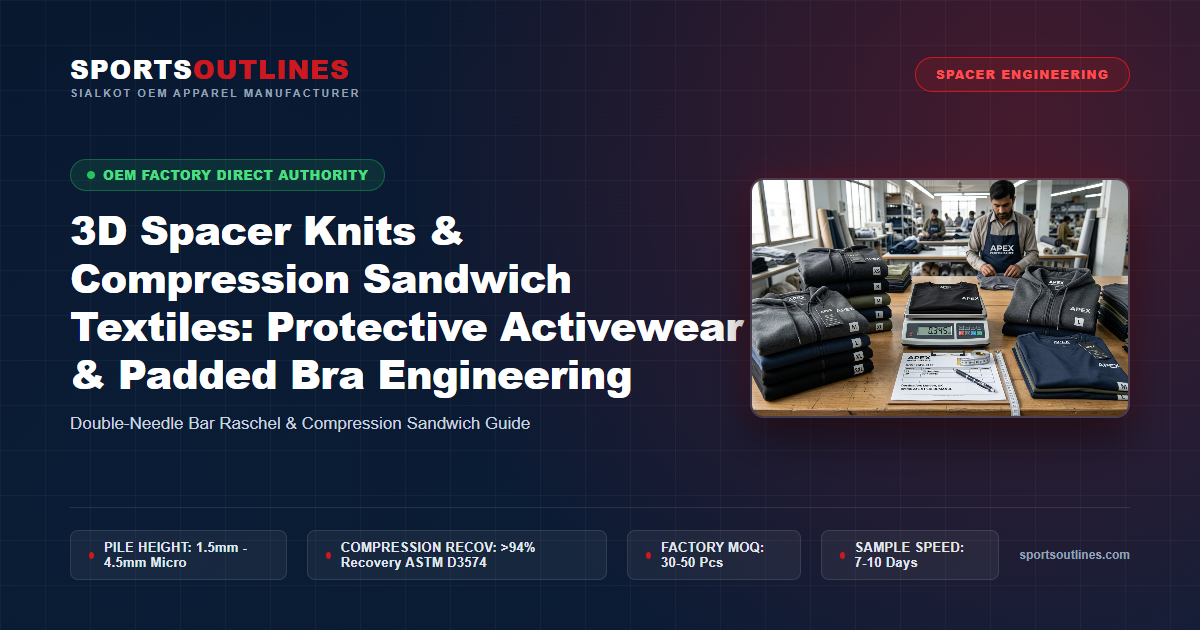
At Sports Outlines in Sialkot, Pakistan, our vertical performance apparel and technical knitting facility engineers custom 3D spacer knit sports bras, thermo-molded breathable bra cups, padded rugby/football compression girdles, and shock-absorbing athletic gear. Supported by our founder-friendly low factory minimum order quantity (MOQ) of strictly 30 to 50 pieces per style/colorway and precision physical sample development (7 to 10 business days, $45 to $85 per piece, non-refundable), Sports Outlines bridges German warp-knitting precision with agile, direct-to-brand manufacturing excellence.
Executive Engineering Summary: 3D Spacer Knits
- Structural Architecture: Tri-layer composite produced on double-needle bar Raschel warp-knitting machines. Upper face and lower back layers are linked by resilient vertical polyester monofilament pile yarns (1.5 mm to 4.5 mm pile height).
- PU Foam Replacement: Replaces solid polyurethane bra pads with a 100% breathable, non-yellowing, hydrophobic textile that does not absorb sweat, dries 3x faster, and thermo-molds into seamless ergonomic breast cups.
- Microclimatic Breathability: Open interstitial volume (>85% air by volume) delivers extraordinary cross-flow air permeability (>150 CFM under ASTM D737) and moisture vapor transmission (MVTR >14,000 g/m²/24h).
- Kinetic Energy Absorption: Under compressive impact, the vertical monofilaments flex elastically, distributing kinetic point loads across a wide planar footprint before snapping back instantly with zero permanent crush deformation.
- Edge Finishing Protocols: Mandates ultrasonic knife cutting, high-frequency perimeter bonding, or micro-stretch binding to encapsulate monofilament ends and prevent prickly skin irritation.
- Low MOQ Direct Sourcing: Sports Outlines delivers fully custom 3D spacer activewear collections with factory MOQs of strictly 30–50 pieces per style/colorway and 7–10 day pre-production physical prototypes ($45–$85 per piece, non-refundable).
1. Double-Needle Bar Raschel Warp-Knitting Machine Mechanics
Unlike standard circular knitting machines that produce single-layer 2D tubes, 3D spacer textiles require specialized double-needle bar Raschel warp-knitting machines (such as the Karl Mayer HighDistance, RD 6/1-12, or RD 7/2-12 systems).
The mechanical engineering of a double-needle bar Raschel machine involves two parallel needle beds operating in synchronization:
- Front Needle Bed (Face Layer): Knits the exterior aesthetic face fabric using multi-filament micro-polyamide or micro-polyester yarns (e.g., 50D/72F or 75D/144F) on 22-gauge to 28-gauge latch or compound needles. This surface can be engineered as a smooth solid jersey, a honeycomb jacquard, or an open-hole mesh.
- Back Needle Bed (Back Layer): Knits the skin-contacting interior face fabric independently, utilizing soft, low-friction microfibers with hydrophilic wicking finishes or silver-ion antimicrobial treatments.
- Middle Guide Bars (Spacer Monofilament Pile): Centrally positioned guide bars (GB3, GB4, GB5) traverse back and forth between the two parallel needle beds, feeding continuous monofilament polyester yarns (diameter 0.08 mm to 0.16 mm, 20D to 60D). The monofilament forms interlaced loops on the front bed, travels across the gap, forms loops on the back bed, and bridges the two textile planes.
- Trick Plate Distance Calibration: The physical distance between the two needle trick plates dictates the exact thickness (pile height) of the finished 3D spacer textile. By adjusting the trick plate distance electronically, textile engineers calibrate fabric thickness continuously from 1.5 mm up to 10.0 mm with sub-millimeter precision.
- Active Electronic Yarn Feed Tensioning: On modern Karl Mayer Raschel systems, electronic warp yarn feeding units (EBA / EBC) regulate thread tension on every guide bar down to ±0.5 cN. Maintaining constant yarn tension prevents uneven pile height variance across wide 138-inch machine widths, guaranteeing uniform cup thickness from roll center to selvage.
- Optical Laser Broken-End Stop Motions: High-speed optical laser scanner sensors continuously inspect the needle zone at 1,200 courses per minute. If a single micro-filament or monofilament breaks, the sensor stops the machine in under 0.02 seconds, preventing dropped stitches, pile voids, or surface laddering defects.
2. Compression Stress-Strain Curve & Kinetic Energy Absorption
The mechanical behavior of 3D spacer knits under compressive force is fundamentally unique. When an athlete experiences an impact (such as a rugby tackle, a barbell drop against the chest, or breast tissue bounce during running), the compression response follows a distinct three-phase stress-strain profile (evaluated under ASTM D3574 / ISO 3386-1 compression force deflection testing):
| Compression Phase | Strain Range (ε) | Mechanical Pile Behavior | Athletic Sensory & Protective Function |
|---|---|---|---|
| 1. Linear Elastic Region | 0% – 15% Strain | Vertical monofilaments undergo pure axial compressive bending | Soft, plush cushioning against skin; gentle breast contouring |
| 2. Plateau / Buckling Region | 15% – 60% Strain | Monofilament columns buckle elastically into S-curves, absorbing energy | Massive kinetic impact dissipation; protects ribs, clavicles & breast tissue |
| 3. Densification Region | > 60% Strain | Monofilaments fully collapse into high-density solid contact | Hard stop resistance preventing bottoming-out against bone |
Crucially, because the spacer pile consists of high-modulus semi-crystalline polyester monofilaments, the energy absorption occurs with zero hysteresis delay. As soon as the impact force is removed, the monofilaments spring back to 100% of their original height within 0.05 seconds, whereas polyurethane foam exhibits significant compressive creep and slow, sluggish recovery.
3. 3D Spacer Knits vs. Polyurethane (PU) Foam in Sports Bras
In women’s athletic apparel, sports bra cup engineering represents one of the most commercially critical applications of 3D spacer technology. Sourcing managers and brand founders must understand the profound operational differences between traditional PU foam cups and engineered 3D spacer cups:
| Engineering Parameter | Traditional Polyurethane (PU) Foam Pad | 3D Spacer Knit Sandwich Cup |
|---|---|---|
| Air Permeability (ASTM D737) | < 15 CFM (Impermeable vapor trap) | 160 – 240 CFM (Unrestricted airflow) |
| Sweat Retention / Sponge Effect | Absorbs up to 400% dry weight in liquid sweat | Hydrophobic monofilaments absorb < 2% water |
| Dry Time After Machine Wash | 8 – 14 hours (Damp core promotes mildew) | 1.5 – 2.5 hours (3x to 5x faster dry time) |
| Wash Durability & Bunching | Crinkles, folds, and rolls in laundry; degrades | Maintains 3D molded memory across 100+ washes |
| UV & Heat Discoloration | Yellows rapidly under light & heat oxidation | 100% Non-yellowing; pristine optical white |
| Thermo-Forming Compatibility | Hot-press moldable but releases volatile VOCs | Thermo-moldable at 185°C with zero chemical VOCs |
4. Thermo-Molding Mechanics: Shaping Seamless 3D Ergonomic Bra Cups
One of the primary manufacturing hurdles in producing spacer sports bras is transforming a flat 2D textile roll into a contoured, anatomical 3D breast cup without introducing cut-and-sewn dart seams across the apex (which would chafe sensitive nipple tissue).
At Sports Outlines, our molding department utilizes automated pneumatic dual-bullet heated thermo-forming presses:
- Precision Aluminum Mold Blocks: CNC-machined female cavities and heated male bullet heads matching exact cup cup volumes (Sizes A through G).
- Calibrated Heat-Setting Window (180°C to 190°C): Polyester reaches its thermoplastic glass transition and crystallization softening point around 185°C. Under 4.0 bar pneumatic clamping pressure for 45 to 60 seconds, the monofilament pile yarns heat-set into the curved spherical geometry.
- Instant Cold-Air Quenching: Immediately following the heated cycle, compressed cold air (15°C) blasts the molded cup, freezing the polymer crystals in their new curved conformation. The resulting spacer cup permanently retains its 3D anatomical dome shape through hundreds of wash cycles with zero collapse.
5. Impact-Absorbing Protective Collision Base Layers: Rugby, Football & Extreme Sports
Beyond sports bras, 3D spacer textiles serve as the premier material for collision sports protective base layers (including rugby padded undershirts, American football 7-pad girdles, goalkeeper impact protection, and motocross liners).
In collision athletic apparel, solid EVA foam pads block sweat evaporation and restrict torso flexion. Sports Outlines deploys heavy-density 3D spacer composites (350 to 450 GSM, pile height 3.0 mm to 5.0 mm):
- Body-Mapped Impact Zones: We engineer multi-density spacer inserts positioned over vulnerable bony landmarks: the acromioclavicular (AC) shoulder joints, floating ribs, iliac crests, and sternum.
- World Rugby Regulation 12 Compliance: For international rugby union, padding thickness cannot exceed 10 mm with a maximum density of 45 kg/m³. Our engineered 6.0 mm dual-layer spacer pads meet World Rugby impact attenuation regulations while weighing 35% less than rubberized pads.
- Instant Micro-Venting During Sprints: When the athlete runs, thoracic chest expansion compresses and releases the spacer mesh, creating a natural mechanical pumping action that flushes trapped hot air out through the mesh face.
6. Edge Finishing Protocols: Preventing Prickly Monofilament Skin Irritation
The most notorious manufacturing defect associated with amateur 3D spacer knit production is “monofilament edge prickle.” When a spacer fabric is cut with conventional mechanical shears or rotary blades, thousands of stiff polyester monofilament pile ends are severed along the perimeter. If these exposed, sharp plastic fiber ends come into contact with the athlete’s skin at the armholes, underbust, or neckline, they cause severe scratching, redness, and customer returns.
At Sports Outlines, our cut-and-sew engineering protocols eliminate monofilament prickle completely through three proven technical methods:
- Ultrasonic Cauterized Slitting: All pattern cutting is executed using 35 kHz ultrasonic cutting horns. High-frequency sound waves melt the monofilament tips instantaneously, forming smooth, rounded micro-beads along the edge rather than sharp needle points.
- Enclosed Fold-Over Micro-Elastic Binding: Perimeter edges (such as sports bra armholes and necklines) are fully encapsulated in soft 15 mm to 20 mm brushed micro-nylon fold-over elastic (FOE) stitched with 3-needle bottom coverstitching. The monofilament ends remain 100% sealed inside the soft elastic binding.
- Bemis 3415 High-Frequency Seamless Bonding: For ultra-clean luxury activewear lines, we deploy thermo-polyurethane (TPU) bonding film. A continuous 12 mm adhesive strip is thermally welded over the raw edge at 165°C, bonding the face and back plies together and creating a flush, razor-thin, chafeless edge.
7. Orthopedic Athletic Bracing & Joint Stabilization Applications
In athletic sports medicine and functional joint rehabilitation, neoprene (polychloroprene rubber) has historically dominated knee sleeves, ankle stabilizers, and elbow supports. While neoprene provides high radial compression, it suffers from a crippling flaw: it is completely non-breathable. During high-intensity training, sweat accumulates under the neoprene sleeve, raising skin temperature to over 38°C, macerating the epidermis, and inducing severe fungal dermatitis and folliculitis.
High-density 3D Spacer compression textiles (320 to 420 GSM, 2.5 mm to 4.0 mm thickness) are rapidly replacing neoprene across medical athletic bracing:
- Dynamic Convective Pumping Effect: As the athlete’s knee flexes and extends during running, the spacer fabric compresses by 25% at full flexion and expands during extension. This mechanical cycle creates an active thermodynamic air pump, expelling humid air through the surface apertures and drawing in cool ambient air, maintaining epidermal skin temperature at a comfortable 32°C.
- Integrated Patellar & Malleolar Stabilizers: Utilizing computerized laser contouring, Sports Outlines cuts targeted circular cavities directly into the spacer core, allowing seamless insertion of medical-grade viscoelastic silicone donut rings for patellar tracking without adding bulky outer seam ridges.
- Hypoallergenic Dermatological Safety: Unlike neoprene which can leach sulfur vulcanizing accelerators and chemical plasticizers, our medical-grade spacer textiles are knitted from 100% inert polyester filaments certified to OEKO-TEX® Standard 100 Class I, guaranteeing zero allergic contact dermatitis during 12-hour continuous wear.
8. Laboratory Testing Protocols for 3D Spacer Fabric Integrity
Because 3D spacer textiles depend on the vertical monofilament pile for structural performance, laboratory quality verification is essential before authorizing bulk apparel cutting:
- Dynamic Cyclic Compression Fatigue (ASTM D3574 Test I3 / ISO 3385): The spacer textile undergoes 80,000 cyclic compression impacts at 70% strain on a pneumatic pounding fatigue tester. To pass our engineering threshold, residual thickness loss must remain strictly under 4.5%, verifying that bra cups and protective pads will not permanently flatten after months of daily use.
- Tensile Delamination & Peel Strength (ASTM D2724): Tensile grips pull the front face and back face apart at 50 mm/min. The inter-loop monofilament anchoring must withstand a minimum peel force of >28 N/50mm, ensuring that the sandwich layers cannot delaminate during high-shear laundry cycles.
- Air Permeability Differential (ASTM D737): Evaluated on a Frazier differential air permeability tester at 125 Pa pressure drop. High-performance spacer knits must exceed 160 CFM (cubic feet per minute per square foot), confirming unrestricted convective airflow.
- Moisture Vapor Transmission Rate (JIS L 1099 B1 Inverted Cup Method): Tested using potassium acetate desiccant cups. Our spacer activewear composites achieve MVTR >14,500 g/m²/24h, ensuring sweat vapor evaporates immediately into the environment.
9. Monomaterial Circularity: 100% Polyester Recycling vs. Multi-Material Foam Waste
One of the most profound hidden environmental crises in modern activewear is the un-recyclability of conventional padded sports bras. A standard sports bra typically contains a nylon exterior shell, a spandex elastane compression lining, a polyurethane foam pad, and polyester sewing threads. When the garment reaches its end of life, these four chemically incompatible polymers cannot be separated economically, condemning millions of sports bras to municipal landfills.
Sports Outlines’ engineered Monomaterial 3D Spacer Architecture provides the definitive solution for sustainable circular activewear:
- 100% Single-Polymer Construction: By engineering the outer face, inner back, vertical spacer monofilaments, and sewing threads exclusively from 100% polyethylene terephthalate (PET / Polyester), the entire garment is 100% mono-material.
- Closed-Loop Chemical Depolymerization: At end of life, the garment can be dropped directly into standard industrial polyester recycling shredders without separating cup pads. The textile dissolves into pure monomer building blocks (BHET / DMT) that can be re-extruded into virgin-quality performance yarns infinitely.
- Post-Consumer Recycled Content (rPET): We offer 3D spacer knit fabrics produced from 100% GRS-certified post-consumer recycled plastic bottles, diverting approximately 12 plastic bottles from ocean waste per sports bra produced.
10. Tensionless Beam Dyeing & Thermal Stenter Finishing Physics
Dyeing and wet-finishing 3D spacer textiles requires extreme mechanical care. In standard apparel processing, textiles are dyed in high-speed overflow jet dyeing machines where fabric ropes are propelled through narrow venturi nozzles under high hydraulic pressures (up to 2.5 to 3.5 bar). If a 3D spacer fabric is subjected to conventional jet dyeing, the intense hydraulic turbulence and bending shear crush the vertical monofilament pile permanently, leaving permanent crease marks and destroying the fabric’s 3D loft.
At Sports Outlines’ certified dye-house partner facilities, 3D spacer knits are finished exclusively using tensionless perforated beam dyeing machines and relaxed pin-tenter drying:
- Perforated Autoclave Beam Dyeing: The spacer fabric is wound in open-width form onto a perforated stainless steel beam under minimal winding tension. Heated dye liquor (130°C for high-energy disperse dyes) is gently pumped from the inside out and outside in through the perforations. The fabric remains completely flat, motionless, and open-width, preserving 100% of the monofilament pile verticality and eliminating creasing.
- Overfeed Stenter Frame Stabilization: After beam dyeing, the wet fabric is fed onto an 8-chamber Bruckner stenter frame with 12% to 15% longitudinal overfeed. The fabric floats on a cushion of hot air (aerodynamic nozzle suspension) without mechanical roller nip pressure, drying and heat-setting the polyester monofilaments into permanent vertical alignment at 180°C.
- Hydrophilic & Silky Hand-Feel Emulsions: During padding, we apply micro-silicone amino-polyether emulsions to the skin-contacting back face, imparting an ultra-luxurious, peach-skin glide while preserving the high friction resistance of the outer athletic shell.
11. Production Cost Breakdown & Private-Label Margin Architecture
3D spacer knit performance bras and protective base layers command premium retail pricing in the fitness and outdoor market. Engineered spacer sports bras retail between $68 and $110 USD, while collision protective compression shirts retail between $85 and $135 USD.
Here is the transparent factory FOB cost breakdown for a high-support, thermo-molded 3D spacer sports bra:
| Cost Element / Component | Technical Specification | Estimated Cost (USD) | Percentage of FOB |
|---|---|---|---|
| 3D Spacer Knit Shell & Cups | 0.55 meters of 280 GSM 2.5 mm Raschel Spacer Fabric | $4.20 – $5.20 | 36% – 39% |
| Thermo-Forming Cup Pressing | Automated pneumatic dual-bullet hot-mold shaping | $1.40 – $1.90 | 12% – 14% |
| High-Modulus Band & Trims | 40 mm plush jacquard underbust elastic, hook-and-eye closure | $1.60 – $2.20 | 14% – 16% |
| Cut, Bind & Assembly (CMT) | Ultrasonic slitting, fold-over elastic binding, flatlock joins | $3.20 – $4.00 | 26% – 29% |
| Branding, QC & Packaging | AQL 2.5 intimate apparel audit, heat-seal tags, biodegradable bags | $0.70 – $1.00 | 5% – 7% |
| Total Direct FOB Production Cost | Finished pro-grade 3D spacer sports bra | $11.10 – $14.30 | 100% |
With FOB manufacturing costs between $11.10 and $14.30 USD, activewear brands retailing at $70 to $95 capture exceptional 78% to 84% gross margins, positioning themselves with a premium, non-yellowing product that solves the #1 consumer complaint in sports bras.
12. Sialkot Manufacturing Excellence: Physical Prototyping & Founder-Friendly Low MOQ
Traditional large-scale Asian manufacturers require massive 1,000 to 2,000 piece minimum orders per cup size for molded spacer bras, presenting an insurmountable barrier for boutique fitness brands and startup apparel founders.
Sports Outlines in Sialkot, Pakistan, removes these barriers through our vertically integrated technical prototyping infrastructure:
- Agile Low Factory MOQ: Strictly 30 to 50 pieces per style/colorway, enabling private labels to launch across comprehensive cup/band size runs (30B to 40DD) without excess inventory liability.
- Physical Pre-Production Prototyping: We develop and dispatch physical prototype samples within 7 to 10 business days for $45 to $85 per piece. This enables brand founders to wear-test breast bounce control, evaluate cup breathability, and audit seam softness before bulk commitment. In alignment with our direct factory transparency and dedicated engineering allocation, sample fees are strictly non-refundable and are never credited toward bulk production orders.
- Full Private-Label Customization: In-house thermo-molding, laser-cut ventilation perforations, custom branded underbust jacquard elastics, and eco-friendly packaging.
Launch Your Custom 3D Spacer Activewear Collection
Partner with Sports Outlines to engineer breathable, non-yellowing 3D spacer sports bras and impact-absorbing collision base layers with German warp-knitting precision and agile low MOQ manufacturing.
13. Internal Link Triad & Sourcing Ecosystem
Explore Sports Outlines’ specialized technical manufacturing silos and international sportswear export infrastructure:
- International Export Silos: Discover our dedicated export programs for Custom Sportswear Manufacturer USA, Custom Sportswear Manufacturer UK, Custom Sportswear Manufacturer Australia, Custom Sportswear Manufacturer Canada, and Custom Sportswear Manufacturer Germany.
- Product Category Hubs: Explore our OEM/ODM manufacturing across Custom Sportswear & Activewear, Technical Outerwear & Jackets, and Athletic Casual Wear.
- Related Technical Guides: Read our in-depth manufacturing guides on High-Modulus Compression Fabrics & mmHg Profiling, Brushed Thermal Roubaix Performance Fabric, and Warp-Knit Tricot vs Circular Interlock.