Sub-Cluster 5.5 • Muay Thai Shorts, Kickboxing Shin Guards, Belly Pads & Curved Thai Pads Engineering (Blog #402)
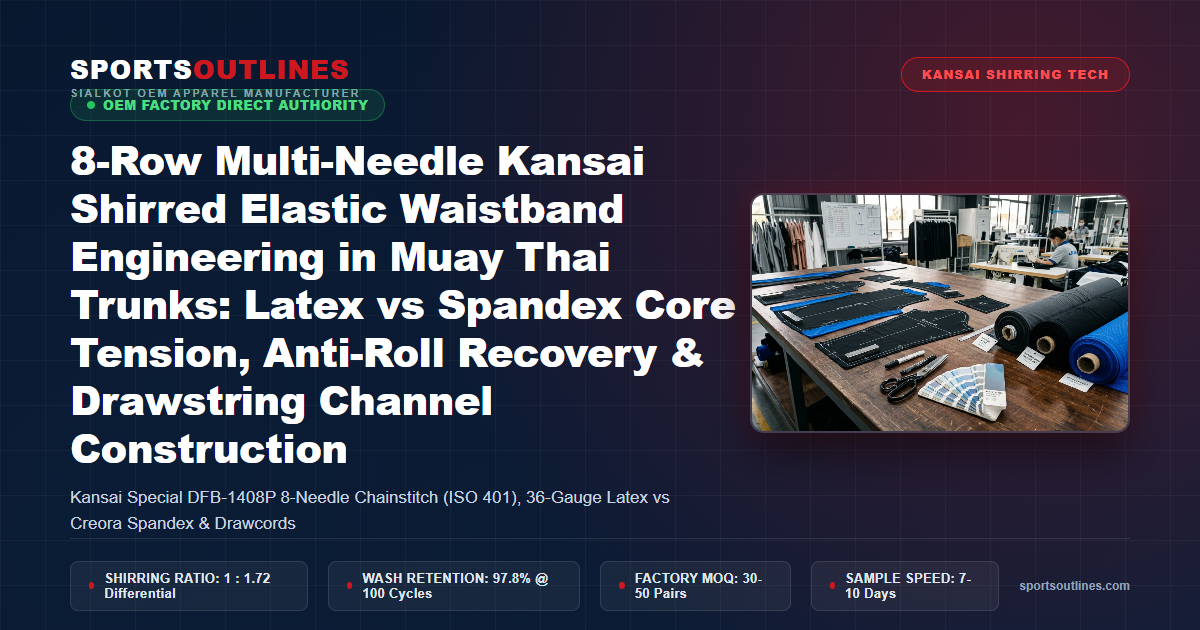
Executive Engineering Summary: The structural signature of an authentic stadium-grade Muay Thai trunk is its 8-Row Multi-Needle Shirred Elastic Waistband ($10.0\text{ cm} / 4.0\text{ in}$ height)—designed to lock a fighter’s shorts and underlying steel groin protector (Kradjab) firmly onto the iliac crest while allowing the top two elastic tiers to be rolled down cleanly before battle. When low-cost factories substitute a single $100\text{ mm}$ wide monofilament elastic band with faux top-stitching, the waistband buckles horizontally during clinch knee strikes and loses $35\%$ of its recovery modulus within 15 wash cycles. This technical guide details Kansai Special `DFB-1408P` 8-Needle Cylinder-Arm Double-Chainstitch (`ISO 401`) Mechanics, 36-Gauge Natural Rubber Latex vs. $1,120\text{D}$ Creora® Spandex Core Modulus, 1 : 1.72 Satin Shirring Differential Ratios, and Center-Anchored Braided Drawcord Tunnel Architecture.
Every veteran *Nak Muay* (Muay Thai fighter), stadium trainer, and combat apparel buyer performs the exact same tactile inspection the moment they pick up a pair of custom Muay Thai shorts: they grip both sides of the waistband and snap it open to full extension. A genuine stadium waistband expands smoothly to **$165\%\text{–}175\%$ of its relaxed width** with a crisp, progressive elastomeric resistance, then snaps back instantaneously into eight uniform, deeply gathered horizontal rows of lustrous Duchess satin micro-pleats without a single popped stitch or twisted internal cord.
Achieving that unmistakable Bangkok stadium waistband hand-feel is one of the most mechanically demanding operations in combat sportswear manufacturing. It requires synchronizing eight parallel feeds of narrow high-modulus braided elastic, two layers of slick $160\text{–}180\text{ GSM}$ 5-harness polyester satin, sixteen cones of `Tex 40` core-spun polyester needle and looper thread, and a pneumatically weighted rear urethane tractor puller on a dedicated multi-needle cylinder-bed machine. In this engineering manual from our Sialkot combat apparel division, we break down the exact physics, machinery, and quality standards behind 8-row and 6-row Muay Thai waistband construction.
1. Multi-Cord Parallel Hooke’s Law Mechanics: Why 8 Independent $8\text{ mm}$ Cords Outperform 1-Piece $100\text{ mm}$ Wide Elastic
Why did traditional Thai fight gear tailors in Bangkok develop the 8-row multi-cord shirred waistband ($10.0\text{ cm} / 4.0\text{ in}$ total height) rather than simply inserting a single $100\text{ mm}$ wide knitted jacquard elastic band like modern boardshorts or compression tights? The answer lies in **Torso Flexion Compliance**, **Groin-Cup Compression Distribution**, and the iconic **Nak Muay Roll-Down Tradition**:
- Independent Horizontal Articulation Across the Iliac Crest & Obliques: The human waist is not a rigid cylinder; between the lower costal cartilage of the ribcage and the anterior superior iliac spine (ASIS) of the pelvis, the circumference changes continuously as the fighter breathes diaphragmatically, twists into a roundhouse kick, or arches backward to evade a head kick. When 8 independent $8.0\text{ mm}$ ($3/8\text{ in}$) braided elastic cords are housed in separate $11.5\text{ mm}$ chainstitch tunnels (`Row 1` through `Row 8`), each horizontal tier stretches to its own local anatomical strain $\varepsilon_i$ without forcing adjacent tiers to buckle or gap away from the skin.
- Clean Folding Hinge Along Chainstitch Valleys (“The Roll-Down Effect”): Over $65\%$ of competitive Muay Thai fighters fold the top $2.5\text{ to }3.5\text{ cm}$ of their waistband down once outward before stepping into the ring—either to shorten the outseam by $3\text{ cm}$ for higher knee clearance or to expose their drawstring above their steel groin cup (*Kradjab*). A single-piece $100\text{ mm}$ wide elastic band resists folding and pops back upright during clinching. In an 8-row Kansai waistband, the `ISO 401` double-chainstitch valley between `Row 2` and `Row 3` acts as a built-in mechanical living hinge, allowing the top two rows to fold over $180^\circ$ and lock flat.
- Anchoring Over Traditional Thai Steel Groin Cups: In professional Muay Thai, fighters wear a heavy cast-steel or aluminum cup tied around the waist and perineum with cotton twill cords prior to pulling on their trunks. The multi-row shirred waistband conforms over the raised contour of the cup cords without creating localized pressure hotspots.
Mathematically, we model the **Total Circumferential Clamping Hoop Tension ($T_{\text{waist}}$)** and the **Radial Interface Contact Pressure ($P_{\text{iliac}}$)** exerted on a fighter’s waist of radius $R_{\text{waist}}$ at fractional elongation $\varepsilon = (C_{\text{worn}} – C_{\text{relaxed}}) / C_{\text{relaxed}}$:
$$T_{\text{waist}}(\varepsilon) = \sum_{i=1}^{N_{\text{rows}}} k_{\text{cord},i} \cdot \varepsilon_i + N_{\text{rows}} \cdot k_{\text{chain},401}(\varepsilon) \quad \Longrightarrow \quad P_{\text{iliac}} = \frac{T_{\text{waist}}(\varepsilon)}{R_{\text{waist}} \cdot H_{\text{waistband}}}$$
Where $N_{\text{rows}} = 8$ (for a traditional $10.0\text{ cm}$ stadium waistband) or $N_{\text{rows}} = 6$ (for a modern $6.5\text{–}7.5\text{ cm}$ Neo-Thai / Kickboxing waistband), $k_{\text{cord},i}$ is the tensile spring constant of each $8\text{ mm}$ braided elastic cord ($\approx 18.5\text{ N}$ at $\varepsilon = 1.0$), and $k_{\text{chain},401}(\varepsilon)$ is the cooperative recovery tension contributed by the 8 rows of `ISO 401` two-thread double chainstitching. At a standard worn elongation of $\varepsilon = 0.32$ ($32\%$ stretch over the relaxed flat waist), an 8-row waistband generates **$T_{\text{waist}} \approx 49.5\text{ N}$** distributed evenly across $H_{\text{waistband}} = 100\text{ mm}$—yielding a comfortable, slip-proof radial holding pressure of **$P_{\text{iliac}} \approx 3.6\text{ kPa}$ ($27\text{ mmHg}$)** that never restricts abdominal breathing.
2. Elastomer Core Metallurgy & Polymer Science: Natural Rubber Latex vs. High-Recovery Spandex vs. Cheap TPE
The longevity of a Muay Thai short waistband depends entirely on the elastomeric core filaments braided inside those eight $8\text{ mm}$ cords. Low-tier factories frequently substitute cheap extruded thermoplastic elastomer (`TPE`) or low-core-count rubber tape that loses $40\%$ of its snap after three warm wash cycles—leaving the shorts sagging dangerously low on the hips.
At Sports Outlines Sialkot, we test and stock three distinct waistband elastic core architectures so B2B brand directors can select the exact tension-to-wash-life profile for their target fight market:
| Elastomer Parameter & Lab Standard | Option A: 36-Gauge Natural Malaysian Rubber Latex Core (Traditional Thai Spec) | Option B: $1,120\text{D}$ High-Recovery Spandex Core (`Creora® HighClo™` — Export Pro Spec) | Substandard Generic Import (1-Piece Wide Monofilament / Low-Count Rubber) |
|---|---|---|---|
| Internal Cord Geometry & Count | 8 Independent $8.0\text{ mm}$ ($3/8\text{ in}$) Braided Cords (6 Cords per $8\text{ mm}$ Ribbon = 48 Latex Ends) | 8 Independent $8.0\text{ mm}$ ($3/8\text{ in}$) Heavy-Duty Knitted/Braided Spandex Cords | Single $100\text{ mm}$ Wide Monofilament Webbing w/ Faux Surface Stitches |
| Outer Braided Sheath Fiber | $150\text{D}/48\text{f}$ High-Tenacity Texturized Polyester (`PET`) | $150\text{D}/48\text{f}$ Hydrophobic Texturized Polyester (`PET`) | Low-Twist Polypropylene (`PP`) + Exposed Monofilament |
| 8-Row Total Modulus @ $50\%$ Stretch (`ASTM D4964`) | $74.0\text{ N}$ ($16.6\text{ lbf}$) — High Initial Stadium Snap | $66.5\text{ N}$ ($14.9\text{ lbf}$) — Smooth Progressive Grip | $92.0\text{ N}$ Initial (Stiff Board) $\rightarrow$ Drops to $38\text{ N}$ After 10 Washes |
| Maximum Working Elongation Limit | $185\%$ ($1.85\times$ Relaxed Flat Width) | $195\%$ ($1.95\times$ Relaxed Flat Width) | $130\%$ (Hard Mechanical Lock-Out) |
| Tension Retention After $100\times$ Washes @ $40^\circ\text{C}$ (`ISO 6330`) | $93.5\%$ Retained Modulus (Requires Cool/Warm Wash, No Tumble Dry) | $97.8\%$ Retained Modulus (Sweat, Heat & Chlorine Resistant) | $<58\%$ Retained (Permanent "Bacon-Edge" Wave Deformation) |
| Needle-Puncture Cut Resistance During Kansai Sewing | Requires `SES` Light Ball-Point Needles + Guided Channel Spacer | Coalesced Multi-Filament Spandex Resists Severing Under Needle Contact | Sharp Needles Sever Monofilaments Causing Dead Zones |
| Roll-Down Articulation (1-Tier or 2-Tier Fold) | Flawless $180^\circ$ Living Hinge Between Every Cord Row | Flawless $180^\circ$ Living Hinge Between Every Cord Row | Buckles Outward & Unfolds During Clinching |
3. Kansai Special `DFB-1408P` / `WX-8808` 8-Needle Double-Chainstitch (`ISO 401`) Machine Architecture
A standard single-needle lockstitch machine (`ISO 301`) can never be used to sew a Muay Thai shirred waistband. Because a lockstitch forms rigid, non-extensible interlacings between a single needle thread and a small bobbin thread, stretching a lockstitched waistband beyond $115\%$ snaps every row of stitching with an audible crack.
In our Sialkot combat shorts production cell, all 6-row, 8-row, and 10-row Muay Thai and professional boxing waistbands are manufactured on dedicated **Kansai Special `DFB-1408P` (Flat-Bed Pre-Shirring) and `WX-8808` (Cylinder-Bed Ring-Closing) 8-Needle Double-Chainstitch (`ISO 401`) Machines** engineered with four precision sub-assemblies:
- 8-Needle / 8-Looper `ISO 401` Two-Thread Chainstitch Geometry ($11.1\text{ mm}$ / $7/16\text{ in}$ Gauge): Each of the 8 vertical needles (`Organ UO113GS #11 / Nm 75` with `SES` light ball-point tips) pairs with an oscillating lower looper fed directly from jumbo cones of `Tex 40` (`40s/2`) core-spun polyester thread—consuming approximately **$3.85\text{ meters}$ of thread per meter of sewn seam per row** ($30.8\text{ meters}$ of thread per waistband!). Because the lower looper interloops triangles of thread on the underside of the casing, the seam elongates effortlessly to **$185\%$** without thread rupture.
- Front Multi-Track Brass Elastic Guide Comb (Zero Needle-Strike Guarantee): Rather than sewing *through* the elastic cords (which risks needle-cutting the rubber cores), the 8 independent $8.0\text{ mm}$ elastic ribbons pass through a precision-milled front brass guide comb positioned exactly midway between the 8 needles (plus a 9th top/bottom edge folder). The needles pierce **only the upper and lower satin casing plies** inside the $3.1\text{ mm}$ valley gaps between adjacent $8.0\text{ mm}$ elastic cords—encapsulating each cord inside a stitch-free frictionless tunnel!
-
Digital Differential Elastic Metering Frame ($R_{\text{shirr}} = 1 : 1.72$): Ahead of the needle bar, the 8 elastic cords pass through a servo-driven tension-metering roller assembly calibrated to stretch the incoming elastic by **$172\%$ ($R_{\text{shirr}} = 1.72$)** as it enters the un-stretched satin casing. For an Adult Size `L` Muay Thai short with a target relaxed flat 1/2 waist of $35.0\text{ cm}$ ($70.0\text{ cm}$ full relaxed circumference), the satin waistband strip is cut to a full un-shirred circumference of:
$$L_{\text{satin,cut}} = C_{\text{relaxed}} \times R_{\text{shirr}} = 70.0\text{ cm} \times 1.72 = 120.4\text{ cm}\text{ (60.2 cm 1/2 Flat Stretch Capacity)}$$
The moment the finished waistband leaves the rear tractor puller and relaxes to $70.0\text{ cm}$, the excess $50.4\text{ cm}$ of $160\text{ GSM}$ Duchess satin gathers into hundreds of micro-accordion pleats ($12\text{ pleats per cm}$) across all 8 rows. - Synchronized Rear Knurled Urethane Tractor Puller (`Kansai PQ` Puller): Because eight stretched $8\text{ mm}$ latex/spandex cords exert nearly $75\text{ N}$ of backward pull against the presser foot, standard feed dogs would stall and cause uneven stitch bunching. A gear-synchronized rear urethane roller grips the full $100\text{ mm}$ width of the waistband $35\text{ mm}$ behind the needles, maintaining a dead-constant stitch density of **$11\text{ SPI}$ ($4.3\text{ stitches/cm}$)** from start to finish.
4. Waistband Profile Architecture: 8-Row Traditional Stadium ($10\text{ cm}$) vs. 6-Row Neo-Thai ($6.5\text{ cm}$) vs. 10-Row Pro Boxing ($11.5\text{ cm}$)
Depending on whether your brand serves traditional Muay Thai gyms, K-1 / GLORY kickboxing promotions, or Western boxing rings, we configure the multi-needle cylinder gauge to three distinct waistband heights:
| Waistband Engineering Specification | 8-Row Traditional Thai Stadium Profile | 6-Row Modern Neo-Thai / Kickboxing Profile | 10-Row Professional Western Boxing Profile |
|---|---|---|---|
| Finished Waistband Height ($H_{\text{waistband}}$) | $10.0\text{ cm}$ ($4.0\text{ in}$) | $6.5\text{–}7.5\text{ cm}$ ($2.55\text{–}2.95\text{ in}$) | $11.5\text{–}12.5\text{ cm}$ ($4.5\text{–}5.0\text{ in}$) |
| Internal Elastic Cord Configuration | $8 \times 8.0\text{ mm}$ Braided Latex or Spandex Cords | $6 \times 8.0\text{ mm}$ Braided Spandex Cords | $10 \times 8.0\text{ mm}$ Cords (Accepts No-Foul Cup Protector) |
| Unfolded Satin Casing Cut Width | $22.4\text{ cm}$ (Folded to $10.0\text{ cm}$ + $1.2\text{ cm}$ Seam Bite) | $15.4\text{ cm}$ (Folded to $6.5\text{ cm}$ + $1.2\text{ cm}$ Seam Bite) | $26.4\text{ cm}$ (Folded to $12.0\text{ cm}$ + $1.2\text{ cm}$ Seam Bite) |
| Top-Edge Decorative Frill / Crown Header | Optional $12\text{ mm}$ Ruffled Top Crown Above `Row 1` | Flush Top-Row Edge (Zero Frill Modern Look) | Contrast Velvet or Metallic Satin Top Piping |
| Drawstring Channel Position | Internal Tunnel Behind `Row 3–4` (Works Rolled or Unrolled) | Central Tunnel Between `Row 3` and `Row 4` | Dual Internal Flat Lace Channels |
| Center-Front Woven Stadium Label Patch Size | $110\text{ mm} \times 65\text{ mm}$ High-Definition Damask / Leatherette | $95\text{ mm} \times 45\text{ mm}$ Low-Profile Woven / 3D Silicone | $130\text{ mm} \times 80\text{ mm}$ Embroidered Fighter Name Crest |
5. Internal Drawstring Channel Engineering, Non-Fray Eyelets & Center-Front Crest Patch Attachment
Two subtle details separate an heirloom-quality Sialkot Muay Thai waistband from a cheap knockoff: **1) How the internal drawstring is channeled and anchored**, and **2) How the rigid center-front brand crest patch is stitched onto a stretchy 8-row waistband without causing thread breakage or corner curl**.
A. Isolated Braided Drawcord Tunnel & Center-Back Anti-Pullout Lock-Tack
If a drawstring is simply laid loose inside the waistband alongside an elastic cord, pulling the drawstring tight bunches the elastic cord and causes the cord to saw against the chainstitches. Furthermore, if the drawstring is placed at the very top row (`Row 1`), any fighter who rolls the top two rows of their waistband down buries their drawstring underneath the fold!
We solve both issues by placing a dedicated **$14\text{ mm}$ isolated drawcord tunnel at the `Row 3–4` level** ($3.5\text{ cm}$ below the top edge), housing a **$10.0\text{ mm}$ wide heavy flat-braided 100% polyester cord** ($\ge 680\text{ N}$ breaking strength) tipped with custom heat-shrunk PVC or engraved gunmetal aglets. Whether the fighter wears the waistband at full $10\text{ cm}$ height or rolls the top two tiers down, the drawstring exits right at the natural iliac crease via dual **CNC keyhole-stitched eyelets (`Juki LBH-1790AN`, $42\text{ stitches/eyelet}$)** on the interior front lining. Finally, a vertical **28-stitch CNC bar-tack** locks the midpoint of the drawcord directly into the center-back waistband seam so the cord can never pull out inside commercial gym washing machines.
B. Pre-Stretched Center-Front Stadium Crest Patch Mounting Protocol
Every authentic pair of Muay Thai shorts features a prominent rectangular brand badge ($110\text{ mm} \times 65\text{ mm}$ high-density woven damask, metallic gold brocade, or embossed PU leather) centered on the front of the 8-row waistband. If a sewing operator stitches that non-stretch woven label onto the waistband while the waistband is completely relaxed ($0\%$ stretch), the label acts as a $110\text{ mm}$ rigid splint—and the very first time the fighter pulls the shorts over their hips, the perimeter stitches at the left and right edges of the label snap!
In our Sialkot factory, the center-front waistband section is clamped onto a **Pneumatic Pre-Tensioning Jig at $25\%$ extension ($\varepsilon = 0.25$)** inside a programmable pattern tacker (`Juki AMS-210EN`). The woven crest label (backed with $120\text{ GSM}$ non-woven stabilizer and folded $5\text{ mm}$ mitered borders) is perimeter-stitched while the underlying satin and elastic are pre-extended by $25\%$, with reinforced $3.5\text{ mm}$ diagonal corner tacks—ensuring the label flexing zone never experiences destructive shear stress when donned.
6. Joining the 8-Row Waistband to the Satin Short Body: 6-Thread Overlock + Cylinder-Bed Chainstitch Ring Closure
There are two distinct construction methods for uniting the 8-row shirred waistband with the lower satin short body, and we engineer both depending on whether the short design includes a continuous vertical center-front/back panel or an uninterrupted ring waistband:
- Method 1 — Integrated One-Piece Folded Body-Extension Waistband (Traditional Lumpinee Spec): The front and back main satin body panels are cut with an extra $21.5\text{ cm}$ of vertical height above the natural waist line. After the anterior rise and posterior seat seams are lap-felled, the upper $21.5\text{ cm}$ extension is folded $10.0\text{ cm}$ inward over the 8 elastic cords and fed through the **Kansai Special `WX-8808` Cylinder-Bed 8-Needle Machine** in a continuous $360^\circ$ circle. Because there is **zero horizontal join seam** between the waistband and the short body, vertical stripes or side-flare piping can flow uninterrupted right up to the bottom of the waistband.
- Method 2 — Contrast Two-Tone Pre-Shirred Ring Waistband Attachment (Two-Tone Color-Block Spec): When a brand requests a contrasting waistband color (for example, a Metallic Gold or Carbon Black 8-row waistband paired with a Crimson Red satin body), the $22.4\text{ cm}$ gold satin casing is pre-shirred with 8 elastic cords on the flat-bed `Kansai DFB-1408P`, closed into a ring with a flat-butted center-back seam, and then joined to the top edge of the red short body under $1.72\times$ differential tension using a **Juki `MO-6816S` 5-Thread Safety Overlock + Single-Needle `ISO 401` Top-Cover Chainstitch** encased in soft $40\text{ GSM}$ polyester tricot binding tape so zero raw seam allowance touches the fighter’s abdomen.
7. Complete Waistband Tension, Shirring & Cut-Consumption Engineering Matrix (`3XS` to `4XL`)
For technical apparel designers and B2B procurement directors across the USA, UK, Canada, Germany, and Australia, below is our exact Sialkot factory calibration table for 8-row Kansai waistband elastic consumption, un-shirred satin cut length, and finished stretch modulus across all sizes:
| Size Grade (Western / Thai) | Relaxed 1/2 Waist Width ($\pm 4\text{ mm}$) | Full Extended 1/2 Waist Width ($172\%$) | Un-Shirred Satin Casing Cut Circumference | Total $8\text{ mm}$ Elastic Cord Consumption (8 Rows) | Flat Braided Drawcord Cut Length | Hoop Clamping Force @ Target Waist |
|---|---|---|---|---|---|---|
| Youth Y-S / 3XS | $22.5\text{ cm}$ ($45.0\text{ cm}$ Ring) | $38.7\text{ cm}$ ($77.4\text{ cm}$ Ring) | $79.8\text{ cm}$ (incl. $2.4\text{ cm}$ Seam) | $3.68\text{ meters / pair}$ | $95\text{ cm}$ | $34.0\text{ N}$ (Youth Comfort Spec) |
| Youth Y-M / 2XS | $25.0\text{ cm}$ ($50.0\text{ cm}$ Ring) | $43.0\text{ cm}$ ($86.0\text{ cm}$ Ring) | $88.4\text{ cm}$ (incl. $2.4\text{ cm}$ Seam) | $4.08\text{ meters / pair}$ | $105\text{ cm}$ | $38.5\text{ N}$ |
| Adult XS (Thai `S`) | $28.5\text{ cm}$ ($57.0\text{ cm}$ Ring) | $49.0\text{ cm}$ ($98.0\text{ cm}$ Ring) | $100.4\text{ cm}$ | $4.64\text{ meters / pair}$ | $118\text{ cm}$ | $44.0\text{ N}$ |
| Adult S (Thai `M`) | $31.0\text{ cm}$ ($62.0\text{ cm}$ Ring) | $53.3\text{ cm}$ ($106.6\text{ cm}$ Ring) | $109.0\text{ cm}$ | $5.04\text{ meters / pair}$ | $126\text{ cm}$ | $46.5\text{ N}$ |
| Adult M (Thai `L`) | $33.0\text{ cm}$ ($66.0\text{ cm}$ Ring) | $56.8\text{ cm}$ ($113.5\text{ cm}$ Ring) | $115.9\text{ cm}$ | $5.36\text{ meters / pair}$ | $134\text{ cm}$ | $48.0\text{ N}$ |
| Adult L (Thai `XL`) | $35.0\text{ cm}$ ($70.0\text{ cm}$ Ring) | $60.2\text{ cm}$ ($120.4\text{ cm}$ Ring) | $122.8\text{ cm}$ | $5.68\text{ meters / pair}$ | $142\text{ cm}$ | $49.5\text{ N}$ ($3.6\text{ kPa}$ Radial) |
| Adult XL (Thai `2XL`) | $37.5\text{ cm}$ ($75.0\text{ cm}$ Ring) | $64.5\text{ cm}$ ($129.0\text{ cm}$ Ring) | $131.4\text{ cm}$ | $6.08\text{ meters / pair}$ | $150\text{ cm}$ | $52.0\text{ N}$ |
| Adult 2XL–3XL (`3XL–4XL`) | $40.0\text{ cm}$ ($80.0\text{ cm}$ Ring) | $68.8\text{ cm}$ ($137.6\text{ cm}$ Ring) | $140.0\text{ cm}$ | $6.48\text{ meters / pair}$ | $160\text{ cm}$ | $55.0\text{ N}$ (Heavyweight Spec) |
8. 8-Stage Kansai Waistband Quality Control & Fatigue Testing Protocol
Every production lot of custom Muay Thai shorts manufactured at Sports Outlines Sialkot undergoes an 8-stage waistband engineering verification before final packaging:
- 1. Incoming Elastic Spool Modulus Calibration (`ASTM D4964`): Every batch of $8.0\text{ mm}$ 36-gauge natural rubber latex and $1,120\text{D}$ `Creora®` spandex cord is tension-tested at $50\%$, $100\%$, and $150\%$ elongation to verify $\pm 3\%$ lot-to-lot consistency before mounting on the Kansai metering creel.
- 2. Brass Guide-Comb Alignment & Zero-Puncture Audit: Before starting each shift on the `Kansai Special DFB-1408P` and `WX-8808`, mechanics dissect a $20\text{ cm}$ test swatch to confirm all 8 needles pierce cleanly through the $3.1\text{ mm}$ satin valleys between cords without nicking a single elastomer filament.
- 3. `ISO 401` Looper Thread Tension & $180\%$ Snap-Stretch Test: Every finished waistband is manually snapped open to $172\%$ full extension three times on a calibrated sizing horn; any audible thread pop or skipped chainstitch loop triggers immediate rejection and re-shirring.
- 4. 500-Cycle Pneumatic Fatigue & Creep Recovery Audit: One sample per 100 pairs undergoes $500\text{ dynamic extension cycles}$ to $160\%$ width; permanent dimensional set after $30\text{ minutes}$ of relaxation must remain strictly $\le 2.2\%$.
- 5. Roll-Down Living-Hinge Verification: Inspectors fold the top two elastic tiers (`Row 1` and `Row 2`) outward $180^\circ$ around the sizing mannequin to confirm the fold sits flat without springing upward or twisting internal cords.
- 6. Pre-Stretched Center-Front Crest Patch Shear Pull Test: The $110\text{ mm} \times 65\text{ mm}$ center-front woven damask or leatherette crest patch is stretched to $145\%$ waist extension to verify zero corner lifting or perimeter stitch cracking.
- 7. Drawcord Eyelets & Center-Back Lock-Tack Pull Test ($\ge 250\text{ N}$): Both ends of the $10\text{ mm}$ flat braided polyester drawcord are subjected to a $250\text{ N}$ tug test against the center-back anchor tack and front keyhole eyelets.
- 8. Steam Relaxation Stabilization & Metal Detection (`Hashima HN-880C`): Waistbands are steamed on a Teflon®-clad expander buck to stabilize satin micro-pleat memory prior to ferrous needle detection ($1.0\text{ mm}$ Fe sensitivity).
For a complete technical overview of our Muay Thai and combat apparel engineering, review our companion guides on Custom Muay Thai Shorts Textile & Pattern Engineering (Duchess Satin vs. Microfiber), MMA Fight Shorts Silicone Gripper Waistband Systems, and Custom Boxing & Muay Thai Gloves Manufacturing.
9. Frequently Asked Questions: 8-Row Kansai Muay Thai Waistband Engineering
Q1: Why do authentic Muay Thai shorts use 8 separate rows of narrow elastic cords instead of a single wide 4-inch elastic band?
A single $10\text{ cm}$ ($4.0\text{ inch}$) monofilament elastic band acts as an unyielding vertical splint across the lower abdomen; when a fighter flexes their torso forward in the clinch or folds the top edge of their waistband down before a fight, a wide single-piece elastic buckles horizontally and loses circumferential contact pressure. By encapsulating 8 independent $8\text{ mm}$ ($3/8\text{ inch}$) braided elastic cords inside parallel double-chainstitch tunnels on a Kansai Special multi-needle cylinder machine, each cord articulates independently over the iliac crest and allows clean 1-channel or 2-channel roll-down customization.
Q2: What is the performance difference between Natural Rubber Latex core elastic and High-Recovery Spandex (Elastane) core elastic in Muay Thai waistbands?
36-Gauge Natural Rubber Latex core braided elastic delivers high initial snap modulus ($18.5\text{ N}$ at $100\%$ extension per cord), ideal for traditional heavy satin trunks worn over a steel groin cup (*Kradjab*), though unprotected rubber can oxidize if washed above $60^\circ\text{C}$ or exposed to chlorine bleach. High-Recovery $1,120\text{D}$ `Creora®` Spandex-Core polyester-braided elastic exhibits slightly softer initial tension ($15.8\text{ N}$ at $100\%$ extension) but survives $200+$ industrial wash cycles, sweat salts, and UV exposure with less than $2.2\%$ permanent tension decay.
Q3: Which industrial sewing machine and stitch class are required to manufacture an authentic 8-row shirred Muay Thai waistband?
Authentic Muay Thai and boxing trunk waistbands are shirred on an 8-needle or 12-needle cylinder-bed double-chainstitch machine such as the Kansai Special `DFB-1408P` or `WX-8808` (`ISO 401` two-thread chainstitch) equipped with a synchronized rear urethane tractor puller and a metered roller-tension frame. Because `ISO 401` chainstitch elongates up to $185\%$ alongside the internal elastic cords without snapping needle threads, the satin casing gathers into uniform micro-pleats at a $1 : 1.72$ stretch ratio.
Q4: How is the internal drawstring channel integrated into an 8-row Kansai waistband without twisting or pulling out during laundering?
Rather than threading a loose string against bare skin, our Sialkot engineers dedicate an isolated $14\text{ mm}$ tunnel behind `Row 3` and `Row 4` to house a heavy-duty $10\text{ mm}$ flat tubular braided polyester drawcord. The drawcord is anchored at the center-back waistband seam with a 28-stitch vertical lock-tack so it can never pull out in washing machines, while exiting through dual keyhole-stitched eyelets on the interior front waist.
Q5: What are your prototype sampling fees and minimum order quantities (MOQ) for custom Muay Thai shorts with 8-row Kansai waistbands?
Physical prototype sampling for custom Muay Thai shorts featuring 8-row or 6-row Kansai Special shirred waistbands, custom woven center-front crest labels, and hand-guided Thai script appliqué is $45 to $85 per pair as a non-refundable development fee delivered via DHL/FedEx in 7 to 10 business days. Bulk production MOQ is 30 to 50 pairs per style and colorway across Youth and Adult sizes (`3XS` to `4XL`).
Specify Authentic 8-Row Kansai Waistband Muay Thai Trunks
Partner with Sports Outlines Sialkot to manufacture custom Muay Thai shorts, kickboxing trunks, and pro boxing shorts featuring genuine 8-needle and 10-needle Kansai Special shirred waistbands. Prototype samples delivered in 7–10 business days ($45–$85/pair) with low 30–50 pair MOQs across our Custom Boxing & Muay Thai Equipment Division.