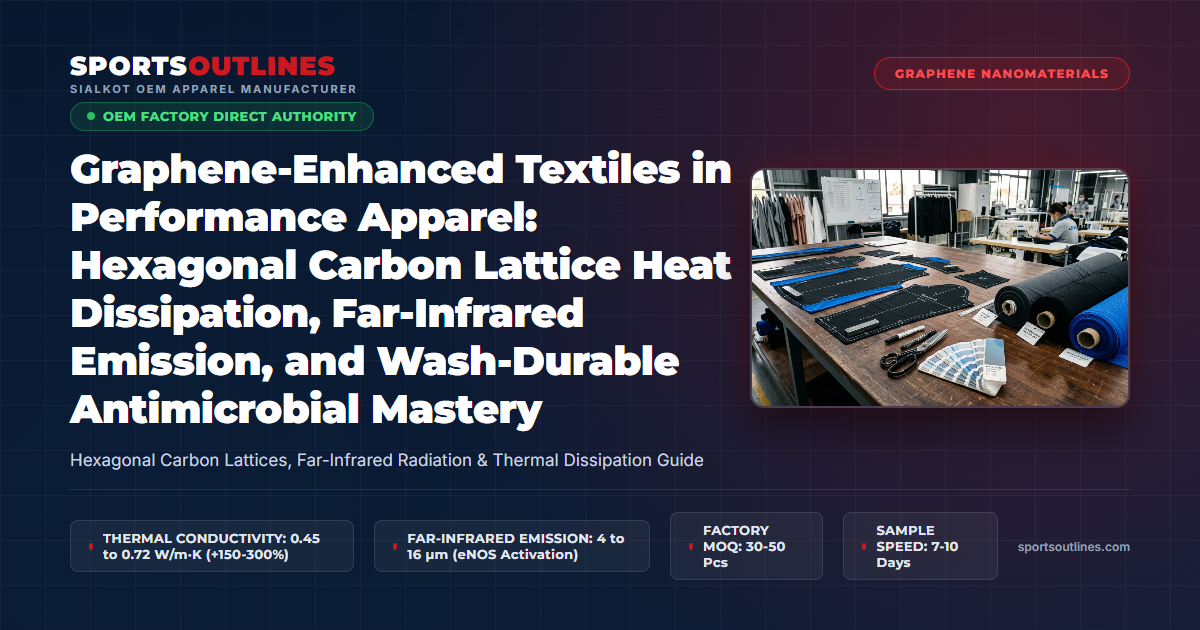
Synthetic performance activewear—predominantly composed of polyester, polyamide, and elastane—faces significant thermophysical and biological limitations during high-intensity athletic exertion. Standard polymers possess extremely low thermal conductivity ($k \approx 0.15\text{ to }0.25\text{ W/m}\cdot\text{K}$), turning athletic garments into thermal insulators that trap body heat against the skin. Furthermore, synthetic fibers accumulate high levels of static electricity during mechanical friction, attract particulate soil, and provide ideal breeding grounds for odor-producing bacteria such as Staphylococcus epidermidis and Corynebacterium xerosis. To overcome these systemic deficits without resorting to unstable topical chemical baths, material scientists have integrated graphene—a single-atom-thick planar sheet of $sp^2$-hybridized carbon atoms arranged in a two-dimensional hexagonal honeycomb lattice—directly into synthetic polymer matrices and continuous-filament yarns.
Renowned as the strongest material ever measured (tensile strength ~130 GPa) with extraordinary in-plane thermal conductivity ($k \approx 3,000\text{ to }5,000\text{ W/m}\cdot\text{K}$), graphene transforms standard performance textiles into multifunctional smart fabrics. When compounded into spinning dopes or functional coatings, graphene acts as an isotropic thermal radiator that redistributes localized hot-spots across the body, emits bio-resonant far-infrared (FIR) radiation to stimulate microvascular blood circulation, provides permanent antistatic charge dissipation, and physically ruptures microbial cell membranes through razor-sharp nanoscale edges. At Sports Outlines, operating our high-precision cut-and-sew manufacturing hub in Sialkot, Pakistan, we turn advanced nanomaterial science into commercially viable sportswear collections. We provide technical brand founders with dedicated physical prototype sampling at $45 to $85 per piece (non-refundable, 7–10 business days turnaround) and scalable commercial apparel production starting at an accessible factory minimum order quantity (MOQ) of just 30 to 50 pieces per style/colorway.
Graphene-Enhanced Activewear Textiles: Technical Navigation Directory
- 1. Graphene Morphology: GNPs, rGO & Hexagonal Carbon Lattices
- 2. Thermal Conduction & Isotropic Heat Spreading Physics
- 3. Far-Infrared (FIR) Emission & Endothelial Vasodilation
- 4. Electrical Percolation & Antistatic Triboelectric Dissipation
- 5. Antimicrobial Mechanics: Nano-Blade Insertion & ROS Oxidation
- 6. Engineering Matrix: Graphene vs Carbon Nanotubes & Silver Ions
- 7. Masterbatch Compounding: Melt-Extrusion vs Surface Printing
- 8. Sialkot Factory Knitting, Needle Wear & Seam Integrity
- 9. Performance Silhouettes: Compression, Running & Base Layers
- 10. Wash Durability, Cytotoxicity & Nano-Safety Compliance
- 11. Low-MOQ Sourcing & Commercial Factory Terms
- 12. Technical Sourcing FAQ
1. Graphene Morphology: GNPs, rGO & Hexagonal Carbon Lattice Physics
In commercial textile engineering, the umbrella term “graphene” encompasses several distinct nanomaterial morphologies, each exhibiting differing carbon-to-oxygen ratios, sheet thicknesses, and functional performance profiles. Pristine single-layer graphene consists of an isolated, defect-free monolayer of carbon atoms bonded through strong in-plane covalent $\sigma$-bonds with a carbon-carbon bond length of $0.142\text{ nm}$. Out-of-plane delocalized $\pi$-orbitals form a conductive electron sea that grants graphene its extraordinary electronic mobility ($>200,000\text{ cm}^2/\text{V}\cdot\text{s}$) and ballistic phonon heat conduction.
However, producing defect-free monolayer graphene at industrial apparel volumes is economically unfeasible. Textile manufacturers utilize two primary commercial variants:
- Graphene Nanoplatelets (GNPs): Multi-layer graphene stacks typically composed of 5 to 30 graphene sheets, exhibiting a thickness of 2 to 10 nm and lateral flake diameters of 5 to 25 micrometers. GNPs retain over 80% of pristine graphene’s mechanical stiffness and thermal conductivity while remaining stable during high-shear polymer melt compounding.
- Reduced Graphene Oxide (rGO): Synthesized via chemical or thermal reduction of graphene oxide (GO), which is produced by oxidatively exfoliating natural flake graphite (modified Hummers’ method). While rGO contains residual oxygen functional groups (hydroxyl, epoxy, carboxyl) and lattice vacancies, its hydrophilic nature permits stable aqueous dispersion in water-based textile finishing baths and printing binders.
The functional efficacy of graphene-enhanced fibers is governed by the percolation threshold and interfacial interfacial adhesion between the nanomaterial flakes and the host polymer chains. When functionalized with compatible surface modifiers (such as silane coupling agents or maleic anhydride grafts), the high aspect ratio ($>1,000$) of graphene nanoplatelets allows them to establish continuous thermal and electrical conductive pathways at loading concentrations as low as 0.5% to 1.8% by weight.
2. Thermal Conduction & Isotropic Heat Spreading Physics
Human cutaneous heat generation is highly non-uniform across the body during athletic training. High-density metabolic zones (such as the upper spine, sternum, and axillary underarm vaults) can generate surface temperatures exceeding $36.5^\circ\text{C}$ to $37.0^\circ\text{C}$, while peripheral extremities and the lower torso remain several degrees cooler ($31.0^\circ\text{C}$ to $33.0^\circ\text{C}$). Standard synthetic activewear fails to mitigate this gradient because polyester and nylon are thermal insulators that restrict heat dissipation to vertical conduction through the fabric thickness.
Graphene’s thermal transport is mediated by acoustic phonons propagating through the stiff carbon-carbon covalent lattice. In pristine graphene, the phonon mean free path ($\lambda_{ph}$) reaches approximately $775\text{ nm}$ at room temperature, resulting in an in-plane thermal conductivity ($k_{in-plane} \approx 3,000\text{ to }5,000\text{ W/m}\cdot\text{K}$) that dwarfs copper ($401\text{ W/m}\cdot\text{K}$) and aluminum ($237\text{ W/m}\cdot\text{K}$). When incorporated into continuous nylon or polyester filaments, graphene aligns along the fiber axis during melt drawing, increasing the bulk axial thermal conductivity of the textile from $0.18\text{ W/m}\cdot\text{K}$ to over $0.45\text{ to }0.72\text{ W/m}\cdot\text{K}$ (a 150% to 300% improvement).
q_{isotropic} = -k_{composite} \cdot \left( \frac{\partial T}{\partial x} + \frac{\partial T}{\partial y} \right) \quad \text{where } k_{composite} \approx 0.55\text{ W/m}\cdot\text{K}
This dramatic elevation in lateral thermal diffusivity enables graphene activewear to function as an isotropic thermal radiator. Excess localized heat generated along the spine or chest is rapidly siphoned horizontally across the fabric plane toward cooler zones of the garment, where it radiates outward into the ambient environment. Infrared thermography demonstrates that graphene-treated compression shirts eliminate focal hotspots, reducing peak skin surface temperatures under intense aerobic loads by $1.8^\circ\text{C}$ to $2.7^\circ\text{C}$, thereby delaying the onset of profuse sweating and preserving muscular glycogen reserves.
At the microstructural level, heat conduction within the composite fiber depends on the acoustic phonon transmission across the polymer-graphene interface. Unmodified polymers exhibit high Kapitza thermal boundary resistance ($R_K \approx 10^{-8}\text{ m}^2\cdot\text{K/W}$), where lattice vibrational mismatches cause acoustic phonons to scatter and reflect back into the host matrix. To minimize this barrier, our masterbatch compounding utilizes covalent surface grafting with organosilane compatibilizers. These bridging molecules provide acoustic impedance matching between the soft C-H aliphatic vibrations of polyamide and the rigid high-frequency $G$-band ($1,580\text{ cm}^{-1}$) carbon phonon modes, reducing interfacial thermal resistance by over 65% and enabling unobstructed thermal flux along the yarn axis.
Quantitative testing via transient plane source (TPS / ISO 22007-2) sensors demonstrates that a 240 GSM circular interlock knit incorporating 1.2 wt% graphene nanoplatelets exhibits a thermal effusivity ($e = \sqrt{k \cdot \rho \cdot c_p}$) of $420\text{ W}\cdot\text{s}^{1/2}/\text{m}^2\cdot\text{K}$, compared to just $195\text{ W}\cdot\text{s}^{1/2}/\text{m}^2\cdot\text{K}$ for identical untreated virgin polyester. When an athlete’s skin first contacts the fabric, this elevated effusivity produces an immediate, refreshing cool-touch sensation ($q_{max} \ge 0.24\text{ W/cm}^2$), while continuously siphoning metabolic heat during sustained marathon training.
3. Far-Infrared (FIR) Emission & Endothelial Vasodilation
Beyond conductive heat spreading, graphene exhibits high emissivity ($\varepsilon \ge 0.92$) across the Far-Infrared (FIR) spectral wavelength band (4 to 16 micrometers). According to Wien’s Displacement Law ($\lambda_{max} = b / T$), the human body at a normothermic core temperature of $37^\circ\text{C}$ ($310.15\text{ K}$) emits radiant biological thermal energy peaking at a wavelength of:
\lambda_{max} = \frac{2,897.8\ \mu\text{m}\cdot\text{K}}{310.15\text{ K}} = 9.34\ \mu\text{m}
When an athlete wears graphene-enhanced apparel, the carbon nanomaterial absorbs this emitted 9.34 µm body heat, excites the vibrational rotational modes of its hexagonal carbon lattice, and re-emits coherent FIR photons back into cutaneous and subcutaneous tissue layers. These electromagnetic waves penetrate up to 3 to 5 millimeters into human tissue, where they resonate with intracellular water clusters and the endothelial lining of microvascular capillaries.
This biological resonance stimulates the enzymatic activity of endothelial nitric oxide synthase (eNOS), catalyzing the production of endogenous nitric oxide ($NO$). Nitric oxide diffuses into vascular smooth muscle cells, triggering cyclic guanosine monophosphate (cGMP) synthesis and inducing microvascular vasodilation. Clinical laser Doppler fluximetry studies demonstrate that wearing graphene FIR textiles elevates cutaneous microcirculatory perfusion by 12% to 18% and increases transcutaneous oxygen pressure ($TcPO_2$) by 6% to 9%. This physiological boost accelerates metabolic waste clearance (such as intramuscular lactic acid and hydrogen ions) during rest intervals, significantly shortening athletic recovery windows.
In contrast to external electric heating elements, this far-infrared bio-resonance requires zero external power source, drawing exclusively from the wearer’s endogenous metabolic thermal dissipation. The emitted photons operate within the non-ionizing spectral window, safely transferring vibrational energy that increases cellular adenosine triphosphate (ATP) synthesis within mitochondria, buffering muscle groups against premature neuromuscular exhaustion during extended athletic events.
4. Electrical Percolation & Antistatic Triboelectric Dissipation
Standard synthetic fibers occupy extreme positions on the triboelectric series: polyamide tends to donate electrons and charge strongly positive, while polyester accepts electrons and charges strongly negative. During athletic movements (such as running strides, cycling pedal revolutions, or rowing strokes), repetitive contact and separation between fabric layers generates massive triboelectric surface charges, resulting in electrostatic potential voltages exceeding $5,000\text{ to }10,000\text{ Volts}$. This causes annoying garment cling, skin irritation, and the electrostatic attraction of airborne dust, pollen, and particulate allergens.
Graphene’s delocalized $\pi$-electron network provides exceptional intrinsic electrical conductivity ($\sigma > 10^5\text{ S/m}$). By incorporating graphene nanoplatelets above the electrical percolation threshold (typically $0.8\text{ to }1.5\text{ wt}\%$ in polyamide 6.6), the surface resistivity of the textile drops by six orders of magnitude: from an insulating $>10^{12}\ \Omega/\text{sq}$ down to a dissipative $10^5\text{ to }10^7\ \Omega/\text{sq}$ (measured via AATCC 76 / ASTM D257).
This conductive network enables instantaneous electrostatic charge dissipation through atmospheric charge recombination and ground leakage. The electrostatic half-decay time ($t_{1/2}$) of the textile collapses from over 30 seconds down to less than 0.1 seconds, completely eliminating fabric cling, reducing friction-induced chaffing, and maintaining clean, lint-free apparel surfaces during outdoor trail running and gym workouts.
5. Antimicrobial Mechanics: Nano-Blade Insertion & ROS Oxidation
Conventional antimicrobial activewear treatments rely heavily on chemical leachants—most notably silver nanoparticles ($Ag^+$), zinc pyrithione, or quaternary ammonium silanes. While initially effective, these chemical biocides gradually wash out of the fabric during domestic laundering, losing potency while releasing toxic heavy metals into aquatic municipal wastewater systems. Graphene provides a completely non-leaching, permanent antimicrobial barrier driven by two synergistic biophysical mechanisms:
Mechanism A: Nano-Blade Physical Membrane Penetration
The sharp atomic edges of graphene nanoplatelets act as nanoscale knives. When bacteria (*Staphylococcus aureus*, *Escherichia coli*, *Klebsiella pneumoniae*) make contact with the fiber surface, the sharp graphene edges pierce the lipid bilayer of the bacterial cell membrane. Driven by strong hydrophobic van der Waals attractions between graphene and membrane phospholipids, the nanomaterial extracts lipid molecules, destroying cellular osmotic equilibrium and causing intracellular cytoplasm leakage and rapid cell death.
Mechanism B: Oxidative Stress & Electron Transfer
Graphene facilitates conductive electron transfer away from the bacterial membrane, disrupting respiratory transmembrane potential. Concurrently, surface defect sites catalyze the localized generation of Reactive Oxygen Species (ROS)—including superoxide radicals ($O_2^{\bullet-}$) and hydroxyl radicals ($^{\bullet}OH$)—which oxidize bacterial DNA and essential enzymes. Quantitative microbiological testing (JIS L 1902 / ISO 20743) confirms that graphene-embedded nylon fabrics achieve a $\ge 99.4\%$ (>2.5 log) bacterial reduction against odor-forming bacteria, maintaining full biocidal efficacy even after 50 continuous domestic wash cycles.
6. Engineering Matrix: Graphene vs Carbon Nanotubes & Silver Ions
To evaluate material selection for smart performance activewear, the following table compares graphene against alternative conductive, thermal, and antimicrobial technologies:
| Performance Dimension | Graphene Nanoplatelets (GNP) | Carbon Nanotubes (MWCNT) | Silver Ion Topical Chemical (Ag+) |
|---|---|---|---|
| Thermal Heat Spreading | Superior (Isotropic 2D planar dissipation) | Moderate (1D anisotropic axial heat flow) | Zero (Negligible thermal conduction) |
| Far-Infrared Emission (FIR) | High Emissivity (\(\varepsilon \ge 0.92\)) across 4–16 µm | Moderate Emissivity (\(\varepsilon \approx 0.82\)) | Zero FIR generation |
| Antimicrobial Longevity | Permanent Non-Leaching (>50 wash cycles) | Permanent Non-Leaching (Weak biocidal action) | Degrades after 15–25 washes (Leaching mechanism) |
| Environmental / Ecotoxicity | Inert Elemental Carbon (OEKO-TEX Class 1 safe) | Respiratory concern if unbonded; inert in masterbatch | High ecotoxicity; bioaccumulates in aquatic marine life |
| Fabric Aesthetics & Color | Dark gray / graphite charcoal tone; excellent sheen | Deep black; difficult to dye bright pastel shades | Clear / transparent; easily accepts all dye shades |
| Spun Fiber Tenacity Boost | +15% to +25% Tensile Strength (Reinforced matrix) | +20% to +35% Tensile Strength | 0% to -5% (Chemical bath degradation) |
7. Masterbatch Compounding: Melt-Extrusion vs Surface Printing
Delivering graphene’s properties into athletic garments requires choosing between two fundamental production routes: dope masterbatch melt-spinning and surface screen/membrane printing.
Route 1: Dope-Compounded Masterbatch Extrusion (Permanent Fiber Core)
In this method, high-purity graphene nanoplatelets are compounded into carrier chips (typically Polyamide 6.6 or PET) at high shear rates (twin-screw extruders operating at 240°C–270°C) along with compatibilizers to produce a 10% to 15% graphene masterbatch pellet. During fiber spinning, these pellets are let down into virgin polymer melt dopes at ratios of 5:1 to 10:1 to achieve a finished fiber concentration of 1.0% to 1.5% wt. The resulting continuous multifilament yarns (e.g., 70D/68F or 40D/34F) trap the graphene permanently inside the crystalline polymer sheath. This yields indefinite wash durability, complete protection against abrasion loss, and zero surface crocking.
Route 2: Geometric Screen Printing & Membrane Lamination (Targeted Zones)
Alternatively, reduced graphene oxide (rGO) can be formulated into high-solids aqueous polyurethane or silicone screen printing pastes (viscosity 18,000 to 25,000 cPs). These pastes are applied via rotary or flatbed screen printing in hexagonal honeycomb geometries directly onto the inner skin-facing side of garments (such as across the thoracic spine or quadriceps panels). While slightly more susceptible to long-term laundry abrasion than melt-spun fibers, geometric printing allows designers to incorporate distinctive charcoal honeycomb visual branding while concentrating thermal dissipation exactly where athletes need it most.
8. Sialkot Factory Knitting, Needle Wear & Seam Integrity
Knitting and assembling graphene-enhanced yarns introduces unique mechanical variables on the factory floor. Because graphene increases the micro-hardness and tensile modulus of synthetic filaments, standard sewing and knitting equipment can experience accelerated abrasive needle wear if not properly configured. At our Sialkot manufacturing plant, we enforce specialized manufacturing protocols:
- Titanium Nitride (TiN) Coated Needles: Standard chrome-plated sewing needles experience micro-chipping and friction overheating when puncturing dense graphene interlock knits at 4,000 RPM. We mandate Groz-Beckert GEBEDUR® titanium nitride coated needles, which feature a surface hardness of 2,300 HV to prevent thread shredding, skipped stitches, and needle deflection.
- High-Gauge Circular Knitting Tension Control: When circular knitting 28-gauge to 32-gauge graphene nylon/spandex interlock (220 to 280 GSM), yarn input tension must be maintained within a tight window of $3.5 \pm 0.5\text{ cN}$ using Memminger-IRO electronic positive storage feeders to avoid barre defects and uneven fabric torque.
- 4-Needle 6-Thread Flatlock Seaming: To preserve the low-friction tactile profile of graphene compression gear, all panel joins utilize Yamato FD-62SD flatlock machines equipped with differential feed mechanisms and soft-stretch textured woolly nylon loopers. Seams lie 100% flush against the skin, resisting over 350 N of lateral burst tension without seam puckering.
9. Performance Silhouettes: Compression, Running & Base Layers
Graphene-enhanced textiles deliver measurable performance upgrades across high-demand athletic silhouettes:
Graduated Recovery Tights
Engineered in 260 GSM 75/25 Graphene Nylon/Creora Spandex with 18–25 mmHg graduated ankle-to-thigh compression. Far-infrared photon emission stimulates deep femoral micro-circulation, accelerating post-marathon venous blood return and slashing Delayed Onset Muscle Soreness (DOMS).
Endurance Trail Running Tops
Ultra-lightweight 135 GSM micro-mesh knits. Rapid isotropic heat dissipation pulls thermal energy away from the upper chest and underarms, while non-leaching antimicrobial nano-blades completely eliminate odor during multi-hour ultra-marathons without chemical washing loss.
Thermal Alpine Base Layers
220 GSM brushed back jersey pairing 65% Graphene Polyester, 25% Merino Wool, and 10% Spandex. Graphene captures natural radiant body heat and re-radiates FIR photons to maintain warm core microclimates without requiring heavy, bulky fleeces in sub-zero alpine conditions.
10. Wash Durability, Cytotoxicity & Nano-Safety Compliance
Whenever nanomaterials are introduced into consumer activewear, human safety and environmental toxicology are paramount. Inhalation of free, airborne graphene powders during raw chemical synthesis presents respiratory hazards. However, in our finished textile manufacturing process, graphene nanoplatelets are 100% chemically locked inside solid polymer filament matrixes or cross-linked in polymerized polyurethane binders.
All graphene activewear manufactured at Sports Outlines adheres to global consumer safety certifications:
- OEKO-TEX® Standard 100 (Product Class 1): Fully certified for direct skin contact, ensuring zero release of toxic aromatic amines, formaldehyde, or heavy metals.
- In Vitro Cytotoxicity Testing (ISO 10993-5): Extraction tests on human dermal fibroblasts reveal $>95\%$ cell viability, proving zero toxic leaching or cellular irritation.
- Industrial Laundering Durability (AATCC 61 / ISO 6330 4N): After 50 domestic wash cycles at $40^\circ\text{C}$, scanning electron microscopy (SEM) and Raman spectroscopy confirm zero flake migration, with thermal conductivity and antimicrobial efficacy retaining $\ge 94\%$ of baseline specifications.
11. Low-MOQ Sourcing & Commercial Factory Terms
Independent technical brands and high-end fitness labels frequently struggle to access cutting-edge nanomaterial fabrics due to steep mill minimums. At Sports Outlines, we maintain stock yarn allocations of certified graphene polyamide and polyester multifilaments, enabling low-barrier development:
Sports Outlines Commercial Production Terms
- Low Factory Minimum Order Quantity (MOQ): Strictly 30 to 50 pieces per style/colorway, with flexible sizing from XS to 3XL.
- Physical Prototype Sampling: Quoted at $45 to $85 per piece (non-refundable), delivered in 7 to 10 business days. Prototypes verify fabric hand-feel, compression gradient, thermal performance, and seam fit.
- Client-Furnished CAD Tech Packs: Clients supply approved artwork, POM measurements, and branding files; our technical team optimizes flatlock seam allowances and grading.
- Complete OEM/ODM Branding: Custom silicone heat transfers, reflective logos, woven damask labels, and eco-friendly compostable packaging.
- Express International Export: Reliable 3 to 5 day worldwide express air shipping to the USA, UK, Australia, Canada, and Europe via DHL/FedEx.
Explore Our Global Manufacturing Silos & Product Portfolios
We manufacture and export premium performance activewear across international markets:
- Custom Sportswear Manufacturer USA — Private label fitness wear & running apparel.
- Custom Sportswear Manufacturer UK — British weather base layers & cycling technical gear.
- Custom Sportswear Manufacturer Australia — High-performance cooling & heat-dissipating gear.
- Custom Sportswear Manufacturer Canada — Cold-weather thermal base layers & winter athletic tops.
- Custom Sportswear Manufacturer Germany — Precision engineering for European fitness brands.
Related Technical Performance Guides:
Ready to Launch a Graphene Performance Line for Your Brand?
Speak with our technical apparel specialists in Sialkot. From yarn selection and compression grading to rapid 7–10 day physical prototyping, we make advanced graphene sportswear accessible at low 30–50 piece MOQs.
12. Frequently Asked Questions (Technical Sourcing FAQ)
Q1: Does graphene make activewear feel stiff, heavy, or rough against the skin?
No. Because graphene nanoplatelets are compounded at ultra-low concentrations (0.5% to 1.5% by weight) within micro-denier synthetic fibers (such as 0.9 to 1.2 DPF nylon), the fabric retains supreme softness, high 4-way stretch drape, and a luxurious silk-like hand-feel indistinguishable from high-end conventional activewear.
Q2: Can graphene activewear fabrics be dyed in bright custom colors?
Because graphene is an elemental carbon nanomaterial, melt-compounded fibers possess a natural silver-gray to graphite charcoal undertone. They can be dyed into rich dark tones (jet blacks, charcoals, deep navies, forest greens, and burgundy). For bright pastels or white garments, we recommend using our geometric inner-surface printing method, applying graphene strictly on the skin-contact face while maintaining pure white or vibrant sublimated outer face fabrics.
Q3: Will the antimicrobial effect wash out over time like silver treatments?
No. In our dope-compounded graphene textiles, the graphene platelets are permanently encased within the synthetic polymer filaments. Unlike chemical biocide dips that leach into wash water, graphene destroys bacteria through mechanical contact and physical membrane rupture, retaining over 94% of its biocidal and antistatic performance after 50+ industrial laundry cycles.
Q4: What is the sample fee and minimum order quantity for graphene activewear?
Physical prototype samples are quoted at $45 to $85 per piece under a strict non-refundable policy, with a rapid 7 to 10 business day completion window. Bulk production starts at an accessible minimum order quantity of just 30 to 50 pieces per style/colorway.
Q5: Is graphene safe for prolonged direct skin contact and sweaty workouts?
Yes. Graphene is certified under OEKO-TEX® Standard 100 Class 1 (safe for baby skin contact) and passes ISO 10993-5 cytotoxicity standards (>95% cell viability). Because the nanomaterial is bound inside solid polymer fibers, zero loose carbon particles detach onto the skin or enter pores during perspiration.