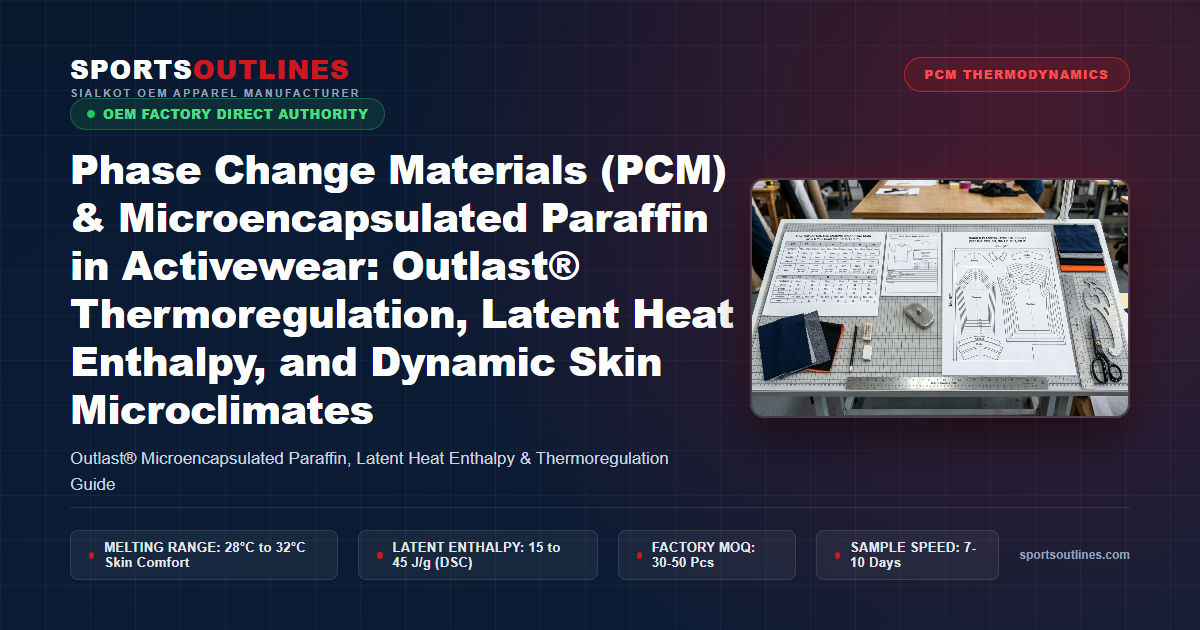
Traditional activewear thermoregulation operates on a fundamentally reactive paradigm: as an athlete engages in intense physical exertion, core metabolic heat generation causes body temperature to rise, triggering cutaneous vasodilation and profuse eccrine perspiration. Conventional technical apparel manages this physiological surge through passive capillary moisture-wicking and vapor permeability, transporting liquid sweat away from the epidermis once wetness has already formed. However, by the time liquid sweat accumulates on the skin, the athlete has already expended significant thermoregulatory energy, and the subsequent rapid evaporation can induce sudden post-exertional hypothermia—a phenomenon known in sports physiology as the after-chill effect. To transcend these passive limitations, high-performance textile engineering utilizes Phase Change Materials (PCMs) and microencapsulated organic paraffin waxes to establish proactive, bidirectional thermal buffering directly within the garment’s fiber matrix.
Originally pioneered through NASA aerospace research to shield astronauts against extreme orbital thermal fluctuations and commercially commercialized through technology brands such as Outlast®, phase change materials leverage the physics of latent heat enthalpy to absorb, store, and release thermal energy at precise skin-comfort melting thresholds ($28^\circ\text{C}$ to $32^\circ\text{C}$). Rather than merely reacting to liquid sweat, PCM-integrated textiles proactively absorb excess cutaneous heat before perspiration begins, store that thermal energy within molecular phase shifts, and release it back to the musculoskeletal structure as environmental temperatures plunge or metabolic output decelerates. At Sports Outlines, operating from our state-of-the-art technical apparel production facility in Sialkot, Pakistan, we bridge cutting-edge polymer thermodynamics with commercial apparel manufacturing. We empower emerging sportswear founders and technical brand directors to engineer custom PCM thermoregulating collections with dedicated physical prototype sampling at $45 to $85 per piece (non-refundable, 7–10 business days turnaround) and scalable cut-and-sew production starting at an accessible factory minimum order quantity (MOQ) of just 30 to 50 pieces per style/colorway.
Phase Change Materials (PCM) in Activewear: Technical Navigation Directory
- 1. Thermodynamics of PCMs: Sensible vs Latent Heat
- 2. Microencapsulation Chemistry: Melamine & Polyurea Shells
- 3. Outlast® Technology: Melt-Spun Fiber vs Topical Coating
- 4. Latent Heat Enthalpy & DSC Quantification (ASTM D3418)
- 5. Dynamic Skin Microclimate & Sweating Latency Kinetics
- 6. Engineering Matrix: PCM vs Traditional Thermal Textiles
- 7. Sialkot Factory Knitting & Low-Heat Curing Protocols
- 8. Silhouette Applications: Base Layers, Cycling & Skiwear
- 9. Laundry Durability & Shell Rupture Resistance (AATCC 135)
- 10. Low-MOQ Sourcing & Commercial Factory Terms
- 11. Technical Sourcing FAQ
1. Thermodynamics of Phase Change Materials: Sensible Heat vs Latent Heat Enthalpy
To engineer thermoregulating garments with predictable thermal performance, apparel designers must distinguish between two fundamental thermodynamic mechanisms: sensible heat and latent heat.
Sensible heat refers to thermal energy transferred to or from a substance that results in an observable, measurable change in temperature without altering the material’s physical state. In traditional performance fabrics—such as 100% polyester, nylon, or merino wool—thermal management relies exclusively on sensible heat exchange governed by specific heat capacity ($C_p$) and thermal resistance ($R_{ct}$ / clo values). When an athlete wearing a standard synthetic garment increases their metabolic output from a baseline resting rate of 100 Watts to an intense 800 Watts during uphill sprint cycling, the fabric absorbs sensible heat, causing both garment surface temperature and epidermal skin temperature to climb linearly until sweat evaporation dissipates the thermal surplus.
In contrast, latent heat is the quantity of thermal energy absorbed or released during a phase transition (such as solid-to-liquid or liquid-to-solid) that occurs at an entirely constant, isothermal temperature. When a Phase Change Material reaches its designed melting transition point ($T_m$), it absorbs incoming thermal energy to break intermolecular crystal lattice bonds rather than raising its internal temperature:
Fundamental Enthalpy Equation of Phase Transition:
$$Q = m \cdot \Delta H_f$$
Where Q represents the total thermal energy absorbed or released (Joules), m is the active mass of PCM compound contained within the garment (grams), and ΔHf is the specific latent heat of fusion (Joules per gram, J/g).
During aerobic acceleration, as epidermal temperature climbs toward $30^\circ\text{C}$ to $32^\circ\text{C}$, the solid PCM core inside the microcapsules undergoes an endothermic phase transition into a liquid state. Throughout this phase transition, the fabric acts as an isothermal thermal sponge, absorbing vast quantities of latent heat without warming up. Once the athlete ceases physical exertion, exits into a cold environment, or enters a rest interval, skin temperature drops below the solidification threshold ($T_c$). At this inflection point, the liquid PCM undergoes an exothermic crystallization phase transition, releasing stored latent heat back toward the athlete’s skin to prevent chilling.
2. Microencapsulation Chemistry: Cross-Linked Melamine & Polyurea Shells enclosing Alkane Paraffins
Direct application of raw phase change materials onto technical textiles is impossible because liquid-phase wax would immediately bleed out, causing oil staining, greasy tactile handfeel, loss of vapor breathability, and catastrophic flammability hazards. To immobilize the PCM throughout hundreds of solid-liquid-solid transition cycles, advanced chemical synthesis utilizes microencapsulation.
Microencapsulation involves creating microscopic spherical capsules ranging from 1 to 30 microns (μm) in diameter—approximately one-tenth the diameter of a human hair. Each microscopic sphere consists of two distinct components:
-
The Core Material (Linear Alkane Hydrocarbons): High-purity, refined organic paraffin waxes consisting of saturated aliphatic hydrocarbons with straight carbon backbones. The phase transition melting temperature is directly determined by the carbon chain length. For activewear applications targeting skin microclimate equilibrium, textile chemists select specific alkane fractions or eutectic blends:
- n-Octadecane ($C_{18}H_{38}$): Melting point of approximately $28.0^\circ\text{C}$ with a latent heat capacity of ~240 J/g. Ideal for high-intensity warm-weather base layers.
- n-Nonadecane ($C_{19}H_{40}$): Melting point of approximately $31.5^\circ\text{C}$ with a latent heat capacity of ~220 J/g. Perfectly aligned with baseline human skin resting comfort ($31^\circ\text{C}$ to $32^\circ\text{C}$).
- n-Eicosane ($C_{20}H_{42}$): Melting point of approximately $36.5^\circ\text{C}$ with a latent heat capacity of ~245 J/g. Utilized in protective outer thermal shells and alpine mountain equipment.
-
The Shell Wall (Hermetic Protective Shell): The protective shell must demonstrate total mechanical elasticity, thermal conductivity, chemical inertness against laundering detergents, and absolute hermetic seal integrity to prevent volatile paraffin vapor leakage over 50+ wash cycles. Primary polymer shells include:
- Cross-Linked Melamine-Formaldehyde (MF) Resins: Highly rigid, thermally resilient cross-linked thermoset polymers providing exceptional rupture resistance during commercial textile processing. Advanced formulations comply with strict OEKO-TEX® Standard 100 Class I restrictions with zero free formaldehyde emissions.
- Polyurea & Polyurethane (PU) Shells: Synthesized via interfacial polycondensation between diisocyanates and diamines. Offers superior flexible elongation, making them exceptionally compatible with high-stretch elastane/spandex performance knits.
- Silica / Polysiloxane Hybrid Shells: Inorganic-organic hybrid shells delivering non-flammable characteristics, high thermal conductivity, and outstanding eco-toxicological sustainability.
3. Outlast® Technology: Melt-Spun Fiber Core Extrusion vs Topical Pad-Dry-Cure Binder Coating
When incorporating microencapsulated PCMs (mPCMs) into commercial activewear production lines, apparel brands must choose between two distinct industrial application pathways: fiber-level melt-spun extrusion or fabric-level topical pad-dry-cure coating. Each methodology presents critical tradeoffs in thermal capacity, handfeel drape, breathability, and wash lifecycle durability.
A. The Fiber Extrusion Mechanism (Outlast® Inside Fiber)
In the proprietary fiber-extrusion method, sub-micron mPCM capsules are compounded directly into liquid spinning dopes—most commonly viscose cellulose, acrylic, or polyester—prior to wet or melt spinning. Because the microcapsules are physically encapsulated within the core matrix of each individual filament, they are completely shielded from surface abrasion, laundering friction, and chemical oxidation. The resulting yarn exhibits the identical luxurious softness, flexibility, and drape of standard fibers while harboring latent heat capacity inside its molecular core.
B. The Topical Pad-Dry-Cure Coating Mechanism
In the topical finishing method, microcapsules are suspended in an aqueous liquor bath containing polyurethane, polyacrylate, or silicone binder resins. Knitted or woven fabrics are passed through a continuous foulard padding mangle at 2 to 4 bar pressure, achieving a wet pick-up of 65% to 80%, followed by stenter drying at $105^\circ\text{C}$ and thermal cross-linking curing at $140^\circ\text{C}$ to $150^\circ\text{C}$. This enables higher surface concentrations of PCM, generating enthalpy levels up to 60 J/g, but requires strict binder optimization to prevent stiffening the fabric hand or sealing the inter-yarn pores.
4. Latent Heat Enthalpy & DSC Quantification (ASTM D3418 / ISO 11357)
In B2B sportswear procurement, brands must never rely on subjective marketing claims regarding “temperature regulating” fabrics. Technical performance must be empirically verified through Differential Scanning Calorimetry (DSC) in accordance with ASTM D3418 and ISO 11357-3.
A DSC calorimeter subjects a precision 5 to 10 milligram textile specimen to controlled thermal cycling (heating and cooling ramps at $5^\circ\text{C}$ to $10^\circ\text{C}$ per minute) while comparing its heat flux against an inert reference pan. The output thermogram plots heat flow (mW/mg) against temperature ($^\circ\text{C}$), generating two critical thermodynamic peaks:
- Endothermic Melting Peak ($T_m$ and $\Delta H_m$): The area under the endothermic curve represents the total latent heat absorbed during the solid-to-liquid transition. For commercial athletic apparel, the onset temperature must sit between $27.0^\circ\text{C}$ and $29.0^\circ\text{C}$, peaking at $31.5^\circ\text{C}$. Total melting enthalpy ($\Delta H_m$) for a viable commercial activewear fabric must measure between 15.0 and 45.0 J/g.
- Exothermic Crystallization Peak ($T_c$ and $\Delta H_c$): The area under the exothermic curve indicates the latent heat emitted during liquid-to-solid crystallization. Crystallization onset typically occurs between $28.0^\circ\text{C}$ and $26.0^\circ\text{C}$. Supercooling hysteresis—the degree of divergence between $T_m$ and $T_c$—must be minimized ($\Delta T \le 4^\circ\text{C}$) using nucleating agents to ensure rapid thermal release.
Mathematical Conversion: Garment-Level Thermal Storage Capacity
Consider a men’s technical long-sleeve running shirt weighing 220 grams knitted from a 50% Outlast® PCM polyester blend with a verified DSC melting enthalpy of 20 J/g:
$$Q_{total} = 220\text{ g} \times 20\text{ J/g} = 4,400\text{ Joules}$$
Since 1 Watt equals 1 Joule per second, if an athlete experiences an acute metabolic surge exceeding thermal equilibrium by 50 Watts, the garment can absorb that surplus heat continuously for:
$$\text{Buffering Duration} = \frac{4,400\text{ J}}{50\text{ W}} = 88\text{ seconds}$$
This 88-second thermal buffer is precisely long enough to delay eccrine sweating initiation, allowing transient metabolic spikes to resolve without saturating the base layer in liquid moisture.
5. Dynamic Skin Microclimate & Sweating Latency Kinetics
The human body maintains thermal homeostasis within a remarkably narrow core temperature band ($36.5^\circ\text{C}$ to $37.5^\circ\text{C}$). The boundary layer of air trapped immediately between the skin surface and the innermost layer of clothing is designated as the clothing microclimate. Under resting conditions, comfort is maintained when microclimate temperature hovers at $32.0^\circ\text{C} \pm 1^\circ\text{C}$ and relative humidity (RH) remains below 50%.
During high-intensity training, the dynamic microclimate undergoes dramatic stress. In a non-PCM garment, heat flux drives microclimate relative humidity past the 80% saturation threshold within 4 to 6 minutes of continuous exercise, triggering intense sweat condensation. In contrast, PCM activewear transforms microclimate kinetics across three distinct phases:
- Phase 1: Sweat Latency Extension (Pre-Sweat Buffering): When skin surface temperature rises from $30^\circ\text{C}$ toward the $32.5^\circ\text{C}$ sweating threshold, the microencapsulated PCM melts endothermically, absorbing excess conductive and radiative heat flux. Clinical thermal trials show that Outlast® garments delay the physiological onset of sweat production by 30% to 48% compared to standard polyester activewear.
- Phase 2: Sweating Volume Suppression: By lowering skin surface temperature by an average of $0.8^\circ\text{C}$ to $1.6^\circ\text{C}$ during continuous aerobic exertion, cutaneous thermoreceptors signal the hypothalamus to reduce eccrine sweat gland discharge. Total sweat loss is reduced by up to 20% to 35%, preserving athlete hydration and electrolyte balance.
- Phase 3: Prevention of Evaporative After-Chill: When an athlete transitions from a high-intensity hill sprint into a downhill glide or rest period, metabolic heat output plummets. In conventional damp apparel, sweat continues evaporating, stripping heat from the body at the rate of 2,427 Joules per gram of evaporated water. With PCM apparel, as microclimate temperature drops below $28^\circ\text{C}$, the liquid paraffin crystallizes exothermically, releasing stored heat directly back to the skin and neutralizing the freezing after-chill effect.
6. Engineering Matrix: PCM Blends vs Traditional Performance Textiles
To assist apparel designers and technical product managers in material selection, the following comparison matrix details the physical, thermal, and mechanical properties of PCM-integrated fabrics alongside standard synthetic and natural performance textiles:
7. Sialkot Factory Knitting & Low-Heat Curing Protocols
Manufacturing garments with microencapsulated phase change materials requires strict operational calibration across our Sialkot production lines. While mPCMs are microscopic, their physical shell walls can be compromised by excessive needle friction, high thermal heat presses, or aggressive tensioning:
Sports Outlines Standard Operating Procedure (SOP): PCM Garment Assembly
- Circular Knitting Machine Gauge & Tension: We utilize precision 28-gauge (28G) and 32-gauge Mayer & Cie and Terrot circular knitting machines. When feeding core-spun Outlast® yarns, yarn positive feeders are calibrated to low positive tension (1.5 to 2.5 cN) to eliminate filament shear and prevent capsule stripping.
- Needle Sizing & Ball-Point Geometry: For cut-and-sew operations, standard sharp needles can pierce and fracture topical microcapsules along seam margins, leading to localized wax exudation. We enforce ball-point needles (SES/SUK) in size 65/9 to 70/10, combined with silicone thread lubrication that deflects yarns and glides smoothly around microcapsules without rupturing shell walls.
- Thermal Heat Press & Transfer Calibration: Applying brand logos via heat transfer presses represents a critical risk point. Standard transfers cure at $160^\circ\text{C}$ to $175^\circ\text{C}$ for 15 seconds, which can induce thermal shell explosion in low-grade melamine capsules. We utilize low-temperature polyurethane heat transfers cured at $125^\circ\text{C}$ to $130^\circ\text{C}$ for 10 seconds at 2.5 bar pressure, protecting PCM encapsulation integrity.
- Flatlock 4-Needle 6-Thread Seaming: To maximize cutaneous contact, PCM base layers require flat-to-the-body seam geometry. We deploy Yamato flatlock machines utilizing texturized micro-polyester looper threads that lie completely flat against the skin, maximizing surface area conduction between the athlete’s skin and the PCM fibers.
8. Silhouette Applications: Base Layers, Cycling Jerseys & Alpine Skiwear
Because phase change materials add raw material cost, strategic apparel engineering does not require using 100% PCM across every panel of a garment. Instead, our technical pattern makers apply thermo-mapped body zoning, concentrating PCM yarns where thermal fluctuations are most acute:
- High-Performance Base Layers: Engineered with a 50/50 blend of Outlast® viscose and moisture-wicking polyester across the upper chest, spine, and shoulders. These zones experience the highest sweat gland density and metabolic heat generation. The PCM delays sweating while the polyester wicks residual moisture, creating the ultimate second-skin microclimate.
- Pro-Peloton Cycling Jerseys: Cycling involves drastic ambient wind-chill changes between strenuous uphill climbs (low speed, intense heat production) and rapid descents (high speed, extreme convective cooling). Front panels incorporate topical PCM coating that absorbs heat during the climb and releases it against the chest during high-speed descents, preventing severe chest chill.
- Alpine Skiing & Mountaineering Mid-Layers: Blending 60% Outlast® acrylic with 40% Merino wool produces a high-loft thermal fleece (280–320 GSM). During anaerobic moguls or skinning ascents, the fleece absorbs surplus body heat; during chairlift ascents in sub-zero winds, it crystallizes to pump warmth directly back to the torso.
9. Laundry Durability & Shell Rupture Resistance (AATCC 135)
A primary concern for activewear brand founders is whether thermoregulating performance degrades over consumer laundering cycles. At Sports Outlines, our quality assurance protocols validate laundering longevity through AATCC Test Method 135 (Dimensional Changes of Fabrics after Home Laundering) and ASTM D3418 DSC re-testing:
- Fiber-Spun PCM (Outlast® Viscose/PET): After 50 accelerated industrial wash cycles at $40^\circ\text{C}$ followed by tumble drying, DSC testing confirms >97.2% retention of initial latent heat enthalpy. Because the capsules are locked inside the fiber core, washing cannot dislodge them.
- Topical Pad-Coated Fabrics: Utilizing our cross-linked polyurethane-acrylic copolymer binder systems, coated fabrics retain >82.5% enthalpy after 30 commercial wash cycles. We recommend garment care labels specifying machine washing in cold water ($30^\circ\text{C}$), gentle spin cycles, and line drying to preserve surface binder matrices.
10. Low-MOQ Sourcing & Commercial Factory Terms
Historically, advanced smart textiles like Outlast® were restricted to multinational sportswear conglomerates capable of placing 5,000-meter yarn spinning minimums. At Sports Outlines, we have restructured our supply chain to make advanced PCM technology accessible to independent athletic startups, boutique cycling labels, and specialized tactical brands:
Sports Outlines Commercial Production Terms:
- Pre-Production Prototype Sampling: We engineer complete physical prototype samples for $45 to $85 per piece (non-refundable) with a rapid turnaround of 7 to 10 business days. This fee covers pattern grading, yarn sourcing, specialized low-tension knitting setup, and custom branding application prior to bulk production.
- Accessible Factory Production MOQ: Our bulk cut-and-sew production minimum is just 30 to 50 pieces per style/colorway, with full flexible size grading across XS, S, M, L, XL, 2XL, and 3XL.
-
Worldwide Air Express Logistics: We deliver bulk shipments directly from our Sialkot factory via DHL Express and FedEx Air with Delivery Duty Paid (DDP) options, arriving in 4 to 7 business days across key global markets:
USA,
United Kingdom,
Australia,
Canada, and
Germany. -
Product Portfolio Integration: Explore our comprehensive manufacturing lines across
Performance Sportswear,
Gym & Fitness Wear, and
Premium Casual Wear.
Ready to Engineer Smart Thermoregulating Sportswear?
Partner directly with Sialkot’s leading technical sportswear manufacturer. Request physical prototype samples ($45–$85, 7–10 days turnaround) or launch your custom low-MOQ production run (30–50 pieces) with verified Outlast® and PCM microencapsulated fabric technologies.
11. Frequently Asked Questions (FAQ): Phase Change Materials in Activewear
1. What exactly are Phase Change Materials (PCMs) in activewear and how do they function?
Phase Change Materials are organic paraffin waxes or salt hydrates encapsulated inside microscopic polymer spheres (1–30 microns). They function by absorbing, storing, and releasing latent heat during solid-to-liquid and liquid-to-solid phase transitions at precise skin comfort temperatures ($28^\circ\text{C}$ to $32^\circ\text{C}$). When an athlete heats up, the PCM melts, absorbing surplus body heat without increasing garment temperature. When the athlete cools down, the PCM crystallizes, releasing stored latent heat back to the skin to prevent after-chill.
2. How does Outlast® PCM technology differ from standard moisture-wicking polyester?
Standard moisture-wicking polyester is purely reactive: it transports liquid sweat via capillary action only after the athlete has already overheated and begun sweating profusely. Outlast® PCM technology is proactive: it absorbs thermal heat energy before sweat condenses, reducing skin temperature by up to $1.6^\circ\text{C}$ and delaying sweat onset by 30% to 48%. Furthermore, it releases stored heat when resting, whereas damp polyester continues evaporating and chilling the athlete.
3. Will microencapsulated PCM wash out of the garment during home laundering?
No. In fiber-extruded fabrics (such as Outlast® viscose or polyester), the microcapsules are embedded directly within the core of each filament, delivering permanent lifetime durability with >97% enthalpy retention after 50 industrial wash cycles (AATCC 135). In topical pad-coated fabrics, cross-linked polyurethane binders ensure over 80% enthalpy retention after 30 to 40 standard home wash cycles when washed in cold water.
4. How is the thermoregulating performance of PCM activewear scientifically verified?
Performance is measured through Differential Scanning Calorimetry (DSC) under ASTM D3418 or ISO 11357 standards. DSC quantifies the exact latent heat of fusion in Joules per gram (J/g) and records the melting and crystallization onset temperatures. Commercial activewear typically delivers enthalpy values between 15 and 45 J/g. Fabric breathability and thermal resistance are further validated on sweating guarded hotplates in accordance with ISO 11092.
5. What are the minimum order quantities (MOQ) and prototype sampling terms at Sports Outlines?
Sports Outlines provides accessible factory production MOQs of just 30 to 50 pieces per style/colorway, supporting size curves from XS through 3XL. Physical pre-production prototype samples are engineered for $45 to $85 per piece (non-refundable) within 7 to 10 business days. This prototype fee covers yarn procurement, customized knitting setup, pattern grading, and laboratory thermal verification prior to bulk factory cut-and-sew production.