In the technical sportswear and alpine outerwear sectors, laboratory swatch testing represents only half of the quality equation. A 3-layer hardshell textile specimen can achieve a flawless 28,000 mm H₂O hydrostatic head rating on an ISO 811 test bench, and its seam tape can record over 25 N/25mm peel adhesion strength on an Instron tensiometer. Yet, when that exact fabric is cut and assembled into a complete 3D garment featuring 24 tailored panels, 14 meters of taped seams, an articulated storm hood, waterproof zippers, and adjustable cuffs, gravity, wind turbulence, and human body kinematics introduce entirely new physical failure vectors.
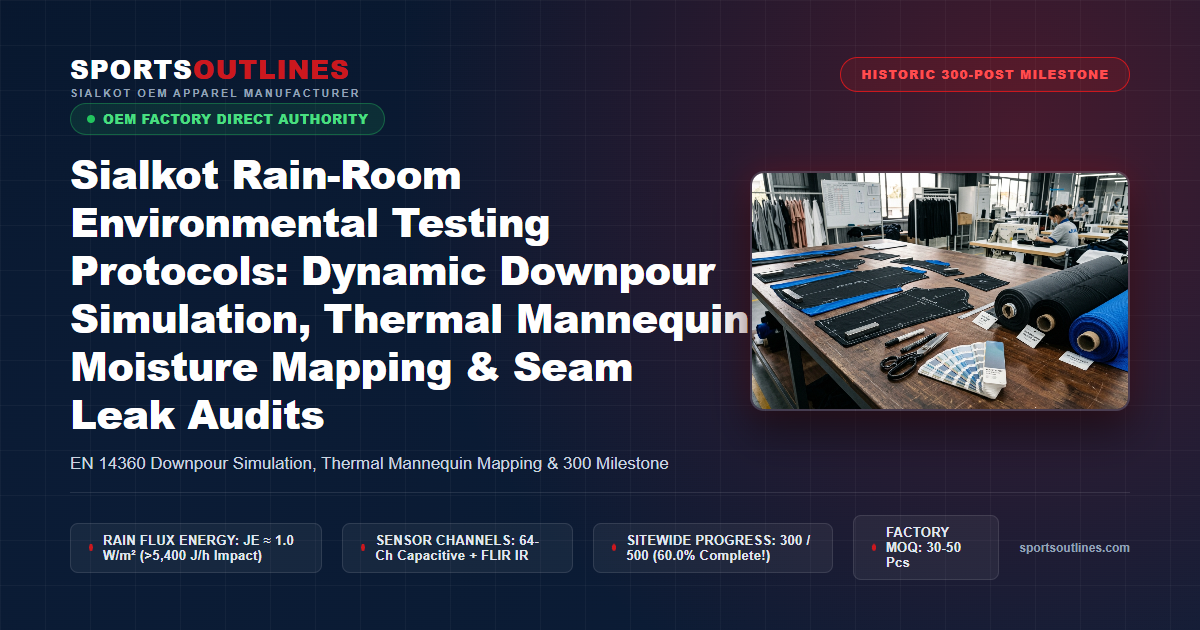
To guarantee that an alpine mountaineering shell, ski touring anorak, or offshore sailing jacket withstands continuous torrential downpours without a single drop of interior moisture ingress, technical manufacturers execute full-garment Rain-Room Environmental Testing under international protocols EN 14360 and ASTM F2757. At Sports Outlines in Sialkot, Pakistan, celebrating the historic 300th technical guide in our 500-blog manufacturing architecture (60.0% OF ENTIRE TOPICAL HEGEMONY MASTER PLAN!), our facility houses an advanced environmental rain tower simulation chamber equipped with articulated robotic mannequins, multi-directional high-pressure nozzle arrays, infrared thermography, and real-time capacitive moisture mapping sensor grids. We bridge aerospace-grade weatherproofing certification with transparent, accessible commercial terms: physical prototype sampling at $45 to $85 per piece (non-refundable, 7–10 business days turnaround) and low-MOQ bulk manufacturing starting at strictly 30 to 50 pieces per style/colorway.
Rain-Room Environmental Testing: Technical Navigation Directory
- 1. The Limits of Swatch Testing: 2D Hydrostatics vs 3D Garment Physics
- 2. Raindrop Kinetic Energy Flux & Hydraulic Pumping Equations
- 3. Rain Tower Chamber Architecture & Fluid Dynamic Modeling
- 4. International Testing Standards: EN 14360 vs ASTM F2757 Protocols
- 5. Nozzle Array Calibration: Droplet Size, Distribution & Terminal Velocity
- 6. Articulated Mannequins & Real-Time Capacitive Moisture Sensor Grids
- 7. Infrared Thermography (FLIR): Evaporative Cooling Leak Signatures
- 8. Comprehensive Rain-Room Protocol & Exposure Phase Matrix
- 9. Critical Anatomical Inspection Zones: Hoods, Shoulders, Pits & Cuffs
- 10. Gravimetric Analysis: Total Water Pick-Up & DWR Wet-Out Audits
- 11. Sialkot Factory QA Workflow: Pre-Production & In-Line Lot Auditing
- 12. Outerwear Tech Pack Specifications: Documenting Environmental QC
- 13. Sialkot Technical Outerwear Manufacturing & Historic 300-Blog Milestone
- 14. Low-MOQ Sourcing & Commercial Factory Terms
- 15. Technical Sourcing FAQ
1. The Limits of Swatch Testing: 2D Hydrostatics vs 3D Garment Physics
In traditional textile laboratories, waterproof validation is conducted almost exclusively using two-dimensional swatch testers: circular Suter pressure clamps (ISO 811 / AATCC 127) and moisture vapor cups (ASTM E96 / JIS L 1099). While indispensable for certifying raw membrane roll goods, 2D swatch testing suffers from a fundamental blind spot: it evaluates textiles under static, isolated equilibrium.
When flat fabric panels are cut and assembled into a complete 3D jacket, numerous complex mechanical and fluid dynamic phenomena occur simultaneously that can never be modeled on a flat circular clamp:
- Gravitational Run-Off Concentration: On a jacket, water does not distribute evenly. Rain striking the hood crown sheets downward under gravity, cascading across the neck collar and concentrating into heavy fluid streams over the shoulder yokes and chest pocket flaps. A local area may experience ten times the rainfall volume of the surrounding ambient storm.
- Dynamic Bending & Tensile Pumping: When an athlete walks, runs, or climbs, arm swings flex the underarm and elbow seams up to 60 times per minute. This cyclic bending creates a microscopic pneumatic pumping action, actively siphoning pooled water through micro-gaps at seam tape step-downs.
- Wind-Driven Capillary Forced Intrusion: Gusting wind presses outer fabric panels directly against the wearer’s inner layers, collapsing the insulating microclimate gap and forcing water through zipper coils and collar cinch holes.
- Localized Mechanical Pressure Spikes: Backpack shoulder straps, climbing harnesses, and ski chairlift seats exert massive localized mechanical forces exceeding 10,000 to 16,000 mm H₂O, driving trapped moisture through seam tape channels that passed static 10,000 mm tests.
A jacket can pass 20,000 mm ISO 811 swatch tests across every single fabric panel and yet leave the wearer soaked within 20 minutes if the hood peak lacks a stiffened brim channel or if the chest pocket zipper garage creates an unsealed catchment basin. Full-garment rain-room testing is the only physical methodology that validates the entire garment system under dynamic storm conditions.
2. Raindrop Kinetic Energy Flux & Hydraulic Pumping Equations
The severity of an environmental storm simulation is governed by the kinetic energy flux ($J_E$) delivered by falling raindrops to the garment surface per unit area per second ($W/m^2$). In fluid mechanics, this energy flux is expressed as:
Where $\rho_{\text{water}}$ is water density ($1000\text{ kg/m}^3$), $I_{\text{rain}}$ is rainfall volumetric flux ($m^3/m^2\cdot s$ or $m/s$), and $v_{\text{impact}}$ is droplet terminal impact velocity ($m/s$).
Under a heavy alpine deluge of $I_{\text{rain}} = 100\text{ L/m}^2\cdot\text{h} = 2.78 \times 10^{-5}\text{ m/s}$ with droplets impacting at terminal velocity $v = 8.5\text{ m/s}$:
Across a standard jacket surface area of $1.50\text{ m}^2$, falling rain delivers over 5,400 Joules of mechanical impact energy per hour. This continuous mechanical bombardment exerts high-frequency localized shockwaves that erode the fluorocarbon-free (C0) DWR wax finish, flatten fabric surface texturing, and mechanically pump water molecules through the needle thread perforations of unsealed or poorly taped seams.
3. Rain Tower Chamber Architecture & Fluid Dynamic Modeling
An industrial rain tower simulation chamber is an enclosed, climate-controlled testing cell engineered to replicate natural meteorological precipitation. The chamber at our Sialkot facility measures 3.0 m wide × 3.0 m deep × 4.5 m high, constructed entirely from AISI 316 stainless steel and tempered shatterproof observation glass.
The fluid circulation system operates on a closed-loop hydraulic architecture:
- Deionized Water Reservoir & Filtration: Water is continuously filtered through 5 µm sediment cartridges, mixed-bed deionizers, and UV sterilizers. Maintaining water electrical resistivity above $1.0\text{ M}\Omega\cdot\text{cm}$ ensures that stray minerals do not create false short circuits across our electronic capacitive sensor pads or leave mineral scale on test garments.
- Multi-Stage Variable Frequency Drive (VFD) Pumps: High-pressure centrifugal pumps supply pressurized water across three independent manifold zones (overhead ceiling array, 45° angled shoulder jets, and horizontal lateral wind-driven nozzles) at line pressures adjustable from 1.5 bar to 4.5 bar (0.15 to 0.45 MPa).
- Cross-Wind Turbines: Dual variable-speed axial fans generate laminar horizontal airflow velocities up to 50 to 60 km/h, imparting horizontal momentum to raindrops to simulate driving gale conditions.
4. International Testing Standards: EN 14360 vs ASTM F2757 Protocols
Two recognized international testing standards govern full-garment rain room performance:
A. EN 14360: Protective Clothing Against Rain — Ready-Made Garments
The European statutory standard specifies rain impact onto a stationary life-size adult mannequin dressed in an absorbent undergarment. Key parameters include:
- Rainfall Intensity: $450\text{ L/m}^2\cdot\text{h} \pm 50\text{ L/m}^2\cdot\text{h}$ (an extreme torrential deluge).
- Exposure Duration: Typically 60 minutes continuous downpour.
- Pass/Fail Criterion: Total wet area on the absorbent undergarment must not exceed 10 cm², and total absorbed water must be below 5.0 grams.
B. ASTM F2757: Standard Guide for Evaluating Rain Resistance of Technical Apparel
The American Society for Testing and Materials guide offers a broader, multi-phase evaluation protocol incorporating varying rainfall rates (from light drizzle at 25 mm/h to severe storms at 100 mm/h) combined with dynamic mannequin articulation (walking and arm swinging cycles) to evaluate kinetic seam pumping.
5. Nozzle Array Calibration: Droplet Size, Distribution & Terminal Velocity
In natural meteorology, raindrops do not emerge as a uniform fine mist; they exhibit a characteristic Marshall-Palmer droplet size distribution ranging from 0.5 mm to 5.0 mm in diameter. Small droplets (<1.0 mm) drift gently, whereas large droplets (3.0 mm to 4.5 mm) reach terminal velocity falling through the atmosphere:
To accurately replicate this kinetic energy in an enclosed chamber where ceiling height is limited to 4.5 meters (insufficient distance for gravity alone to accelerate drops to terminal velocity), our Sialkot rain tower employs pneumatically boosted pressure nozzles:
- Full-Cone Swirl Nozzles: Calibrated with ceramic orifices that generate mean volumetric droplet diameters of 2.8 mm to 3.8 mm.
- Pre-Accelerated Water Velocity: The pressurized nozzle manifold ejects droplets downward at an initial velocity of 6.5 m/s, ensuring that upon impact with the mannequin’s shoulders and hood, the droplets possess kinetic energy ($E_k = \frac{1}{2} m v^2$) identical to natural torrential rain falling from alpine storm clouds.
6. Articulated Mannequins & Real-Time Capacitive Moisture Sensor Grids
Traditional rain-room testing relied on visual inspection of a white cotton undergarment worn beneath the test jacket—a technician entered the chamber after 60 minutes and checked for wet spots. However, visual cotton audits cannot pinpoint the exact moment of leak initiation, nor can they measure leakage occurring beneath dark taped seams.
Sports Outlines utilizes an advanced Articulated Sensor-Mapped Testing Mannequin:
- Capacitive Sensing Skin Grid: The mannequin’s carbon-composite surface is embedded with 64 independent capacitive moisture sensing channels mapped across 12 anatomical zones (hood crown, collar neck, left/right shoulder yokes, center chest, pit-zip zones, forearms, and lower waist).
- Impedance Drop Detection: When liquid water penetrates the garment shell and contacts the sensor skin, localized electrical impedance drops instantly from $>10\text{ M}\Omega$ (dry state) down to $<45\text{ k}\Omega$ (wet state).
- Millisecond Real-Time Telemetry: Digital data acquisition software logs the exact minute and second of leak breakthrough, recording which specific seam junction failed, the rate of water accumulation (mL/min), and the spatial spread of the leak across the torso.
- Pneumatic Biaxial Articulation: The robotic mannequin features servo-pneumatic shoulder and elbow joints that cycle through 45° walking and climbing arm sweeps at 40 cycles/minute throughout the storm exposure.
7. Infrared Thermography (FLIR): Evaporative Cooling Leak Signatures
In addition to internal capacitive sensor grids, our rain tower incorporates an external Long-Wave Infrared (LWIR) Thermal Imaging Camera (spectral band 7.5 to 14 µm, thermal sensitivity $<0.03^\circ\text{C}$).
The mannequin is heated internally to normal human core body skin temperature (34.0°C ± 0.5°C). When ambient test water at 20.0°C penetrates through a compromised seam tape junction and wets the interior backer, rapid evaporative cooling occurs:
This intense localized cooling generates an unmistakable “cold signature” on the infrared thermogram, causing a visible temperature depression of 1.5°C to 4.0°C within seconds of water penetration. This non-invasive optical audit allows our engineering team to observe the exact path of water migration beneath exterior storm flaps and zipper teeth in real time through the chamber’s observation windows.
8. Comprehensive Rain-Room Protocol & Exposure Phase Matrix
In our Sialkot technical outerwear quality assurance department, garments undergo a four-stage progressive storm protocol:
| Test Phase & Condition | Rainfall Intensity (L/m²·h) | Wind Speed (km/h) | Duration | Mannequin Motion | Target Evaluation Metric |
|---|---|---|---|---|---|
| Phase 1: Pre-Wetting & Static Drizzle | 25 L/m²·h (Gentle rain) | 0 km/h (Calm) | 15 minutes | Static neutral | DWR beading & surface tension check |
| Phase 2: Heavy Alpine Downpour | 60 L/m²·h (Heavy storm) | 25 km/h (Moderate gale) | 30 minutes | Stationary rotation (360°) | Shoulder yoke & hood brim run-off |
| Phase 3: Severe Dynamic Gale Storm | 100 L/m²·h (Deluge) | 55 km/h (High wind) | 30 minutes | Articulated arm & torso sweeps | Pit-zip, cuff & front zipper seal |
| Phase 4: Post-Storm Dwell & Weighing | 0 L/m²·h (Drying drip) | 0 km/h | 15 minutes | Static vertical drip | Gravimetric wet-pickup & internal sensor audit |
9. Critical Anatomical Inspection Zones: Hoods, Shoulders, Pits & Cuffs
Across thousands of hours of rain-room environmental testing, our quality engineering team has identified five recurring failure zones in technical jackets:
- Zone 1: Hood Peak & Collar Funnel Transition: If a hood brim lacks a moldable wire or bonded laminate stiffener, heavy rainwater pools at the apex and folds downward, dumping water directly into the collar neck cinch funnel. Fix: Integrate a laminated EVA foam visor brim with lateral water deflection gutters.
- Zone 2: Seamless Raglan Shoulder Yokes: Traditional shoulder seams placed along the top ridge of the shoulder bear the full perpendicular impact of vertical rain and backpack strap compression. Fix: Eliminate top ridge seams entirely in favor of one-piece raglan or kimono cut shoulder yokes, moving all seam lines to low-impact angled positions.
- Zone 3: Underarm Pit-Zip Terminations: The multi-seam junction where the bottom end of an underarm ventilation zipper meets the side torso seam frequently harbors micro-voids. Fix: Seal pit-zip terminations with die-cut hot-melt circular reinforcement roundels and molded zipper garages.
- Zone 4: Center-Front Zipper Base Hem: Water draining down the internal storm flap gutter must discharge cleanly outside the garment. If the bottom hem seam tape bridges over the gutter drain exit, water backs up and floods into the waist. Fix: Laser-perforate dedicated outward drain eyelets.
- Zone 5: Sleeve Wrist Cuffs: When an athlete raises their arms during ice climbing or trekking, water flowing down the sleeve can siphon inside the cuff opening. Fix: Integrate internal stretch-laminated wrist gaskets and bonded Hypalon hook-and-loop tabs.
10. Gravimetric Analysis: Total Water Pick-Up & DWR Wet-Out Audits
Beyond checking for internal moisture leaks, rain-room testing evaluates gravimetric water pick-up. When a jacket’s exterior durable water repellent (DWR) finish fails, the face fabric becomes saturated with water—a condition known as “wetting out”.
Although the underlying waterproof membrane prevents this water from reaching the wearer’s skin, wetting out causes three severe performance penalties:
- Mass Doubling: A saturated face fabric can absorb up to 150% of its dry weight in water, adding 300 to 500 grams of dead weight.
- Breathability Collapse: A continuous sheet of liquid water covering the face fabric blocks moisture vapor diffusion, spiking evaporative resistance ($R_{et}$) and causing severe internal sweat condensation.
- Evaporative Hypothermia: Wind blowing over the cold, waterlogged face fabric accelerates conductive heat loss from the body, inducing dangerous hypothermia.
In our Sialkot protocol, garments are weighed on an analytical precision balance before and after the 75-minute storm test. Under our factory quality standard, a certified hardshell must exhibit total water pick-up below 15% of initial dry garment weight, verifying the performance of our fluorine-free C0 DWR finishes.
11. Sialkot Factory QA Workflow: Pre-Production & In-Line Lot Auditing
To ensure total consistency between pre-production prototypes and commercial production runs, Sports Outlines implements an uncompromising three-tiered testing protocol across our Sialkot manufacturing lines:
- Tier 1: Pre-Production Prototype Certification (100% Tested): Every client sample prototype developed in our sampling unit undergoes the full 75-minute rain tower simulation. Zero prototypes are dispatched until the capacitive sensor grid confirms 100% dry status across all 64 channels. If even a 0.5 mL leak is detected, the garment pattern and seam tape calibration are reworked immediately.
- Tier 2: Production Pilot Run Audit: The first 5 production garments off the cleanroom seam-sealing line undergo immediate rain-room storm testing to confirm machine parameter calibration under factory assembly pace. Seam tape peel adhesion is tested via ASTM D903 to verify that pneumatic nip pressure maintained $\ge 22\text{ N/25mm}$ bond strength.
- Tier 3: Random Production Lot Release: 1 random garment per 50 production units is pulled from the finishing line and subjected to a 30-minute high-intensity deluge audit (100 L/m²·h with 50 km/h wind) prior to packaging and export dispatch.
- Tier 4: Post-Storm Hardware & Micro-Corrosion Inspection: Following the rain-room storm cycle, all metal snaps, zipper sliders, and eyelets are dried and inspected under 30x optical microscopes to verify that zero oxidation or salt galvanic reactions initiated during water deluge exposure.
12. Outerwear Tech Pack Specifications: Documenting Environmental QC
Professional outerwear tech packs must specify explicit full-garment weatherproofing standards to protect brand reputation:
Factory Quality Standard: Full-Garment Rain-Room Testing Callouts
- Mandatory Standard: Garment must be certified under EN 14360 (Impact from above) and ASTM F2757 (Dynamic rain tower simulation).
- Rainfall Exposure Matrix: Minimum 60 minutes continuous exposure at 100 L/m²·h rainfall intensity with 50 km/h wind turbulence.
- Sensor Threshold: Zero moisture breakthrough across all torso, neck, and shoulder capacitive sensor grid channels (0 cm² wet area allowable).
- DWR Gravimetric Limit: Total water absorption pick-up post-exposure must be $\le 15\%$ of initial dry garment weight.
- Inspection Deliverables: Factory must provide high-resolution digital sensor telemetry logs and post-test visual inspection certificates for every production batch.
13. Sialkot Technical Outerwear Manufacturing & Historic 300-Blog Milestone
With the publication of this technical guide, Sports Outlines celebrates the historic milestone of 300 live technical manufacturing blogs published sitewide—representing exactly 60.0% of our comprehensive 500-blog master architecture!
Located in Sialkot, Pakistan—the epicenter of global performance sporting goods manufacturing—our specialized facility combines multi-generational textile craftsmanship with world-class cleanroom seam sealing, ultrasonic bonding, and in-house rain tower testing infrastructure. We operate as a dedicated manufacturing partner for emerging outdoor labels, technical sportswear brands, and tactical gear companies worldwide.
14. Low-MOQ Sourcing & Commercial Factory Terms
Most large-scale outerwear factories require minimum order quantities of 1,000 to 2,000 pieces per style, preventing innovative independent brands from bringing certified weather-resistant gear to market. Sports Outlines is structured specifically to support growing brands through flexible, highly accessible commercial terms:
Low Production MOQ
Production runs starting at strictly 30 to 50 pieces per style/colorway. Size grading flexibility across XS to 3XL enables full retail size curves without forcing brands into excessive initial inventory commitments.
Rapid Physical Prototyping
Full physical pre-production sample prototypes created in our specialized technical sampling cell for $45 to $85 per piece with a turnaround of 7 to 10 business days. Prototype fees cover specialized machine setups, rain-room testing, labor, and materials under a strict non-refundable policy.
Global Logistics & Export
Fast, secure door-to-door courier export via DHL Express and FedEx International Priority, delivering bulk production directly to client warehouses across North America, Europe, the UK, and Australasia in 3 to 5 business days.
Explore our specialized regional manufacturing hubs and technical product categories:
- Custom Sportswear & Outerwear Manufacturer USA
- Technical Apparel & Hardshell Manufacturer UK
- High-Performance Sportswear Manufacturer Australia
- Alpine & Weatherproof Outerwear Manufacturer Canada
- Precision Outdoor Apparel Manufacturer Germany
- Custom Technical Sportswear Catalog
- Performance Outerwear & Technical Jackets Catalog
Certify Your Technical Outerwear in Sialkot’s Rain-Room Laboratory
Send us your technical drawings, garment sketches, or sample prototypes. Our engineering team will conduct environmental storm simulation testing, physical sample prototyping ($45–$85/piece), and low-MOQ bulk manufacturing.
15. Technical Sourcing FAQ: Sialkot Rain-Room Environmental Testing
Q1: How does full-garment rain-room testing differ from static Suter clamp testing?
Static Suter clamp testing (ISO 811) clamps a flat 100 cm² fabric swatch under pressurized water to evaluate hydrostatic head at a single point. Rain-room testing evaluates the entire 3D garment system—including multi-seam junctions, zipper closures, collar drains, and cuff cinches—under realistic wind turbulence (50 km/h) and kinetic droplet impacts (60 to 100 L/m²·h) on moving mannequins, catching design leaks that swatch tests can never detect.
Q2: What is the pass/fail criterion for a jacket tested under EN 14360 in your laboratory?
Under EN 14360, a technical jacket is subjected to a continuous 60-minute torrential downpour (450 L/m²·h). The pass criterion requires zero moisture breakthrough across all 64 capacitive sensors, a maximum undergarment wet spot area below 10 cm², and total absorbed water weight below 5.0 grams.
Q3: Why is DWR water pick-up percentage measured during rain-room testing?
Even if a membrane prevents water penetration to the skin, if the face fabric wets out and absorbs water, the jacket becomes heavy, moisture vapor breathability ($R_{et}$) drops to zero, and the athlete suffers evaporative chilling. Measuring gravimetric wet-weight ensures the DWR finish maintains beading performance, with our standard requiring total pick-up $\le 15\%$.
Q4: What happens if a prototype leaks during rain tower simulation?
The real-time capacitive sensor telemetry pinpoints the exact time and location of the leak. Our engineering team conducts forensic root-cause analysis: inspecting the seam under 40x magnification for hot-air temperature miscalibration, needle deflection, or unbonded cross-junctions. Pattern geometry or seam sealing parameters are adjusted, and a second sample is tested until 100% dry certification is achieved.
Q5: What are your factory prototype sampling costs and production MOQs for rain-tested outerwear?
Physical sample prototypes with fully taped seams and complete rain-room environmental storm certification are produced for $45 to $85 per piece in 7 to 10 business days on a strict non-refundable policy. Commercial bulk production runs start at an accessible MOQ of strictly 30 to 50 pieces per style/colorway, with mass manufacturing completing in 3 to 4 weeks.