Direct Manufacturer Answer: How to Manufacture Custom Compression Rashguards
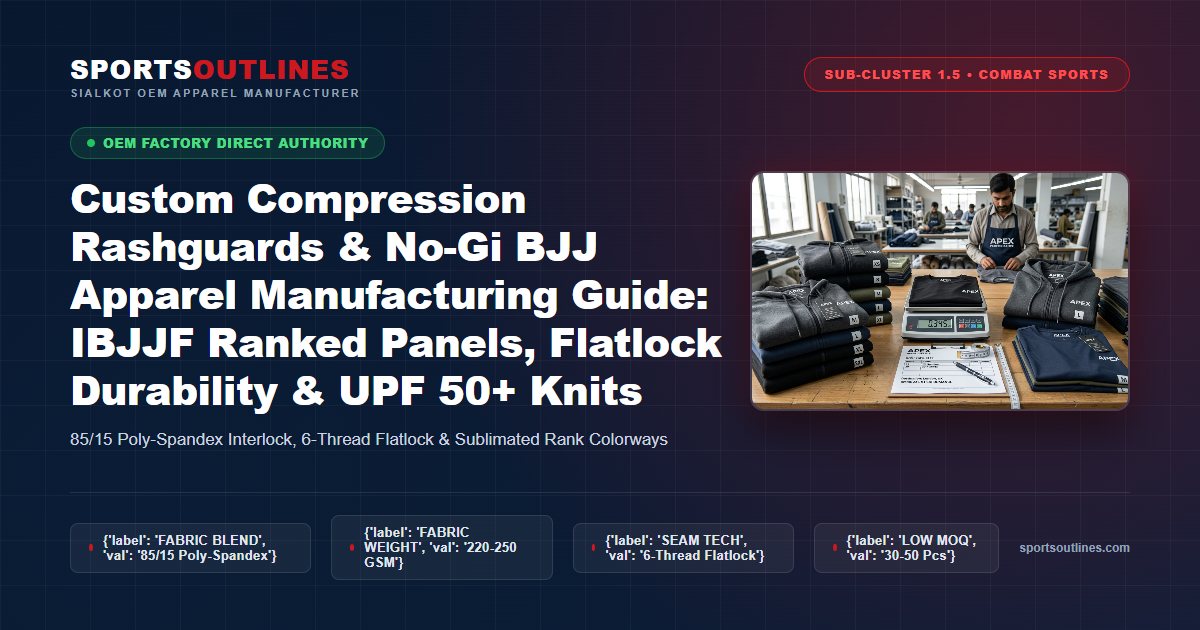
Manufacturing tournament-grade custom compression rashguards and No-Gi Brazilian Jiu-Jitsu (BJJ) apparel requires high-elasticity textile science paired with zero-abrasion structural seam technology. The industry benchmark fabric is a 230 to 250 GSM 4-way stretch interlock knit composed of 85% continuous-filament polyester and 15% elastane (spandex), providing 150% multi-directional elongation with a 98% mechanical snap-back recovery rating. All panel junctions are constructed using 4-needle 6-thread flatlock stitching utilizing high-tensile texturized nylon threads, creating perfectly flat, flush seams that eliminate skin chafing and mat burns during relentless skin-on-skin friction. For competition compliance under IBJJF Rule Article 8.2, tournament rashguards must incorporate at least 10% of the athlete’s designated belt rank color (White, Blue, Purple, Brown, Black) on an otherwise solid black or white base. The bottom hem is engineered with an internal anti-slip vulcanized silicone gel gripper bead to prevent the garment from riding up over the abdomen during guard play and scrambling. Factory direct low MOQ at our Sialkot facility starts at 30 to 50 rashguards per model and rank colorway across adult (XS–3XL) and youth sizes. Pre-production physical prototype samples cost $45 to $85 per custom piece completed in 7 to 10 business days.
- Textile Composition: 85/15 Polyester-Spandex (230–250 GSM) or 80/20 Nylon-Spandex premium brushed interlock.
- Seam Technology: 4-Needle 6-Thread Flatlock with differential feed and texturized stretch looper threads.
- Anti-Ride-Up Hem: 25 mm wave-patterned silicone gel grip beading fused directly to interior bottom hem.
- Antimicrobial Treatment: Silver-ion nanoparticle bath infusion preventing ringworm, staph, and permanent odor.
- IBJJF Compliance: 100% compliant with No-Gi uniform rules (10% belt rank color allocation, solid black/white base).
- Print Quality: Molecular digital dye sublimation with Italian Kiian inks (fade-proof, zero texture, bleach resistant).
- Factory Low MOQ: 30–50 pieces per style across mixed adult and youth size runs.
- Physical Prototype Sampling: $45–$85 per custom sample in 7–10 days (strict zero credit/refund policy).
- Direct Sialkot Sourcing: WhatsApp factory floor direct at +92 316 7932595 or sportsoutlines.com.
In combat sports, grappling, and submission wrestling, a rashguard is far more than a decorative shirt—it is functional protective equipment. During an intense two-hour No-Gi training session or an ADCC championship match, an athlete’s upper body endures extreme rotational friction against vinyl mats, abrasive canvas Gi collars, coarse facial stubble, and aggressive collar-tie grips.
For martial arts academy owners, combat lifestyle brands, and gym apparel founders in the USA, UK, Australia, and Germany, sourcing rashguards from standard t-shirt suppliers frequently yields catastrophic product defects: standard overlock seams unraveling under armpit shear stress, paper-thin 160 GSM fabric turning see-through when wet with sweat, low-grade sublimation ink fading to gray after three washes, and rashguards riding up to the athlete’s chest every time they play guard.
At Sports Outlines in Sialkot, Pakistan, our dedicated technical compression lines produce tens of thousands of custom sublimated rashguards annually for premier grappling leagues, academy chains, and international fightwear labels. This comprehensive technical B2B manufacturing guide explains the precise textile physics of high-density compression knits, 6-thread flatlock seam engineering, antimicrobial hygiene infusions, silicone grip mechanics, IBJJF tournament rulebook compliance, size grading, wholesale cost structures, and low MOQ factory sourcing.
1. Textile Engineering: Polyester-Spandex vs. Nylon-Spandex Knits
The primary engineering parameter of a combat rashguard is its yarn composition and density. Generic activewear tees use 140 to 180 GSM single jersey. In combat sports, this fabric fails instantly—it thins out under tension, tears against mat seams, and retains bacteria. We manufacture combat rashguards using two heavy-density interlock knit categories:
The Science of 240 GSM Compression Density
Why is 240 GSM the undisputed sweet spot for combat rashguards? At 200 GSM or below, the fabric stretches thin when an athlete bends their elbows or arches their back, causing the print to look washed out and exposing skin underneath. Above 280 GSM, the fabric becomes excessively warm, retaining too much body heat and causing premature exhaustion in hot academies.
At 240 GSM, our multi-filament polyester-spandex interlock provides true graduated medical-grade compression (15–20 mmHg). This pressure supports upper-body muscle oscillation during explosive scrambles, accelerates venous blood return, and prevents blood pooling in the forearms during heavy grip fights. Furthermore, our textiles are certified UPF 50+ (blocking 98% of harmful UVA and UVB radiation) for outdoor beach wrestling and MMA training camps.
Antimicrobial Hygiene: Silver-Ion Nanoparticle Infusion
Combat sports mats are breeding grounds for dermatological infections, including ringworm (Tinea corporis), MRSA staph infections, and folliculitis. Standard polyester activewear traps organic sebum and bacteria within its fiber micropores, leading to permanent bacterial colonization and the foul sour odor known as “permastink” (caused by bacteria metabolizing sweat into isovaleric acid). At Sports Outlines, all our raw compression knit bolts undergo a permanent silver-ion (Ag+) nanoparticle liquid bath infusion during the finishing stage. Silver ions puncture bacterial cell membranes and inhibit cellular replication, achieving a 99.8% bacterial reduction rate according to ISO 20743 testing standards even after 50 commercial hot washes.
Dye Sublimation Molecular Infusion & Anti-Sheer White “Grin-Through” Prevention
One of the most persistent technical defects plaguing cheap compression wear is “grin-through”—when a dark or intricately printed rashguard is stretched over broad musculature (such as the lats, trapezius, or chest), and the unprinted white interior core of the yarn becomes visible through the opened knit interstices, making the garment appear faded, washed out, or sheer. At Sports Outlines, we eliminate this phenomenon through a combination of high-density circular knitting and calibrated rotary heat transfer engineering.
Our print lines utilize genuine Italian Kiian high-density disperse sublimation inks transferred under a continuous rotary calender press at 215°C (419°F) at 38 PSI of pneumatic drum pressure for an exact 34-second dwell time. Under this extreme heat and pressure, the disperse dye molecules vaporize directly into the amorphous zones of the polyester polymer chains, achieving complete molecular dye absorption rather than resting superficially on the fiber surface. When tested under ISO 105-E04 (Color Fastness to Perspiration) and AATCC 61-2A (Accelerated Laundering), our prints achieve Grade 4.5–5.0 ratings with zero color migration, zero crocking, and zero micro-cracking across 150+ mat sessions.
2. Seam Architecture: 4-Needle 6-Thread Flatlock Engineering
In combat grappling, the seam is the most common point of failure. A traditional overlock seam creates a raised, 4-millimeter ridge of compressed thread on the inside of the garment. Under the crushing pressure of side control or a tight guillotine choke, this raised ridge digs painfully into the athlete’s ribs, shoulders, and neck, leaving bloody friction abrasions known as “seam burn.”
To eliminate seam abrasion, every Sports Outlines rashguard is assembled using 4-needle 6-thread flatlock stitching machinery (Yamato / Kansai Special flat-seamers):
Differential Feed & Texturized Looper Thread Engineering
A flatlock machine requires precise operator calibration. If the machine’s differential feed dogs are set improperly, the seam will either pucker into wavy ripples or stretch the fabric permanently out of shape. Our technicians calibrate differential feed ratio to 1:1.2 matching our 240 GSM knit. Crucially, we string our bottom and top loopers with texturized micro-filament nylon thread (Woolly Nylon). Unlike stiff spun polyester, texturized nylon expands like a soft cloud of microfiber over the needle punctures, creating a velvety, soft-touch seam that feels completely invisible against the athlete’s skin.
3. IBJJF No-Gi Uniform Rulebook: Belt Rank Color Regulations
In official tournaments sanctioned by the IBJJF (such as the World No-Gi Championships and Pan No-Gi Championships), athletes are strictly audited at the bullpen. A rashguard that fails IBJJF Rule Article 8.2 will result in disqualification. We engineer full five-tier ranked rashguard collections that comply 100% with IBJJF guidelines:
Short Sleeve vs. Long Sleeve Raglan Pattern Cuts
In casual gym tees, sleeves are cut as standard set-in shoulders with a circular armhole seam. In combat grappling, a set-in sleeve restricts upward arm extension and creates a pinch point right at the acromioclavicular shoulder joint. We cut our rashguards exclusively with curved raglan sleeves extending from the collarbone diagonally down under the armpit. Raglan sleeves provide 360-degree rotational mobility, enabling athletes to execute high underhooks, kimura grips, and overhead sweeps without the sleeve pulling the entire torso hem upward.
4. Anti-Ride-Up Engineering: Vulcanized Silicone Gel Gripper Hems
The single most frequent complaint from BJJ practitioners regarding cheap rashguards is the dreaded “belly ride-up.” During guard play, when an athlete inverts or plays bottom open guard, their hips elevate above their shoulders. Standard rashguards slide straight up toward the chest, bunching under the armpits and exposing bare sweaty skin to the mat.
At Sports Outlines, we eliminate this flaw by applying an advanced silicone gel gripper bead system along the interior bottom hem:
- Wave-Patterned Liquid Silicone Application: Instead of a stiff, continuous rubber band that restricts breathing, we screen-print a dynamic sinusoidal wave pattern of medical-grade liquid silicone rubber directly onto the folded interior hem.
- Thermal Vulcanization: The silicone is heat-cured at 160°C for 3 minutes, cross-linking the polymer into the polyester fabric fibers. It will not peel, crack, or dissolve even after 100+ commercial wash cycles.
- Tackiness Under Moisture: Unlike generic elastic that loses friction when wet, our vulcanized silicone becomes more adhesive when exposed to perspiration, creating an unbreakable mechanical grip against the waistband of the fighter’s shorts or spats.
5. High-Definition Dye Sublimation & Kiian Ink Saturation
All our custom rashguards feature 100% full-coverage digital dye sublimation printing. Using genuine Italian Kiian high-density sublimation inks and high-speed Epson print engines, we convert graphic artwork directly into high-temperature gas (at 200°C / 392°F under 4.5 bar pneumatic calender press pressure). The dye molecules penetrate deep into the core amorphous zones of the polyester fibers.
Because the ink becomes a permanent molecular component of the fabric rather than a surface film, the sublimated rashguard maintains:
- Zero Hand-Feel: The fabric feels equally silky and weightless across all printed and unprinted areas.
- Zero Cracking or Peeling: Even when the rashguard is stretched over broad muscular chests to 150% elongation, the print stretches synchronously without cracking or creating white fissures.
- Bleach & Blood Resistance: Combat sports apparel is frequently washed in antimicrobial detergents, oxygen bleach, or hot water to eliminate staph, ringworm, and blood stains. Kiian sublimation inks exhibit Grade 5 colorfastness, remaining razor-sharp and vivid through intense sanitization cycles.
6. Anatomical Size Grading Matrix: Adult Men, Women & Youth
Compression garments require precise circumference grading. A rashguard that is too loose loses its physiological compression benefits, while one that is too tight tears at the neck opening during pull-on. The table below represents our standard international size grading matrix:
7. Points of Measure (POM) & Technical Quality Control Protocols
Precision pattern drafting for compression apparel differs fundamentally from loose sportswear. Because 4-way stretch interlock knit expands up to 150% under tension, manufacturing tolerances must be held to strict millimeter standards. Our factory tech packs utilize eight standardized Points of Measure (POM):
- Chest Width (Half Flat): Measured 2.5 cm below the armhole seam across the chest. Production tolerance is strictly ±0.5 cm.
- Body Length (HPS): High Point Shoulder to bottom hem edge. Measured with garment relaxed on an inspection table (±0.8 cm tolerance).
- Neck Opening Circumference & Collar Band: Double-folded 1.5 cm self-fabric rib binding. Must elongate to a minimum 58 cm circumference under 40 N tension to allow easy pull-on over athlete headgear without stretching out or snapping threads.
- Bicep Half Width: Measured perpendicular to upper sleeve edge at widest arm point (±0.4 cm tolerance).
- Wrist Cuff Opening: Graded from 7.5 cm (XS) to 10.0 cm (3XL) relaxed, providing a tight compression seal without cutting off forearm blood circulation.
- Stitch Density (SPI): All 6-thread flatlock seams are calibrated to 12 to 14 Stitches Per Inch (SPI). Lower stitch counts (8–10 SPI) leave micro-gaps that unravel under shearing pressure, while excessive counts (>16 SPI) perforate and weaken the elastane filaments.
- Needle Detection & Metal Safety: All finished compression garments pass through high-sensitivity conveyor metal detectors (detecting ferrous particles down to 1.0 mm) to ensure zero broken needle fragments remain embedded in the flatlock seams.
8. Sourcing Economics: Unit Costs, Sampling Rules & Low Factory MOQ
At Sports Outlines, we empower martial arts academies, grappling tournaments, and private label combat wear brands with factory direct low MOQ starting at only 30 to 50 rashguards per model/colorway.
Sampling Protocol: $45–$85 Physical Prototypes in 7–10 Days
We mandate physical sample approval prior to bulk production. Physical prototypes cost $45 to $85 per custom piece. This fee covers digital graphic separation, sublimation paper printing, calendar heat press transfer, laser cutting, 6-thread flatlock assembly, and silicone hem curing over 7 to 10 business days. We maintain a strict zero-refund and zero-credit policy on sample fees. Once approved, the prototype becomes the inspection benchmark for bulk manufacturing.
Manufacture Custom Compression Rashguards with Low MOQ
Equip your academy or launch your fightwear line with tour-tested compression gear engineered in Sialkot. From 240 GSM poly-spandex knits to seamless 6-thread flatlock stitching and IBJJF-approved ranked panels, we bring your vision to reality with 30–50 pieces low MOQ and fast 7–10 days physical sampling.
9. Frequently Asked Questions (FAQ) — Compression Rashguard Manufacturing
1. Why is 4-needle 6-thread flatlock stitching necessary on BJJ rashguards?
Standard overlock seams leave a 3–4 mm raised internal ridge that digs into the skin under mat pressure, causing painful friction burns and bleeding. 4-needle 6-thread flatlock joins fabric panels completely flush edge-to-edge, producing a flat, indestructible seam that glides smoothly over bare skin without chafing.
2. What are the IBJJF rules regarding ranked rashguards for No-Gi competition?
Under IBJJF Rule Article 8.2, a competitor’s rashguard must be either solid black, solid white, or black-and-white, with at least 10% of the garment displaying the color of their current belt rank (White, Blue, Purple, Brown, or Black). Both short sleeve and long sleeve variants are permitted provided they meet these rank allocations.
3. How does the silicone gel waistband prevent the rashguard from riding up?
A continuous wave-patterned silicone gel bead is thermally cured onto the interior bottom hem. As the athlete moves, the tacky silicone adheres firmly to fight shorts or spats, completely preventing the rashguard from riding up over the ribs during inverted guard play and scrambles.
4. What is your minimum order quantity (MOQ) for custom sublimated rashguards?
Our factory direct low MOQ is 30 to 50 pieces per style. You can split this low quantity across multiple sizes (XS to 3XL) and can also divide it across ranked colorways for martial arts academy orders.
5. How much does a physical prototype sample cost, and what is the turnaround time?
A pre-production physical prototype costs $45 to $85 per piece. Turnaround time for custom Kiian dye sublimation, laser cutting, flatlock stitching, and silicone hem curing is 7 to 10 business days, followed by 4 to 6 business days for DHL/FedEx Express air delivery directly from Sialkot.
6. What is the bursting strength of your flatlock seams under multi-directional grappling stress?
Our 4-needle 6-thread flatlock seams undergo ASTM D3787 ball burst testing and consistently withstand hydraulic pressures exceeding 320 Newtons without thread rupturing. The differential feed mechanism on our Yamato flat-seamers feeds the fabric with an exact 1:1.2 gathering ratio, allowing the seams to expand up to 130% of their resting length without popping.
7. Can you produce custom long-sleeve and short-sleeve rashguards within the same MOQ order?
Yes. Within our low 30 to 50 piece production minimum, you can split your order between long-sleeve and short-sleeve variations provided they share the same core graphic artwork or ranked academy collection themes.
Explore Related Combat Sports & Teamwear Manufacturing Guides:
Complete your combat apparel collection with our factory guides on Custom MMA Fight Shorts, Custom BJJ Gis & Kimonos, or review our Factory Sportswear Catalog.