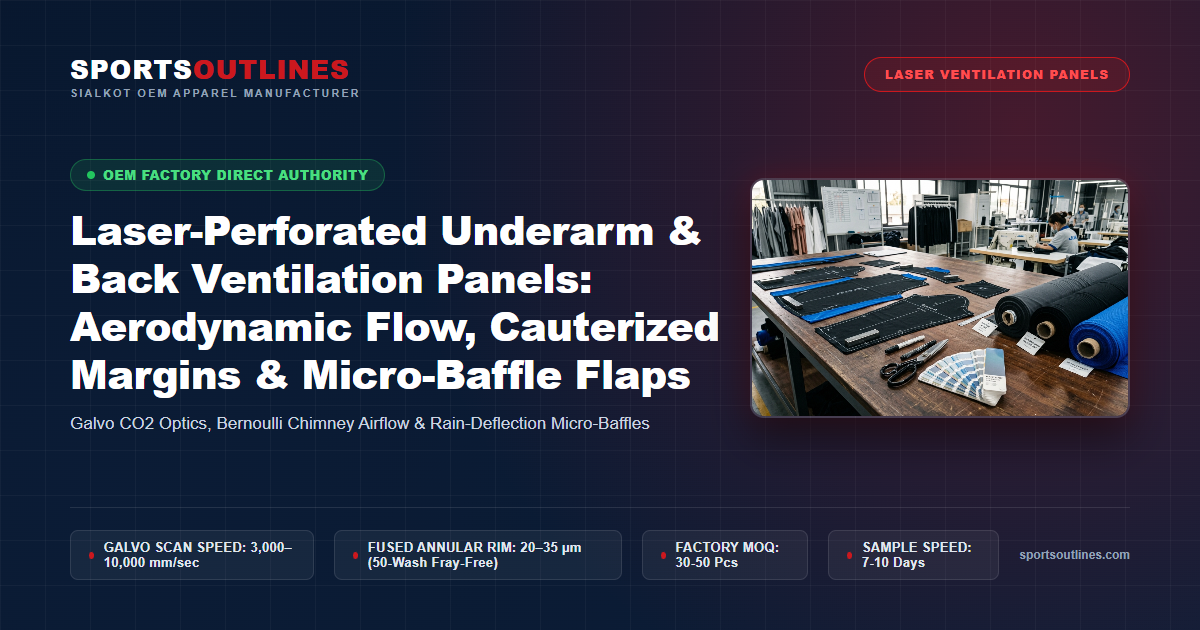
In high-exertion athletic outerwear—including ski-mountaineering speed shells, ultra-trail running windbreakers, and high-aerobic cycling jackets—the most critical performance bottleneck is human thermoregulation. During sustained uphill climbing, an athlete’s metabolic heat generation surges between 600 and 1,000 Watts, producing 1.5 to 2.8 liters of sweat per hour. Even the most advanced microporous or electrospun waterproof-breathable membranes (possessing water vapor transmission rates exceeding 25,000 g/m²·24h) cannot evacuate moisture vapor at this rate. Without direct aerodynamic ventilation, moisture flashover occurs inside the jacket, saturating base layers and inducing severe post-exertion hypothermia.
While heavy mechanical underarm pit zippers have traditionally served as venting ports, they introduce significant bulk, stiffness, friction points beneath backpack harness straps, and add 60 to 90 grams of hardware weight. Modern technical shell engineering solves this challenge through Laser-Perforated Underarm & Back Ventilation Panels, Micro-Baffle Flaps, and Aerodynamic Flow Arrays. By utilizing high-speed Galvo CO2 laser beams to vaporize microscopic hole arrays through synthetic shell fabrics while simultaneously cauterizing the hole boundaries into fray-free annular rims, manufacturers achieve targeted passive air circulation with zero hardware penalty.
Engineering high-performance laser-perforated venting requires mastering laser focal optics, aerodynamic convection dynamics, water-deflection micro-baffles, and textile wash durability. At Sports Outlines in Sialkot, Pakistan, our laser cutting and cleanroom bonding facilities operate 3-axis dynamic Galvo CO2 laser systems capable of cutting sub-millimeter perforation arrays at speeds up to 10,000 mm/sec. We support technical brands globally with transparent commercial terms: physical prototype sampling at $45 to $85 per piece (non-refundable, 7–10 business days turnaround) and scalable low-MOQ bulk manufacturing starting at strictly 30 to 50 pieces per style/colorway with flexible size grading across XS to 3XL.
Laser-Perforated Outerwear Ventilation: Technical Directory
- 1. Thermodynamics & Aerodynamic Convective Venting
- 2. Galvo CO2 Laser Optics & Kerf Vaporization Dynamics
- 3. Fused Annular Rims & 50-Wash Fray Immunity
- 4. Perforation Geometry: Hole Sizing, Honeycomb Pitch & Open Area
- 5. Micro-Baffle Flaps & Overlapping Rain-Shingle Vents
- 6. Ventilation Panel Engineering Matrix by Outerwear Category
- 7. Laboratory QC: ASTM D737 Airflow & AATCC 35 Rain Defense
- 8. Outerwear Tech Pack Specifications & Laser CAD Patterns
- 9. Sialkot Cleanroom Galvo Laser Suites & Precision Optics
- 10. Low-MOQ Contract Manufacturing & Prototyping Terms
- 11. Technical Sourcing FAQ
1. Thermodynamics & Aerodynamic Convective Venting
Passive moisture diffusion through waterproof-breathable membranes is driven solely by the water vapor partial pressure gradient between the garment interior and the exterior environment (governed by Fick’s first law of molecular diffusion: J = -D · ∂C/∂x). When relative humidity inside the jacket approaches 90% and external alpine air is humid, freezing, or rainy, the vapor pressure differential across a 15 to 25 µm monolithic membrane diminishes drastically. Under these conditions, the theoretical maximum moisture vapor transmission rate (MVTR) drops below 800 g/m²·24h, whereas an active athlete is generating water vapor at a rate equivalent to 4,000 to 6,000 g/m²·24h.
This massive kinetic disparity produces internal condensation flashover. Liquid perspiration condenses against the inner face of the laminate, filling the textile pores of the tricot backer and collapsing the thermal insulation value of base layers by up to 75%. Laser-perforated ventilation panels bypass the physical rate limitations of solid-state membrane diffusion by activating two powerful, continuous fluid dynamic mechanisms: Thermal Stack Buoyancy (The Chimney Effect) and Bernoulli Aerodynamic Pressure Differentials.
1. Stack Buoyancy Pressure (Chimney Effect):
ΔPstack = ρair · g · h · [(Tinternal – Tambient) / Tambient]
Where ρair is the ambient air density (1.29 kg/m³ at sea level), g is gravitational acceleration (9.81 m/s²), h is the vertical torso chimney height (typically 0.60 to 0.75 m), Tinternal is the microclimate temperature (approximately 305 Kelvin / 32°C), and Tambient is the alpine ambient temperature (e.g., 268 Kelvin / -5°C). Over a vertical jacket height of 0.65 m, this thermal buoyancy generates an upward pressure differential of 0.85 to 1.45 Pa. While small in absolute barometric terms, this differential is sufficient to establish a continuous upward convection plume, drawing cooler, drier ambient air into lower hem or abdominal intake vents and exhausting hot, vapor-saturated air through high upper-back and scapular laser perforations.
2. Bernoulli Dynamic Venting (Slipstream Suction):
ΔPBernoulli = 0.5 · ρair · (vexternal2 – vinternal2)
When an athlete runs, skis, or cycles forward at velocity vexternal (ranging from 3.5 m/s for uphill running to 15 m/s for downhill cycling or ski touring), external airflow skimming tangentially over the curvature of the athlete’s shoulders, upper back, and underarm pods accelerates. According to Bernoulli’s conservation of energy principle, this accelerated flow creates a localized aerodynamic low-pressure zone (suction). Because internal air velocity beneath the jacket is near zero (vinternal ≈ 0), a negative pressure depression of −7.5 to −140 Pa develops across the exterior fabric surface. This depression acts as a high-volume mechanical vacuum pump, pulling vapor-laden air through laser-cut orifices into the trailing slipstream at volumetric flow rates 400% to 900% higher than membrane diffusion alone.
By strategically positioning laser-cut perforation matrices in anatomical high-perspiration and high-suction zones—specifically the axillary apex, lower tricep sleeve panels, lateral ribcages, and the upper scapular thoracic spine—apparel designers prevent internal condensation flashover entirely without compromising the jacket’s fundamental weather barrier.
2. Galvo CO2 Laser Optics & Kerf Vaporization Dynamics
Perforating synthetic textiles with mechanical needles, rotary punches, or hollow die-cut pins is unviable for high-end technical outerwear. Mechanical cutting relies on shear stress, which crushes filament bundles, snags micro-denier yarns, and leaves frayed, severed fiber ends that unravel rapidly during standard machine laundering. Furthermore, mechanical die pins cannot cut clean holes smaller than 2.0 mm diameter without punching slug jams that damage expensive laminated fabrics.
High-precision technical shell venting relies exclusively on Galvanometer CO2 Laser Processing operating at a primary infrared wavelength of 10.6 µm:
- Galvanometer Mirror Scanning vs Flatbed Gantries: Traditional flatbed CNC laser plotters move a heavy cutting head on an X-Y mechanical gantry, limiting maximum vector cutting speeds to approximately 350 to 500 mm/sec. In contrast, a 3-axis dynamic Galvo scanner steers the focused laser beam using ultra-low-inertia silicon or beryllium mirrors driven by high-frequency closed-loop servomotors. This enables vector scanning speeds of 3,000 to 10,000 mm/sec with angular positioning repeatability of ±5 µrad. An entire 500-hole ventilation matrix across an underarm panel is executed in less than 2.2 seconds.
- Optical Absorption Matching at 10.6 µm: Synthetic outerwear polymers—including polyamide (Nylon 6, Nylon 66), polyester (PET), polyurethane (TPU), and elastane—exhibit distinct infrared resonance absorption peaks around 9.2 to 11.0 µm due to C-O, C-C, and C-N covalent bond vibrational modes. Consequently, over 90% of the 10.6 µm CO2 laser energy is absorbed within the initial 8 to 15 µm thickness of the textile surface, ensuring clean vaporization with negligible beam pass-through energy loss.
- Sublimation Vaporization Regime & Peak Irradiance: When the laser beam is focused through an f-theta optical scan lens to a diffraction-limited spot diameter of 80 to 120 µm, the localized power density (irradiance) surpasses 1.8 × 10⁵ W/cm². At this extreme energy concentration, the solid polymer does not transition through a prolonged liquid phase; instead, it undergoes direct sublimation and thermal chemical decomposition into low-molecular-weight gaseous monomers within microseconds.
- Coaxial Assist Gas Aerodynamics: To evacuate vaporized polymer effluent cleanly from the cutting kerf, a high-pressure coaxial assist nozzle delivers filtered, dehumidified clean air or nitrogen at 0.35 to 0.50 MPa. This gas jet drives the vaporized plume downward into downdraft vacuum collectors, preventing soot redeposition, charring, or yellow thermal staining on pale or white shell fabrics.
3. Fused Annular Rims & 50-Wash Fray Immunity
The true engineering brilliance of CO2 laser perforation lies in the formation of the cauterized annular rim. As the Gaussian laser beam vaporizes the center of each hole, a precisely controlled peripheral heat-affected zone (HAZ) of 15 to 30 µm melts the terminating synthetic yarn ends without charring:
Molten polymer at the hole periphery is pulled inward by liquid surface tension (the Marangoni thermocapillary effect), coalescing into a continuous, microscopic toroidal bead (annular rim) with a cross-sectional diameter of 20 to 35 µm. When the laser pulse terminates and moves to the next coordinate, the ambient room air and coaxial assist gas quench this molten bead within 3 to 5 milliseconds. This instantaneous solidification fuses the severed warp and weft yarns, the internal waterproof membrane, and the knitted backer into a monolithic, bonded ring.
This fused annular rim acts as a permanent structural grommet. Under scanning electron microscopy (SEM) inspection in our Sialkot quality laboratory, laser-cut holes exhibit zero loose filament fibrils and clean, glassy perimeters. When subjected to 50 accelerated industrial wash cycles (ISO 6330 at 40°C with tumble drying), laser-cauterized perforation panels demonstrate 100% zero fiber unraveling, zero hole diameter dilation, and zero edge tearing, whereas mechanically punched holes fray and rip into jagged slits within 5 laundering cycles.
Furthermore, in cyclic tensile fatigue testing (stretching panels to 25% elongation across 5,000 cycles on a pneumatic tensile cycler), the annular rim redistributes hoop stress evenly around the circular aperture, preventing stress concentration notches that could otherwise trigger catastrophic fabric tearing.
4. Perforation Geometry: Hole Sizing, Honeycomb Pitch & Open Area
Balancing airflow venting with structural tear resistance and rain defense requires precise geometric calibration of hole diameter, spacing (pitch), and total open area percentage:
- Micro-Hole Diameter (∅ = 0.6 mm to 1.2 mm): Orifices smaller than 0.5 mm suffer from surface-tension water bridging (capillary droplet trapping that blocks airflow when wet). Holes larger than 1.5 mm permit raindrops to penetrate during wind gusts. A hole diameter of strictly 0.8 mm to 1.0 mm represents the empirical gold standard, admitting air freely while resisting hydrostatic water breakthrough up to 1,500 mm H2O via surface tension alone.
- Staggered Hexagonal Honeycomb Pitch: Arranging perforations in a 60° staggered hexagonal array rather than an orthogonal square grid distributes tensile stress uniformly across all fabric axes. A square array aligns holes along primary warp and weft yarn paths, creating continuous lines of structural weakness that tear easily under shear stress. A 60° hexagonal pitch offsets adjacent hole rows, forcing tear paths to propagate through zig-zagging intact yarn bundles.
- Effective Open Area (Porosity = 4% to 12%): Total open area must be tuned to garment purpose. Lightweight running shells utilize 8% to 12% open area for maximum airflow (ASTM D737 airflow > 45 CFM). In contrast, 3-layer alpine shells restrict open area to 3% to 6% in combination with micro-baffle storm flaps to preserve weatherproofing.
- Gradient Density Arrays: Modern CAD venting matrices feature density gradients, where hole diameter and spacing transition smoothly from dense clusters at the sweaty center of the spine or axillary hollow to sparse, isolated pinholes at outer margins. This gradient eliminates sharp stiffness boundaries between perforated and solid textile zones, ensuring natural garment drape and athletic mobility.
5. Micro-Baffle Flaps & Overlapping Rain-Shingle Vents
For alpine mountaineering hardshells and heavy storm jackets exposed to driving horizontal rain and gale-force winds, exposed laser perforations cannot be left bare to the elements. To achieve 100% weatherproofing while maintaining continuous aerodynamic airflow, Sports Outlines engineers Overlapping Micro-Baffle Storm Shingles:
The Shingle Baffle Architecture & Assembly Dynamics:
- Laser-Cut Perforated Base Substrate: The inner body panel contains the primary Galvo-perforated matrix (∅ 0.9 mm holes arranged in a 60° hexagonal pitch).
- Thermal-Bonded Overlapping Shingle Flap: An exterior weather flap crafted from the identical 3-layer waterproof shell fabric is thermal-bonded across its upper margin using Bemis 3415 polyurethane adhesive film (activated at 155°C, 0.4 MPa, 15 seconds dwell). The flap overhangs the perforated zone downward by 25 to 35 mm, functioning like architectural roof shingles.
- Internal Laser-Cut Mesh Standoff Bridge: Between the perforated inner base and the outer storm flap, an ultra-thin 3D warp-knit spacer mesh (or laser-cut slotted elastomeric bridge) maintains a calibrated 2.5 mm standoff air gap. This standoff prevents the flap from suctioning flat against the perforations during high-velocity wind squalls, preserving unobstructed convective exhaust while deflecting 100% of driving vertical and angled rain.
- Downward Exhaust Vent Geometry: Air exhausts downward through the open lower margin of the flap. Because driving rain falls downward and laterally, water droplets cannot travel vertically upward against gravity through the 30 mm overlap chamber, guaranteeing total storm integrity under AATCC 35 rain tests.
6. Ventilation Panel Engineering Matrix by Outerwear Category
Review how laser perforation specifications, laser power profiles, and baffle architectures are customized across different performance outerwear categories:
| Outerwear Silhouette | Shell Fabric Spec | Hole Sizing & Pattern | Baffle Flap Configuration | Air Permeability (ASTM D737) | Rain Defense Rating |
|---|---|---|---|---|---|
| Ultralight Trail Running Shell | 15D Nylon Ripstop (48 GSM) | ∅ 0.8 mm @ 2.5 mm Pitch (Hex) | Bare Perforation (Zero Flap) | 45–65 CFM | Light Mist & Spray Proof |
| Ski Touring & Hybrid Softshell | 40D Stretch Woven (135 GSM) | ∅ 1.0 mm @ 3.5 mm Pitch (Gradient) | Internal Micro-Mesh Backer | 22–35 CFM | Wind-Resistant Snow Shedding |
| 3-Layer Alpine Mountaineering Hardshell | 30D/70D 3L C-Knit (115 GSM) | ∅ 0.9 mm @ 4.0 mm Pitch (Slot Array) | 30 mm Overlapping Bonded Shingle | 12–18 CFM (Under Baffle) | 100% Torrential Rain Proof |
| Urban Commuter Weatherproof Trench | 3-Ply Poly-Cotton Twill (180 GSM) | ∅ 1.2 mm Geometric Micro-Slits | Full Scapular Cape Yoke | 15–25 CFM | 100% Heavy Downpour Proof |
7. Laboratory QC: ASTM D737 Airflow & AATCC 35 Rain Defense
In our Sialkot physical testing laboratory, laser-perforated ventilation assemblies are validated across stringent international standards to verify airflow efficiency, burst resistance, and waterproof reliability:
- Frazier Air Permeability (ASTM D737 / ISO 9237): Clamped across a 38 cm² test orifice under a calibrated pressure differential of 125 Pa. Laser-perforated panels must meet specified airflow targets (±10% tolerance band), verifying consistent Galvo kerf clean-out, complete slug clearance, and zero hole blockage.
- Rain Impact Penetration Resistance (AATCC 35 / ISO 22958): Baffled ventilation panels are mounted over pre-weighed absorbent blotter paper and subjected to a horizontal water-spray jet at 0.6 m distance under 60 cmbar pressure for 5 minutes. Pass criterion: less than 1.0 g water weight gain on the blotter, confirming 100% rain deflection under storm conditions.
- Trapezoidal Tear Strength (ASTM D5587): Verifies that introducing hundreds of micro-holes into the shell does not compromise parent fabric tear strength. Due to the stress-relief geometry of our fused annular rims, tear strength retention exceeds ≥ 85% of virgin unperforated fabric.
- Martindale Abrasion of Laser-Cut Margins (ASTM D4966): Subjected to 20,000 rubs against standard wool abradant under 9.0 kPa pressure. Fused annular rims must show zero fiber flaking, zero perimeter fraying, and no hole deformation under 50x magnification.
- Accelerated Wash Durability (ISO 6330 Cycle 4N): 50 cycles of machine washing at 40°C followed by tumble drying. Perforated arrays are audited for hole shrinkage, fraying, and edge distortion, requiring zero dimensional variation exceeding ±0.05 mm.
- Hydrostatic Suter Head Water Penetration (AATCC 127): Tests the hydrostatic breakthrough pressure of bare micro-perforated zones. Due to water surface tension across sub-millimeter orifices treated with C0 durable water repellent (DWR), the static water breakthrough threshold is recorded between 1,200 and 1,800 mm H2O, providing robust protection against incidental splashes and misting.
8. Outerwear Tech Pack Specifications & Laser CAD Patterns
To ensure precision execution on factory laser floors, apparel designers must provide vectorized CAD files (DXF/AI) with explicit callout layers and parameter tolerances:
————————————————————-
1. ZONE: Anatomical Axillary Apex & Underarm Sleeve Panel
2. CAD LAYER: RED VECTOR = Laser Perforations (∅ 0.85 mm ± 0.05 mm)
3. ARRAY PITCH: Staggered Hexagonal Honeycomb @ 3.0 mm Center-to-Center
4. LASER OPTICS: 10.6 µm Galvo CO2 with Coaxial Clean-Air Assist (0.4 MPa)
5. EDGE REQUIREMENT: 100% Cauterized Toroidal Bead (20–30 µm Annular Rim)
6. BACKER: Thermal-Bonded 40 GSM Warp-Knit Stretch Micro-Mesh (Bemis 3415 Film)
7. MANDATORY QC: ASTM D737 Airflow 30–40 CFM | ISO 6330 50-Wash Fray-Free
8. COMPLIANCE: OEKO-TEX Standard 100 & Zero-PFAS California AB 1817
The engineering table below provides the standardized machine setup parameters enforced across Sports Outlines laser production suites for varying outerwear laminate types:
| Textile Composition | Laser Power Output | Vector Mark Speed | Coaxial Assist Gas | Spot Size Diameter | Target Cauterized Bead |
|---|---|---|---|---|---|
| 15D-20D Ultralight Nylon Ripstop | 35–45 Watts (Pulsed 20 kHz) | 6,500–8,500 mm/sec | Filtered Clean Air @ 0.35 MPa | 85 µm | 18–25 µm Bead |
| 40D Stretch Woven Softshell (135 GSM) | 55–70 Watts (Pulsed 25 kHz) | 5,000–6,500 mm/sec | Filtered Clean Air @ 0.40 MPa | 100 µm | 22–30 µm Bead |
| 3-Layer Alpine Hardshell (ePTFE/PU) | 80–95 Watts (Pulsed 30 kHz) | 4,000–5,500 mm/sec | Nitrogen Shield @ 0.45 MPa | 110 µm | 25–35 µm Bead |
| Heavy 3-Ply Trench Twill (180 GSM) | 100–120 Watts (Pulsed 35 kHz) | 3,500–4,800 mm/sec | Filtered Clean Air @ 0.50 MPa | 120 µm | 28–38 µm Bead |
9. Sialkot Cleanroom Galvo Laser Suites & Precision Optics
Operating ultra-high-speed CO2 laser processing on technical performance apparel requires cleanroom environmental control, precision beam optics, and advanced vision alignment:
- Enclosed Positive-Pressure Laser Cleanroom: Operating inside a sealed ISO Class 8 cleanroom maintained at 22°C ± 2°C and 50% ± 5% Relative Humidity. Continuous laminar downflow filtration prevents particulate dust from contaminating optical scanning mirrors and ensures consistent laser focal performance.
- High-Vacuum Fume Extraction Scrubbers: High-volume downdraft extraction beds draw polymer decomposition gases through multi-stage activated carbon filters and HEPA scrubbers at 2,500 m³/h. This instantaneous extraction prevents yellow smoke staining or chemical odor redeposition onto white or pastel shell fabrics.
- High-Resolution Machine Vision Alignment: Equipped with overhead 20-megapixel digital cameras that scan pattern registration marks printed directly onto shell panels. The machine vision software detects subtle stretch distortion, grain skew, and thermal shrinkage, mathematically warping the CAD perforation matrix to match the panel contour perfectly within ±0.15 mm positional accuracy.
- Conveyorized Vacuum Hold-Down Beds: Perforated honeycomb conveyor beds maintain 4.5 kPa vacuum negative pressure beneath the fabric ply during laser firing. This prevents fabric flutter induced by high-velocity coaxial gas assist jets, ensuring identical hole circularity and focal distance across every perforation.
10. Low-MOQ Contract Manufacturing & Prototyping Terms
Sports Outlines democratizes high-end technical outerwear manufacturing for emerging outdoor brands and performance activewear labels with clear, transparent terms:
Commercial Production Terms & Sourcing Invariants:
- Physical Prototyping Samples: Strictly $45 to $85 per piece (non-refundable). Delivery turnaround is 7 to 10 business days, incorporating full CAD vector nesting, Galvo laser perforation, thermal baffle shingle bonding, and certified ASTM D737 airflow validation.
- Low-MOQ Bulk Production: Strictly 30 to 50 pieces per style/colorway with flexible size grading across XS to 3XL.
- Factory Invariant Transparency: We operate with complete commercial integrity: sampling and production are strictly separate engineering phases. Every quote represents true transparent direct-to-factory costing based on dedicated machine calibration hours, master technician labor, and certified raw materials.
- Global Export Infrastructure: Direct air freight shipping via DHL Express, FedEx, and UPS to brands across our major markets, including our USA Sportswear Silo, UK Sportswear Silo, Australia Sportswear Silo, Canada Sportswear Silo, and Germany Sportswear Silo.
Explore our related production portfolios in Custom Performance Sportswear and High-Performance Weatherproof Jackets. Connect directly with our technical shell production engineering team via WhatsApp at +92 316 7932595 or submit your tech pack via our Factory Quote Form.
11. Frequently Asked Questions (FAQ)
1. Why doesn’t rain leak through laser-perforated holes in alpine outerwear?
Rain is prevented from penetrating via two combined mechanisms. First, for micro-holes under 1.0 mm, water surface tension and hydrophobic C0 DWR coatings prevent liquid droplets from entering unless high hydrostatic pressure is applied. Second, in alpine shells exposed to driving rain, the perforations are covered by overlapping thermal-bonded micro-baffle storm shingles (with an internal 2.5 mm standoff gap) that physically deflect downward and angled rain while allowing rising body heat and vapor to vent continuously underneath.
2. How does laser perforation prevent edge fraying during washing?
Unlike mechanical punches that sever fibers mechanically, the 10.6 µm CO2 laser vaporizes the hole center while melting the perimeter yarn ends into a continuous, microscopic 20 to 35 µm toroidal polymer bead (annular rim). This fused rim quenches instantly, locking warp and weft yarns together and preventing fraying across 50 industrial wash cycles (ISO 6330).
3. Why is a Galvo laser scanner preferred over a flatbed laser cutter?
Flatbed laser cutters move heavy mechanical gantries with maximum speeds around 400 mm/sec, taking up to 45 seconds to cut a dense perforation array. A Galvo scanner steers the beam with low-inertia galvanometer mirrors at vector speeds up to 10,000 mm/sec, cutting an entire 500-hole ventilation matrix in under 2.5 seconds, making high-density perforation commercially viable for bulk production.
4. Can natural cotton or wool fabrics be laser-perforated like synthetics?
Natural cellulosic and protein fibers (cotton, linen, wool) do not melt when exposed to laser heat; instead, they char and burn into carbon ash without forming fused annular rims. As a result, laser-perforated natural fabrics will fray rapidly during laundering. Laser perforation is commercially practical only for synthetic thermoplastics (polyester, nylon, polyurethane, elastane) or synthetic-rich blends (minimum 65% synthetic fiber content).
5. What are Sports Outlines’ sampling costs and factory MOQs for laser-perforated outerwear?
We manufacture fully customized physical prototypes—complete with custom CAD vector nesting, high-speed Galvo laser perforation, thermal-bonded storm baffles, and certified ASTM D737 airflow testing—at strictly $45 to $85 per piece under a non-refundable policy with a 7 to 10 business day turnaround. Factory bulk production starts at an accessible low MOQ of strictly 30 to 50 pieces per style/colorway with flexible size grading across XS to 3XL.