Direct Manufacturer Answer: How to Manufacture Custom Cricket Whites & Test Match Polos
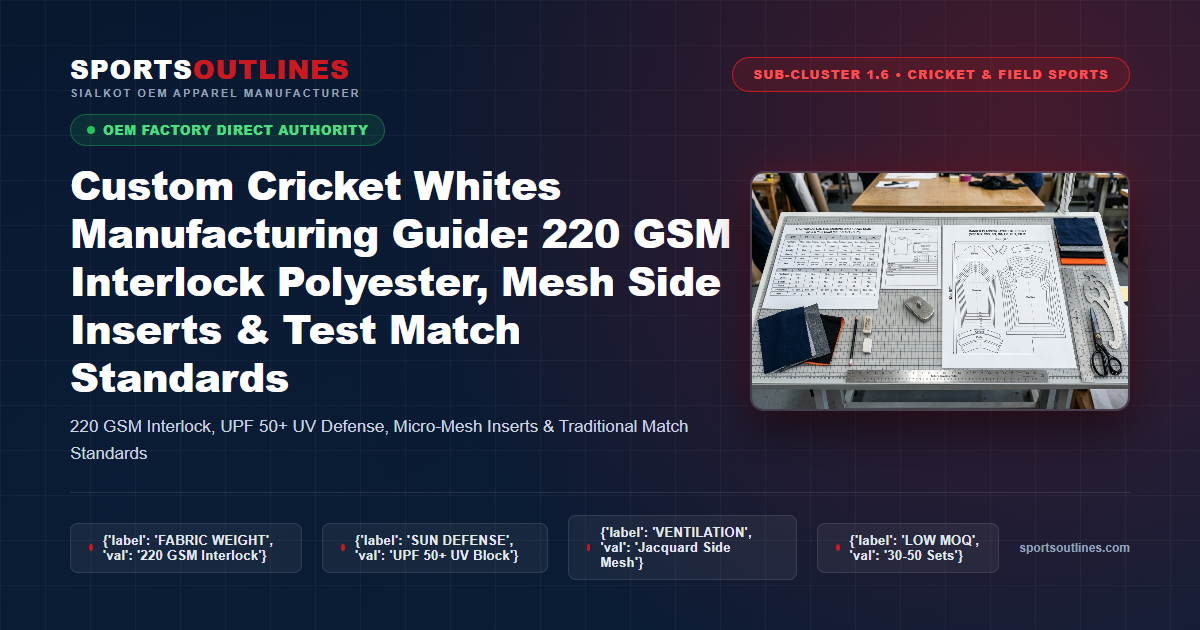
Manufacturing traditional cricket whites and multi-day Test match playing apparel requires high-end technical knits engineered for prolonged sun exposure, heavy sweat loading, and aggressive multi-directional fielding movements. Professional cricket match shirts are constructed from 210 to 230 GSM circular interlock or high-gauge micro-polyester (100% micro-denier poly or 92/8 poly-elastane) treated with permanent UPF 50+ ultraviolet radiation inhibitors and hydrophilic moisture-management finishes. To sustain thermoregulation across 6-hour playing sessions in extreme ambient heat, the chassis integrates 140 GSM warp-knit jacquard micro-mesh ventilation zones along the underarm gussets, flank panels, and posterior lower lumbar region. Collar construction utilizes either a traditional 3-button self-fabric ribbed polo placket or a modern low-profile French concealed button stand with reinforced fusible interlining that maintains crisp vertical collar shape without curling under sweater layers. Textile shades are calibrated strictly between traditional heritage cream / ivory (Pantone 11-0604 TCX Gardenia) and modern tournament optic white (CIE Whiteness Index >140) to comply with Marylebone Cricket Club (MCC) and International Cricket Council (ICC) Clause 19 uniform regulations. Factory direct low MOQ at our Sialkot facility starts at 30 to 50 uniform sets per design with mixed sizing curves from Youth YS to Adult 4XL. Pre-production physical prototype samples cost $45 to $85 per custom set completed in 7 to 10 business days.
- Fabric Construction: 220 GSM High-Twist Micro-Interlock with UPF 50+ UV blocking and anti-microbial silver-ion finish.
- Ventilation Architecture: 140 GSM laser-cut or engineered jacquard micro-mesh panels on lateral flanks and underarms.
- Collar Placket Engineering: 3-button fused placket with melamine break-resistant buttons and internal neck sweat tape.
- Shade Compliance: Precise optical spectrophotometer calibration for ICC Traditional Cream vs. Premier League Optic White.
- Sleeve Options: Short sleeve raglan cuts with clean-bonded hems or full-length articulated sleeves with ribbed cuff retention.
- Factory Low MOQ: 30–50 complete sets per style with flexible size grading across adult and junior club rosters.
- Physical Prototype Sampling: $45–$85 per custom set completed in 7–10 days (strict zero credit/refund policy).
- Direct Sourcing Communication: WhatsApp factory direct at +92 316 7932595 or sportsoutlines.com.
In the storied tradition of cricket—from English county championships and Australian grade cricket to premier club leagues across South Africa, New Zealand, and the Caribbean—cricket whites represent the soul of the sport. Unlike 20-over evening matches played in colorful sublimated kits, traditional multi-day and red-ball cricket demands that athletes spend five to seven hours under blazing summer sun, performing explosive bowling strides, low slips catching, and high-friction diving stops on hard turf outfields.
For cricket club secretaries, private school sports directors, kit suppliers, and sportswear brand founders across the UK, Australia, the USA, and Canada, sourcing custom cricket whites from generic activewear suppliers invariably results in catastrophic apparel failures. Common factory defects include flimsy 140 GSM t-shirt polyesters that become see-through when damp with perspiration, collar plackets that curl and flop after two washes, mismatched color tones where trousers appear yellow next to an optic white polo, and rapid seam tearing under fast-bowler shoulder abduction.
At Sports Outlines in Sialkot, Pakistan—the global heartland of premium cricket equipment and teamwear manufacturing—our dedicated cricket apparel lines engineer tournament-grade Test and club whites. We supply premier club leagues, private academies, and international apparel brands with precision cut-and-sew and sublimated whites. This comprehensive technical guide details the textile science of 220 GSM interlock, UPF 50+ ultraviolet defense, cream vs. white shade standards, placket engineering, sizing matrices, and factory direct low MOQ economics.
1. Textile Engineering: 220 GSM Interlock vs. Standard Single Jersey
The fabric chosen for cricket whites must satisfy a paradoxical set of technical demands: it must feel substantial and opaque while white, yet provide rapid thermodynamic sweat dissipation and sun deflection during grueling mid-summer heatwaves. Standard 150 GSM single jersey fabrics fail because white yarn naturally has lower optical opacity; when wet, it clings transparently to skin.
At Sports Outlines, we construct our match shirts from 210 to 230 GSM circular double-knit interlock. In interlock knitting, two sets of needles alternate to knit two interlocking fabric layers back-to-back. The resulting textile is mirror-smooth on both faces, possesses built-in structural density, and prevents “grin-through” opacity breakdown even under heavy sweat saturation:
2. Color Standardization: Traditional Heritage Cream vs. Modern Optic White
In international cricket, “white” is not a singular color. Cricket boards and county clubs adhere strictly to historical traditions, and providing the wrong white hue causes severe client rejection:
- Traditional Heritage Cream / Ivory (ECB & MCC Standard): Favored by traditional English clubs, premier private schools, and heritage Test leagues. This shade carries a warm, subtle yellow-beige undertone matching natural raw wool cricket flannels of the 19th century. We formulate this shade using calibrated disperse dye batches matching Pantone 11-0604 TCX (Gardenia) or Pantone 11-0105 TCX (Antique White).
- Modern Premier League Optic White (ICC & Cricket Australia): Favored by modern state associations, modern academy leagues, and tropical tournaments. This shade utilizes optical brightening agents (OBAs) to achieve an immaculate, high-luminance radiant white that reflects solar radiation and looks brilliantly crisp on high-definition television broadcasts. We certify an optical whiteness index exceeding 140 under CIE D65 illuminant.
- Spectrophotometer Lot-to-Lot Matching: When a club orders 200 shirts and 200 trousers, the shirt fabric (interlock) and trouser fabric (stretch twill/interlock) must match identically under both natural midday sunlight and clubhouse fluorescent lighting. We audit all dye lots with Datacolor spectrophotometers, enforcing a color variance tolerance of Delta E < 0.6, eliminating mismatched top-and-bottom tones.
3. Ergonomic Mobility & Ventilation: The Fast Bowler Shoulder & Jacquard Mesh
A cricket match shirt must accommodate extreme bio-mechanical arm actions. During the bowling delivery stride, a fast bowler elevates their bowling arm into 180 degrees of vertical abduction while their non-bowling arm pulls down with massive counter-rotational force. If a shirt has a traditional tight set-in sleeve, this action pulls the shirt hem completely out of the trousers and places extreme shear stress on the underarm armhole seam.
Our engineering team overcomes this with three specialized tailoring architectural enhancements:
- Modified Raglan-Hybrid Sleeve Cut: We employ a modified raglan sleeve geometry where the sleeve seam runs diagonally from the collar placket directly to the underarm, combined with an articulated underarm gusset diamond. This allows 360-degree rotational shoulder mobility with zero vertical hem lift, keeping the shirt cleanly tucked into trousers throughout an 8-over bowling spell.
- 140 GSM Warp-Knit Lateral Mesh Chimneys: We insert continuous vertical panels of 140 GSM high-permeability jacquard mesh extending from the underarm sleeve cuff down the lateral ribcage to the hem. These panels act as convective chimneys, venting trapped body heat generated during long fielding sessions.
- Extended Tennis-Tail Drop Hem: We extend the posterior back hem by 4.5 to 6.0 cm relative to the front hem, reinforced with twin-needle coverstitching. When an athlete bends forward at slips or crouches behind the stumps as wicketkeeper, the shirt maintains secure tuck retention inside the trouser waistband.
4. Placket & Collar Engineering: The Anti-Curl Fused Polo Stand
In classic cricket, the collar placket is the aesthetic focal point of the uniform. Low-quality manufacturers cut costs by using unstiffened self-fabric or cheap knit collars without fusible interlinings. After a single machine wash, the collar points curl upward like bacon strips, the placket puckers, and the shirt looks unkempt.
5. Quality Assurance Protocols: Laboratory Testing & Sun Defense
At Sports Outlines, every batch of cricket fabric undergoes rigorous laboratory performance benchmarking before advancing to precision cutting:
6. Points of Measure (POM) Quality Tolerances & Sizing Matrix
Because cricket players wear protective chest guards, arm guards, and athletic supporters underneath their match apparel, our sizing grading accounts for protective gear bulk without creating a sloppy, loose silhouette:
Points of Measure (POM) Quality Tolerance Audits
Every production run is audited against strict millimeter-level Point of Measure (POM) tolerance windows to prevent sizing variation between player kits:
7. Sourcing Economics: Unit Costs, Sampling Rules & Low Factory MOQ
At Sports Outlines, we remove the multi-hundred minimum order barriers imposed by overseas mega-factories. We offer factory direct low MOQ starting at only 30 to 50 sets per style with split sizing across adult and youth matrices:
Physical Prototype Sampling: $45–$85 in 7–10 Days
Before cutting bulk club orders, we create a physical pre-production prototype sample for your board review. Physical prototypes cost $45 to $85 per custom set (shirt and trousers). This fee covers digital CAD pattern drafting, collar placket fusing, embroidery digitizing, precision laser cutting, assembly, and lab inspection over 7 to 10 business days. We maintain a firm zero-refund and zero-credit policy on sample fees. Once approved, the prototype becomes the immutable golden standard for the entire production run.
Manufacture Custom Cricket Whites & Test Match Kits
Equip your cricket club, school, or apparel brand with professional cricket whites engineered in Sialkot. Featuring 220 GSM double-interlock, UPF 50+ UV defense, non-curl plackets, and lateral cooling mesh, we offer 30–50 sets low MOQ and fast 7–10 days physical sampling.
8. Frequently Asked Questions (FAQ) — Custom Cricket Whites Manufacturing
1. What is the ideal fabric GSM weight for cricket whites?
The ideal fabric weight for match shirts is 210 to 230 GSM double-knit interlock polyester. Lighter fabrics (140–160 GSM) become transparent when wet with perspiration and cling uncomfortably to players’ skin during long match sessions. For trousers, a heavier 230 to 250 GSM stretch twill or double-knit provides necessary abrasion resistance against diving stops.
2. What is the difference between traditional cream and optic white cricket uniforms?
Traditional cream (Pantone 11-0604 Gardenia) carries a warm ivory/off-white undertone reflecting heritage English flannel uniforms, favored by traditional club leagues and Test cricket. Optic white uses optical brighteners to produce an ultra-radiant bright white (CIE whiteness index >140), favored by modern schools and state academies. We formulate both shades with exact spectrophotometer lot-matching.
3. How do you prevent polo collars from curling after washing?
We fuse the upper and lower placket panels and collar band with an 80 GSM high-tack thermoplastic woven interlining using an industrial rotary heat press. This permanently locks the collar tips and placket face flat, preventing the edges from curling or puckering across repeated commercial laundry cycles.
4. Do your cricket whites provide certified UPF ultraviolet protection?
Yes. Our 220 GSM micro-interlock fabric is tested under AS/NZS 4399:2020 standards, achieving certified UPF 50+ ultraviolet protection. The dense double-knit weave combined with titanium dioxide yarn additives blocks over 98% of harmful UVA and UVB radiation during full-day matches.
5. What is the minimum order quantity (MOQ) for custom cricket whites?
Our factory direct low MOQ is 30 to 50 sets per style. You can split this volume across adult (XS–4XL) and junior (YM–YXL) size curves, and you can divide orders between short sleeve and long sleeve shirts within the same design run.
6. How much does a physical sample prototype cost, and what is the turnaround time?
A physical custom prototype sample costs $45 to $85 per uniform set (shirt and trousers). Production turnaround time for pattern drafting, custom embroidery digitizing, placket fusing, and assembly is 7 to 10 business days, followed by 4 to 6 business days for DHL/FedEx Express air shipping from Sialkot.
7. Can you customize shirts with both short and long sleeves in the same order?
Yes. Fast bowlers and fielders often prefer short sleeves for mobility, while spin bowlers, batsmen, and slip fielders frequently choose long sleeves for complete sun protection. We allow you to split your 30–50 piece batch between short sleeve and long sleeve variants with identical fabric and branding.
8. What branding methods do you use for club crests and sponsor logos?
We offer direct high-definition Madeira thread embroidery (up to 15,000 stitches), 3D raised matte silicone crests, high-density damask woven patches with merrowed borders, and heat-welded PU sponsor logos. All trims comply with ICC Clause 19 size limitations (crest up to 64.5 cm², sponsor logo up to 206 cm²).
9. How does the extended drop-tail hem prevent shirts from untucking?
Our pattern incorporates a 5.0 cm extended back drop-tail hem with reinforced side seam vents. When a wicketkeeper crouches or a slip fielder dives, the extra posterior fabric remains securely anchored below the trouser waistband, eliminating constant re-tucking during match play.
10. How do you prevent trousers from ripping during low boundary diving stops?
We construct matching cricket trousers with a 240 GSM high-twist stretch interlock, reinforced with internal dual-layer knee scuff lining and a continuous diamond crotch gusset joined with 5-thread safety overlock stitching. This absorbs lateral sliding friction across turf without thread blowout.
Explore Related Cricket & Teamwear Manufacturing Guides:
Complete your club kit with our factory guides on Custom T20 Cricket Jerseys, Custom Cricket Trousers, or browse our Factory Sportswear Catalog.