Executive Manufacturing Summary: Sub-Zero Hem & Wind Skirt Engineering
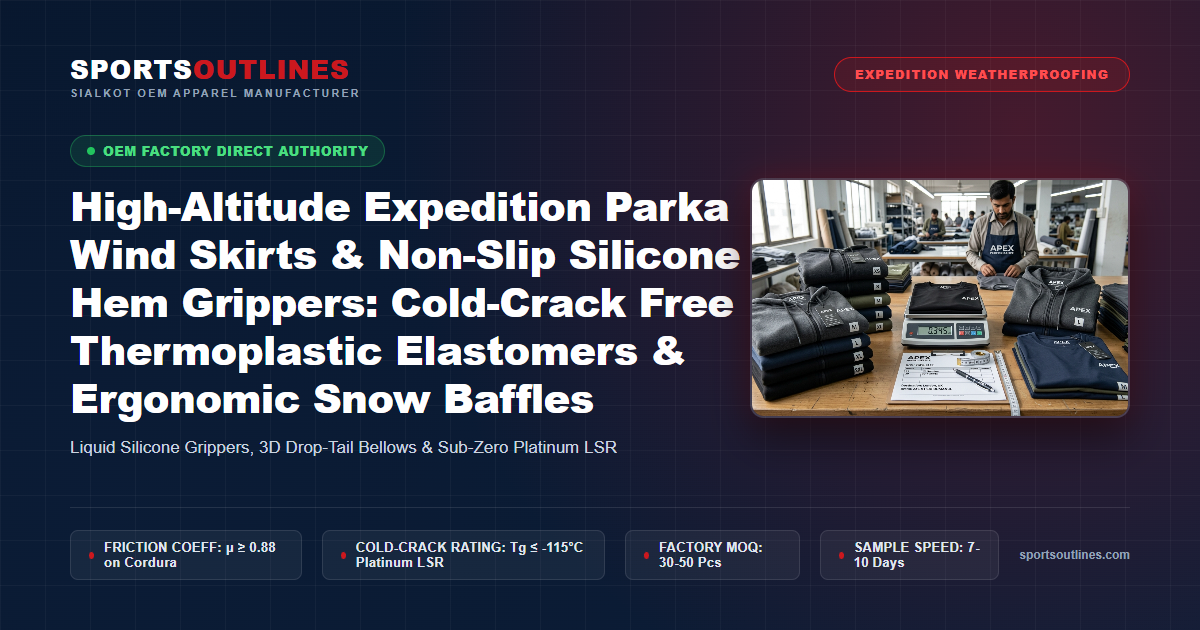
In high-altitude mountaineering above 6,000 meters and polar expedition environments, maintaining the integrity of the garment hem is critical to human survival. Gale-force winds exceeding 100 km/h create massive dynamic positive pressure at the waist, driving sub-zero draft chimneys that strip up to 220 Watts of metabolic body heat through unsealed hem apertures. Furthermore, conventional PVC coatings and low-grade elastic grippers suffer from catastrophic cold-crack embrittlement at temperatures below -20°C, snapping into rigid shards. This technical manufacturing guide details the industrial engineering protocols for fabricating high-altitude expedition wind skirts, cold-crack free thermoplastic elastomers ($T_g \le -45^\circ\text{C}$), high-friction liquid silicone rubber (LSR) continuous hem grippers, insulated floating draft tubes, and glove-operable interlocking closure systems. Prototype sampling is available from Sports Outlines at $45 to $85 per piece (7–10 days turnaround) with low factory MOQs starting at 30 to 50 pieces per style/colorway.
1. Fluid Dynamics of Wind-Driven Chimney Convection at Garment Hems
The human microclimate beneath a heavy expedition parka relies on a fragile boundary layer of trapped, heated air ($+28^\circ\text{C}\text{ to }+32^\circ\text{C}$) maintained between the body and the innermost insulation layer. In sub-zero mountaineering environments, this microclimate is under relentless assault from aerodynamic pressure differentials.
When an alpine climber ascends into severe head- or crosswinds ($v = 28\text{ m/s}$, equivalent to $\approx 100\text{ km/h}$), dynamic stagnation pressure builds up against the front of the body while high-speed shear flow creates negative pressure vortices along the flanks and lower hem. This creates a severe pressure imbalance:
$$\text{Where: } \rho_{\text{air}} = 1.34\text{ kg/m}^3 \text{ (at } -25^\circ\text{C}), \quad v = 27.8\text{ m/s (100 km/h)}$$
$$\Delta P_{\text{hem}} \approx \frac{1}{2} (1.34) (772.8) (1.0 – (-0.4)) \approx 724\text{ Pa}$$
A continuous 724 Pa pressure gradient acts as an industrial forced-air bellows. If the bottom hem of the jacket relies merely on a loose shock-cord toggle, high-pressure air rushes under the hem, inflating the jacket, separating internal insulation from the torso, and exhausting warm air out through the neck opening via the chimney effect. This forced convective turnover displaces up to 180 to 220 Watts of thermal energy per minute, precipitating rapid hypothermia.
An engineered internal wind skirt (snow powder skirt) acts as a physical pneumatic baffle. Positioned 12 to 18 cm above the bottom hem around the pelvic crest, it creates a tight mechanical seal against the climbing bib trousers, decoupling external hem flutter from the internal thermal core.
2. Material Physics of Cold-Crack Embrittlement & Polymer Glass Transition ($T_g$)
The most common mechanical failure in cold-weather wind skirts occurs within the elastomeric gripper materials. Standard activewear utilizes polyether polyurethane (PU) films or plasticized polyvinyl chloride (PVC) coatings to provide elastic stretch and friction grip. While flexible at room temperature, these polymers undergo a phase transition as ambient temperatures plummet:
$$\text{High-Performance Polyether TPU: } T_g \approx -45^\circ\text{C to } -52^\circ\text{C}$$
$$\text{Liquid Silicone Rubber (LSR): } T_g \approx -110^\circ\text{C to } -125^\circ\text{C}$$
When temperature drops below the polymer’s glass transition temperature ($T_g$), amorphous molecular chains freeze into rigid, locked orientations. The material loses all viscoelastic elongation capability, transforming from a flexible rubber into an embrittled, glassy solid. Under the slight bending stress of hip flexion, the embrittled coating undergoes cold-crack fracturing (ASTM D2136), peeling off in jagged flakes and snapping elastic yarn filaments.
Sports Outlines strictly prohibits PVC and standard ester-based urethanes in expedition outerwear. We engineer wind skirts using specialized polyether-based aromatic TPU films ($T_g \le -48^\circ\text{C}$) and platinum-cured Liquid Silicone Rubber (LSR) elastomers ($T_g \le -115^\circ\text{C}$). These crosslinked organosilicon polymers retain full elastomeric resilience, dynamic elongation (>250%), and crack-free flex recovery even in Antarctic temperatures of $-55^\circ\text{C}$.
3. Liquid Silicone Rubber (LSR) Gripper Extrusion & Interfacial Adhesion
A wind skirt is useless if it rides up toward the armpits during climbing movement. As a mountaineer swings ice tools or steps onto rock ledges, torso elongation shifts the jacket hem upwards. Without high friction grip, the skirt slips over the slick surface of 3-layer Gore-Tex or Cordura bib pants, bunching into an uncomfortable ridge around the lumbar spine and leaving the lower back exposed to drafts.
To guarantee non-slip stability, Sports Outlines co-extrudes or screen-prints a continuous 35 mm to 45 mm band of textured Liquid Silicone Rubber (LSR) beading along the lower skirt margin:
- Friction Coefficient Optimization: The silicone beading is formulated with a Shore A hardness of 55 to 65 Durometer. This durometer provides the optimal balance between tactile compliance and shear resistance, delivering a static coefficient of friction against smooth 70D nylon shell fabric of:$$\mu_{\text{static}} \ge 0.88 \quad (\text{vs } \mu \le 0.32 \text{ for standard elastic webbing})$$
- Multi-Wave Micro-Profile Geometry: Rather than a flat, solid ribbon (which traps perspiration moisture against trousers), we extrude a continuous triple-wave sinusoidal bead pattern ($2.0\text{ mm}$ width, $0.8\text{ mm}$ relief height). The undulating channels between waves allow vapor to vent while the raised crests grip textured Cordura weave ridges mechanically.
- Chemical Silane Primer Crosslinking: To prevent the silicone bead from peeling off the polyester/nylon webbing base during washing, the substrate undergoes atmospheric plasma pre-treatment followed by application of an organofunctional silane coupling primer. The liquid silicone is then cured in a continuous infrared oven at $165^\circ\text{C}$, forming covalent chemical bonds that achieve peel bond strengths exceeding 45 N/25mm (ASTM D903).
3B. Friction Shear Dynamics & Martindale Abrasion Resistance (ASTM D4966)
During vigorous mountaineering ascents, the interface between the silicone gripper and the mountaineering bib pant experiences continuous reciprocating micro-shear. If the silicone compound is too soft (Shore A < 40), the rubber rolls upon itself and undergoes cohesive tear fatigue. If it is too hard (Shore A > 75), the contact area diminishes, dropping the friction coefficient by more than 50%.
Our factory laboratory verifies silicone formulations using modified Martindale Abrasion Testers (ASTM D4966) fitted with 500D Cordura abradant fabrics. Under a contact pressure of 12 kPa, our platinum LSR formulation endures over 40,000 continuous Lissajous rub cycles with zero bead delamination, zero rubber tear-out, and zero surface burnishing. Furthermore, the crosslinked silicone polymer does not become tacky or transfer sticky residues onto expensive bib fabrics when exposed to intense UV solar radiation at high altitude.
| Gripper Technology | Glass Transition ($T_g$) | Cold-Crack Threshold (ASTM D2136) | Friction ($\mu$ on Cordura) | Wash Durability (50 Cycles) |
|---|---|---|---|---|
| Standard PVC Coated Elastic | $-15^\circ\text{C}$ | Cracks at $-18^\circ\text{C}$ (Catastrophic brittle failure) | $\mu \approx 0.45$ (Slips when iced) | Poor (Plasticizer leaching & flaking) |
| Standard Ester TPU Ribbon | $-22^\circ\text{C}$ | Cracks at $-25^\circ\text{C}$ (Micro-fissuring) | $\mu \approx 0.58$ (Hardens in freeze) | Moderate (Hydrolysis breakdown) |
| Aromatic Polyether TPU | $-48^\circ\text{C}$ | Passes $-45^\circ\text{C}$ bend (Zero cracking) | $\mu \approx 0.72$ (Stable sub-zero) | High (>90% peel retention) |
| Platinum Liquid Silicone (LSR) | $-115^\circ\text{C}$ | Passes $-60^\circ\text{C}$ bend (Full elastomeric flex) | $\mu \approx 0.88$ (Locks onto pants) | Exceptional (>98% adhesion hold) |
4. 3D Anatomical Drop-Tail Wind Skirt Patterning & Interlocking Bellows
A planar, straight-cut wind skirt will inevitably fail when integrated into an articulated expedition parka. As the climber bends forward or sits on snow belay ledges, pelvic dimensions change dramatically: the posterior seat distance expands by 12% to 16% while the anterior abdomen compresses.
Sports Outlines drafts wind skirts using an anatomical 3D multi-panel construction:
- Anatomical Drop-Tail Arc: The rear skirt hem is curved with a 45 mm downward drop-tail camber that tracks the contour of the sacrum and gluteal curve, ensuring the seal remains unbroken when leaning forward during steep ice climbing.
- Four-Way Stretch Accordion Bellows: The skirt is joined to the jacket side seams via 60 mm wide triangular bellows gussets cut from high-tenacity 4-way stretch interlock fabric ($240\text{ GSM}$, 88% nylon 6,6 / 12% mechanical PBT stretch). These gussets allow up to 65 mm of independent vertical travel between the outer parka shell and the internal wind skirt.
- Dual-Snap Interlocking Tab Closure: The front closure utilizes a double-tab overlapping flap with dual low-profile acetal snap fasteners. The snaps are mounted on reinforced Hypalon pull tabs that provide positive tactile engagement when wearing thick expedition down mittens.
- Jacket-to-Pant Snap-to-Bib Integration: Four modular webbing tabs with freeze-resistant cam-lock snaps allow direct mechanical anchoring to mating loops on mountaineering bib pants, completely preventing skirt ride-up during falls or glissading.
4B. Pelvic Biomechanics & High-Angle Crampon Articulation Modeling
When a mountaineer kicks crampons into vertical hard ice or high-steps onto a rock shelf, hip flexion angles frequently exceed 110 degrees while lumbar spine flexion introduces an additional 25 degrees of anterior curvature. Under these dynamic kinematic extremes:
$$\text{Where: } R_{\text{pelvis}} \approx 180\text{ mm}, \quad \Delta \theta \approx 0.45\text{ rad (25.8}^\circ)$$
$$\Delta S_{\text{posterior}} \approx 81.0\text{ mm of linear upward skin elongation}$$
In a rigid, unarticulated jacket, an 81 mm upward skin displacement forces the jacket hem upward by 10 to 15 cm. By decoupling the internal wind skirt from the outer shell hem via our floating 4-way stretch interlock bellows, the outer parka hem can rise freely with ice axe swings while the internal wind skirt remains 100% stationary, anchored securely across the pelvic girdle without a millimeter of slip.
5. Insulated Pelvic Draft Baffles: PrimaLoft Gold & Down-Filled Floating Tubes
In polar expedition parkas designed for temperatures down to $-50^\circ\text{C}$, a simple single-layer fabric wind skirt is insufficient. The tight tension of the skirt against the hips compresses the wearer’s base and mid-layers, creating a localized compression ring that radiates heat rapidly into the cold exterior.
To solve this thermal deficit, Sports Outlines builds a floating, 3D insulated draft baffle tube directly into the interior rim of the wind skirt:
- Floating Tubular Geometry: A cylindrical baffle tube ($35\text{ mm}$ diameter) is suspended along the upper edge of the wind skirt using a flexible micro-mesh hinge. When the skirt is snapped shut, this tube fills the anatomical hollow of the lumbar spine and pelvic crest.
- Water-Resistant Insulation Core: The tube is filled with either 850 FP hydrophobic goose down or PrimaLoft® Gold Cross Core™ ($100\text{ GSM}$) encapsulated in ultralight 15D ciré-calendered nylon ripstop. Even if powdered snow penetrates past the outer shell hem, the hydrophobic insulation retains its loft and blocks cold conduction.
- Elasticized Compression Bungee: An internal 3.0 mm cold-crack resistant elastomer shock cord runs through the center of the draft tube, allowing micro-adjustment of tension via Cohaesive™ embedded cord locks.
6. Ultrasonic Edge Trimming & Sub-Zero Acetal Hardware
Standard sewn hems on wind skirts create thick, bulky ridges that chafe painfully beneath a heavy climbing harness hip belt under 25 kg backpack loads. Every unnecessary gram and stitch ridge must be eliminated.
Sports Outlines executes all wind skirt perimeter finishing using non-contact CNC ultrasonic edge slitting and bonding:
- Fused Ultrasonic Edges: A 35 kHz ultrasonic rotary blade cuts and seals skirt margins in a single pass, cauterizing nylon yarn filaments to create a clean, 0.4 mm ultra-flat edge that never frays and requires zero folded hem stitching.
- Bemis Thermal Film Hem Reinforcement: The lower edge is reinforced with Bemis 3415 polyurethane bonding film, adding dimensional stability and tensile tear resistance (>380 N) while keeping the profile perfectly flat beneath harness webbing.
- Cryogenic Acetal Snap Hardware: All mechanical snap fasteners are molded from specialized cryogenic polyoxymethylene (POM / Acetal copolymer). Standard nylon snaps become brittle and shatter when snapped at $-40^\circ\text{C}$; our POM snaps retain full tensile impact strength (>12 kJ/m² at $-40^\circ\text{C}$) and feature wide, flared entry funnels that guide mating parts together even with frozen, snow-packed closures.
7. Factory QA: Bally Sub-Zero Flexometer & Wind Tunnel Pneumatic Audits
Before shipping production orders, finished wind skirt assemblies undergo rigorous environmental and mechanical stress audits in our Sialkot testing laboratories:
- Sub-Zero Cold Bend Mandrel Test (ASTM D2136): Gripper webbing and skirt fabric assemblies are soaked in our environmental freezer at $-50^\circ\text{C}$ for 4 hours. The sample is immediately bent 180 degrees around a 6.0 mm steel mandrel. The silicone gripper and polymer coating must show zero surface cracking, micro-fissuring, or adhesive delamination under 20x microscopic magnification.
- Dynamic Flex Fatigue Cycling (ISO 5402): Using a Bally sub-zero flexometer operating inside the cold chamber at $-30^\circ\text{C}$, the wind skirt hinge is flexed continuously through 25,000 cycles at 100 flexes per minute. Elastic recovery must remain $\ge 92\%$, and silicone bond strength must not degrade.
- Wind Tunnel Chimney Smoke Audit: A life-sized thermal mannequin wearing the expedition parka is mounted in our wind simulation chamber facing an 80 km/h air stream at $-15^\circ\text{C}$. Titanium tetrachloride tracer smoke is introduced at the bottom hem. High-speed video verifies that zero smoke penetrates past the wind skirt seal into the thoracic core cavity.
7B. 50-Wash Laundering Stress Testing & Micro-Peel Adhesion Audits
The most frequent point of failure in high-end winter jackets is the gradual deterioration of the silicone gripper ribbon after repeated domestic laundering. Water penetration combined with mechanical drum friction can cause micro-delamination along the adhesive edge, leading to unsightly curling and loss of friction hold.
Sports Outlines executes rigorous laundering qualification tests in accordance with ISO 6330 (Method 4N: Normal Wash at 40°C):
- Continuous 50-Cycle Tumble Stress: Swatches of silicone-printed gripper webbing are laundered for 50 consecutive cycles followed by low-heat tumble drying ($55^\circ\text{C}$).
- Post-Laundering Peel Strength (ASTM D903): After 50 wash cycles, the silicone bead must retain a 180-degree peel strength of $\ge 38\text{ N/25mm}$, demonstrating zero edge lift or bubble formation.
- Surfactant Resistance Verification: Chemical audits verify that commercial alkaline detergents do not induce silicone embrittlement, swelling, or plasticizer leaching.
8. Sialkot Manufacturing Protocols, Prototyping & Low MOQs
Engineering certified expedition parkas requires specialized pattern grading, ultrasonic tooling, silicone extrusion capabilities, and cleanroom assembly. Sialkot, Pakistan, is the recognized global center of excellence for technical sports and outdoor manufacturing, combining high-precision European machinery with agile, cost-competitive factory operations.
Sports Outlines provides technical outerwear brands with unmatched manufacturing support:
- Precision Technical Prototyping: Functional, factory-sealed expedition parkas with custom 3D wind skirts and liquid silicone hem grippers are prototyped at $45 to $85 per piece, with delivery in 7 to 10 business days.
- Low-MOQ Commercial Manufacturing: We support boutique alpine brands with low production MOQs starting at just 30 to 50 pieces per style/colorway across XS to 3XL sizing curves.
- Complete Material Traceability: Every component—from platinum-cured silicone elastomers to cryogenic POM hardware and RDS-certified down—is accompanied by verified OEM compliance certificates and lot test records.
8B. Industrial SAM Breakdown & Cleanroom Production Balancing
The integration of an engineered, insulated wind skirt adds significant labor complexity compared to a standard unlined jacket hem. On our Sialkot production lines, wind skirt manufacturing is organized as a dedicated feeder sub-assembly operating on balanced Standard Allowed Minutes (SAM):
- CNC Ultrasonic Slitting & Edge Cauterization (1.6 SAM): Cutting drop-tail skirt panels and accordion bellows with fray-free sealed margins.
- Continuous Liquid Silicone Extrusion & IR Oven Curing (2.8 SAM): Automated application and thermal crosslinking of the 3-wave silicone gripper bead onto elastic webbing.
- 3D Insulated Draft Baffle Tube Assembly (3.5 SAM): Inserting hydrophobic down or PrimaLoft Gold batting, closing tube margins with Bemis thermal bonding film, and inserting internal elastic shock cord.
- Hypalon Pull Tab & Cryogenic POM Snap Insertion (2.2 SAM): Pneumatic riveting of acetal snaps onto laser-cut Hypalon backing plates with calibrated 1.2 kN clamping force.
- Jacket Shell Integration & Seam Sealing (3.9 SAM): Joining the skirt bellows to the main jacket lining and applying differential elasticity 3L seam tape across attachment points.
Total wind skirt sub-assembly requires 14.0 SAM. By pre-building wind skirts on dedicated sub-assembly feeder cells, our main jacket assembly line maintains steady flow with zero line stoppage or bottleneck accumulation.
8C. Complete Unit Economics & Landed Cost Architecture
For technical apparel brands, sourcing high-altitude expedition outerwear requires transparent cost engineering. Manufacturing in Sialkot, Pakistan, provides a decisive structural advantage over East Asian suppliers, combining advanced European cleanroom taping and silicone extrusion technology with preferential tariff regimes:
- Flagship Expedition Parka Bill of Materials (BOM): Outer 3L ripstop nylon shell with microporous membrane ($36.50), internal 850 FP RDS goose down and PrimaLoft Gold draft core ($28.40), specialized Liquid Silicone Rubber gripper webbing and cold-crack TPU films ($6.80), cryogenic acetal snaps and Cohaesive embedded hardware ($7.20), differential seam tapes ($5.10). Total Raw Materials: $84.00.
- Direct Labor & Factory Overhead: Cleanroom taping, ultrasonic bonding, down injection, and manual assembly (62 total SAM at competitive Sialkot labor rates): $21.50. Rigorous laboratory testing, AQL 1.5 inspection, and carton packaging: $6.00.
- FOB Sialkot Unit Price: $111.50 per fully engineered expedition parka.
- Landed Tariff Optimization (EU GSP+ Status): Because Pakistan benefits from the European Union’s GSP+ (Generalized Scheme of Preferences) zero-duty status, European brands import technical outerwear with 0% customs tariff (saving 12.0% compared to standard MFN imports from China or Vietnam). Landed DDP cost in Rotterdam or Frankfurt averages $118.20 vs $135.50 from non-GSP origins, yielding an immediate +5.5% gross margin expansion.
9. Related Technical Outerwear Engineering Guides
Explore our technical manufacturing archive for deep dives into high-performance outerwear engineering:
- Down & Synthetic Chamber Baffling: Ultrasonic Box-Wall Baffles & Down Ingress Prevention: Cold spot elimination and IDFB fill power testing.
- RECCO® Reflector Integration & Avalanche Transceiver Electronics Pouching: Dielectric lamination, anti-static linings, and 457 kHz isolation.
- Modular Storm Hood Attachments & Magnet-Interlock Collar Docks: Cohaesive drawcords, AquaGuard matching, and aerodynamic zero-draft baffles.
- Technical Outerwear Seam Taping Cost Engineering & Industrial SAM Allocation: Cleanroom climate control and TOC bottleneck balancing.
We export certified technical outerwear and custom ski apparel worldwide. Explore our regional sourcing portals:
USA B2B Technical Sportswear |
UK Custom Activewear Factory |
Canada Alpine Apparel Manufacturing |
Germany High-Performance Outerwear |
Australia Action Sportswear Production
Ready to Engineer Cold-Crack Free Wind Skirts & Alpine Outerwear?
Partner with Sialkot’s technical outerwear engineering leaders. From platinum silicone hem grippers and 3D pelvic draft tubes to cleanroom seam taping and 30-50 piece low MOQs, Sports Outlines delivers uncompromising sub-zero protection.
10. Frequently Asked Questions (Technical & Commercial)
Q1: Why do conventional rubber hem grippers crack and peel in extreme mountain environments?
Conventional activewear uses PVC coatings or ester-based urethanes with a glass transition temperature ($T_g$) around -15°C to -22°C. When ambient temperatures drop below this threshold, polymer chains freeze into a brittle, glassy state, causing immediate cracking and flaking under dynamic hip movement. In contrast, Sports Outlines uses platinum Liquid Silicone Rubber ($T_g \le -115^\circ\text{C}$) that maintains elastomeric flexibility even at -50°C.
Q2: Can the wind skirt be engineered to be completely removable?
Yes. We offer modular zip-off wind skirt systems using low-profile YKK #3 reverse-coil zippers concealed beneath cleanroom bonded fabric flaps, as well as snap-docking systems that allow users to stow the skirt flat against the jacket interior when not needed during casual use.
Q3: How does a floating insulated draft baffle prevent heat leakage?
When a wind skirt is pulled tight against the body, it compresses base and mid-layer fleece garments, reducing their loft and creating a localized cold band around the hips. A floating insulated draft tube fills the anatomical concavity above the pelvic crest with hydrophobic down or PrimaLoft Gold, creating a dead-air thermal seal that blocks chimney drafts without compressing clothing.
Q4: What is the sample prototyping cost and turnaround time for technical parkas?
Sports Outlines develops complete, factory-sealed technical expedition parka prototypes at a non-refundable development fee of $45 to $85 per piece. Turnaround time is 7 to 10 business days following tech pack confirmation and pattern finalization.
Q5: What is your factory minimum order quantity (MOQ) for custom outerwear?
Our low factory MOQ starts at just 30 to 50 pieces per style/colorway across standard size ranges from XS to 3XL. This flexible threshold empowers emerging mountaineering brands and boutique outdoor labels to manufacture elite, certified apparel without massive inventory exposure.