
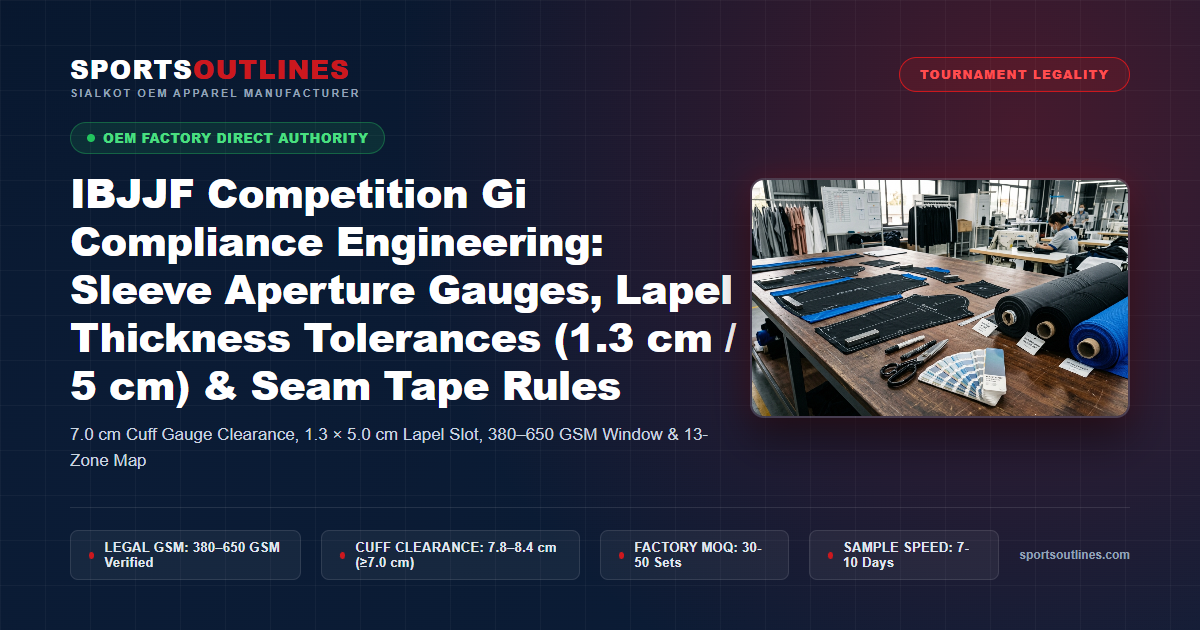
Regulatory & Metrology Compliance Directive: Engineering 100% IBJJF-Legal Tournament Kimonos
For a Brazilian Jiu-Jitsu athlete who has spent months preparing for the IBJJF World Championships, Pan-Ams, or European Open—and paid hundreds of dollars in registration and travel—nothing is more devastating than failing the Bullpen Uniform Inspection (“The Gi Check”) five minutes before stepping onto the mat. For a fightwear brand founder, a single viral social media post showing one of your sponsored athletes getting disqualified because your factory sewed a $14.2\text{ mm}$ thick lapel seam, used a $45\text{ mm}$ wide internal cuff tape, or graded a sleeve aperture that shrank to $6.4\text{ cm}$ can destroy brand credibility overnight. Concluding Part 1 of Sub-Cluster 5.3 (50.0% Sub-Cluster Milestone & 385 Live Technical Blogs Sitewide), this regulatory engineering blueprint codifies the complete 2024–2026 IBJJF, AJP (Abu Dhabi World Pro), and JJIF Uniform Regulations into deterministic Sialkot factory CAD tolerances—covering the official IBJJF Gi Checker gauge geometry, the updated 380–650 GSM weave window, internal reinforcement tape limits, and the 13-zone authorized patch placement map.
1. Metrology of the Official IBJJF “Gi Checker” Inspection Gauge
Before an athlete is permitted to step onto the official weigh-in scale inside the IBJJF bullpen, an official uniform inspector tests their Gi using a standardized rigid block gauge known as the IBJJF Gi Checker (Medidor Oficial de kimono). This anodized aluminum or high-density polymer tool measures $15.0\text{ cm}$ in total length $\times 7.0\text{ cm}$ in width $\times 3.5\text{ cm}$ in height, and incorporates a precision-machined rectangular cutout slot at one end measuring $5.0\text{ cm}$ ($50.0\text{ mm}$) deep by $1.3\text{ cm}$ ($13.0\text{ mm}$) wide.
The inspector performs three non-negotiable mechanical pass/fail checks using this gauge while the athlete stands upright with arms extended horizontally forward at $90^\circ$ to the torso:
- The $7.0\text{ cm}$ Sleeve & Pant Cuff Aperture Insertion Test: The inspector inserts the $7.0\text{ cm}$ ($70.0\text{ mm}$) wide body of the Gi Checker horizontally inside the opening of both jacket sleeves (with the athlete’s arms extended straight forward and wrists relaxed) and vertically inside the bottom cuff of both trouser legs. The $7.0\text{ cm}$ gauge must slide completely inside the sleeve cuff alongside the athlete’s wrist without the fabric binding or requiring force!
- The $1.3\text{ cm} \times 5.0\text{ cm}$ Lapel Collar Slot Gauge Test: The inspector slides the $13.0\text{ mm} \times 50.0\text{ mm}$ rectangular cutout slot over the lapel collar at multiple points along the chest and trapezius curve. If the collar is thicker than $13.0\text{ mm}$ (causing the gauge to jam) or wider than $50.0\text{ mm}$ (preventing the back of the slot from touching the outer edge of the lapel), the Gi fails immediately.
- The $5.0\text{ cm}$ Wrist & Ankle Reach Extension Test: With the athlete extending both arms straight forward at $90^\circ$ shoulder flexion (palms facing downward), the bottom edge of the sleeve cuff must reach to within $\le 5.0\text{ cm}$ ($50.0\text{ mm}$) of the distal wrist crease. Similarly, the bottom hem of the Gi pants must reach to within $\le 5.0\text{ cm}$ above the lateral malleolus (ankle bone).
Geometric Cuff-Clearance Calculus: Converting 3D Wrist Circumference + 7.0 cm Gauge to Flat Pattern Width
A common mistake among generic apparel patternmakers is assuming that a $7.0\text{ cm}$ IBJJF aperture rule simply means making the flat sleeve opening $14.0\text{ cm}$ wide. In reality, when the athlete’s oval wrist (circumference $C_{\text{wrist}}$) AND the rigid rectangular IBJJF gauge (width $W_{\text{gauge}} = 7.0\text{ cm}$, thickness $H_{\text{gauge}} = 3.5\text{ cm}$) occupy the inside of a $1.8\text{ mm}$ thick Pearl Weave cuff simultaneously, the required Post-Wash Flat Half-Width ($W_{\text{flat,min}}$) of the sleeve opening is governed by the perimeter envelope equation:
\[ W_{\text{flat,pre-wash}} = \left[ \frac{C_{\text{wrist}} + 2 W_{\text{gauge}} + \pi t_{\text{cuff}}}{4} + \Delta_{\text{safety}} \right] \cdot \left( 1 + \Delta S_{\text{weft}} \right) \]
For a muscular A2/A3 competitor with a $18.0\text{ cm}$ wrist circumference, substituting $W_{\text{gauge}} = 7.0\text{ cm}$, $t_{\text{cuff}} = 0.35\text{ cm}$ (double-turned hem + internal tape), safety buffer $\Delta_{\text{safety}} = 0.8\text{ cm}$, and Sanforized shrinkage allowance $\Delta S_{\text{weft}} = 0.015$ yields a mandatory factory Pre-Wash Flat Sleeve Cuff Width of $16.4\text{ cm}$ to $17.2\text{ cm}$ (which settles to $16.0\text{–}16.8\text{ cm}$ post-wash, giving effortless $7.0\text{ cm}$ vertical clearance below the wrist)!
2. The Master IBJJF Uniform Regulation vs. Sports Outlines Factory CAD Tolerance Matrix
Following the major 2024/2025 IBJJF Uniform Rulebook updates—which formalized strict minimum and maximum GSM boundaries and tightened internal seam tape inspections—every competition BJJ Gi manufactured at Sports Outlines is audited on our QC tables against the following deterministic engineering tolerances:
| IBJJF Inspection Parameter | Official IBJJF Rulebook Limit | Common Factory Disqualification Cause | Sports Outlines Calibrated Sialkot Target |
|---|---|---|---|
| 1. Jacket Fabric Material & Weave | 100% Cotton (or cotton-like cellulosic) Woven Weave ONLY; Ripstop jackets strictly prohibited | Using poly-cotton blends or woven Ripstop fabric on the Gi top | 100% Combed Ring-Spun Cotton Pearl, Gold, or Single Weave |
| 2. Jacket Fabric Weight (GSM Window) | Minimum $\mathbf{380\text{ GSM}}$ to Maximum $\mathbf{650\text{ GSM}}$ | 300–350 GSM “ultralight” weaves failing min limit, or 750 GSM Double Weaves failing max limit | Calibrated $400\text{ GSM}$, $450\text{ GSM}$, or $550\text{ GSM}$ ($\pm 3\%$ lot tolerance) |
| 3. Pant Fabric Material & Weight | 100% Cotton Twill or 100% Cotton Ripstop (No stretch spandex or shiny synthetic nylon) | 65/35 poly-cotton Ripstop pants with glossy synthetic sheen | $10\text{ oz}$ ($340\text{ GSM}$) 100% Cotton Ripstop or $10\text{–}12\text{ oz}$ Cotton Drill Twill |
| 4. Lapel Collar Thickness ($t_{\text{collar}}$) | Maximum $\le \mathbf{1.3\text{ cm}}$ ($13.0\text{ mm}$) | Inner collar-to-jacket seam overlap swelling to $13.8\text{–}14.5\text{ mm}$ after washing | $11.2\text{ to }11.8\text{ mm}$ (with $1.5\text{ mm}$ skived inner EVA seam channel) |
| 5. Lapel Collar Width ($w_{\text{collar}}$) | Maximum $\le \mathbf{5.0\text{ cm}}$ ($50.0\text{ mm}$) | Wide $52\text{ mm}$ collars bottoming out inside the $5.0\text{ cm}$ Gi Checker slot | $47.0\text{ to }48.5\text{ mm}$ uniform width across entire U-curve |
| 6. Sleeve & Pant Cuff Aperture Clearance | Minimum $\ge \mathbf{7.0\text{ cm}}$ ($70.0\text{ mm}$) vertical clearance with wrist/ankle inside | Tapered “tailored” sleeves shrinking to $6.2\text{ cm}$ clearance after 2 washes | $16.0\text{–}17.2\text{ cm}$ flat half-width (gives $7.8\text{–}8.4\text{ cm}$ clearance post-wash) |
| 7. Internal Cuff Reinforcement Tape | Max width $\le \mathbf{4.0\text{ cm}}$ ($40.0\text{ mm}$); must be sewn flat with zero stiff double-lip | Using $50\text{ mm}$ wide decorative ribbon or folding thick canvas inside the cuff | $30.0\text{ to }35.0\text{ mm}$ soft-woven Jacquard tape with 4-row flat Kansai stitching |
| 8. Authorized Uniform Colorways | Strictly Solid White, Solid Royal Blue, or Solid Black (Jacket, Collar & Pants must match) | Navy blue, grey, olive, or contrast-colored lapel collars (e.g., black collar on white Gi) | Pantone-calibrated IBJJF Optical White, Royal Blue (`19-4052 TCX`), & Jet Black |
3. The Internal Seam Tape & “Double-Lip Cuff” Crackdown: How to Brand Cuffs Legally
In recent competition seasons, several prominent BJJ brands had their Gis flagged at IBJJF majors not because of sleeve length, but because of illegal internal sleeve and pant cuff reinforcement architecture. Specifically, some factories tried to make sleeve grips harder for opponents to hold by folding a double layer of heavy canvas inside the wrist cuff or sewing a thick $50\text{ mm}$ wide polyester webbing strap inside the opening without stitching down its top edge—creating an internal “pocket” that could catch and break an opponent’s fingers during spider-guard grip fighting!
To ensure 100% compliance with IBJJF Article 8.1.4 while still delivering luxury custom branding inside the cuffs and skirt vents, Sports Outlines enforces three strict cuff-finishing engineering rules:
- Maximum $35\text{ mm}$ ($3.5\text{ cm}$) Custom Jacquard Tape Width: Because the IBJJF ceiling for internal cuff reinforcement tape is $4.0\text{ cm}$ ($40.0\text{ mm}$), we weave all custom branded inner sleeve and ankle tapes at a nominal width of $32.0\text{ mm}$ to $35.0\text{ mm}$.
- Soft-Hand Combed Cotton or High-Filament Micro-Satin Weave: Abrasive nylon webbing or scratchy metallic lurex threads inside the sleeve cuff are strictly prohibited (as they lacerate the opponent’s fingers when establishing a pocket grip). We weave our internal seam tapes using ultra-smooth high-density polyester taffeta or combed cotton herringbone that feels completely smooth to the touch.
- 4-Row Edge-to-Edge Kansai Lockstitching (Zero Open Lip): When our operators attach the $35\text{ mm}$ custom tape inside the double-turned sleeve cuff hem, a 4-needle Kansai Special machine stitches through the very bottom edge, two intermediate channels, and within $1.5\text{ mm}$ of the top edge of the tape—guaranteeing the tape is fused 100% flat against the Pearl Weave interior with zero gap where a finger or toe could ever snag!
4. The IBJJF 13-Zone Patch & Embroidery Map: Where Logos Are Legal (and Where They Cause Instant Removal)
During the Bullpen Gi Check, if a brand places a woven patch or heavy embroidery in an unauthorized gripping zone, the inspector will force the athlete to rip the patch off with a seam ripper on the spot—or disqualify the uniform if it is direct embroidery that cannot be removed! Why does the IBJJF regulate logo placement so strictly? Because heavy patches or dense embroidery placed right on the lapel collar, wrist cuff edge, or central groin/hip gripping zones alter fabric thickness and block legitimate opponent grips.
Our CAD tech-pack designers map all custom B2B brand logos, direct tatami embroidery (covered in detail in our upcoming Blog #386), and woven patches strictly inside the 13 Authorized IBJJF Branding Zones:
- Jacket Authorized Zones (Zones 1 to 8):
- Zone 1 (Upper Shoulders / Deltoid Strip): Across both left and right shoulder caps extending down the upper sleeve bicep.
- Zone 2 (Upper Chest — Left & Right): Above the pectoral line, maintaining at least $1.5\text{ cm}$ clearance from the inner edge of the EVA lapel collar seam so the logo never interferes with the $1.3\text{ cm} \times 5.0\text{ cm}$ lapel gauge!
- Zone 3 (Mid-Torso / Ribcage Flanks): Below the belt line or on the lateral torso panels.
- Zone 4 (Lower Front Lapel Skirt Tips): Standard rectangular brand label zone ($4.5 \times 12.0\text{ cm}$ max) at the very bottom corner of the left and right front skirt.
- Zone 5 (Upper Back Below Collar): Centered below the rear neck collar seam across the upper trapezius/scapula.
- Zone 6 (Main Center-Back Billboard): Large academy or brand crest centered on the dorsal torso above the belt line.
- Zone 7 (Lower Rear Skirt Hem): Horizontal strip across the bottom back skirt hem, maintaining at least $7.0\text{ cm}$ clearance from the bottom edge if using a thick sewn-on patch (direct embroidery or thin woven labels on the hem edge are carefully calibrated).
- Pant Authorized Zones (Zones 9 to 13):
- Zone 9 & 10 (Upper Front Thighs / Hip Pockets): Left and right upper quadriceps above the knee reinforcement panel.
- Zone 11 (Lateral Outseam Leg Stripes): Running vertically down the outer side seam of the pant leg (maintaining clearance from the bottom $7.0\text{ cm}$ ankle cuff opening).
- Zone 12 (Lower Front Shin Below Knee Shield): Only permitted if positioned above the $7.0\text{ cm}$ ankle cuff gauge zone and stitched 100% flat around all four edges.
- Zone 13 (Rear Calf / Hamstring Panel): Back of the pant legs below the gluteal line.
- STRICTLY FORBIDDEN LOGO ZONES (Never Place Embroidery or Patches Here):
- Directly on the $5.0\text{ cm}$ EVA Lapel Collar (except a small thin woven brand tag at the absolute bottom tip of the lapel skirt).
- Within the distal $7.0\text{ cm}$ of the sleeve wrist cuff or pant ankle cuff where the referee inserts the Gi Checker gauge and opponents take spider/Toreando grips.
- Directly across the central diamond crotch gusset or buttock seat seam.
5. Multi-Federation Compliance: Harmonizing IBJJF, AJP (UAEJJF) & JJIF (Ju-Jitsu International Federation) Specs
For global fightwear brands selling across North America, Europe, the Middle East (Abu Dhabi World Pro / AJP Tour), and Asian Games (JJIF Newaza), a single flagship competition Gi SKU must simultaneously satisfy all three international governing bodies. At Sports Outlines, our “Triple-Federation Harmonized Competition Block” bridges the subtle differences between these rulebooks:
- Colorway Harmonization: While IBJJF permits White, Royal Blue, and Black Gis for all belt ranks, JJIF (Olympic Council of Asia / World Games Newaza) mandates strictly White or Royal Blue (with obligatory Red/Blue athlete belt/anklet designations), and AJP mandates White or Royal Blue for select televised finals. Therefore, we always advise B2B brands to anchor $70\%$ of their competition inventory in IBJJF/AJP Optical White and Royal Blue, with Jet Black as the #1 lifestyle/IBJJF colorway.
- Contrast Stitching Rules: Under current IBJJF rules, subtle contrast stitching on a solid White, Royal Blue, or Black Gi is permitted provided the jacket, collar, and pants are the same solid legal base color (though tonal matching thread—White-on-White, Blue-on-Blue, Black-on-Black—is required for JJIF national team events).
- Sublimated Inner Rashguard Yoke Linings (Preview of Batch 74 / Blog #387): Under the updated IBJJF rulebook, internal sublimated mesh linings are permitted inside the upper shoulder/back yoke area, provided the lining does not extend down into the sleeves or alter the thickness/grip mechanics of the jacket skirt.
5B. IBJJF “Gi-On” Weigh-In Mass Engineering: Component-by-Component Grammage Budget (Size A2)
Unlike Judo, Olympic Wrestling, or MMA—where athletes weigh in wearing only compression undergarments the day before or morning of the event—the IBJJF enforces an immediate pre-match “Gi-On + Belt-On” weigh-in inside the bullpen with a strict zero-ounce allowance! For example, an Adult Male Middleweight (Médio) competitor must weigh $\le 82.30\text{ kg}$ ($181.60\text{ lbs}$) while wearing his complete dry Gi jacket, pants, and rank belt.
Consequently, if a factory delivers a “450 GSM Competition Gi” that secretly weighs $1.95\text{ kg}$ ($4.30\text{ lbs}$) in size A2 due to over-heavy cotton lapel cores, excessive internal canvas linings, and overweight 14 oz twill pants, the athlete is forced to sweat off an extra $500\text{ grams}$ ($1.1\text{ lbs}$) of intracellular water in the sauna before stepping onto the mat! At Sports Outlines, we engineer our 380 GSM Legal Featherweight and 450 GSM Pro Competition blocks against a deterministic, digital-scale-verified component mass budget:
| Gi Sub-Assembly Component (Size A2) | 380 GSM IBJJF Feather-Comp Spec | 450 GSM IBJJF Flagship Pro Spec | 550 GSM IBJJF Max-Armor Spec | Weight-Saving Engineering Lever |
|---|---|---|---|---|
| 1. Single-Piece Pearl Weave Jacket Shell | $645\text{ g}$ | $765\text{ g}$ | $935\text{ g}$ | Precision Sanforized GSM control ($\pm 2.5\%$) |
| 2. Lapel Collar (Core + Outer Sheath) | $185\text{ g}$ (EVA + Ripstop) | $210\text{ g}$ (EVA + 12oz Twill) | $235\text{ g}$ (High-Duro EVA + Twill) | Vulcanized EVA saves $-170\text{ g}$ vs cotton duck |
| 3. Reinforcements, Seam Tapes & Embroidery | $55\text{ g}$ (Minimalist Direct) | $75\text{ g}$ (Pro Tatami Crest) | $95\text{ g}$ (Heavy Yoke + Patches) | Direct embroidery saves $-45\text{ g}$ vs thick patches |
| 4. Complete Trousers (With Gusset & Cord) | $425\text{ g}$ ($10\text{ oz}$ Cotton Ripstop) | $455\text{ g}$ ($10\text{ oz}$ Ripstop / Twill) | $585\text{ g}$ ($12\text{ oz}$ Bull Drill Twill) | 10 oz Cotton Ripstop saves $-130\text{ g}$ vs 12 oz Twill |
| Total Complete Dry A2 Gi Weight | $\mathbf{1,310\text{ g}}$ ($2.88\text{ lbs}$) | $\mathbf{1,505\text{ g}}$ ($3.31\text{ lbs}$) | $\mathbf{1,850\text{ g}}$ ($4.07\text{ lbs}$) | 100% IBJJF Compliant (Printed on Care Label) |
5C. Our Sialkot “Bullpen Simulation” QC Gate: The 10-Point Pre-Shipment IBJJF Audit
Before any production shipment of custom competition BJJ Gis is cleared for export packing at Sports Outlines, our Quality Assurance team executes a physical AQL 1.5 Pre-Shipment IBJJF Bullpen Simulation on finished garments across every size tier (A0 to A5, A1L–A3L, F1–F4, M00–M4):
- Circular GSM Cutter Verification (ASTM D3776): Five $100\text{ cm}^2$ circular fabric discs are die-cut from the Sanforized Pearl Weave roll and weighed on a $0.01\text{ g}$ analytical balance, verifying that finished fabric weight sits safely inside the $380\text{ to }650\text{ GSM}$ IBJJF legal corridor (never dipping below $392\text{ GSM}$ on a 400 GSM spec).
- $13.0\text{ mm} \times 50.0\text{ mm}$ Steel Slot Pass-Through Test: An anodized IBJJF Gi Checker gauge is slid continuously from the bottom left lapel tip, up around the rear cervical neck curve, and down to the bottom right lapel tip—verifying zero binding at the inner jacket-to-collar seam overlap.
- 3D Anatomical Arm-Form + $7.0\text{ cm}$ Cuff Insertion Test: Jacket sleeves are mounted onto size-graded anatomical forearm mannequins and tested with the $7.0\text{ cm}$ Gi Checker block to confirm at least $7.8\text{ cm}$ of unobstructed vertical cuff aperture clearance.
- Internal Seam Tape Caliper Audit ($\le 40.0\text{ mm}$): Digital calipers verify that all custom jacquard inner sleeve and ankle cuff tapes measure $32.0\text{ to }35.0\text{ mm}$ wide and are locked down via 4-row edge-to-edge stitching with zero loose pocket lip.
- 13-Zone Logo Clearance Verification: Every woven patch and direct embroidery is checked against template overlays to confirm $\ge 1.5\text{ cm}$ clearance from the lapel collar edge and $\ge 7.0\text{ cm}$ clearance from distal cuff openings.
- 100% Cotton Fiber Composition FTIR / Burn Verification on Ripstop Pants: Confirming zero synthetic polyester/spandex adulteration in IBJJF-designated Ripstop and Twill trouser lots.
- Spectrophotometric Color Uniformity ($\Delta E_{\text{CMC}} \le 0.8$): Verifying that the Pearl Weave jacket, the 12 oz Twill / 10 oz Ripstop lapel sheath, and the Ripstop/Twill trousers match under D65 daylight illumination with zero shade mismatch between top and bottom!
- 3-Cycle Post-Wash Equilibrium Re-Inspection: One full Gi set per size lot is washed 3 times at $30^\circ\text{C}$ and re-measured against our Post-Wash Equilibrium Spec Sheet to guarantee that post-shrinkage sleeve reach and cuff aperture remain 100% IBJJF legal.
- Broken-Needle Ferrous Metal Detection (`Hashima HN-880C`): Every folded Gi set passes through a dual-beam conveyor metal detector calibrated to $1.0\text{ mm Fe}$ sensitivity to guarantee zero broken sewing or embroidery needle fragments inside the thick EVA collar or Pearl Weave folds.
- Digital Scale Grammage Serialization: Exact finished set weight (to $\pm 5\text{ g}$) is recorded on the QC pass dossier so your e-commerce store can publish exact weight-cut charts for tournament athletes!
6. Manufacture 100% IBJJF-Guaranteed Competition BJJ Gis with Sports Outlines
Every tournament BJJ Gi produced at Sports Outlines in Sialkot undergoes a physical pre-shipment inspection using an authentic calibrated IBJJF Gi Checker Gauge ($7.0\text{ cm} \times 3.5\text{ cm} \times 1.3\text{ cm}$) across both pre-washed and wash-tested audit units:
- Low Factory Production MOQ (30 to 50 Sets per Style/Colorway): Launch your IBJJF-compliant 400 GSM, 450 GSM, or 550 GSM Pearl Weave competition line at just 30 to 50 sets per design and colorway across standard adult (A0–A5), fitted Long/Husky (A1L, A2L, A2H, A3L), Female (F1–F4), and Kids (M00–M4) sizes.
- 7–10 Day Physical Prototype Sampling ($45 to $85 Non-Refundable Development Fee): Receive a complete physical competition prototype ($45–$85 per set non-refundable engineering fee, shipped via DHL/FedEx in 7–10 business days) so you and your sponsored black belts can verify Gi Checker clearance, post-wash sleeve reach, and weigh-in mass before bulk production.
- Global Export Logistics Across 5 Regional Silos:
- USA IBJJF Worlds, Pans & Academy Gi Manufacturing Silo: Fast air and sea DDP delivery to California, Texas, Florida, and New York grappling brands.
- UK BJJ Open & British Grappling Uniform Hub: Zero-tariff DCTS export fulfillment to UK fightwear labels.
- Germany & IBJJF European Championship GSP+ 0% Duty Silo: Duty-free REX certified cotton BJJ Gi imports across the European Union.
- Canada Tournament & Academy Kimono Supply Chain: Precision-graded IBJJF-legal Gis delivered across Canada.
- Australia & Pan-Pacific IBJJF Uniform Logistics: 400–450 GSM competition Pearl Weave Gis for Australian and New Zealand athletes.
- Full-Spectrum B2B Catalog: Combine your IBJJF Gi order with IBJJF Ranked No-Gi Rashguards & Fight Shorts, Team Podium & Warmup Jackets, and Custom Academy Streetwear Hoodies. Review our previous deep-dive on Military Ripstop vs. Cotton Drill Gi Pants (Blog #384).
7. Frequently Asked Questions (FAQ): IBJJF Competition Gi Compliance Engineering
Q1: What are the exact dimensions of the official IBJJF Gi Checker gauge used in tournament inspections?
The official IBJJF Gi Checker block measures 15.0 cm long x 7.0 cm wide x 3.5 cm high, and features a cutout slot at one end measuring 5.0 cm deep x 1.3 cm wide. It is used to verify that sleeve and pant cuff openings have at least 7.0 cm of internal clearance, that the lapel collar does not exceed 5.0 cm in width or 1.3 cm in thickness, and that sleeves/pants reach within 5.0 cm of the wrist and ankle creases.
Q2: What did the recent 2024–2026 IBJJF Uniform Rulebook updates change regarding Gi jacket GSM and seam tape?
The updated IBJJF regulations established an explicit fabric weight window requiring competition Gi jackets to weigh between 380 GSM (minimum) and 650 GSM (maximum), outlawing ultra-thin sub-350 GSM tops and ultra-heavy 750+ GSM Double Weaves. Additionally, internal reinforcement tape inside sleeve and pant cuffs is strictly capped at 4.0 cm maximum width and must be sewn completely flat.
Q3: Can a BJJ Gi have a contrast-colored lapel collar (such as a black collar on a white Gi) in IBJJF competition?
No. Under IBJJF Uniform Regulations, the entire Gi—including the jacket body, the EVA lapel collar sheath, and the pants—must be a uniform solid color of either White, Royal Blue, or Black. Contrast-colored collars or mismatched jacket/pant colors are strictly prohibited in IBJJF tournaments.
Q4: What is the prototype sampling fee and lead time to test an IBJJF-compliant custom BJJ Gi?
Custom physical BJJ Gi prototypes are produced for a flat, non-refundable development fee of $45 to $85 per set and shipped worldwide via express air courier in 7 to 10 business days.
Q5: What is the factory minimum order quantity (MOQ) for IBJJF-approved custom BJJ Gis at Sports Outlines?
Our factory production MOQ is just 30 to 50 sets per style and colorway across standard adult (A0–A5), fitted Long/Husky (A1L–A3L, A2H), female (F1–F4), and youth (M00–M4) sizes.
Launch Your 100% IBJJF-Guaranteed Competition Gi Line Today
Every sleeve aperture, $11.5\text{ mm}$ EVA lapel collar, $35\text{ mm}$ Jacquard seam tape, and 450 GSM Sanforized Pearl Weave roll is physically verified against official IBJJF Gi Checker gauges. Start with 30–50 set low MOQs and 7–10 day physical prototyping ($45–$85/set).
Pingback: Ultra-Light Competition & Travel BJJ Gis (250 to 350 GSM): Ripstop-Weave Hybrids, IBJJF Weight-Cut Math & Tear-Stop Reinforcements - Sports Outlines
Pingback: Custom BJJ Gi Production Cost Engineering: Loom Weaving MOQ, Embroidery Stitch-Count Pricing & Sialkot Export Logistics - Sports Outlines
Pingback: IBJJF & AJP No-Gi Uniform Compliance Engineering: Ranked Belt Color Area Ratios (10% Rule), Sublimated Color Fastness & Pocketless Short Mandates - Sports Outlines