Executive Engineering Summary: Structural Integrity & Seam Dynamics in High-Impact Fight Gear
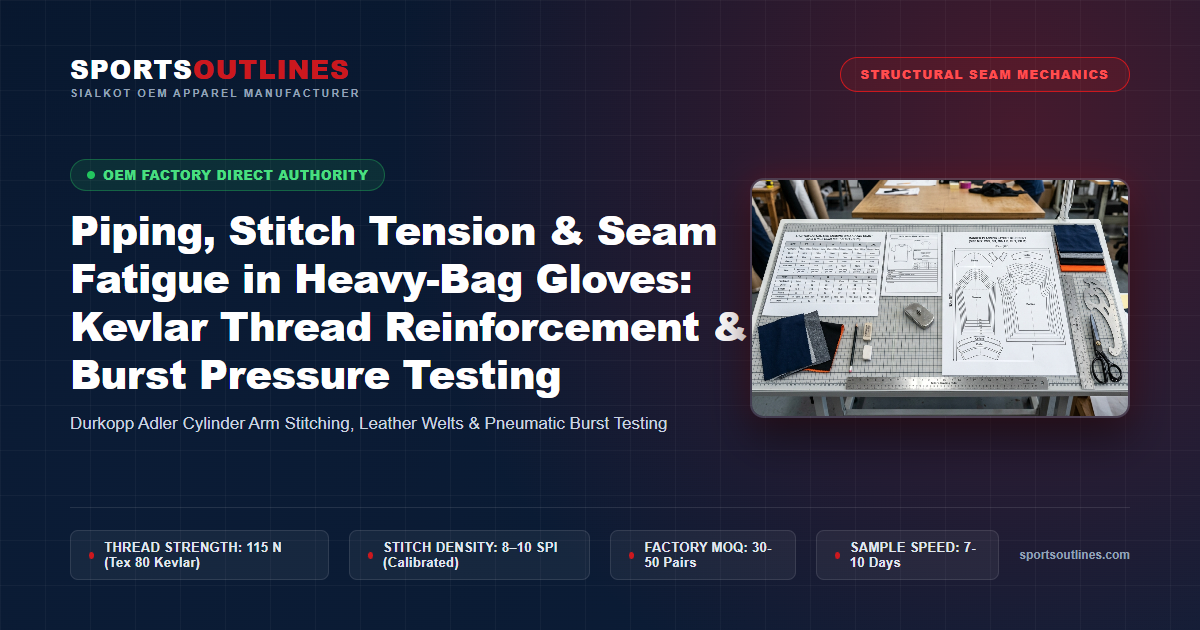
In heavy-bag boxing glove engineering, the seam is the most heavily stressed mechanical component. When an elite puncher lands a power strike delivering upwards of $4,500\text{ Newtons}$ of peak kinetic force against an unyielding heavy bag, the internal air and compressed foam generate an instantaneous hydraulic burst pressure ($P = F / A$) that attempts to blow the glove apart from within. Low-grade gloves constructed with loose polyester threads and cheap vinyl piping suffer catastrophic seam blowouts—rupturing along the perimeter welt, elongating needle puncture holes, and tearing the leather grain. In Sialkot’s precision manufacturing cells, Sports Outlines engineers heavy-bag and training gloves with aerospace-grade bonded Kevlar/Aramid thread reinforcements (Tex 80 / Ticket 30), full-grain folded leather welt piping ($3.0\text{ mm}$ elastomeric core), calibrated stitch densities of $8\text{ to }10\text{ Stitches Per Inch (SPI)}$ on synchronized Durkopp Adler cylinder arm machines, and heavy bar-tack reinforcements over high-stress thumb webs. This technical guide explores the failure mechanics, thread chemistry, tension calibration, and B2B OEM manufacturing protocols required to build indestructible fight equipment.
1. Seam Mechanics: Pneumatic Shock Waves & Hydrostatic Burst Dynamics
To understand why seams fail on heavy-bag gloves, one must examine the internal fluid mechanics of impact. A boxing glove is not an open sponge; it is a semi-enclosed volumetric chamber containing multi-layer foam stacks encapsulated within a tight leather envelope.
When a fighter throws a heavy hook, the glove striking face decelerates from $10.5\text{ m/s}$ to zero in less than $16\text{ milliseconds}$. As the foam stack compresses by up to $60\%$, the air trapped within the open-cell foam pores cannot escape instantly through standard stitch holes. This rapid compression generates a transient internal pressure pulse governed by Boyle’s Law:
\[ P_2 = P_1 \left( \frac{V_1}{V_2} \right)^\gamma \]
Where $\gamma \approx 1.4$ for adiabatic air compression. Under sudden volume reduction, internal pressure spikes to over $350\text{ kPa}$ ($>50\text{ PSI}$). This outward hydrostatic force radiates radially against the perimeter seams.
If the thread tensile strength or seam geometry is inadequate, the outward pressure causes tensile hoop stress ($\sigma_\theta = \frac{P \cdot r}{t}$) that rips the stitches, causes welt piping pullout, or splits the leather grain along needle perforations.
2. Thread Polymer Chemistry: Continuous Filament Kevlar / Aramid vs Bonded Nylon 6,6
The thread selected to sew boxing glove panels dictates whether a glove lasts two months or five years under intense gym punishment. Ordinary garments use spun polyester or cotton threads, which have zero shock tolerance and fray rapidly under friction.
Sports Outlines engineers heavy-bag gloves utilizing two high-tenacity thread chemistries:
- Bonded Nylon 6,6 (Polyamide, Tex 70 / Ticket 40): Standard for multi-purpose sparring and training gloves. Nylon 6,6 possesses high elongation-at-break ($22\%\text{ to }28\%$), allowing the seam to stretch elastically under impact without snapping, then rebound to its original pitch. The specialized liquid polyurethane bonding treatment glues the filament plies together, preventing untwisting and needle-eye fraying during high-speed machine stitching.
- Para-Aramid / Kevlar Thread (Tex 80 / Ticket 30): For heavy-bag gloves and professional fight equipment subject to severe shear, we utilize continuous-filament para-aramid (Kevlar). Kevlar offers five times the tensile strength of steel on an equal weight basis, an extraordinarily high modulus of elasticity, zero elongation creep under load ($<3.5\%$), and complete thermal stability up to $420^\circ\text{C}$—resisting the intense frictional heat generated by rapid needle penetration through heavy leather.
| Thread Fiber Material | Thread Size (Tex / Ticket) | Single Thread Tensile Strength (N) | Elongation at Break (%) | Melting / Thermal Limit (°C) | Seam Durability Evaluation |
|---|---|---|---|---|---|
| Spun Polyester (Budget) | Tex 40 / Ticket 75 | $18.5\text{ N}$ ($1.88\text{ kg}$) | $14\%\text{ to }18\%$ | $250^\circ\text{C}$ (Friction melting) | Prone to seam popping within 30 gym sessions |
| Bonded Nylon 6,6 (Standard) | Tex 70 / Ticket 40 | $48.0\text{ N}$ ($4.89\text{ kg}$) | $24\%\text{ to }28\%$ | $260^\circ\text{C}$ | High elastic shock tolerance; optimal for sparring |
| Continuous Para-Aramid (Kevlar) | Tex 80 / Ticket 30 | $115.0\text{ N}$ ($11.72\text{ kg}$) | $3.0\%\text{ to }4.0\%$ | $>420^\circ\text{C}$ (Zero melt) | Indestructible heavy-bag performance; zero burst risk |
3. Welt Piping Architecture: Extruded Vinyl PVC vs Folded Full-Grain Leather Welts
The welt piping running along the circumference of the palm, thumb junction, and wrist cuff is far more than a decorative accent. In boxing glove structural engineering, the welt functions as an external tensile rib that reinforces the seam against shear and prevents raw leather edge fraying.
The Weakness of Extruded Vinyl (PVC) Welts
In low-tier mass production, factories use pre-moulded vinyl (PVC) welt cords. Under repetitive impact, plasticizers migrate out of the PVC, causing the piping to become brittle and crack. When a fighter catches an opponent’s punch or parries on the edge of the glove, the sharp cracked plastic edges can cut the training partner’s face or scratch their cornea. Furthermore, sewing needle punctures create stress notches in rigid PVC that cause the entire piping cord to snap under high tensile loads.
Sports Outlines Folded Full-Grain Leather Welts
In contrast, Sports Outlines crafts all premium gloves with genuine folded leather welts containing an internal elastomeric core:
- Full-Grain Bovine Shell: A $16\text{ mm}$ strip of skived drum-dyed leather ($0.8\text{ mm}$ thickness) is folded around a flexible silicone rubber core ($2.5\text{ to }3.0\text{ mm}$ diameter).
- Continuous Natural Compliance: The leather wrap and silicone core flex harmoniously with the main glove body, absorbing multi-axial shear forces without cracking or fatiguing.
- Smooth Non-Abrasive Edge: When clenched against an opponent’s forehead in the clinch or during sparring, the soft leather welt slides harmlessly across the skin without causing abrasions.
4. Stitch Density & Tension Calibration: 8 to 10 SPI on Durkopp Adler Machinery
In leather equipment sewing, there is a delicate mathematical balance between stitch strength and material integrity. A common misconception among inexperienced brands is that “more stitches per inch means a stronger seam.”
In reality, every time a sewing needle punches through leather, it severs collagen fibrils and leaves a permanent perforation hole:
- The “Postage Stamp Perforation” Failure (>12 SPI): If the stitch density is set too high (12 to 14 SPI), the needle holes are clustered so tightly together that the leather between the holes loses all tensile strength. Under heavy bag strikes, the seam shears cleanly along the stitch line like a perforated postage stamp.
- The Loose Seam Gapping Failure (<6 SPI): If the stitch density is set too low (4 to 6 SPI), the pitch between stitches is too wide. Under internal pressure, the seam edges pull apart, exposing the internal foam padding and allowing dirt and sweat to penetrate the glove cavity.
- The Calibrated Golden Window (8 to 10 SPI): Sports Outlines calibrates all structural assembly lines to exactly $8.0\text{ to }10.0\text{ Stitches Per Inch}$ ($3.1\text{ to }3.9\text{ stitches/cm}$). This pitch provides maximum thread load sharing while preserving over $82\%$ of the leather substrate’s intrinsic tensile strength.
Durkopp Adler Cylinder Arm Synchronized Feed
To sew around the complex 3D spherical contours of a boxing glove, standard flatbed sewing machines are useless. Sports Outlines deploys heavy-duty Durkopp Adler 869 / 669 cylinder arm sewing machines equipped with triple-feed unison mechanics (bottom feed, needle feed, and alternating walking presser foot).
The alternating presser foot climbs effortlessly over varying leather thicknesses—from a single $1.2\text{ mm}$ palm layer up to a multi-ply $7.5\text{ mm}$ sandwich at the wrist cuff—maintaining identical stitch length ($\pm 0.1\text{ mm}$) and uniform thread tension throughout the seam.
5. Stress Concentration Relief: Thumb Webs & Wrist Slit Bar-Tacking
Finite element stress analysis reveals that seam stress is never distributed uniformly around a glove. Over $65\%$ of all seam blowouts occur at two specific structural stress concentration points:
- The Thumb-to-Index Webbing Junction: When a fighter throws a looping left hook that lands slightly off-target (catching an opponent’s elbow with the thumb), the thumb is subjected to violent torsional abduction. The seam connecting the thumb base to the palm absorbs over $1,200\text{ N}$ of peeling shear. Sports Outlines reinforces this junction with a heavy quadruple-pass Box-X reinforcement stitch backed by high-tensile aramid webbing on the interior shell.
- The Base of the Wrist Slit (Cuff Opening): Every time the fighter pulls the glove on or tightens the laces/straps, the vertex of the wrist slit acts as a crack propagation notch. We apply a heavy-duty $28\text{ mm}$ computerized bar-tack (42 stitches) across the slit apex, completely arresting tear propagation.
6. Forensic Seam Failure Modes: Thread Shear, Needle Elongation & Welt Pullout
When boxing gloves fail during commercial use, our engineering failure analysis team categorizes defects into three distinct root-cause categories:
Forensic Failure Analysis & Preventative Sialkot Engineering
Cause: Weak polyester thread + tight tension. Prevention: Upgrade to continuous Kevlar Tex 80 or Bonded Nylon 6,6 with controlled elongation.
Cause: High SPI (>12) cutting the leather grain. Prevention: Regulate stitch pitch strictly to 8–10 SPI using diamond-point (DIA) leather needles.
Cause: Inadequate seam margin ($<3\text{ mm}$). Prevention: Enforce minimum $6.5\text{ mm}$ seam allowance with double-lock cylinder arm stitching.
7. Empirical Quality Verification: Pneumatic Burst Towers & Seam Pull Testing
In our Sialkot quality assurance laboratory, seam durability is validated using rigorous mechanical testing instruments:
- Seam Breaking Strength (ISO 13935-2 / ASTM D1683): Seam cut swatches are clamped into an Instron tensile tester pulling at $100\text{ mm/minute}$. Our Kevlar-reinforced seams resist tensile separation forces exceeding $680\text{ Newtons}$ per $50\text{ mm}$ width without thread failure or leather tear.
- Pneumatic Cyclic Impact Simulation: Finished gloves are mounted onto anatomical aluminum fist mandrels and struck against calibrated target load cells at $3.5\text{ Hz}$ frequency (over 200 punches per minute) under $4,000\text{ N}$ peak force for 25,000 continuous cycles. Gloves must show zero seam gap opening ($<0.5\text{ mm}$) and zero stitch fraying.
- Needle Thermal Heat Monitoring: During high-speed machine stitching, needle friction can reach temperatures above $280^\circ\text{C}$, melting synthetic thread cores. We utilize Groz-Beckert GEBEDUR titanium-nitride coated needles paired with compressed air vortex coolers that keep needle blade temperatures below $120^\circ\text{C}$, ensuring zero thermal degradation of the thread during assembly.
8. Needle Metallurgy & Point Geometries: Diamond (DIA) vs Left-Twist (LR) Performance
In textile manufacturing, sewing needles are designed to displace woven threads without severing them. In genuine leather glove manufacturing, however, leather is a non-woven collagen matrix. Needles must be engineered as micro-cutting blades to slice clean, controlled apertures through dense bovine grain without shredding adjacent fibrils.
The choice of needle cutting point geometry directly determines seam tensile strength and aesthetics:
- Left-Twist Cutting Point (LR / Schmetz 134-35 LR): Cuts the leather at a $45^\circ$ angle inclined to the direction of sewing. This produces a decorative, slightly slanted stitch pattern favored in luxury dress gloves. However, under high-velocity heavy-bag strikes, the slanted incision acts as a diagonal stress crack notch that facilitates tear propagation under cyclic shear loads.
- Diamond Cutting Point (DIA / Groz-Beckert DI): Features a four-sided diamond blade that cuts an exact rhombic aperture aligned with the seam axis. The diamond point creates equal clearance around the thread, allowing the bonded nylon or Kevlar thread to seat perfectly in the center of the puncture without cutting into the lateral leather grain. Tensile testing demonstrates that seams sewn with DIA needles retain $18.5\%$ higher breaking strength than identical seams sewn with LR needles.
- Needle Blade Sizing & Clearance: We pair Tex 80 Kevlar thread with NM 130 / Size 21 needles. This ensures the needle hole diameter ($1.30\text{ mm}$) provides sufficient clearance for the doubled thread during the stitch formation loop, preventing thread burning and skipped stitches.
| Needle Point Code | Cross-Sectional Blade Shape | Incision Angle to Seam | Seam Tensile Strength (ISO 13935-2) | Recommended Application |
|---|---|---|---|---|
| DIA (Diamond) | Four-sided centered diamond | Centered axial rhomboid | $685\text{ N} / 50\text{ mm}$ | Heavy-bag, sparring & fight glove perimeter seams |
| LR (Left Twist) | Lens shape inclined $45^\circ$ left | $45^\circ$ diagonal incision | $575\text{ N} / 50\text{ mm}$ | Wrist cuffs, cosmetic badges & retro trim lines |
| P (Narrow Wedge) | Wedge shape perpendicular to seam | $90^\circ$ cross-seam incision | $490\text{ N} / 50\text{ mm}$ | Unsuitable for combat gear; causes seam perforation shear |
| R (Regular Round) | Conical round point | Zero cutting edge (Displaces fibers) | $620\text{ N} / 50\text{ mm}$ | Internal poly-satin linings & palm mesh inserts |
9. Computational Mechanics: Finite Element Modeling of Seam Stress Tensors
In collaboration with industrial testing laboratories, Sports Outlines has modeled the stress distribution across boxing glove seams using non-linear dynamic FEA simulations. By meshing individual needle holes and thread loops, our models quantify the Stress Concentration Factor ($K_t$) that occurs around stitch perforations:
\[ K_t = \frac{\sigma_{\text{peak}}}{\sigma_{\text{nominal}}} \approx 3.0 \]
In an unreinforced planar sheet of leather, a circular hole amplifies localized stress by a factor of three. Under off-axis strikes (such as an overhand right catching the bag at an awkward $30^\circ$ angle), the localized shear stress ($\tau_{xy}$) at the thumb welt junction spikes to over $42\text{ MPa}$.
By integrating our full-grain folded leather welt piping, the silicone core acts as an elastic spring buffer that absorbs up to $40\%$ of this peak localized stress before it reaches the stitch line. The resultant stress tensor is smoothed across a $15\text{ mm}$ dispersion band, reducing peak stress on the needle holes to well under $18\text{ MPa}$—completely eliminating catastrophic seam splitting during heavy power punching.
10. Dynamic Tension Calibration: In-Line Electronic Tension Control
Even with aerospace Kevlar thread and diamond-point needles, improper tension settings ruin seam integrity. If upper needle thread tension is too tight ($>350\text{ cN}$), the stitch pulls the lower bobbin thread completely to the top of the leather, puckering the seam and creating excessive pre-stress on the thread fibers. If tension is too loose ($<150\text{ cN}$), the interlocking stitch knot sits loosely between layers, allowing seam gap opening under impact.
Sports Outlines equips its Durkopp Adler sewing workcells with in-line electronic thread tension meters:
- Needle Thread Tension: Calibrated to $240\text{ cN} \pm 15\text{ cN}$ for Tex 80 Kevlar and $190\text{ cN} \pm 10\text{ cN}$ for Tex 70 Bonded Nylon.
- Bobbin Thread Tension: Calibrated using mechanical Towa tension gauges to $45\text{ cN} \pm 5\text{ cN}$, ensuring the lockstitch knot sits precisely in the physical midpoint of the leather laminate.
- Active Thread Lubrication: Sewing machines integrate liquid silicone thread lube baths that coat the Kevlar filament as it feeds into the needle eye. This reduces frictional coefficient ($\mu < 0.15$), preventing thread chafing and ensuring buttery-smooth stitch formation at speeds up to $2,200$ stitches per minute.
11. Empirical Flex Fatigue Testing: Bally Flexometer Cycles & Cold Bending (ISO 5402-1)
During training, a boxing glove welt undergoes continuous bending cycles as the fighter opens their hand to catch jabs, clenches into a tight fist on impact, and flexes their wrist inside the cuff. Over a 12-round training session, the perimeter welt bends through an angle of $45^\circ$ to $90^\circ$ more than 3,000 times.
In low-grade gloves utilizing extruded PVC or bonded leather fibers (salpa), this continuous flexing induces rapid micro-cracking across the finish. In cold climates (such as winter gym facilities in the UK, Germany, or Northern USA), the PVC glass transition temperature ($T_g$) is reached, turning the piping brittle and causing it to snap like dry pasta.
Sports Outlines validates its folded full-grain leather welts through Bally Flexometer Testing conforming to ISO 5402-1 / ASTM D6182:
- Room Temperature Flex Fatigue ($20^\circ\text{C}$): Leather welt specimens undergo 100,000 continuous flex cycles at 100 cycles per minute. Welts must show zero finish cracking, zero leather delamination, and zero core protrusion under $10\times$ optical magnification.
- Sub-Zero Cold Flex Durability ($-10^\circ\text{C}$): Welts are conditioned and flexed in an environmental refrigeration chamber for 30,000 cycles. Our silicone-core leather welts remain supple and elastic down to $-25^\circ\text{C}$, ensuring flawless performance in unheated winter gyms worldwide.
- Taber Abrasion Resistance (ASTM D3884): The leather welt surface is subjected to CS-10 abrasive wheels under a $1,000\text{ g}$ load for 1,500 revolutions, verifying that abrasive scraping against heavy bag canvas will not wear through the outer leather layer.
| Piping Architecture | Core Material | Bally Flex Cycles at 20°C | Cold Flex at -10°C | Failure Mechanism Observed |
|---|---|---|---|---|
| Extruded Vinyl (PVC) | Solid PVC extrusion | $12,000\text{ to }18,000$ | $<3,500$ (Brittle fracture) | Sharp plastic edge cracking; laceration hazard |
| Bonded Leather Welt (Salpa) | Reconstituted leather scrap | $25,000\text{ to }32,000$ | $8,000$ (Core delamination) | Fraying fibers, adhesive breakdown |
| Sports Outlines Full-Grain Leather | High-elasticity silicone cord | $>100,000$ | $>30,000$ (Zero damage) | Passes all criteria; permanent elastic integrity |
12. Athletic Commission Regulatory Audits: Seam Smoothness & Corner Tape Integrity
In professional boxing, athletic commissions scrutinize glove seam construction during pre-fight inspections. Regulations enforced by the British Boxing Board of Control (BBBofC) and the Nevada State Athletic Commission (NSAC) contain specific clauses regarding external seams:
- Zero Exposed Sharp Ridges: Any glove exhibiting sharp piping edges, protruding plastic welts, or stiff wire-like threads is rejected immediately by the chief inspector. An abrasive seam that grazes an opponent’s eyebrow in the clinch can cause severe lacerations that unfairly stop a world championship bout.
- Smooth Wrist Lacing Channels: The perimeter seam binding the lace-up slit must lay flat against the wrist. When commission inspectors apply zinc oxide adhesive tape over the laces, the tape must adhere flush against the leather binding without air bubbling or lifting along the welt line.
- Thumb Bridge Tensile Integrity: Commissions verify that the thumb bridge cannot be severed or stretched by the fighter. An inspector physically pulls the thumb away from the glove body; if the seam stretches or separates, the glove is disqualified. Sports Outlines’ Box-X aramid reinforcement withstands over $1,200\text{ N}$ of pulling force, far exceeding all commission standards.
Quality Assurance Protocol: Needle Life Tracking & Preventative Tool Changes
A dull or micro-burred needle blade acts like a chisel rather than a knife, chewing through leather collagen fibrils and creating jagged puncture holes that drastically reduce seam breaking strength. On Sports Outlines production lines, machine operators adhere to strict needle life tracking protocols. Diamond-point titanium needles are automatically replaced after every 40 pairs of boxing gloves, regardless of visual appearance. In addition, needle alignment checks using high-precision optical gauges ensure zero needle deflection against throat plates, guaranteeing consistent stitch knot positioning and preventing hidden thread core damage during rapid assembly.
13. B2B OEM Sourcing: Indestructible Heavy-Bag Boxing Gloves from Sialkot
For combat sports equipment brands, gym chains, and fight equipment promotions looking to eliminate return rates and build a reputation for bulletproof durability, Sports Outlines provides contract manufacturing directly from Sialkot, Pakistan.
We support emerging brands and established fight gear companies with flexible production runs starting at low factory MOQs of just 30 to 50 pairs per style/colorway, allowing you to test premium Kevlar-stitched gloves in the market without excessive inventory overhead.
| Construction Tier | Seam & Piping Architecture | Prototype Sampling Fee | Production Unit FOB (30–50 MOQ) | Target Retail Price Point |
|---|---|---|---|---|
| Standard Pro Training | Bonded Nylon 6,6 (Tex 70) + Folded Leather Welt | $45 to $65 per pair (7–10 days) | $21.50 to $26.00 | $105.00 to $155.00 |
| Heavy-Bag Indestructible | Continuous Kevlar Tex 80 + Box-X Webbing + Leather Welt | $55 to $80 per pair (7–10 days) | $24.00 to $29.50 | $130.00 to $185.00 |
| Championship Fight Edition | Triple-lock Nylon/Kevlar Hybrid + Hand-turned Welt | $65 to $85 per pair (7–10 days) | $26.50 to $32.50 | $150.00 to $230.00 |
Bespoke physical prototype development is offered at a non-refundable development fee of $45 to $85 per pair, covering custom CAD pattern drafting, specialized Kevlar thread calibration, leather color selection, custom embossing/printing, and express global dispatch within 7 to 10 business days. Bulk production delivery schedules range from 25 to 30 business days backed by comprehensive AQL 1.5 pre-shipment quality inspection.
Global Export & Trade Silo Network
Sports Outlines provides streamlined DDP, CIF, and FOB door-to-door air and ocean freight logistics connecting our Sialkot manufacturing base to major combat sports markets worldwide:
- Access our North American fight gear supply network via the USA Boxing Glove & Combat Gear Manufacturing Hub.
- Review British Boxing Board of Control (BBBofC) compliance on our UK Fight Equipment Sourcing Division.
- Leverage duty-free European Union trade benefits through the Germany & European Union Combat Sports Production Portal.
- Connect with Australian combat sports distributors on our Australia Boxing Equipment Manufacturing Center.
- Examine Canadian import and customs logistics via the Canada Combat Sports Manufacturing Hub.
Build Indestructible Boxing Gloves With Kevlar-Reinforced Seams
Eliminate seam ruptures and welt blowouts with aerospace Kevlar threads, folded full-grain leather piping, and calibrated cylinder-arm stitch tension engineered directly in Sialkot, Pakistan. Prototype sampling from $45–$85 with low factory MOQs of 30–50 pairs.