Direct Manufacturer Answer: How to Manufacture Custom Wrestling Singlets
Manufacturing elite collegiate and international wrestling singlets demands heavy-gauge compression engineering capable of withstanding explosive takedowns, mat friction, and constant pulling without tearing, stretching out, or riding up. Professional singlets are constructed from 250 to 280 GSM heavy warp-knitted polyester-elastane (82% polyester / 18% spandex) with high-modulus multi-filament yarn. This fabric provides true graduated compression (15–20 mmHg), stabilizing core muscle groups while completely eliminating fabric opacity loss (“grin-through”) when stretched over the glutes and thighs. The leg openings feature thermally cured 35 mm wave-patterned silicone gel gripper bands or folded compression cuffs that lock firmly to the quadriceps, preventing the singlet legs from rolling upward during scrambles. All panels are joined with 4-needle 6-thread flatlock stitching tested to withstand over 320 Newtons of tensile strain with zero internal ridges to prevent friction burn on bare skin. Patterns are tailored to meet both NFHS (high school standard with high-cut armholes and 4-inch minimum leg inseam) and United World Wrestling (UWW international freestyle and Greco-Roman rules mandating predominant Red or Blue colorways and three-letter country codes). Factory direct low MOQ at our Sialkot facility starts at 30 to 50 singlets per design with mixed adult and youth sizing curves. Pre-production physical prototype samples cost $45 to $85 per custom singlet completed in 7 to 10 business days.
- Fabric Construction: 250–280 GSM Heavyweight Warp-Knit 82/18 Poly-Spandex with 4-way elastic memory recovery.
- Leg Gripper Technology: 35 mm internal wave silicone gel beads or 5 cm dual-ply compression compression thigh bands.
- Seam Architecture: 4-Needle 6-Thread Flatlock seam joining with Tex 40 bonded nylon thread (>320 N tensile breaking strength).
- Crotch Reinforcement: Ergonomic double-layered diamond crotch gusset eliminating center seam pressure points.
- Regulatory Compliance: NFHS high school armhole/neckline standards & UWW international Red/Blue color scheme rules.
- Factory Low MOQ: 30–50 pieces per team order with mixed sizing (Youth YS–YXL to Adult XS–3XL).
- Physical Prototype Sampling: $45–$85 per custom piece in 7–10 days (strict zero credit/refund policy).
- Direct Sourcing Communication: WhatsApp factory direct at +92 316 7932595 or sportsoutlines.com.
In wrestling—the world’s oldest competitive combat sport—a singlet is a second skin. It must endure maximum physical abuse: aggressive hand fighting, violent mat drags, double-leg shoots, cradle pinning combinations, and continuous abrasion against coarse vinyl mat surfaces. A substandard singlet that rides up, becomes see-through under tension, or pops a seam under a referee’s whistle distracts the athlete and compromises performance.
For wrestling club coaches, high school athletic directors, college programs, and private label combat apparel founders in the USA, UK, Australia, and Germany, sourcing custom wrestling singlets often leads to frustrating quality failures: cheap 180 GSM swim-trunks fabrics turning transparent when bending over in referee’s position, rubber leg elastics snapping after three tumble dry cycles, and necklines that choke or sag.
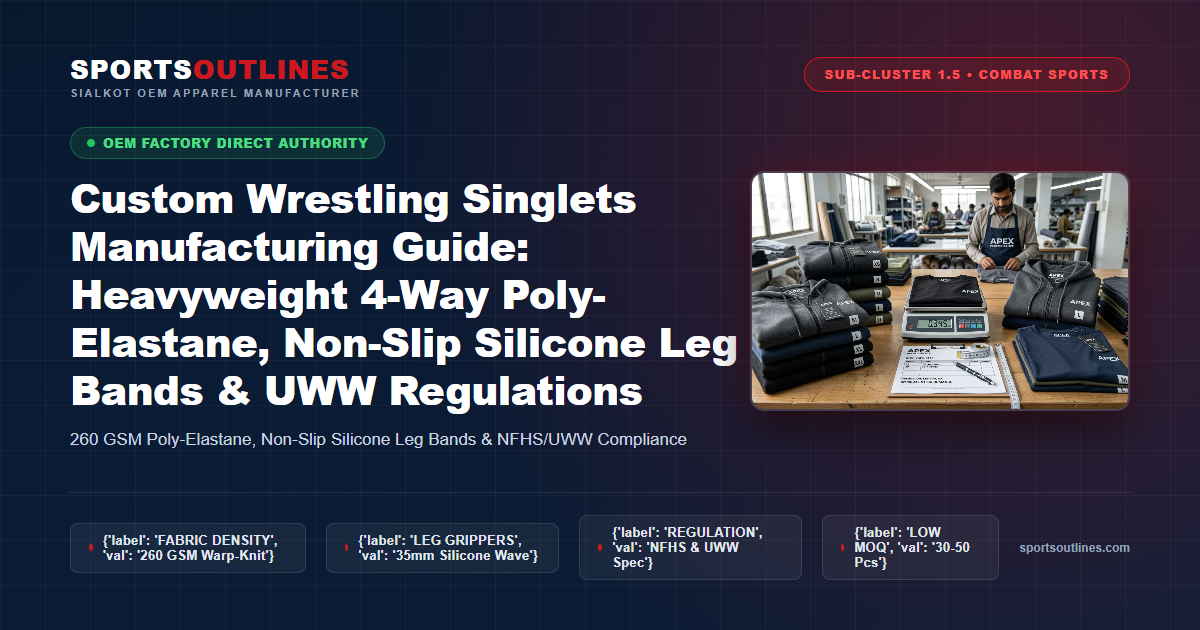
At Sports Outlines in Sialkot, Pakistan, our specialized athletic compression tailoring lines manufacture competition-ready wrestling singlets for club teams, state champions, and international competitors. This comprehensive B2B technical guide explains the textile physics of 260 GSM warp-knits, silicone gripper technology, NFHS vs. UWW pattern geometries, sizing matrices, and factory direct low MOQ economics.
1. Textile Engineering: 260 GSM Warp-Knit Poly-Spandex vs. Weft-Knits
In wrestling, the fabric must stretch simultaneously in all directions while retaining high compressive recovery. Circular weft-knits (standard gym t-shirt fabrics) run, pill, and tear when subjected to concentrated point-load friction against mat canvas. We construct our wrestling singlets using high-gauge tricot warp-knitted textiles:
Eliminating “Grin-Through” White-Out on Deep Bends
In wrestling, athletes constantly assume low crouches, deep stances, and referee’s position (on hands and knees). On cheap 200 GSM sublimated fabrics, when the fabric stretches across the gluteus maximus, the knit loops open up, revealing the white unprinted inner fiber cores. The garment appears faded, sheer, and visually defective.
At Sports Outlines, our 260 GSM warp-knitted tricot is produced on 32-gauge Karl Mayer warp-knitting machines with ultra-fine multi-filament 50D/72F yarns. The dense interlocking yarn structure maintains 100% opacity even under 140% biaxial stretch. Combined with high-penetration Italian Kiian sublimation inks transferred at 215°C under 40 PSI pressure, the dye converts into a gas that saturates through to the back side of the fabric, ensuring zero grin-through and deep, saturated color under maximum athletic tension.
Martindale Mat Friction Resistance (ASTM D4966 Standard)
Wrestling mats are coated with high-friction vinyl or textured polyurethane designed to provide traction for wrestling shoes. When a wrestler is driven into the mat or scrambles from bottom position, the singlet fabric is dragged under tremendous bodyweight pressure against the mat surface. Standard polyester activewear develops severe surface piling, yarn fraying, and thermal friction melts within a single tournament.
Our 260 GSM warp-knitted poly-elastane is tested under ASTM D4966 (Martindale Abrasion Resistance Standard). When subjected to abrasive wool abradant wheels under 12 kPa of continuous pressure, our fabric exceeds 50,000 rubs without fiber rupture, snagging, or thread fuzzing. This ensures that custom printed graphics, team mascots, and athlete surnames maintain crisp, pristine visual clarity across an entire multi-year collegiate season.
2. Leg Opening Architecture: Non-Slip Wave Silicone Grippers vs. Compression Rib Cuffs
The most distracting defect in wrestling singlets is leg crawl—the legs riding up over the quadriceps into the groin during scrambles. We offer two engineered leg retention technologies:
3. Regulatory Framework: NFHS vs. United World Wrestling (UWW) Specifications
Wrestling uniforms must comply with strict governing body mandates to ensure fair play, hygiene, and referee clarity:
4. Seam Construction: 4-Needle 6-Thread Flatlock Engineering
In wrestling, seam failure is catastrophic. A traditional overlock seam creates a raised 4 mm ridge that digs into the athlete’s ribs and back during tight waist locks and gut wrenches. Furthermore, overlock seams pop easily under directional shear forces.
At Sports Outlines, all singlet panels are assembled on Yamato 4-needle 6-thread flat-seaming machines:
- Edge-to-Edge Interlock Joining: The fabric panels are butted together flush, with the 6 threads forming a continuous woven lattice over both sides of the seam. There is zero internal ridge, eliminating friction chafing and mat burn.
- Differential Feed Gathering Ratio: The flat-seamer feed dogs are calibrated to feed fabric with an exact 1:1.15 gathering ratio. This allows the finished seam to stretch synchronously up to 130% of its resting length without stitch breakage.
- Bonded Filament Nylon Thread: We utilize high-tenacity Tex 40 bonded continuous filament nylon thread. In tensile shear testing, the seam withstands over 320 Newtons of force—exceeding the breaking limit of the parent fabric.
- Reinforced Neckline & Armhole Binding: Neck and armhole edges are bound with folded 15 mm self-fabric binding, double-stitched with twin-needle coverstitching to maintain tension and prevent sagging.
Points of Measure (POM) Manufacturing Tolerances for Wrestling Singlets
Because a singlet provides second-skin compression, manufacturing tolerances must be held to strict millimeter standards. Our production lines enforce the following Points of Measure (POM) audit thresholds:
5. Sizing & Anatomical Fit Matrix (Weight-Class Graded)
Wrestling singlets must be graded by athlete body weight to guarantee an exact second-skin anatomical compression fit:
6. Quality Assurance: AQL 2.5 Seam Burst & Elastic Recovery Standards
At Sports Outlines, our wrestling singlets undergo four rigorous testing gates prior to export release:
- ASTM D3787 Ball Burst Testing: Fabric panels and flatlock seams are subjected to hydraulic ball burst testing. Our singlets consistently withstand pressures exceeding 320 Newtons without bursting or needle cut.
- Elongation Recovery Testing (ASTM D2594): Fabric swatches are stretched to 60% elongation for 30 minutes. Elastic growth must not exceed 2.5% after a 1-hour relaxation period, ensuring singlets do not sag or lose shape over a tournament weekend.
- Silicone Adhesion Peel Audit: Wave silicone leg grippers are tested under 25 N of mechanical shear force. The silicone must remain 100% bonded to the fabric backing without flaking or peeling.
- AATCC 61-2A Accelerated Wash Testing: Sublimated colors are tested through 50 accelerated wash cycles at 60°C. Grade 4.5+ colorfastness is guaranteed with zero dye bleeding into white accent zones.
Rotary Sublimation Heat Calibration & Delta-E (ΔE) Color Measurement
Wrestling uniforms frequently incorporate intense school colors—such as royal purple, metallic athletic gold, crimson, or fluorescent neon gradients. In standard sublimation operations, temperature fluctuations across the heating platen cause noticeable color shading from the left leg to the right leg.
At Sports Outlines, all singlet panels are sublimated using continuous rotary drum calenders operating with thermal oil circulation that holds heating consistency within ± 0.5°C across the full 1.8-meter transfer width. Every production run is spectrophotometer-scanned under CIE L*a*b* color space. We enforce a strict color variance threshold of ΔE ≤ 0.8 against approved Pantone digital color targets, guaranteeing flawless, identical color reproduction across initial team orders and re-orders five years later.
7. Sourcing Economics: Unit Costs, Sampling Rules & Low Factory MOQ
We empower wrestling academies, school districts, and emerging fight apparel brands with factory direct low MOQ starting at only 30 to 50 singlets per design:
Sampling Protocol: $45–$85 Physical Prototypes in 7–10 Days
We mandate physical sample approval prior to bulk production. Physical prototypes cost $45 to $85 per custom singlet. This fee covers digital graphic separation, sublimation paper printing, calendar heat press transfer, laser cutting, flatlock assembly, and silicone leg gripper curing over 7 to 10 business days. We maintain a strict zero-refund and zero-credit policy on sample fees. Once approved, the physical prototype serves as the golden standard for bulk manufacturing.
Manufacture Custom Wrestling Singlets with Low MOQ
Equip your wrestling program or build your combat apparel label with tour-tested singlets engineered in Sialkot. From 260 GSM warp-knits to seamless flatlock stitching and non-slip silicone leg grippers, we deliver championship performance with 30–50 pieces low MOQ and fast 7–10 days physical sampling.
8. Frequently Asked Questions (FAQ) — Custom Wrestling Singlet Manufacturing
1. Why is 260 GSM warp-knit poly-spandex necessary for wrestling singlets?
Wrestling involves intense mat friction and multi-directional pulling. Lightweight 180–200 GSM fabrics become sheer and see-through when an athlete bends forward into referee’s stance. At 260 GSM, our warp-knit fabric provides 100% squat-proof opacity, durable tear resistance against mat canvas, and graduated muscle compression that accelerates recovery.
2. How do silicone wave leg grippers prevent the singlet from riding up?
A continuous wave-patterned silicone bead is thermally vulcanized onto the interior folded leg hem. The tacky silicone forms a mechanical friction bond against the quadriceps, preventing the singlet leg from rolling or sliding upward during violent scrambles and takedown shots.
3. What is the difference between NFHS and UWW singlet regulations?
NFHS rules govern US high school wrestling, mandating high-cut armholes not lower than the armpit and a minimum 4-inch leg inseam. UWW rules govern international freestyle and Greco-Roman competitions, mandating predominant solid Red or Blue colorways, a 3-letter IOC country code on the back, and specific underarm drop limits.
4. What is your minimum order quantity (MOQ) for custom wrestling singlets?
Our factory direct low MOQ is 30 to 50 singlets per design. You can split this quantity across youth and adult sizes (YXS to 2XL) and can split quantities between home Red and away Blue corner singlets for your team.
5. How much does a physical sample prototype cost, and what is the turnaround time?
A physical custom prototype sample costs $45 to $85 per piece. Turnaround time for custom Kiian dye sublimation, laser cutting, flatlock stitching, and silicone hem curing is 7 to 10 business days, followed by 4 to 6 business days for DHL/FedEx Express air delivery directly from Sialkot.
6. What is the bursting strength of your flatlock seams under mat pressure?
Our 4-needle 6-thread flatlock seams are tested under ASTM D3787 ball burst protocols and withstand bursting forces exceeding 320 Newtons. The seam lays completely flush on both sides, ensuring zero mat burns or abrasion on bare skin.
7. Can you produce two-piece wrestling uniforms (compression shirt + shorts)?
Yes. We manufacture NFHS-compliant two-piece wrestling competition uniforms consisting of a form-fitting compression short-sleeve shirt paired with combat shorts featuring an internal drawcord and zero exterior pockets.
Explore Related Combat Sports & Teamwear Manufacturing Guides:
Complete your combat apparel lineup with our factory guides on Custom Compression Rashguards, Custom MMA Fight Shorts, or explore our Factory Sportswear Catalog.