Super-Cluster 6 • Sub-Cluster 6.1: Tech Pack, CAD, BOM & Color Engineering (Blog #436)
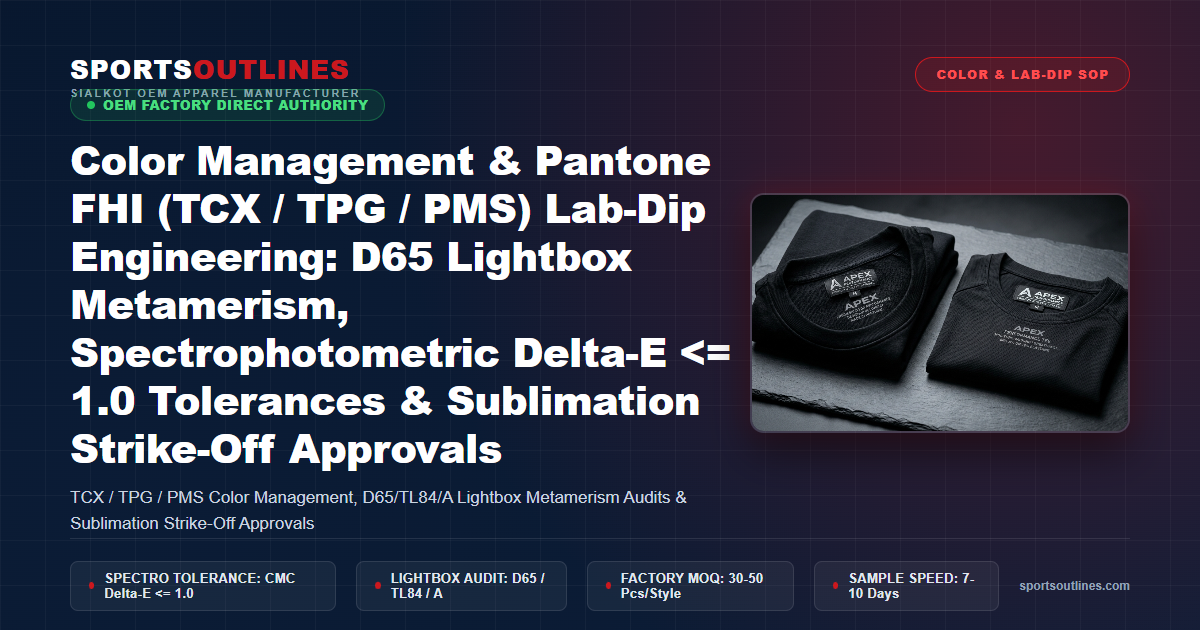
Executive Technical Answer: How Do B2B Sportswear Brands Achieve `Delta-E <= 1.0` Color Accuracy Across Multi-Substrate Capsules?
In industrial sportswear manufacturing, specifying a generic RGB/Hex screen code (`#1A2B4C`) or a paper graphic-print swatch (`Pantone® PMS 286 C`) for dyed fabrics guarantees severe shade mismatch across garments. Production-grade textile color management mandates specifying Pantone® Fashion, Home + Interiors (`FHI`) `TCX` (100% Cotton Swatch) or `TSX` (Polyester Swatch) 6-Digit Standards (`e.g., 19-4052 TCX Classic Blue`) on `Sheet 5` of your tech pack, verified inside our Sialkot dyeing and sublimation lab using X-Rite® `Ci7800` Spherical Benchtop Spectrophotometers under the `CMC(2:1)` Ellipsoidal Color-Difference Equation ($\Delta E_{\text{CMC}(2:1)} \le 1.0\text{ for solid dye lots}$ and $\le 1.5\text{ across multi-fiber trims}$). Every physical `A/B/C` Textile Lab-Dip and Rotary Sublimation Fabric Strike-Off is audited inside a calibrated VeriVide® / GretagMacbeth Multi-Illuminant Viewing Booth across three mandatory light sources—`D65` (`6500K` Noon Daylight), `TL84 / F11` (`4000K` European Retail Store Fluorescent), and `CWF / LED 3500K` (`4150K` North American Department Store Lighting)—guaranteeing a Metamerism Index ($\text{MI} \le 0.50$) so your `2×2` cotton-spandex rib cuffs, polyester body shell, and YKK® zipper tape never shift into mismatched purple or green hues under retail store lighting. At Sports Outlines, we execute custom lab-dips and digital sublimation strike-offs within 4–6 business days, produce physical prototypes in 7–10 business days ($45–$85 per piece non-refundable development fee), and scale bulk production at a 30–50 piece MOQ per style/colorway.
Imagine launching a flagship 4-piece athletic capsule in `”Midnight Navy”` or `”Sage Olive”`—consisting of a `450 GSM` combed cotton French Terry hoodie (`2×2` rib cuffs), a `240 GSM` nylon-spandex compression legging, a `165 GSM` 4-way stretch woven polyester fight short, and a `#5` YKK® reverse-coil zipper. When the cartons arrive at your warehouse and you hang the collection under your studio LED lights, disaster strikes: the cotton hoodie looks warm charcoal-navy, the nylon leggings look electric violet-blue, the polyester shorts look greenish-teal, and the zipper tape looks jet black! Even worse, when you walk the garments outside into natural sunlight, the hoodie and leggings suddenly look similar again.
This optical phenomenon is known in textile color physics as Illuminant & Cross-Substrate Metamerism, and it is responsible for over 35% of bulk color rejections in cross-category activewear. Whether you are scaling an athletic label through our USA, UK, Canada, Germany, or Australia export hubs, this engineering guide deconstructs the exact spectrophotometric equations, Pantone® system translations, dye-class selections, and strike-off approval protocols used on our Sialkot factory floor.
1. Deconstructing the Pantone® Taxonomy: `TCX` vs. `TSX` vs. `TPG` vs. `PMS (C/U)`
The first rule of Sheet 5 (Colorway & Lab-Dip Matrix) in a sportswear tech pack is choosing the correct physical color reference standard. Designers trained in graphic or web design frequently specify `RGB`, `CMYK`, `Hex (#)`, or `Pantone® PMS Solid Coated (C)` numbers for apparel fabrics. Here is why each Pantone® system behaves differently on the dye-house floor:
- Pantone® FHI `TCX` (`Textile Cotton eXtended` — 2,625 Colors, e.g., `19-1664 TCX True Red`): The undisputed global standard for cotton, cotton-polyester fleece (`French Terry`), modal, viscose, and matte nylon activewear. Every `TCX` standard is a physical `100%` double-layered unbacked cotton poplin swatch dyed with reactive dyes and accompanied by a downloadable Spectral Reflectance Curve (`QTX` file format, measured from `400 nm` to `700 nm` at `10 nm` intervals). Because the `TCX` swatch has a 3D woven yarn micro-texture and matte diffuse reflectance, our dye masters load its digital `.QTX` spectral curve directly into our `Datacolor / X-Rite` recipe prediction computer.
- Pantone® FHI `TSX` (`Textile Polyester Swatch` — 203 High-Chroma & Neon Colors, e.g., `13-0630 TSX Safety Yellow`): Natural cotton fibers cannot physically achieve the high chroma ($C^* > 85$) of neon fluorescents, vibrant electric blues, or deep high-sheen synthetics because reactive dyes on cellulose have lower light-scattering saturation than disperse dyes encapsulated inside trilobal polyester filaments. Whenever you specify a high-visibility marathon running vest, neon cycling jersey, or high-sheen compression rashguard, specify a `TSX` (`100%` warp-knit polyester swatch) or `TN` (`Textile Nylon Brights` neon swatch).
- Pantone® FHI `TPG` (`Textile Paper – Green`, formerly `TPX` — Lead-Free Lacquer on Paper): A cost-effective desktop fan-deck version of the `TCX` library where the exact same 6-digit color numbers (`e.g., 19-4052 TPG`) are printed as a matte nitrocellulose lacquer coating on paper. While convenient for studio moodboards, a `TPG` paper chip has a flat, non-porous surface that reflects light differently than a porous knitted textile ($\Delta E \approx 0.8\text{ to }1.6$ between `TPG` paper and `TCX` fabric of the same code!). For bulk dyeing, our Sialkot lab always converts your `TPG` code to its master `TCX` `.QTX` digital spectral reflectance file.
- Pantone® `PMS` (`Pantone Matching System — Solid Coated ‘C’ / Uncoated ‘U’`, e.g., `PMS 186 C`): Engineered for offset lithographic printing inks on glossy paper, plastisol/silicone screen-printing inks, 3D TPU/silicone heat-transfer crests, and retail hangtag packaging (`BOM-P02`). Use `PMS Coated (C)` codes on `Sheet 6` (Artwork & Screen Print Callouts) and `Sheet 7` (Hangtag Packaging), while reserving `TCX / TSX` codes for dyed fabrics and trims on `Sheet 5`!
| Pantone® System Suffix | Physical Substrate Carrier | Digital Spectral Format | Chroma & Surface Gloss Profile | Mandatory Sportswear Tech Pack Application |
|---|---|---|---|---|
| `FHI TCX` (`19-4052 TCX`) | `100%` Unbacked Cotton Poplin Swatch | `.QTX` (`400–700 nm` 31-pt curve) | Matte 3D yarn texture (`60° Gloss < 4 GU`) | Piece-dyed hoodies, tees, joggers, BJJ Gis, matte nylon leggings & woven trims |
| `FHI TSX / TN` (`13-0630 TSX`) | `100%` Polyester (`TSX`) or Nylon (`TN`) Knit | `.QTX` + UV-Calibrated Fluorescence | High-chroma synthetic sheen & neon brights | Sublimated team kits, hi-vis running singlets, cycling jerseys & rashguards |
| `FHI TPG` (`19-4052 TPG`) | Lead-Free Lacquer Coating on Paper Card | Converted to Master `.QTX` (`TCX`) | Flat semi-matte paper (`ΔE ~ 1.1` vs `TCX`) | Studio design selection & matte polyurethane coated synthetic leather / EVA pads |
| `PMS Coated (C)` (`PMS 286 C`) | Lithographic Paste Ink on Gloss Paper | `PantoneLIVE™` / `CIELAB D50/2°` | High specular surface gloss (`60–75 GU`) | Plastisol/silicone screen prints, 3D TPU crests, custom aglets & swing hangtags |
| `RGB / Hex (#)` (`#1D4ED8`) | Backlit Emissive OLED/LCD Monitor Screen | None (Varies `±15 ΔE` by monitor!) | Additive light emission (Cannot be dyed!) | NEVER USE FOR BULK TEXTILES (Must be mapped to `TCX/PMS` before sampling) |
2. Spectrophotometric Physics: Why `CMC(2:1)` (`ΔE_CMC <= 1.0`) Beats Legacy `CIELAB ΔE*ab`
How does an industrial dye-house prove mathematically that a dyed fabric roll matches your Pantone® `TCX` standard without relying on the subjective opinion of a human inspector? We measure the fabric inside an Integrating-Sphere Benchtop Spectrophotometer (`X-Rite® Ci7800` or `Datacolor 800` with `d/8°` diffuse illumination, `10°` CIE Standard Observer, Specular Component Included `SCI`).
In 3D color space, any shade is defined by three cylindrical coordinates: Lightness ($L^*$, from `0` pure black to `100` pure white), Chroma / Saturation ($C^* = \sqrt{(a^*)^2 + (b^*)^2}$, distance from neutral grey axis), and Hue Angle ($h^\circ = \arctan(b^*/a^*)$, `0°` Red, `90°` Yellow, `180°` Green, `270°` Blue). While older factories still use the basic 1976 Euclidean distance formula ($\Delta E^*_{ab} = \sqrt{(\Delta L^*)^2 + (\Delta a^*)^2 + (\Delta b^*)^2}$), the human eye is non-uniform: our retinas are roughly twice as tolerant of small shifts in Lightness ($\Delta L^*$) as they are of shifts in Chroma ($\Delta C^*$), and ultra-sensitive to even tiny shifts in Hue ($\Delta H^*$)—especially in neutral charcoal greys, olive drabs, and skin-tone beiges!
Therefore, all Tier-1 global sportswear brands (`Nike, Adidas, Lululemon, Under Armour, and Sports Outlines`) enforce the `AATCC EP7 / ISO 105-J03 CMC(l:c)` Color Measurement Committee Ellipsoidal Equation with a `2:1` Lightness-to-Chroma commercial weighting ratio ($\text{CMC}(2:1)$):
Delta_E_CMC(2:1) = Sqrt[ (Delta_L* / (2 * S_L))^2 + (Delta_C* / (1 * S_C))^2 + (Delta_H* / S_H)^2 ] <= 1.00 (Pass Gate)
Where $S_L$, $S_C$, and $S_H$ are semi-axis ellipsoidal scaling functions that automatically tighten the hue tolerance in tricky low-chroma neutrals (`Cool Grey`, `Taupe`, `Khaki`, `Navy`) and slightly relax chroma tolerance in high-saturation brights (`Neon Orange`, `Royal Blue`). Furthermore, every dyed swatch is folded into 4 opaque plies (`4x thickness`) before clamping against the `25.4 mm` (`1.0″`) spectrophotometer aperture so zero light leaks through the knit backing.
| Color QC Stage & Component Pairing | Max Allowed `ΔE_CMC(2:1)` | Max Hue Shift (`|ΔH*|`) | ISO 105-A02 Grey Scale Rating | Sialkot Factory Action Gate |
|---|---|---|---|---|
| 1. Primary Shell Fabric Lab-Dip vs. Master `.QTX` | `ΔE_CMC <= 0.80` (Target) / `1.00` (Max) | `<= 0.45` | `Grade 4.5 – 5.0` | Approved as Option `A` in `A/B/C` lab-dip card |
| 2. Bulk Dye Lot-to-Lot Continuity (`Batch 1` vs. `Batch 2`) | `ΔE_CMC <= 0.80` (`5-5-5` Shade Sorting) | `<= 0.40` | `Grade 4.5+` | Rolls grouped by `5-5-5` shade-band; never mixed in one garment |
| 3. Within-Roll Center-to-Selvedge (`C-S-C`) Shading | `ΔE_CMC <= 0.50` (Left-Center-Right) | `<= 0.25` | `Grade 4.8 – 5.0` | Audited across `Left / Center / Right` of every roll before cutting |
| 4. Shell Body vs. `2×2` Rib Cuff/Collar (`Same Fiber`) | `ΔE_CMC <= 1.00` (Co-Dyed in Same Jet Vat) | `<= 0.50` | `Grade 4.5` | Fleece body and `2×2` rib are dyed together in the same dye bath |
| 5. Cross-Substrate Trim (`Cotton Body` vs. `Poly Zipper/Mesh`) | `ΔE_CMC <= 1.25 – 1.50` (`MI <= 0.50`) | `<= 0.65` (Same Hue Quadrant!) | `Grade 4.0 – 4.5` | Audited side-by-side under `D65 + TL84 + CWF` lightbox |
3. Defeating Illuminant Metamerism (`D65`, `TL84`, `CWF`) & Cross-Substrate Dye Chemistry
Why do two fabrics (`e.g., a reactive-dyed cotton hoodie and an acid-dyed nylon windbreaker overlay`) match under `D65` daylight ($\Delta E_{\text{CMC}} = 0.45$) yet clash violently under `TL84` store lighting ($\Delta E_{\text{CMC}} = 2.85$, where one turns reddish-plum and the other turns greenish-slate)? Because of Spectral Curve Crossing (Metamerism)!
When a cotton fabric is dyed with a trichromatic combination of Reactive Yellow, Reactive Red, and Reactive Blue, and a nylon fabric is dyed with Acid Yellow, Acid Red, and Acid Blue, their spectral reflectance curves $R(\lambda)$ across `400–700 nm` may intersect at three points. Under continuous-spectrum daylight (`D65`), the positive and negative spectral differences cancel out. However, retail fluorescent lamps (`TL84` and `CWF`) emit massive, narrow Mercury-Vapor Spectral Energy Spikes at `436 nm` (Violet-Blue), `546 nm` (Green), and `611 nm` (Orange-Red)! If the nylon dye recipe has a reflectance peak at `611 nm` while the cotton dye recipe has a trough at `611 nm`, the store lamp amplifies that orange-red peak by `400%`—causing the nylon to flare reddish-purple in the dressing room!
| Sportswear Fiber Substrate | Mandatory Industrial Dye Class | Dye Bath Temp & Fixation Chemistry | Wash & Sweat Fastness (`ISO 105-C06 / E04`) | Cross-Substrate Metamerism Control Protocol |
|---|---|---|---|---|
| 100% Cotton / Cotton-Modal (`Fleece, Jersey, Gi`) | Bifunctional Vinyl-Sulfone / MCT Reactive Dyes | `60°C – 80°C` Alkaline Soda-Ash Covalent Bond | `Grade 4.5` (After 2x `95°C` Soaping-Off) | Co-dye `2×2` cotton-spandex rib in the exact same jet vat as fleece body |
| 100% Polyester / PET-Spandex (`Interlock, Mesh, Satin`) | High-Energy (`SE/S` Class) Disperse Dyes | `130°C` High-Pressure HT Jet (`122°C` w/ Spandex) | `Grade 4.5 – 5.0` (With Reduction Clearing) | Mandatory alkaline sodium dithionite reduction clearing to strip surface oligomers |
| Polyamide 6 / 6,6 (`Supplex® Leggings, Tricot, Tactel`) | 1:2 Metal-Complex / Milling Acid Dyes + Syntan | `98°C` Weakly Acidic Bath (`pH 4.5–5.5`) | `Grade 4.5` (With Double Syntan Back-Tanning) | Select non-metameric acid-blue chromophores to prevent red-flare under `TL84/CWF` |
| CVC / Poly-Cotton Blends (`65/35` or `80/20` Fleece) | Two-Bath Disperse (`130°C`) + Reactive (`60°C`) | Sequential Dual-Bath Cross-Dyeing + Clearing | `Grade 4.5` (`Zero Heather Frosting`) | Match both polyester disperse recipe and cotton reactive recipe to identical `.QTX` |
4. Rotary Sublimation Strike-Off Engineering: ICC Profiling, Blanket Shrinkage & `310%` Rich Black
When your collection uses digital rotary dye-sublimation (`rashguards, cycling jerseys, soccer kits, basketball uniforms, or fight shorts`), color is not created in a liquid dye vat—it is printed onto transfer paper via 8-head Epson® SureColor / MS JP4 industrial piezoelectric plotters (`CMYK + Light Cyan + Light Magenta + Fluorescent Pink/Yellow` or `Orange/Violet`) and vapor-infused into `100%` polyester fabric on an oil-heated Monti Antonio® rotary calender drum (`204°C–208°C` for `35–42 seconds`).
Why do amateur sublimation shops print muddy greys, washed-out blacks that turn white when stretched, and team reds that look orange? Because raw `CMYK` ink on paper looks completely dull and brown before heat transfer, and different polyester fabrics (`e.g., 145 GSM pinhole mesh vs. 260 GSM 32-gauge Lycra interlock`) shift the sublimated color by up to `4.5 ΔE`! At Sports Outlines, we enforce a 4-Step Sublimation Strike-Off Protocol:
- Step 1 — Substrate-Specific Custom `.ICC` Spectrophotometric Profiling (`Ergosoft / Caldera RIP`): We never use a generic “default polyester” printer profile. For each fabric base (`150 GSM` interlock, `180 GSM` birdseye mesh, `250 GSM` warp-knit rashguard tricot, `165 GSM` 4-way stretch woven microfiber), we print a `1,617-patch ISO 12642-2 (IT8.7/4) Calibration Chart` onto that exact fabric, scan the sublimated fabric patches with an automated `X-Rite i1Pro 3 Plus` spectrophotometer table, and generate a custom `.ICC` lookup table that maps your Pantone® spot colors within $\Delta E_{\text{CMC}} \le 1.1$.
- Step 2 — The Physical 25-Swatch “Color Blanket” Strike-Off Grid: Whenever a brand orders a critical custom shade (such as an NCAA university crimson, corporate sponsor teal, or military coyote tan), we print a `5 × 5` Matrix Swatch Blanket directly onto the bulk fabric: the center cell (`C3`) is our spectrophotometric target, surrounded by 24 micro-stepped variations shifting Lightness ($\pm 2\%, \pm 4\%$), Red/Green ($\pm a^*$), and Yellow/Blue ($\pm b^*$). We courier this physical fabric blanket to you (or photograph it inside our `D65 / TL84` lightbox alongside the physical Pantone® `TCX` swatch card) so you can sign off on the exact cell (`e.g., Cell B4`) before bulk printing!
- Step 3 — `310%` Rich-Black Ink Load + `Creora® Black` Elastane for Zero Grin-Through: In Adobe Illustrator, standard `100% K` (black channel only) prints as a washed-out dark grey ($L^* \approx 24$) in dye-sublimation. For deep, jet-black compression wear ($L^* \le 11.5$), our RIP engine applies a linearized `310%` Total Area Coverage (`C: 75% / M: 68% / Y: 67% / K: 100%`) onto `115 GSM` high-release thermo-tacky paper, transferred under `+6.0%` mechanical pre-tension onto fabric knitted with dope-dyed black elastane (`Creora® Black`)—eliminating white spandex grin-through at `100%` squat or grappling stretch.
| Sublimation Color Defect | Root Cause on Printing / Calender Floor | Sialkot Engineering Prevention SOP | Verified QC Metric |
|---|---|---|---|
| 1. Washed-Out Charcoal Black (`L* > 20`) | Artwork exported as `100% K` only or low-density `70 GSM` untacky paper | Enforce `310%` Rich-Black (`C75 M68 Y67 K100`) on `115 GSM` tacky paper at `205°C / 40s` | `CIELAB L* <= 11.5` (`K/S >= 24.5`) |
| 2. White Elastane Grin-Through Under Stretch | Sublimation gas only dyes outer loop crowns; white spandex core shows at stretch | Knit 32G interlock with `Creora® Black` spandex + `+6%` servo pre-stretch at calender | `ΔL*(75% stretch) <= +1.4` |
| 3. Ghosting / Double-Shadow Halo on Logos | Transfer paper shifts by `1–2 mm` against shrinking hot fabric during drum exit | Use heat-activated silica-coated thermo-tacky paper (`115 GSM`) that bonds to knit | `0.00 mm` edge halo (`1,440 dpi`) |
| 4. Dye Migration (“Sublimation Bleed”) After Storage | Low-molecular-weight disperse ink sublimates into white plastisol/silicone logos | Use high-energy disperse inks (`Mw > 360 g/mol`) + activated-carbon blocker base ink | `ISO 105-X11 Grade 4.5–5.0` (`70°C / 48h`) |
5. The `A/B/C` Physical Lab-Dip Card & `5-5-5` Bulk Shade-Band Sorting SOP
How does our Sialkot lab execute your color approval from tech pack submission to bulk cutting? Every custom dye-lot request follows our Deterministic 3-Stage Color Gate:
- Stage 1 — The `A / B / C` Tri-Option Lab-Dip Card (`4–6 Business Days`): Rather than sending a single swatch that might be slightly too warm or too cool for your creative vision, our laboratory precision-dyes three `10 cm × 10 cm` swatches (`Option A`: closest mathematical match $\Delta E_{\text{CMC}} \le 0.45$; `Option B`: `+0.3` slightly warmer/brighter; `Option C`: `-0.3` slightly cooler/deeper) on the exact bulk greige fabric. Each card includes the printed X-Rite `Ci7800` spectral pass report under `D65 / TL84 / CWF`.
- Stage 2 — Pre-Production Prototype & Trim Continuity Verification (`7–10 Business Days`, `$45–$85/pc` Non-Refundable Sample Fee): Once you approve `Option A` (or `B/C`), we construct your physical garment prototype and mount the approved shell swatch alongside the matching `2×2` rib, sewing thread (`Coats Epic / Seamsoft`), zipper tape, and silicone/embroidery strike-off on a unified Master Trim Continuity Card.
- Stage 3 — Bulk `5-5-5` Shade-Band Roll Sorting & Colorfastness Lab Gate: When bulk fabric rolls exit the stenter frame, our QC lab cuts a head-end and tail-end strip from every roll and measures its $(\Delta L^*, \Delta C^*, \Delta H^*)$ coordinates against your signed Master Lab-Dip. Rolls are assigned a 3-digit `5-5-5` Shade Code (`where 5 = zero deviation, 4 = -0.25, 6 = +0.25`). Only rolls sharing the exact same shade group (`e.g., 5-5-5`) are spread together on the cutting table—and every single garment bundle (`Front, Back, Left Sleeve, Right Sleeve, Hood`) is cut from the exact same fabric ply (`Single-Ply Bundle Numbering`) so zero panel-to-panel shading can ever occur!
| Mandatory Colorfastness Test | ISO / AATCC Standard Code | Laboratory Test Conditions | Minimum Bulk Pass Grade (`1–5 Scale`) | Real-World Athletic Failure Prevented |
|---|---|---|---|---|
| 1. Domestic & Commercial Washing | `ISO 105-C06 (C2S)` / `AATCC 61 (2A)` | `40°C–60°C` w/ ECE detergent + steel balls + DW multifiber strip | Shade Change `>= 4.5` / Staining `>= 4.0` | Prevents crimson/navy panels from bleeding onto white contrast inserts in wash |
| 2. Acid & Alkaline Perspiration | `ISO 105-E04` / `AATCC 15` | L-Histidine sweat solution (`pH 5.5` & `pH 8.0`), `37°C` for `4 hours` @ `12.5 kPa` | Shade Change `>= 4.5` / Staining `>= 4.5` | Eliminates dye bleeding onto athlete skin, white towels, or gym mats when sweating |
| 3. Dry & Wet Crocking (Rubbing) | `ISO 105-X12` / `AATCC 8` | `10 cycles` under `9.0 N` downward finger load (`Dry` & `100% Wet` pickup) | Dry `>= 4.5` / Wet `>= 3.5–4.0` | Prevents black/blue BJJ Gis, hand wraps & hoodies from rubbing off on hands/shoes |
| 4. Xenon-Arc Solar UV Light | `ISO 105-B02` / `AATCC 16.3 (Opt 3)` | `20–40 AFU` Xenon-Arc lamp + Perspiration-Light (`ISO 105-B07`) | `Grade >= 4.0` (`Blue Wool Scale 5+`) | Prevents outdoor soccer, cycling, golf & running kits from sun-fading on shoulders |
| 5. Phenolic Yellowing (White Storage) | `ISO 105-X18` (Courtaulds Test) | `2,6-Di-tert-butyl-4-nitrophenol` test paper at `50°C` for `16 hours` | `Grade >= 4.5` (`BHT-Free Polybags`) | Prevents Optic White (`11-0601 TCX`) jerseys/Gis from turning yellow inside cartons |
6. Frequently Asked Questions (FAQ): Pantone® TCX Lab-Dip & Color Engineering
Q1: Why should I specify `Pantone® FHI TCX` instead of `PMS Coated (C)` or `Hex/RGB` codes for dyed sportswear fabrics?
`RGB/Hex` values are additive light emissions that vary by up to `15 ΔE` across different monitors, while `PMS Coated (C)` swatches are glossy lithographic inks printed on paper. `Pantone® FHI TCX` standards are physical `100%` cotton textile swatches backed by a 31-point (`400–700 nm`) `.QTX` digital spectral reflectance curve that loads directly into our dye-house spectrophotometer.
Q2: How do you match custom Pantone® TCX colors when my bulk order is only 30–50 pieces per style?
We support **30–50 piece low-MOQ color accuracy** through three pathways: (1) our 18-fabric Sialkot Stock Program pre-dyed to Pantone® TCX standards across core colors, (2) our `25 kg to 50 kg` sample-jet dyeing vats for custom reactive/disperse dye lots on 50-piece orders, and (3) `100%` custom-profiled rotary dye-sublimation (`ΔE_CMC <= 1.1`) on polyester and poly-spandex bases with zero dye-vat minimum.
Q3: How much does a physical prototype sample with custom color strike-offs cost?
Physical pre-production garment prototyping is strictly $45–$85 per piece/pair/set as a non-refundable development fee with a 7–10 business days production turnaround. Physical `A/B/C` lab-dip swatches and sublimation fabric strike-offs are included as part of your sampling development package.
Q4: What is illuminant metamerism, and why do you inspect lab-dips under `D65`, `TL84`, and `CWF` lightboxes?
Illuminant metamerism occurs when two fabrics (such as a cotton hoodie body and a polyester zipper tape) match under `D65` natural daylight (`6500K`), but shift into clashing red or green shades under `TL84` (`4000K` European store lighting) or `CWF` (`4150K` US store lighting). Auditing every lab-dip across all three illuminants inside a VeriVide® booth ensures your garments match everywhere your customer wears them.
Q5: How do you prevent Optic White (`11-0601 TCX`) sportswear from turning yellow inside shipping cartons?
Yellowing of white nylon and polyester garments in transit is caused by **Phenolic Yellowing**—a chemical reaction between nitrogen oxides (`NOx`) in warehouse air and `BHT` (`butylated hydroxytoluene`) antioxidants used in cheap polybags. We finish white textiles with a citric-acid anti-phenolic buffer (`pH 5.5`, `ISO 105-X18 Grade >= 4.5`) and pack solely in `100% BHT-Free` virgin `LDPE/CPE` polybags.
Ready for Spectrophotometric `ΔE ≤ 1.0` Color Precision on Your Next Sportswear Line?
Send us your Pantone® `TCX / TSX / PMS` codes or physical reference garments. Our Sialkot color lab delivers `A/B/C` lab-dips and sublimation blankets in 4–6 days, physical prototypes in 7–10 business days ($45–$85/pc non-refundable sample fee), and bulk manufacturing at 30–50 piece low MOQs.