
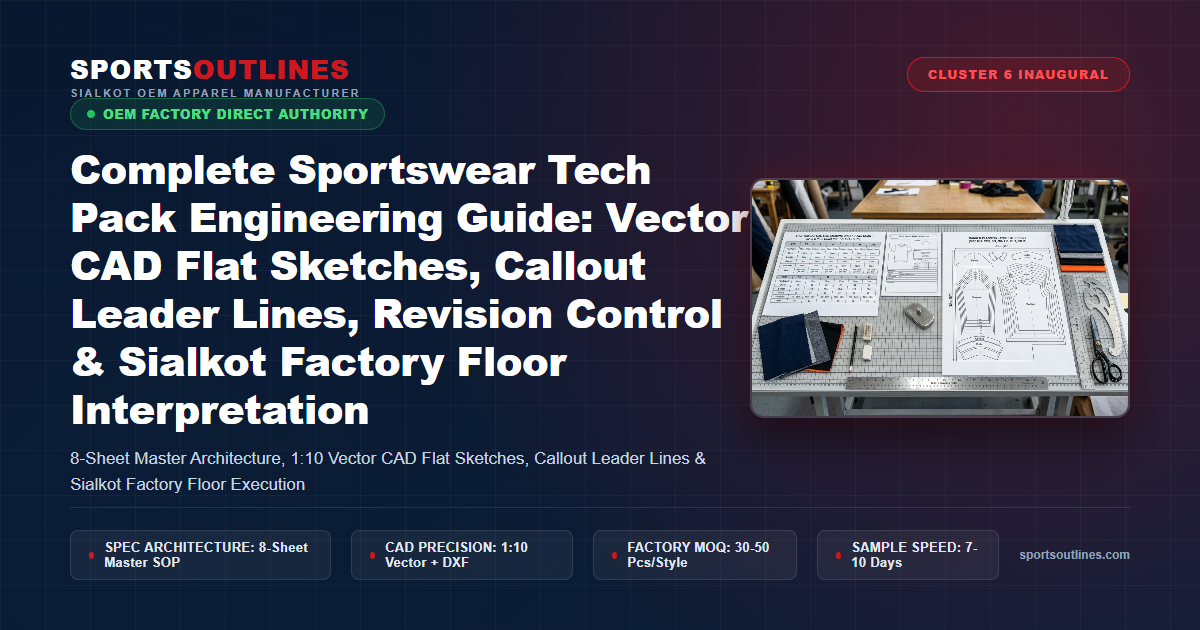
Super-Cluster 6 Inaugural • Sub-Cluster 6.1 • Industrial Apparel Product Development & Blueprint Engineering
Executive Technical Summary: Deterministic 8-Sheet Tech Pack Architecture, Orthographic Vector CAD Flats & Zero-Ambiguity Sialkot Production Routing
In industrial garment manufacturing, a Technical Specification Package (Tech Pack) is not a mood board or an artistic fashion illustration—it is the legally binding, mathematically deterministic engineering blueprint that governs every millimeter of pattern drafting, fabric consumption, thread tension, artwork coordinates, and final ISO 2859-1 AQL 2.5 quality control inspection. When a sportswear brand sends an ambiguous 3D render or an un-dimensioned smartphone photo to an overseas factory, the pattern master is forced to guess up to 42 critical construction variables—resulting in twisted seams, incorrect GSM drape, mispositioned chest logos, and costly multi-round sampling delays. This B2B engineering guide deconstructs the complete 8-Sheet Sportswear Tech Pack Architecture used on our Sialkot factory floor, covering orthographic Adobe Illustrator vector CAD flats, callout leader-line syntax, revision control matrices, and department-by-department production routing.
Direct Manufacturer Answer: What Must a Factory-Ready Sportswear Tech Pack Include?
A production-ready B2B sportswear tech pack requires eight deterministic engineering sheets: (1) Master Cover & Revision Control Sheet, (2) Orthographic 2D Vector CAD Flat Sketches (Front, Back, Side & Interior Views), (3) Construction Callouts & ISO 4915 Seam Cross-Sections, (4) Multi-Tier Bill of Materials (BOM) with Pantone® TCX/TPG codes, (5) Graded Points of Measure (POM) Specification & Tolerance Table, (6) Artwork, Print & Embroidery Placement Coordinates, (7) Private-Label Neck Tag, Care Label & Hangtag Spec, and (8) Folding, Polybag & Master Carton Packing Instructions.
- Low MOQ Execution: True factory-direct 30–50 pieces per style/colorway across mixed sizes (`XS` to `3XL`).
- Physical Prototyping: Custom pre-production samples engineered in 7–10 business days at a strict $45–$85 per piece/set non-refundable development fee.
- Direct Engineering Desk: Submit your PDF/AI tech packs via Factory RFQ Portal or WhatsApp +92 316 7932595.
For athletic apparel founders, technical designers, and B2B procurement directors scaling private-label collections across the United States, United Kingdom, Canada, Germany, and Australia, the difference between a profitable 14-day bulk production run and a disastrous three-month sampling bottleneck lies almost entirely in the mathematical clarity of the tech pack. In high-performance activewear—where 4-way stretch warp-knit compression leggings, laser-perforated running singlets, and 3-layer seam-taped alpine shells operate under negative-ease tension and dynamic biomechanical strain—verbal descriptions like “make it athletic fit with stretchy seams” have zero engineering meaning on a factory cutting floor.
When a tech pack arrives at Sports Outlines in Sialkot, Pakistan, it does not sit on a single account manager’s laptop. Instead, it is disassembled into specialized department travelers that simultaneously drive six distinct industrial workstations: the Gerber/Lectra CAD Pattern Master, the Fabric & Trim Sourcing Store, the Monti Antonio Sublimation / Tajima Embroidery Floor, the Industrial Sewing Line Engineer, the In-Line & Final AQL 2.5 Quality Inspector, and the FOB Costing & Export Packing Desk. This comprehensive guide provides the exact technical framework to engineer a zero-ambiguity sportswear tech pack that translates your creative vision into repeatable, defect-free factory output.
1. The Economic & Engineering Physics of Tech Pack Precision: Eliminating the Interpretation Variance
Every garment style consists of roughly $N_{\text{vars}} = 38\text{ to }65$ discrete specification variables—ranging from yarn filament denier, fabric areal weight ($\text{GSM}$), and bi-axial elongation modulus to stitch class (`ISO 4915`), needle point geometry, stitch density ($\text{SPI}$), seam allowance width, elastic feed ratio, and xy-cartesian logo coordinates. We can model the probability of achieving a first-time-right physical prototype ($P_{\text{Proto-1}}$) as a function of specified vs. unspecified variables:
P_Proto1 = Product_{i=1 to N_vars} [ 1 – (1 – S_i) * E_guess,i ] where Cost_Delay = N_revisions * ($65 Sample_Avg + 9_Days_Lead_Time + $45_Courier)
Where $S_i \in \{0, 1\}$ indicates whether variable $i$ is explicitly defined in the tech pack, and $E_{\text{guess},i}$ is the probability that an unguided pattern maker’s default assumption diverges from the brand founder’s mental expectation. Even if an experienced Sialkot pattern master guesses correctly $90\%$ of the time on missing specifications ($E_{\text{guess},i} = 0.10$), leaving just 15 construction details unspecified drops the probability of a perfect first prototype to $(0.90)^{15} = 20.6\%$.
- The Mood-Board Trap (`0–25%` Specification Completeness): Brands submitting only front/back color mockups or competitor reference photos routinely require 3 to 4 physical sampling rounds, consuming `28–36 business days` and `$250–$400+` in cumulative sampling and express courier fees before bulk fabric can even be ordered.
- The Factory-Ready 8-Sheet Tech Pack (`95–100%` Specification Completeness): Brands submitting a complete orthographic vector tech pack with explicit BOM, POM, and ISO 4915 stitch callouts achieve 92%+ approval on the very first physical prototype (or require only minor $\pm 1.0\text{ cm}$ grade-rule tweaks prior to bulk cutting), compressing total development time to a single 7–10 business day prototype cycle at our standard $45–$85 per piece non-refundable sample fee.
| Tech Pack Sheet # & Title | Core Engineering Data Contained | Target Sialkot Factory Department | Failure Mode If Omitted or Ambiguous | Mandatory File / Data Standard |
|---|---|---|---|---|
| Sheet 1: Master Header & Revision Log | Style ID, Season, Gender Block, Base Size, Sample Stage (`Proto 1` / `PPS`), Dated Change Log | Merchandising, Production Planning & QC | Sewing floor builds bulk run from outdated Proto-1 PDF instead of revised PPS spec | ISO 9001 Version Control (`Rev 1.0`, `Rev 2.0`) |
| Sheet 2: Orthographic Vector CAD Flats | 1:10 Proportional Front, Back, Lateral Side & Inside-Out Turn Views with Stitch Lines | Gerber / Lectra CAD Pattern Drafting Room | Misplaced raglan yoke curves, missing underarm gussets, wrong pocket bag anchoring | Adobe Illustrator (`.AI` / Vector `.PDF`) |
| Sheet 3: Construction & Seam Callouts | Leader-line callouts specifying ISO 4915 stitch codes, SPI, seam allowance & hem folds | Industrial IE Line Balancing & Sewing Floor | 4-thread overlock used where 6-thread ISO 607 flatlock was required; seam popping | ISO 4915 (`301, 401, 514, 605, 607`) |
| Sheet 4: Multi-Tier Bill of Materials (BOM) | Shell/Liner GSM, fiber blend, knit gauge, zipper gauge, thread Tex, Pantone® TCX swatches | Raw Material Purchasing, Dye House & Costing | Wrong fabric hand-feel, sheer leggings, mismatched thread/zipper tape colorways | Pantone® FHI `TCX`/`TPG` + ASTM Spec |
| Sheet 5: Graded POM & Tolerance Matrix | Alphanumeric POM codes (`A` to `Z`), measurement diagrams, `XS–3XL` grade rules & `±cm` tolerances | CAD Grading Desk & Final AQL 2.5 QC Table | Inconsistent sizing across batch, tight armholes in `2XL`, disputed QC inspection criteria | Centimeters (`cm`) or Inches (`in`) + `±Tol` |
| Sheet 6: Artwork & Decoration Placement | Exact `(X, Y)` distance from HPS/Center-Front, graphic width/height across size breaks, ink/stitch method | Screen Print, Sublimation, Heat Press & Embroidery | Chest logo printed into armpit seam; back graphic looks tiny on `3XL` hoodies | 300 DPI CMYK / Outlined `.AI` / `.EPS` |
| Sheet 7: Branding Trims & Regulatory Labels | Heat-seal neck transfer or woven damask label, wash-care symbols (`ISO 3758`), RN/COO, hangtag cord position | Trim Weaving Loom, Heat-Press & Finishing Line | US CBP / EU customs hold for missing fiber content or Country of Origin (`Made in Pakistan`) | US FTC / EU 1007/2011 / ISO 3758 |
| Sheet 8: Folding, Polybag & Carton Spec | Fold dimensions, tissue/clip rules, frosted zip polybag warning text, FNSKU/EAN barcode & carton marks | Final Packing, Barcode Verification & Dispatch | 3PL/Amazon FBA receiving rejection due to missing suffocation warnings or unscannable barcodes | GS1-128 / Amazon FBA / 5-Ply ECT-44 |
2. Engineering Orthographic 2D Vector CAD Flat Sketches (Front, Back, Lateral & Interior Views)
The visual anchor of any sportswear tech pack is the Orthographic 2D Vector CAD Flat Sketch (commonly called a “Technical Flat”). Unlike 3D stylized fashion croquis that exaggerate torso taper or drape folds, a technical flat depicts the garment laid completely flat on an inspection table in strict 1:8 or 1:10 geometric scale with zero perspective distortion.
2.1 Standardized Adobe Illustrator Line-Weight Hierarchy
When our Gerber AccuMark pattern masters inspect a technical flat, they rely on standardized vector stroke weights (`pt`) and dash arrays to distinguish between structural fabric edges, overlapping panels, topstitching, and internal pocket bags:
- Garment Outer Perimeter Silhouette (`1.50 pt – 2.00 pt` Solid Black Stroke, Round Cap/Round Join): Defines the outer cut boundary of the torso, sleeves, hood, or pant legs. Using rounded stroke caps and joins in Adobe Illustrator prevents sharp miter spikes at acute collar corners or side-slit vents.
- Structural Panel Join Seams & Yokes (`0.75 pt – 1.00 pt` Solid Black Stroke): Indicates where separate cut pattern pieces—such as raglan sleeve crowns, underarm breathable mesh gussets, or contoured gluteal yoke panels—are joined together.
- Visible Topstitching & Coverstitch Lines (`0.40 pt – 0.50 pt` Dashed Stroke: `2.5 pt Dash / 1.5 pt Gap`): Represents single-needle (`ISO 301`), twin-needle coverstitch (`ISO 605` with two parallel dashed lines spaced `1.5 mm` apart at 1:10 scale), or 4-needle 6-thread flatlock (`ISO 607` with twin parallel dashed lines bridged by a cross-hatch pattern brush).
- Internal Hidden Construction / X-Ray Ghost Lines (`0.35 pt` Dotted Grey Stroke `#64748b`, `1.0 pt Dash / 2.0 pt Gap`): Depicts internal components invisible from the exterior—such as pocket bag perimeters, internal protective groin cup pouches, waistband drawcord tunnels, or storm-flap facing widths.
- Bartack & Stress-Point Reinforcements (`1.25 pt` Zig-Zag Symbol in Brand Red `#cc181e`): Highlights high-load anchor zones (pocket corners, side-slit apexes, drawcord eyelet exits) requiring a 28-to-42-stitch CNC lockstitch bartack so the industrial engineer assigns a dedicated `Juki LK-1900BN` operation on the sewing line.
2.2 Why Four Orthographic Views Are Mandatory for Technical Sportswear
A simple front-and-back flat sketch suffices for a basic promotional cotton t-shirt, but fails completely for articulated performance apparel. High-complexity athletic silhouettes require four synchronized orthographic views:
- Anterior (Front) Orthographic View: Shows collar drop, center-front zipper placket, kangaroo or zippered welt pockets, front panel blocking, and chest/thigh branding.
- Posterior (Back) Orthographic View: Shows back neck yoke, scapular articulation darts, drop-tail hem curvature, rear zippered media pocket, and center-back reflective spine tape.
- Lateral Profile (Side) View: Indispensable for garments featuring 3-panel side gussets (such as continuous wrist-to-waist axillary rashguard gussets, 3-panel ergonomic joggers with side-seam utility pockets, or 3D articulated helmet-compatible ski hoods). Without a lateral view, the pattern maker cannot see whether the side panel tapers toward the cuff or terminates at the hem.
- Interior (Inside-Out) Turn View: Mandatory for dual-layer garments—including 2-in-1 running shorts with built-in compression liners, sports bras with removable cup pocket openings and underband elastic encasements, BJJ Gis with sublimated mesh inner shoulder yokes, and waterproof jackets with internal media pockets and powder skirts.
| Vector CAD Element | Illustrator Stroke Weight & Style | Hex Color Code | Physical Garment Feature Represented | Pattern Master & Sewing Interpretation |
|---|---|---|---|---|
| Outer Garment Outline | `1.75 pt` Solid, Round Cap & Join | #0F172A (Deep Slate) | External perimeter profile of the flat-laid garment | Defines outer silhouette proportions and hem drop angles |
| Cut-and-Sew Panel Seam | `0.85 pt` Solid Line | #1E293B (Charcoal) | Join line between two separate cut fabric panels | Instructs CAD drafter to split master block and add `7–10 mm` seam allowance |
| Single-Needle Lockstitch (`ISO 301`) | `0.45 pt` Dashed (`2.5 pt / 1.5 pt`) | #334155 (Medium Grey) | Edgestitch or topstitch around zippers, pockets & plackets | Routes operation to Juki DDL-9000C single-needle lockstitch (`10–12 SPI`) |
| Twin/Tri-Needle Coverstitch (`ISO 406/605`) | Dual/Triple `0.40 pt` Parallel Dashed | #334155 (Medium Grey) | Stretch hem fold on sleeves, bottom hems & necklines | Routes to Pegasus W500/W600 cylinder-bed coverstitch (`5.6 mm` or `6.4 mm` gauge) |
| 4-Needle 6-Thread Flatlock (`ISO 607`) | `6.0 mm` Scaled Cross-Hatch Pattern Brush | #475569 (Steel Blue) | Zero-bulk external spreader stitch on rashguards & leggings | Routes to Yamato FD-62G feed-off-the-arm flatseamer (`0.0 mm` butt-seam allowance) |
| Internal X-Ray / Ghost Component | `0.35 pt` Dotted (`1.0 pt / 2.0 pt`) | #2563EB (Blueprint Blue) | Hidden pocket bags, internal drawcord channels, cup pouches | Prevents pattern maker from omitting internal pocketing or facing layers |
| Callout Leader Line & Node | `0.60 pt` Solid `45°/90°` Elbow + `3 pt` Dot | #CC181E (Signal Red) | Connects specific seam/trim location to numbered engineering note | Eliminates visual clutter; links directly to BOM Item # and ISO Stitch Code |
3. Callout Leader-Line Syntax: Writing Deterministic Factory Instructions
A common mistake in amateur tech packs is surrounding a flat sketch with vague conversational notes such as “Use nice heavy ribbing here” or “Make sure pocket zipper is waterproof.” On an industrial production floor, every callout leader line (`#CC181E` `0.60 pt` orthogonal elbow line terminating in a solid `3 pt` target anchor dot on the exact seam) must obey the 5-Parameter Callout Formula:
[Callout #] = [BOM Ref ID] + [Finished Dimension (mm)] + [ISO 4915 Stitch Code & Gauge] + [SPI / Thread Spec] + [Special Folding / Tension Rule]
Compare how a vague startup note versus a deterministic Sports Outlines engineering callout instructs the sewing floor across five critical sportswear assemblies:
- Hoodie Cuff Ribbing Attachment:
• Ambiguous Note: “Ribbed cuff at sleeve end, double stitched.”
• Deterministic Engineering Callout: `[C-04]` Attach `BOM-T02` (`480 GSM 2×2 Cotton/Spandex Tubular Rib`) folded double to `7.0 cm` finished height (`14.0 cm` cut + `1.6 cm` seam allowance). Join to sleeve with `ISO 514` 4-thread overlock (`7 mm` bite, `12 SPI`), then fold seam allowance toward sleeve body and topstitch `3.0 mm` (`1/8″`) above join using `ISO 406` 2-needle bottom coverstitch (`4.8 mm` gauge, `11 SPI`, `Tex 40` core-spun PET needle thread + `Tex 27` woolly nylon looper). Ratio: Cuff opening `1:0.78` differential ease against sleeve opening. - Compression Legging High-Waistband Assembly:
• Ambiguous Note: “High tummy control waistband with hidden key pocket.”
• Deterministic Engineering Callout: `[C-07]` Construct `10.5 cm` finished height contoured 2-ply self-fabric (`BOM-F01` `260 GSM 75/25 Nylon-Spandex Interlock`) waistband lined internally with 1-ply `BOM-F03` (`160 GSM Power-Mesh`) at top edge folded over `10 mm` clear mobilon elastic tape (`0%` gather, anti-roll stabilizer). Attach waistband to lower pant body via `ISO 607` 4-needle 6-thread flatlock (`6.0 mm` gauge, `14 SPI`, `Groz-Beckert RG Nm 70/10` ballpoint needles). Insert `9.0 cm × 11.0 cm` envelope key pocket (`BOM-F03`) into center-back inner waistband panel prior to closing. - Waterproof Zippered Chest Pocket (`Laser-Cut & Bonded`):
• Ambiguous Note: “Waterproof chest zip pocket with garage.”
• Deterministic Engineering Callout: `[C-11]` CNC laser-cut `16.5 cm × 1.2 cm` vertical pocket window on left chest (`5.5 cm` from CF zip, top edge `19.0 cm` below HPS). Bond `BOM-Z02` (`#3 YKK® AquaGuard® Matte PU Reverse-Coil Zipper`, `16.0 cm` cut length) to back of window using `15 mm` `Bemis® 3415` polyurethane hot-melt adhesive film at `155°C / 4.2 bar / 18 sec`. Form folded `2.2 cm × 1.4 cm` laser-cut hypalon slider garage at top terminus. Anchor internal `18.0 cm × 22.0 cm` warp-knit brushed tricot pocket bag (`BOM-F04`) with internal perimeter热-bond tape (`zero exterior needle holes`). - Sublimated Soccer / Rugby Jersey Collar & Back-Neck Tape:
• Ambiguous Note: “Reinforced V-neck collar with brand tape inside.”
• Deterministic Engineering Callout: `[C-02]` Construct mitered crossover V-neck collar (`2.2 cm` finished visible rib width) using `BOM-T01` (`100% Polyester 1×1 Flatbed Rib`). Bar-tack center-front V-apex internally (`28 stitches`). Bind raw back-neck shoulder-to-shoulder seam with `10 mm` finished width custom sublimated satin-twill neck tape (`BOM-L03`) using `ISO 406` twin-needle chainstitch (`6.4 mm` gauge, `12 SPI`) extending neatly into both shoulder seams.
4. Sialkot Factory Floor Interpretation: How Your Tech Pack Travels Across 6 Departments
Understanding how an export factory physically disassembles and executes your tech pack allows you to structure each sheet for maximum speed and zero cross-departmental friction. At Sports Outlines, the moment your tech pack passes pre-flight review, our Enterprise Resource Planning (ERP) and Product Lifecycle Management (PLM) desk splits it into Six Departmental Job Cards:
| Factory Workstation / Cell | Tech Pack Sheets Consumed | Software & Machinery Driven | Critical Engineering Parameters Extracted | Mandatory Sign-Off Gate |
|---|---|---|---|---|
| 1. CAD Pattern & Marker Room | Sheets 2, 3 & 5 (Flats, Seams, POM) | Gerber AccuMark® 2D/3D, Lectra Modaris®, Graphtec Plotter | Base size dimensions, seam allowances (`0 mm` flatlock vs `7 mm` overlock), shrinkage/stretch compensation, grainline arrows | Digital DXF/AAMA Pattern Audit |
| 2. Textile Mill & Trim Store | Sheets 4 & 7 (BOM & Labels) | X-Rite Ci7800 Spectrophotometer, GSM Circular Cutter, 4-Point Inspection Frame | Fiber % blend, GSM (`±5%`), Pantone® TCX lab-dip (`ΔE ≤ 1.0`), zipper length by size, woven/heat-transfer neck label count | Approved Trim Card (`Trim Board`) |
| 3. CNC Cutting & Bundling Floor | Sheets 2, 4 & 5 (Marker + Fabric Spec) | Eastman Automated Spreader, Bullmer CNC Knife Cutter, Galvo CO2 Laser | 24-hr fabric relaxation requirement, nap/one-way directional lay rules, notch types (`V-notch` vs `slit`), bundle ticket numbering | Top/Middle/Bottom Ply Cut Check |
| 4. Print, Sublimation & Embroidery | Sheet 6 (Artwork Placement & Spec) | Epson SureColor F10070, Monti Antonio Calender, M&R Automatic Press, Tajima TMEZ | Exact `(X, Y)` laser placement jig coordinates from HPS/CF, screen mesh counts, silicone/puff height, Tajima `.DST` stitch density | Cut-Panel Strike-Off Sign-Off |
| 5. Industrial Sewing Cell (IE) | Sheets 2, 3 & 7 (Seams & Trims) | Juki DDL-9000C, Pegasus W600, Yamato FD-62G, Kansai Multi-Needle, Bemis Bonder | Operation breakdown (`SAM`), needle point (`RG` vs `SES`), differential feed setting, folder attachment width, bartack map | First-Off-Line (`FOL`) Piece Approval |
| 6. Final AQL 2.5 QC & Export Packing | Sheets 5, 7 & 8 (POM, Labels, Packing) | Calibrated Steel Tape Table, Hashima HN-880C Needle Detector, Zebra Barcode Verifier | POM measurement method & `±cm` tolerance gates, hangtag security loop location, fold board size (`28×35 cm`), carton assortment | ISO 2859-1 AQL 2.5 Certificate |
5. Artwork, Print & Embroidery Placement Coordinate Engineering (`Sheet 6`)
One of the most frequent causes of B2B garment disputes occurs when a brand places a logo “visually” on an Illustrator flat sketch without specifying mathematical coordinates or size-break scaling rules. What looks centered on a 2D flat sketch of a Size Medium hoodie can end up sitting awkwardly high near the collarbone or drifting into the lateral curve of the chest on a physical Size `2XL` garment.
5.1 The Two-Axis Cartesian Datum System (`HPS` & `CF / CB`)
Every graphic, screen print, 3D silicone heat transfer, or direct embroidery placement on `Sheet 6` must be anchored to two immutable anatomical datum lines on the garment:
- Vertical Y-Axis Datum (`HPS` — High Point Shoulder, or `CB Neck Seam`): Never measure chest logo drop from the “front neck seam,” because front neck drops vary dramatically between crewnecks, V-necks, and quarter-zips, and ribbed collars stretch during pressing. Always specify the vertical drop ($Y_{\text{drop}}$) from the High Point Shoulder (`HPS` — where the inner collar seam meets the shoulder seam) straight down parallel to Center Front (`CF`) to the top edge of the artwork (e.g., “Top edge of Left Chest Logo = `18.5 cm` (`7.25″`) vertically down from Left HPS”). For back graphics, measure vertically down from the Center Back (`CB`) collar seam to the top edge of the back artwork (e.g., “`7.5 cm` (`3.0″`) below CB neck seam”).
- Horizontal X-Axis Datum (`CF` — Center Front Line, or Outseam): For left/right chest logos, specify the horizontal distance ($X_{\text{offset}}$) from the Center Front (`CF`) vertical fold line (or center of zipper teeth) to the innermost edge (or center axis) of the logo (e.g., “Center of Left Chest Crest = `9.5 cm` (`3.75″`) from Center Front in Base Size L”). For pant or short thigh logos, specify the vertical distance up from the bottom leg hem and horizontal distance forward from the lateral outseam.
5.2 Multi-Tier Artwork Scaling Across Size Breaks (`XS–S`, `M–L`, `XL–3XL`)
A `28.0 cm` (`11.0″`) wide chest screen print that fills the torso of a Size Small gym tee (`47.0 cm` half-chest width = `59.6%` visual coverage) will look disproportionately small on a Size `3XL` tee (`63.0 cm` half-chest width = `44.4%` coverage) if printed with the same screen. Conversely, making seven separate sets of 6-color silkscreens or embroidery `.DST` files for every size from `XS` to `3XL` wastes setup budget. Our Sialkot print engineering standard utilizes 2-Tier or 3-Tier Proportional Size-Break Grouping:
- Group A (`Youth L/XL` & Adult `2XS – S`): Graphic Width = `88%` of Base Scale (e.g., `25.0 cm` front chest print; `Y_drop from HPS = 17.0 cm`).
- Group B (Core Adult `M – L – XL` Base Scale): Graphic Width = `100%` of Base Scale (e.g., `28.5 cm` front chest print; `Y_drop from HPS = 18.5 cm`).
- Group C (Plus/Heavyweight `2XL – 4XL`): Graphic Width = `112%` of Base Scale (e.g., `32.0 cm` front chest print; `Y_drop from HPS = 20.0 cm`).
| Anatomical Placement Zone | Primary Y-Axis Datum Reference | Primary X-Axis Datum Reference | Standard Base Size `L` Coordinates | Standard Graphic Dimensions (`L`) |
|---|---|---|---|---|
| Left / Right Chest Crest | High Point Shoulder (`HPS`) to Logo Top Edge | Center Front (`CF`) to Logo Center Axis | `Y = 18.0–19.5 cm` down; `X = 9.0–10.5 cm` from CF | `6.5 cm – 9.0 cm` Width |
| Full Center Front Chest Graphic | `HPS` (or `CF` Neck Seam Drop) to Logo Top | Centered on `CF` (`X = 0.0 cm` offset) | `Y = 17.5–19.0 cm` below HPS (`7.0–8.5 cm` below collar) | `26.0 cm – 30.5 cm` Width |
| Back Neck Yoke Locker Logo | Center Back (`CB`) Collar Join Seam to Logo Top | Centered on `CB` Spine Axis | `Y = 3.0–4.5 cm` below CB collar seam | `3.5 cm – 6.0 cm` Width |
| Full Back Shoulder/Torso Print | `CB` Collar Seam to Graphic Top Edge | Centered on `CB` Spine Axis | `Y = 9.0–12.5 cm` below CB collar seam (or `5 cm` below hood tip) | `28.0 cm – 34.0 cm` Width |
| Deltoid / Upper Sleeve Badge | Top Shoulder Crown Seam (or Bottom Cuff Edge) | Centered on Top Sleeve Fold Line | `Y = 9.5–11.5 cm` below shoulder seam (or `2.5 cm` above short cuff) | `5.0 cm – 7.5 cm` Width |
| Shorts / Joggers Left Thigh Logo | Bottom Leg Hem Edge up to Logo Bottom Edge | Lateral Outseam forward toward Front Crease | `Y = 4.5 cm` above bottom hem; `X = 5.0 cm` forward of outseam | `4.5 cm – 7.0 cm` Width |
6. Revision Control, Sample Stage Lifecycle & Redlining Protocol (`Sheet 1`)
As a garment progresses from initial concept (`Proto 1`) to Fit Sample (`Proto 2`), Pre-Production Sample (`PPS`), and Bulk Production (`Gold Seal`), specifications inevitably evolve. Perhaps after testing `Proto 1` in the gym, you decide to lower the front neckline by `1.0 cm`, switch the pocket zipper from `#3` to `#5`, and increase the hoodie cuff width by `0.5 cm`. If those changes are communicated via scattered WhatsApp voice notes or email threads without updating the master PDF tech pack, sewing operators on the bulk line will inevitably revert to the original `Proto 1` drawing.
Every professional sportswear tech pack enforces a strict ISO 9001 Revision Control Protocol on `Sheet 1`:
- Unique Alphanumeric Style Code (`SKU Root`): Assign an immutable identifier structured as `[Brand]-[Year/Season]-[Category]-[Sequential#]`—for example, `SO-26FW-HD-104` (Sports Outlines, 2026 Fall/Winter, Hoodie, Style #104).
- Sequential Revision Versioning & File Naming: Never overwrite a file with names like `Hoodie_Final_FINAL_v2.pdf`. Use strict date-stamped semantic versioning: `SO-26FW-HD-104_TechPack_Rev1.0_2026-10-13_Proto1.pdf` $\rightarrow$ `Rev2.0_2026-10-24_PPS.pdf` $\rightarrow$ `Rev3.0_2026-10-30_BULK-APPROVED.pdf`.
- Visual Delta Highlighting (`Yellow Highlight + Red Cloud Callouts`): Whenever a dimension, BOM component, or stitch callout changes between `Rev 1.0` and `Rev 2.0`, highlight the modified cell in bright yellow (`#FEF08A`) with bold crimson text (`#CC181E`) on the relevant sheet AND log the exact “Was $\rightarrow$ Now” entry in the `Sheet 1` Master Revision Table so the pattern master immediately spots every change in under 10 seconds.
| Revision Version & Stage | Date (ISO 8601) | Target Sheet & Code | Previous Specification (“WAS”) | Updated Specification (“NOW”) | Engineering Rationale & Author |
|---|---|---|---|---|---|
| `Rev 1.0` — Proto 1 Release | 2026-10-01 | All Sheets (`1–8`) | Initial baseline release | Initial baseline spec issued for 1st physical prototype (`$45–$85` sample fee) | Initial Base Size `L` pattern draft |
| `Rev 1.1` — Trim Update | 2026-10-04 | Sheet 4 (`BOM-Z01`) | `#3` Nylon Reverse-Coil Zipper | `#5` YKK® AquaGuard® Matte Black Water-Resistant Zipper | Upgraded slider pull durability for heavy gym bag wear |
| `Rev 2.0` — Post-Proto 1 Fit | 2026-10-11 | Sheet 5 (`POM-D` & `POM-K`) | Front Neck Drop `8.5 cm`; Sleeve Bicep `21.0 cm` | Front Neck Drop `9.5 cm` (`+1.0 cm`); Sleeve Bicep `22.2 cm` (`+1.2 cm`) | Increased throat clearance & pump-cover bicep mobility |
| `Rev 2.1` — Artwork Adjust | 2026-10-12 | Sheet 6 (`ART-01`) | Left Chest 3D Silicone Badge `Y = 20.5 cm` from HPS | Left Chest 3D Silicone Badge `Y = 18.5 cm` from HPS (`Raised 2.0 cm`) | Elevated badge onto upper pectoral shelf after live fit test |
| `Rev 3.0` — Gold Seal Bulk | 2026-10-13 | All Sheets (`1–8`) | PPS Review Status | LOCKED FOR BULK PRODUCTION (50-Pc Split-Size Run Approved) | Signed off by Brand Director & Sialkot Pattern Master |
7. The 12-Point Sialkot Pre-Flight Tech Pack Audit Checklist
Before releasing any tech pack to our sample room or bulk cutting floor, run your document through our 12-Point Pre-Flight Engineering Audit to guarantee zero production stalls:
| Audit Gate # | Verification Parameter | Pass Criteria / Quantitative Standard | Common Amateur Error Corrected |
|---|---|---|---|
| Gate 01: Proportional Flat Scale | 2D Vector Flat Sketch Aspect Ratio vs. POM Table | CAD Chest-to-Length ratio matches POM table within `±3%` | Drawing a cropped boxy hoodie flat while listing a longline `78 cm` body length in POM |
| Gate 02: Half vs. Full Circumference | Explicitly labeled `1/2 Flat Measure` vs. `Full Girth` | 100% of horizontal POMs labeled `1/2 Measure (Laid Flat)` | Mixing full body chest circumference (`108 cm`) with flat hem width (`52 cm`) in one table |
| Gate 03: Geometric Summation Lock | Sub-component POMs sum to total garment POM | `Across Shoulder = (2 × Shoulder Slope) + Neck Width` | Specifying mathematically impossible shoulder, neck-width, and sleeve-length combinations |
| Gate 04: Fabric GSM & Stretch Spec | Areal weight (`GSM`), fiber %, knit structure & 4-way stretch | Exact spec (e.g., `260 GSM ±5%, 75% PA66 / 25% Elastane Interlock`) | Writing “stretchy spandex fabric” without GSM, gauge, or nylon vs. polyester choice |
| Gate 05: Pantone® Color Standards | Pantone® FHI `TCX`/`TPG` for fabrics & `PMS C` for inks | 6-digit Pantone® TCX code + Hex/CMYK backup for every colorway | Relying on uncalibrated RGB monitor screenshots for custom dye-lot matching |
| Gate 06: ISO 4915 Seam Callouts | Stitch class, needle gauge, SPI & seam allowance per zone | Explicit `ISO 607 / 605 / 514 / 301` callouts on all load seams | Assuming the factory knows which seams should be flatlocked vs. overlocked |
| Gate 07: Outlined Vector Artwork | Typography converted to outlines (`Create Outlines`) | 100% vector `.AI`/`.EPS` paths with zero missing font links | Sending live custom fonts that default to Arial when opened on the print RIP station |
| Gate 08: Cartesian Logo Coordinates | `X` and `Y` distances from `HPS`, `CF`, `CB` or `Outseam` | Exact `cm` coordinates + 2-tier or 3-tier size-break scaling | Eyeballing logo placement on a flat sketch without numeric distance anchors |
8. Frequently Asked Questions (FAQ): Sportswear Tech Pack Engineering
Q1: What file formats do your Sialkot CAD pattern masters and print engineers accept for custom sportswear tech packs?
We accept multi-page vector PDFs (`.PDF`) exported from Adobe Illustrator, native Adobe Illustrator files (`.AI` / `.EPS`) with all fonts converted to outlines (`Type -> Create Outlines`), Excel/CSV graded measurement and BOM workbooks (`.XLSX`), and industrial 2D/3D CAD pattern files (`.DXF-AAMA`, `.ASTM`, Gerber `.TMP/.ZIP`, Lectra `.MDL`, or CLO3D/Browzwear `.ZPRJ` packages).
Q2: What if I have a complete tech pack for the design and fabrics, but I need your pattern master to build the graded XS–3XL size chart?
If you provide the vector flat sketches, BOM specifications, and either your target Base Size (`M` or `L`) measurements or a physical benchmark reference garment shipped to our Sialkot facility, our Gerber AccuMark pattern masters can draft the master block and apply our anthropometric Western athletic grading rules (`XS` to `3XL`) during your paid pre-production prototyping stage.
Q3: How much does physical prototype sampling cost once my tech pack is submitted, and what is the turnaround time?
Physical pre-production prototype sampling is strictly $45–$85 per piece/pair/set as a non-refundable development fee covering dedicated Gerber CAD pattern drafting, single-ply fabric/trim cutting, custom sublimation/embroidery setup, and sample-room assembly. Turnaround time is 7–10 business days from tech pack lock, plus 3–5 days via DHL/FedEx Express air courier.
Q4: What is your minimum order quantity (MOQ) once my tech pack and physical prototype sample are approved?
Our factory-direct bulk production MOQ is strictly 30–50 pieces per style/colorway, with full size-curve splitting across `XS, S, M, L, XL, 2XL, and 3XL` (for example, `5 XS / 8 S / 12 M / 12 L / 8 XL / 5 2XL = 50 pieces total`).
Q5: Why should vertical logo drop always be measured from High Point Shoulder (HPS) instead of the front collar seam?
Front collar drop varies significantly by neckline style (crewneck vs. deep V-neck vs. quarter-zip) and rib-knit collar width, and the curved front neckline distorts when stretched over a printing pallet. The High Point Shoulder (`HPS`—the intersection where the inner collar seam meets the top shoulder seam) is a fixed structural anchor across all garment sizes and silhouettes, guaranteeing `±1.5 mm` laser-registered logo repeatability.
Ready to Turn Your Sportswear Tech Pack into Precision Sialkot Production?
Upload your 8-sheet vector tech pack directly to our Sialkot engineering desk for a line-by-line BOM/SAM FOB quote. We execute physical prototypes in 7–10 business days ($45–$85/pc non-refundable development fee) and scale your bulk production at true 30–50 piece low MOQs with ISO 2859-1 AQL 2.5 certification.
Pingback: Points of Measure (POM) & Garment Dimensional Tolerance Engineering: How to Spec Chest, Waist, Inseam & Raglan Sleeve Grading Tables (±0.5 cm to ±1.5 cm QC Gates) - Sports Outlines
Pingback: Specifying Industrial Seam & Stitch Callouts in Tech Packs: ISO 4915 Stitch Classes (301 Lockstitch, 401 Chainstitch, 504/514 Overlock, 605 Coverstitch, 607 Flatlock), SPI & Seam Allowances - Sports Outlines
Pingback: Pre-Production Samples (PPS), Size-Set Runs & Golden Sample Sealing: Locking Bulk Manufacturing Tolerances Before Cutting 30-50+ Piece Production Orders - Sports Outlines