
Super-Cluster 6 • Sub-Cluster 6.1: Tech Pack, CAD, BOM & Prototyping Economics (Blog #437)
Executive Technical Answer: Why Does a Custom Sportswear Prototype Cost `$45–$85` When the Bulk FOB Price Is `$10–$16`?
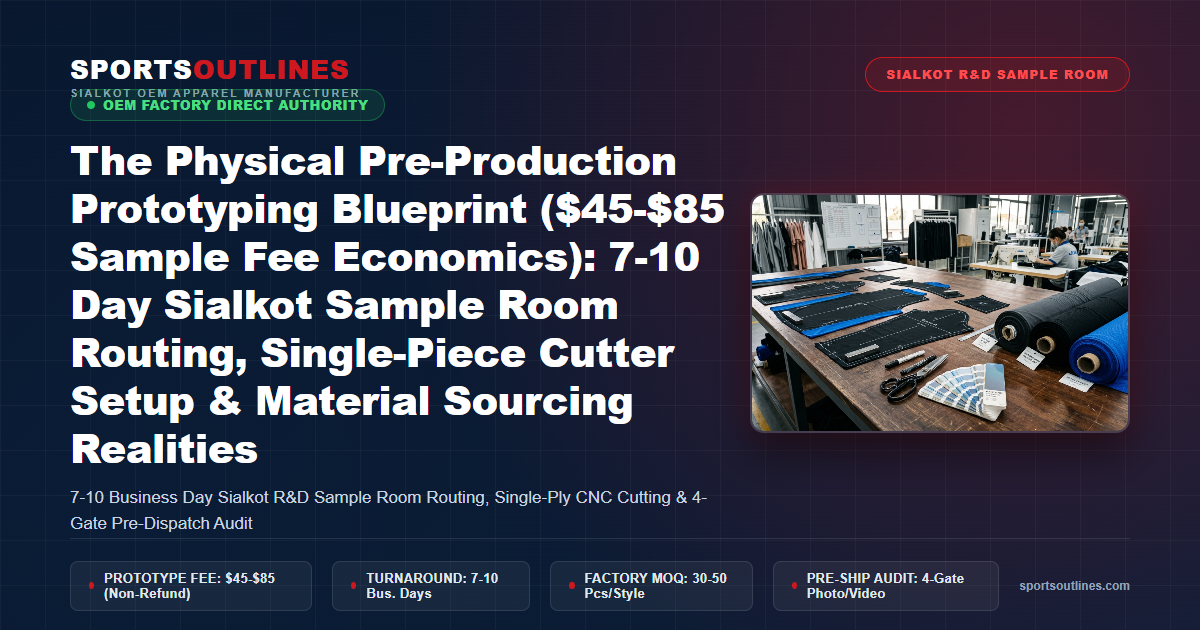
First-time apparel founders often ask why a single physical pre-production prototype costs $45 to $85 per piece/pair/set (strictly as a non-refundable development fee with a 7–10 business days turnaround) when the bulk 50-piece FOB unit price for that exact same garment is `$10.50 to $16.50`. The answer lies in Single-Unit Setup Amortization vs. Cellular Assembly-Line Economies of Scale. In a 100-piece bulk run, one-time engineering setups—including Gerber AccuMark® 2D/3D Master Pattern Drafting (`2.5 hours`), Single-Ply Flatbed Plotter/Laser Cutting (`0.75 hours` at `62%` single-garment marker efficiency), Tajima `.DST` Embroidery Tape Digitizing or Silk-Screen Film/Stencil Emulsion Exposure (`1.5 hours`), Machine Threading & Folder Calibration across 4 to 6 industrial sewing machines (`ISO 514, ISO 605, ISO 607, ISO 301`), and Senior Master Tailor Single-Piece Construction (`3.5x` slower than a balanced 18-operator cellular line)—are divided across 100 units (`~$0.85/pc`). When building a single 1-of-1 prototype in our dedicated Sialkot R&D Sample Room, 100% of those `7.5 to 11.0 hours` of specialized engineering labor, retail-lot fabric yardage surcharges, and setup consumables are absorbed by one single garment ($N = 1$). Charging a transparent, non-refundable $45–$85 sample development fee covers actual R&D technician wages and materials without inflating your bulk unit pricing, enabling Sports Outlines to deliver true 30–50 piece bulk MOQs with zero hidden subsidies.
In B2B sportswear manufacturing, the physical prototype (`Proto #1`) is the moment your 2D vector tech pack transforms into a three-dimensional, wearable reality that you can stretch, squat-test, wash-test, and photograph for pre-launch marketing. Yet the economics and operational routing of a factory sample room remain a “black box” to most emerging brand founders and sourcing directors.
Why does a dedicated sample room operate completely separately from the main bulk sewing floor? How is a single custom garment routed through 8 departments in exactly 7 to 10 business days? And why do genuine vertical manufacturers charge a transparent, non-refundable $45–$85 development fee rather than burying inflated setup costs inside artificial 500-piece minimums? Whether you are developing custom activewear, streetwear, or combat sports equipment for distribution in the USA, UK, Canada, Germany, or Australia, this technical blueprint breaks down every dollar and every hour of the Sialkot prototyping lifecycle.
1. The Mathematics of Single-Piece Prototyping (`N = 1`) vs. Cellular Bulk Production (`N >= 50`)
To understand why a 1-of-1 prototype costs `$45–$85` to engineer in-house, let us examine the industrial engineering equation governing Total Unit Manufacturing Cost ($C_{\text{unit}}(N)$) as a function of order quantity ($N$):
C_unit(N) = [ C_CAD_Pattern + C_Screen_or_DST_Setup + C_Machine_Changeover ] / N + [ C_BOM(N) + (SAM_bulk * M_inefficiency(N) * r_labor) ]
Notice what happens to every term in this equation when $N = 1$ (a single prototype sample) compared to $N = 100$ (a standard bulk order):
- 1. Unamortized CAD Pattern & Tech Pack Engineering ($C_{\text{CAD}} = \$18.00\text{–}\$26.00$): Before a single thread is sewn, a Senior Gerber AccuMark® CAD Pattern Master spends `2.0 to 3.5 hours` drafting the `Base Size` 2D pattern block (`12 to 28 individual pattern pieces` for a technical hoodie, track jacket, or BJJ Gi), calculating directional shrinkage compensation (`Warp % × Weft %`), adding exact ASTM D6193 seam allowances, and plotting the 1:1 full-scale marker. In a 100-piece bulk order, that `$22.00` CAD cost equals just `$0.22 per garment`. In a 1-piece sample ($N = 1$), the single prototype absorbs the entire `$22.00`!
- 2. Decoration Tooling & Setup ($C_{\text{Deco\_Setup}} = \$12.00\text{–}\$28.00$): Whether your garment features a 4-color high-density plastisol/silicone screen print (requiring 4 film positives, 4 emulsion-coated mesh screens exposed under UV light, and 25 minutes of 8-head carousel registration for a single pull!), a `25,000-stitch` 3D puff/tatami embroidery crest (requiring `1.5 hours` of manual Wilcom/Tajima `.DST` stitch-angle and pull-compensation digitizing), or a custom `.ICC`-profiled rotary sublimation transfer, 100% of that pre-press setup is executed for one single strike.
- 3. Single-Piece Marker Waste & Small-Lot Material Procurement ($C_{\text{BOM}}(1) = 1.65 \times C_{\text{BOM}}(100)$): As proven in our Multi-Size CAD Marker Nesting guide, plotting a single `Size Large` garment across a `175 cm` wide fabric roll achieves only `62%–68%` marker utilization (compared to `86.5%` on a multi-size bulk marker), wasting `35%+` of the cut yardage. Furthermore, specialty zippers, custom-dyed cords, and imported foams must be pulled from our R&D sample library at small-lot unit rates.
- 4. Sample Master Tailor Labor vs. Progressive Bundle Line ($M_{\text{inefficiency}}(1) = 3.5\times$): On a bulk production line, 18 operators sit in a balanced cellular sequence where Operator #4 only sews `ISO 607` flatlock side seams all day at `100%` rhythm (`0.65 minutes/seam`). In the R&D Sample Room, a single Senior Master Sample Tailor builds the entire garment from start to finish—walking between 6 different specialized machines (`Juki DDL-9000C lockstitch, MO-6814S 4-thread overlock, Pegasus W664 3-needle coverstitch, Yamato FD-62G 4-needle 6-thread flatseamer, Kansai 8-needle waistband machine, and Juki LK-1900BN CNC bartacker`), re-threading cones, swapping presser feet, and adjusting differential feed tensions for every single operation!
| Factory Cost Center (Technical Cut-and-Sew Style) | R&D Sample Room (`N = 1` Prototype) | Bulk Cellular Line (`N = 50 Pcs` MOQ) | Scale Production (`N = 500 Pcs`) | Why `N = 1` Costs `4x–5x` More Per Unit |
|---|---|---|---|---|
| 1. Gerber AccuMark® 2D/3D Pattern Drafting | `$18.00 / pc` (`2.5 hrs` @ `N=1`) | `$0.36 / pc` | `$0.04 / pc` | 100% of pattern-master drafting time sits on 1 garment |
| 2. Fabric, Trim & Hardware Consumption (`BOM`) | `$12.50 / pc` (`64%` marker yield) | `$7.60 / pc` (`85.6%` yield) | `$6.45 / pc` (`89.2%` yield) | Single-garment roll cut wastes lateral fabric width + small-lot trim pull |
| 3. Single-Ply Laser/Plotter Cutting & Bundling | `$6.50 / pc` (`45 min` setup) | `$0.45 / pc` (`50-ply` stack cut) | `$0.22 / pc` (`100-ply` CNC cut) | Cutting 1 ply by hand/laser takes nearly as long as cutting a 50-ply stack |
| 4. Screen Stencil / `.DST` Digitizing / Sublimation RIP | `$14.00 / pc` (`1-of-1` strike) | `$1.15 / pc` | `$0.65 / pc` | Screens/tapes must be burned, digitized, and registered for 1 strike |
| 5. Industrial Sewing (`6 Machine Changeovers`) & QC | `$14.00 / pc` (`Master Sample Tailor`) | `$3.94 / pc` (`18-Op Cellular Line`) | `$3.14 / pc` | 6 machine re-threadings + folder swaps + 28-point POM audit report |
| TOTAL FACTORY DEVELOPMENT / UNIT COST | `$65.00` (`$45–$85 Sample Fee`) | `$13.50 / pc` (`50-Pc Bulk FOB`) | `$10.50 / pc` (`500-Pc Bulk FOB`) | Non-refundable sample fee keeps bulk FOB 100% uninflated! |
2. Inside the 7–10 Business Day Sialkot R&D Sample Room Chronology (`Day 1` to `Day 10`)
Why do trading companies and middlemen take `4 to 6 weeks` to deliver a single garment sample, whereas our vertically integrated Sialkot facility completes custom physical prototypes in 7 to 10 business days? Because our Dedicated 24-Machine R&D Sample Room sits under the exact same roof as our Gerber CAD room, our fabric/trim stock library, our rotary sublimation/screen/embroidery floor, and our leather/foam molding workshop—meaning our sample masters never have to interrupt a running bulk line or wait on third-party subcontractors.
Here is the exact day-by-day engineering routing of your prototype from tech pack sign-off (`Day 1`) to DHL/FedEx dispatch (`Day 10`):
| Sample Room Timeline | Sialkot Factory Department | Technical Engineering Operations Executed | Client Verification Deliverable |
|---|---|---|---|
| `Day 1 – Day 2` | 1. Merchandising & Gerber AccuMark® CAD Room | Tech pack audit (`Sheets 1–8`), Base Size 2D/3D pattern drafting, shrinkage compensation (`+2%`), seam allowance & notch assignment, and 1:1 full-scale marker plotting. | Digital `.PDF` CAD Pattern Piece Map & BOM Confirmation Sheet |
| `Day 2 – Day 3` | 2. Textile Store, Mini-Jet Dye Lab & Trim Room | Pull approved GSM shell/rib/mesh from Sialkot Stock Program (or run mini-jet sample dye / sublimation blanket), steam-relax fabric for 12 hours, and kit zippers/threads/cords. | D65 Lightbox Swatch & Trim Kit Photo Verification |
| `Day 4` | 3. Single-Ply CNC Laser / Flatbed Cutting Table | Precision single-ply cutting of all garment panels (`Front, Back, Sleeves, Gussets, Pocket Bags, Hood/Collar`), `V-notch` clipping, and drill-hole alignment marking. | Cut-Panel Bundle Inspection (`100%` Piece Count Check) |
| `Day 5 – Day 6` | 4. Decoration Floor (`Screen / Silicone / Embroidery / Sublimation`) | Execute cut-panel decoration before sewing: `.DST` Tajima embroidery with cutaway/Cloud-Shield backing, 3D raised matte silicone heat-press, plastisol screen print (`160°C` tunnel cure), or rotary calender sublimation (`205°C`). | High-Resolution Macro Strike-Off Photos Sent via WhatsApp/Email |
| `Day 7 – Day 8` | 5. R&D Sample Sewing Room (`24 Dedicated Machines`) | Senior Master Tailor assembles garment across `ISO 607` flatlock, `ISO 514` 4-thread overlock, `ISO 605` straddle coverstitch, `ISO 301` zipper setting, and CNC `42-stitch` bartacking, followed by steam finishing. | First-Off-Table Construction & Seam Stretch “Crack” Test |
| `Day 9 – Day 10` | 6. 24-Hr Relaxation, QC Audit Table & DHL/FedEx Dispatch | Condition garment flat for 24 hours (`ISO 139`), measure all `POM A–Z` points against `Sheet 2` tolerances, photograph tape-measure proof on every POM, attach swatch cards, and dispatch via `3–5 day` DHL/FedEx Express. | Signed `Sheet 8` Sample QC Report + Live Photo/Video Dossier + Tracking # |
3. Transparent `$45–$85` Sample Fee Tier Matrix Across Sportswear & Combat Categories
Why does Sports Outlines quote a transparent range of $45 to $85 per prototype unit rather than a single flat price? Because a 4-panel sublimated compression rashguard (`11.80 SAM`, zero hardware) requires less than one-third the material mass, pattern complexity, and sewing/molding labor of a `480 GSM` 3-layer waterproof seam-taped ski jacket or a hand-laced top-grain cowhide boxing glove with 4-layer molded foam! Below is our exact Category-by-Category Prototype Fee Schedule:
| Prototype Tier & Product Complexity | Representative Sportswear & Combat Silhouettes | Non-Refundable Sample Fee | Sample Room Turnaround | Bulk MOQ (`30–50 Units`) FOB Range |
|---|---|---|---|---|
| Tier 1: Core Activewear & Sublimated Teamwear | Gym T-shirts, tank tops, sublimated soccer/basketball jerseys, rashguards, running shorts, sports bras, wrestling singlets | `$45 – $55 / pc` | `7–8 Business Days` | `$6.50 – $11.50 / pc` |
| Tier 2: Multi-Panel Compression & Fight Bottoms | 8-panel squat-proof leggings w/ zip pockets, grappling spats, MMA/No-Gi fight shorts, Duchess satin Muay Thai trunks w/ appliqué | `$55 – $65 / pc` | `7–9 Business Days` | `$8.50 – $14.50 / pc` |
| Tier 3: Heavyweight Streetwear Fleece & Cut-and-Sew | `400–550 GSM` French Terry hoodies, scuba tech zip-ups, cargo joggers, 2-piece tracksuits, baseball/hockey jerseys w/ tackle twill | `$65 – $75 / pc (or set)` | `8–10 Business Days` | `$12.50 – $22.00 / pc` |
| Tier 4: Technical Outerwear, BJJ/Judo Gis & Leather Gear | 3L seam-taped waterproof shells, down puffer jackets, wool/leather varsity jackets, `450–950 GSM` BJJ/Judo Gis, cowhide boxing/MMA gloves, shin guards & Thai pads | `$75 – $85 / pc (pair/set)` | `9–10 Business Days` | `$18.50 – $38.00 / unit` |
4. Overcoming the “Sample Yardage Minimum Trap”: Substitute vs. Actual Bulk Trims
One of the most important operational realities every apparel founder must understand during `Proto #1` sampling is the distinction between Available Sample-Room Stock Materials and Custom-Manufactured Bulk Trims (`Woven Jacquard Elastic, Custom-Molded Metal Zipper Pullers, Custom Woven Neck Labels`).
Why? Because external trim mills that weave custom jacquard waistband elastic (`with your raised brand name knitted into the nylon/spandex core`) or die-cast custom 3D zinc-alloy zipper pullers require `300 meters` of elastic or `500–1,000 pieces` of metal hardware (plus a `$90–$150` steel mold tooling fee and `14 days` of foundry setup). If a brand insisted on waiting for a custom zinc-alloy mold just to sew `1 prototype hoodie`, the sample would cost `$230+` and take `25 days`! Instead, professional B2B factories execute the Dual-Track Prototype & Trim Strike-Off Strategy:
- Garment Silhouette, Shell Fabric, Seam Construction & Print/Embroidery (`100% Actual Bulk Spec on Proto #1`): Your physical garment prototype is cut and sewn using the exact target GSM fabric structure (`e.g., 450 GSM 100% Cotton French Terry` or `250 GSM 78/22 Nylon-Spandex Interlock`), the exact `ISO 4915` stitch classes (`ISO 607` flatlock or `ISO 605` straddle coverstitch), and the actual screen print, sublimation, or Tajima embroidery artwork.
- Hardware & Jacquard Elastic on `Proto #1` (`Dimensionally Identical Functional Equivalent` + `Digital/Physical Trim Strike-Off`): For `Proto #1` fit and construction evaluation, we install an unbranded stock YKK® zipper puller, stock `40 mm` waistband elastic of the exact same modulus (`125%` elongation), and a heat-transfer neck label so your fit prototype ships in 7–10 business days at $45–$85. Once your garment fit is approved and your bulk order (`30–50+ pieces`) is placed, custom woven labels, hangtags, and custom TPU/silicone pullers are produced for the Pre-Production Sample (`PPS`) and bulk run!
| BOM Component Category | `Proto #1` Execution (`7–10 Days`, `$45–$85`) | `PPS / Bulk` Execution (`30–50+ Pcs` Order) | Engineering Rationale |
|---|---|---|---|
| 1. Primary Shell, Mesh & Rib Fabrics | `100%` Target GSM & Blend + `A/B/C` Lab-Dip Card | Exact Approved Bulk Dye Lot (`ΔE_CMC <= 0.8`) | Ensures `Proto #1` has identical drape, stretch recovery & shrinkage as bulk |
| 2. Screen Print, Embroidery & Sublimation | `100%` Actual Artwork Applied Directly to Garment | Identical Registered Stencil / `.DST` Tape / `.ICC` Profile | Validates ink curing, stitch density, stabilizer hand-feel & placement |
| 3. Zipper Chain Gauge (`#3 / #5` AquaGuard/Coil) | `100%` Exact Gauge, Tape Type & Auto-Lock Slider | Custom Pantone-Dyed Tape + Custom Branded Puller | Verifies zipper wave behavior and seam allowance on `Proto #1` |
| 4. Custom Jacquard Elastic Waistband | Matching-Modulus Solid Stock Elastic (or Sublimated Elastic) | Custom Loom-Woven Jacquard Logo Elastic (`or Sublimated`) | Avoids `300m` needle-loom setup delay before waistband tension is approved |
| 5. Neck Labels, Wash Care & Hangtags | Tagless DTF/Screen Neck Transfer + Stock Care Label | Full Custom Woven Damask / Tagless Transfer + `500 GSM` Hangtag | Allows immediate 7–10 day sample dispatch while label looms are queued |
5. The 4-Gate Pre-Dispatch Sample Audit: Why Your Prototype Never Ships “Blind”
Many overseas factories mail out a sample without ever measuring it or sending photos first—forcing you to pay international DHL courier charges and wait 5 days only to discover a misspelled logo or a chest width that is `3 cm` too narrow! At Sports Outlines, no physical prototype is allowed to leave our Sialkot dispatch desk until you review and approve our 4-Part Digital Pre-Shipment Sample Dossier (`sent on Day 8–9`):
- 1. High-Resolution Studio Flat-Lay & Mannequin Photo Set (`12–18 Angles`): Front, back, left/right profile, interior turned-inside-out seam inspection (`showing ISO 607 flatlock or ISO 514 overlock loopers`), and macro close-ups of every print, embroidery, zipper garage, and bartack.
- 2. Tape-Measure Photographic Proof Across Key POMs: Clear overhead photos showing a calibrated steel/fiberglass millimeter tape laid across `POM-A` (`1/2 Chest`), `POM-B` (`1/2 Waist`), `POM-D` (`HPS Length`), `POM-F` (`Sleeve Length`), and `POM-M/T` (`Waist/Inseam`), paired with the completed `Sheet 8` Sample Measurement Table comparing `Spec vs. Actual` (`must be within ±0.5 cm`).
- 3. Digital Gram-Scale Mass Verification Photo: The finished prototype is placed on a calibrated `0.1 g` digital laboratory scale (`e.g., 685.4 g for a Size L 450 GSM Hoodie` or `452.0 g for a 16 oz Boxing Glove`) to prove exact textile GSM and foam density compliance.
- 4. Live Stretch, Drape & Squat-Opacity Video (`MP4` via WhatsApp/Email): A 30-second video demonstrating seam stretch elasticity, zipper glide, and biaxial light-extinction opacity (`for leggings/rashguards`). If you spot any minor tweak before shipping, we adjust it right in the sample room within 24 hours—saving you an entire international shipping cycle!
| Sample Stage Designation | Primary Engineering Purpose | When Required in Product Lifecycle | Materials & Trims Used | Lead Time & Fee Structure |
|---|---|---|---|---|
| 1. `Proto #1` (First Development Sample) | Validate 2D/3D CAD silhouette, Base Size fit, GSM hand-feel, seam classes & primary artwork | All brand-new custom styles before bulk PO | Actual GSM shell fabric + actual deco + stock functional trims | `7–10 Days` (`$45–$85/pc` non-refundable) |
| 2. `2nd Fit Proto` (Revision Sample) | Verify pattern redlines if user modifies silhouette (`e.g., +2 cm drop shoulder`) after `Proto #1` | Only if major structural pattern changes are requested (~15% of styles) | Updated `Rev 2.0` CAD pattern + actual shell fabric | `5–7 Days` (`$45–$85/pc` non-refundable) |
| 3. `PPS` (Pre-Production Sample) | Final “Golden Sample” seal verifying bulk dye lot + custom woven labels, hangtags & polybag | After bulk PO (`30–50+ pcs`) deposit is placed, prior to bulk cutting | `100%` Final Bulk Fabric, Custom Trims & Packaging | `4–6 Days` (Included in Bulk PO Setup) |
| 4. `TOP` (Top-of-Production Sample) | Verify first finished units coming off the bulk sewing & packing line match sealed `PPS` | During bulk production before final balance & air/sea dispatch | Pulled randomly from first `10%` of bulk output | Digital Dossier / Pulled from Bulk Run |
5B. Single-Ply CNC Flatbed Cutting Physics & Consolidated Multi-SKU Courier Freight Engineering
Why does cutting a single physical prototype garment in the R&D sample room require fundamentally different machine physics than cutting a 50-piece or 500-piece bulk production order? On the bulk cutting floor, fabric rolls are spread 20 to 60 plies deep and compressed under a heavy vacuum polyethylene top-sheet (`65 kPa suction pressure`), turning soft knitwear into a rigid, solid block that an Eastman® vertical reciprocating straight-knife blade can slice cleanly. When cutting just one single layer of fabric (`1-ply`) for a `$45–$85` prototype sample, there is no multi-ply vertical mass to stabilize the textile. If an operator attempts to push a heavy vertical straight-knife through a single layer of `220 GSM` 4-way stretch Nylon/Lycra® tricot or `480 GSM` loopback cotton French Terry, the fabric edge curls, snags, and stretches ahead of the blade—introducing `+0.6 cm to +1.1 cm` of cut-panel distortion before the garment is ever sewn.
To eliminate single-ply cutting distortion during our 7–10 business day Sialkot sample room routing, our R&D engineering cell utilizes two specialized single-ply cutting protocols depending on fiber composition:
- 1. High-Frequency Ultrasonic & Cooled Rotary Wheel CNC Flatbed Cutting (`For Polyester, Polyamide & Elastane Compression Knits`): Rather than dragging a vertical blade through elastic synthetic knits, the single fabric ply is held flat on a micro-perforated vacuum table while a computer-guided rotary decagonal wheel (or sealed-edge laser head for sublimated polyester panels and Cordura® fight-short chassis) rolls across the Gerber AccuMark® vector perimeter with zero horizontal drag force. This locks seam allowances at an exact `6.0 mm` (`for ISO 607 flatlock`) or `7.0 mm` (`for ISO 514 4-thread overlock`) with `±0.2 mm` geometric precision.
- 2. Kraft-Underlay & Pattern-Weight Shear Stabilization (`For Heavyweight 400–600 GSM Cotton Fleece, Leather & Multi-Layer Combat Gear`): When cutting heavy brushed cotton fleece, wool varsity melton, or full-grain cowhide leather hides for prototype jackets and boxing gloves, the relaxed single ply is pinned over a high-friction `80 GSM` perforated kraft paper underlay. This prevents bottom-layer differential creep and ensures that front and back torso panels match down to the millimeter at the side seams.
Equally important to internal sample room physics is International Express Air Courier Consolidation Economics (`DHL Express / FedEx International Priority`). When brands located in the United States, United Kingdom, Canada, Germany, or Australia develop a multi-garment capsule, ordering single prototypes one week apart triggers the courier’s base minimum airwaybill charge (`Zone 1-to-Zone 4 base minimum for the first 0.5 kg`) every single time. By synchronizing 3 to 5 capsule SKUs into a single simultaneous 7–10 day sample room ticket and vacuum-compressing the finished prototypes into one consolidated DHL Flyer or Box, brands reduce their per-sample landed shipping overhead by more than 52% while evaluating their entire collection’s Pantone TCX color harmony and modular sizing simultaneously.
6. Frequently Asked Questions (FAQ): Physical Pre-Production Prototyping Economics
Q1: Why is the `$45–$85` prototype sample fee a non-refundable development charge?
Constructing a single 1-of-1 custom prototype consumes `7.5 to 11.0 hours` of direct human engineering labor (Gerber AccuMark® CAD drafting, single-ply laser cutting, screen/embroidery setup, and Senior Master Tailor assembly across 6 industrial machines) plus small-lot fabric and trim yardage. Charging a transparent, non-refundable `$45–$85` development fee covers actual R&D sample-room costs directly so we never have to inflate your bulk unit prices (`$6.50–$22.00 FOB`) or impose 500-piece minimums.
Q2: How long does it take to produce and ship a custom prototype sample from Sialkot?
In-house sample room production takes strictly 7–10 business days from tech pack confirmation. Prior to physical dispatch, you receive a complete 4-Part Digital Pre-Shipment Dossier (studio photos, tape-measure POM photos, gram-scale weight check, and stretch/opacity video). Express DHL/FedEx air courier delivery to the USA, UK, Europe, Canada, or Australia takes an additional 3–5 business days.
Q3: Can I order prototypes for 2 or 3 styles at the same time to save on international DHL/FedEx shipping?
Yes! Consolidating `2 to 4 prototype samples` into a single DHL/FedEx Express parcel cuts your per-piece international air courier cost by **`-45% to -60%`** compared to shipping single garments in separate weekly parcels, and allows you to receive a coordinated fabric swatch ring alongside your capsule.
Q4: What if I don’t have a technical CAD pattern—can you reverse-engineer a physical garment I mail to Sialkot?
Absolutely. Over 40% of our B2B clients courier a physical benchmark garment (`a favorite hoodie, legging, rashguard, or boxing glove`) to our Sialkot R&D lab. Our pattern masters measure every `POM` on our digital digitizer table, test the fabric GSM and knit gauge under a microscope, and draft your custom Gerber AccuMark® block with your requested modifications.
Q5: Once I approve my physical prototype, what is the minimum bulk order quantity (MOQ)?
Once your prototype is approved, our factory-direct bulk MOQ is strictly 30–50 pieces/pairs/sets per style/colorway, with multi-size grading (`XS` to `3XL`) included in your bulk setup.
Ready to Launch Your Physical Prototype in Sialkot’s 24-Machine R&D Sample Room?
Send us your tech pack or benchmark garment specs today. We engineer physical prototypes in 7–10 business days ($45–$85/pc non-refundable sample fee) with full tape-measure photo verification before shipping, and scale your bulk run at 30–50 piece low MOQs.
Pingback: Tech Pack & Product Development Cost Engineering: Avoiding the $3,000 Revision Loop, Split-Sizing 30-50 MOQ Allocation & Speed-to-Market ROI - Sports Outlines