
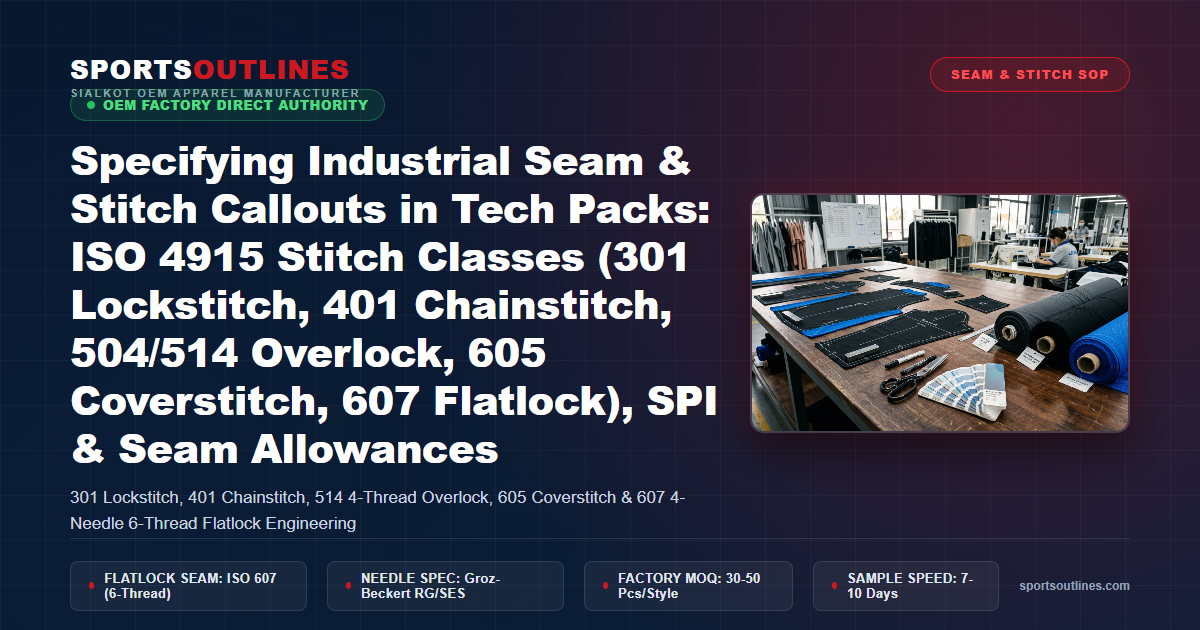
Super-Cluster 6 • Sub-Cluster 6.1 • ISO 4915 Stitch Kinematics, ASTM D6193 Seam Topology & Sewing Line IE
Executive Technical Summary: Matching Seam Elongation Modulus to 4-Way Stretch Textiles via ISO 4915 / ASTM D6193 Callouts, SPI Calibration & Ballpoint Needles
In high-performance sportswear, a garment is only as strong and elastic as its weakest seam. You can source the world’s finest `260 GSM` 4-way stretch Nylon 6,6 / Lycra® interlock capable of `160%` bi-axial elongation—yet if your tech pack (`Sheet 3` of the 8-Sheet Sportswear Tech Pack) fails to specify the exact ISO 4915 Stitch Class, ASTM D6193 Seam Topology, Needle Gauge (`mm`), Stitch Density (`SPI` — Stitches Per Inch), and Groz-Beckert® Ballpoint Needle Point (`RG / SES / SKF`), an unguided sewing line may join load-bearing seams with a low-stretch `ISO 301` lockstitch or a narrow `ISO 504` 3-thread overlock that cracks on the very first deep squat. This B2B industrial sewing engineering guide provides the complete taxonomy and mathematical formulas to specify zero-failure seam callouts on every athletic silhouette.
Direct Manufacturer Answer: Which ISO 4915 Stitch Classes Should Be Specified in a Sportswear Tech Pack?
Technical sportswear relies on six core ISO 4915 stitch classes: (1) `ISO 301` (Single-Needle Lockstitch, `10–12 SPI`) for non-stretch woven zippers, plackets, and pockets, (2) `ISO 401` (2-Thread Multi-Needle Chainstitch) for high-tensile elasticized waistbands (`Kansai 4-to-8 needle`) and lap-felled BJJ Gi/short seams, (3) `ISO 514` (2-Needle 4-Thread Overlock, `6–7 mm` bite, `12–14 SPI`) for structural assembly of jerseys, tees, hoodies, and joggers, (4) `ISO 516` (5-Thread Safety Stitch = `401 + 504`) for non-stretch woven shorts and track pants, (5) `ISO 406 / 605` (2- or 3-Needle Coverstitch, `5.6 mm` or `6.4 mm` gauge) for stretch hems and neck bindings, and (6) `ISO 607` (4-Needle 6-Thread Feed-Off-The-Arm Flatlock, `6.0 mm` gauge, `14–16 SPI`) for zero-bulk, `150%+` stretch compression rashguards, leggings, and wrestling singlets.
- Low MOQ Precision Sewing: True factory-direct 30–50 pieces per style/colorway built on dedicated Juki, Pegasus, Yamato, and Kansai cellular lines.
- Physical Seam Prototyping: Test your exact ISO 4915 stitch callouts on a live prototype in 7–10 business days ($45–$85/pc non-refundable sample fee).
- Direct IE Sewing Desk: Submit your construction callouts via Factory RFQ Portal or WhatsApp +92 316 7932595.
For activewear technical designers, apparel founders, and B2B sourcing directors across the United States, United Kingdom, Canada, Germany, and Australia, understanding the interaction between ISO 4915 Stitch Classes (how the needles and loopers interlace thread) and ASTM D6193 / ISO 4916 Seam Classifications (how the cut fabric plies are folded and lapped before stitching) is essential for both garment longevity and CAD pattern accuracy.
Why does seam selection directly impact CAD pattern drafting (`Sheet 2` and `Sheet 5`)? Because an `ISO 514` 4-thread overlock seam requires a `7.0 mm` (`1/4″`) seam allowance on each pattern edge (`14.0 mm` total fabric consumed per join), whereas a true `ISO 607` 4-needle 6-thread feed-off-the-arm flatlock (`FSa-1` butt-seam) trims and butts the two raw fabric edges together with `0.0 mm to 1.5 mm` overlap (`zero folded seam bulk`), and a `Juki MS-1261` 3-needle lap-felled seam (`LSc-3`) on BJJ Gi pants consumes `12.0 mm` per edge (`24.0 mm` total)! If the stitch class changes after patterns are drafted, the entire garment’s circumference shifts by `2.0 to 4.5 cm`.
1. The Longitudinal Seam Elongation Equation & Stitch-Density (`SPI`) Calibration
Why does a seam “pop” or crack when an athlete pulls a tight rashguard over their shoulders or performs a deep barbell squat in compression leggings? A seam cracks whenever the Maximum Geometric Elongation of the Thread Loop ($\varepsilon_{\text{seam,max}}$) is lower than the Working Strain of the Knitted Fabric ($\varepsilon_{\text{fabric,wear}} \in [35\%, 95\%]$). We can model longitudinal seam extensibility as a function of the thread consumption ratio ($R_{\text{thread}} = L_{\text{thread}} / L_{\text{seam}}$), stitch density ($\text{SPI}$, in stitches per `25.4 mm`), and thread break elongation ($\varepsilon_{\text{thread}}$):
Seam_Stretch_Max (%) = [ sqrt( (1 + k_loop * SPI * b_width)^2 + (1 + eps_thread)^2 ) – 1 ] * 100% > Fabric_Working_Strain (%)
This equation reveals two critical industrial sewing laws that must be codified in `Sheet 3` of your tech pack:
- Why `ISO 301` Lockstitch Fails on Knits (`Max Stretch = 18%–28%`): In a single-needle lockstitch (`Juki DDL-9000C`), an upper needle thread interlocks with a lower bobbin thread directly inside the fabric plane (`R_thread ≈ 2.4 m/m`). Because there are zero diagonal looper triangles to uncoil when the seam is pulled lengthwise, an `ISO 301` seam hits a hard geometric stop at `22%` elongation and snaps! Never specify `ISO 301` along any stretch seam (necklines, armholes, cuffs, waistbands, or crotch seams) on knitted garments.
- The Goldilocks `SPI` Zone (`12 to 16 SPI` for Activewear Knits; `8 to 10 SPI` for Heavy Leather/Canvas): Increasing stitch density on a 4-thread overlock (`ISO 514`) or 6-thread flatlock (`ISO 607`) from `9 SPI` to `14 SPI` stores `55%` more diagonal looper yarn per inch of seam, boosting seam stretch from `65%` up to `145%–160%`. However, pushing stitch density too high (`>18 SPI`) on delicate micro-denier knits causes “Postage-Stamp Perforation”—where closely spaced needle penetrations cut adjacent knit loops and cause the fabric itself to tear along the stitch line! Therefore, our Sialkot IE standard locks activewear stretch seams strictly at `12–14 SPI` for `ISO 514 / 605` and `14–16 SPI` for `ISO 607` flatlock.
| ISO 4915 Code | Industrial Stitch Name & Thread Config | Sialkot Machine Platform | Max Longitudinal Seam Stretch | Thread Ratio (`m / 1m Seam`) | Standard SPI & Gauge (`mm`) | Primary Sportswear Application |
|---|---|---|---|---|---|---|
| `ISO 301` | Single-Needle Lockstitch (`1 Needle + 1 Bobbin`) | Juki DDL-9000C / Adler 205 | `18% – 28%` (Low Stretch) | `2.4 – 2.8 m/m` | `10–12 SPI` (Woven) / `6–8 SPI` (Leather) | Zipper insertion, woven plackets, welt pockets, BJJ Gi lapels & leather gear |
| `ISO 401` | Two-Thread Double-Locked Chainstitch (`1N + 1L` per row) | Kansai WX-8808 / Juki MS-1261 | `55% – 75%` (High Tensile) | `5.2 m/m` (per needle row) | `11–13 SPI` (`6.4 mm` multi-row gauge) | 4-to-8-row shirred Muay Thai/jogger waistbands & 3-needle lap-felled seams |
| `ISO 504` | 1-Needle 3-Thread Overedge Serging (`1N + 2 Loopers`) | Pegasus M900 / Juki MO-6804S | `85% – 105%` (Edge Finish Only) | `11.5 – 13.0 m/m` | `12 SPI` (`4.0 mm` bite width) | Raw edge anti-fray serging on woven panels prior to `ISO 301` topstitching |
| `ISO 514` | 2-Needle 4-Thread Mock-Safety Overlock (`2N + 2L`) | Pegasus EX5214 / Juki MO-6814S | `115% – 135%` (Full Structural) | `14.5 – 16.5 m/m` | `12–14 SPI` (`2.0 mm` N-space / `6–7 mm` total) | Primary structural join for tees, jerseys, hoodies, joggers & shorts |
| `ISO 516` | 2-Needle 5-Thread True Safety Stitch (`ISO 401 + 504`) | Juki MO-6816S Safety Stitcher | `60% – 75%` (High Burst Woven) | `17.5 – 19.0 m/m` | `11–12 SPI` (`3.2 mm` + `5.0 mm` overedge) | High-burst side seams on woven Muay Thai trunks, boardshorts & windbreakers |
| `ISO 406 / 605` | 2-Needle (`406`) or 3-Needle (`605`) Bottom/Top Coverstitch | Pegasus W500 / W664 Cylinder | `125% – 145%` (Elastic Hem) | `14.0 m/m` (`406`) / `21.5 m/m` (`605`) | `12–14 SPI` (`4.8 mm`, `5.6 mm` or `6.4 mm` gauge) | Sleeve/bottom hem turn-ups, collar rib straddle topstitching & binding |
| `ISO 607` | 4-Needle 6-Thread Feed-Off-The-Arm Flatlock (`4N + 1L + 1S`) | Yamato FD-62G / Pegasus W664-35 | `145% – 165%` (Zero-Chafe Max) | `28.0 – 32.0 m/m` | `14–16 SPI` (`6.0 mm` gauge, `0.9 mm` thick) | Rashguards, compression leggings, spats, cycling bibs & wrestling singlets |
2. ASTM D6193 / ISO 4916 Seam Classifications (`SS`, `LS`, `BS`, `FS`) & Seam Allowance Engineering
While `ISO 4915` defines the stitch, ASTM D6193 (and ISO 4916) defines the geometric 3D fold of the fabric plies. Combining the two codes in your tech pack callouts (e.g., `SSa-1 / ISO 514` or `FSa-1 / ISO 607`) eliminates 100% of pattern-allowance and sewing-folder ambiguity:
- Class `SS` — Superimposed Seam (`SSa-1`, `SSe-2`): Two or more plies of fabric are stacked edge-on-edge in the same direction and stitched near the raw margin (`SSa-1 / ISO 514` 4-thread overlock with a `7.0 mm` seam allowance). For hoodies and crewnecks, we frequently upgrade shoulder, armhole, and cuff joins to a 2-Step Superimposed Straddle Seam (`SSa-1 / ISO 514` + `ISO 406 / 605` Top Coverstitch): the two panels are first overlocked together (`7 mm` allowance), then the folded seam allowance is pressed toward the body panel and straddle-stitched from the exterior with a 2-needle or 3-needle coverstitch, reducing interior ridge height by `-48%` and raising seam burst strength by `+65%`.
- Class `LS` — Lapped Seam (`LSc-2`, `LSc-3` Triple Lap-Felled): Two fabric plies overlap from opposite directions with raw edges tucked inside an interlocking S-folder and stitched through all four layers (`ISO 401` 2-needle or 3-needle chainstitch on a `Juki MS-1261` feed-off-the-arm machine; `12.0 mm` seam allowance per edge). Mandatory for BJJ Gi jackets/pants, Judo Gis, and MMA fight short outseams/crotches exceeding `1,250 N` grab burst strength.
- Class `BS` — Bound Seam (`BSa-1`, `BSc-1` Folder Binding): A narrow strip of rib knit, self-fabric interlock, or sublimated satin tape is fed through a precision `S-folder` or `C-folder` attachment to wrap around the raw perimeter edge of a neckline, tank-top armhole, or split running short hem (`ISO 406` 2-needle chainstitch or `ISO 605` coverstitch; `0.0 mm` seam allowance on the body panel edge!).
- Class `FS` — Flat Seam (`FSa-1` Butt-Edge or Micro-Overlap): Two raw fabric edges are fed into dual opposing trimming knives on a `Yamato FD-62G` 4-needle 6-thread flatseamer (`ISO 607`, `6.0 mm` gauge) that trim both edges flush and join them edge-to-edge (`0.0 mm` butt-seam or `1.3 mm` micro-overlap) encased between a top spreader thread and a bottom woolly-nylon looper. Because there is no folded internal seam allowance ridge, seam profile thickness is only `0.92 mm`—eliminating mat-burn and skin chafing under high-compression loads.
| ASTM D6193 + ISO 4915 Callout | Cross-Section Topology Description | CAD Pattern Seam Allowance | Finished Seam Thickness (`250 GSM`) | Transverse Burst Strength (`ISO 13938`) |
|---|---|---|---|---|
| `SSa-1 / ISO 514` | 2-Ply Superimposed 4-Thread Overlock | `6.0 mm – 7.0 mm` (`1/4″`) per edge | `2.45 mm` (Internal vertical flange) | `640 – 720 kPa` |
| `SSa-1 + LSd / ISO 514 + 605` | 4-Thread Overlock + 3-Needle Straddle Coverstitch | `7.0 mm` (`1/4″`) per edge | `1.45 mm` (Pressed flat against body) | `820 – 910 kPa` |
| `FSa-1 / ISO 607` | 4-Needle 6-Thread Feed-Off-Arm Butt-Edge Flatlock | `0.0 mm – 2.5 mm` (Trimmed in-machine) | `0.92 mm` (Ultra-flat zero-chafe) | `840 – 920 kPa` |
| `EFb-1 / ISO 406 or 605` | Single-Fold Edge Hem with 2- or 3-Needle Bottom Coverstitch | `20.0 mm – 25.0 mm` (`3/4″–1.0″`) turn-up | `1.35 mm` (Raw edge encased by looper) | `780 kPa` (`135%` stretch) |
| `BSc-1 / ISO 406` | Double-Fold Folder-Applied Binding (Tank Armhole / Neck) | `0.0 mm` on Body Edge (`36 mm` cut strip) | `1.80 mm` (`10 mm` finished visible width) | `890 kPa` |
| `LSc-3 / ISO 401` | 3-Needle Interlocked S-Fold Lap-Felled Seam (`6.4 mm` gauge) | `12.0 mm` (`1/2″`) per edge | `2.80 mm` (Zero exposed raw edges) | `>1,350 N` Grab Tensile |
3. Preventing Micro-Denier & Elastane Yarn Severance: Specifying Groz-Beckert® Needle Points (`RG`, `SES`, `SKF`, `SAN 10`)
One of the most insidious defects in compression activewear (`leggings, sports bras, rashguards, and cycling bibs`) is Needle-Cut Elastane Run Propagation (“Pin-Holes Along the Seam”). This defect does not appear on the factory inspection table immediately after sewing—instead, after the consumer stretches the garment and washes it twice, tiny runs and ladders open up directly beside the flatlock or overlock needle track!
Why does this happen? Because standard woven-fabric sewing needles have a sharp conical or acute round point (`R` or `SPI`) that slices right through the microscopic `40D–70D` spandex filaments knitted inside a 28-gauge or 32-gauge interlock! To prevent yarn severance, `Sheet 3` of your tech pack must mandate Groz-Beckert® (or Schmetz®) Ballpoint Displacing Needles matched to the fabric structure:
- `SES` (Light Ball Point) & `SUK` (Medium Ball Point): Features a rounded hemispherical tip that gently pushes cotton/polyester jersey and French Terry knit loops aside to pass through the inter-loop interstices without cutting the yarn (`Nm 70/10` to `Nm 85/13`).
- `RG` (Rounded Point with Small Ball) & `SKF / SKL` (Special Elastomer Ball Point): Specifically engineered for high-gauge (`28G–36G`) warp-knit tricot and double-knit interlocks containing `18%–28%` bare or core-spun Lycra®/Creora® elastane (`Nm 65/9` to `Nm 75/11`). Paired with a **Titanium Nitride (`TiN` / `GEBEDUR™`) surface coating** and **`SAN® 10 XS` slim-cross-section blade geometry**, these needles reduce penetration force by `-32%` and keep needle friction temperature below $115^\circ\text{C}$ at $5,500\text{ SPM}$ (well below the $175^\circ\text{C}$ softening point of spandex).
| Sportswear Fabric Category | Mandatory Needle Point Code | Metric Size (`Nm` / Singer) | Surface Coating Spec | Defect Prevented on Production Floor |
|---|---|---|---|---|
| 28G–36G Compression Interlock & Tricot (`18–25% Spandex`) | `Groz-Beckert RG` or `SKF / SAN 10` | `Nm 65/9 – Nm 70/10` | `GEBEDUR™ TiN` Gold Coating | Eliminates severed elastane filaments, seam pin-holes & skipped loops |
| 140–195 GSM Sublimated Polyester Mesh & Single Jersey | `SES` (Light Ball Point) | `Nm 70/10 – Nm 75/11` | Chromium / `TiN` | Prevents yarn snagging and white fiber pull-out along sublimated seams |
| 330–480 GSM Heavyweight French Terry & Brushed Fleece | `SUK` (Medium Ball Point) | `Nm 80/12 – Nm 90/14` | Chromium / `TiN` | Displaces heavy loopback terry yarns without cutting rear fleece pile |
| 130–180 GSM 4-Way Stretch Woven Microfiber & 3L Shells | `SPI` (Acute Round Point / `SAN 6`) | `Nm 70/10 – Nm 80/12` | `GEBEDUR™ TiN` | Produces clean, pucker-free penetration in densely woven DWR shells |
| Top-Grain Cowhide & `Syntek` Microfiber Combat Gear | `SD1` (Round-Triangular Tip) or `LR` | `Nm 120/19 – Nm 140/22` | `TiN` + Cold-Air Vortex | Prevents straight-slit tear propagation on high-impact boxing/MMA gloves |
4. Master Garment Seam Callout Blueprint Across 5 Core Sportswear Silhouettes
You can copy the following production-proven Zone-by-Zone Seam Callout Matrix directly into `Sheet 3` of your sportswear tech packs:
| Sportswear Garment Archetype | Shoulder, Armhole & Side / Inseam Join | Collar / Neckband / Waistband Join | Sleeve Cuff & Bottom Hem Finish | High-Stress Bartack Reinforcement Zones |
|---|---|---|---|---|
| 1. Compression Rashguard / Squat-Proof Leggings | `FSa-1 / ISO 607` 4-Needle 6-Thread Flatlock (`6.0 mm` gauge, `15 SPI`, `Tex 27` woolly looper) | `FSa-1 / ISO 607` Flatlock (`6.0 mm` gauge) + clear mobilon stabilizer in top WB fold | `EFb-1 / ISO 605` 3-Needle Top/Bottom Coverstitch (`5.6 mm` gauge, `20 mm` turn-up w/ LSR gripper) | `28-stitch` flatlock tail lock-tack at cuff & hem side-seam ends (`internal`) |
| 2. Fitted Gym T-Shirt & Sublimated Team Jersey | `SSa-1 / ISO 514` 2-Needle 4-Thread Overlock (`6.5 mm` bite, `13 SPI`, `3.5 mm` silicone shoulder tape) | `ISO 514` Overlock + `BSc / ISO 406` `10 mm` Back-Neck Satin Tape (`6.4 mm` twin-needle chainstitch) | `EFb-1 / ISO 406` 2-Needle Bottom Coverstitch (`5.6 mm` gauge, `20 mm` hem fold, `12 SPI`) | `28-stitch` micro-bartack at side-slit hem vents (if split drop-tail hem) |
| 3. Heavyweight 450 GSM Streetwear Hoodie & Jogger | `SSa-1 / ISO 514` Overlock (`7 mm`) + `ISO 605` 3-Needle Straddle Coverstitch (`6.4 mm` gauge, `11 SPI`) | Hood: `ISO 514` + `10 mm` herringbone neck tape; Jogger WB: `Kansai 4-Needle ISO 401` + `ISO 514` | 2-Ply `2×2` Rib joined via `ISO 514` Overlock + `ISO 406` `3 mm` top-coverstitch on body side | `42-stitch` CNC bartacks at upper/lower kangaroo pocket corners & drawcord exits |
| 4. Hardware-Free MMA / No-Gi Fight Shorts | `LSc-3 / ISO 401` 3-Needle Triple Lap-Felled Outseams + `ISO 607` Flatlocked Lycra Saddle Gusset | `ISO 301` 4-Row Lockstitched Non-Stretch Waistband w/ Recessed T-Flap Velcro + LSR Gripper | Laser-Cut Heat-Bonded Hem (`Bemis 3415` `20 mm`) or `18 mm` Nylon Bias Tape (`ISO 301` Twin-Needle) | Dual `42-stitch` Box-X bartacks at `100 mm` lateral side-slit apexes (`>780 N` tear) |
| 5. 3-Layer Waterproof Seam-Taped Alpine Shell | `SSa-1 / ISO 301` Single-Needle Lockstitch (`10 SPI`, `10 mm` allowance) + `20 mm` 3L Hot-Air Seam Tape | `ISO 301` + `20 mm` 3L Tricot Seam Tape (`620°C` nozzle, `4.5 bar` nip roller, `>20,000 mm` H2O) | Ultrasonic Cut + `25 mm` `Bemis®` Bonded Hem Tunnel encapsulating `Cohaesive™` shock-cord locks | Internal hypalon-backed bartacks sealed on reverse with `22 mm` circular die-cut 3L tape patches |
5. Differential Feed Ratio (`DFR`), Presser-Foot Pressure (`N`) & Thread Tension (`cN`) Calibration for Pucker-Free Seams
Even if a factory uses the exact `ISO 514` overlock, `ISO 605` coverstitch, or `ISO 607` flatlock machine specified in your tech pack, poorly calibrated Differential Feed Dogs and excessive Needle/Looper Thread Tension (`cN`) will ruin lightweight sublimated jerseys, 4-way stretch leggings, and DWR windbreaker shells with two classic sewing defects: “Lettuce-Edge Wave Distortion” (stretched, ruffled seams) or “Tension Seam Puckering” (gathered, rippling seams).
5.1 How Differential Feed Ratio (`DFR = V_front / V_rear`) Eliminates Seam Waving on Elastomeric Knits
Modern industrial overlock (`Juki MO-6814S`), coverstitch (`Pegasus W600`), and flatlock (`Yamato FD-62G`) machines are equipped with Split Dual Feed Dogs underneath the throat plate: a Front Main Feed Dog ($V_{\text{front}}$) positioned ahead of the needles and a Rear Differential Feed Dog ($V_{\text{rear}}$) positioned behind the needles. The ratio of their linear stroke lengths defines the Differential Feed Ratio ($\text{DFR} = V_{\text{front}} / V_{\text{rear}}$):
- Positive Gathering Feed (`DFR = 1.15 : 1` to `1.45 : 1` — Mandatory for 4-Way Stretch Knits): When sewing `200–280 GSM` nylon/polyester-spandex compression leggings, rashguards, or sports bras under presser-foot pressure (`18–24 N`), friction against the upper presser foot naturally stretches the top fabric ply forward as it enters the needle zone. By setting the front feed dog to advance `15% to 35%` faster than the rear feed dog (`DFR = 1.15–1.35`), the feed mechanism micro-compresses the elastic knit right as the needle loops interlock—ensuring the finished seam relaxes completely flat (`0.0 mm` wave height) when removed from the machine!
- Negative Stretching Feed (`DFR = 0.75 : 1` to `0.90 : 1` — Mandatory for Lightweight DWR Wovens): Conversely, when sewing tightly woven `65–110 GSM` micro-ripstop windbreakers or 3-layer waterproof shells along the warp grain with `ISO 301` or `ISO 516`, structural thread jamming pushes adjacent warp yarns apart (“structural jamming pucker”). Setting a slight negative differential feed (`DFR = 0.85 : 1`) combined with low needle thread tension (`65–85 cN` measured via a digital `Towa / Schmidt` tension gauge) holds the woven ply taut across the needle plate and produces a glass-smooth, pucker-free outer seam (`AATCC 88B Grade 4.5–5.0`).
| Machine & Stitch Operation | Target Fabric Substrate | Differential Feed Ratio (`DFR`) | Needle Thread Tension (`cN`) | Looper Thread Tension (`cN`) | Presser Foot Force (`N`) |
|---|---|---|---|---|---|
| `Yamato FD-62G` (`ISO 607` Flatlock) | 220–260 GSM 4-Way Stretch Rashguard / Legging | `1.20 : 1 – 1.30 : 1` | `45 – 55 cN` (`Tex 24 CS`) | `18 – 24 cN` (`Tex 27 Woolly`) | `22 – 26 N` |
| `Juki MO-6814S` (`ISO 514` 4T Overlock) | 150–190 GSM Sublimated Polyester Interlock / Mesh | `1.10 : 1 – 1.20 : 1` | `50 – 65 cN` (`Tex 24 CS`) | `20 – 28 cN` (`Tex 27 Woolly`) | `18 – 22 N` |
| `Pegasus W664` (`ISO 605` 3N Coverstitch) | 380–480 GSM Heavyweight Cotton French Terry Fleece | `1.25 : 1 – 1.40 : 1` | `75 – 95 cN` (`Tex 30/40 CS`) | `28 – 35 cN` (`Tex 27/30`) | `30 – 36 N` |
| `Juki DDL-9000C` (`ISO 301` Digital Feed) | 85–145 GSM Woven Ripstop / 3-Layer Waterproof Shell | `0.85 : 1 – 0.95 : 1` (Anti-pucker) | `65 – 80 cN` (`Tex 30 CS`) | `22 – 28 cN` (Bobbin Case) | `15 – 18 N` (`Teflon Foot`) |
| `Juki MS-1261` (`ISO 401` 3N Lap-Felled) | 450–750 GSM Cotton Pearl Weave BJJ Gi / Heavy Duck | `1.00 : 1` (Synchronized Puller) | `135 – 165 cN` (`Tex 60 CS`) | `55 – 70 cN` (`Tex 60 CS`) | `42 – 48 N` (`Rear Puller`) |
6. Frequently Asked Questions (FAQ): Specifying ISO 4915 Seam & Stitch Callouts
Q1: What is the difference between an `ISO 605` 3-Needle Top-and-Bottom Coverstitch and a true `ISO 607` 4-Needle 6-Thread Flatlock?
Many low-tier factories try to pass off a 3-needle flatbed coverstitch (`ISO 605`, sewn over an already-overlocked overlap seam) as “flatlock.” While `ISO 605` looks similar from the outside, it leaves a folded `2.2 mm` fabric ridge underneath. A true `ISO 607` 4-Needle 6-Thread Feed-Off-The-Arm Flatlock (`Yamato FD-62G` / `Pegasus W664`) trims both raw edges flush inside the machine and joins them edge-to-edge (`butt-seam`) with 4 needles, 1 lower looper, and 1 upper spreader—creating a completely flat `0.92 mm` seam on both sides of the garment.
Q2: Why should clear `Mobilon` (TPU elastomer) tape or `3.5 mm` silicone tape be specified inside the shoulder seams of t-shirts and jerseys?
A knitted shoulder seam sits on a bias/cross-grain angle that stretches out of shape under the weight of the sleeves when hung on a retail hanger or soaked with sweat. Feeding a `3.5 mm to 5.0 mm` clear thermoplastic polyurethane (`Mobilon`) tape directly through the folder of the `ISO 514` 4-thread overlock machine reinforces the shoulder seam with `100%` elastic recovery while remaining completely invisible from the exterior.
Q3: How much does physical prototype sampling cost to test my ISO 4915 seam callouts on actual garments?
Physical pre-production prototype sampling is strictly $45–$85 per piece/pair/set as a non-refundable development fee with a 7–10 business days production turnaround. Every prototype is sewn on the exact industrial machines (`Yamato FD-62G`, `Pegasus W600`, `Kansai WX-8808`) that will run your bulk order.
Q4: What is your bulk MOQ for custom cut-and-sew sportswear using `ISO 607` flatlock or `ISO 401` multi-needle waistbands?
Our factory-direct bulk MOQ is strictly 30–50 pieces per style/colorway across mixed sizes (`XS` to `3XL`), with custom thread color matching (`Coats Epic / Seamsoft` shades) included.
Q5: How do you test seam burst strength and elongation recovery before shipping bulk orders?
During First-Off-Line (`FOL`) setup and in-line QC, our technicians perform a 100% Stretch-“Crack” Test (stretching every neckband, armhole, cuff, waistband, and crotch seam to maximum garment extension by hand and on pneumatic expanders to verify zero thread-popping clicks) alongside hydraulic diaphragm burst testing (`ISO 13938-1`) and `ISO 2859-1 AQL 2.5` visual seam audits.
Ready to Build Zero-Failure Sportswear on Sialkot’s Premier Industrial Sewing Lines?
From 4-needle 6-thread `ISO 607` Yamato flatseamers and 8-needle Kansai waistbands to laser-cut `Bemis®` bonded alpine shells, we execute your exact construction callouts. Prototype in 7–10 business days ($45–$85/pc non-refundable sample fee) and scale at 30–50 piece low MOQs.
Pingback: The Physical Pre-Production Prototyping Blueprint ($45-$85 Sample Fee Economics): 7-10 Day Sialkot Sample Room Routing, Single-Piece Cutter Setup & Material Sourcing Realities - Sports Outlines